
The compound which contains a divalent negative radical.
- Aluminium nitride
- Sodium plumbite
- Potassium permanganate
- Iron [III] nitrate
Answer
Sodium plumbite
Reason — Sodium (Na) is a monovalent positive ion. There are 2 sodium ions, giving a total positive charge of +2. The negative radical in sodium plumbite is plumbite (PbO2)-2 which is divalent. Since the compound is electrically neutral, the negative radical must have a charge of −2.
Aluminium nitride is trivalent. Potassium permanganate and Iron [III] nitrate are monovalent.
The balanced equation from the following.
- 2Pb3O4 ⟶ 6PbO + 2O2
- 4NH3 + 5O2 ⟶ 4NO + 6H2O
- 2Ca(NO3)2 ⟶ CaO + 4NO2 + O2
- FeCl3 + 3NaOH ⟶ 3NaCl + 2Fe(OH)3
Answer
4NH3 + 5O2 ⟶ 4NO + 6H2O
Reason — There are 4 nitrogen atoms, 12 hydrogen atoms and 10 oxygen atoms on both the reactant and product sides. Hence, it is a balanced equation.
The direct combination reaction from the following conversions.
- Acidified water to oxygen on passage of electric current.
- Copper [II] sulphate to copper on reaction with iron.
- Magnesium to magnesium nitride by burning.
- Iron [II] sulphate to iron [II] hydroxide on reaction with sodium hydroxide.
Answer
Magnesium to magnesium nitride by burning.
Reason — This is a direct combination reaction because two substances combine directly to form a single product.
3Mg + N2 ⟶ Mg3N2
Acidified water to oxygen is an electrolytic decomposition reaction. Copper sulphate to copper is a displacement reaction. Iron sulphate to iron hydroxide is double decomposition.
The substance which causes permanent hardness in water.
- Calcium sulphate
- Calcium sulphide
- Calcium sulphite
- Calcium carbonate
Answer
Calcium sulphate
Reason — Permanent hardness of water is caused by soluble sulphates and chlorides of calcium and magnesium. Since calcium sulphate is a soluble salt, it dissolves in water and releases calcium ions, which cause hardness.
Calcium sulphide is not responsible for hardness of water. Calcium sulphite is sparingly soluble and unstable. Calcium carbonate is almost insoluble in water.
In the atoms 3919K & 4119K, the factor which is different in the atoms is its:
- Atomic number
- Number of electrons
- Number of protons
- Number of nucleons
Answer
Number of nucleons
Reason — Since, both have the same atomic number = 19
So, they have the same number of protons = 19
and same number of electrons = 19
But their mass numbers are different 39 and 41
Number of nucleons = protons + neutrons
Therefore, number of nucleons is different.
The covalent molecule which is the odd one out:
- Water
- Carbon tetrachloride
- Oxygen
- Methane
Answer
Water
Reason — Water is a polar covalent molecule because the shared electrons are unequally distributed and the molecule has an angular shape. Carbon tetrachloride, oxygen and methane are non-polar covalent molecules.
The period which contains a liquid halogen.
- Period 2
- Period 3
- Period 4
- Period 1
Answer
Period 4
Reason — Period 4 contains bromine and it is a halogen and present in liquid form.
Period 2 contains fluorine, Period 3 contains chlorine, which are gases. Period 1 contains only hydrogen and helium; there is no halogen in Period 1.
The electronegative element from:
- Sodium [Na]
- Fluorine [F]
- Potassium [K]
- Neon [Ne]
Answer
Fluorine
Reason — Electronegativity is the ability of an atom to attract electrons towards itself in a chemical bond. Fluorine strongly attracts electrons in a bond. Therefore, it is the most electronegative element in the periodic table.
Sodium is a metal with low electronegativity as it tends to lose electrons. Potassium is even more electropositive than sodium and has very low electronegativity. Neon is a noble gas with a complete outer shell; it does not usually form bonds.
The metal which reacts with steam, acids & alkalis to liberate hydrogen.
- Lead
- Aluminium
- Copper
- Mercury
Answer
Aluminium
Reason — The metal that can react with steam, acids, and alkalis to produce hydrogen gas is aluminium.
Aluminium reacts with steam to produce hydrogen gas
2Al + 3H2O ⟶ Al2O3 + 3H2
Aluminium reacts with dilute acids (like HCl) to release hydrogen
2Al + 3H2SO4 ⟶ Al2(SO4)3 + 3H2
Aluminium is amphoteric, so it also reacts with strong alkalis (like NaOH) to produce hydrogen
2Al + 2NaOH + 2H2O ⟶ 2NaAlO2 + 3H2
The incorrect statement in Bosch process, in the industrial production of hydrogen.
- Production of water gas involves the reactants white hot coke and steam.
- Excess steam is mixed with water gas & passed over a catalyst at elevated temperatures for oxidation of water gas to hydrogen.
- The promoter used in the conversion of water gas to hydrogen is an oxide of chromium.
- Unreacted CO2 is removed from the mixture, by dissolving the mixture in ammoniacal cuprous chloride solution.
Answer
Unreacted CO2 is removed from the mixture, by dissolving the mixture in ammoniacal cuprous chloride solution.
Reason — In the Bosch process, CO2 is removed using water or alkali. Ammoniacal cuprous chloride is used to remove CO.
The temperature 50 K on the Centigrade scale is:
- -240°C
- -223°C
- 223°C
- -225°C
Answer
-223°C
Reason — Kelvin scale starts from absolute zero.
°C = K - 273
Since, K = 50
°C = 50-273
= -223°C
A non-metal whose oxide contributes to both global warming & acid rain.
- Carbon
- Nitrogen
- Sulphur
- Phosphorus
Answer
Nitrogen
Reason — Oxides of nitrogen are responsible for acid rain because they form nitric acid in the atmosphere. Also, nitrous oxide is a greenhouse gas that contributes to global warming. So nitrogen is the non-metal whose oxides contribute to both effects.
Carbon forms oxides like carbon dioxide which contributes to global warming but does not cause acid rain. Sulphur forms sulphuric acid which leads to acid rain but not global warming. Phosphorus forms oxides like phosphorus pentoxide which reacts with water to form phosphoric acid. It does not contribute to acid rain or global warming.
Photolysis reaction results in the formation of:
- [O] + [O]
- O2 + [O]
- O3 + [O]
- O3
Answer
O2 + [O]
Reason — Photolysis means breaking of a molecule by sunlight. In the atmosphere, when UV light acts on ozone, ozone breaks into molecular oxygen and nascent oxygen.
O3 O2 + [O]
The sodium salt which reacts with a dilute acid, to liberate a gas which turns lead nitrate solution black.
- Sodium sulphide
- Sodium nitrate
- Sodium carbonate
- Sodium sulphite
Answer
Sodium sulphide
Reason — When sodium sulphide reacts with a dilute acid, it produces hydrogen sulphide gas.
Na2S + 2HCl ⟶ 2NaCl + H2S↑
H2S gas reacts with lead nitrate solution to form lead sulphide (PbS), which is a black precipitate
Pb(NO3)2 + H2S ⟶ PbS↓ + 2HNO3
Sodium nitrate does not produce a gas with dilute acid. Sodium carbonate produces CO2 which turns lime water milky. Sodium sulphite produces SO2 which bleaches solutions.
Assertion (A): Algae are a major source of water pollution.
Reason (R): Phosphates increase algae growth leading to consumption of oxygen dissolved in water, leading to death of marine organisms.
- Both A & R are true and R is the correct explanation of A.
- Both A & R are true but R is not the correct explanation of A.
- A is true but R is false.
- A is false but R is true.
Answer
A is false but R is true.
Reason — A is false as algae are not a source of water pollution. Excessive algal growth (algal bloom) occurs because of water pollution caused by nutrients like phosphates and nitrates.
R is true as phosphates stimulate algal growth. When the algae die, bacteria decompose them and consume dissolved oxygen. This oxygen depletion can kill fish and other aquatic organisms.
Therefore, A is false but R is true is the correct option.
The number of unshared pair of electrons in a molecule of oxygen.
- Two
- Four
- One
- Six
Answer
Four
Reason — Since, one oxygen atom has 2 lone pairs, therefore, 2 oxygen atoms will have 4 lone pairs.
The compound having a divalent acidic radical.
- Fe2S3
- Fe(OH)2
- Fe(NO3)3
- MnCl2
Answer
Fe2S3
Reason — An acidic radical is the negative ion. A divalent acidic radical is an anion having a charge of -2. In Fe2S3, sulphide ion (S2-) is a divalent acidic radical. OH-, NO3- and Cl- are monovalent acidic radicals.
The number of electrons in the valence shell of a chloride anion:
- 7
- 8
- 6
- 5
Answer
8
Reason — Electronic configuration of chlorine: 2, 8, 7
So a neutral chlorine atom has 7 electrons in its valence shell.
Chlorine gains one electron to complete its octet.
Cl + e- ⟶ Cl-
Now the electronic configuration becomes: 2, 8, 8
So a chlorine anion has 8 electrons in its valence shell.
The substance which on thermal decomposition, does not produce a gas, which turns blue cobalt chloride paper pink.
- Blue vitriol
- Washing soda
- Ammonium chloride
- Epsom salt
Answer
Ammonium chloride
Reason — Ammonium chloride produces ammonia gas and hydrogen chloride gas on heating. Therefore, it does not produce a gas that turns blue cobalt chloride paper pink.
Blue vitriol, washing soda and Epsom salt contain water of crystallization and produces water vapour.
Assertion (A): The conversion of ammonia to nitric oxide proceeds with evolution of heat energy.
Reason (R): Endothermic reactions cannot be sustained without supply of energy.
- Both A & R are true and R is the correct explanation of A.
- Both A & R are true but R is not the correct explanation of A.
- A is true but R is false.
- A is false but R is true.
Answer
Both A & R are true but R is not the correct explanation of A.
Reason — A is true as the conversion of ammonia to nitric oxide is exothermic.
R is true as an endothermic reaction absorbs heat from its surroundings. Therefore, continuous energy input is generally required for it to proceed.
Therefore, Both A & R are true but R is not the correct explanation of A is the correct option.
Assertion (A): The conversion of Iron [II] chloride to Iron [III] chloride is an oxidation reaction.
Reason (R): The reaction involves loss of electrons by Iron atoms.
- Both A & R are true and R is the correct explanation of A.
- Both A & R are true but R is not the correct explanation of A.
- A is true but R is false.
- A is false but R is true.
Answer
Both A & R are true and R is the correct explanation of A.
Reason — A is true as Iron [II] chloride contains Fe2+, while Iron [III] chloride contains Fe3+. R is true because Fe2+ loses one electron to form Fe3+:
Fe2+ ⟶ Fe3+ + e-
Loss of electrons is oxidation. Hence, R correctly explains A.
The molecular weight of compound 'X' is 44. The compound is ............... [nitrogen monoxide / nitrogen dioxide / dinitrogen oxide (N = 14, O = 16)].
Answer
The molecular weight of compound 'X' is 44. The compound is dinitrogen oxide.
The formation of a compound 'A' from aluminium, containing a trivalent acidic radical, is an example of a ............... [displacement / direct combination] reaction.
Answer
The formation of a compound 'A' from aluminium, containing a trivalent acidic radical, is an example of a direct combination reaction.
Molten lead bromide dissociates into lead & bromide ions by absorption of ............... [heat / electrical / light] energy.
Answer
Molten lead bromide dissociates into lead & bromide ions by absorption of heat energy.
An example of a pentahydrate salt which changes colour on heating is ............... [blue vitriol / Glauber's salt].
Answer
An example of a pentahydrate salt which changes colour on heating is blue vitriol.
State which of the atoms ............... [3517X, 4018Y] has the same number of electrons in the L & M shells.
Answer
State which of the atoms 4018Y has the same number of electrons in the L & M shells.
A cation of calcium Ca2+ has ............... [12 / 8 / 6] electrons in the penultimate shell.
Answer
A cation of calcium Ca2+ has 8 electrons in the penultimate shell.
The number of unshared electrons in a molecule of methane is / are ............... [one / none].
Answer
The number of unshared electrons in a molecule of methane is none.
Alkali metals have ............... [one / two] valence electron/s, alkaline earth metals have two valence electrons & nickel, a transition element, has ............... [one / two] valence electrons.
Answer
Alkali metals have one valence electron/s, alkaline earth metals have two valence electrons & nickel, a transition element, has two valence electrons.
The metal which reacts with dilute acids, least vigorously to liberate hydrogen is ............... [magnesium / iron / aluminium] while ............... [calcium / lead] have no reaction with dilute acids.
Answer
The metal which reacts with dilute acids, least vigorously to liberate hydrogen is iron while lead has no reaction with dilute acids.
A chemical which destroys the ozone layer and on the other hand, contributes to global warming is ............... [CO2 / CH4 / CCl4].
Answer
A chemical which destroys the ozone layer and on the other hand, contributes to global warming is CCl4.
Match the following — Column A with Column B.
| Column A | Column B |
|---|---|
| (a) Magnesium | (i) Electronegative element |
| (b) Boron & Silicon | (ii) Post transition elements |
| (c) Nitrogen | (iii) Transition elements |
| (d) Iron & Copper | (iv) Alkaline earth metal |
| (e) Aluminium | (v) Bridge elements |
Answer
| Column A | Column B |
|---|---|
| (a) Magnesium | (iv) Alkaline earth metal |
| (b) Boron & Silicon | (v) Bridge elements |
| (c) Nitrogen | (i) Electronegative element |
| (d) Iron & Copper | (iii) Transition elements |
| (e) Aluminium | (ii) Post transition elements |
Match the following — Column A with Column B.
| Column A | Column B |
|---|---|
| (a) Calcium carbonate ⟶ Calcium oxide | (i) Precipitation reaction |
| (b) Copper [II] hydroxide ⟶ Copper sulphate | (ii) Displacement reaction |
| (c) Silver chloride ⟶ Silver | (iii) Thermal decomposition |
| (d) Copper [II] sulphate ⟶ Copper hydroxide | (iv) Neutralization reaction |
| (e) Copper [II] sulphate ⟶ Copper | (v) Photochemical reaction |
Answer
| Column A | Column B |
|---|---|
| (a) Calcium carbonate ⟶ Calcium oxide | (iii) Thermal decomposition |
| (b) Copper [II] hydroxide ⟶ Copper sulphate | (iv) Neutralization reaction |
| (c) Silver chloride ⟶ Silver | (v) Photochemical reaction |
| (d) Copper [II] sulphate ⟶ Copper hydroxide | (i) Precipitation reaction |
| (e) Copper [II] sulphate ⟶ Copper | (ii) Displacement reaction |
Match the following — Column A with Column B.
| Column A | Column B |
|---|---|
| (a) Ag2O | (i) Fe2+ |
| (b) FeS | (ii) Ag2+ |
| (c) MnO2 | (iii) Fe3+ |
| (d) AgO | (iv) Ag1+ |
| (e) Fe2S3 | (v) Mn2+ |
| (vi) Mn4+ |
Answer
| Column A | Column B |
|---|---|
| (a) Ag2O | (iv) Ag1+ |
| (b) FeS | (i) Fe2+ |
| (c) MnO2 | (vi) Mn4+ |
| (d) AgO | (ii) Ag2+ |
| (e) Fe2S3 | (iii) Fe3+ |
Match the following — Column A with Column B.
| Column A | Column B |
|---|---|
| (a) Methane | (i) Reacts with sulphur vapours to give a foul-smelling gas |
| (b) Chlorine | (ii) Unreactive or inert |
| (c) Sulphur dioxide | (iii) Green house gas |
| (d) Hydrogen | (iv) Liberates iodine from KI |
| (e) Neon | (v) Pollutant for acid rain |
Answer
| Column A | Column B |
|---|---|
| (a) Methane | (iii) Green house gas |
| (b) Chlorine | (iv) Liberates iodine from KI |
| (c) Sulphur dioxide | (v) Pollutant for acid rain |
| (d) Hydrogen | (i) Reacts with sulphur vapours to give a foul-smelling gas |
| (e) Neon | (ii) Unreactive or inert |
Match the following — Column A with Column B.
| Column A | Column B |
|---|---|
| (a) 23592U, 23892U | (i) Endothermic reaction |
| (b) CaCl2 | (ii) A metalloid in the period with the element X [2, 8] |
| (c) A mixture of CO & H2 | (iii) A deliquescent salt causing permanent hardness in water |
| (d) Boron | (iv) Differ in number of nucleons |
| (e) Thermal decomposition of limestone | (v) Water gas |
Answer
| Column A | Column B |
|---|---|
| (a) 23592U, 23892U | (iv) Differ in number of nucleons |
| (b) CaCl2 | (iii) A deliquescent salt causing permanent hardness in water |
| (c) A mixture of CO & H2 | (v) Water gas |
| (d) Boron | (ii) A metalloid in the period with the element X [2, 8] |
| (e) Thermal decomposition of limestone | (i) Endothermic reaction |
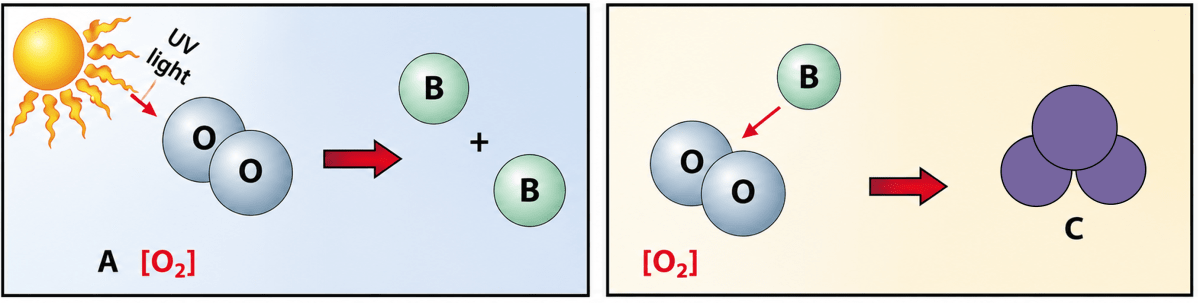
The diagram represents the formation of a bluish explosive gas. 'A' is a molecule of oxygen gas. State what do 'B' & 'C' represent.
Answer
The bluish explosive gas is ozone.
O2 [O] + [O]
[O] + O2 ⟶ O3
B is nascent oxygen and C is ozone.
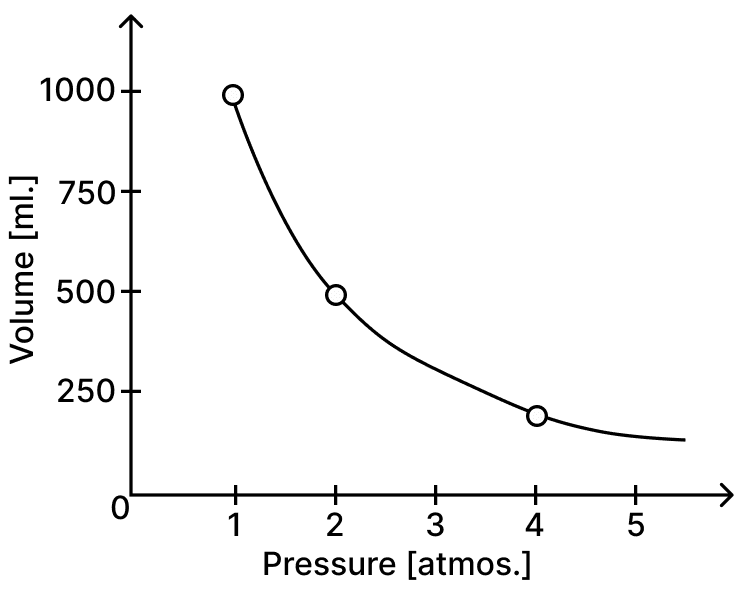
The graph represents which of the following? Justify your answer.
Answer
Reason — The graph shows Volume (V) on the y-axis and Pressure (P) on the x-axis.
As pressure increases, volume decreases in such a way that the curve is a rectangular hyperbola. This indicates an inverse relationship between pressure and volume.
According to Boyle's Law:
V ∝
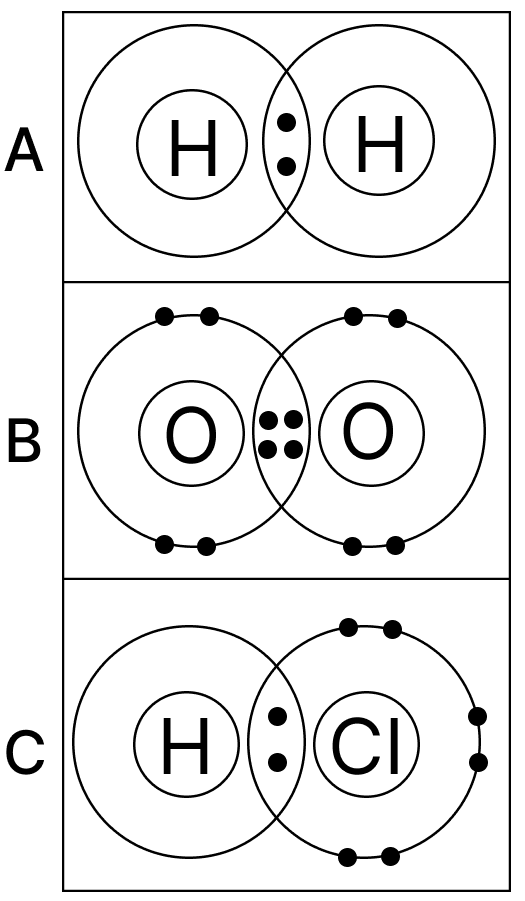
From the molecule 'A', 'B' & 'C', state which is the odd one out. Justify your answer.
Answer
A= H2
It is formed by sharing one pair of electrons (single covalent bond).
B = O2
It is formed by sharing two pairs of electrons (double covalent bond).
C = HCl
It is formed by sharing one pair of electrons (single covalent bond).
Therefore, B (O2) is the odd one out because it contains a double covalent bond, whereas A and C contain single covalent bonds.
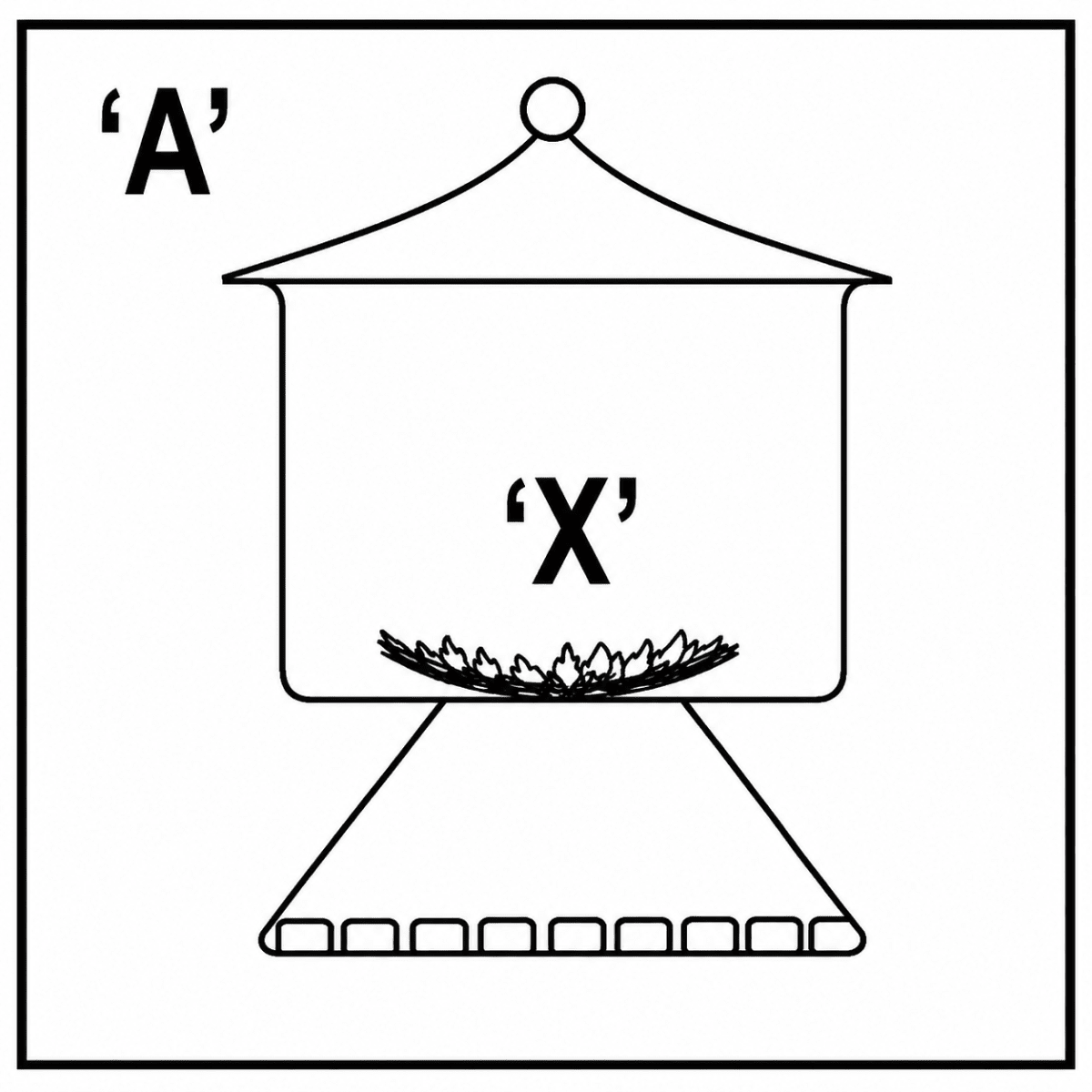
The substance 'X' preferred to be placed in the apparatus 'A' which is deliquescent & hygroscopic.
- P2O5
- Anhydrous CaCl2
- CaO
Answer
Anhydrous CaCl2
Reason — Anhydrous CaCl2 is hygroscopic and absorbs moisture from the air. It is deliquescent and absorbs so much moisture that it eventually dissolves in the absorbed water. It is commonly used as a drying agent in desiccators.
P2O5 and CaO are hygroscopic.
Which of the following is correct for 'A'?
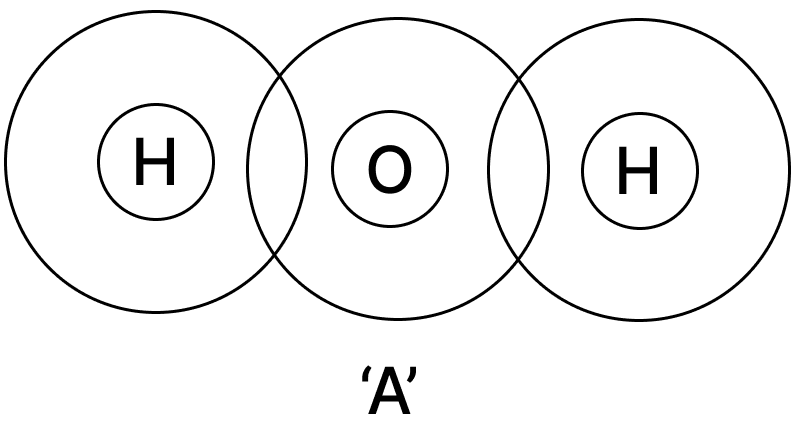
- Components in 'A' retain their original properties.
- Particles in 'A' have uniform composition.
- Components in 'A' can be separated by physical means.
Answer
Particles in 'A' have uniform composition.
Reason — A compound always has a fixed ratio of its elements. Every water molecule contains 2 hydrogen atoms and 1 oxygen atom. Therefore, water has a uniform composition throughout.
In a compound, the constituent elements do not retain their original properties. Hydrogen is a combustible gas and oxygen supports combustion, but water has properties entirely different from both.
The elements in a compound are chemically combined. They cannot be separated by physical methods such as filtration, evaporation, or distillation.
The element present in methanol but not in methane.
Answer
Oxygen
Reason — Methane (CH4) contains carbon and hydrogen. Methanol (CH3OH) contains carbon, hydrogen, and oxygen. Therefore, the element present in methanol but not in methane is oxygen.
A positive radical which is basic in nature.
Answer
A positive radical which is basic in nature is Na+.
A neutral gas which reduces iron [II] oxide to iron.
Answer
A neutral gas which reduces iron [II] oxide to iron is hydrogen.
A solid drying & dehydrating agent which is an acidic oxide.
Answer
A solid drying & dehydrating agent which is an acidic oxide is phosphorus pentoxide.
The element from 126X & 3216Y whose acidic oxide has no effect on acidified KMnO4 solution.
Answer
The element from 126X & 3216Y whose acidic oxide has no effect on acidified KMnO4 solution is carbon.
The number of electrons in the M-shell of Mg2+.
Answer
The number of electrons in the M-shell of Mg2+ is 0.
Since, electronic configuration is 2, 8.
K shell = 2 electrons
L shell = 8 electrons
The element with stable electronic configuration, in the period of the periodic table having the most reactive halogen.
Answer
The element with stable electronic configuration, in the period of the periodic table having the most reactive halogen is neon.
The reduced product formed when a gas which turns moist lead acetate paper silvery black, is reacted with a gas which turns moist starch iodide paper blue-black.
Answer
The reduced product formed when a gas which turns moist lead acetate paper silvery black, is reacted with a gas which turns moist starch iodide paper blue-black is hydrogen chloride.
Gas that turns moist lead acetate paper silvery black is hydrogen sulphide.
Gas that turns moist starch iodide paper blue-black is chlorine.
When H2S reacts with Cl2
H2S + Cl2 ⟶ 2HCl + S
The value of the standard pressure in atmosphere, when the standard temperature is 273 K.
Answer
The value of the standard pressure in atmosphere, when the standard temperature is 273 K is 1 atm.
The gaseous organic compound containing a halogen, which contributes to global warming & destruction of the ozone layer.
Answer
The gaseous organic compound containing a halogen, which contributes to global warming & destruction of the ozone layer is chlorofluorocarbon (CFC).
An example of a colloidal solution, in which the dispersed phase is carbon and the dispersed medium is air.
Answer
An example of a colloidal solution, in which the dispersed phase is carbon and the dispersed medium is air is smoke.
Copper oxide exists as Cu2O & CuO, but sodium oxide as Na2O only. Give a reason.
Answer
Copper can show two valencies, +1 and +2, because it is a transition element. Therefore, it forms two oxides : Cu2O and CuO.
Sodium has only one valency, +1, since it has one electron in its outermost shell and loses only that electron. Hence it forms only one oxide: Na2O.
State the difference between the two conversions of silver compounds to silver:
(a) 2AgNO3 ⟶ 2Ag + 2NO2 + O2
(b) 2AgCl ⟶ 2Ag + Cl2
Answer
2AgNO3 ⟶ 2Ag + 2NO2 + O2 is thermal decomposition.
2AgCl ⟶ 2Ag + Cl2 is photochemical decomposition.
Temporary hardness in water can be removed by boiling, but permanent hardness in water cannot be removed similarly. Give a reason.
Answer
Temporary hardness can be removed by boiling because on boiling the calcium & magnesium bicarbonates in water decompose to give insoluble carbonates, carbon dioxide & water, whereas permanent hardness cannot be removed by boiling because chlorides and sulphates are not decomposed on heating.
Atomic mass of 3919X & 4119X are different, but of two atoms of 3919X is the same. Give a reason.
Answer
3919X & 4119X are isotopes of the same element. They have same atomic number but differ in the number of neutrons. Therefore, have different mass number.
Two atoms of 3919X have identical numbers of protons and neutrons and therefore the same atomic mass.
Does a molecule of nitrogen have a lone pair of electrons? Give reasons.
Answer
Yes, a molecule of nitrogen (N2) has lone pairs of electrons.
Each nitrogen atom has 5 valence electrons. In an N2 molecule, the two nitrogen atoms share three pairs of electrons, forming a triple covalent bond. After forming the triple bond, each nitrogen atom still has one pair of unshared (lone) electrons left.
Across a period, a transition from metallic to non-metallic character is seen, but no such transition is seen down a group. Give reasons.
Answer
As we move from left to right across a period, the nuclear charge increases but the number of shells remains the same. So, elements gradually lose their tendency to lose electrons and gain a tendency to gain electrons. Hence, there is a gradual change from metallic character to non-metallic character across a period.
As we move down a group, the number of electron shells increases. All the elements in a group have the same number of valence electrons, so they show similar chemical properties. Therefore, the metallic or non-metallic nature generally remains the same down a group (metals remain metals and non-metals remain non-metals), and no transition from metallic to non-metallic character is observed down a group.
In Bosch process, the conversion of coke to water gas & water gas to hydrogen are both reduction reactions. Give reasons.
Answer
Conversion of coke to water gas
C + H2O ⟶ CO + H2
Steam is converted to hydrogen. The oxidation state of hydrogen decreases from +1 to 0, water is reduced.
CO + H2 + H2O ⟶ CO2 + 2H2
Steam is converted to hydrogen gas. The oxidation state of hydrogen decreases from +1 to 0. Therefore, water undergoes reduction.
Ideal gas equation may not work for gases at extremely high pressures. Give reasons.
Answer
The ideal gas equation:
PV = nRT
At extremely high pressures, these assumptions are no longer valid because gas molecules are forced very close together, so their actual volume becomes significant compared to the container volume. The molecules come close enough for intermolecular forces of attraction and repulsion to affect their behaviour.
Differentiate between 'ozone oxygen cycle' & 'ozone depletion'.
Answer
| Ozone–Oxygen Cycle | Ozone Depletion |
|---|---|
| It is a continuous process in which ozone is formed and broken down in the stratosphere | It is the destruction of ozone in the stratosphere |
| It helps absorb harmful ultraviolet radiation and protects life on Earth | It allows more harmful UV radiation to reach the Earth's surface, increasing risks such as skin cancer |
State why copper has +1 valency in Cu2O & +2 valency in CuO.
Answer
The outermost shell has one electron and the penultimate shell contains 18 electrons. However the penultimate shell has not attained stability and one or more electrons sometimes jump to the outermost shell thereby increasing the valency electron. Therefore, copper has +1 valency in Cu2O & +2 valency in CuO.
State which of the two equations complies with the Law of conservation of matter. Justify your answer.
(a) 3Al + 2H2SO4 ⟶ Al2(SO4)3 + 3H2
(b) H2S + 2FeCl3 ⟶ 2FeCl2 + 2HCl + S
Answer
Law of conservation of matter states :
Matter can neither be created nor destroyed in a chemical reaction. Therefore, the total mass of the reactants is always equal to the total mass of the products.
H2S + 2FeCl3 ⟶ 2FeCl2 + 2HCl + S
This equation is balanced. There are 2 atoms of iron, 2 atoms of hydrogen, 1 atom of sulphur and 6 atoms of chlorine on both sides of the reaction.
An electrovalent bond is formed between 2412X & 3517Y, but a covalent bond is formed between 2 atoms of 3517Y. Give reasons.
Answer
2412X has electronic configuration 2, 8, 2 and tends to lose 2 electrons to attain a stable octet.
3517Y has electronic configuration 2, 8, 7 and tends to gain 1 electron to complete its octet.
X becomes positively charged and Y becomes negatively charged. One X atom transfers two electrons to two Y atoms.
Each 3517Y atom has 7 valence electrons and needs 1 more electron to complete its octet. Since both 3517Y atoms need electrons, neither can donate electrons to the other. Therefore, they share one pair of electrons.
Formation of ozone in the atmosphere is an example of a photochemical reaction, but formation of hydrogen from brine solution is not. Justify your answer.
Answer
A photochemical reaction is a chemical reaction that is initiated or carried out by the absorption of light energy. In the atmosphere, ultraviolet rays from the Sun split oxygen molecules. The oxygen atoms then combine with oxygen molecules to form ozone. Since sunlight (UV radiation) is essential for the reaction, the formation of ozone is a photochemical reaction.
O2 [O] + [O]
Hydrogen is produced from brine (aqueous sodium chloride) by electrolysis. Here, the reaction is brought about by electrical energy, not by light energy.
2NaCl + 2H2O 2NaOH + H2 + Cl2
Give balanced equation for the conversion A, B & C, each resulting in formation of a diatomic molecule.
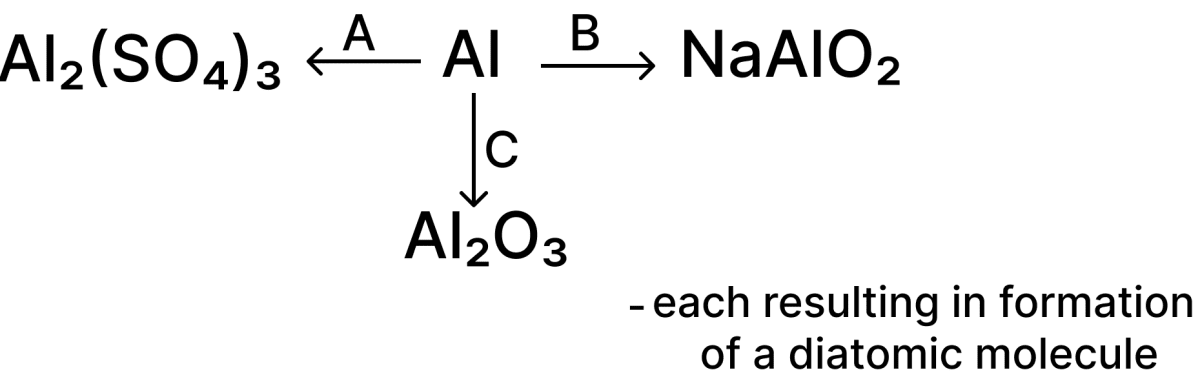
Answer
Equation for A:
2Al + 3H2SO4 ⟶ Al2(SO4)3 + 3H2
Equation for B:
2Al + 2NaOH + 2H2O ⟶ 2NaAlO2 + 3H2
Equation for C:
2Al + 3H2O ⟶ Al2O3 + 3H2
Differentiate between the terms 'photolysis' & 'ozone depletion'.
Answer
Differences between 'photolysis' and 'ozone depletion' are:
| Photolysis | Ozone depletion |
|---|---|
| Photolysis is the decomposition of a substance by the action of light | Ozone depletion is the reduction in the concentration of ozone in the stratosphere |
| It is a chemical process | It is an environmental phenomenon resulting from chemical reactions that destroy ozone |
Give balanced equations:
(a) For reaction of a greenish yellow oxidizing agent, with a foul smelling gas which is oxidised to a yellow non-metal.
(b) For conversions 'A' & 'B'.
O2 O3 2O2
Answer
(a) The greenish-yellow oxidizing agent is chlorine gas and the foul-smelling gas is hydrogen sulphide, which smells like rotten eggs. Hydrogen sulphide is oxidized by chlorine to sulphur, a yellow non-metal.
H2S + Cl2 ⟶ 2HCl + S
The yellow non-metal formed is sulphur.
(b) Equation A :
O2 + [O] ⟶ O3
Equation B :
O3 + [O] ⟶ 2O2
A student was given three sodium salts: A: sodium sulphide, B: sodium sulphite, C: sodium carbonate [& a dil. acid]. Can he distinguish:
(a) B & C using lime water only, as a reagent?
(b) B & C using acidified K2Cr2O7 solution?
(c) A & B using acidified KMnO4 solution?
(d) A & B using lead nitrate solution?
Justify your answer in each case.
Answer
(a) B & C cannot be distinguished using lime water only.
CO2 turns lime water milky due to formation of calcium carbonate. SO2 also turns lime water milky due to formation of calcium sulphite. In both cases, the milkiness disappears on passing excess gas due to formation of soluble bicarbonate or bisulphite.
(b) B & C can be distinguished using acidified K2Cr2O7 solution as SO2 is a reducing agent and changes orange acidified potassium dichromate to green.
CO2 has no effect.
(c) A & B cannot be distinguished using acidified KMnO4 solution because H2S reduces acidified potassium permanganate, decolourising the purple solution. SO2 also reduces acidified potassium permanganate, decolourising the purple solution.
(d) A & B can be distinguished using lead nitrate solution because H2S gives a black precipitate of lead sulphide. SO2 does not produce a black precipitate with lead nitrate solution.
Give a reason why:
(a) pure hydrogen burns quietly in air,
(b) a hydrogen-air mixture burns with a characteristic 'pop' sound,
(c) hydrogen-chlorine mixture burns explosively in direct sunlight.
Answer
(a) Pure hydrogen burns slowly in air to form water, releasing heat gradually. Since the reaction is not very rapid, it burns with a pale blue flame without producing any sound.
(b) When hydrogen is mixed with air, oxygen is already intimately mixed with the hydrogen. On ignition, the reaction occurs very rapidly, causing sudden expansion of gases and producing a 'pop' sound.
(c) Direct sunlight initiates a photochemical reaction between hydrogen and chlorine. The reaction proceeds extremely rapidly (chain reaction), releasing a large amount of energy in a very short time, resulting in an explosion.
Arrange the elements:
(a) B, C, Li, Be — in increasing order of valency.
(b) O, C, F, N — in increasing order of electronegativity.
(c) I, Cl, Br, F — in decreasing order of electronegativity.
(d) F, O, C, N — in decreasing order of non-metallic character.
Answer
(a) Increasing order of valency of the elements: Li, Be, B, C
(b) Increasing order of electronegativity of the elements: C, N, O, F
(c) Decreasing order of electronegativity of the elements: F, Cl, Br, I
(d) Decreasing order of non-metallic character of the elements: F, O, N, C