
Which of the following data visualisation techniques is depicted in this image?
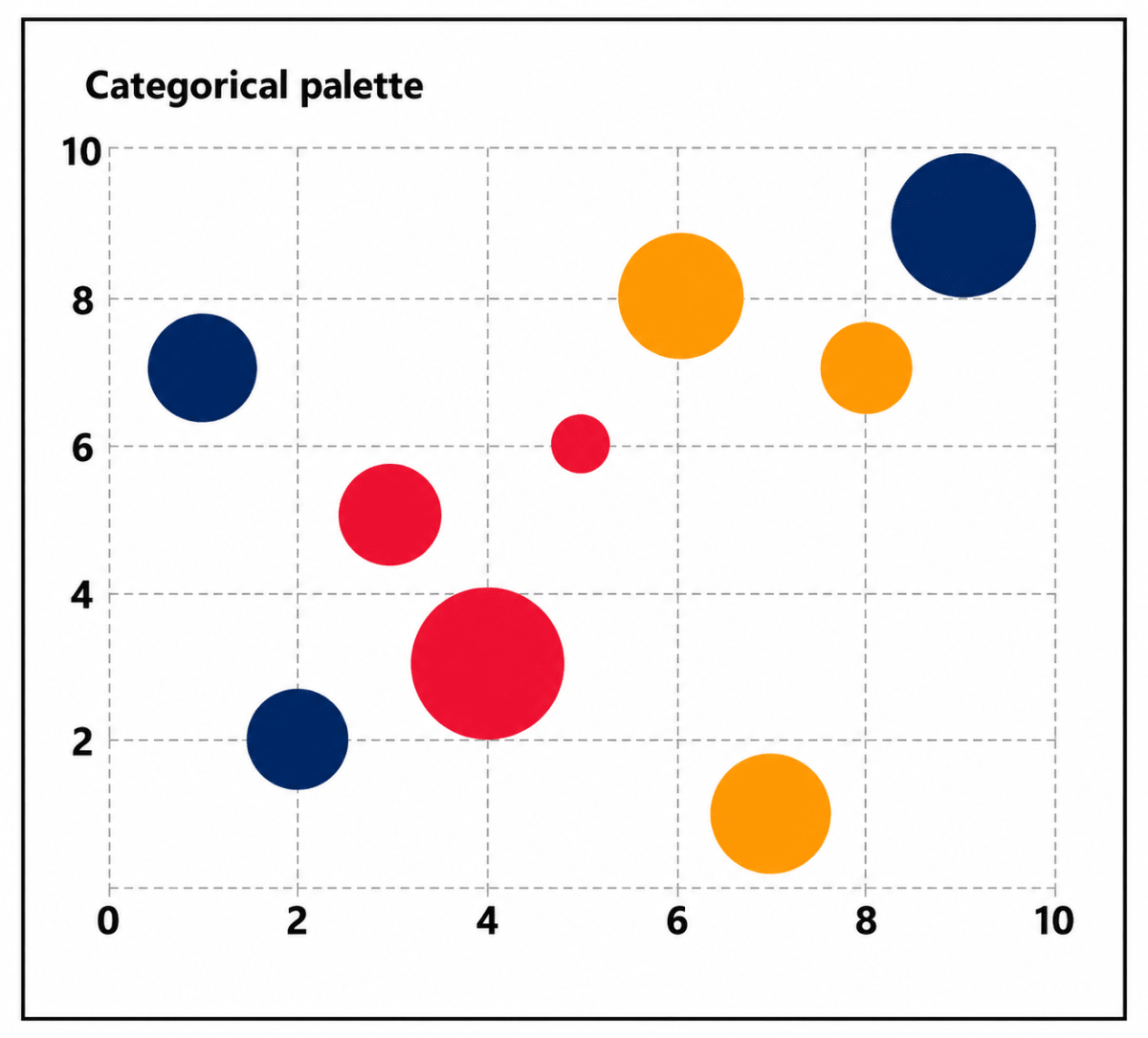
- Scatter Plot
- Fizz Plot
- Ball Plot
- Bubble Plot
Answer
Bubble Plot
Reason — The image depicts a Bubble Plot, which is a sophisticated data visualisation tool that displays three dimensions of data simultaneously. Each point's position is determined by two variables on the x and y axes, while the size of the bubble represents a third variable.
What is the first stage in the AI Project Cycle?
- Data Acquisition
- Data Exploration
- Problem Scoping
- Modelling
Answer
Problem Scoping
Reason — Problem Scoping is the first stage of the AI Project Cycle, where the problem to be solved is identified and defined thoroughly, including understanding stakeholders, setting objectives and establishing constraints.
Which stage involves gathering relevant data for the project?
- Problem Scoping
- Data Acquisition
- Modelling
- Evaluation
Answer
Data Acquisition
Reason — Data Acquisition is the stage where information needed for the AI system is gathered from various sources like sensors, databases, APIs, surveys and the internet.
Which of the following is NOT a step in the AI Project Cycle?
- Evaluation
- Data Cleaning
- Problem Scoping
- Data Acquisition
Answer
Data Cleaning
Reason — The five main stages of the AI Project Cycle are Problem Scoping, Data Acquisition, Data Exploration, Modelling and Evaluation. Data Cleaning is part of the Data Exploration stage, not a separate step in the AI Project Cycle.
Which of the following does not belong to the components of 4Ws Canvas?
- Who
- Where
- What
- When
Answer
When
Reason — The 4Ws Canvas in the AI Project Cycle consists of four key questions — Who, What, Where and Why. "When" is not a component of the 4Ws Canvas.
What is data acquisition in the context of AI?
- The process of creating data
- The process of gathering information for AI systems
- The process of deleting old data
- The process of analysing data
Answer
The process of gathering information for AI systems
Reason — Data acquisition is the process of gathering information that an AI system needs to function. Without the right data, an AI system cannot work properly.
What type of data might a Smart Agriculture project need?
- Data regarding local restaurants
- Data about soil quality and weather conditions
- Data nearby galaxies
- Data around urban traffic patterns
Answer
Data about soil quality and weather conditions
Reason — A Smart Agriculture project requires data about soil quality, weather conditions and crop health to optimise irrigation, planting schedules and resource management.
What does structured data mean?
- Randomly organised data
- Data not arranged in any specific format
- Data organised in rows and columns
- Data painted on a canvas
Answer
Data organised in rows and columns
Reason — Structured data is well-organised, found in databases or spreadsheets, arranged in rows and columns, making it straightforward to input, store, retrieve and analyse.
In a data visualisation, ............... can be the best suited for showing the distribution of a single numerical variable?
- Bar chart
- Histogram
- Scatter plot
- Pie chart
Answer
Histogram
Reason — A histogram is a graphical representation of data grouped into continuous number ranges, depicted as vertical bars. It is most suitable for visualising the distribution, central tendency and variability of a single numerical variable.
............... is most suitable for comparing the proportion of different categories as a whole in a data visualisation?
- Bar chart
- Line chart
- Scatter plot
- Pie chart
Answer
Pie chart
Reason — A pie chart displays data as a circular region divided into segments, where each slice represents a category's contribution to the whole. It is most suitable for comparing the proportion of different categories as parts of a whole.
Fill in the blanks:
- The first step in the AI project cycle is project ..............., where the problem is identified and defined.
- Data ............... involves creating and training machine learning models as part of the AI Project Cycle.
- ............... is the process of gathering information that an AI system needs to function.
- ............... data is well-organised, typically found in databases or spreadsheets.
- ............... data represents descriptive information, usually collected through interviews, surveys or observations.
- ............... graph is a technique to visualise data that uses either horizontal or vertical bars.
- In a data visualisation, ............... chart is the most suitable for showing the change in values over time.
- ............... plot is a two-dimensional data visualisation that uses dots to represent the values for two different variables represented by points.
- ............... map portrays the geographic pattern of a particular subject matter in a geographic area.
- In a ............... graph, a node represents an individual element or entity, such as a person, computer or organisation, connected by the edges.
Answer
- The first step in the AI project cycle is project scoping, where the problem is identified and defined.
- Data modelling involves creating and training machine learning models as part of the AI Project Cycle.
- Data acquisition is the process of gathering information that an AI system needs to function.
- Structured data is well-organised, typically found in databases or spreadsheets.
- Qualitative data represents descriptive information, usually collected through interviews, surveys or observations.
- Bar graph is a technique to visualise data that uses either horizontal or vertical bars.
- In a data visualisation, line chart is the most suitable for showing the change in values over time.
- Scatter plot is a two-dimensional data visualisation that uses dots to represent the values for two different variables represented by points.
- Choropleth map portrays the geographic pattern of a particular subject matter in a geographic area.
- In a network graph, a node represents an individual element or entity, such as a person, computer or organisation, connected by the edges.
Name the type of data visualisation technique used:
- to depict numeric data with one variable
- to depict numeric data with two variables
- to depict the chronological order of events
- to use colours for plotting values
Answer
- Histogram
- Scatter Plot
- Timeline
- Heat Map
Assertion (A): In AI Project Cycle, the modelling means developing algorithms that can analyse and interpret data to make decisions or predictions.
Reason (R): The goal of modelling is to build systems that can perform tasks such as learning, reasoning and solving problems.
Based on the above assertion and reasoning, pick an appropriate statement from the options given below:
- Both A and R are true and R is the correct explanation of A.
- Both A and R are true and R is not the correct explanation of A.
- A is true but R is false.
- A is false but R is true.
- Both A and R are false.
Answer
Both A and R are true and R is the correct explanation of A.
Reason — In AI, modelling involves developing algorithms that can analyse and interpret data to make decisions or predictions. The goal is to build systems that can perform tasks such as learning, reasoning and solving problems, which correctly explains why modelling is essential in the AI Project Cycle.
Assertion (A): Data acquisition is crucial for an AI system to function effectively.
Reason (R): Without the correct data, an AI system cannot make accurate predictions or decisions.
Based on the above assertion and reasoning, pick an appropriate statement from the options given below:
- Both A and R are true and R is the correct explanation of A.
- Both A and R are true and R is not the correct explanation of A.
- A is true but R is false.
- A is false but R is true.
- Both A and R are false.
Answer
Both A and R are true and R is the correct explanation of A.
Reason — Data acquisition is crucial because AI systems learn from the data provided to them. If the data is accurate and relevant, the AI will make good and precise decisions. If the data is poor, the AI will not perform well.
Structured data is well-organised and easily searchable data, typically found in databases or spreadsheets (such as Microsoft Excel). This data is arranged in rows and columns, making it straightforward to input, store, retrieve, and analyse. For instance, your school's timetable is a form of structured data, with rows representing each class and columns containing details like subject, teacher, and time. This arrangement facilitates efficient data management and retrieval.
Based on the above paragraph, answer the following questions:
(a) What is structured data?
- Data that has no specific format
- Data that is well-organised and easily searchable
- Data that cannot be stored in databases
- Data that is difficult to retrieve and analyse
(b) Where is structured data typically found?
- In random text files
- In handwritten notes
- In databases or spreadsheets
- In video files
(c) What is the purpose of arranging data in rows and columns?
- To facilitate efficient data management and retrieval
- To make it easier to delete
- To make it look visually appealing
- To prevent data from being edited
(d) How is structured data usually arranged?
- In paragraphs and sentences
- In a timeline format
- In rows and columns
- In graphical format
Answer
(a) Data that is well-organised and easily searchable
(b) In databases or spreadsheets
(c) To facilitate efficient data management and retrieval
(d) In rows and columns
Problem scoping is the first step in any AI project where we define and understand the problem thoroughly. This phase includes several important steps — Identifying the Problem, Defining Objectives, Understanding Stakeholders and Setting Constraints.
Based on the above paragraph, answer the following questions:
(a) Which aspect of Problem Scoping involves identifying everyone who will be affected by the project?
- Identifying the Problem
- Setting Constraints
- Choosing Algorithms
- Understanding Stakeholders
(b) What should be set to ensure that the AI project has measurable outcomes?
- Constraints
- Stakeholder roles
- Objectives
- Data collection methods
(c) ............... is the process of determining any limitations, such as budget or time, that may affect the AI project.
(d) ............... involves identifying everyone who will be involved in or affected by the project.
Answer
(a) Understanding Stakeholders
(b) Objectives
(c) Setting Constraints is the process of determining any limitations, such as budget or time, that may affect the AI project.
(d) Understanding Stakeholders involves identifying everyone who will be involved in or affected by the project.
Write short notes on Problem Scoping.
Answer
Problem Scoping is the first step in any AI project where we define and understand the problem thoroughly. This phase includes several important steps such as selecting a theme, identifying the problem, setting goals, identifying stakeholders and establishing constraints. It ensures that the AI project addresses a relevant and well-defined issue. The 4Ws Canvas (Who, What, Where, Why) is commonly used during this phase to comprehensively understand the problem and develop a targeted solution.
Write short notes on Data Exploration.
Answer
Data Exploration refers to the initial step in data analysis where analysts use data visualisation and statistical techniques to describe characteristics of the dataset such as size, quantity and accuracy. It involves examining and analysing datasets to uncover patterns, trends and insights. The process includes data cleaning, transformation and preliminary statistical analysis. It helps analysts understand the structure of data and the relationships within the data, preparing it for more in-depth analysis and visualisation.
Write short notes on Data Visualisation.
Answer
Data Visualisation is the process of communicating and translating data and information into visual contexts to make the data easier for the human brain to understand. It uses charts, graphs and other visual tools to represent analysed data in a graphical form. It communicates complex ideas more clearly, helps identify patterns or trends and makes large datasets easier to interpret. Common techniques include plots, charts/graphs, maps, timelines, network diagrams and word clouds.
Write short notes on Histogram.
Answer
A Histogram is a graphical representation of data grouped into continuous number ranges, depicted as vertical bars. The horizontal axis displays the number ranges, while the vertical axis represents the frequency or amount of data present in each range. Histograms are useful for visualising the distribution, central tendency and variability of a dataset, as well as for identifying patterns such as skewness or the presence of outliers. They are commonly used in statistics, quality control and research.
Write short notes on Maps.
Answer
Maps are graphical representations that use geographical maps as a visual backdrop to display data points or statistical information associated with specific geographic locations. They help in visualising spatial distribution and regional patterns of data. The two common types are Heat Maps, which use colour gradients to represent value magnitudes within a matrix, and Choropleth Maps, which use colour shading on geographic areas to represent data values like population density, income levels or election results.
Write short notes on Network Chart.
Answer
A Network Chart visually represents relationships between interconnected entities or nodes. Each node symbolises an individual element such as a person, computer or organisation, while the connecting lines or edges illustrate the relationships or interactions between them. Network diagrams are used to illustrate complex systems, highlighting how elements are linked and how things interact. They are widely employed in fields like computer networking, social network analysis, project management and organisational structure mapping.
Write short notes on Word Cloud.
Answer
A Word Cloud is a visual representation of text data, displaying words in varying sizes based on their frequency or importance. The more frequently a word appears in the text, the larger it appears in the word cloud. The words often appear bolder or follow a specific colour scheme according to their frequency. Word clouds are used to summarise and visualise textual information, making it easy to identify key themes, topics or keywords. They are commonly utilised in fields such as data analysis, market research and content visualisation.
Write short notes on Charts.
Answer
Charts are visual representations of data or information, typically using symbols and colours to display relationships, trends or patterns. They are represented through X-axis and Y-axis with at least one numerical value on one of the axes. Charts help simplify complex data for easier understanding and analysis. Common types of charts include Line Chart (for trends over time), Bar Chart (for comparing categories), Pie Chart (for showing proportions of a whole) and Histogram (for showing frequency distributions).
What is meant by AI Project Cycle?
Answer
The AI Project Cycle is a structured approach for developing AI solutions and projects. It ensures that AI projects are systematically and efficiently executed in a time-bound manner.
Why Problem Scoping is crucial in an AI project?
Answer
Problem Scoping is crucial in an AI project because it is the first step where we define and understand the problem thoroughly. It ensures that the project addresses a relevant and well-defined issue. By clearly defining the problem, identifying stakeholders, setting objectives and establishing constraints, problem scoping provides clear direction to the entire project. Without proper problem scoping, the AI solution may not meet the actual needs of users and resources could be wasted on solving the wrong problem.
What are the key considerations when setting constraints in Problem Scoping?
Answer
The key considerations when setting constraints in Problem Scoping are as follows:
- Budget — The amount of money available to spend on the project, including costs for developing the AI, buying necessary equipment and ongoing maintenance.
- Time — The total time allowed to complete the project, from the beginning stages to when the AI system is fully operational.
- Technology — The tools and resources needed to make the project work, such as sensors, drones, internet connectivity and computing resources.
- Ethical Considerations — Making sure the project respects privacy, gets consent from everyone involved and doesn't harm the environment.
Why is data acquisition important in AI projects?
Answer
Data acquisition is important in AI projects because AI systems learn from the data provided to them. Think of it like collecting ingredients for a recipe - without the right ingredients, you can't cook a good meal. Similarly, without good data, an AI system can't work properly. If the data is accurate and relevant, the AI will make good and precise decisions. If the data is poor, the AI won't perform well. Thus, the quality of data directly impacts the effectiveness and reliability of the AI system.
What are the main steps involved in data acquisition?
Answer
The main steps involved in data acquisition are as follows:
- Identifying Data Needs — Determine what kind of data the AI project needs.
- Collecting Data — Gather the data from various sources such as sensors, drones or the internet.
- Ensuring Data Quality — Check that the data is accurate and relevant by removing errors or irrelevant information.
- Storing Data — Store the data in an organised way such as in databases or cloud storage so it can be easily accessed.
- Using Data — Feed the cleaned and organised data into the AI system for analysis and learning.
Explain structured data with an example.
Answer
Structured data is well-organised data, typically found in databases or spreadsheets (such as Microsoft Excel). This data is arranged in rows and columns, making it straightforward to input, store, retrieve and analyse. It facilitates efficient data management and retrieval.
For example, a school's timetable is a form of structured data, where rows represent each class and columns contain details like subject, teacher and time.
Explain the process of data acquisition in AI.
Answer
Data acquisition is the process of gathering information that an AI system needs to function. The process involves several key steps. First, the data needs of the project are identified to determine what kind of data is required. Next, the data is collected from various sources such as sensors, drones, databases, APIs, surveys or web scraping. The collected data is then checked for quality by removing errors and irrelevant information to ensure accuracy. After that, the data is stored in an organised manner using databases or cloud storage. Finally, the cleaned and organised data is fed into the AI system to enable it to analyse, learn and make predictions or decisions.
How does structured data differ from unstructured data? Give examples.
Answer
Structured data is well-organised data that is arranged in rows and columns, typically found in databases or spreadsheets. It is easy to input, store, retrieve and analyse. For example, a school's timetable or an Excel sheet of student marks.
Unstructured data, on the other hand, does not have a predefined format, making it more difficult to process and analyse. It includes various formats like written documents, pictures, audio recordings and videos. For example, photos saved on a phone or text messages sent to friends.
What are the different types of data used in context to AI project cycle?
Answer
The different types of data used in the AI project cycle are as follows:
- Structured Data — Well-organised data found in databases or spreadsheets, arranged in rows and columns. Example: School's timetable.
- Unstructured Data — Data that does not have a predefined format, such as written documents, pictures, audio recordings and videos. Example: Photos saved on phones.
- Qualitative Data — Descriptive, non-numerical information collected through interviews, surveys or observations. Example: Sharing your favourite movie.
- Quantitative Data — Numerical values and measurements that quantify characteristics or behaviour. Example: Height, weight or age.
Why is data visualisation important in data analysis?
Answer
Data visualisation is important in data analysis because it represents data in a visual form, making it easier for the human brain to understand. It communicates information clearly and efficiently using graphical representations such as charts and graphs. It helps users in analysing large amounts of data in a simpler way and supports in finding incorrect data, corrupted or missing values. It also makes complex data more accessible, understandable and usable, enabling stakeholders to identify patterns, trends and make informed decisions.
What is the benefit of using line charts in data visualisation?
Answer
Line charts are used to plot the relationship or dependence of one variable on another to display changes or trends. The main benefit of using line charts is that they are ideal for visualising continuous data and identifying trends, patterns and fluctuations over very long periods or continuously changing data. They are most often used to evaluate how data has changed over time. Line charts are widely used in fields such as finance, economics and science to monitor progress, forecast future data and analyse relationships between variables.
Explain the following data visualisation techniques:
(a) Scatter Plot (b) Line Chart (c) Bar Graph (d) Heat Map (e) Timeline (f) Choropleth Map
Answer
(a) Scatter Plot — A scatter plot is a two-dimensional data visualisation that uses dots to represent the values for two different variables plotted against the horizontal and vertical axes. Each point implies the value for each observation. It is useful in illustrating relationships between variables and can be used to identify trends or correlations in data.
(b) Line Chart — A line chart is used to plot the relationship or dependence of one variable on another to display changes or trends. It is most often used to evaluate how data has changed over time and is ideal for visualising continuous data and identifying trends and fluctuations.
(c) Bar Graph — A bar graph is one of the most popular ways to visualise data using rectangular bars where each bar represents a category. The two types are Vertical Column chart (data with vertical bars) and Horizontal Column chart (data with flat horizontal bars). It is highly effective for comparing different categories and analysing data changes.
(d) Heat Map — A heat map is a data visualisation tool that uses colour gradients to represent value magnitudes within a matrix. Each cell is coloured based on its value, with different colours indicating various data ranges. Heat maps effectively display large, complex datasets, making patterns, correlations and anomalies easily identifiable.
(e) Timeline — A timeline is a graphical representation that shows events in chronological order along a linear scale. It can be horizontal or vertical and typically includes dates, labels and brief event descriptions. Timelines are effective for visualising historical developments, project schedules or process evolution.
(f) Choropleth Map — Choropleth maps are thematic maps that depict the geographic distribution of a specific subject across areas like countries, states or regions. They use colour shading to represent data values, with darker colours indicating higher values and lighter colours indicating lower values. Examples include India's map of Covid 19 spread.
What are the two main types of modelling techniques in AI?
Answer
The two main types of modelling techniques in AI are:
Rule-Based Models — These models follow specific rules set by humans. For example, "If the object is round and red, it is likely an apple." They offer simplicity and consistency but lack flexibility and learning capability.
Learning-Based Models — These models learn from data instead of following strict rules. They analyse patterns in the data and make decisions based on what they have learned. They can be further classified into Supervised, Un-supervised and Reinforcement learning.
Give two differences between rule-based model and learning-based model.
Answer
The two differences between rule-based and learning-based models are as follows:
Decision Making — A rule-based model makes decisions by following specific predefined rules set by humans, whereas a learning-based model makes decisions by analysing patterns in the data it has been trained on.
Learning Ability — A rule-based model does not learn from new experiences and always uses the same set of rules unless they are manually updated. In contrast, a learning-based model can learn from new data and improve over time, eliminating the need for manual rule updates.
What are the advantages and disadvantages of rule-based modelling?
Answer
Advantages of Rule-Based Modelling:
- Easy to Understand — The system's decisions are clear because they follow straightforward rules.
- Simple to Create — Setting up a rule-based system is easy since you just need to define the rules.
- Consistent — The system behaves predictably, always following the same rules under the same conditions.
Disadvantages of Rule-Based Modelling:
- Not Flexible — The system can only handle situations covered by the predefined rules. Unexpected scenarios can be challenging to handle.
- Difficult to Manage — As the number of rules increases, it becomes harder to maintain and update the system.
- No Learning — The system does not learn from new experiences. It always uses the same set of rules unless they are manually updated.