
What does the following image depict?

- Vision
- Computer Vision
- Human Eye
- Visualisation of an object
Answer
Computer Vision
Reason — The image depicts Computer Vision which is a domain of Artificial Intelligence that enables computers and machines to interpret and understand visual information from the digital world. The eye in the image is shown integrated with digital/circuit elements, symbolising how machines are given the ability to "see" like humans.
Speech Recognition is an example of ............... AI.
- Strong
- Narrow
- Medium
- Robust
Answer
Narrow
Reason — Speech Recognition is an example of Narrow AI (also known as Weak AI) because it is trained to perform only one specific, dedicated task with intelligence and cannot perform tasks beyond its defined limits.
Which of the following can be referred as sensing device in Computer Vision system?
- Eye
- Camera
- Eye Ball
- Retina
Answer
Camera
Reason — In a Computer Vision system, a camera or any similar device works as a sensing device that is responsible for capturing images of the objects as an input, just like the human eye does in the human vision system.
What does the letter N signify in NLP?
- Nature
- Natural
- Normal
- Neutral
Answer
Natural
Reason — NLP stands for Natural Language Processing. It is a domain of artificial intelligence that helps computers to read, understand and write text in the same way as humans, using natural languages such as English, Hindi, Bengali, etc.
The fundamental unit of neural networks is ............... .
- neurons
- nucleus
- brain
- axon
Answer
neurons
Reason — The neurons (nerve cells) are the fundamental building block of neural networks. In biological structures, they are cells like any other cells of the body which receive and transmit signals to different parts of the body.
An artificial neural network consists of a large number of artificial neurons called ............... .
- cells
- brain
- nodes
- veins
Answer
nodes
Reason — An artificial neural network consists of a large number of artificial neurons called nodes which are arranged in a sequence of layers. These layers enable the neural network to identify the inputs and compute a meaningful output.
Which of the following is true for dendrites?
- It acts as a transmitter.
- It acts as a receptor.
- It responses to nerve impulses.
- None of them
Answer
It acts as a receptor.
Reason — Dendrites are like fibres branched in different directions which are connected to many cells in the cluster to receive information or signals from other neurons. Therefore, they act as receptors in a neuron.
Which is most appropriate to define the purpose of Axon?
- as receptors
- as a transmitter
- as a transmission
- none of them
Answer
as a transmitter
Reason — Axon is a tube-like structure that carries electrical pulses from the cell body and sends the output signal to another neuron for the flow of information. Hence, it acts as a transmitter.
State whether the following statements are True or False:
- Narrow AI is a type of intelligence which can perform any intellectual task with efficiency like a human being.
- In supervised learning, a machine learns under the guidance of the user.
- Machine Learning is a superset of artificial intelligence.
- Artificial Neural Networks is a computational model inspired by the structure and functioning of biological neural networks.
- Email services use natural language processing to identify the contents of each email.
- Facial recognition is one of the most well-known applications of natural intelligence.
- The basic parts of an artificial neural network are artificial neurons or nodes.
- The term Artificial Neural Network is derived from Biological neural networks.
- The blood cells are the fundamental building block of neural networks.
- The dendrites receive signals from other neurons.
Answer
- False
Corrected Statement: General AI (Strong AI) is a type of intelligence which can perform any intellectual task with efficiency like a human being. - True
- False
Corrected Statement: Machine Learning is a subset of artificial intelligence. - True
- True
- False
Corrected Statement: Facial recognition is one of the most well-known applications of computer vision. - True
- True
- False
Corrected Statement: The neurons (nerve cells) are the fundamental building block of neural networks. - True
Three types of AI, based on capability
(a) ...............
(b) ...............
(c) ...............
Answer
(a) Narrow AI
(b) General AI
(c) Super AI
Three areas of application of machine learning
(a) ...............
(b) ...............
(c) ...............
Answer
(a) Social Media
(b) Virtual Assistants
(c) Self-driving Cars
Three layers of neural network
(a) ...............
(b) ...............
(c) ...............
Answer
(a) Input Layer
(b) Hidden Layer
(c) Output Layer
Three areas of application of computer vision
(a) ...............
(b) ...............
(c) ...............
Answer
(a) Facial Recognition
(b) Object Detection and Tracking
(c) Self-driving Cars
Label the components of Human Neural Networks:
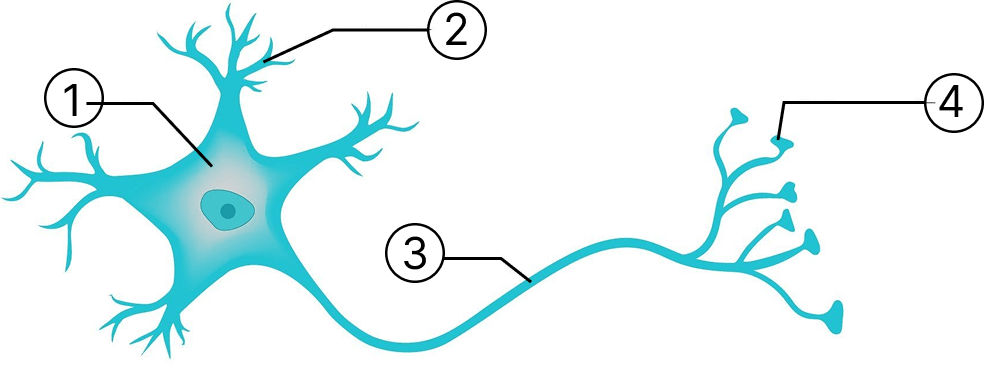
Answer
- Cell Body (Soma)
- Dendrites
- Axon
- Axon Terminals
Assertion (A): In supervised learning, a machine learns under some guidance of a developer.
Reason (R): The labelled data and the output are provided to train the model. Once the model is trained, it is tested with same or similar kind of data to predict the desired answer.
Based on the above assertion and reasoning, pick an appropriate statement from the options given below:
- Both A and R are true and R is the correct explanation of A.
- Both A and R are true and R is not the correct explanation of A.
- A is true but R is false.
- A is false but R is true.
- Both A and R are false.
Answer
Both A and R are true and R is the correct explanation of A.
Reason — In supervised learning, a machine learns under the guidance of a developer, similar to how a teacher guides students in school. The labelled input data along with the expected output are provided to train the model. Once trained, the model is tested with same or similar kind of data and is expected to predict the correct output. Thus, R correctly explains how supervised learning works as stated in A.
Domains of AI refers to as the various specialised areas within artificial intelligence. These domains deal with specific problems, techniques, applications, etc. to make it easier to categorise and understand the vast field of artificial intelligence. The following are some statements which are related to domains of AI. Read the statements carefully and identify the domains.
(a) In this processing, human language is separated into fragments so that the grammatical structure of sentences and the meaning of words can be analysed.
(b) It involves on the use of artificial neural networks to model and solve complex problems.
(c) It enables the computers and machines to interpret and understand visual information from the digital world such as images, videos or any visual inputs.
(d) It is a subset and fundamental domain within artificial intelligence which focuses on the development of computer programs.
Answer
(a) Natural Language Processing (NLP)
(b) Neural Network
(c) Computer Vision
(d) Machine Learning
What is meant Super AI?
Answer
Super Artificial Intelligence represents a highly advanced AI category that goes beyond human intellect, boasting the ability to outperform humans in tasks requiring cognitive skills. Emerging from the advancements in General Artificial Intelligence, it encompasses features such as reasoning, puzzle-solving, decision-making and autonomous communication. This tier of AI is characterised by intellectual capacities that significantly exceed human potential. Currently, the concept of Super AI is largely theoretical and subject to much speculation.
Mention three tasks associated with Computer Vision.
Answer
Three tasks associated with Computer Vision are:
- Identification of Object: The system identifies and locates items of interest within a visual frame, separating them from the background.
- Extraction of Features: The system extracts distinctive features of the object such as shape, colour, texture or specific patterns that help differentiate it from others.
- Classification of Objects: Using the features extracted, the object is then classified into a category (such as person, vehicle, etc.). This classification relies on machine learning models trained with numerous images.
How does a machine begin to learn? Explain with an example.
Answer
A machine begins to learn by being trained with a large amount of data and identifying patterns within the data. The more examples the program sees and the more it practices with that data set, the better it becomes in its recognition capabilities.
Example: Suppose we want to make a computer program learn how to differentiate between an apple and an orange. To do so, we would start by showing it numerous pictures of both the objects i.e., apples and oranges. The program will look at the pictures and try to find similarities or patterns between them. It might notice that apple can be of the colour green or red but oranges can only be orange in colour. Based on these patterns, the program recognises and can make an informed decision about any specified picture fed into its system - recognising if it is an apple or an orange. This is how the machine begins to learn.
Enlist any five applications of Machine Learning.
Answer
Five applications of Machine Learning are:
- Social Media: Platforms like Facebook use machine learning to personalise user experiences, such as showing similar posts based on user activity.
- Virtual Assistants: Smart assistants use unsupervised and supervised learning techniques to interpret and supply context or natural speech.
- HR Information Systems: Used by Human Resource Information System (HRIS) for identifying the best candidates for an open position by filtering applications.
- Customer Relationship Management: CRM software uses machine learning models to analyse prompts given by sales members and respond to important messages and emails.
- Self-driving Cars: Algorithms based on Machine Learning models are used to drive the car autonomously.
What is an Expert System? Give two examples.
Answer
An Expert System is an AI-based software that mimics the decision-making ability of a human expert. It uses a knowledge base of facts and rules, along with an inference engine, to solve complex problems in a specific domain, such as medical diagnosis or financial analysis. Expert systems provide solutions, explanations and recommendations by reasoning through stored knowledge, simulating the expertise of a human in a particular field.
Two examples of Expert System are:
- MYCIN: It is an early expert system developed in the 1970s for diagnosing bacterial infections and recommending appropriate antibiotics.
- DENDRAL: It is an early AI expert system developed in the 1960s for chemical analysis, specifically to infer molecular structures from mass spectrometry data.
Explain the areas of applications of Computer Vision:
(a) In healthcare
(b) In agriculture
Answer
(a) In Healthcare: Computer vision is making a big impact in the healthcare sector through the following applications:
- X-Ray Analysis: Computer vision can be successfully used in X-ray analysis to enhance efficiency and accuracy in diagnosing and treating diseases.
- CT Scan and MRI: AI with computer vision designs systems that analyse radiology images (CT scans and MRI) with a high level of accuracy. It reduces the time for disease detection, enhancing the chances of saving a patient's life.
(b) In Agriculture: Computer vision is used in agriculture to improve yields and reduce wastage of crops. The use of drones, equipped with computer vision technology, helps in monitoring crops and identifying potential issues such as pest infestations, nutrient deficiencies, etc. It is also being used to develop new agricultural technologies such as autonomous tractors and robotic harvesters.
Explain the areas of applications of Natural Language Processing:
(a) In chatbots
(b) In voice assistants
Answer
(a) In Chatbots: Chatbots are created using natural language processing and machine learning to interact with humans in a way that they sound like humans themselves. Depending on the complexities, they can either just respond to specific keywords or can even have full conversations with users.
(b) In Voice Assistants: Voice assistants such as Siri, Alexa or Google Assistant are used to make calls, place reminders, schedule meetings, set alarms, surf the internet, etc. They use a complex combination of speech recognition, natural language understanding and natural language processing to understand what humans are saying and then act accordingly. Thus, these voice assistants have made our life much easier.
What is meant by Neural Networks?
Answer
Neural Network is a key idea in Artificial Intelligence (AI) and machine learning. It is a computer model inspired by how the human brain works with its biological neural networks. This layered network enables machines empowered with neural networks to recognise patterns, categorise inputs, predict outcomes, etc. Neural networks can also be referred to as a type of machine learning process that uses interconnected nodes or neurons in a layered structure resembling the human brain. At the core, a neural network comprises of artificial neurons or nodes which accept user input, process it and produce a meaningful output using an activation function.
Explain the following in context of neural networks:
(a) Dendrites
(b) Cell Body
(c) Axon
Answer
(a) Dendrites: The dendrites are like fibres branched in different directions. They are connected to many cells in the cluster to receive information or signals from other neurons that get connected to it. They act as receptors of the neuron.
(b) Cell Body (Soma): The cell body refers to as the information processing system of a neuron. It takes in all the information coming from different dendrites and processes it.
(c) Axon: Axon is a tube-like structure that carries electrical pulses from the cell body and sends the output signal to another neuron for the flow of information. It acts as a transmitter.
Define the role of the following layers in context of Artificial Neural Networks:
(a) Input Layer
(b) Hidden Layer
(c) Output Layer
Answer
(a) Input Layer: The Input layer refers to as the first layer of nodes in an artificial neural network. It receives the input data from the external world.
(b) Hidden Layer: The Hidden Layers are the intermediate layers between the input and output layer. It may consist of one or more layers and process the data where a lot of calculations happen. It enables a neural network to learn complex tasks and achieve excellent performance.
(c) Output Layer: The Output layer is the last layer of neurons in an artificial neural network that produces the final answer for the input tasks.