
Identify the type of robot that is depicted in the given image.
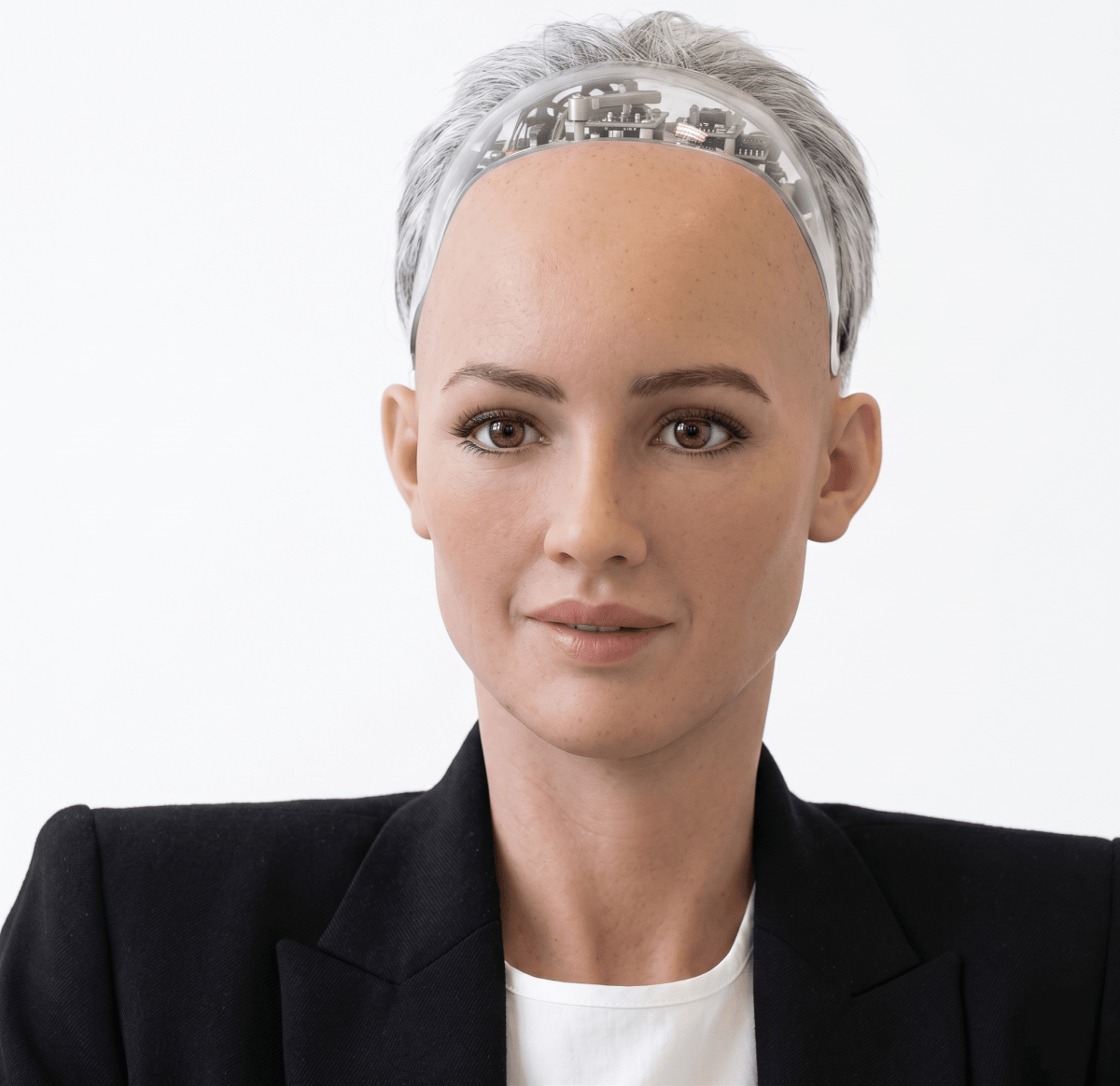
- Woman robot
- First robot citizen
- Intelligent robot
- Humanoid robot
Answer
First robot citizen
Reason — The image depicts Sophia, a super-smart robot with Artificial Intelligence, created by David Hanson in 2016. She became a citizen of Saudi Arabia, which made her the first robot ever to become a citizen of a country.
............... is the first digitally operated industrial robot invented by George Devol.
- Ultimate
- Animate
- Unimate
- Climate
Answer
Unimate
Reason — Unimate was introduced as the very first industrial robot. It was invented in 1954 by the American engineer George Devol along with Joseph Engelberger and was used in the General Motors Corporation factory in Trenton, New Jersey.
Which of the following statements is true for a robot?
- It is a programmable machine.
- It can execute specific tasks with little or no human intervention.
- It can be used to replace human activities in near future.
- All of the above
Answer
All of the above
Reason — Robots are referred to as programmable machines that can execute specific tasks with little or no human intervention. They are assumed to be vital devices which can be used to replace human and human activities in near future. Hence, all three statements are true for a robot.
Choose the odd man out:
- Artificial Intelligence
- Robot
- Natural Intelligence
- Robotics
Answer
Natural Intelligence
Reason — Artificial Intelligence, Robot and Robotics are all related to machines and technology, whereas Natural Intelligence refers to the intelligence possessed by humans and other living beings, making it the odd one out.
The laws of Robotics were formulated by science fiction writer ............... .
- Isaac Newton
- Isaac Barrow
- Isaac Greenwood
- Isaac Asimov
Answer
Isaac Asimov
Reason — The Laws of Robotics were formulated by science fiction writer Isaac Asimov in his stories about robots. These laws were introduced in his 1942 short story Runaround and are designed to govern the behaviour of robots and ensure their interactions with humans remain safe and ethical.
From which of the following Czech word robot has been derived?
- Robata
- Robota
- iRobot
- Robotus
Answer
Robota
Reason — The word "robot" is derived from the Czech word "robota" which means "Forced Labour". The term was coined by Czech writer Karel Čapek in his 1920 play R.U.R. (Rossum's Universal Robots).
Fill in the blanks:
- ................ is a branch of engineering which includes different branches such as Mechanical Engineering, Electronic Engineering, etc.
- ................ unveiled a pair of battery-powered, tortoise-shaped robots.
- A humanoid robot ................ was designed and created in 1997 by the robotics experts at MIT.
- ................ popularly known as the first robot ever to become the citizen of a country.
- ................ coined the term "robots", derived from the Czech word which means forced labour.
- In 1954, ................ invented the first modern robotic arm called Unimate.
Answer
- Robotics is a branch of engineering which includes different branches such as Mechanical Engineering, Electronic Engineering, etc.
- William Grey Walter unveiled a pair of battery-powered, tortoise-shaped robots.
- A humanoid robot Kismet was designed and created in 1997 by the robotics experts at MIT.
- Sophia popularly known as the first robot ever to become the citizen of a country.
- Karel Čapek coined the term "robots", derived from the Czech word which means forced labour.
- In 1954, George Devol invented the first modern robotic arm called Unimate.
Match the following:
| Column A | Column B |
|---|---|
| Kiva Robot | iRobot |
| Isaac Asimov | Forced Labour |
| Roomba | Amazon |
| Robota | Mobile Robot |
| Shakey | Laws of Robotics |
Answer
| Column A | Column B |
|---|---|
| Kiva Robot | Amazon |
| Isaac Asimov | Laws of Robotics |
| Roomba | iRobot |
| Robota | Forced Labour |
| Shakey | Mobile Robot |
Assertion (A): The Laws of Robotics were formulated by science fiction writer Isaac Asimov.
Reason (R): These laws are designed to govern the behaviour of robots and ensure their interactions with humans remain safe and ethical.
Based on the above discussion, choose an appropriate statement from the options given below:
- Both A and R are true and R is the correct explanation of A.
- Both A and R are true and R is not the correct explanation of A.
- A is true but R is false.
- A is false but R is true.
- Both A and R are false.
Answer
Both A and R are true and R is the correct explanation of A.
Reason — The Laws of Robotics were formulated by science fiction writer Isaac Asimov in his 1942 short story Runaround. These laws are specifically designed to govern the behaviour of robots and ensure their interactions with humans remain safe and ethical. Hence, R is the correct explanation of A.
The programmable machines that can execute specific tasks with little or no human intervention. They typically have sensors, actuators and a control system that enables them to interact with their environment. They are assumed to be vital devices which can be used to replace human and human activities in near future.
Based on the above statements, answer the following questions?
(a) Which programmable machines are we talking about?
(b) Name the branch or field from where these machines are designed.
(c) From which Czech word, the programmable machine derive?
(d) Name any two components of these programmable machines.
Answer
(a) Robots
(b) Robotics
(c) Robota
(d) Sensors and Actuators
Write short notes on Robot.
Answer
Robots are referred to as the programmable machines that can execute specific tasks with little or no human intervention. They typically have sensors, actuators and a control system that enables them to interact with their environment. They are assumed to be vital devices which can be used to replace human and human activities in near future. Some robots are even capable of working in difficult environments where humans cannot reach or in areas where the work environment is hazardous.
Write short notes on Robotics.
Answer
Robotics is the field of creating and designing robots (programmable machines) that can perform tasks automatically or with human guidance. These robots are built to help us with different jobs, right from manufacturing cars to exploring distant planets, etc. Robotics is a branch of engineering which includes different branches such as Mechanical Engineering, Electronic Engineering, etc. It continues to evolve with modern advancements in AI, machine learning and materials science, pushing the boundaries of what robots can do.
Write short notes on Sophia.
Answer
Sophia is a super-smart robot with Artificial Intelligence, created in 2016 by David Hanson, a robotics designer and Chief Executive Officer (CEO) of Hanson Robotics. Sophia can copy human expressions, talk like humans and even share her thoughts on certain subjects. She is built to learn and get even smarter as time goes on. Sophia was first presented to the world in February 2016. Later on, she became a citizen of Saudi Arabia, which made her the first robot ever to become a citizen of a country. Thereafter, the United Nations Development Programme named her the very first Innovative Champion.
Write short notes on Unimate.
Answer
Unimate became the very first industrial robot, invented by an American engineer George Devol along with Joseph Engelberger in 1954. It was a prototype of Unimate that was used in the General Motors Corporation factory in Trenton, New Jersey. Before Unimate, workers had to be very careful while handling parts on the assembly line to avoid accidents. With the invention of the Unimate, which had a patented arm prototype, workers could be safer. The success of Unimate led to the creation of many more industrial robots.
Write short notes on Kismet.
Answer
Kismet is a humanoid robot built in 1997 by experts at MIT, led by Dr. Cynthia Breazeal. The name Kismet is derived from an Arabic word meaning fate or luck. Kismet was designed to interact with humans through emotional expressions, enabled with the features of a robotic face capable of conveying a range of emotions, such as happiness, sadness and surprise. Using vision and auditory sensors, Kismet interprets human facial expressions and voice tones, responding in kind. Its primary purpose was to study human-robot interaction and emotional communication, advancing the understanding of how robots can engage with humans on an emotional and social level.
Write short notes on Shakey.
Answer
Shakey is known as the first general-purpose mobile robot, developed in 1969. Shakey could think about what to do next, understand what was around it, make plans and talk in regular English. The robot had a TV screen called a Cathode Ray Tube (CRT) to see things nearby. The most interesting feature was that Shakey could plan its own path to move safely around objects, making it a major milestone in the evolution of robotics.
Enlist any five characteristics of a robot.
Answer
The five characteristics of a robot are as follows:
- Autonomous — Robots can function independently, performing tasks without constant human guidance.
- Sensing — They possess sensors to perceive their surroundings, allowing them to collect data and respond accordingly.
- Mobility — Many robots can navigate their environment, utilising wheels, legs, or other locomotion mechanisms.
- Precision — Robots are often engineered to carry out tasks with exactness and accuracy, making them valuable for applications where human error must be minimised.
- Consistency — They can repeat tasks reliably and consistently, making them suitable for repetitive operations.
Give two advantages and two disadvantages of a robot.
Answer
Advantages of Robots:
- Robots work without human/manual interaction because they are automatic.
- Robots offer increased productivity and efficiency in the manufacturing industry as compared to humans.
Disadvantages of Robots:
- Robots need high-class maintenance, otherwise they will malfunction or stop working altogether.
- People may lose their job if robots are deployed in their place in factories.
What is meant by Humanoid Robot? Explain in brief.
Answer
A Humanoid Robot is a type of robot that resembles the shape of the human body. They are designed and made functional so that they can interact with human tools and environments. They walk, talk, and respond like humans. Examples of humanoid robots include Kismet, which was designed to interact with humans through emotional expressions and Sophia, a super-smart robot with Artificial Intelligence that became the first robot citizen.
What is the difference between a cobot and a robot?
Answer
The differences between a cobot and a robot are as follows:
| Cobot | Robot |
|---|---|
| A cobot (collaborative robot) is designed to work safely alongside humans in a shared workspace. | A robot is a programmable machine that performs tasks automatically or with little human intervention. |
| Cobots assist human workers and enhance productivity without replacing them. | Robots are often used to automate tasks and may replace human activities in some areas. |
| Cobots are equipped with advanced sensors and AI to safely interact with humans. | Robots may or may not directly interact with humans. |
| Example: Collaborative robots used in warehouses and healthcare. | Example: Unimate, Roomba, Shakey. |
What are the three laws of Robotics?
Answer
The three laws of Robotics formulated by Isaac Asimov are as follows:
- First Law — A robot may not injure a human being or through inaction, allow a human being to come to harm.
- Second Law — A robot must obey the orders given to it by human beings, except where such orders would conflict with the First Law.
- Third Law — A robot must protect its own existence as long as such protection does not conflict with the First or Second Law.
Explain the benefits of using Robots with respect to Humans underlying the following:
(a) Increased Quality
(b) Increased Efficiency
(c) Working in Hazardous Environments
(d) Improved Workplace
Answer
The benefits of using Robots with respect to Humans are explained below:
(a) Increased Quality — Robots can perform tasks with great precision, without the risk of deviations and errors introduced by humans who can get tired or inattentive. They follow instructions precisely without fail and produce faultless, flawless products of the same standard. Since robots follow strict programming, they do not make mistakes as humans might due to distraction, fatigue or lack of foresight. For example, in electronics or automotive industries, mechanical arms assemble parts with almost perfect precision, reducing errors to almost nil and increasing the quality of products.
(b) Increased Efficiency — Robots are designed to perform tasks in the most efficient way possible, following optimal pathways and reducing the wastage of time on unnecessary movements or actions. This results in faster task completion with minimal waste. Advanced robots are engineered to conserve energy by optimising movement and minimising idle time. For example, in warehouses like Amazon's fulfillment centres, robots are used for sorting, packing and retrieving items, improving the efficiency of logistics and supply chain management by cutting down on retrieval and processing time.
(c) Working in Hazardous Environments — Robots can work in places that are too dangerous for people, like areas with very high or low temperatures, toxic air or risky zones such as nuclear plants or deep underwater. By handling these tasks, robots help prevent injuries and keep people safe. They can even deal with dangerous substances, radioactive materials or heavy objects that would be risky for humans to lift. Robots are also useful in disaster zones, like after earthquakes or fires, where they can check the damage, search for people in need of help and even perform rescue operations.
(d) Improved Workplace — Using robots at work helps make the workplace better for human employees. Robots can take over tasks that are boring, repetitive, or require a lot of physical effort. This frees up human workers to do more interesting, creative and mentally engaging jobs. When robots handle the dull tasks, people feel less tired, both mentally and physically, which helps create a healthier and happier team. For example, in factories, robots can manage jobs like sorting or packaging items on the assembly line, while human workers can focus on more important tasks like checking quality or improving systems.