
What does the given image depict?
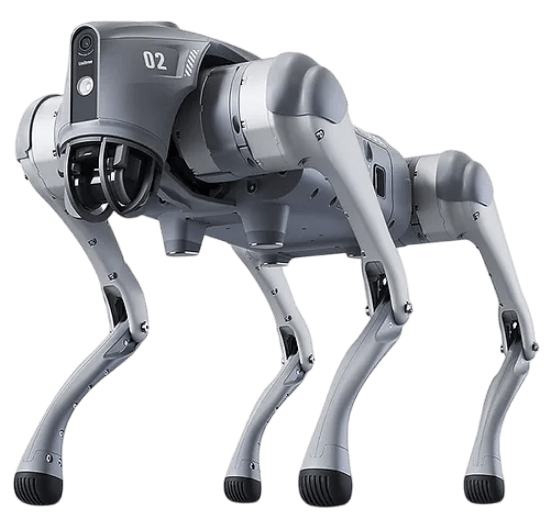
- Humanoid Robot
- Animal Robot
- Legged Robot
- Underwater Robot
Answer
Legged Robot
Reason — The picture depicts a four-legged robot, which is a type of legged robot. Legged robots are mobile machines that move using limbs, resembling human or animal legs, enabling them to navigate complex terrains.
Which of the following statements is not appropriate for drones?
- It is an unmanned aerial vehicle.
- It is a flying robot.
- It cannot be controlled remotely.
- It can operate autonomously using software-driven flight plans.
Answer
It cannot be controlled remotely.
Reason — A drone is an unmanned flying robot system which can be controlled by a remote control or fly autonomously using software-driven flight plans with sensors and GPS. Hence, the statement that it cannot be controlled remotely is not appropriate for drones.
A multi-rotor drone is equipped with quad-copters. How many rotors does it enable with?
- Two rotors
- Four rotors
- Six rotors
- Eight rotors
Answer
Four rotors
Reason — The prefix "quad" means four. Therefore, a quad-copter is a multi-rotor drone equipped with four rotors, which provide stability, hovering ability and precise control.
In the word GPS, what does the letter G signify?
- Globe
- Global
- Glory
Answer
Global
Reason — GPS stands for Global Positioning System. Therefore, the letter "G" in GPS signifies "Global". GPS is a satellite-based navigation system used in drones and aerial robots for accurate location tracking and navigation.
Which of the following statements is not appropriate for an insect-inspired robot?
- It is an insectoid robot.
- It is not enabled with AI.
- Its movement often mimics insect physiology.
- It is typically using a hexapod structure.
Answer
It is not enabled with AI.
Reason — An insect-inspired robot is also known as an insectoid robot. Its movement often mimics insect physiology and it commonly uses a hexapod structure. These robots are also equipped with AI for navigation and behaviour. Therefore, the statement that it is not enabled with AI is not appropriate for an insect-inspired robot.
Which type of robots are commonly used in an assembly line?
- Industrial Robots
- Service Robots
- Security Robots
- Domestic Robots
Answer
Industrial Robots
Reason — Industrial robots are developed to automate intensive production tasks, especially on assembly line. They have a robotic arm or manipulator arm which resembles a human arm and can perform a wide range of movements with high productivity and efficiency.
Fill in the blanks:
- ............... robots are autonomous machines capable of performing tasks without direct human intervention.
- ............... robots are mobile machines that move using limbs, typically resembling human or animal legs.
- The robotic systems, designed to fly autonomously or via remote control are known as ............... robots.
- ............... robots are mechanical devices designed to function in subaquatic environments without direct human involvement.
- ............... robots are mobile machines that move on the ground using wheels for movement.
- ............... robots mimic the structures, functions or behaviour of living organisms to solve complex problems.
Answer
- Automatic robots are autonomous machines capable of performing tasks without direct human intervention.
- Legged robots are mobile machines that move using limbs, typically resembling human or animal legs.
- The robotic systems, designed to fly autonomously or via remote control are known as Aerial robots.
- Underwater robots are mechanical devices designed to function in subaquatic environments without direct human involvement.
- Wheeled robots are mobile machines that move on the ground using wheels for movement.
- Bio-inspired robots mimic the structures, functions or behaviour of living organisms to solve complex problems.
Write down the full forms of the following:
- UAV : ...............
- VTOL : ...............
- ROV : ...............
- AUV : ...............
- UVG : ...............
Answer
- UAV – Unmanned Aerial Vehicle
- VTOL – Vertical Take-Off and Landing
- ROV – Remotely Operated Vehicle
- AUV – Autonomous Underwater Vehicle
- UGV – Unmanned Ground Vehicle
Give an example of each of the following:
- Business robot : ...............
- First social humanoid robot : ...............
- Security robot : ...............
- Restaurant robot : ...............
- Humanoid robot : ...............
- Entertainment robot : ...............
Answer
- Business robot : Promobot
- First social humanoid robot : Sophia
- Security robot : Nimbo
- Restaurant robot : Penny
- Humanoid robot : Pepper
- Entertainment robot : Sony's Aibo
Assertion (A): Bio-inspired robots mimic the structures, functions or behaviour of living organisms to solve complex problems.
Reason (R): These robots draw inspiration from animals or plants, like legged robots emulating insect movements or drones mimicking bird flight.
Based on the above discussion, choose an appropriate statement from the options given below:
- Both A and R are true and R is the correct explanation of A.
- Both A and R are true and R is not the correct explanation of A.
- A is true but R is false.
- A is false but R is true.
- Both A and R are false.
Answer
Both A and R are true and R is the correct explanation of A.
Reason — Bio-inspired robots are designed by mimicking the structures, functions or behaviour of living organisms to solve complex problems. They draw inspiration from animals or plants, such as legged robots emulating insect movements or drones mimicking bird flight, which offers improved adaptability and efficiency in navigation, movement and task performance across various environments.
There are various types of robots that we see in our daily lives. They belong to various categories according to the service provided by them. Read these statements carefully and identify the types of real-world robots.
(a) They are the most commonly used to assist human beings in their daily lives. They clean the floor of our home automatically as per the given instructions.
(b) A lawn mower is a grass cutting machine, used to mow grass. This robotic mower saves time by maintaining our lawn with minimal work from us.
(c) These robots have significantly enhanced productivity, safety and time efficiency in various industries.
(d) They are designed to amuse, interact with and engage users, housemates or guests. They use artificial intelligence, sensors and animations to create enjoyable experiences.
Answer
(a) Domestic Robots
(b) Service Robots
(c) Industrial Robots
(d) Entertainment Robots
Write short notes on Aerial Robot.
Answer
Aerial Robots, also known as Drones or Unmanned Aerial Vehicles (UAVs), are robotic systems designed to fly autonomously or via remote control. They are equipped with sensors, cameras, GPS (Global Positioning System) and AI. They can perform tasks like surveillance, mapping, inspection and delivery. Their ability to access hard-to-reach or hazardous areas makes them invaluable for tasks such as crop monitoring, search and rescue and infrastructure inspection.
Write short notes on Ground Robot.
Answer
Ground robots, also known as Unmanned Ground Vehicles (UGVs), are unmanned or remote-controlled vehicles designed to operate and perform tasks on land. They are equipped with sensors, cameras and AI. These robots are built to traverse various terrains, making them valuable in fields like agriculture, military, construction and logistics. They offer significant benefits, especially in hazardous conditions, by reducing risks to human life and enhancing operational efficiency.
Write short notes on Underwater Robot.
Answer
Underwater robots are mechanical devices designed to function in subaquatic environments without direct human involvement. They are commonly used for ocean exploration, underwater infrastructure maintenance, environmental monitoring and underwater photography. These robots are classified into two main types: Remotely Operated Vehicles (ROVs), which are controlled by a human operator, and Autonomous Underwater Vehicles (AUVs), which are pre-programmed to navigate and respond to their surroundings independently. They are equipped with sensors, cameras and manipulators.
Write short notes on Fixed-Wing Drone.
Answer
A fixed-wing drone has rigid wings, similar to an airplane, which provide lift without the need for vertical rotors. It requires energy only to move forward, making it highly energy-efficient. These drones can cover long distances, map large areas and loiter for extended periods with flight times averaging a few hours. However, fuel-powered fixed-wing UAVs can stay aloft for 16 hours or more. They are capable of flying at high altitudes, carrying heavier payloads and are more stable in flight, making them ideal for long-duration missions and extensive aerial monitoring.
Write short notes on Wheeled Robot.
Answer
Wheeled robots are mobile machines that navigate the ground using wheels, which allow efficient movement on flat surfaces. This design is often favoured because it is much simpler compared to legged robots, making production and programming for flat terrain navigation easier. Additionally, wheeled robots are generally easier to control than other types. They are widely used in fields such as manufacturing, logistics and service robotics. Their straightforward design and high energy efficiency make them ideal for tasks like transportation, inspection, and material handling in structured environments.
Write short notes on Legged Robot.
Answer
Legged robots are mobile machines that move using limbs, typically resembling human or animal legs. This design enables them to navigate complex terrains, such as rocky, uneven or stair-filled environments, where wheeled or tracked robots would struggle. Legged robots, such as bipedal or quadrupedal robots, provide better adaptability and mobility in challenging conditions, making them ideal for tasks requiring flexibility and stability in diverse settings.
Write short notes on Bird-inspired Robot.
Answer
Bird-inspired robots mimic avian flight using flapping wings. They can fly by imitating the wing movements of birds. These robots hold great potential for applications in surveillance, detection, recreation and rescue. However, when the wings flap at high speeds, significant vibration and friction between moving parts occur, reducing the robot's efficiency. An example is Festo's SmartBird, which is a robotic seagull that flies by flapping its wings and directs by twisting them at specific angles.
Write short notes on Entertainment Robot.
Answer
Entertainment robots are the robots designed for the sole subjective pleasure of humans. They are made to amuse, interact with and engage users, housemates or guests. They use artificial intelligence, sensors and animations to create enjoyable experiences. For example, Sony's Aibo is a robotic dog that mimics pet-like behaviour, responding to voice commands, recognising faces and learning from interactions. These robots blend technology and fun, enhancing leisure activities and personal companionship.
Write short notes on Industrial Robot.
Answer
An industrial robot was developed to automate intensive production tasks, especially on an assembly line. They have an arm known as robotic arm or manipulator arm which resembles a human arm. These arms can move to fixed degrees of freedom allowing the arms to a wide range of movements. These robots have significantly enhanced productivity, safety and time efficiency in various industries. They can produce high-quality results without requiring breaks and also help in reducing the risk of injury in hazardous environments.
What is meant by Field/Terrain Robots? What are their types?
Answer
A field/terrain robot is a mobile robot designed to operate in dynamic, unstructured environments like forests, farms, construction sites or disaster zones. Unlike factory robots, which perform repetitive tasks in controlled settings, field robots must adapt to varying and unpredictable conditions. They are equipped with advanced sensors, GPS and AI algorithms, enabling them to navigate challenging terrains, avoid obstacles and adjust their actions based on real-time data.
These robots are categorised into the following three types:
- Aerial Robots
- Ground Robots
- Underwater Robots
"Drone is an unmanned aerial vehicle fly." Explain.
Answer
A drone is an unmanned flying robot system, also known as an Unmanned Aerial Vehicle (UAV). It can be controlled by a remote controller or fly autonomously using software-driven flight plans with sensors and GPS. Drones vary in shapes and sizes, serving various purposes from aerial photography to item delivery and agricultural monitoring. Their versatility and advanced technology make them useful across many industries such as agriculture, surveillance, delivery systems, disaster management and environmental monitoring.
How are agricultural robots are useful to farmers?
Answer
Agricultural robots have demonstrated their value in multiple worldwide farming operations. The digitisation of agriculture, alongside advancements in Artificial Intelligence, is pushing automation boundaries. This development is a cornerstone of precision agriculture, aiming to optimise inputs like fertilisers, pesticides, and herbicides while increasing crop yields. Aerial imaging, a critical component, offers farmers valuable insights into crop health and soil conditions, promoting more efficient and sustainable farming practices. In agriculture, three types of drones carry out specific tasks: Fixed-Wing Drones, Rotary Wing Drones, and Hybrid Drones.
In what ways medical drones provide services in healthcare sector?
Answer
Today's healthcare systems aim to enhance the quality of life through advanced technology. Flying robots or drones are emerging as innovative solutions in healthcare in the following ways:
- They effectively address logistical challenges in delivering medical supplies to hard-to-reach areas.
- They transport microbiological samples, pharmaceuticals, vaccines and emergency equipment.
- They have proven invaluable for healthcare providers during pandemic situations, significantly improving their operational efficiency.
- They help modernise medical services through advanced technologies.
What are the various applications of Aerial Robots?
Answer
The most important application of aerial robots is aerial observations, which can be used for topography maps, environmental surveys, crop monitoring, etc. The various applications of aerial robots are as follows:
- In Agriculture: These robots are used for crop monitoring, precision farming, and spraying pesticides or fertilizers.
- In Delivery System: They are employed by companies like Amazon for efficient package delivery, especially in hard-to-reach areas.
- In Surveillance: The aerial robots are utilised for security, border control and military operations for real-time monitoring.
- In Disaster Management: These robots are deployed for search and rescue missions, damage assessment and delivering aid to disaster-stricken areas.
- In Environmental Monitoring: They are used to track wildlife, monitor deforestation and assess air and water quality.
What is meant Ground Robots? What are their types?
Answer
Ground robots, also known as Unmanned Ground Vehicles (UGVs), are unmanned or remote-controlled vehicles designed to operate and perform tasks on land. They are equipped with sensors, cameras and advanced AI. These robots are built to traverse various terrains, making them valuable in fields like agriculture, military, construction and logistics.
The three main types of ground robots are:
- Wheeled Robots: Mobile machines that navigate the ground using wheels, ideal for flat surfaces.
- Tracked Robots: Robots that use continuous tracks (like tank treads) for movement, allowing them to traverse rough, uneven or loose terrain.
- Legged Robots: Mobile machines that move using limbs, typically resembling human or animal legs, enabling them to navigate complex terrains.
Distinguish between Manual and Automatic Robots.
Answer
| Manual Robots | Automatic Robots |
|---|---|
| Manual robots are robots that require humans to operate them directly. | Automatic robots are autonomous machines capable of performing tasks without direct human intervention. |
| They rely entirely on human control to perform tasks accurately. | They are programmed to follow specific instructions or adapt to their environment using sensors and AI. |
| They need constant guidance from humans rather than working independently. | They improve efficiency, reduce human error and work independently. |
| Example: The Da Vinci Surgical System. | Example: Roomba (robotic vacuum cleaner by iRobot). |
What is meant by Bio-inspired Robots? What are their types?
Answer
Bio-inspired robots mimic the structures, functions or behaviour of living organisms to solve complex problems. These robots draw inspiration from animals or plants, like legged robots emulating insect movements or drones mimicking bird flight. They offer improved adaptability and efficiency in navigation, movement and task performance across various environments.
The different types of Bio-inspired robots are:
- Humanoid Robots
- Bird-inspired Robots
- Snake-inspired Robots
- Insect-inspired Robots
How are Domestic Robots are useful in our daily life?
Answer
Domestic robots are most commonly used to assist human beings in their daily lives. These robots are autonomous and operate by using an internal control system that can be manually controlled. The most common service robot of this type is the Vacuum Cleaner Robot.
The robot vacuum is ready to provide service at home. The user just needs to input proper instructions to the robot such as repeating a cleaning cycle three times in smaller rooms or cleaning twice in a medium-sized room. It then cleans the floor of the home automatically. Roomba is one of the most popular Robot Vacuum cleaners. Thus, domestic robots save time and effort by handling daily household chores.
What are the different types of Real-World Robots? Name them.
Answer
There are various types of real-world robots that we see in our daily lives. They belong to various categories according to the service provided by them. The different types of real-world robots are:
- Domestic Robots
- Service Robots
- Industrial Robots
- Business Robots
- Security Robots
- Agriculture Robots
- Medical Robots
- Entertainment Robots
What is meant by Humanoid Robot?
Answer
Humanoid robots are robots built to resemble human bodies and are designed to interact with human tools and surroundings. They are becoming increasingly important in today's research. These robots are programmed to behave like humans, which can be helpful in many areas such as training, industry, home use, entertainment, medicine and even in military and government tasks. For example, Pepper is a humanoid robot designed to interact with people. It can assist them, share information with them and help customers at retail stores.
Explain the following areas of applications of robots in brief:
(a) In Medical Science
(b) In Scientific Research
Answer
(a) In Medical Science: The medical field is continuously evolving, with new technologies and techniques emerging daily. In recent years, the use of robots in surgery has become increasingly common, benefiting both patients and doctors. Robots are transforming routine surgeries, especially laparoscopic procedures, which are already quicker than traditional open abdominal surgeries. These advanced machines can move autonomously, providing unmatched precision when operating on delicate structures within the body, such as with endoscopic procedures.
(b) In Scientific Research: Robots are now being used to discover new drugs and assist scientists in scientific research work. They are also used to create artificial organs and perform surgery. In microbiology labs, robots are used to analyse the cell structures and predict appropriate test results.
How are robots useful in:
(a) Agriculture
(b) Medical field?
Answer
(a) In Agriculture: Robots are rapidly making an impact in agriculture in every step of farming. They are being used in plantation, seeding, irrigation, fertilising crops such as fruits and vegetables, etc. They use sensors and cameras to detect when the crops are ready to be picked. Moreover, these machines can handle a wide range of tasks such as planting and irrigation to pest control and soil analysis. As a result, farmers can reap the benefits of increased productivity, reduced labour costs and a reduced need for harmful chemicals.
(b) In Medical Field: Robots are widely used in medical fields, especially in surgery to assist doctors in delicate procedures, injuries and illness. They enhance precision in surgeries, automate routine procedures and provide rehabilitation support. They include robotic-assisted surgery, diagnostics and patient care. These robots improve outcomes by minimising human error, reducing recovery times and increasing efficiency in hospitals, transforming modern healthcare with cutting-edge technology.