
Which of the following components of a robot is depicted in this image?
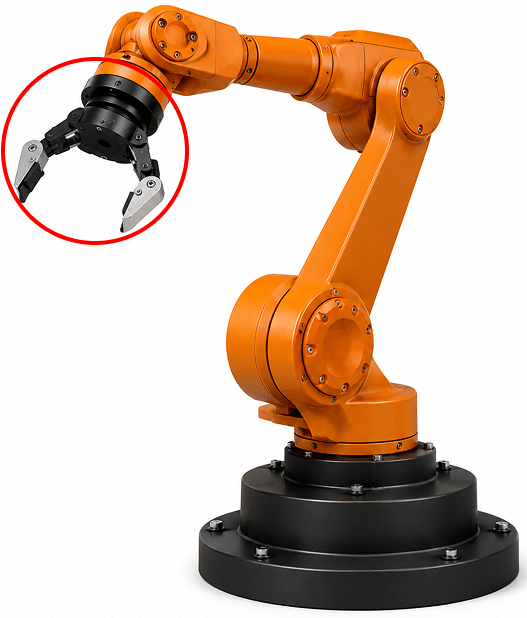
- Tongue
- Actuator
- End-effector
- Sensor
Answer
End-effector
Reason — The image depicts a gripper attached to the end of a robotic arm, which is known as an end-effector. End-effectors are tools or devices attached to the end of a robot arm, enabling it to interact with objects by grasping, holding or manipulating them.
Which of the following directs the device to perform physical actions like moving, rotating or gripping in a robot?
- Controller
- Sensor
- Actuator
- Power Source
Answer
Actuator
Reason — An actuator is an integral part of a device or a machine which directs the device to perform physical actions such as moving, rotating, gripping, etc. after processing the input received from the sensors. In other words, it is the component that generates response in any smart machine.
Which of the following communication systems is not related to wireless communication in Robots?
- Wi-Fi
- Hi-Fi
- Bluetooth
- RF modules
Answer
Hi-Fi
Reason — Wi-Fi, Bluetooth and RF (Radio Frequency) modules are wireless communication systems commonly used in robots for remote control and data transmission. Hi-Fi (High Fidelity) refers to high-quality audio reproduction and is not a wireless communication system used in robots.
Which of the following is not a component of a robot?
- Sensors
- Actuators
- Power Supply
- Accumulators
Answer
Accumulators
Reason — Sensors, Actuators and Power Supply are essential components of a robot used in its construction and functioning. Accumulators are not listed among the main components of a robot.
Which of the following type of batteries are mostly used in Mobile Robots?
- Duracell
- Lithium-ion
- Alkaline battery
- Dry cell
Answer
Lithium-ion
Reason — Lithium-ion batteries are mostly used in Mobile Robots due to their high energy density, which ensures that the robot has enough power for extended operations. They are rechargeable and provide reliable power for long-duration tasks.
Fill in the blanks:
- ............... is the mechanism in a robot to enable them to interact physically with the environment.
- The control system or the central processing unit refers to as the ............... of a robot.
- ............... grippers are suitable for handling non-ferromagnetic materials.
- Underwater robots are also known as ............... operated vehicles.
- Robots consist of several key components, often called ............... blocks.
- ............... robots can use wheels for smooth surfaces, legs for complex terrain or tracks for uneven environments.
Answer
- Actuator is the mechanism in a robot to enable them to interact physically with the environment.
- The control system or the central processing unit refers to as the brain of a robot.
- Vacuum grippers are suitable for handling non-ferromagnetic materials.
- Underwater robots are also known as remotely operated vehicles.
- Robots consist of several key components, often called building blocks.
- Mobile robots can use wheels for smooth surfaces, legs for complex terrain or tracks for uneven environments.
Name the following:
- Any two components of a robot:
(a) ...............
(b) ............... - Any two grippers used in industrial robots:
(a) ...............
(b) ............... - Any two types of sensors used in a robot:
(a) ...............
(b) ............... - Any two types of actuators used in a robot:
(a) ...............
(b) ............... - Any two types of building blocks of a robot:
(a) ...............
(b) ...............
Answer
- Any two components of a robot:
(a) Sensors
(b) Actuators - Any two grippers used in industrial robots:
(a) Mechanical Grippers
(b) Vacuum Grippers - Any two types of sensors used in a robot:
(a) Proximity Sensors
(b) Light Sensors - Any two types of actuators used in a robot:
(a) Electric Actuators
(b) Pneumatic Actuators - Any two types of building blocks of a robot:
(a) Mechanical Block
(b) Electronic Block
Write down the full form of the following:
- ROV : ...............
- GPS : ...............
- SLAM : ...............
- IMU : ...............
- LiDAR : ...............
Answer
- ROV : Remotely Operated Vehicle
- GPS : Global Positioning System
- SLAM : Simultaneous Localisation and Mapping
- IMU : Inertial Measurement Unit
- LiDAR : Light Detection and Ranging
Assertion (A): Global Positioning System signals cannot penetrate water.
Reason (R): So, they are used when the robot surfaces to determine its location before diving.
Based on the above discussion, choose an appropriate statement from the options given below:
- Both A and R are true and R is the correct explanation of A.
- Both A and R are true and R is not the correct explanation of A.
- A is true but R is false.
- A is false but R is true.
- Both A and R are false.
Answer
Both A and R are true and R is the correct explanation of A.
Reason — GPS signals cannot penetrate water, which is why underwater robots use GPS only when they surface to determine their location before diving. This makes the Reason a correct and explanation of the Assertion, as the inability of GPS signals to penetrate water is the very cause for using them only at the surface.
We know that the most common AI enabled device is the Smart Robot and the use of such devices make our life easier and more comfortable. These devices perform their tasks using some vital components. The following are descriptions of some such components. Read the statements carefully and identify the components used in robots.
(a) It is an integral part of a device or a machine which directs the device to perform physical actions such as moving, rotating, gripping, etc. after getting the input from the sensor.
(b) These components come in different sizes and shapes, through which the object is handled to perform the various tasks such as to do welding, riveting, painting sprays, etc.
(c) The components of a robot become functional only when it is incorporated into a robot.
(d) They are referred to as the receptive parts of an environment which takes input for the machine to be put into action.
Answer
(a) Actuator
(b) End-effectors (Grippers)
(c) Power Supply
(d) Sensors
Write short notes on Sensors.
Answer
Sensors in a robot are similar to the sensory organs in human beings such as the eyes, nose, ear and tongue. They are used to sense or receive external signals from human beings or surroundings and direct those to the brain (control unit) of the robot to perceive and interact with its environment. Sensors allow robots to collect data about their surroundings, internal conditions and even human presence. They convert physical inputs like light, sound or heat into data that the robot's controller can use to make decisions and perform tasks. Some commonly used sensors include proximity sensors, light sensors, temperature sensors, pressure sensors and touch sensors.
Write short notes on Actuators.
Answer
Actuators are the moving parts of a robot. Some examples of actuators are motors, pumps and compressors. The brain of the robot guides these actuators as to when and what movements are to be made. An actuator is an integral part of a device or machine which directs the device to perform physical actions such as moving, rotating, gripping, etc. after processing the input received from the sensors. In other words, it is the component that generates response in any smart machine. The three main types of actuators are Electric Actuators, Pneumatic Actuators and Hydraulic Actuators.
Write short notes on End-effectors.
Answer
End-effectors are tools or devices attached to the end of a robot arm, enabling it to interact with objects. Grippers are a type of end-effector that grasp or hold objects, commonly used in tasks like picking and placing. The primary function of grippers is to provide robots with the ability to pick up, move and manipulate objects in a controlled manner. They come in different sizes and shapes, and the choice depends on the type and size of the object being handled. Factory robots use end-effectors for various tasks such as welding, riveting and painting sprays. The three main types of grippers are Mechanical Grippers, Vacuum Grippers and Magnetic Grippers.
Write short notes on Building blocks of a robot.
Answer
Robots consist of several key components, often called "building blocks". These components include the mechanical structure, electrical and electronic components, actuators for movement, sensors for environmental perception, computational/control systems for decision-making and a power source for operation. Among all these components, three main building blocks of a robot are discussed: the Mechanical Block, the Electronic Block and the Computational Block. These blocks work together in harmony to ensure smooth, reliable and effective robot performance.
Write short notes on Electronic block of a robot.
Answer
The electronic block of a robot plays a crucial role in powering, controlling and interfacing various components such as sensors, actuators and processors. It is responsible for ensuring smooth communication and operation between all parts of the robot. The electronic block manages key functions such as power management, signal processing, control and co-ordination, communication interface and safety systems. It distributes electrical power, receives signals from sensors, sends control signals to actuators and prevents short circuits or electrical overloads. Thus, the electronic block is essentially the nervous system of the robot, ensuring proper coordination between all its components.
Write short notes on Computational block of a robot.
Answer
The computational block acts as the brain of the robot, executing tasks from navigation to object manipulation. This block is essential for a robot's decision-making, processing and control. It integrates data from sensors, runs algorithms and generates commands for the robot's movement and tasks. The computational block is responsible for data processing, decision-making, control systems and communication. It includes microcontrollers or processors that run algorithms, handle real-time operations and manage inputs and outputs from sensors and actuators. In conclusion, the computational block serves as the robot's intelligence center, processing data, making decisions and controlling all robotic operations through sophisticated algorithms and real-time systems.
What are the various components of a robot? Name them.
Answer
A robot consists of several vital components that work together to enable it to perform tasks. The main components of a robot are:
- Control System — The central processing unit which acts as the brain of the robot.
- Sensors — Receive external signals and direct them to the control unit.
- Actuators — The moving parts that perform physical actions like moving, rotating and gripping.
- End Effectors — Tools attached to the end of a robot arm to interact with objects.
- Power Supply — Provides the energy required to operate the robot's components.
- Programming — Equips the robot to accept input, process information and generate output.
Draw a neat labelled block diagram of a robot.
Answer
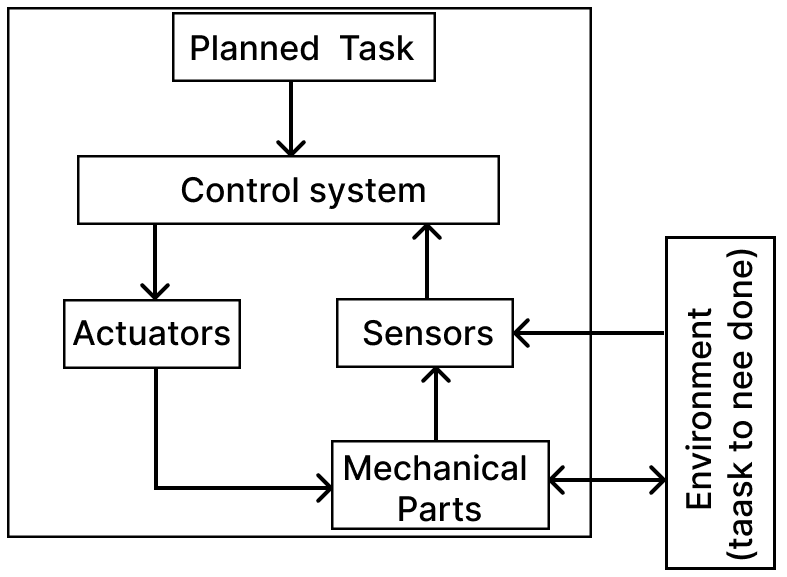
The block diagram of a robot shows how the different components are inter-related to work together to enable the robot to perform a specific task. The planned task is given to the Control System, which manages the Actuators and Sensors. The Sensors capture data from the Environment, while the Actuators drive the Mechanical Parts to perform the required actions. The controller acts as the brain of the robot to direct its movements and behaviour.
What is meant by the building blocks of a robot?
Answer
The building blocks of a robot refer to the several key components that are essential to make a robot functional. These components include the mechanical structure, electrical and electronic components, actuators for movement, sensors for environmental perception, computational/control systems for decision-making and a power source for operation. The three main building blocks of a robot are the Mechanical Block, the Electronic Block and the Computational Block. Together, these blocks enable the robot to function and interact with its environment.
Explain the function of the following blocks:
(a) Mechanical Block
(b) Electronic Block
(c) Computational Block
Answer
(a) Mechanical Block: The mechanical block in a robot refers to the part of overall mechanical structure which serves to connect and integrate various mechanical components. It provides a stable and rigid platform so that the various components can be mounted for proper functioning. It includes joints, actuators and end-effectors. This block enables the robot to physically interact with its environment, handling tasks such as locomotion, grasping or performing mechanical work.
(b) Electronic Block: The electronic block of a robot plays a crucial role in powering, controlling and interfacing various components such as sensors, actuators and processors. It manages power distribution, signal processing, control and co-ordination, communication interface and safety systems. The electronic block is essentially the nervous system of the robot, ensuring proper coordination between all its components.
(c) Computational Block: The computational block acts as the brain of the robot, executing tasks from navigation to object manipulation. It is responsible for data processing, decision-making, sending commands to actuators and communication with external systems. It integrates data from sensors, runs algorithms and generates commands for the robot's movement and tasks. Thus, it serves as the robot's intelligence center.
Name any five design aspects for the following:
(a) Humanoid Robots
(b) Aerial Robots
(c) Underwater Robots
(d) Mobile Robots
Answer
(a) Humanoid Robots:
- Mechanical Design (Body Structure, Degrees of Freedom, Materials)
- Actuation Systems (Motors and Actuators)
- Sensors and Perception (Vision, Tactile, Proximity Sensors)
- Control Systems (Real-Time Processing, Kinematics and Dynamics Control)
- Human-Robot Interaction (Speech Recognition, Gesture and Facial Recognition)
(b) Aerial Robots:
- Aerodynamic Structure (Lightweight Frame, Shape and Design)
- Propulsion System (Motors and Propellers)
- Control and Navigation Systems (Flight Control Algorithms, GPS and Navigation Sensors)
- Power Supply (Battery or Fuel Source, Energy Management)
- Sensors and Perception (Vision Systems, Proximity Sensors)
(c) Underwater Robots:
- Hydrodynamic Structure (Shape, Corrosion-resistant Materials)
- Propulsion System (Thrusters, Buoyancy Control)
- Pressure Resistance (Pressure Body, Depth Assessment)
- Control and Navigation Systems (Sonar and Acoustic Sensors, GPS for Surface Use)
- Sensors and Perception (Visual System, Environmental Sensors)
(d) Mobile Robots:
- Framework Design (Material and Structure, Modularity)
- Propulsion System (Movement, Drive Mechanism)
- Navigation and Control Systems (SLAM, Obstacle Avoidance)
- Power Supply (Battery System, Energy Management)
- Sensors and Perception (Vision Systems, Proximity Sensors)