
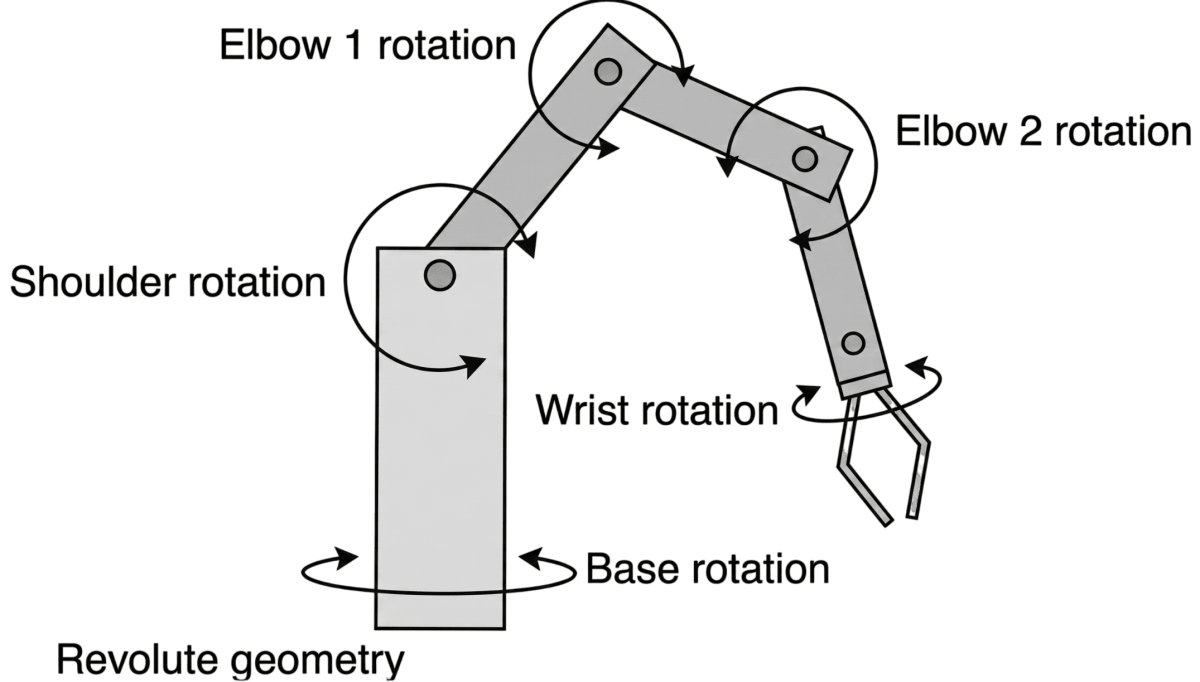
Which of the following types of joint of a robot is depicted in this image?
- Prismatic Joint
- Revolute Joint
- Spherical Joint
- Universal Joint
Answer
Revolute Joint
Reason — The image depicts a revolute joint as it shows multiple rotation points such as Elbow rotation, Shoulder rotation, Wrist rotation and Base rotation. A revolute joint allows the links of a robot to rotate around a fixed axis, enabling angular motion similar to how a human elbow or knee works.
In which of the following motion, the movement of a robot or its components takes place in a straight line?
- Circular Motion
- Angular Motion
- Spherical Motion
- Linear Motion
Answer
Linear Motion
Reason — Linear motion refers to the movement of a robot or its parts in a straight line, which can be horizontal, vertical or diagonal. Robots achieve this movement with the help of linear actuators.
In robotics, which of the following joints is also known as ball and socket joint?
- Spherical Joint
- Cylindrical Joint
- Revolute Joint
- Prismatic Joint
Answer
Spherical Joint
Reason — A spherical joint is also known as a ball-and-socket joint, which allows rotational movement in multiple directions around a single point. It provides three degrees of freedom, pitch, yaw and roll, enabling more complex and flexible motions.
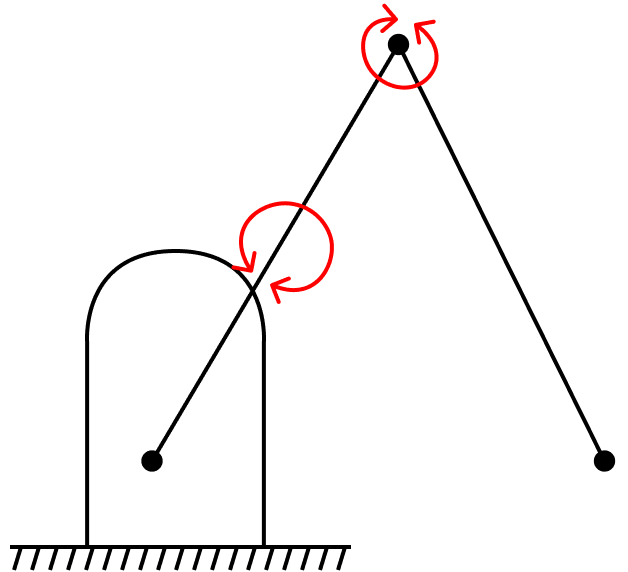
How many degrees of freedom does the following figure have?
- two
- three
- four
- six
Answer
two
Reason — The figure shows a robotic arm with two rotational joints, where each revolute joint provides one degree of freedom. Therefore, the figure has two degrees of freedom in total.
Which of the following is not related to degree of freedom that provide the ability to robots to rotate and change orientation freely?
- pitch
- yaw
- roll
- swing
Answer
swing
Reason — Pitch (up/down), yaw (left/right) and roll (rotation around the axis) are the three rotational degrees of freedom that allow robots to rotate and change orientation freely. Swing is not related to the rotational degrees of freedom of a robot.
If a simple robotic arm is having with three revolute joints, then how many degrees of freedom will it have?
- three
- four
- five
- six
Answer
three
Reason — Each revolute joint provides one degree of freedom, allowing rotation around a single axis. Therefore, a simple robotic arm with three revolute joints will have three degrees of freedom, meaning it can rotate in three different directions.
Fill in the blanks:
- The ............... of Industrial Robots deals with the assembling of various components of a robot.
- ............... motion refers to the movement of a robot in a plane, allowing it to travel along both the X and Y axes simultaneously.
- The movement of ............... motion occurs in a straight line, which can be horizontal, vertical or diagonal.
- ............... links are solid components that do not bend or compress, providing stability and consistency in motion.
- ............... joint provides a single degree of freedom, allowing movement in one linear direction.
- Each revolute joint has one degree of freedom, meaning it provides rotation around only ............... axis (horizontal or vertical).
Answer
- The anatomy of Industrial Robots deals with the assembling of various components of a robot.
- Two-dimensional motion refers to the movement of a robot in a plane, allowing it to travel along both the X and Y axes simultaneously.
- The movement of linear motion occurs in a straight line, which can be horizontal, vertical or diagonal.
- Rigid links are solid components that do not bend or compress, providing stability and consistency in motion.
- Prismatic joint provides a single degree of freedom, allowing movement in one linear direction.
- Each revolute joint has one degree of freedom, meaning it provides rotation around only one axis (horizontal or vertical).
State whether the following statements are True or False:
- Revolute joints allow a robot to rotate a part around a single axis, enabling angular movement, typically measured in degrees.
- Soft links maintain the overall shape and strength of the robot, which is crucial for supporting weight and handling various tasks.
- The angular motion systems often incorporate guide rails to ensure smooth, straight movement and prevent lateral deviations.
- Circular motion refers to as the movement of a robot along a curved or circular path around a fixed point or axis.
- Spherical joint allows the links of a robot to move linearly along an axis without rotating.
- The DoF of a joint indicates the number of independent axes along which motion is allowed.
Answer
- True
- False
Corrected Statement: Rigid links maintain the overall shape and strength of the robot, which is crucial for supporting weight and handling various tasks. - False
Corrected Statement: Linear motion systems often incorporate guide rails to ensure smooth, straight movement and prevent lateral deviations. - True
- False
Corrected Statement: Prismatic joint allows the links of a robot to move linearly along an axis without rotating. - True
Name the following with the reference to robotics:
- Three types of motions:
(a) ...............
(b) ...............
(c) ............... - Three types of joints:
(a) ...............
(b) ...............
(c) ............... - Two types of links:
(a) ...............
(b) ...............
Answer
- Three types of motions:
(a) Linear Motion
(b) Angular Motion
(c) Circular Motion - Three types of joints:
(a) Prismatic Joint
(b) Revolute Joint
(c) Spherical Joint - Two types of links:
(a) Rigid Link
(b) Soft Link
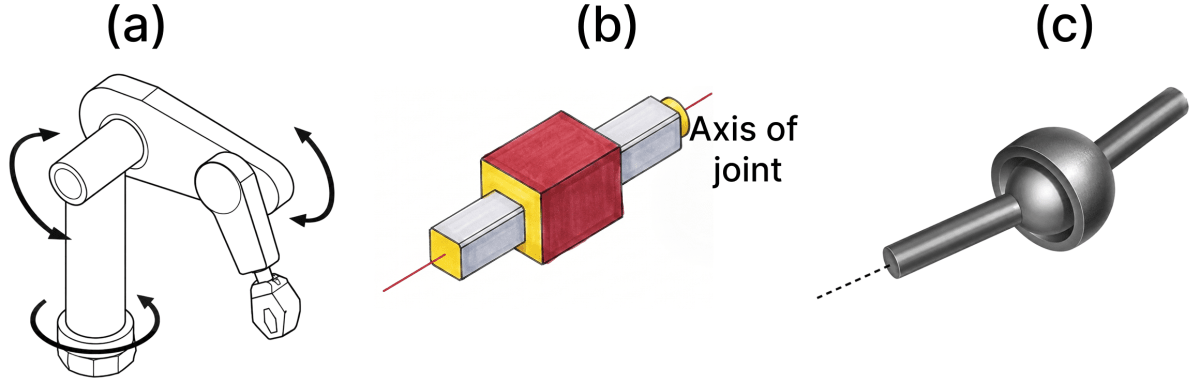
Name the following joints with the reference to robotics:
Answer
(a) Revolute Joint
(b) Prismatic Joint
(c) Spherical Joint
Assertion (A): In robotics, the soft link refers to as the flexible or elastic connection between different parts of a robot.
Reason (R): The soft links can bend, stretch or compress, giving robots greater adaptability and compliance, especially in tasks involving interaction with unpredictable environments.
Based on the above discussion, choose an appropriate statement from the options given below:
- Both A and R are true and R is the correct explanation of A.
- Both A and R are true and R is not the correct explanation of A.
- A is true but R is false.
- A is false but R is true.
- Both A and R are false.
Answer
Both A and R are true and R is the correct explanation of A.
Reason — A soft link in robotics refers to the flexible or elastic connection between different parts of a robot, allowing deformation under force while still transmitting motion. Unlike rigid links, soft links can bend, stretch or compress, giving robots greater adaptability and compliance, especially in tasks involving interaction with unpredictable environments. Hence, the reason correctly explains the assertion.
Motion in a robot refers to as the movement capabilities that allow it to navigate and interact with its environment. It comprises various types of motion depending on its design and purpose. The following are some statements which are concerned with various types of motions applied in robotics.
Read these statements and identify the types of motions used in robots.
(a) In this motion, the robot moves around a central axis, either internal (like a robot arm rotating at the base) or external (moving around an object or location).
(b) This motion is a fundamental aspect of robotic design and functionality. The movement occurs in a straight line which can be horizontal, vertical or diagonal.
(c) This motion involves changes in the angle between two connected components, such as between the segments of a robotic arm or a robot's joints.
Answer
(a) Circular Motion
(b) Linear Motion
(c) Angular Motion
Write short notes on Angular Motion (with reference to robotics).
Answer
Angular motion is important for robots that need to turn or rotate at their joints. This kind of movement happens when robot parts rotate around a set point or axis, changing the angle between two connected parts, like sections of a robotic arm. It provides flexibility and precise control, helping robots perform detailed tasks across different fields, from factories to advanced humanoid robots. Angular motion is precisely controlled using motors and actuators at each joint, enabling accurate positioning for tasks like assembly, welding or picking up objects.
Write short notes on Circular Motion (with reference to robotics).
Answer
Circular motion refers to as the movement of a robot along a curved or circular path around a fixed point or axis. This type of motion is essential in tasks requiring rotation or orbiting movements, enabling robots to navigate curves or rotate components. This motion is crucial in various applications, from robotic arms performing precise tasks to mobile robots navigating curved paths. The circular motion enhances the flexibility and functionality of robots in numerous industrial and service settings. It is controlled by motors and actuators that manage the rotational speed and direction of the robot.
Write short notes on Prismatic Joint (with reference to robotics).
Answer
A prismatic joint, also known as a sliding or linear joint, allows the links of a robot to move linearly along an axis without rotating. This type of joint facilitates linear motion by changing the distance between connected parts, making it essential for extending or retracting movements. It provides a single degree of freedom, allowing movement in one linear direction. The motion is controlled by linear actuators such as hydraulic or pneumatic cylinders or motors. These joints are widely used in applications that require precise positioning and extension, such as in robotic arms, SCARA robots and automated material handling systems.
Write short notes on Revolute Joint (with reference to robotics).
Answer
A revolute joint, also known as a rotational or hinge joint, allows links of a robot to rotate around a fixed axis. This type of joint provides angular movement, enabling rotational motion similar to how a human elbow or knee works. Each revolute joint has one degree of freedom, meaning it provides rotation around only one axis (horizontal or vertical). The rotation is controlled by motors, such as servo or stepper motors, which regulate the angle, speed, and direction of movement. These joints are widely used in robotic arms, humanoid robots and industrial robots for tasks like welding, painting or assembly.
Write short notes on Spherical Joint (with reference to robotics).
Answer
A spherical joint is also known as a ball-and-socket joint, which allows rotational movement in multiple directions around a single point. This joint provides three degrees of freedom viz. pitch (up/down), yaw (left/right) and roll (rotation around the axis), enabling more complex and flexible motions. The joint consists of a ball fitting into a socket, similar to the human shoulder or hip joint, enabling fluid and multi-directional movement. Spherical joints are used in humanoid robots, particularly at the shoulders and hips, in robotic arms for flexible movement, and also in camera gimbals and drones for smooth, multi-axis movement.
Write short notes on Links (with reference to robotics).
Answer
In robotics, links refer to the rigid components that connect joints and form the structure of the robot. They are made up of rigid materials to withstand the forces and torques involved in the movements of robots. They transmit forces and motions between joints and serve as the robot's "skeleton." The links provide stability and support while enabling movement, allowing the robot to perform tasks with precision and coordination. There are two common types of links used in robotics - Rigid Link and Soft Link.
What is meant by Robotics? Explain any three aspects of robot anatomy.
Answer
Robotics is an area of study that brings together different subjects like engineering, computer science, and artificial intelligence to create robots. These robots are special machines designed to do tasks, either on their own or with a little help from humans. They are especially useful in places that are dangerous or difficult for people to reach.
Three aspects of robot anatomy are explained below:
Versatility: Robots are highly versatile and capable of performing a wide range of tasks across various industries, from manufacturing to healthcare. They can be reprogrammed or adapted with different tools and sensors, allowing them to handle diverse tasks with efficiency and precision.
Mobility: Mobility allows robots to move within their environments, using wheels, legs, tracks or aerial systems. This enables them to navigate dynamic settings, perform tasks in complex terrains and adapt to changing conditions, making them ideal for exploration, delivery and rescue operations.
End-effectors: A robot's hand is referred to as an End-effector. The two primary types of end-effectors are grippers and tools. The grippers are used to pick and place objects, while tools perform tasks such as spray painting, spot welding and other operations on a workpiece.
What is meant by linear motion in robotics? What are its types?
Answer
Linear motion is an essential part of how robots are designed and work, allowing them to complete tasks accurately and effectively. This type of motion means that a robot or its parts move in a straight line. Robots achieve this movement with the help of linear actuators.
Linear motion can be further divided into two types:
One-Dimensional Motion: One-Dimensional motion refers to the movement of a robot along a straight path in one-dimensional space, typically along a single axis (X, Y or Z). This type of motion is essential for various robotic applications, enabling precise and controlled movements.
Two-Dimensional Motion: Two-dimensional motion refers to the movement of a robot in a plane, allowing it to travel along both the X and Y axes simultaneously. This type of motion enables robots to navigate and interact with their environment more flexibly, facilitating tasks that require movement in multiple directions.
Distinguish between One-dimensional Motion and Two-dimensional Motion (with reference to robotics).
Answer
| One-dimensional Motion | Two-dimensional Motion |
|---|---|
| It refers to the movement of a robot along a straight path in one-dimensional space, typically along a single axis (X, Y or Z). | It refers to the movement of a robot in a plane, allowing it to travel along both the X and Y axes simultaneously. |
| It enables precise and controlled movements along a single direction. | It enables robots to navigate and interact with their environment more flexibly in multiple directions. |
Distinguish between Angular Motion and Circular Motion (with reference to robotics).
Answer
| Angular Motion | Circular Motion |
|---|---|
| It refers to the rotation of a robot or its parts around a fixed internal axis or joint. | It involves the robot or its component moving along a circular path around an external point or axis. |
| It deals with the change in angle, such as the rotation of a robotic arm at a joint. | The entire robot or tool moves in a full circle, maintaining a constant distance from the center. |
| It involves the change in the angle between two connected parts, such as the bending of a robotic arm's elbow joint. | It refers to the movement around a central point, such as a robot rotating around a fixed base or following a curved path. |
Distinguish between Prismatic Joint and Revolute Joint (with reference to robotics).
Answer
| Prismatic Joint | Revolute Joint |
|---|---|
| It allows the links of a robot to move linearly along an axis without rotating. | It allows links of a robot to rotate around a fixed axis. |
| It provides a single degree of freedom in one linear direction. | It provides one degree of freedom around an axis (horizontal or vertical). |
| It is controlled by linear actuators such as hydraulic or pneumatic cylinders. | It is controlled by motors such as servo or stepper motors. |
Distinguish between Rigid Link and Soft Link (with reference to robotics).
Answer
| Rigid Link | Soft Link |
|---|---|
| It refers to the solid, inflexible part of a robot that connects two joints. | It refers to the flexible or elastic connection between different parts of a robot. |
| Rigid links do not bend or deform during movement. | Soft links can bend, stretch or compress under force. |
| It ensures precise transmission of motion and forces. | It provides flexibility and adaptability for interaction with delicate objects or complex environments. |
Enlist any three characteristics of the following (with respect to robotics):
(a) Linear Motion
(b) Circular Motion
(c) Prismatic Joint
(d) Revolute Joint
Answer
(a) Three characteristics of Linear Motion:
- The movement occurs in a straight line, which can be horizontal, vertical or diagonal.
- The linear motion is usually controlled by actuators such as motors, hydraulic cylinders or linear actuators, which provide force to move the robot in a designated direction.
- The linear motion allows for accurate positioning, making it ideal for tasks such as pick-and-place operations, assembly and material handling.
(b) Three characteristics of Circular Motion:
- The robot moves around a central axis, either internal (like a robot arm rotating at the base) or external (moving around an object or location).
- Circular motion is controlled by motors and actuators that manage the rotational speed and direction of the robot.
- In this motion, the robot maintains a constant distance from the center of the path, forming a circular route.
(c) Three characteristics of Prismatic Joint:
- The prismatic joints move in a straight line (linear motion) along one axis (X, Y or Z), enabling linear extension or compression.
- It provides a single degree of freedom, allowing movement in one linear direction.
- The motion is controlled by linear actuators such as hydraulic or pneumatic cylinders or motors, which drive the movement along the designated axis.
(d) Three characteristics of Revolute Joint:
- Revolute joints allow a robot to rotate a part around a single axis, enabling angular movement, typically measured in degrees.
- Each revolute joint has one degree of freedom, meaning it provides rotation around only one axis (horizontal or vertical).
- The rotation is controlled by motors, such as servo or stepper motors, which regulate the angle, speed, and direction of movement.
What are the advantages of the following joints in robotics?
(a) Prismatic Joint
(b) Spherical Joint
Answer
(a) Advantages of Prismatic Joint:
- It provides highly accurate linear motion, essential in tasks like cutting, welding or material placement.
- This joint offers a straightforward design for achieving linear movements without complex rotational dynamics.
- It is ideal for tasks requiring direct forward or backward movements without rotation.
(b) Advantages of Spherical Joint:
- It enables the robots to move in multiple directions, making them ideal for tasks that require extensive freedom of motion.
- It is similar to human shoulder or hip joints, spherical joints which allow the robots to replicate natural and multi-axis movements.
- These joints are essential in applications where they require fine adjustments and complex motions, such as in medical or industrial robots.
Explain any three applications of the following (with respect to robotics):
(a) Linear Motion
(b) Circular Motion
Answer
(a) Three applications of Linear Motion:
In Robotic Arms: The linear motion is fundamental in robotic arms that extend and retract to reach objects. For example, a robotic arm may move linearly to grab an item from a conveyor belt.
In Conveyor Systems: Many automated systems use linear motion to transport items from one location to another, enhancing efficiency in manufacturing and logistics.
In 3D Printers: In 3D printing, the print head or build platform moves linearly in X, Y and Z directions to create three-dimensional objects layer by layer.
(b) Three applications of Circular Motion:
In Robotic Arms: The circular motion is common in robotic arms that rotate around joints to reach different positions within their workspace, such as welding or assembling parts.
In Mobile Robots: These robots use circular motion to navigate curved paths, often in combination with other motion types to follow more complex paths.
In Industrial Automation: The circular motion is used in automated systems where robots rotate to perform tasks around a fixed point, such as packaging, material handling, inspection, etc.
What do you understand by degree of freedom in a robot? Explain with an example.
Answer
In robotics, the degree of freedom (DoF) refers to the number of independent parameters that define the movement of a robot or position in its workspace. It defines how freely a robot can move in its environment, typically in terms of translation (linear motion) and rotation (angular motion). The DoF of a joint indicates the number of independent axes along which motion is allowed. The more DoF means greater flexibility and adaptability, allowing the robot to perform complex tasks. However, higher DoF also increases cost, complexity and control challenges.
Example: A simple robotic arm with three revolute joints has three degrees of freedom, meaning it can rotate in three different directions. Similarly, an industrial robot with 6 degrees of freedom (DoF) consists of six joints that allow it to move in three linear directions (X, Y, Z axes) and three rotational axes (pitch, yaw, roll). This range of motion enables the robot to reach different positions and orientations, making it ideal for tasks like welding, painting, assembly and material handling.