
Which of the following types of Artificial Intelligence does the image depict?
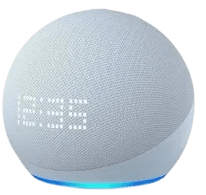
- Small AI
- Narrow AI
- Weak AI
- Strong AI
Answer
Narrow AI
Reason — The image depicts Amazon Alexa, a smart voice assistant. Alexa is specialised in a narrow domain and is created to carry out a specific set of tasks, which classifies it as Narrow AI.
Which of the following refers to as human intelligence?
- Artificial Intelligence
- Natural Intelligence
- Super Intelligence
- Ultra Intelligence
Answer
Natural Intelligence
Reason — Natural Intelligence refers to the cognitive abilities inherent in humans, which help them in thinking, learning, solving problems and improving in day-to-day activities. Hence, human intelligence refers to Natural Intelligence.
General AI is also known as ...............
- Strong AI
- Weak AI
- Narrow AI
- Broad AI
Answer
Strong AI
Reason — The term "General AI" is also used to describe "Strong AI" or "Human-Level AI" or "Artificial General Intelligence (AGI)" which refers to AI systems that can exhibit human-level intelligence across a variety of tasks and domains.
............... is known as father of Artificial Intelligence.
- John Lewis
- Alan Turing
- John Dalton
- John McCarthy
Answer
John McCarthy
Reason — John McCarthy, an American Computer Scientist from MIT, first introduced the term "Artificial Intelligence" in 1955 during the Dartmouth Conference, earning him the title of the "Father of Artificial Intelligence".
............... can not be considered to be an example of Weak AI.
- Alexa
- Smart Car
- Star Trek
- Google Maps
Answer
Star Trek
Reason — Star Trek is a work of science fiction that depicts Artificial General Intelligence (AGI) or Strong AI, not Weak AI. Alexa, Smart Cars and Google Maps are real examples of Weak or Narrow AI since they perform specific tasks.
............... set a model, known as Turing Test, to test for machine intelligence.
- John McCarthy
- Sam Altman
- Charles Babbage
- Alan Turing
Answer
Alan Turing
Reason — In 1950, the famous computer scientist and mathematician Alan Turing introduced the Turing Test to check if a machine can think and make smart decisions like a human being.
Which of the following is a chess-playing computer using AI, developed by IBM?
- Light Blue
- Deep Blue
- Sky Blue
- Navy Blue
Answer
Deep Blue
Reason — Deep Blue was a chess-playing computer developed by IBM. In 1997, it defeated the reigning world chess champion Garry Kasparov, marking the ultimate battle of Man vs Machine.
............... coined the term Machine Learning.
- Alan Turing
- John McCarthy
- Brad Rutter
- Arthur Samuel
Answer
Arthur Samuel
Reason — In 1959, Arthur Samuel, a professor and electric engineer, developed the first self-learning program known as the Samuel Checkers-playing Program and coined the term Machine Learning.
State whether the following statements are True or False:
- Humans are born with natural intelligence that helps the environment to provide some sorts of amazing things.
- Artificial Intelligence does not require plenty of time and resources.
- There is always a possibility to make mistakes by human beings.
- The intelligence is the ability to learn and deal with the new situations or challenges.
- In 1950, Alan Turing coined the term "Artificial Intelligence".
- AI applications automate the tedious and repetitive tasks comfortably.
- Sophia is referred to as the first-ever chatbot invented in the 1960s by Joseph Weizenbaum.
- ChatGPT is a chatbot developed by OpenAI, Microsoft Corporation and was launched in the year 2022.
Answer
- True
- False
Corrected Statement: Artificial Intelligence requires plenty of time and resources. - True
- True
- False
Corrected Statement: John McCarthy first introduced the term "Artificial Intelligence" in 1950. - True
- False
Corrected Statement: Eliza is referred to as the first-ever chatbot invented in the 1960s by Joseph Weizenbaum. - True
- CEO : ...............
- IBM : ...............
- GPT : ...............
- LISP : ...............
- CRT : ...............
Answer
- CEO – Chief Executive Officer
- IBM – International Business Machine
- GPT – Generative Pre-training Transformer
- LISP – List Processing
- CRT – Cathode Ray Tube
| Column A | Column B |
|---|---|
| Alan Turing | AI Music Composer |
| Amper | Founder of ChatGPT |
| Sam Altman | Bombe Machine |
| John McCarthy | Socially Humanoid Robot |
| Sophia | LISP |
Answer
| Column A | Column B |
|---|---|
| Alan Turing | Bombe Machine |
| Amper | AI Music Composer |
| Sam Altman | Founder of ChatGPT |
| John McCarthy | LISP |
| Sophia | Socially Humanoid Robot |
Assertion (A): The development of driving skill to safety control a vehicle is derived through natural intelligence possesses by humans.
Reason (R): The intelligence is the ability to learn and deal with the new situations or challenges.
Based on the above discussion, choose an appropriate statement from the options given below:
- Both A and R are correct and R is the correct explanation of A.
- Both A and R are true and R is not the correct explanation for A.
- A is true but R is false.
- A is false but R is true.
- Both A and R are false.
Answer
Both A and R are correct and R is the correct explanation of A.
Reason — Driving skill is developed through natural intelligence, which is the ability of humans to learn and adapt to new situations. Since intelligence enables humans to deal with new challenges like learning to drive a vehicle, Reason (R) correctly explains Assertion (A).
The revolution of artificial intelligence had begun in early 1940s. Today, the concept of artificial intelligence has increased involvement with a person's day-to-day life. One can witness the technological development in various fields including systems, machines or devices.
Read the following statements and identify the system, machine or device that played a role in artificial intelligence.
(a) It the first-ever chatbot invented in the 1960s by Joseph Weizenbaum at the Artificial Intelligence Laboratory at MIT. It is a computer program for the study of natural language communication between man and machine. Identify the chatbot.
(b) The voice recognition system used on iPhone which made a great impact in the field of artificial intelligence. Name the voice recognition system.
(c) Hansen Robotics created a socially humanoid robot with the help of Artificial Intelligence. Name the socially humanoid robot.
(d) AI developed the first artificially intelligent musician, producer and composer to create and put out an album. What am I talking about?
Answer
(a) Eliza
(b) Siri
(c) Sophia
(d) Amper
Write short notes on Artificial Intelligence.
Answer
Artificial Intelligence (AI) is the technology that makes use of machines, like computer systems or robots, to think and learn just like the human mind does. This is done by developing computer systems and algorithms that are capable of learning from data, reasoning, understanding natural language, perceiving their environments and adapting to new situations. The goal of AI is to create efficient systems capable of mimicking or surpassing human intellectual abilities, such as pattern recognition, problem-solving and decision-making. AI is used to enhance and improve the efficiency of many objects that we use in our day-to-day lives like smartphones, video games, shopping experiences and even some toys.
Write short notes on Eliza.
Answer
Eliza is known as the first-ever chatbot created in the 1960s by Joseph Weizenbaum at the Artificial Intelligence Laboratory at MIT. It was a computer program that explored how people and machines talk to each other naturally. Eliza acted as a robot therapist that responded to users with pre-written answers, making them feel like they were chatting with someone who understands their feelings. Eliza used a method called pattern matching to simulate conversation like a human. The idea behind Eliza was to make people talk more and feel like they're chatting with a therapist.
Write short notes on Weak or Narrow AI.
Answer
Artificial Intelligence (AI) systems that specialise in a narrow domain and are created in order to carry out a specific set of tasks are referred to as Narrow or Weak AI. These systems are extremely proficient at a specific function, but they lack the ability to generalise or do things that aren't within their area of expertise. For example, Alexa is one of the most commonly used smart voice assistants which responds only to the keywords it is programmed to understand. Some other examples of Weak AI include Chatbots, Email spam filters, Smart Voice Assistants like Siri, Self-driving Cars and Google Maps.
Write short notes on IBM Watson.
Answer
IBM Watson is a question-answering computer system which is capable of answering questions modelled in natural language. It is an artificial intelligence platform developed by IBM (International Business Machine) that influences natural language processing and machine learning to understand and respond to inquiries. Watson gained its fame by competing and winning in the quiz show Jeopardy! against human champions Brad Rutter and Ken Jennings in 2011, where it won the first-place prize of $1 million. It has since been applied to various industries, including healthcare, finance and customer service to analyse and interpret large volumes of data.
Write short notes on Strong AI.
Answer
Strong AI is also known as "General AI", "Human-Level AI" or "Artificial General Intelligence (AGI)". It refers to those Artificial Intelligence (AI) systems that can exhibit human-level intelligence across a variety of tasks and domains. These hypothetical systems can be capable of comprehending, learning and applying knowledge in a similar capacity as humans do. Strong AI is still a work in progress and not yet a reality. Because it does not actually exist yet, the only true examples of AGI are found in works of science fiction like Star Trek: The Next Generation, Wall-E and Her.
Write short notes on ChatGPT.
Answer
ChatGPT is a smart chatbot created through the collaboration between OpenAI and Microsoft Corporation, and it was launched on November 30, 2022. OpenAI was founded by Elon Musk and Sam Altman, among others. ChatGPT is an AI chatbot capable of engaging in conversations with people and generating its own unique, human-like responses. The term ChatGPT stands for Chat Generative Pre-training Transformer. It has a wide range of capabilities including translating text into different languages, summarizing long passages, completing unfinished sentences, generating conversations, writing computer code in various programming languages and correcting errors in existing code.
Humans are born with 'Natural Intelligence'. Comment.
Answer
Humans are born with Natural Intelligence which is like a superpower for our brain that helps us in thinking, learning, solving problems and gives us the zeal to improve in our day-to-day activities. It is what makes us smart and capable of doing all the creative or imaginary things we do every day. Just like birds are born with the ability to fly and fishes are born with the ability to swim, humans are born with natural intelligence which enables them to communicate, learn and lead a civilised life. Natural Intelligence can be developed and improved over time through learning and diverse experiences.
Enlist any five features of 'Artificial Intelligence'.
Answer
The five features of Artificial Intelligence are as follows:
- AI systems are capable of learning from data and experience, which helps them become more effective over time.
- These systems are capable of logical thinking and reasoning, information analysis and complicated problem-solving.
- AI systems can make decisions and take actions independently without human intervention.
- It can process and understand human language, enabling machines to understand, generate and respond to human speech or text.
- It enables the automation of repetitive or labour-intensive tasks, leading to increased efficiency and productivity.
Give two differences between Strong AI and Weak AI.
Answer
| Strong AI | Weak AI |
|---|---|
| Strong AI can carry out a wide range of tasks on their own. | Weak AI is dedicated to a specific task. |
| Strong AI refers to as a hypothetical machine that exhibits human cognitive abilities. | Weak AI refers to as an intelligent behaviour that is modeled to solve problems. |
What was the basic setup of 'Turing Test' made by Alan Turing?
Answer
The basic configuration of the Turing Test was setup in the following ways:
- In the test, there are three players: two humans and a computer.
- One person asks questions, while the other human and the computer answer them.
- The questioner asks questions on a specific topic using a particular way and situation.
- After a while, the questioner has to decide which answer came from the computer and which one from the human.
- The test is repeated multiple times.
- If the questioner can't tell which answer is from the computer half of the time or less, the computer is considered very smart because the questioner thinks it's as smart as a human.
How do our learning process begin? Explain with an example.
Answer
Our learning process begins with the help of Neurons (nerve cells) which are the fundamental units of the brain and the nervous system. The nerve cells or neurons are responsible for receiving sensory input from the external world. Thereafter, they transmit the information into electrical signals and share these impulses with the different areas of the brain. Based on the strength of these signals (i.e., either increases or decreases), our learning begins.
Example — If a picture of a ball is shown to a child for the first time and taught that it is a ball, then he or she would always identify the same picture as a ball through a pattern which gets registered in his or her brain. Once trained, the child is capable of identifying similar objects when shown again. This is how the child begins to learn.
What conclusion did Alan Turing draw in his experiment 'Turing Test'?
Answer
Alan Turing concluded from his Turing Test experiment that "The computer passes the test successfully and the machine is said to be intelligent that can think like human beings." A machine is said to be intelligent when the Human Questioner asks a question to both the machine and a human and cannot distinguish by the response whether it is given by a Machine or a Human. Post the conclusion of the test, it was derived that a machine is no less intelligent as compared to a human being and can take an informed decision on its own. This further led to the study of Artificial Intelligence with a focus to empower machines to think like a human being.
Deep Blue was the ultimate battle of Man vs Machine. Comment.
Answer
In 1997, IBM developed a chess-playing computer called Deep Blue, which became the ultimate battle of Man vs Machine to figure out who outsmarts whom. The reigning chess legend Garry Kasparov was challenged to beat the machine Deep Blue. It was unbelievable when Kasparov became the first world champion to lose a match to a computer and was defeated by the IBM supercomputer Deep Blue in a highly publicised match. Everyone stuck to the game and were shocked that Deep Blue could beat the chess champion Garry Kasparov. This left people wondering about how machines could easily outsmart humans in a variety of tasks.
Unimate became the very first industrial robot. In what ways, did it make an impact in industries during those days?
Answer
Unimate was invented by an American engineer George Devol in 1954 and a prototype of the Unimate was used in a General Motors Corporation factory in Trenton, New Jersey. It revolutionised the world by becoming the very first industrial robot. Before Unimate, workers had to be very careful while handling parts on the assembly line to avoid accidents. With the invention of the Unimate, which had a patented arm prototype, workers could be safer as the dangerous tasks were handled by the robot. The success of Unimate led to the creation of many more industrial robots, transforming the manufacturing industry by improving safety, speed and efficiency.
How Alexa has made an impact as a virtual assistance in the field of AI?
Answer
Alexa is a virtual assistant developed by Amazon which is available on smartwatches, car monitors, speakers, TV and other platforms. It utilises natural language processing and machine learning to respond to voice commands, perform tasks and provide information to users. Alexa can perform various tasks such as answering questions, playing music, setting alarms and timers, sharing weather conditions and controlling smart home devices. It has the ability to understand context and adapt to user preferences contributing to its user-friendly interface. Nowadays, it has become one of the leading smart assistants in the market and has become an integral part of many households, offering convenience and efficiency in daily tasks.
Explain the following domains of AI:
(a) Machine Learning
(b) Deep Learning
(c) Natural Language Processing
(d) Computer Vision
Answer
(a) Machine Learning — Machine Learning is a subset and fundamental domain within artificial intelligence. It focuses on the development of computer programs that can access data and use it to learn for themselves. It is characterised by its ability to enable computers to learn and make decisions based on data without explicit programming. Machine learning uses algorithms and historical data to predict its outcome more accurately.
(b) Deep Learning — Deep Learning is a sub-set of Machine Learning. Basically, it involves the use of artificial neural networks to model and solve complex problems. The techniques used in deep learning is a part of machine learning but, the reverse action does not hold true. It uses complex algorithms and neural networks to train a model.
(c) Natural Language Processing — Natural Language Processing (NLP) is one of the domains of artificial intelligence that helps computers to read, understand or write text in the same way as humans. It involves the interaction between computers and human language and emphasises on enabling machines to understand, interpret and generate human language. NLP is significant because of its ability to bridge the communication gap between humans and machines. It enables Chatbots to understand and respond to user queries, automates language translation and extracts insights from text data.
(d) Computer Vision — Computer Vision is one of the domains of Artificial Intelligence that works almost in the same manner as human vision. It uses machine learning and neural networks to enable computers and machines to interpret and understand visual information from the digital world such as images, videos, any visual inputs, etc. It takes actions, makes decisions and makes recommendations based on the input information. If AI is the brain of computers and machines, Computer Vision is like the eyes of computers and machines.