
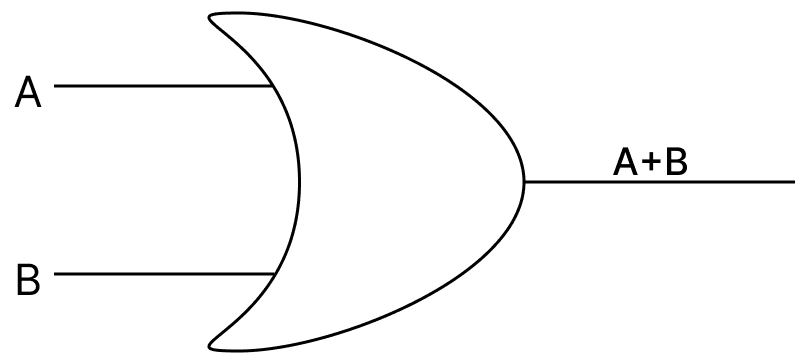
Which of the following logical gates is depicted in this image?
- AND Gate
- OR Gate
- NOR Gate
- NOT Gate
Answer
OR Gate
Reason — The image depicts an OR gate, which produces an output (A + B) that is the sum of the input signals. The output is 0 only when all the input signals are 0, otherwise the output is 1.
Boolean Algebra was developed by ...............
- Claude Shannon
- George Boole
- Lady Ada
- Blaise Pascal
Answer
George Boole
Reason — Boolean Algebra was developed by George Boole, an English Mathematician, who in 1847 published a book named 'Mathematical Analysis of Logic', laying the foundation of Boolean Algebra, also known as Logical Algebra.
A variable that contains a value in terms of 0's and 1's is said to be:
- Boolean variable
- Logical variable
- Integer variable
- Numeric variable
Answer
Boolean variable
Reason — A Boolean variable is a data type that can hold only one of two binary values — 1 or 0, On or Off, True or False. It is commonly used in programming for decision-making, logical operations and control flow.
An AND logic gate produces the output in terms of ...............
- Product of the input values
- Sum of the input values
- Product of complement of the input values
- Sum of complement of the input values
Answer
Product of the input values
Reason — An AND gate produces a single output from a number of input signals which is the product of all the input signals. The output is 1 only when all the input signals are 1, otherwise the output is 0.
Which of the following relations results in false?
- 1+0=0
- 0.0=0
- 1+1=1
- 1.0=0
Answer
1+0=0
Reason — In Boolean algebra, '+' represents OR operation. According to the OR truth table, if at least one operand is 1, the output becomes 1. Therefore, 1 + 0 = 1, not 0. Hence, 1 + 0 = 0 is false.
Which of the following is a unary operator?
- AND
- OR
- NOT
- NOR
Answer
NOT
Reason — NOT is a unary operator because it operates on only one input signal. It inverts the value of its operand — if the operand is True, it returns False and vice-versa. Hence, the NOT gate is also called the unary gate.
The tabular structure which shows the input values used in a logical process and the output received is called a ...............
- truth table
- symbol table
- design table
- logic table
Answer
truth table
Reason — A truth table is a mathematical table used to represent the possible outcomes of a logical expression based on all possible combinations of its inputs. It is commonly used in Boolean algebra and digital logic design to visualise how the logical operations like AND, OR, NOT, etc. behave with different input values.
Which of the following is not a logical operator?
- Logical AND
- Logical OR
- Logical NOT
- Logical IF
Answer
Logical IF
Reason — The three fundamental logical operators are AND, OR and NOT. Logical IF is not a logical operator, it is a conditional construct used for decision-making in programming.
State whether the following statements are True or False:
- The word "data" originates from the Latin word datum.
- Qualitative data It refers to data that can be measured, counted and expressed numerically.
- The result obtained after processing of data is known as information.
- A truth table is a mathematical table used to represent the possible outcomes of a logical expression based on all possible combinations of its inputs.
- Logical operator is an integrated circuit, used to perform logical functions or Boolean functions.
- Deterministic computing refers to as the computing model where the outcome of a computation is predictable and consistent for a given set of inputs.
Answer
- True
- False
Corrected Statement: Qualitative data refers to non-numerical information that describes characteristics, qualities or attributes of something. - True
- True
- False
Corrected Statement: Logic gate is an integrated circuit, used to perform logical functions or Boolean functions. - True
Assertion (A): Deterministic computing refers to as the computing model where the outcome of a computation is predictable and consistent for a given set of inputs.
Reason (R): In deterministic systems, the same input will always produce the different output, regardless of when or how many times the computation is performed.
Based on the above discussion, choose an appropriate statement from the options given below:
- Both A and R are true and R is the correct explanation of A.
- Both A and R are true and R is not the correct explanation of A.
- A is true but R is false.
- A is false but R is true.
- Both A and R are false.
Answer
A is true but R is false.
Reason — The assertion is true as deterministic computing refers to the computing model where the outcome is predictable and consistent for a given set of inputs. However, the reason is false because in deterministic systems, the same input will always produce the same output (not different output), regardless of when or how many times the computation is performed.
Deterministic computing always produces the same output for a given input, ensuring predictable and repeatable results. Whereas, probabilistic computing may yield different outcomes for the same input due to the influence of chance or randomness. Read the following real-world examples and identify whether they belong to deterministic or probabilistic computing.
(a) Weather forecasting involves assessing different weather conditions based on past data and the current conditions.
(b) The time and date on a clock or calendar showing current time and date.
(c) Insurance companies use this model to assess the risk of insuring individuals or groups.
(d) Determining the shortest path between the two points on a map.
Answer
(a) Probabilistic computing
(b) Deterministic computing
(c) Probabilistic computing
(d) Deterministic computing
Write short notes on Qualitative Data.
Answer
Qualitative data refers to the non-numerical information that describes characteristics, qualities or attributes of something. It captures the "what" or "how" rather than the "how many" or "how much". Qualitative data is typically descriptive and is used to understand underlying reasons, opinions or motivations. It can further be categorised into two types — Nominal Data (which categorises data without any order, e.g., colors, names) and Ordinal Data (which involves data with a meaningful order but no fixed interval, e.g., rankings, satisfaction levels).
Write short notes on Quantitative Data.
Answer
Quantitative data refers to the data that can be measured, counted and expressed numerically. It deals with quantities and is used for statistical analysis, allowing researchers to measure and compare values. Quantitative data answers questions like "how many", "how much" or "how often". It can further be categorised into two types — Discrete Data (which consists of distinct, separate values, often whole numbers, e.g., the number of students in a class) and Continuous Data (which can take any value within a range, e.g., height, weight, temperature).
Write short notes on Logical Operator.
Answer
A logical operator is a symbol or word used to combine two or more expressions, where the resulting value of the compound expression is determined by the values of the original expressions. These operators are used in programming and mathematics to perform logical operations on Boolean values, returning either true or false, based on the inputs. The most common logical operators include AND, OR and NOT.
Write short notes on Logical AND operator.
Answer
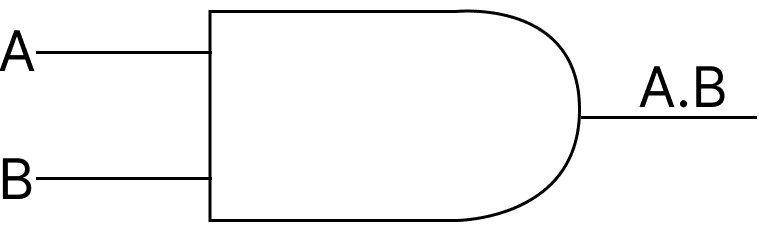
Logical AND is a Boolean operator that returns True only if both operands are true. If either or both operands are false, the result is False. This operator results in logical product of two or more binary valued quantities. It is denoted by a dot ( . ) sign. The output of a logical AND operation is 1 only when all the input values are 1; the output is 0 for any other combination of input bits.
Write short notes on Logical OR operator.
Answer
Logical OR is a Boolean operator that returns True, if at least one of the operands is true. It only returns False when both operands are false and is used for conditional evaluations. This operator results in logical addition of two or more binary valued quantities. It is denoted by a plus ( + ) sign. The output of logical OR is 0 only when all the operands are 0, otherwise the output is 1.
Write short notes on Logical NOT operator.
Answer
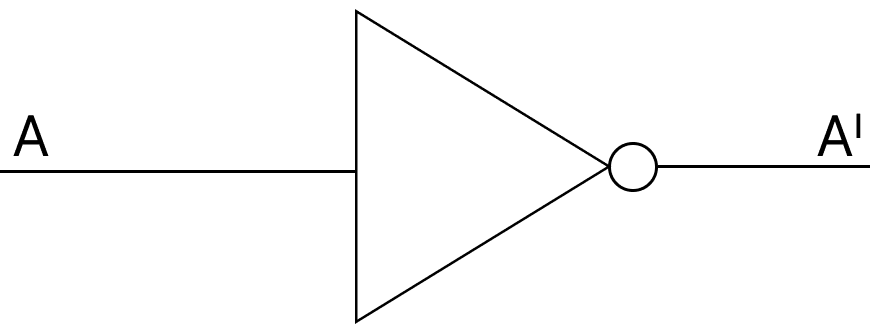
Logical NOT is a Boolean operator that inverts the value of its operand. If the operand is True, it returns False and vice-versa, used for negating conditions. In other words, this operator provides the complement of the given binary valued quantity, i.e., it converts 0's into 1's and 1's into 0's. It is represented as (') or (—). NOT operation is also called complement or invert operation, as it inverts the low signal into high and vice-versa.
Define data. What are its types?
Answer
Data refers to the raw, unprocessed facts or figures collected for reference, analysis or processing. It represents information in various forms, such as numbers, text, images or symbols, which can be used to derive insights or make decisions when analysed.
Data is broadly classified into two categories:
- Qualitative Data — It refers to the non-numerical information that describes characteristics, qualities or attributes of something. It can further be categorised into Nominal Data and Ordinal Data.
- Quantitative Data — It refers to the data that can be measured, counted and expressed numerically. It can further be categorised into Discrete Data and Continuous Data.
Give two examples of Qualitative Data and Quantitative Data.
Answer
Examples of Qualitative Data:
- Customer Feedback — Comments such as "The service was excellent" or "The product is durable and well-designed."
- Color Descriptions — Descriptions of objects based on color, such as "The car is red" or "The house is painted blue."
Examples of Quantitative Data:
- Height and Weight — The height of students in a class, such as "5 feet 6 inches" or the weight of objects, like "20 kilograms."
- Test Scores — The exam results, such as "Anjali scored 85 out of 100" or "The average test score was 75."
Enlist any three real-world applications of data.
Answer
Three real-world applications of data are:
- Healthcare — Data is used for patient diagnosis, treatment plans and predictive analytics. It helps in improving patient outcomes through personalised medicine and early detection of diseases.
- Finance — Banks and financial institutions use data for fraud detection and risk management. It also works in personalised financial products like loans and credit cards.
- Transportation — Data is used in traffic management, route optimisation and vehicle tracking systems like GPS, helping in improving efficiency in logistics and reducing congestion.
Give two differences between Data and Information.
Answer
The differences between Data and Information are:
| Data | Information |
|---|---|
| It is just text and numbers. | It is processed and interpreted data. |
| It is unorganised facts and details. | It is the result of data processing. |
Explain the significance of data to artificial intelligence (AI).
Answer
Data is the foundation of Artificial Intelligence (AI), as it enables AI systems to learn, make decisions and perform tasks. AI cannot function effectively without data. The primary significances of data to AI are:
- Training AI Models — AI algorithms, particularly in machine learning and deep learning, require vast amounts of data to learn patterns, relationships and behaviour.
- Improving Accuracy — As more data is fed into AI systems, the models can learn more complex patterns and make better predictions.
- Decision-Making — AI systems analyse large datasets to make real-time decisions based on historical patterns and new data.
- Personalisation — Data helps AI systems personalise user experiences by analysing user behaviour, preferences and interactions.
- Automation and Optimisation — Data collected from operations is processed by AI to optimise processes, reduce errors and automate repetitive tasks.
- Continuous Learning — AI models can continuously update and adapt as they are exposed to new data, making them dynamic and capable of evolving in real-time.
What is meant by AI Project Cycle? Name the different phases of AI Project Cycle.
Answer
The AI Project Cycle is a structured process involving various phases guiding the development and deployment of AI solutions for specific tasks or problems.
The different phases of AI Project Cycle are:
- Problem Scoping — Defining the problem and objectives.
- Data Acquisition — Gathering relevant data.
- Data Exploration — Analysing and understanding data.
- Modeling — Training AI models on data.
- Evaluation — Assessing model performance and refining it for accuracy.
What are the fundamental concepts of boolean algebra?
Answer
Boolean algebra, also known as Logical Algebra, was developed by George Boole in 1847 to deal with logical problems in Mathematics by using only two values, i.e., digits 0 (zero) and 1 (one), or 'False' and 'True', or 'ON' and 'OFF' logical states. The fundamental concepts of Boolean algebra are:
- Boolean Variable — A data type that can hold one of two values — 1 or 0, On or Off, True or False. It is commonly used in programming for decision-making, logical operations and control flow.
- Truth Table — A mathematical table used to represent the possible outcomes of a logical expression based on all possible combinations of its inputs.
- Logical Operators — Symbols or words used to combine two or more expressions. The most common logical operators include AND, OR and NOT.
- Logic Gates — Integrated circuits used to perform logical operations or Boolean functions. The three fundamental gates are AND, OR and NOT.
What is 'Truth Table'? Explain with reference to boolean algebra.
Answer
A truth table is a mathematical table used to represent the possible outcomes of a logical expression based on all possible combinations of its inputs. It is commonly used in Boolean algebra and digital logic design to visualise how the logical operations like AND, OR, NOT, etc. will behave with different input values.
For example, the truth table of AND operator is shown below:
| A | B | A AND B |
|---|---|---|
| True | True | True |
| True | False | False |
| False | True | False |
| False | False | False |
In this table, A AND B is true only when both A and B are true.
What is meant by logic gates? Name three fundamental logic gates.
Answer
A logic gate is an integrated circuit which is used to perform logical operations or Boolean functions. It accepts two or more input signals but provides only one output signal based on a certain logical operation. The logic gates which are independent are termed as fundamental or basic logic gates.
The three fundamental logic gates are:
- AND Gate
- OR Gate
- NOT Gate
Draw the truth table for the following logical operators:
(a) Logical AND
(b) Logical OR
(c) Logical NOT
Answer
(a) Truth Table of Logical AND:
| A | B | A . B |
|---|---|---|
| 0 | 0 | 0 |
| 0 | 1 | 0 |
| 1 | 0 | 0 |
| 1 | 1 | 1 |
(b) Truth Table of Logical OR:
| A | B | A + B |
|---|---|---|
| 0 | 0 | 0 |
| 0 | 1 | 1 |
| 1 | 0 | 1 |
| 1 | 1 | 1 |
(c) Truth Table of Logical NOT:
| A | A' |
|---|---|
| 0 | 1 |
| 1 | 0 |
Draw logic gates for the following:
(a) AND gate
(b) OR gate
(c) NOT gate
Answer
(a) AND Gate:
(b) OR Gate:
(c) NOT Gate:
What are basic logic gates? Why are they called so?
Answer
Basic logic gates are the fundamental logic gates that are independent and not derived from any other gates. There are three basic logic gates — AND gate, OR gate and NOT gate.
They are called basic or fundamental logic gates because they are independent and cannot be constructed using other gates. On the contrary, all other logic gates (such as NAND, NOR, XOR, etc.) are derived from these three basic gates by combining two or more of them. Hence, these gates form the foundation for designing all other complex logical circuits.
Explain Deterministic Computing with the help of an example.
Answer
Deterministic computing refers to the computing model where the outcome of a computation is predictable and consistent for a given set of inputs. In deterministic systems, the same input will always produce the same output, regardless of when or how many times the computation is performed. This predictability is essential in applications where reliability and accuracy are critical, such as embedded systems, real-time systems and financial calculations.
Example: Calculating the factorial of a number
Given a non-negative integer n, the factorial n! means the product of all positive integers from 1 to n.
For instance, if n = 5, then 5! = 5 × 4 × 3 × 2 × 1 = 120
No matter how many times we perform this calculation or when we do it, 5! will always yield 120. This demonstrates deterministic computing, since the output is predictable and consistent for any given input.
Enlist any three real-world examples of Deterministic Computing.
Answer
Three real-world examples of Deterministic Computing are:
- Temperature Conversion — Converting a temperature from Celsius to Fahrenheit using the formula F = (9C/5) + 32 will always yield the same Fahrenheit value for a given Celsius input.
- Calculating Volume of a Cuboid — The volume of a cuboid can be calculated using the formula: Volume = length × breadth × height. For a well-defined set of inputs, the output will always be the same.
- Sorting a List of Numbers — Given a list of numbers, deterministic algorithms like Merge Sort or Quick Sort will always produce the same sorted list for the same input, in a predictable manner.
Mention two advantages and two limitations of Deterministic Computing.
Answer
Advantages of Deterministic Computing:
- Simplicity — Deterministic systems are generally easier to understand and implement because their behaviour follows a clear set of rules.
- Predictability — The outcome is always consistent for a given input, making deterministic systems reliable for critical applications where accuracy is paramount.
Limitations of Deterministic Computing:
- Lack of Flexibility — Deterministic systems may not adapt well to dynamic or unpredictable environments, where non-deterministic approaches might be more appropriate.
- Inability to Handle Uncertainty — Deterministic problems do not account for randomness or uncertainty, making them unsuitable for tasks involving incomplete or noisy data.