
Which of the following is a book of grammar on Tamil?
- Tirukhural
- Tolkappiyam
- Kundlakesi
- Silappadikaram
Answer
Tolkappiyam
Reason — Tolkappiyam is the earliest available work on Tamil grammar. It is an important literary source of the Sangam Age and also provides valuable information about the society, culture, and political life of the ancient Tamils.
Choose the wrong pair:
- Local market : Angadi
- Day market : Nalangadi
- Evening market : Allangadi
- Uraiyur : Silk fabrics
Answer
Uraiyur : Silk fabrics
Reason — Uraiyur was a main centre for the manufacture of cotton fabrics, not silk, so this pair is wrong. The other pairs are correct — local markets were known as Angadis, the day market as Nalangadi, and the evening bazaar as Allangadi.
Foreign trade with which country brought in a large amount of gold?
- Rome
- Egypt
- Persia
- USA
Answer
Rome
Reason — Foreign trade with Rome brought significant Roman currency in gold and silver, and the Romans paid in gold for the goods imported from the Southern kingdoms.
Who was the author of Tirukkural?
- Rabindranath Tagore
- Tiruvannamalai
- Thiruvalluvar
- Civaka
Answer
Thiruvalluvar
Reason — Tirukkural, a classic composition of 1330 Tamil couplets, was authored by Thiruvalluvar, a Tamil poet said to have lived any time between the 2nd and 6th century CE.
Which is the earliest and the greatest epic of Sangam Age?
- Civaka Cintamani
- Manimegalai
- Silappadikaram
- All of these
Answer
Silappadikaram
Reason — Silappadikaram was the earliest and the greatest of the epics of the Sangam Age. It is the tragic story of the merchant Kovalan of Puhar and his wife Kannagi.
Choose the odd one out.
- Inscriptions
- Herostones
- Manimegalai
- Megaliths
Answer
Manimegalai
Reason — Inscriptions, Herostones and Megaliths are archaeological sources of the Sangam Age, whereas Manimegalai is a literary source, being one of the two great Tamil epics. Hence Manimegalai is the odd one out.
Manimegalai is associated with which Tamil epic?
- Silappadikaram
- Kundlakasi
- Civaka Chintamani
- Valayapathi
Answer
Silappadikaram
Reason — Manimegalai is the story of Manimegalai, the daughter of Kovalan and Madhavi of Silappadikaram, who becomes a Buddhist nun to preach the doctrine.
Which of the following statements is/are correct about Herostones?
(i) These were for the brave persons.
(ii) Herostones were planted for the people who lost their lives fighting wild animals.
(iii) Most of the herostones have inscriptions on them.
- Only (iii)
- Only (ii), (iii)
- Only (i), (iii)
- (i), (ii), (iii)
Answer
(i), (ii), (iii)
Reason — All three statements are correct. Herostones were erected for brave persons who sacrificed their lives; some lost their lives fighting the dangers of wild animals while reclaiming forest land; and most of the herostones bear inscriptions on them mentioning the heroes' names, families and regions.
Which of the following statements are true about Economic life?
(i) Silk clothes were produced in the Tamil country
(ii) People exchanged honey with fish
(iii) Local market were known as angadis
(iv) Rice was staple food
- (i), (ii) and (iv)
- (i), (ii) and (iii)
- (ii), (iii) and (iv)
- (i), (ii), (iii) and (iv)
Answer
(i), (ii), (iii) and (iv)
Reason — All four statements are correct. Silk clothes were produced in the Tamil country, the people of the Kurinji region exchanged honey with the Neydal region for fish and salt, local markets were known as Angadis, and rice was the staple food during the Sangam period.
Which region was famous for jackfruit?
- Madurai
- Uraiyur
- Pandya
- Chera
Answer
Chera
Reason — Chera country was famous for jackfruit, along with spices like ginger, cardamom, cinnamon, pepper and turmeric.
Give the most important reason for erecting the given picture.

- This was erected to recognise the bravest soldier who fought in Chola army
- These were erected for the heroes who sacrificed their lives for safeguarding the villages and their culture
- These were Megaliths erected on burial grounds
- These were erected for the villagers who killed a wild animal
Answer
These were erected for the heroes who sacrificed their lives for safeguarding the villages and their culture
Reason — The picture shows Herostones, which were erected for the heroes who sacrificed their lives to the cause of safeguarding the villages and their culture.
'The people of the Sangam Age traded with foreign countries.' Which of the following statements correctly describes the same?
- The Romans imported the pearls of the Pandya kingdom
- Gemstones, ivory, sandalwood, and silk textiles were exported to Greece and Rome
- The Southern kingdoms exported spices, pepper to Rome, Greece and other countries
- All of these
Answer
All of these
Reason — All the statements are correct. The Romans imported the pearls of the Pandya kingdom, which were highly valued in Rome; gemstones, ivory, sandalwood and silk were exported to Greece and Rome; and the Southern kingdoms exported spices and pepper to Rome, Greece and other countries.
Read the two statements given below about Silappadikaram. Select the option that shows the correct relationship between (A) and (B).
(A) : It was the earliest and the greatest epic of the Sangam Age
(B) : It marks the beginning of Kannagi cult as Kannagi avenges the death of her husband.
- (B) Contradicts (A)
- (B) is the reason for (A)
- (A) is true but (B) is false
- (A) and (B) are independent of each other
Answer
(B) is the reason for (A)
Explanation — Both statements are individually true — Silappadikaram was the earliest and the greatest epic of the Sangam Age (A), and it marks the beginning of the Kannagi cult as Kannagi avenges the death of her husband and becomes a goddess (B).
A college student named Sheela is doing a project on the Sangam Age. About which book she is most likely to write in detail?
- Silappadikaram
- Manimegalai
- Tirukkural
- Tolkappiyam
Answer
Tirukkural
Reason — Tirukkural is a classic composition of 1330 Tamil couplets arranged into 3 sections and 133 chapters. It covers many aspects of life, from ruling a country to ploughing a piece of land, and throws light on the lives of the ancient Tamils.
Consider the two statements given below and select the option that shows the correct relationship between (A) and (R).
Assertion (A): The Herostones were erected to remember the brave persons of the village.
Reason (R): These heroes had sacrificed their life to safeguard the village and its culture.
- Both (A) and (R) are true, and (R) is the correct explanation of (A)
- Both (A) and (R) are true, but (R) is not the correct explanation of (A)
- (A) is true but (R) is false
- (A) is false but (R) is true.
Answer
Both (A) and (R) are true, and (R) is the correct explanation of (A)
Explanation — Both (A) and (R) are true, and (R) is the correct explanation of (A). The herostones were erected for the heroes who sacrificed their lives to the cause of safeguarding the villages and their culture; this very sacrifice is the reason such brave persons were remembered through herostones.
Consider the two statements given below and select the option that shows the correct relationship between (A) and (R).
Assertion (A): The Sangam Age came to an end around 3rd Century CE.
Reason (R): The Cholas, Cheras and the Pandyas continued to rule until early Medieval Age.
- Both (A) and (R) are true, and (R) is the correct explanation of (A)
- Both (A) and (R) are true, but (R) is not the correct explanation of (A)
- (A) is true but (R) is false
- (A) is false but (R) is true.
Answer
Both (A) and (R) are true, but (R) is not the correct explanation of (A)
Explanation — Both (A) and (R) are true, but (R) is not the correct explanation of (A). The Sangam Age ended around the 3rd century CE, and the dynasties of the Cheras, Cholas and Pandyas persisted into later historical periods, notably the medieval period. However, the continued rule of these dynasties is not the reason for the end of the Sangam Age.
Which port city was significant during the Sangam Age for trade?
Answer
Puhar or Kaveripattinam, the capital city of the Chola kingdom, was significant during the Sangam Age for trade.
Read the following excerpt and answer the question that follows:
"The didactic literature, which includes the world famous Tirukkural is mostly in stanzaic form, the stanza having from two to five lines."
(Source: https://www.du.ac.in/up/oads/new-web/04012023_Appendix-108.pdf)
Who authored Tirukkural?
Answer
Tirukkural was authored by Thiruvalluvar, the Tamil poet who is said to have lived any time between the 2nd and 6th century CE.
Which heroine from Silappadikaram was hailed for her chastity?
Answer
Kannagi, the wife of Kovalan from Puhar in Silappadikaram, was hailed for her chastity.
What were herostones, and why were they erected?
Answer
The herostones were erected for the heroes who sacrificed their lives to the cause of safeguarding the villages and their culture. Most of the herostones bear inscriptions often mentioning the names of the heroes, their families, regions, and other details.
What materials were used to inscribe records during the Sangam Age?
Answer
During the Sangam Age, records were inscribed on stones and copper plates.
What was the first capital of the Chola kingdom?
Answer
The first capital of the Chola kingdom was Uraiyur.
Which food items were considered luxuries in the Sangam Age?
Answer
Appam or rice cake soaked in milk and the flesh of tortoises were considered luxuries in the Sangam Age.
Read the following excerpt and answer the question that follows:
"The Sangam texts mention prominently only the ports of Musiri, Puhar (Kaveripattinam) and Korkai, the three great ports of the three great rulers of the timess."
(Source: https://www.du.ac.in/up/oads/new-web/04012023_Appendix-108.pdf)
Who founded Kaveripattinam, and why was it significant?
Answer
Kaveripattinam (Puhar) was a bustling port city founded by King Karikalan, which later became the new Chola capital city. This city became a hub for trade and cultural exchange, attracting merchants from faroff lands.
Name a Pandya ruler associated with the legend of Silappadikaram.
Answer
Ariyappadaikadantha Neduncheliyan, a Pandya ruler, is associated with the legend of Silappadikaram.
What titles did the Chera kings hold?
Answer
The Chera kings held titles such as Vanavar, Villavar, and Malaiyar.
What were the names of the day and evening markets in port towns?
Answer
The day market was called Nalangadi, and the evening market was called Allangadi.
What were the four social divisions in Sangam society as mentioned in Tolkappiyam?
Answer
Tolkappiyam refers to the four social divisions prevalent in Sangam society, namely: Athanar, Arasar, Vaisigar, and Vellalar.
Why are the cities of Puhar and Madurai significant in Sangam literature?
Answer
Puhar and Madurai are significant in Sangam literature because Puhar was a major port city and Chola capital, known for its trade and prosperity. Madurai was the Pandya capital and the center of the Tamil Sangam assemblies, where much of Sangam literature was composed. Both cities reflect the cultural, political, and economic life of ancient Tamilakam.
Why is the Kallanai considered significant?
Answer
The Kallanai Dam (Grand Anicut) across the Kaveri River, is an engineering marvel still in use. It ensures effective irrigation and supports agriculture.
What emblem did the Pandyas use, and what did it symbolise?
Answer
The Pandyas used the fish emblem, which symbolized their strong connection to maritime trade and the sea.
Read the following excerpt and answer the questions that follow:
"Tolkappiyam, a treatise on Tamil grammar and poetics, composed probably during the second Sangam, is the oldest extant literary work in Tamil."
(Source: https://www.du.ac.in/up/oads/new-web/04012023_Appendix-108.pdf)
(a) What is the significance of the grammatical treatise Tolkappiyam?
(b) Why is Tolkappiyam important for understanding Tamil society?
Answer
(a) The grammatical treatise like the 'Tolkappiyam' not only gives the inflection and syntax of words and sentences but also includes classification of habitats, animals, plants and human beings. The discussion on human emotion and interaction is particularly significant.
(b) The Tolkappiyam has been instrumental in understanding the evolution of the Tamil language as well as forming an idea of the literary and cultural aspects of the Tamil society.
What types of records were inscribed on stones and copper plates?
Answer
The rulers of ancient Tamilakam, even those of the Pallava dynasty, gave land grants to the brahman saints and kept the records in the temples in the form of inscriptions on stone and copper plates.
'The chief occupation of people was agriculture.' Discuss.
Answer
The chief occupation of the people was agriculture. The ancient Tamils cultivated a wide range of crops such as rice, sugarcane, millets, pepper, grams, coconut, beans, cotton, plantain, tamarind and sandalwood. Paddy was the main crop. Chera country was famous for jackfruit, and spices like ginger, cardamom, cinnamon, pepper and turmeric. Spices constituted major items of export. Irrigation through rivers, tanks and wells was used for cultivation. Cotton was grown on large scale.
Read the following excerpt and answer the questions that follow:
"The Sangam literature apart from giving information on the important rulers who ruled over Tamil region namely the Pandyas (the oldest ruling dynasty in Tamil country ruling the southern part of Tamil Nadu)."
(Source: https://egyankosh.ac.in/bitstream/123456789/84174/3/Unit-7.pdf)
(a) Name two Pandya rulers mentioned in Sangam literature.
(b) Which Pandya ruler defeated a Chera-Chola coalition?
Answer
(a) Sangam literature mentions notable Pandya rulers like Mudhukudumi Peruvazhthi, known for his sacrifices, and Ariyappadaikadantha Neduncheliyan, linked to the Silappadikaram legend.
(b) Thalaiyalanganathu Nedunchezhiyan defeated a Chera-Chola coalition.
Read the following excerpt and answer the questions that follow:
"Feasts were organised for collective entertainment and had social significance as well. The custom of feeding guests was a common custom and eating without a guest to partake of the food was considered unsatisfying."
(Source: https://www.du.ac.in/up/oads/new-web/04012023_Appendix-108.pdf)
(a) Which forms of entertainment were widely practised in Sangam society?
(b) What activities were common in villages during the Sangam Age?
Answer
(a) Feasts were a popular form of collective entertainment in Sangam society, often organized for social bonding. Other common forms included music, dance, cock-fighting, goat-fighting, gambling and wrestling.
(b) In Sangam Age villages, feasts were commonly organised for collective entertainment and social bonding. A key custom was feeding guests, as eating without a guest was considered unsatisfying, reflecting the importance of hospitality in village life.
Which commodities contributed to the Chera kingdom's prominence in international trade?
Answer
The Cheras exported spices like black pepper, gemstones, ivory, sandalwood, cotton, and silk with many other countries, which contributed to the Chera kingdom's prominence in international trade.
Describe the position of women during the Sangam Age.
Answer
During the Sangam Age, women enjoyed a respectable position in society. Chastity was considered their greatest virtue, as illustrated by Kannagi. Women had the freedom to choose their life partners. Widows were not allowed to remarry or inherit property. Women studied religious scriptures and many became poets, such as Avvaiyar, Nachchellaiyar and Kakkaipadiniyar. Women dancers were also patronised by the nobility.
Read the following excerpt and answer the questions that follow:
"Early Cholas ruled over the kingdom of Tamil Nadu during the pre and post Sangam period (C. 600 BCE to 300 CE). Their early capitals were Urayur/Uraiyur (Tiruchirapalli) and Kaveripattinam. Mention of the early Chola, Chera and Pandayas is made in the Ashokan inscriptions (second and thirteenth rock edits). Karikala Chola was the most prominent of the early Cholas who is referred to in a number of Sangam poetic compositions."
(Source: https://egyankosh.ac.in/bitstream/123456789/84174/3/Unit-7.pdf)
(a) How did the location of the Chola kingdom contribute to its agricultural prosperity?
(b) Discuss King Karikalan's contributions to the Chola dynasty, focusing cn his military achievements and the construction of Kallanai.
(c) How did the Cholas contribute to Tamil art, literature, and architecture?
Answer
(a) The Chola kingdom, also known as Cholamandalam, covered present-day Thanjavur and Tiruchirappalli districts. Situated northeast of the Pandya territory, between the Pennar and Vellar rivers, it flourished in the fertile valley of the Kaveri river, renowned for its abundant water resources and agricultural prosperity.
(b) Karikalan, the most prominent early Chola ruler, is remembered for his leadership and achievements. He defeated the Chera and Pandya kings at the Battle of Venni and expanded his kingdom beyond Kanchipuram. His construction of the Kallanai Dam (Grand Anicut) across the Kaveri River, an engineering marvel still in use, ensured effective irrigation and supported agriculture.
(c) The Cholas were patrons of art, literature, and architecture. Their temples, adorned with intricate sculptures and towering gopurams, served as centres of worship, culture, and economic activity, showcasing their dedication to Tamil heritage.
The Sangam Age is considered a golden age due to its flourishing literature, societal advancements, and the contributions of the Cheras, Pandyas, and Cholas. With reference to this, answer the following questions:
(a) How does Sangam literature provide insights into the political and cultural life of this period?
(b) How do other Tamil poems provide a comprehensive picture of life during the Sangam Age?
(c) What themes dominate Sangam literature, and why are they important?
Answer
(a) Sangam literature describes the rule and achievements of the Cheras, Cholas, and Pandyas, giving insights into their administration, warfare, diplomacy, and patronage of arts. It also highlights the cultural life, including festivals, social customs, trade, and entertainment, showcasing a rich and organized society.
(b) The Sangam literature varying from almost 3rd century BCE to 3rd century CE was composed by many poets including Thiruvalluvar, the author of Tirukkural. All these poems composed during the Sangam period are important as they deal with every aspect of Tamil life during this period of about 1000 years or even more. From their study we come to know about love, war, governance, bereavement and joys of the Tamil people. They give a true picture of the social, economic and cultural life of the people.
(c) The main themes are love, war, governance, bereavement and joys of the Tamil people. These themes are important as they reflect the emotional and social values of the time, balancing the inner experiences of individuals with the duties and achievements in society.
The fall of these Tamil dynasties marked the end of an era, but their contributions remained deeply rooted in Tamil history and culture. With reference to this, answer the following questions:
(a) What factors contributed to the decline of the Chera, Chola, and Pandya kingdoms?
(b) How did these dynasties leave a lasting impact on Tamil trade, literature, and cultural heritage?
(c) Discuss the role of Sangam literature in preserving the legacy of the Tamil dynasties.
Answer
(a) The dynasties of the Cheras, Cholas, and Pandyas persisted in later historical periods, notably during the medieval period. The decline of these dynasties was due to internal conflicts, succession disputes, frequent wars, and external invasions. Over time, political instability and loss of control over trade routes also weakened their power.
(b) The Cheras, Cholas, and Pandyas promoted trade with foreign lands, making Tamilakam a major trading hub. They patronized poets and scholars, resulting in a rich body of Tamil literature. Their support for temples, art, and architecture helped shape Tamil cultural identity, which left a lasting impact on Tamil society.
(c) Sangam literature, along with classical works like Tirukkural by Thiruvalluvar, provides important insights into various aspects of life of the ancient Tamils. The Tamil Grammatical works and Tamil Epics have proved very useful in forming an idea of the social, economic and cultural life of the ancient Tamils. These poems and texts serve as key sources for understanding the legacy of the Chera, Chola, and Pandya dynasties, including their governance, values, and contributions to Tamil society.
With reference to the picture given below answer the following questions.
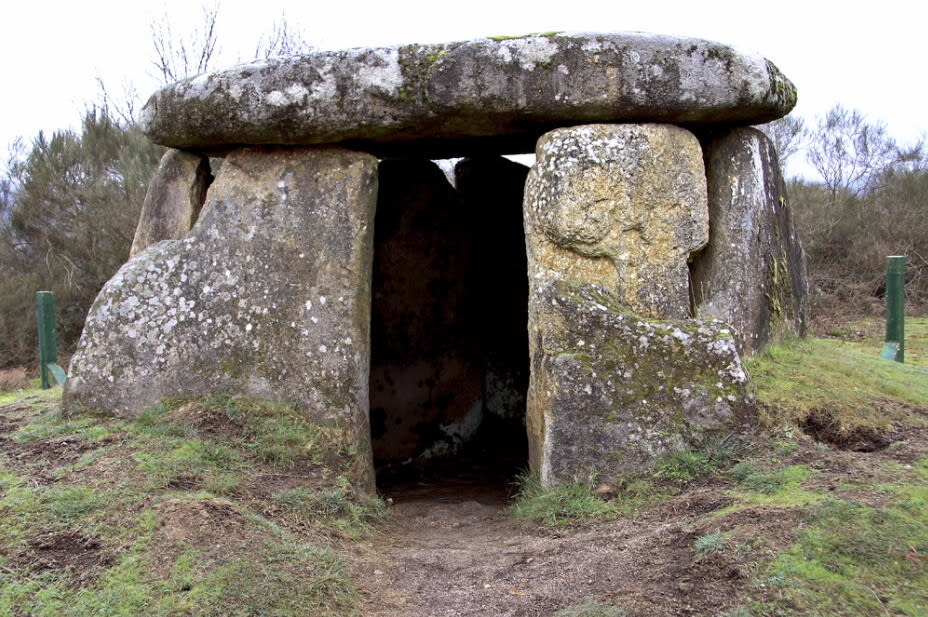
(a) Identify the picture.
(b) Why was it erected?
(c) Describe its significance.
Answer
(a) The given picture shows a Megalith.
(b) The megaliths were erected as burial grounds. They were used to mark burial sites and sometimes arranged in a circular pattern. Some had inscriptions, which help us understand different aspects of the social life of people during the Sangam Age.
(c) Megaliths have been found in different parts of the Tamil country ruled by the Chera, Chola, and Pandya dynasties. Some megaliths were arranged in a circular pattern, and a few had inscriptions engraved on them. These inscriptions are important as they help us form an idea of different aspects of the social life of people during the Sangam Age.
What were the key factors that made the Sangam Age an economically prosperous period in Tamil history?
Answer
There were many key factors that made the Sangam Age an economically prosperous period in Tamil history.
- Thriving Agriculture — Fertile land and irrigation through rivers, tanks and wells supported agriculture. The ancient Tamils cultivated rice, sugarcane, millets, pepper, grams, coconut, beans, cotton, plantain and tamarind. Paddy was the main crop.
- Trade and Commerce — Local markets were known as Angadis. Day markets (Nalangadi) and evening bazaars (Allangadi) existed in port towns. Internal and overseas trade flourished with Rome, Greece, Egypt, China and South-East Asia.
- Port cities — Puhar (Kaveripattinam) was a bustling port city of the Cholas. Korkai was the chief port of the Pandya kingdom. Naura, Tyndis and Muziris were important ports on the west coast.
- Stable rule — The Chera, Chola, and Pandya dynasties provided stable governance and patronized trade and commerce.
- Industry and Crafts — Weaving and spinning were important crafts during the Sangam period, with Uraiyur and Madurai as main centers for producing and exporting fine cotton fabrics. Other crafts included carpentry, blacksmithing, goldsmithing, pottery, along with fishing and hunting as significant occupations.