
Which of the following statements is/are correct regarding Allahabad pillar inscription?
(i) It is inscribed on an Ashokan pillar
(ii) It was composed by Harisena
(iii) It describes the reign of Samudragupta, glorifies his conquests and achievements
- Only (i)
- (i), (ii)
- (i), (ii), (iii)
- only (ii) and (iii)
Answer
(i), (ii), (iii)
Reason — All three statements are correct. The Prayaga Prashasti is inscribed on an Ashokan Pillar at Allahabad, was written in Sanskrit by Harisena, the court poet of Samudragupta, and glorifies Samudragupta's conquests and achievements.
Who is referred to as the Indian Napolean?
- Chandragupta II
- Samudragupta
- Chandragupta I
- Sri Gupta
Answer
Samudragupta
Reason — Samudragupta was a great conqueror and rightly deserves to be called the "Indian Napoleon" because of his remarkable military campaigns, extensive conquests, and exceptional leadership.
Choose the incorrect pair.
- Kalidasa : Raghuvamsha
- Vishakhadatta : Mudrarakshasa
- Shudraka : Mrichchhakatikam
- Bharavi : Ravana Vadha
Answer
Bharavi : Ravana Vadha
Reason — Bharavi wrote Kiratarjuniya, which describes the battle between Arjuna and Lord Shiva disguised as Kirata. Therefore, the pair "Bharavi : Ravana Vadha" is incorrect.
The book 'Dashkumarcharita' describes the adventure of:
- Ten princes
- Ten robbers
- Ten unmarried youngmen
- Ten warriors
Answer
Ten princes
Reason — Dandin's Dashkumarcharita describes the adventures of ten princes in lucid prose.
Which of the following is a collection of fables?
- Amarkosha
- Kiratarjunia
- Panchatantra
- Brihatkatha Kosh
Answer
Panchatantra
Reason — The Panchatantra is a collection of animal stories in which animals and birds play the parts of kings, ministers and common men.
Consider the two statements given below and select the option that shows the correct relationship between (A) and (R).
Assertion (A): Vagabhata was a prominent physician of the period.
Reason (R): He wrote two famous treatises : Ashtangahridaya and Ashtanga Sangraha.
- Both (A) and (R) are true, and (R) is the correct explanation of (A)
- Both (A) and (R) are true, but (R) is not the correct explanation of (A)
- (A) is true but (R) is false
- (A) is false but (R) is true.
Answer
Both (A) and (R) are true, and (R) is the correct explanation of (A)
Explanation — Vaghbhatta was the most distinguished physician of the Gupta period, so Assertion (A) is true. He wrote his famous treatise Ashtangahridaya Samhita and continued the tradition of Charaka, and Astanga-Sangraha is also counted among the important medical works of the age. Thus Reason (R) is true and correctly explains why he is regarded as a prominent physician.
Who patronised famous "Nav Ratnas"?
- Samudragupta
- Vikramaditya
- Brahmagupta
- Chandragupta
Answer
Vikramaditya
Reason — The famous "Nav Ratnas", such as Kalidasa, Varahamihira and Amarsimha, adorned the court of Chandragupta II, who bore the title Vikramaditya.
Which language was the Court Language of Guptas?
- Hindi
- English
- Sanskrit
- Marathi
Answer
Sanskrit
Reason — Sanskrit saw its revival during the Gupta period and became prominent, especially in the courts and classical literature, and so served as the court language of the Guptas.
Which of the following statement is/are correct?
(i) Vaghbhatta and Dhanavantari were physicians
(ii) Varahamihira was great mathematician and astronomer
(iii) Shudraka was a great dramatist
- Only (i) and (ii)
- Only (ii)
- Only (ii) and (iii)
- (i), (ii) and (iii)
Answer
(i), (ii) and (iii)
Reason — All three statements are correct. Vaghbhatta and Dhanavantari were great physicians of the period, Varahamihira was among the greatest mathematicians and astronomers, and Shudraka was a great dramatist who wrote the Mrichchhakatikam.
'India made great progress in the field of education during the Gupta period.' Which of the following statements correctly describes the same?
- There were many pathshalas or schools
- Many students were educated in the universities
- There were many universities like Nalanda, Taxila and Sarnath where even foreign students flocked to receive higher education
- The Gupta issued a large number of gold coins
Answer
There were many universities like Nalanda, Taxila and Sarnath where even foreign students flocked to receive higher education
Reason — India's progress in education is best shown by the many universities like Nalanda, Taxila and Sarnath, to which students from all parts of India and from many foreign countries flocked to receive higher education.
Identify the reasons why Vishnu temple at Deogarh marked a transition from earlier temples.
P : Instead of flat-roofed temples, now a Shikhara was built over the Garbhagriha.
Q : This temple is erected on a platform which is decorated with sculptures based on the scenes from the Ramayana and Mahabharata.
R : Ajanta caves illustrate the great advancement that the Guptas had made in the field of architecture.
S : The brick temple at Bhitragaon is another fine specimen of the Gupta period.
- P and Q
- Q and R
- R and S
- P and S
Answer
P and Q
Reason — P and Q correctly explain the transition: the Deogarh temple replaced the earlier flat roof with a Shikhara over the Garbhagriha and stands on a platform decorated with sculptures depicting scenes from the Ramayana and Mahabharata. R (the Ajanta caves) and S (the Bhitargaon brick temple) refer to other structures and do not explain the transition marked by the Deogarh temple.
Read the two statements given below about Kalidasa. Select the option that shows the correct relationship between (A) and (B).
(A) : He is rightly called the 'Shakespeare of India'.
(B) : Kalidasa's plays and poetry have been translated into various languages of the world
- (B) contradicts (A)
- (B) is the reason for (A)
- (A) is true but (B) is false
- (A) and (B) are independent of each other
Answer
(B) is the reason for (A)
Explanation — Kalidasa was the greatest poet and playwright of the age and is rightly called the 'Shakespeare of India', so (A) is true. His plays and poetry have been translated into various languages of the world, which reflects his universal appeal and is the very reason he is compared to Shakespeare. Hence (B) is the reason for (A).
What is the most significant aspect of the given picture.

- Inverted lotus built at the top
- Polished stone with lustre
- Rustless wonder showing art of metallurgy reaching the pinnacle
- The statue of Buddha at the top of pillar
Answer
Rustless wonder showing art of metallurgy reaching the pinnacle
Reason — The picture shows the Iron Pillar near the Qutab Minar, which has been exposed to sun, rain and storms for centuries yet has not rusted — a rustless wonder revealing that the art of metallurgy had reached its pinnacle during the Gupta age.
Consider the two statements given below and select the option that shows the correct relationship between (A) and (R).
Assertion (A): The art of casting metals reached a high degree of perfection during the Gupta Age.
Reason (R): The Iron pillar near Qutub Minar has still not rusted.
- Both (A) and (R) are true, and (R) is the correct explanation of (A)
- Both (A) and (R) are true, but (R) is not the correct explanation of (A)
- (A) is true but (R) is false
- (A) is false but (R) is true.
Answer
Both (A) and (R) are true, and (R) is the correct explanation of (A)
Explanation — The art of casting metals did reach a high degree of development during the Gupta age, so Assertion (A) is true. The Iron Pillar near the Qutab Minar, which has been exposed to sun, rain and storms for centuries yet has not rusted, is itself the proof of this metallurgical skill. Thus Reason (R) is true and correctly explains the Assertion.
Who was Fa-Hien, and during whose reign did he visit India?
Answer
Fa-Hien was a Chinese Buddhist pilgrim who visited India during the reign of Chandragupta II (Vikramaditya) of the Gupta dynasty.
Who were the two great grammarians of the Gupta period?
Answer
The two great grammarians of the Gupta period were Patanjali and Amar Singh. Patanjali wrote the Mahabhashya and Amar Singh compiled the Amarkosha, the most celebrated works of their kind.
Read the following excerpt and answer the question that follows:
"After declaring his independence in Magadha, he with the help of a matrimonial alliance with the Lichchhavis, enlarged his kingdom."
(Source: https://egyankosh.ac.in/bitstream/123456789/20162/1/Unit-32.pdf)
Whom did Chandragupta I marry to strengthen his rule?
Answer
Chandragupta I strengthened his rule through a strategic marriage to the Lichchhavi princess Kumaradevi.
Name two centres of learning during the Gupta period.
Answer
Two centres of learning during the Gupta period were Nalanda and Taxila.
Which sciences flourished during the Gupta period?
Answer
During the Gupta period, the sciences of medicine, mathematics, and astronomy flourished and reached great heights.
What distinguished the Gupta governance from the Mauryan governance?
Answer
The Gupta administration saw a shift from centralised control to decentralisation, with functions like tax collection and law enforcement increasingly handled by the priestly and warrior classes. This marked a move towards a feudal system, unlike the Mauryan centralised rule.
Read the following excerpt and answer the question that follows:
"It was an intensely active period in mathematics which encouraged the development of astronomy as a precise science."
Name the three greatest mathematicians and astronomers of the Gupta period.
Answer
The three greatest mathematicians and astronomers of the Gupta period were Aryabhata, Varahamihira, and Brahmagupta.
Where are the best specimens of the Gupta paintings found?
Answer
The best specimens of Gupta paintings are found in the Ajanta caves (Maharashtra) and the Bagh caves (Madhya Pradesh).
Name two great physicians of the Gupta period.
Answer
Two great physicians of the Gupta period were Vaghbhatta and Dhanavantari.
Which Gupta king was known as Vikramaditya?
Answer
Chandragupta II was known as Vikramaditya.
What was the main source of income in the Gupta Empire?
Answer
The main source of income in the Gupta Empire was land revenue, fixed at one-fourth of the produce.
Name any two members of the "Nav Ratnas" from Chandragupta II's court.
Answer
Two famous members of the "Nav Ratnas" in Chandragupta II’s court were Kalidasa and Varahamihira.
Read the following excerpt and answer the questions that follow:
"The Hindu gods, as represented in the sculpture of this period, were mainly incarnations of Vishnu, the most popular among them being those of narasimha (half man/half lion) and varaha (boar)."
(a) What does this suggest about religious art during the Gupta period?
(b) What were the main religions practised during the Gupta period as per Fa-Hien's accounts?
Answer
(a) Religious art during the Gupta period was strongly influenced by Hinduism, with sculptures focusing on the incarnations of Vishnu, such as Narasimha (half-man, half-lion) and Varaha (boar), showing the popularity of Vishnu worship through sculpture.
(b) According to Fa-Hien, the main religions practised during the Gupta period were Vaishnavism, Shaivism, Buddhism, and Jainism.
What was the main focus of education at Nalanda University?
Answer
The main focus of education at Nalanda University was the study of the four Vedas, logic, grammar, medicine, and the philosophy of the Hinayana and Mahayana schools of Buddhism.
What is the importance of the 'Panchtantra'?
Answer
The Panchatantra is a famous collection of animal fables written by Vishnu Sharma to teach the art of statecraft to princes. Filled with wit and wisdom, the stories use animals and birds to represent humans and convey moral and political lessons.
Who were the first two rulers of the Gupta dynasty, and why is their history significant?
Answer
The first two rulers of the Gupta dynasty are Sri Gupta and Chandragupta I. Their history is significant because Sri Gupta laid the foundation of the Gupta Empire, which later expanded under Chandragupta I and led to a golden age in Indian history marked by progress in art, science, literature, and administration.
Read the following excerpt and answer the questions that follow:
"The Devi Chandraguptam, however, points to the fact that Chandragupta II's major campaign was fought against the Sakas. The Udaygiri cave inscription of Virasena, Chandragupta II's minister of war and peace, records that Chandragupta came with him to that region to 'conquer the whole world', referring to the Saka wars."
(a) Which regions did Chandragupta II annex after defeating the Sakas?
(b) What title did Chandragupta II earn for these conquests?
Answer
(a) Chandragupta II annexed the territories of the Sakas in Malwa, Gujarat, and Saurashtra.
(b) Chandragupta II earned the title 'Shakari' (Conqueror of the Sakas) for these conquests.
What is the importance of the Allahabad Pillar Inscription?
Answer
The Allahabad Pillar Inscription, written in Sanskrit by Harisena, is the most important source of information about Samudragupta. It provides first-hand knowledge of his reign and gives an impressive list of kings and tribal republics conquered by him.
Give one great work of each of the following:
(a) Vishakhadatta
(b) Bhasa
(c) Banabhatta
Answer
(a) One great work of Vishakhadatta is Mudrarakshasa or the 'Seal of Rakshasa'.
(b) One great work of Bhasa is Svapna-Vasavadatta or the 'Dream Of Princess Vasavadatta'.
(c) One great work of Banabhatta is Kadambari.
How can you say that the Gupta period made great progress in the field of metallurgy?
Answer
The Gupta period saw significant advancements in metallurgy, highlighted by the Iron Pillar at Delhi, which has remained rust-free for many years, showcasing advanced ironworking. Gupta artisans also excelled in metal casting, producing intricate copper statues like the Sultanganj Buddha and Nalanda Buddha, demonstrating their skill. Additionally, they minted fine gold coins with detailed designs, reflecting their expertise in precious metals. These achievements, including innovative alloying and smelting techniques, illustrate the Gupta's mastery of metallurgy, influencing future generations.
Discuss the contribution of Sushruta in medicine.
Answer
Sushruta was the first surgeon of ancient India. He made significant contributions in the field of medicine.
- Sushruta wrote Sushruta Samhita. This treatise explains all aspects of general medicine including detailed account of surgery.
- Sushruta is called 'father of plastic surgery'.
- Sushruta's disciples studied for six years before starting surgical training. He instructed them to practice making incisions on vegetables or dead animals to perfect their technique.
- Sushruta's medical prowess is exhibited through his writings on rhinoplasty, involving nasal reconstructions using skin from patient's cheek or forehead.
What was Samudragupta's most significant military campaign?
Answer
Samudragupta's most important military exploit was his Deccan campaign, covering 3,000 miles through dense forests with the same boldness as that of Alexander and Napoleon. While marching towards the south, he defeated several powerful rulers including some confederacies, and had the southern kings accept his suzerainty, showing that he was a wise statesman.
Why is the painting of Avalokiteshvera Padmapani so famous?
Answer
The painting of Avalokiteshvera Padmapani from Ajanta Cave No. 1 is famous for its expression of compassion and tenderness, reflecting the figure's role in relieving human suffering.
Fa-Hien documented the social and economic conditions of India during the Gupta period. With reference to this, answer the following questions:
(a) Why is Fa-Hien's account considered a valuable source for understanding the Gupta period?
(b) How did his accounts highlight the religious and cultural tolerance of the time?
(c) What role did such foreign accounts play in reconstructing Indian history?
Answer
(a) Fa-Hien's account is considered a valuable source for understanding the Gupta period because it provides a detailed firsthand observation of the social, economic, and religious conditions in India during the reign of Chandragupta II. His descriptions of cities like Pataliputra as prosperous and flourishing, the presence of charitable institutions such as hospitals, and the peaceful coexistence of multiple religions offer insights into Gupta society. Additionally, his mention of the mild penal code and the depiction of Hindu gods on coins and sculptures further enriches our understanding of the period's governance, culture, and religious diversity.
(b) Fa-Hien's accounts highlight the religious and cultural tolerance of the Gupta period by noting the harmonious coexistence of various religions, including Vaishnavism, Shaivism, Buddhism, and Jainism. He observed that people lived peacefully without ill will toward different sects, reflecting a society where multiple religious traditions were respected. Additionally, the depiction of Hindu gods and goddesses on coins, sculptures, and paintings indicates the cultural acceptance of diverse religious symbols.
(c) Fa-Hien's observations help historians understand the administrative structure, religious diversity, economic conditions, social, political, and cultural conditions of the Gupta period. His descriptions offer valuable insights into the daily life, religious practices, and tolerance prevalent in India at the time, supplementing the limited or biased records from within the country.
Read the lines given below and answer the question that follows:
"With fertile lands in eastern Uttar Pradesh and Bihar and abundant iron ore in Central India, the Gupta Empire thrived economically, fostering remarkable advancements in literature, art, architecture, science, and culture."
(a) Explain how the geographical advantages contributed to the economic prosperity of the Gupta Empire.
(b) Discuss the cultural and intellectual achievements during the Gupta period, highlighting why it is called the "golden age" of Indian history.
(c) How did the stable administration of the Gupta rulers influence trade and commerce?
Answer
(a) The Gupta Empire benefited from fertile lands in eastern Uttar Pradesh and Bihar, which supported agriculture and produced abundant crops, ensuring food security and surplus production. Additionally, Central India's abundant iron ore provided raw materials for metalwork and weaponry, boosting industries and trade. These geographic advantages created a strong economic foundation that contributed to the prosperity and growth of the Gupta Empire.
(b) The Gupta period is considered the "golden age" of Indian history due to its remarkable advancements in literature, art, architecture, science, and culture. In literature, renowned figures like Kalidasa and Varahamihira flourished. Art and sculpture reached new heights, with the Gupta style becoming a distinct and influential form. The Gupta period also saw significant progress in mathematics, with the introduction of the decimal system and the concept of zero. Buddhism, Hinduism, and Jainism thrived, and architectural marvels like temples were built. The era also saw the creation of lasting cultural works, making it a time of intellectual and artistic flourishing.
(c) The stable administration of the Gupta rulers provided a peaceful environment for trade and commerce to flourish. The Guptas established efficient systems of taxation, law, and order, encouraging domestic and international trade. This stability allowed merchants to travel and trade safely, and the road networks built during this time facilitated the movement of goods. The promotion of crafts and industries also spurred trade in goods like cotton, silk, spices, and metal products, boosting both internal markets and exports.
Read the following excerpt and answer the questions that follows:
"A lengthy eulogy to Samudragupta (who ruled until c. 375) was inscribed on an Asokan pillar at Allahabad that provides detailed information about his military achievements and lists the names of the states and people conquered by him."
(a) Who was Harisena, and what does his work reveal about Samudragupta's conquests?
(b) Why is this inscription considered a critical source for understanding the Gupta Empire?
(c) Compare the importance of inscriptions with other sources, such as coins and foreign accounts, for studying ancient history.
Answer
(a) Harisena was the court poet of Samudragupta. Harisena wrote the Allahabad Pillar Inscription in Sanskrit. It provides detailed information about his military achievements and lists the names of the states and people conquered by him.
(b) This inscription provides a firsthand knowledge of Samudragupta's reign. It describes the reign of the Guptas and provides an impressive list of kings and tribal republics that were conquered by Samudragupta.
(c) Inscriptions, coins, and foreign accounts are key sources for studying ancient history, each offering different insights:
- Inscriptions are official records that provide reliable, detailed accounts of rulers achievements, laws, and administration. They are invaluable for understanding political and military history but may be biased.
- Coins offer insights into the economy, royal iconography, and cultural symbolism, though they don't provide detailed narratives like inscriptions.
- Foreign accounts give an outsider's view of society, especially regarding culture, religion, and international relations. However, they can be biased or inaccurate.
- Together, these sources complement each other: inscriptions for official records, coins for economic and cultural insights, and foreign accounts for external perspectives.
The Guptas achieved remarkable advancements in art and culture. With reference to this, answer the following questions:
(a) What are the main characteristics of Gupta sculpture?
(b) How do the Ajanta paintings reflect the artistic excellence of the Gupta period?
(c) Compare the Bagh and Ajanta paintings in terms of style and themes.
Answer
(a) Gupta sculpture is known for its exquisite beauty and high skill. The art became distinctly Indian in character, moving away from foreign influences. The subjects depicted included scenes from the Buddha's life and Puranic mythology, treated with remarkable freshness. These sculptures show a sense of elegance and serenity, reflecting the cultural advancements of the Gupta period.
(b) The Ajanta paintings reflect the artistic excellence of the Gupta period through their superb execution and beautiful form and color. The paintings exhibit a deep insight into the human condition, with figures like Avalokiteshvara Padmapani embodying compassion and tenderness. The detailed composition, from the smallest elements like pearls and flowers to the overall scene, showcases the highest technical skill. The figures are set in a naturalistic environment, surrounded by celestial beings and animals, which adds to the realism and spiritual depth of the artwork, highlighting the artistic mastery of the time.
(c) The Ajanta paintings are known for their fine execution and detailed depictions of Buddhist themes, such as scenes from the Buddha's life. In comparison, Bagh paintings also depict religious themes but are simpler in style, focusing on scenes like a procession of elephants and a lovely scene of a dancer and woman musicians. The Ajanta paintings are more intricate and refined, while the Bagh paintings feature more bold and vivid depictions.
With reference to the picture given below answer the following questions:
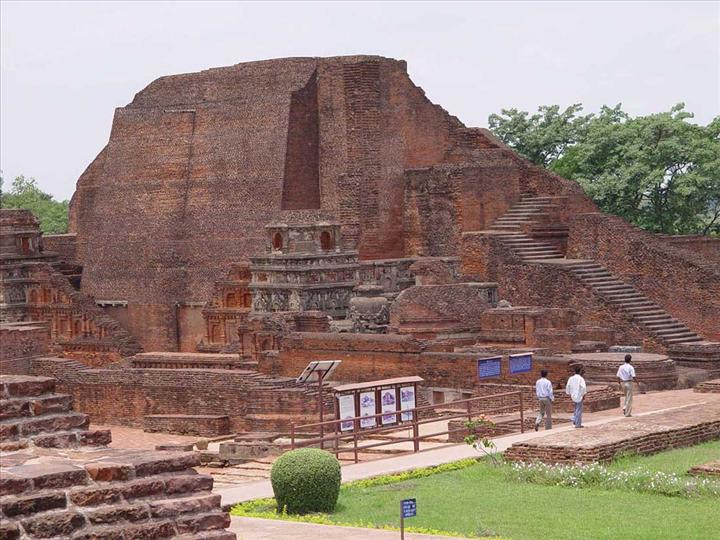
(a) Identify the monument shown in the image and describe its historical significance during the Gupta period.
(b) Name some of the foreign countries from which students came to study at Nalanda.
(c) What were the names of the three great libraries? Discuss the importance of these libraries in preserving and advancing knowledge during the Gupta period.
Answer
(a) The monument shown is the ruins of Nalanda University, the most renowned educational institution of ancient India, located near Rajagriha in Bihar. It was founded during the reign of Kumaragupta in the middle of the 5th century CE. Nalanda provided various facilities to students and had three great libraries. It holds special historical significance as the foremost centre of higher learning of the Gupta period, attracting scholars from across Asia.
(b) The foreign students who came to study at Nalanda included individuals from China, Korea, Japan, Tibet, Sri Lanka, and Southeast Asia.
(c) The three great libraries were called Ratnasagar, Ratnadadhi and Ratnaranjak.
- Preserving Knowledge: These libraries housed important manuscripts on Buddhism, philosophy, medicine, and astronomy, preserving ancient wisdom for future generations.
- Intellectual Exchange: Nalanda attracted scholars from across Asia, fostering a global exchange of ideas and knowledge.
- Advancing Learning: The libraries supported research and debate, contributing to the growth of knowledge in various fields.
- Cultural Influence: They played a key role in spreading Indian intellectual traditions to other parts of Asia.