
Who was first ruler of Slave Dynasty?
- Mahmud Ghaznavi
- Qutub-ud-din Aibak
- Illtutmish
- Razia Sultan
Answer
Qutub-ud-din Aibak
Reason — Qutub-ud-din Aibak was the first ruler of the Slave Dynasty. After the death of Muhammad Ghori in 1206 CE, he declared himself the Sultan of Delhi, thereby establishing the Delhi Sultanate and becoming the first ruler of the Slave Dynasty.
Identify the special features of Qutub Minar?
(i) It has 5 storeys.
(ii) The minar is circular tower about 14.3 m at the base.
(iii) Red Sandstone was used in the construction of minar.
- Only (i), (ii)
- Only (i), (iii)
- Only (ii), (iii)
- All of these
Answer
All of these
Reason — All three statements are correct special features of the Qutub Minar. It has five storeys tapering as they ascend, it is a circular tower about 14.3 metres at the base (narrowing to 2.7 metres at the summit), and red sandstone (along with marble and grey quartzite) was used in its construction. Hence, all of these describe its special features.
Which forts were captured by Qutubuddin Aibak?
- Kalinjar in Bundelkhand and Anhilwara in Madhya Pradesh
- Kalinjar in Gujarat and Anhilwara in Madhya Pradesh
- Kalinjar in Gujarat and Anhilwara in Bundelkhand
- Kalinjar in Bundelkhand and Anhilwara in Gujarat
Answer
Kalinjar in Bundelkhand and Anhilwara in Gujarat
Reason — Qutub-ud-din Aibak strengthened his rule through significant conquests, which included the capture of Kalinjar in Bundelkhand and Anhilwara, the Solanki capital in Gujarat.
What were Markets Superintendents called?
- Shahana-i-Mandi
- Raja-i-Mandi
- Razia-a-Mandi
- Razia-i-Sultan
Answer
Shahana-i-Mandi
Reason — Under Alauddin Khilji's market regulations, the market superintendent who controlled the markets was known as the Shahana-i-Mandi. Traders were required to register with him and faced strict penalties for fraudulent practices.
What is dagh?
- Brandings of horses
- Branding of dogs
- Brandings of Bulls
- None of these
Answer
Brandings of horses
Reason — Dagh refers to the branding of horses. Alauddin Khilji introduced this system so that soldiers could not show the same horse more than once or replace it with a weaker one, thereby preventing fraudulent practices in the army.
"Muhammad-Bin-Tughlaq has been unkindly called by historians as 'the wisest fool'". Which of the following statements correctly describes the same?
- He was a great scholar, mathematician and philosopher
- His very sensible and rational ideas failed as he chose wrong methods to implement them in haste
- All his schemes emptied his treasury
- His prestige suffered and there were many rebellions in his kingdom
Answer
His very sensible and rational ideas failed as he chose wrong methods to implement them in haste
Reason — Muhammad-bin-Tughlaq was called the 'Wisest Fool' because, although he was a great scholar, mathematician and philosopher, his sensible and rational ideas failed as he chose the wrong methods to implement them in haste. It was this failure of his rational ideas due to faulty implementation, rather than his scholarship, the emptying of his treasury, or the rebellions alone, that best describes why he earned this title.
Identify the reasons why the use of token currency by Muhammad-bin Tughlaq failed?
P : People or public at large started making copper coins at home.
Q : Market was flooded with fake copper coins.
R : Foreign traders refused to accept them.
S : The Government suffered a great financial loss as it had to take back even the fake coins.
- P and Q
- Q and R
- R and S
- P and S
Answer
P and Q
Reason — The token currency failed chiefly because the Sultan did not ensure that only the government would mint copper coins. As a result, people started making copper coins at home (P) and the market was flooded with fake copper coins (Q). These were the direct reasons for its failure. The refusal of foreign traders to accept the coins (R) and the government's financial loss (S) were consequences of this failure rather than its causes. Hence, P and Q are correct.
Who was founder of Tughlaq dynasty?
- Ala-ud-Khalji
- Razia Sultan
- Balban
- Gazi Malik
Answer
Gazi Malik
Reason — Ghazi Malik, also known as Ghiyasuddin Tughlaq, was the founder of the Tughlaq dynasty. In 1320, the Sultanate passed into his hands and he established his own dynasty.
Read the two statements given below about Alauddin's Deccan campaign. Select the option that shows the correct relationship between (A) and (B).
(A) : His campaigns in the South were carried on by his commander Malik Kafur who even attacked Madurai.
(B) : The Yadavas of Devagiri, the Kakatiyas of Warrangal and the Hoysalas of Dwarasamudra were defeated by Malik Kafur.
- (B) contradicts (A)
- (B) is the reason for (A)
- (A) is true but (B) is false
- (A) and (B) are independent of each other
Answer
(B) is the reason for (A)
Explanation — Both statements are true. Malik Kafur carried on Alauddin's campaigns in the South, defeating the Yadavas of Devagiri, the Kakatiyas of Warangal and the Hoysalas of Dwarasamudra, and eventually advancing as far as Madurai. His successive victories over these southern kingdoms were what enabled him to push deeper into the peninsula and attack Madurai. Therefore, (B) is the reason for (A).
Which Delhi Sultan had the ambition to become Sikandar-i-Sani?
- Balban
- Alauddin Khalji
- Muhammad-bin-Tughlaq
- Ibrahim Lodhi
Answer
Alauddin Khalji
Reason — Alauddin Khalji had the ambition to become Sikandar-i-Sani. He even contemplated conquering the entire world, with some sources suggesting that he sought to emulate Alexander the Great, whose title Sikandar-i-Sani (the Second Alexander) he wished to adopt.
Who introduced 'Chehra' and 'dagh'?
- Alauddin Khalji
- Balban
- lltutmish
- Muhammad bin Tughlaq
Answer
Alauddin Khalji
Reason — As part of his military reforms, Alauddin Khalji introduced the chehra system (identity documentation for soldiers) and the dagh system (branding of horses) to prevent fraudulent practices and maintain discipline in the army.
Saloni is preparing a project on Slave dynasty. She is Most likely to highlight the reign of which Sultan?
- Qutbuddin Aibak
- Razia
- Balban
- Nasiruddin Mahmud
Answer
Balban
Reason — Balban was the greatest ruler of the Slave dynasty. He expanded the empire, fortified its frontiers, repelled Mongol invasions, and maintained strict control over the nobles through his 'blood and iron policy'. Hence, a project on the Slave dynasty would most likely highlight his reign.
Consider the two statements given below and select the option that shows the correct relationship between (A) and (R).
Assertion (A): Muhammad-bin-Tughlaq shifted his capital from Delhi to Devagiri.
Reason (R): Devagiri was centrally located and was not prone to Mongol invasions.
- Both (A) and (R) are true, and (R) is the correct explanation of (A)
- Both (A) and (R) are true, but (R) is not the correct explanation of (A)
- (A) is true but (R) is false
- (A) is false but (R) is true.
Answer
Both (A) and (R) are true, and (R) is the correct explanation of (A).
Explanation — Muhammad-bin-Tughlaq shifted his capital from Delhi to Devagiri (renamed Daulatabad) because Delhi was too close to the North-West frontier from where the Mongols attacked regularly. Devagiri, lying in the south and centrally located within his empire, was far from the Mongol frontier and thus not prone to their invasions. Therefore (R) correctly explains (A).
Consider the two statements given below and select the option that shows the correct relationship between (A) and (R).
Assertion (A): Alauddin introduced innovative market reforms.
Reason (R): Its main aim was to make available cheap grains and other items for general public.
- Both (A) and (R) are true, and (R) is the correct explanation of (A)
- Both (A) and (R) are true, but (R) is not the correct explanation of (A)
- (A) is true but (R) is false
- (A) is false but (R) is true.
Answer
(A) is true but (R) is false.
Explanation — Alauddin Khilji did introduce innovative market reforms, so (A) is true. However, the main aim of these reforms was to sustain a large standing army at reduced cost by keeping the prices of essential goods low, and not primarily to make cheap grains and other items available for the general public. Hence (R) is false.
Name any two rulers of the Slave dynasty.
Answer
Two rulers of the Slave dynasty are — Qutub-ud-din Aibak and Iltutmish.
What new name was given to Devagiri?
Answer
The new name given to Devagiri was Daulatabad.
Name the Delhi Sultan who first of all invaded the Deccan.
Answer
The Delhi Sultan who first invaded the Deccan was Alauddin Khilji.
Who began and completed the construction of Qutub Minar?
Answer
Qutub-ud-din Aibak began the construction of the Qutub Minar, while Iltutmish, his successor, completed it.
Read the following excerpt and answer the question that follows:
"Malik Kafur was one among them who later became the trusted commander of the Khalji forces and led the invasions to South India"
(Source: https://www.nios.ac.in/media/documents/SrSec315NEW/315\_History\_Eng/315\_History\_Eng\_Lesson9.pdf)
Name three kingdoms defeated by Malik Kafur in the south.
Answer
The three kingdoms defeated by Malik Kafur in the south were — Yadava kingdom (Devagiri), Kakatiya kingdom (Warangal), and Hoysala kingdom (Dwarasamudra)
In which region did Muhammad-bin-Tughlaq raise taxes, and why was it a mistake?
Answer
Muhammad-bin-Tughlaq raised taxes in the Doab region, which was the fertile land area. However, this policy was a mistake as the area was suffering from famine in the year the taxes were raised.
Explain the Deccan expedition of Alauddin Khilji.
Answer
In 1307, Alauddin Khilji sent Malik Kafur to Devagiri to enforce tribute from the Yadava ruler, Ramachandra Dev, who was defeated again but allowed to rule in return for annual tribute and a marriage alliance. In 1310, Kafur defeated the Kakatiya ruler Prataprudradev of Warangal, who agreed to pay regular tribute. The campaign brought immense wealth, including the Kohinoor diamond. Kafur then captured Dwarasamudra, where the Hoysala king Vira Ballala III surrendered and accepted Khilji's suzerainty. Finally, Kafur plundered Madurai and other temple cities like Srirangam. These expeditions brought huge amounts of gold, jewels, and valuables to Delhi, greatly enriching Alauddin's empire.
Explain the significance of the Qutub Minar as a historical monument.
Answer
The Qutub Minar is a significant historical monument built by Qutubuddin Aibak and completed by Iltutmish in 1220 CE. It was started in 1199 CE and dedicated to the Sufi saint Qutub-ud-din Bakhtiyar Kaki. It is world-famous for its great height and architectural design, standing 72.5 metres tall, making it the tallest brick minaret in the world.
The minar has five storeys that taper as they ascend, with a base diameter of 14.3 metres narrowing to 2.7 metres at the top. It is constructed using red sandstone, marble, and grey quartzite. The structure features verses from the Holy Quran, intricate carvings, and floral motifs. According to Lane-Poole, its jutting balconies, alternating fluting, and fine Arabic inscriptions highlight its beauty and craftsmanship. It is considered an architectural marvel that every visitor to Delhi should see.
Read the following excerpt and answer the questions that follow:
"Qutbuddin Aibak was a Turkish slave who had risen to high rank in Muhammad Ghori's army. After Muhammad Ghori's death in AD 1206, the control of his Indian possessions was passed on to Qutbuddin Aibak."
(Source: https://www.nios.ac.in/media/documents/SrSec315NEW/315\_History\_Eng/315\_History\_Eng\_Lesson9.pdf)
(a) Who appointed Qutubuddin Aibak as Viceroy of Delhi?
(b) What led to Qutubuddin Aibak becoming the Sultan of Delhi?
Answer
(a) Muhammad Ghori appointed Qutub-ud-din Aibak as the Viceroy of Delhi.
(b) After the death of Muhammad Ghori in 1206, Qutub-ud-din Aibak assumed control of the Indian territories and declared himself the Sultan of Delhi.
What steps were undertaken by Alauddin to control the nobility?
Answer
Alauddin Khalji undertook several steps to control the nobility and maintain centralized authority:
- Nobles were prohibited from holding private gatherings or forming marriage alliances without the Sultan's approval, preventing them from forging independent power bases.
- Gambling was strictly forbidden to maintain discipline and social order.
- An efficient spy system was established to monitor the activities of nobles and detect potential conspiracies.
Name two major administrative experiments undertaken by Muhammad-bin-Tughlaq.
Answer
Two major administrative experiments undertaken by Muhammad-bin-Tughlaq are:
- He raised the taxes in Doab region which was very fertile. The area was suffering a famine in the year he raised the taxes.
- The Sultan decided to move his capital from Delhi to Devagiri (renamed Daulatabad) to avoid Mongol attacks from the North-West. He ordered the entire population to shift, leading to many casualties due to poor planning, lack of transport, and provisions.
Describe the revenue reforms of Alauddin Khilji.
Answer
The revenue reforms of Alauddin Khilji are:
- Alauddin tried to increase revenue collection by raising demand, implementing direct collection, and controlling the intermediaries.
- Alauddin intended to bring most parts of Doab into Khalisa land. Peasants were required to pay taxes in cash and not in kind.
- He confiscated the landed property of all courtiers and officers.
- Khots, Muqaddams, and Choudharies (rural landlords) were required to pay taxes to the state.
- All revenue assignments were cancelled and revenue was collected directly by central administration.
- He undertook to regularly inspecting the records of Patwari (Village accountant) to eliminate bribery.
- Alauddin also ordered a new revenue survey of all land and implemented a uniform tax rate for all classes, set at half of the standing crop. Special taxes were imposed an pastures (chari) and houses (ghari), affecting both rural and urban populations.
Read the following excerpt and answer the questions that follow:
"Since Alauddin wanted to maintain a large army, he therefore, lowered and fixed the price of the commodities of daily use. To control the prices, Alauddin set up three different markets for different commodities in Delhi. These markets were the grain market (Mandi), cloth market (Sarai Adl) and the market for horses, slaves, cattles, etc."
(Source: https://www.nios.ac.in/media/documents/SrSec315NEW/315\_History\_Eng/315\_History\_Eng\_Lesson9.pdf)
(a) What measures did Alauddin Khalji take to control markets and prices?
(b) Why was the establishment of Shahana-i-Mandi significant for market regulation?
(c) How did Alauddin Khalji ensure the availability of essential commodities to the people?
Answer
(a) Alauddin Khalji took several measures to control markets and prices, including:
- Fixing the Prices: He lowered and fixed the prices of essential commodities to ensure they remained affordable.
- Setting Up Different Markets: He established three distinct markets in Delhi to regulate different types of goods:
- Grain Market (Mandi)
- Cloth Market (Sarai Adl)
- Market for Horses, Slaves, Cattle, etc.
(b) The establishment of Shahana-i-Mandi was significant because it helped in overseeing and enforcing the regulation of prices in the markets. This system ensured that merchants adhered to the fixed prices, preventing them from exploiting the public and helping to maintain market stability.
(c) Alauddin Khalji ensured the availability of essential commodities by lowering their prices and maintaining a large stock of goods. This helped in stabilizing supply and made sure that essential items were always accessible to the people.
With reference to the Delhi Sultanate, answer the following questions to understand its historical significance and contributions:
(a) How did disunity among Indian kings pave the way for the Turks to establish their rule?
(b) Why was the Delhi Sultanate significant in medieval Indian history?
(c) Name the five dynasties that ruled the Delhi Sultanate and their respective time periods.
Answer
(a) During the 10th and 11th centuries, North India saw the emergence of many small kingdoms and due to the absence of a strong central government, these kingdoms were often in conflict with one another, leading to a lack of political unity. This disunity paved the way for the Turks to achieve swift victories during their conquests in the 11th and 12th centuries. By the 13th century CE, their empire was firmly established.
(b) The Delhi Sultanate ruled much of present-day India, Pakistan, and Bangladesh for over 300 years. The rulers of the five dynasties, known as Sultans, governed from Delhi, which served as their capital and gave this period its name. This period saw the rise of many important reforms in most parts of India, that were united under the Delhi Sultanate.
(c) The Delhi Sultanate (1206—1526) was ruled by five successive dynasties :
- The Slave Dynasty (1206—1290)
- The Khalji Dynasty (1290-1320)
- The Tughlaq Dynasty (1320—1414)
- The Sayyid Dynasty (1414—1451)
- The Lodi Dynasty (1451—1526)
With reference to Muhammad-bin-Tughlaq, answer the following:
(a) Give three reasons why Muhammad-bin-Tughlaq is known as the "Wise Fool".
(b) Why did the angry peasants refuse to obey on taxation in Doab?
(c) Why did the Sultan decide to transfer his capital from Delhi to Devagiri in the south?
Answer
(a) Three reasons why Muhammad-bin-Tughlaq is known as the "Wise Fool" are:
- He was a great scholar, mathematician and philosopher, but his plans often failed due to lack of proper planning and execution.
- His decision to move the capital from Delhi to Daulatabad (Devagiri), which caused hardship to the people, and a lot of people lost their lives.
- He increased taxes in the Doab region at the time of the famine, which angered the peasants and led to widespread revolt.
(b) The angry peasants refused to obey the taxation in Doab as at the time the taxation was implemented, the area was suffering from a famine.
(c) The Sultan decided to transfer his capital from Delhi to Devagiri (Daulatabad) in the South. This is because Delhi was too close to the North-West frontier from where the Mongols attacked regularly.
Analyse the administrative structure of the Delhi Sultanate by addressing the following aspects:
(a) The role and powers of the Sultan in governance.
(b) The organisation and functions of the Central Government.
(c) Land Revenue System
Answer
(a) The Sultan was an absolute ruler, often exercising considerable power over his subjects. He ruled with the help of nobles. The law was based on the Islamic tradition. Qazis and Ulemas played important roles in the judicial and religious aspects of governance. The power of the Sultan was based on the military force, the loyalty of nobles, and strong administrative systems. He administered all the functions of the government. Though wars were frequent, the Sultan's income also came from taxes, trade, and land revenue, not just booty.
(b) The government was run under various departments. Four departments were most important. Each department was supervised by a minister or a high officer. The Wazir was the Prime Minister. He headed the diwan-i-wizarat. The Diwani-Arz looked after the military organisation, headed by Ariz-i-Mumalik. The Qazi was the Chief Justice and the judicial system was based on the Islamic Law. The department of diwan-i-insha looked after the state correspondence. The diwan-i-risalat looked after religious affairs and education.
(c) Land revenue was the main source of income for the Delhi Sultans. Some land was reserved for the Sultan, and its revenue was used for his personal expenses. The remaining land was given to officers and nobles, who kept part of the revenue as salary and used another part to maintain soldiers, still keeping enough for a luxurious life.
Revenue was categorized into:
- Kharaj (tax on cultivation)
- Jizya (tax on non-Muslims)
- Khams (one-fifth of war booty)
- Zakat (tax on flocks, herds, gold, silver, etc. from Muslims)
A separate Agriculture Department, Diwan-i-Amir Kohi, managed land revenue collection, assisted by officers like Muqqadams and Patwaris.
With reference to the given picture, answer the following questions:
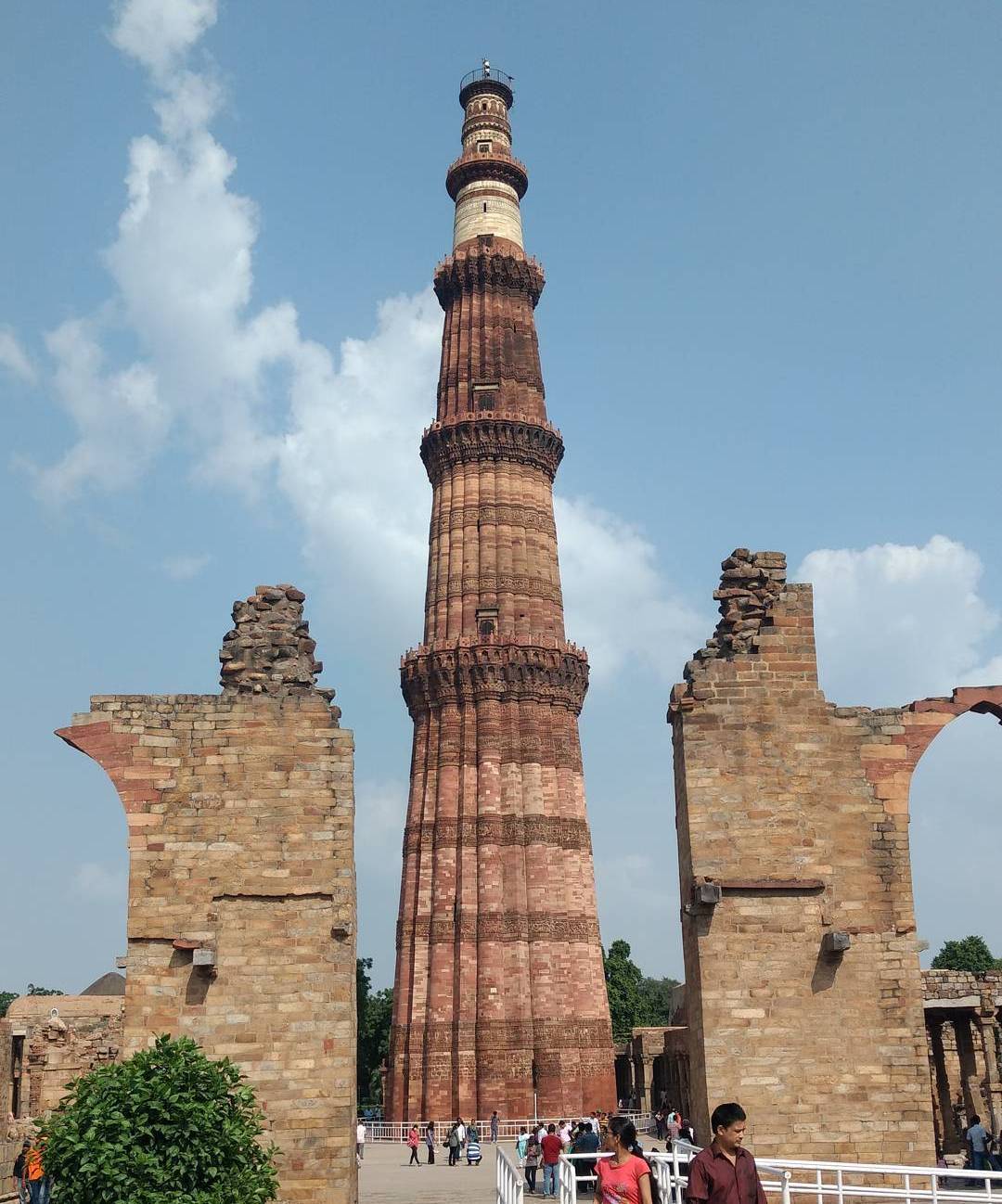
(a) Where is it located?
(b) Who began its construction?
(c) Who completed it?
(d) What are its important features?
Answer
(a) The picture shows the Qutub Minar, which is located in Delhi, India.
(b) Its construction was begun by Qutub-ud-din Aibak in 1199 CE.
(c) It was completed by Iltutmish in 1220 CE.
(d) Its special features are:
- It is 72.5 tall, making it the tallest minaret in the world made of bricks.
- It has five storeys tapering as they ascend.
- The minar is circular tower about 14.3 metres at the base and tapers to the width of 2.7 metres at the summit.
- Red sandstone, marble and grey quartzite were used in the construction of the Minar.
- Verses from the Holy Quran and some intricate carvings, floral motifs are inscribed on this minar.