
Consider the two statements given below and select the option that shows the correct relationship between (A) and (R).
Assertion (A): The writ 'Mandamus' means 'we command'.
Reason (R): This writ is issued by a court to a public servant to enquire into the legality of his holding a public office.
- Both (A) and (R) are true, and (R) is the correct explanation of (A)
- Both (A) and (R) are true, but (R) is not the correct explanation of (A)
- (A) is true but (R) is false
- (A) is false but (R) is true
Answer
(A) is true but (R) is false
Explanation — Mandamus literally means "we command". The statement in (R) describes the writ of Quo Warranto, which is issued to enquire into the legality of a person's claim to a public office, not Mandamus.
Which of the following is not a Fundamental Right?
- Right against exploitation
- Equality of opportunity in matters of public appointment
- Right to strike
- Right to freedom of practising any profession
Answer
Right to strike
Reason — The Constitution guarantees Fundamental Rights such as the Right against Exploitation, Equality of Opportunity in matters of public employment, and the Right to practise any profession. The Right to strike is not one of the Fundamental Rights.
How can the Fundamental Rights be protected by a citizen?
- By approaching the Supreme Court or High Courts which will issue appropriate writs against the authority
- Parliament will take note of such violations and tell the courts
- The Executive will inform the Courts
- It is automatically protected
Answer
By approaching the Supreme Court or High Courts which will issue appropriate writs against the authority
Reason — Under the Right to Constitutional Remedies (Article 32), a citizen whose Fundamental Rights are violated can approach the Supreme Court or the High Courts. These courts have the power to issue appropriate writs to protect Fundamental Rights.
Under what circumstances can some of the Fundamental Rights be suspended?
- On the order of court
- When President's rule is imposed
- When a proclamation of National Emergency is in operation
- During financial emergency
Answer
When a proclamation of National Emergency is in operation
Reason — Fundamental Rights are suspendable. Certain rights, such as those under Article 19, can be suspended during a National Emergency proclaimed under Article 352 to safeguard national interest and integrity. However, the rights under Articles 20 and 21 remain enforceable.
Which Fundamental Right can be said to be specially applicable to children?
- Right to education up to 14 years of age
- Right to employment up to 14 years of age
- Right to be educated in the mother tongue in primary education
- Right to employment in dangerous occupations
Answer
Right to education up to 14 years of age
Reason — Article 21A, added by the Constitution (86th Amendment) Act, 2002, provides for free and compulsory education for all children between the ages of 6 and 14 years. It is therefore the Fundamental Right specially applicable to children.
With reference to the image given below, identify the Fundamental Right.

- Right against Exploitation
- Cultural and Educational Rights
- Right to Constitutional Remedies
- Right to Freedom of Religion
Answer
Right against Exploitation
Reason — The image depicts child labour. Article 24, which falls under the Right against Exploitation, prohibits the employment of children below the age of 14 in mines, factories and other hazardous occupations.
What does the phrase 'equality before the law' used in Article 14, mean?
- That all individuals are equal
- That all laws are the same for everybody
- That all individuals are equally subjected to the ordinary law of the land
- That everybody is to be treated equally by the law in equal circumstances
Answer
That all individuals are equally subjected to the ordinary law of the land
Reason — Article 14 guarantees equality before the law and equal protection of the laws. It means that no person is above the law and that all individuals are equally subject to the ordinary law of the land.
Complete the analogy
Prohibition of discrimination: Article 15 :: ............... : Article 17
- Protection of life and liberty
- Abolition of titles
- Freedom to manage religious affairs
- Abolition of untouchability
Answer
Abolition of untouchability
Reason — Just as Article 15 provides for the prohibition of discrimination, Article 17 abolishes the practice of untouchability and forbids its practice in any form.
Mr. Verma faced discrimination based on his religion during a job application process. Which Fundamental Right has been violated in this situation?
- Right to Freedom of Religion (Article 25)
- Right to Freedom of Speech (Article 19)
- Right against Exploitation (Article 23)
- Right to Equality (Article 14)
Answer
Right to Equality (Article 14)
Reason — The Right to Equality prohibits discrimination on grounds of religion and guarantees equality of opportunity in matters of public employment. Therefore, discrimination on the basis of religion violates this Fundamental Right.
Which is the Fundamental Duty depicted in the below image?

- To defend the country and render national service when called upon to do so
- To abide by the Constitution and respect its ideals and institutions, the National Flag and the National Anthem
- To safeguard public property
- To strive towards excellence in all spheres of individual and collective activity
Answer
To abide by the Constitution and respect its ideals and institutions, the National Flag and the National Anthem
Reason — Article 51A(a) of the Constitution lays down that it shall be the duty of every citizen of India to abide by the Constitution and respect its ideals and institutions, the National Flag and the National Anthem. This is the duty depicted in the image.
Which one of the following rights was described by B.R. Ambedkar as 'the heart and soul of the constitution'?
- Right to Freedom of Religion
- Right to Property
- Right to Equality
- Right to Constitutional Remedies
Answer
Right to Constitutional Remedies
Reason — The Right to Constitutional Remedies (Article 32) is the most important of the Fundamental Rights, as it is the only guarantee against encroachment on the other rights. Without it, the remaining rights would have been meaningless. Dr. B.R. Ambedkar therefore described it as the very soul of the Constitution and the very heart of it.
The Preventive Detention Act has a restraining effect on
- Right to Equality
- Right to Freedom
- Right to Freedom of Religion
- Right to Constitutional Remedies
Answer
Right to Freedom
Reason — The Right to Freedom is not absolute. Various laws passed by the Parliament, such as MISA (Maintenance of Internal Security Act), ESMA (Essential Services Maintenance Act) and the Preventive Detention Act, have imposed certain restrictions on the exercise of this Right, under which a person can be detained for up to three months without trial.
Consider the two statements given below and select the option that shows the correct relationship between (A) and (R).
Assertion (A): Fundamental Rights are justiciable.
Reason (R): Fundamental Duties are not justiciable.
- Both (A) and (R) are true, and (R) is the correct explanation of (A)
- Both (A) and (R) are true, but (R) is not the correct explanation of (A)
- (A) is true but (R) is false
- (A) is false but (R) is true
Answer
Both (A) and (R) are true, but (R) is not the correct explanation of (A)
Explanation — Fundamental Rights are justiciable because a person can approach a court if these rights are violated. Fundamental Duties are not justiciable and are not legally enforceable. Therefore, both statements are true, but the Reason does not explain the Assertion.
The Right to Education (RTE) is a Fundamental Right. Which of the following statements correctly describes the same?
- It is applicable to all citizens
- It is a Fundamental Right since the enforcement of the Constitution
- It is a temporary law
- It makes education as a Fundamental Right of every child between the ages of 6 and 14 years
Answer
It makes education as a Fundamental Right of every child between the ages of 6 and 14 years
Reason — The Right to Education Act makes education a Fundamental Right of every child between the ages of 6 and 14 years. It is not applicable to all citizens, nor is it a temporary law, and it became a Fundamental Right only in 2002 through the 86th Amendment and not since the enforcement of the Constitution.
Identify the characteristics of the Fundamental Rights.
P : They are bestowed on every citizen without consideration of caste, creed, religion, sex or place of birth.
Q : They are absolute as no restrictions can be imposed on them even by our Parliament.
R : These rights can never be suspended, even during Emergency.
S : These are justiciable, meaning they can be enforced in a court of law.
Options:
- P and Q
- Q and R
- P and S
- R and S
Answer
P and S
Reason — P is correct because Fundamental Rights are available to every citizen without discrimination. S is correct because these rights are justiciable and can be enforced in a court of law. Q is incorrect because Fundamental Rights are subject to reasonable restrictions, and R is incorrect because some Fundamental Rights can be suspended during a National Emergency.
Read the two statements given below about the Right to Constitutional Remedies. Select the correct relationship between (A) and (B).
(A) The apex court has been vested with the power to issue orders, directions and writs in order to protect the fundamental rights of the complainant.
(B) Article 32 confers upon the citizens this Right which implies that every citizen is entitled to move the Supreme Court or any High Court if his / her Fundamental Right is encroached upon or abridged by the state, any authority or any person.
- (B) contradicts (A)
- (B) is the reason for (A)
- (A) is true but (B) is false
- (A) and (B) are independent of each other
Answer
(B) is the reason for (A)
Explanation — Article 32 of the Constitution confers upon the citizens the Right to Constitutional Remedies, which implies that every citizen is entitled to move the Supreme Court or the High Courts if his or her Fundamental Rights are encroached upon. It is because of this Article that the courts have been vested with the power to issue orders, directions and writs in order to protect the rights of the complainant. Hence, (B) is the reason for (A).
Identify the odd one out.
- Right against Exploitation
- Right to Constitutional Remedies
- Cultural and Educational Rights
- To value and preserve the rich heritage of our composite culture
Answer
To value and preserve the rich heritage of our composite culture
Reason — The first three are Fundamental Rights, whereas to value and preserve the rich heritage of our composite culture is a Fundamental Duty. Hence, it is the odd one out.
A college student named Sheela is making a project on Fundamental Duties. Which of the following amendments, she is most likely to study in detail?
- 42nd Amendment Act (1976)
- 42nd Amendment Act (1978)
- 44th Amendment Act (1978)
- 45th Amendment Act (1980)
Answer
42nd Amendment Act (1976)
Reason — Fundamental Duties were added to the Constitution by the 42nd Amendment Act, 1976. Therefore, Sheela would study this Amendment.
Explain the term Fundamental Rights.
Answer
Fundamental Rights are the basic rights essential for the development and all-round progress of an individual. It is the duty of the State to ensure that these rights are not denied to the citizens.
Name the different Fundamental Rights guaranteed to the citizens of India.
Answer
The different Fundamental Rights guaranteed to the citizens of India are:
- Right to Equality
- Right to Freedom
- Right against Exploitation
- Right to Freedom of Religion
- Cultural and Educational Rights
- Right to Constitutional Remedies
Explain the term Right to Equality.
Answer
The Right to Equality establishes equality before the law and equal protection of the law, regardless of status, caste, creed, religion, sect, sex or colour.
Read the excerpt given below and identify the writ discussed here.
"It is a Latin term which literally means 'to have the body'. It is an order issued by the court to a person who has detained another person, to produce the body the latter before."
(Source: Indian Polity by M Laxmikanth)
Answer
The writ described is Habeas Corpus.
Mention one limitation to the exercise of the Right to Freedom of Speech and Expression.
Answer
The Right to Freedom of Speech and Expression cannot be used to endanger the security and integrity of the State.
Name the Fundamental Right that prohibits forced labour.
Answer
The Fundamental Right that prohibits forced labour is the Right against Exploitation.
Name the Fundamental Right that aims at the preservation of culture, language and script of the minorities in India.
Answer
The Fundamental Right that aims at the preservation of culture, language, and script of the minorities in India is Cultural and Educational Rights (Articles 29 and 30).
Ms. Patel was not allowed to practise her religion freely due to the government's ban on religious rituals. Which Fundamental Right is being violated here?
Answer
The Fundamental Right being violated here is the Right to Freedom of Religion (Articles 25 to 28).
With reference to the given newspaper article, examine the fundamental rights that the citizens can use to protect their Fundamental Rights.
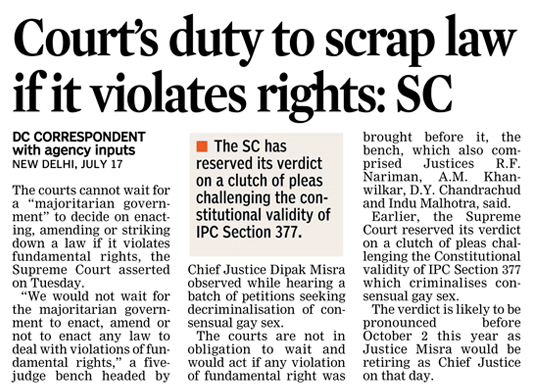
Answer
The Fundamental Right that citizens can use to protect their other Fundamental Rights is the Right to Constitutional Remedies (Article 32).
Mention two Fundamental Rights granted to the citizens of India which bring out the secular nature of the state.
Answer
Two Fundamental Rights granted to the citizens of India which bring out the secular nature of the state are:
- Right to Freedom of Religion.
- Right to Equality.
What is the meaning of Right to Constitutional Remedies?
Answer
The Right to Constitutional Remedies implies that every citizen is entitled to move the Supreme Court or the High Courts if his or her Fundamental Rights are encroached upon or abridged.
Name the Fundamental Right which protects the interests of the linguistic minorities in India.
Answer
The Fundamental Right which protects the interests of the linguistic minorities in India is Cultural and Educational Rights (Articles 29 and 30).
Read the excerpt given below and answer the question that follows:
"Our ideas and personality develop only when we are able to freely communicate with others."
(Source: Democratic Politics- I by NCERT)
Briefly explain the Fundamental Rights discussed here.Answer
The Fundamental Right being discussed here is the Right to Freedom of Speech and Expression.
This right allows citizens to express their views freely on matters of public and national importance. However, it cannot be misused to slander others, endanger the security of the State or incite violence.
Mention two Fundamental Duties of the Indian citizens.
Answer
Two Fundamental Duties of the Indian citizens are:
- To abide by the Constitution and respect its ideals and institutions, the National Flag and the National Anthem.
- To uphold and protect the sovereignty, unity and integrity of India.
Why has the practice of awarding titles been abolished by the Constitution?
Answer
The practice of awarding titles has been abolished by the Constitution. This has been done because conferring such titles goes against the spirit of social equality. Only military and academic degrees can be conferred.
Explain the term writ.
Answer
A writ is a formal written order issued by the Supreme Court or a High Court to enforce Fundamental Rights.
Ravi, a social activist, found that his friend, Sunil, had been arrested by the police without being informed of the charges against him. Sunil was not presented before a Magistrate within 24 hours, as law requires. Ravi approached the High Court, seeking Sunil's immediate release, arguing that his detention was unlawful.
Which writ can Ravi file in the High Court to ensure Sunil's immediate release from unlawful detention? Explain the writ in brief.
Answer
Ravi can file a Habeas Corpus writ in the High Court to ensure Sunil's immediate release from unlawful detention.
Habeas Corpus — It means 'to have the body'. By issuing such a writ, the court can get the body of any person released if it has been unlawfully detained by any person or a group of persons or by the State. This writ is thus a significant safeguard for the personal freedom of a citizen.
What is the significance of Fundamental Duties?
Answer
Fundamental Duties specify one's obligations to society and the nation. Though they are not legally enforceable, they remind citizens of their responsibilities towards the country.
The Right to Education (RTE) Act is a landmark in ensuring educational equality in India. Based on the provided statement, answer the following questions:
(a) Explain the significance of the 86th Amendment of the Indian Constitution in the context of elementary education.
(b) Analyse how the reservation of 25% of seats for weaker sections in private and minority schools helps promote social equality.
Answer
(a) The Right to Education at elementary level has been made one of the Fundamental Rights in 2002 under the 86th Amendment of the Indian Constitution. The Act makes education a Fundamental Right of every child between the ages of 6 and 14 and specifies certain minimum norms in elementary schools.
(b) The 25% reservation for weaker sections in private and minority schools, as mandated by the Right to Education Act (RTE), plays a significant role in promoting social equality. By ensuring that children from economically disadvantaged backgrounds have access to quality education in private schools, the reservation helps bridge the gap between rich and poor in terms of educational opportunities.
"The Right to Freedom is actually a cluster of several rights." In this context explain the following:
(a) How far do you agree with this view?
(b) Explain the different rights incorporated in the Right to Freedom.
Answer
(a) I fully agree with this view.
The Right to Freedom, as enshrined in the Indian Constitution under Articles 19 to 22, is not a single, isolated right but rather a bundle (or cluster) of rights that ensure various kinds of individual and collective freedoms to the citizens of the Republic of India.
(b) Different rights incorporated in the Right to Freedom are:
- Right to Freedom of Speech and Expression — Citizens of India can freely discuss all matters concerning public as well as national well-being orally or through the press, but cannot slander others, jeopardise the safety and integrity of the State or incite violence.
- Freedom to Assemble Peacefully and without Arms — Peaceful assembly is allowed for the exchange of views and propagation.
- Freedom to Form Associations or Unions — To protect both individual and collective interests, the Constitution guarantees this right. However, restrictions can be imposed if unions or associations threaten state security or engage in illegal or immoral activities.
- Freedom to Free Movement — Every Indian citizen has the right to move freely across the country, except in private properties. No one can be detained without legal authority, though the State may impose restrictions in the public interest.
- Freedom to Reside and Settle in Any Part of the Territory of India — Every citizen of India can reside anywhere in the country, provided it doesn't harm the interests of weaker sections. Property can be owned or transferred freely, except in protected tribal areas. The State may acquire property for public use.
- Freedom to Practise Any Profession or to Carry on Any Occupation — The Constitution grants every citizen the right to practise any profession or occupation, provided it does not harm public interest or violate moral ethics, such as trafficking or smuggling.
With reference to the Right to Equality explain the following :
(a) Which articles of the Constitution deal with these rights?
(b) Describe the subject matter of any two of these rights.
Answer
(a) The Right to Equality is covered under Articles 14 to 18 of the Indian Constitution. These articles aim to establish equality before the law and prohibit discrimination on various grounds.
(b) The subject matter of any two of these rights are as follows:
- Article 14 establishes equality before the law and equal protection of the law, regardless of status, caste, creed, religion, sect, sex or colour.
- Article 17 of the Indian Constitution abolishes the practice of untouchability, declaring it forbidden in any form. This landmark provision prohibits untouchability and criminalises the enforcement of any disability arising from it.
With reference to Fundamental Duties explain the following :
(a) Mention any four Fundamental Duties.
(b) Why have Fundamental Duties been included in the Constitution?
Answer
(a) Four fundamental duties are given below:
- To abide by the Constitution and respect its ideals and institutions, the National Flag and the National Anthem.
- To cherish and follow the noble ideals which inspired our national struggle for freedom.
- To uphold and protect the sovereignty, unity and integrity of India.
- To defend the country and render national service when called upon to do so.
(b) Fundamental Duties have been included in the Constitution to remind citizens that rights and responsibilities go hand in hand. While the Constitution grants various Fundamental Rights, it also expects citizens to uphold the unity, integrity, and values of the nation.
The writs are significant tools for upholding justice and protecting Fundamental Rights in a democratic system.
Answer the following questions based on your understanding:
(a) Explain the meaning of the term 'writ' and its importance in ensuring justice and the protection of rights.
(b) Differentiate between Prohibition and Certiorari.
(c) Apply the concept of writs to the following situation:
A person is appointed as the head of a government department without meeting the necessary qualifications required for the position. Which writ can be filed to challenge the legality of this appointment and why?
Answer
(a) A writ is a formal written order issued by the Supreme Court or a High Court. It provides legal remedies to individuals who are not adequately protected under ordinary laws. The Constitution empowers the Supreme Court and the High Courts to issue certain writs.
The writs are important because:
- They serve as powerful tools to protect citizens' rights.
- Help prevent arbitrary actions by public authorities.
- Ensure legal accountability and uphold the rule of law.
- Empower citizens to directly approach the courts when their rights are violated.
(b) The difference between Prohibition and Certiorari are given below:
| Aspect | Prohibition | Certiorari |
|---|---|---|
| Meaning | This writ is an order from a superior court — the Supreme Court or a High Court — to an inferior court to stop proceedings in a case. | This writ is issued by a superior court to the judicial or quasi-judicial authorities in order to quash their order or decision. |
| Purpose | To prevent a court or authority from acting beyond its jurisdiction. | To correct or review a wrongful decision already made. |
| Timing | It is issued while proceedings are ongoing. | It is issued after an order has been passed. |
(c) Quo-warranto can be filed to challenge the legality of this appointment.
Since the individual has been appointed as the head of a government department without fulfilling the prescribed qualifications, filing a writ of Quo-Warranto allows the court to examine the validity of the appointment. If the court finds that the appointment was made without proper legal authority or in violation of the rules, it can declare the appointment illegal and order the removal of the person from the office.