
Which among the following Articles of the Indian Constitution deals with Directive Principles of State Policy?
- Articles 32 to 40
- Articles 26 to 41
- Articles 30 to 45
- Articles 36 to 51
Answer
Articles 36 to 51
Reason — The Directive Principles of State Policy are contained in Part IV of the Constitution, which comprises Articles 36 to 51. These principles provide guidelines to the State for making laws and policies for the welfare of the people.
The Directive Principles of State Policy are contained in ............... of the Indian constitution.
- Part V
- Part IV
- Part II
- Part III
Answer
Part IV
Reason — The Directive Principles of State Policy are laid down in Part IV of the Constitution (Articles 36 to 51). Part III contains the Fundamental Rights, while Parts II and V deal with citizenship and the Union respectively.
Right to Fair Compensation and Transparency in Land Acquisition, Rehabilitation and Resettlement bill was passed by the Parliament in
- 2017
- 2013
- 2019
- 2011
Answer
2013
Reason — The Right to Fair Compensation and Transparency in Land Acquisition, Rehabilitation and Resettlement Bill was passed by the Parliament in 2013 and came into force on January 1, 2014. It provides for fair compensation and transparency in land acquisition and assures the rehabilitation of those affected.
Analyse the given image and identify the statement NOT aligned with its context.

- It was launched on February 18, 2016.
- Farmers will have to pay a uniform premium of 2 per cent for all Kharif crops.
- For annual commercial and horticultural crops, farmers will have to pay a premium of 10 per cent.
- Farmers will have to pay a uniform premium of 1.5 per cent for all Rabi crops.
Answer
For annual commercial and horticultural crops, farmers will have to pay a premium of 10 per cent.
Reason — The image refers to the Pradhan Mantri Fasal Bima Yojana (PMFBY), launched on February 18, 2016. Under this scheme farmers pay a uniform premium of 2 per cent for all Kharif crops and 1.5 per cent for all Rabi crops, but for annual commercial and horticultural crops the premium is 5 per cent, not 10 per cent.
............... of the Indian Constitution lays down that in particular the state shall endeavour to bring about prohibition of the consumption, except for medicinal purposes, of intoxicating drinks and of drugs which are injurious to health.
- Article 45
- Article 42
- Article 40
- Article 47
Answer
Article 47
Reason — Article 47 lays down that the State shall endeavour to prohibit the consumption of intoxicating drinks and drugs, except for medicinal purposes, as they are injurious to health. This principle is grouped under the Gandhian Principles.
The Panchayati Raj has been established in rural areas in order to promote the idea of
- Local Self-government
- Welfare at grassroot level
- Self-government
- Healthcare
Answer
Local Self-government
Reason — Article 40 lays down that the State shall take steps to organise village panchayats and endow them with such powers and authority as necessary to enable them to function as units of self-government. The Panchayati Raj therefore promotes local self-government in rural areas.
With reference to the given excerpt, identify the statement that is aligned with its context.
"Dr B. R. Ambedkar described Directive Principles as a "Novel Feature" of the Constitution. They are in the nature of general directions, instructions or guidelines to the State."
(Source: 20 DIRECTIVE PRINCIPLES OF STATE POLICY by the National Institute of Open Schooling)
- Directive Principles are Justiciable
- The Principles focus on making society miserable.
- The Directive Principles give guidelines to the government to make laws and draft their policies according to the objectives of the Constitution.
- They are not a reliable measure to evaluate a government's performance.
Answer
The Directive Principles give guidelines to the government to make laws and draft their policies according to the objectives of the Constitution.
Reason — The Directive Principles are general directions or guidelines to the State; they guide the government in making laws and framing policies according to the objectives of the Constitution. They are not justiciable, they aim at the welfare of the people, and they also serve as a measure to evaluate the government's efforts towards socio-economic justice.
Which among the following articles of the Indian Constitution lays down that the state shall endeavour to secure for the citizens a uniform civil code throughout the territory of India?
- Article 59
- Article 44
- Article 55
- Article 51
Answer
Article 44
Reason — Article 44 lays down that the State shall endeavour to secure for the citizens a uniform civil code throughout the territory of India. It is grouped under the Directive Principles pertaining to Law, Justice and Administration.
Consider the two statements given below and select the option that shows the correct relationship between (A) and (R).
Assertion (A): The VB- G RAM G Act has recently replaced MGNREGA.
Reason (R): It guarantees at least 125 days of work to rural poor.
- Both (A) and (R) are true, and (R) is the correct explanation of (A)
- Both (A) and (R) are true, but (R) is not the correct explanation of (A)
- (A) is true but (R) is false
- (A) is false but (R) is true.
Answer
Both (A) and (R) are true, but (R) is not the correct explanation of (A)
Explanation — The VB- G RAM G Act has replaced the Mahatma Gandhi National Rural Employment Guarantee Act (MGNREGA), 2005, and it does raise the guarantee of wage employment for a rural household from 100 days to 125 days in a year. However, the 125-day guarantee is only a feature of the new Act; it is not the reason for which the Act replaced MGNREGA. Hence, both (A) and (R) are true, but (R) is not the correct explanation of (A).
Identify the correct statement:
- Directive Principles of State Policy are not justiciable
- Directive Principles of State Policy are justiciable
- Directive Principles of State Policy are not meant for the government to create certain privileges for the citizens
- All the above
Answer
Directive Principles of State Policy are not justiciable
Reason — Directive Principles of State Policy are contained in Part IV of the Constitution and are not justiciable, meaning they cannot be enforced by any court of law. They serve as guidelines to the State in making laws and policies for the welfare of the people.
Which statement is true about Article 48(A) of the Indian Constitution?
(i) State shall improve environment.
(ii) State shall protect every monument.
(iii) State shall endeavour to promote international peace and security.
- only (i)
- only (ii)
- only (iii)
- both (i) and (ii)
Answer
only (i)
Reason — Article 48(A) lays down that the State shall endeavour to protect and improve the environment while safeguarding the forests and wildlife of the country. Protection of monuments comes under Article 49 and promotion of international peace and security under Article 51.
There is a difference between Directive Principles and Fundamental Rights. Which of the following statements correctly describes the same?
- Fundamental Rights aim to establish welfare state whereas Directive Principles aim to establish political democracy
- Fundamental Rights are directions to the state to attain certain set objectives whereas the Directives are a certain kind of restrictions on the state
- Courts can issue writs for the enforcement of Directives but not for that of Fundamental Rights
- Directives are not justiciable by any court of law but the Fundamental Rights are justiciable
Answer
Directives are not justiciable by any court of law but the Fundamental Rights are justiciable
Reason — The Directive Principles are not justiciable or enforceable by any court of law, whereas the Fundamental Rights are justiciable and citizens can seek protection from a High Court or the Supreme Court for their enforcement.
When was Jan Dhan Yojana announced?
- 2014
- 1946
- 1950
- 2017
Answer
2014
Reason — The Pradhan Mantri Jan Dhan Yojana, a social upliftment scheme, was announced by the Prime Minister, Narendra Modi on August 15, 2014. Under this scheme bank accounts were opened for the poor to bring them into the financial mainstream.
Promotion of cottage Industries : Article 43 : : Organisation of Panchayat : ...............
- Article 39
- Article 49
- Article 40
- Article 50
Answer
Article 40
Reason — Just as Article 43 provides for the promotion of cottage industries on an individual or cooperative basis in rural areas, Article 40 provides for the organisation of village panchayats as units of self-government. Both are grouped under the Gandhian Principles.
Gandhian Principles consist of :
- organisation of village panchayats
- promotion of educational and economic interests of SCs and STs
- promotion of cottage industries
- All of these
Answer
All of these
Reason — The Gandhian Principles include the organisation of village panchayats (Article 40), promotion of cottage industries (Article 43) and promotion of the educational and economic interests of Scheduled Castes, Scheduled Tribes and other weaker sections (Article 46). Therefore, all the given statements are included under the Gandhian Principles.
Under which Article there is a provision for organisation of agriculture and animal husbandry on modern and scientific lines?
- Article 44
- Article 45
- Article 47
- Article 48
Answer
Article 48
Reason — Article 48 lays down that the State shall endeavour to organise agriculture and animal husbandry on modern and scientific lines and shall take steps for preserving and improving the breeds, prohibiting the slaughter of cows and calves and other milch and drought animals.
Read the two statements given below about National Food Security Act, 2013 and select the option that shows the correct relationship between (A) and (B).
(A) It gives right to subsidised foodgrains to 67 per cent population.
(B) It provides at least 100 days of employment in a year to each rural household in the country.
- (B) contradicts (A)
- (B) is the reason for (A)
- (A) is true but (B) is false
- (A) and (B) are independent of each other
Answer
(A) is true but (B) is false
Explanation — Statement (A) is true, as the National Food Security Act, 2013 gives the right to subsidised foodgrains to 67 per cent of India's population. Statement (B) is false, because the guarantee of at least 100 days of employment in a year to every rural household is provided by the Mahatma Gandhi National Rural Employment Guarantee Act, 2005 and not by the National Food Security Act.
Identify the odd one out of the following welfare schemes launched by the Government.
- PMUY
- PMFBY
- Jan Dhan Yojana
- ABPMJAY
Answer
Jan Dhan Yojana
Reason — PMUY (2016), PMFBY (2016) and ABPMJAY (2018) are all referred to by their abbreviations and were launched between 2016 and 2018, whereas the Jan Dhan Yojana was announced earlier, on August 15, 2014. Hence, it is the odd one out.
Consider the two statements given below and select the option that shows the correct relationship between (A) and (R).
Assertion (A): The women's Reservation Bill was approved by Parliament in 2023.
Reason (R): This legislation provides 33% of total seats in Lok Sabha and State Assemblies as reserved for women.
- Both (A) and (R) are true, and (R) is the correct explanation of (A)
- Both (A) and (R) are true, but (R) is not the correct explanation of (A)
- (A) is true but (R) is false
- (A) is false but (R) is true.
Answer
Both (A) and (R) are true, but (R) is not the correct explanation of (A)
Explanation — The Women's Reservation Bill, also called the Nari Shakti Vandan Adhiniyam, was approved by Parliament on 21st September 2023, and it does provide 33% reserved seats for women in the Lok Sabha and State Assemblies. However, the 33% reservation is a provision of the legislation; it does not explain why the Bill was approved by Parliament in 2023. Hence, both (A) and (R) are true, but (R) is not the correct explanation of (A).
Mention two Directive Principles based on Gandhian ideals.
Answer
Two directive principles based on Gandhian ideals are:
- Organisation of Village Panchayats — Article 40 lays down that the State shall take steps to organise village panchayats and endow them with such powers and authority as necessary to enable them to function as units of self-government.
- Promotion of Cottage Industries — Article 43 lays down that the State shall endeavour to promote cottage industries on an individual or cooperative basis in rural areas.
"The Directive Principles of State Policy are non-justiciable but aim to establish social and economic democracy."
With reference to the given statement answer the question that follows:
What does it mean when Directive Principles are described as non-justiciable?
Answer
The Directive Principles are described as non-justiciable. It means that they are not legally enforceable by the courts.
Name the Directive Principle of State Policy that aims at the upliftment of the weaker sections of the society.
Answer
The Directive Principle of State Policy that aims at the upliftment of the weaker sections of the society is: Promotion of Educational and Economic Interests of Scheduled Castes, Scheduled Tribes and Other Weaker Sections, as mentioned in Article 46.
The newspaper goes on to state that:
"Uttarakhand has announced plans to implement the Uniform Civil Code (UCC) from January 2025, aiming to set a precedent for other states and rekindle national discussions on the UCC."
(Source: Outlook India)
Under which Article of the Directive Principles of State Policy is it mentioned?Answer
The Uniform Civil Code (UCC) is mentioned under Article 44 of the Directive Principles of State Policy. It lays down that the State shall endeavour to secure for the citizens a uniform civil code throughout the territory of India.
Mention one Directive Principle which aims at the welfare of children.
Answer
One Directive principle that aims at the welfare of children is: Welfare of children and youth Article 39(f).
Mention the Directive Principles of State Policy which refer to each of the following :
(i) Public Health, and
(ii) Ancient Monuments.
Answer
(i) Public Health — Duty of the State to raise the level of nutrition, standard of living, and improve public health, as mentioned in Article 47.
(ii) Ancient Monuments — Protection of monuments and places/objects of national importance, as mentioned in Article 49.
State one Directive Principle of State Policy in respect of each of the following :
(i) Economic Equality, and
(ii) Social Equality.
Answer
(i) Economic Equality — Equal pay for equal work for both men and women.
(ii) Social Equality — Promotion of educational and economic interests of Scheduled Castes, Scheduled Tribes, and other weaker sections.
Mention two Directive Principles of State Policy which have been implemented by the Central or a State Government.
Answer
Two Directive Principles of State Policy which have been implemented by the Central or a State Government are:
- Equal Pay for Equal Work – Implemented through the Equal Remuneration Act and subsequent labour laws.
- Right to Work – Implemented through the Mahatma Gandhi National Rural Employment Guarantee Act (MGNREGA), 2005.
What is the main purpose of the Directive Principles of State Policy in the Indian Constitution?
Answer
The main purpose of the Directive Principles of State Policy (DPSPs) in the Indian Constitution is to guide the government while making or implementing laws. They give directions to the State for undertaking certain things for the welfare of the people. The Directive Principles of State Policy seek the well-being of the citizens just as the Fundamental Rights do.
How are the Directive Principles of State Policy helpful in establishing a Welfare State in India?
Answer
The Directive Principles of State Policy (DPSPs) play a crucial role in establishing a Welfare State in India by providing a framework for social, economic, and political well-being. Though they are non-justiciable, they serve as essential guidelines for the government to create laws and policies that aim to improve the quality of life for all citizens.
With reference to the Directive Principles of State Policy, describe the following :
(a) Meaning of the Directive Principles of State Policy.
(b) Their Significance in the Constitution of India.
Answer
(a) The Indian Constitution has laid down certain principles which the Government should consider while making or implementing laws. These principles are known as the 'Directive Principles of State Policy'.
(b) The Directive Principles of State Policy are very significant due to the following reasons:
- The Directive Principles give guidelines to the government to make laws and draft their policies according to the objectives of the Constitution. They provide a framework for establishing a welfare state and guiding governance in a democracy.
- They serve as guidelines to evaluate the government's efforts towards achieving socio-economic justice.
- They enlighten and educate people of what they can expect from the politicians to whom they vote to power.
- They guide the courts in interpreting the Constitution and in balancing Fundamental Rights with the goals of socio-economic justice.
- Although the directive principles are non-justiciable, they are backed by public opinion, which is in reality the real sanction behind every law.
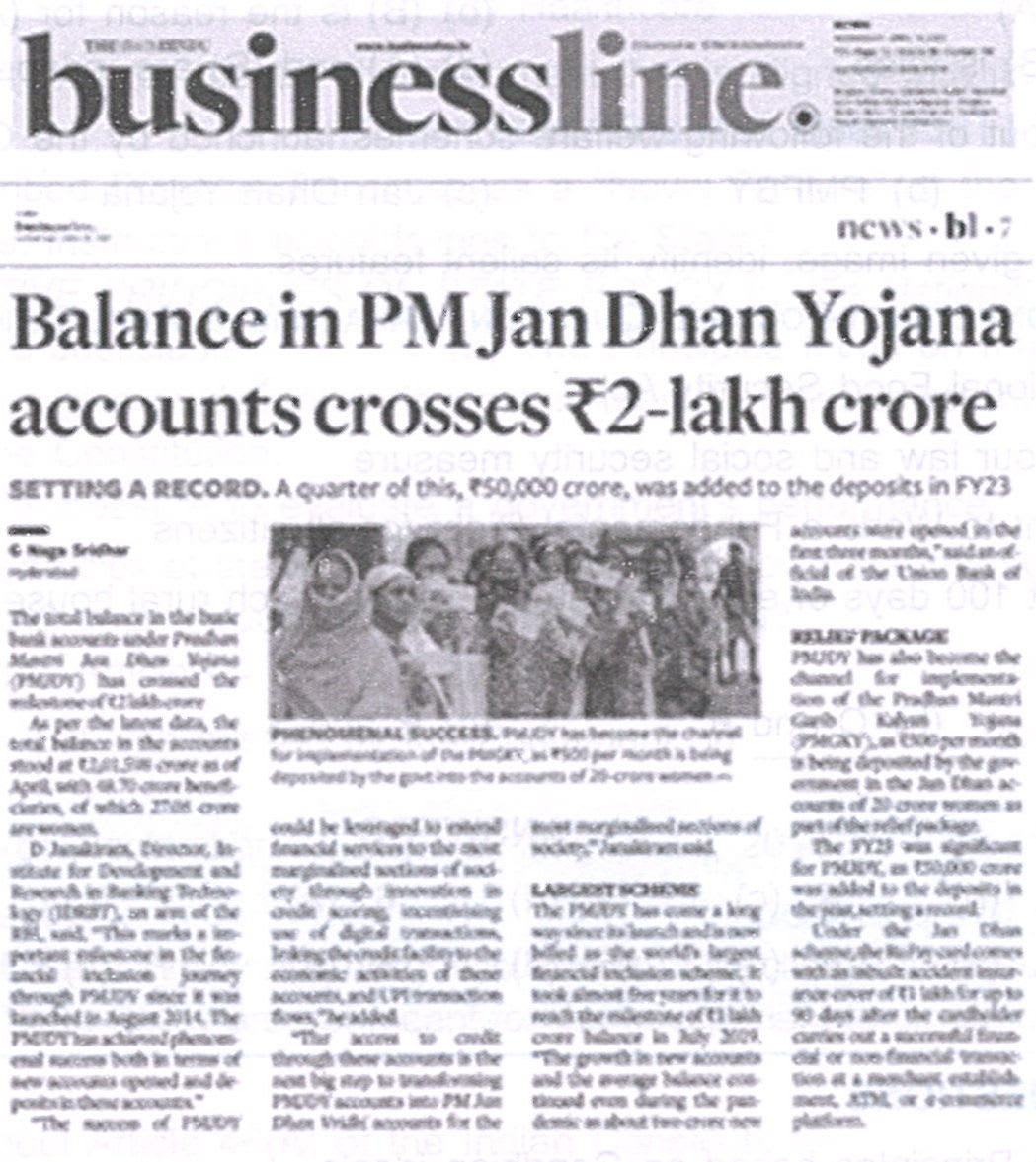
With reference to the given image, analyse the steps taken toward establishing a welfare state in economic terms. Also, examine the significance of the Directive Principles.
Answer
The given image refers to the 'Pradhan Mantri Jan Dhan Yojana'.
Steps taken towards establishing a Welfare State in economic terms — The 'Pradhan Mantri Jan Dhan Yojana' was announced by the Prime Minister, Narendra Modi on August 15, 2014. Under this scheme, bank accounts have been opened for the poor. Each account has a life insurance cover of ₹30,000, adding to the one lakh accidental insurance benefit already available under the account. The account is accompanied with a Rupay enabled debit card. This scheme is aimed at improving the lives of millions of India's poor by bringing them into the financial mainstream and freeing them from the clutches of moneylenders, while giving them the benefit of insurance cover.
Significance of the Directive Principles —
- The Directive Principles give guidelines to the government to make laws and draft their policies according to the objectives of the Constitution. They provide a framework for establishing a welfare state and guiding governance in a democracy.
- They serve as guidelines to evaluate the government's efforts towards achieving socio-economic justice.
- They enlighten and educate people of what they can expect from the politicians to whom they vote to power.
- They guide the courts in interpreting the Constitution and in balancing Fundamental Rights with the goals of socio-economic justice.
- Although the directive principles are non-justiciable, they are backed by public opinion, which is in reality the real sanction behind every law.