
Which among the following Articles of the Indian Constitution grants universal adult franchise to the citizens according to which every citizen of eighteen years and above is entitled to cast his/her vote in an election?
- Articles 352 of the Indian Constitution
- Article 309 of the Indian Constitution
- Article 326 of the Indian Constitution
- Article 311 of the Indian Constitution
Answer
Article 326 of the Indian Constitution
Reason — Article 326 of the Constitution of India grants universal adult franchise, under which every citizen who is eighteen years of age or above is entitled to cast his/her vote in an election. Therefore, Article 326 is the correct answer.
Identify the correct statement. It is generally said,
- "No elections, no democracy".
- "No elections, no monarchy".
- "No elections, no dictatorship".
- "No elections, no secularism".
Answer
"No elections, no democracy".
Reason — It is generally said, "No elections, no democracy". This saying denotes that without elections a democratic government cannot be set up, as elections are the means by which citizens choose their representatives.
The members of Lok Sabha and State Legislature are elected by the method of
- two-round system
- direct elections
- cumulative voting
- indirect elections
Answer
direct elections
Reason — In direct election, voters directly elect their representatives to the legislature. The MPs (Members of Parliament, Lok Sabha), the MLAs (Members of the Legislative Assemblies) and the members of local bodies are elected through direct elections.
Which among the following elections are held before the completion of the term of five years when the legislature is dissolved due to one reason or other?
- Mid-term Elections
- General Elections
- By-Elections
- Indirect Elections
Answer
Mid-term Elections
Reason — Mid-term elections are the elections which are held before the completion of the term of five years, when the legislature is dissolved because the Central or State government fails to prove its majority. The newly formed legislature then has a full five-year term.
'Save Democracy' was the slogan given by
- Janata Party in 1977
- Bharatiya Janta Party in 1977
- Indian National Congress in 1980
- Janata Dal in 1989
Answer
Janata Party in 1977
Reason — 'Save Democracy' was the slogan given by the Janata Party in the year 1977.
Read the two statements given below about the direct elections and select the option that shows the correct relationship between (A) and (R).
Assertion (A): Mid-term elections are held after 5 years, to the legislative bodies.
Reason (R): By-elections are held to fill the vacancy due to death or resignation of a member of Parliament or a member of Vidhan Sabha.
- Both (A) and (R) are true, and (R) is the correct explanation of (A).
- Both (A) and (R) are true, but (R) is not the correct explanation of (A).
- (A) is true, but (R) is false.
- (A) is false, but (R) is true.
Answer
(A) is false, but (R) is true.
Explanation — Mid-term elections are not held after 5 years. They are held before the completion of the term of five years when the legislature is dissolved due to one reason or the other. Hence, (A) is false. By-elections are held to fill the vacancy in the Parliament or State Legislatures caused by the resignation or death of a member during their term of office. Hence, (R) is true.
Complete the analogy. Mid-Term Elections : Fail to Prove Majority : : General Elections : ...............
- Held after every five years
- Held when a government completes its half term
- Held due to political crisis
- Held after a short period of dissolution
Answer
Held after every five years
Reason — Mid-term elections are held when a government fails to prove its majority and the legislature is dissolved before its full term. In the same way, general elections are the regular elections held for the formation of the Lok Sabha or the State Assemblies after every five years.
Read the two statements given below about the direct elections and select the option that shows the correct relationship between (A) and (R).
Assertion (A): Direct elections are considered more democratic than indirect elections.
Reason (R): In direct elections, voters directly elect their representatives, ensuring greater public participation and accountability.
- Both (A) and (R) are true, and (R) is the correct explanation of (A).
- Both (A) and (R) are true, but (R) is not the correct explanation of (A).
- (A) is true, but (R) is false.
- (A) is false, but (R) is true.
Answer
Both (A) and (R) are true, and (R) is the correct explanation of (A).
Explanation — In direct elections, voters directly elect their representatives. Since the electorate directly participates in choosing its representatives, direct elections are considered more democratic than indirect elections. Hence, both (A) and (R) are true, and (R) is the correct explanation of (A).
Which among the following is one of the functions of the Election Commission?
- Delimitation of Constituencies
- Holding of Election and Declaration of Results
- Preparation of Electoral Rolls
- All of these
Answer
All of these
Reason — The Election Commission performs functions such as delimitation of constituencies, preparation of electoral rolls, and holding elections and declaring the results. Therefore, all the given options are correct.
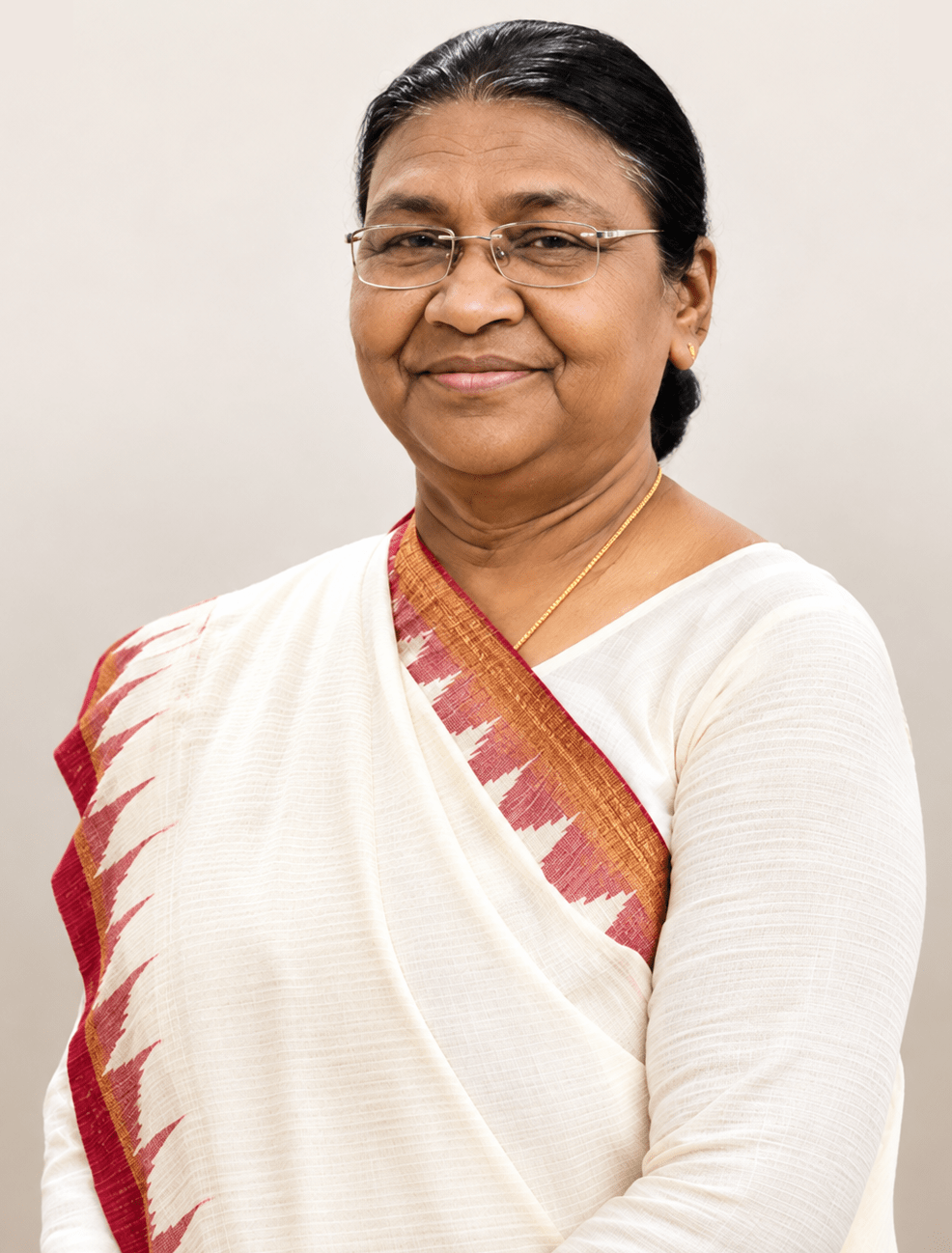
How was the personality shown in the picture elected as the President of India?
- By-elections
- Unanimously
- Directly
- Indirectly
Answer
Indirectly
Reason — The President of India is elected by the method of indirect election, in which the voters do not elect the Head of State directly but elect an intermediary body or electoral college which in turn elects the President.
What is the full form of MLA?
- Minister of Legislative Assembly
- Minister of Liberty Association
- Member of Legislative Assembly
- Member of Liberty Association
Answer
Member of Legislative Assembly
Reason — MLA stands for Member of Legislative Assembly. MLAs are elected through direct elections in which voters directly elect their representatives to the State Legislature.
Replace the underlined phrase with the correct option:
Direct elections are used to elect the President and Vice-President of India.
- members of the Rajya Sabha.
- judges of the Supreme Court.
- members of the Lok Sabha and State Legislative Assemblies.
- members of Finance Commission.
Answer
members of the Lok Sabha and State Legislative Assemblies.
Reason — The President and Vice-President of India are elected by the method of indirect election. It is the members of the Lok Sabha and the State Legislative Assemblies who are directly elected by the voters.
Reserved Constituencies in India continue to play a crucial role in ensuring representation for Scheduled Castes (SCs) and Scheduled Tribes (STs) in the Central and State legislatures. The reserved constituencies in India are intended to:
- Prevent political domination by majority groups.
- Ensure representation for Scheduled Castes (SCs) and Scheduled Tribes (STs).
- Guarantee equal representation for women.
- Promote economic reforms through policy of representation.
Answer
Ensure representation for Scheduled Castes (SCs) and Scheduled Tribes (STs).
Reason — The framers of the Constitution feared that in an open electoral competition the weaker sections might not get elected to the Lok Sabha and the Vidhan Sabhas, which would deprive our legislative bodies of the voice of a significant section of the population. Hence, reserved constituencies were provided to ensure representation for the Scheduled Castes and the Scheduled Tribes in the Central and State legislatures.
Who gave the slogan 'Garibi Hatao'?
- Late Rajiv Gandhi
- Late Indira Gandhi
- Sonia Gandhi
- Mr. Narendra Modi
Answer
Late Indira Gandhi
Reason — The slogan 'Garibi Hatao' (remove poverty) was given by the Congress party led by Late Indira Gandhi in the General Election to the Lok Sabha in 1971.
General Elections are held for the formation of
- Supreme Court
- Rajya Sabha
- Lok Sabha
- High court
Answer
Lok Sabha
Reason — General elections are the regular elections which are held after every five years for the formation of the Lok Sabha or the State Assemblies. The members of the Rajya Sabha are elected indirectly, while the judges of the Supreme Court and the High Courts are appointed and not elected.
The method of direct election is more democratic. Which of the following statements correctly describes the same?
- The system of direct election stimulates political interest among voters
- This system is less exposed to corruption
- This system makes the representatives more responsible to public opinion
- This system enables the electorate to take part in constituting the government directly as per universal adult franchise
Answer
This system enables the electorate to take part in constituting the government directly as per universal adult franchise
Reason — The method of direct election is said to be most democratic because it enables the electorate to take part in constituting the government directly, every adult citizen holding the right to vote under universal adult franchise. The other options are also merits of direct election, but they do not explain why the system is more democratic.
Identify the demerits of indirect election.
P: It is anti-democratic to an extent.
Q: It kills popular interests in the elections
R: This system places powers in the hands of ignorant voters.
S: Under the Indirect system majority of voters are swayed by false promises of clever orators and leaders
- P and Q
- Q and R
- R and S
- P and S
Answer
P and Q
Reason — Indirect election is considered anti-democratic to an extent because it keeps a distance between the voters and their representatives, and it is also condemned on the ground that it kills popular interest in the elections, the primary voters ceasing to take any interest in public matters. Hence, P and Q are demerits of indirect election. R and S are demerits of direct election, and so they are incorrect.
Read the two statements given below about the new Act regarding the appointment of CEC and ECs.
(A) The new Act replaces the Election Commission Act, 1991.
(B) As per the new Act, the CEC and ECs will be appointed by the President on the recommendation of a Selection Committee comprising the PM, a Union Cabinet Minister, and the Leader of Opposition in Lok Sabha.
- (B) contradicts (A)
- (B) is the reason for (A)
- (A) is true but (B) is false
- (A) and (B) are independent of each other
Answer
(B) is the reason for (A)
Explanation — The Chief Election Commissioner and Other Election Commissioners (Appointment, Conditions of Service and Term of Office) Act, 2023 replaced the Election Commission Act, 1991. The new Act introduced a new procedure for the appointment of the Chief Election Commissioner and Election Commissioners through a Selection Committee comprising the Prime Minister, a Union Cabinet Minister and the Leader of Opposition in the Lok Sabha. Hence, option (2) is the correct answer as per the answer key.
"Article 326 of the Constitution grants universal adult franchise to the citizens, according to which every citizen of eighteen years and above is entitled to cast his/her vote in an election."
How does Article 326 reflect the democratic values of inclusivity and equality?
Answer
Article 326 of the Constitution reflects the democratic values of inclusivity and equality by granting universal adult franchise, under which every citizen who is eighteen years of age or above is entitled to cast his or her vote in an election.
What do you mean by an election?
Answer
An election is a process through which the citizens of a country choose their representatives to govern them, in a free, fair, and regular manner.
What is the need for elections? Why is it said, "No elections, no democracy"?
Answer
Elections are necessary because they enable the people to choose their representatives and form a democratic government. Without elections, a democratic government cannot be set up. Hence, it is rightly said, "No elections, no democracy."
Why is it said that modern democracies are representative?
Answer
Modern democracies cover such vast area that all their citizens, who run into millions, cannot possibly take part in the government. They can do so through their representatives who form a comparatively small number. In order to choose such representatives elections are a must. That is why, it said that modern democracies are representative democracies.
Who controls the elections of the President, Vice-President and the Parliament?
Answer
The Election Commission controls the elections of the President, Vice-President and the Parliament.
State one function of the Election Commission.
Answer
According to Article 324, the Election Commission is vested with the power of superintendence, direction and control of elections to parliament, state legislatures, the offices of the President and Vice President of India.
What is meant by a by-election?
Answer
The process of conducting elections to fill the vacancy in the Parliament or State Legislatures because of the resignation or death of a member during their term of office is called a by-election. The newly elected members serve the remaining term.
What is meant by mid-term election?
Answer
Mid-term elections are the elections which are held before the completion of the term of five years when the legislature is dissolved due to one reason or the other. Such elections are held when the Central government or the State government fails to prove its majority in the legislature and elections are held for the formation of new government. The newly formed legislature will have a full five-year term.
Differentiate between direct and indirect elections with examples.
Answer
Difference between direct and indirect elections:
| Direct elections | Indirect elections | |
|---|---|---|
| 1. | Voters directly elect their representatives. | Voters do not directly elect their representatives or Head of State. They elect only an intermediary body or electoral college. |
| 2. | Law regulates the qualifications, age, etc. of voters and establishes eligibility requirements for contestants. | The elected representatives form the electoral college. |
| 3. | Every adult citizen holds the right to vote. | Every elected representative holds the right to vote. |
| 4. | There is a large body of voters called the electorate. | There is a small body of voters. |
| 5. | Members of Legislative Assemblies and members of the Lok Sabha are directly elected. | Members of State Legislative Councils, members of the Rajya Sabha, President and Vice President of India are elected indirectly. |
With reference to the nomination of candidates explain the following :
(a) Who fixes the date of election?
(b) What are nomination papers?
(c) What do you mean by scrutiny of papers?
Answer
(a) The fixing of exact date of election rests with the Election Commission.
(b) Nomination papers are the prescribed forms that a candidate intending to contest an election has to submit within the specified time.
(c) After the submission of nomination papers, the Election Commission scrutinises their papers and accepts or rejects the nomination papers as the case may be.
For every democratic country, elections are very important. In this connection, answer the following :
(a) Election Commission
(b) Composition of Election Commission.
Answer
(a) To ensure free and fair election in the country, there is a special organisation known as the Election Commission. Article 324 of the Constitution provides that the power of superintendence, direction and control of elections to parliament, state legislatures, the offices of the President and Vice President of India shall be vested in the Election Commission.
(b) The CEC (Chief Election Commissioner) and ECs (Election Commissioner) will be appointed by the President upon the recommendation of a Selection Committee. The selection committee will consist of Prime Minister, a Union Cabinet Minister, and Leader of opposition/leader of the largest opposition party in Lok Sabha. A search committee headed by the Cabinet Secretary will propose a panel of names to the selection committee.
With reference to the Election Commission explain the following :
(a) Who appoints the Chief Election Commissioner and other Election Commissioners?
(b) Describe any two functions of the Election Commission.
Answer
(a) The President appoints the Chief Election Commissioner and other Election Commissioners upon the recommendation of a Selection Committee.
(b) Two functions of the Election Commission are:
- To superintend, direct and control elections to the Parliament and the State Legislatures.
- To conduct elections to the posts of the President and the Vice-President.
With regard to the kinds of elections explain the following :
(a) Merits of Direct Election
(b) Demerits of Indirect Election
(c) Merits of Indirect Election
(d) Demerits of Direct Election
Answer
(a) The Merits of Direct Election are given below:
- Firstly, it is said that the method of direct election is most democratic as it enables the electorate to take part in constituting the government directly.
- The system of direct election makes the representative more accountable to public opinion. They try to keep them in touch with the voters and try to better their condition.
- The system of direct election stimulates political interest among voters. Each voter feels that their voice will count in the formation of the government and selection of the law-makers. Such a system encourages active citizenship.
- The advocates of this system claim that this system is less exposed to corruption. Under this system a candidate has to approach a large number of voters. It is quite difficult to bribe or intimidate such a broad electorate.
(b) The Demerits of Indirect Election are given below:
- Firstly, it is considered anti-democratic. Democracy requires that contact between the representatives and voters should be direct and immediate. But indirect election keeps a distance between the voters and their representatives.
- The system of indirect election is condemned on the ground that it kills popular interest in the elections. The primary voters cease to take any interest in public matters.
- The smaller electorate in indirect elections is more vulnerable to corruption and undue influence.
- Lastly, in some cases, the system of indirect election has been reduced to a formality due to the influence of the party system.
(c) The Merits of Indirect Election are given below:
- The system of indirect election is said to be free from the complexity of popular passion. It transfers the choice of representatives from the hands of the masses into the hands of a few selected persons who are likely to be less swayed by political passions.
- Again, it is said that the system of indirect election saves us from such dangers which can result from haste. It has been rightly said, "Haste makes waste". Under this system, in fact, there are two elections, as such mistakes made at one stage can be corrected at another stage. The time-gap in two elections cools down the passions and members of the electoral college can think twice before electing any candidate.
(d) The Demerits of Direct Election are given below:
- The system of direct election places powers in the hands of ignorant voters. Most of the voters are either illiterate or ignorant who do not have intelligence or independence enough to vote for the right candidate.
- Under this system a majority of voters are swayed by false promises of the clever orators and they fall in the trap quite easily.