
What are the articles in the Indian Constitution that deal with the organisation, composition, duration, procedures, privileges and powers of the State Legislature?
- Articles 168 to 212
- Articles 8 to 12
- Articles 18 to 28
- Articles 301 to 335
Answer
Articles 168 to 212
Reason — Articles 168 to 212 of the Indian Constitution deal with the organisation, composition, duration, procedures, privileges, and powers of the State Legislature. These constitutional provisions define the structure and functioning of the State Legislature, including the Legislative Assembly and, where applicable, the Legislative Council.
How many states have Unicameral System?
- Four
- Fifteen
- Twenty
- Twenty two
Answer
Twenty two
Reason — Out of the 28 states, 6 states have Bicameral Legislatures, while the remaining 22 states have a Unicameral Legislature, consisting of the Governor and the Legislative Assembly.
Read the two statements given below about State Legislative Assembly and select the option that shows the correct relationship between (A) and (B).
(A) : The Uttar Pradesh Legislative Assembly consists of 403 elected members.
(B) : The Uttar Pradesh Legislative Council has 100 members.
- (B) contradicts (A)
- (B) is the reason for (A)
- (A) is true but (B) is false
- (A) and (B) are independent of each other
Answer
(A) and (B) are independent of each other
Reason — The Uttar Pradesh Legislative Assembly has 403 elected members and its Legislative Council has 100 members. Both statements are correct facts about the two separate Houses, but neither is the cause or explanation of the other, so they are independent of each other.
On the basis of given news, identify the correct statement.
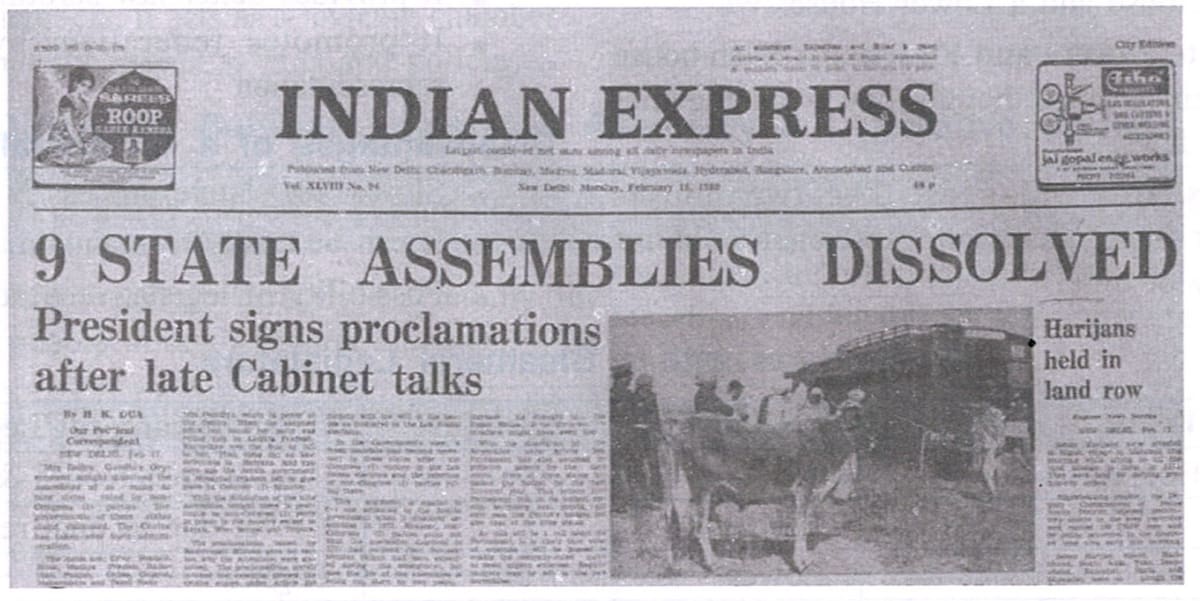
- The word dissolution refers to the dismissal of all the legislative members in the assembly.
- The State Legislative Assembly is not a permanent body.
- Immediately after dissolution of the Assembly the Election Commission of India takes steps for holding fresh elections for constituting the new Legislative Assembly.
- All the above
Answer
All the above
Reason — The Legislative Assembly is not a permanent body and can be dissolved before its term ends. Dissolution means the dismissal of all the members of the Assembly, after which the Election Commission of India holds fresh elections to constitute a new Assembly. As all three statements are correct, the answer is 'All the above'.
Identify the reason why is the Legislative Assembly more powerful than Legislative Council in a state?
P : The Legislative Assembly can make laws on its own and govern a state in India.
Q : The Legislative Assembly does not need the Legislative Council at all.
R : The term of the Legislative Assembly is always fixed.
S : The Legislative Assembly consists of less members as comparison to the Legislative Council.
- P and Q
- Q and R
- R and S
- P and S
Answer
P and Q
Reason — The Legislative Assembly is more powerful because the Legislative Council has only limited powers. The Council can delay ordinary bills for a limited period but cannot permanently reject them, and Money Bills can be introduced only in the Legislative Assembly.
Read the two statements given below about the direct elections and select the option that shows the correct relationship between (A) and (R).
Assertion (A) : Minimum age to contest an election for Vidhan Sabha is 25 years.
Reason (R) : Such candidate must be a registered voter in any constituency of any state in India.
- Both (A) and (R) are true, and (R) is the correct explanation of (A).
- Both (A) and (R) are true, but (R) is not the correct explanation of (A).
- (A) is true, but (R) is false.
- (A) is false, but (R) is true.
Answer
(A) is true, but (R) is false.
Explanation — The minimum age to contest an election for the Legislative Assembly (Vidhan Sabha) is 25 years, so Assertion (A) is true. However, a candidate must be a registered voter in any constituency of the state in which they are contesting the election, not of any state in India. Hence, Reason (R) is false.
Read the two statements given below about the direct elections and select the option that shows the correct relationship between (A) and (R).
Assertion (A) : The term of a Legislative Assembly is 5 years.
Reason (R) : But a Legislative Assembly may be dissolved earlier in case of President's Rule or when the incumbent government fails to have majority.
- Both (A) and (R) are true, and (R) is the correct explanation of (A).
- Both (A) and (R) are true, but (R) is not the correct explanation of (A).
- (A) is true, but (R) is false.
- (A) is false, but (R) is true.
Answer
Both (A) and (R) are true, but (R) is not the correct explanation of (A).
Explanation — The term of a Legislative Assembly is 5 years, so Assertion (A) is true. A Legislative Assembly may also be dissolved earlier in case of President's Rule or when the incumbent government loses its majority, so Reason (R) is also true. However, the possibility of early dissolution does not explain why the normal term of the Assembly is fixed at 5 years, so Reason (R) is not the correct explanation of Assertion (A).
What is the term of a Legislative Assembly in normal circumstances?
- 2 years
- 3 years
- 5 years
- 6 years
Answer
5 years
Reason — The normal term of a Legislative Assembly is five years. However, it may be dissolved earlier under certain circumstances.
Who is the presiding officer of the Legislative Assembly?
- Minister of State for Finance
- Chief Minister
- Speaker
- Deputy Chief Minister
Answer
Speaker
Reason — The Speaker is the presiding officer and the highest authority of the State Legislative Assembly. He is elected by the members of the Assembly and presides over its meetings.
How many states in India have a Legislative Council?
- 3
- 6
- 7
- 10
Answer
6
Reason — Not all states have a Legislative Council; only 6 out of 28 states have one, namely Uttar Pradesh, Karnataka, Maharashtra, Andhra Pradesh, Telangana, and Bihar.
The creation and abolition of a Legislative Council in a state require approval from which authority?
- State Legislative Assembly
- The Supreme Court of India
- Parliament of India
- The High Court of the concerned state
Answer
Parliament of India
Reason — Under Article 169 of the Constitution, Parliament may create or abolish a Legislative Council if the concerned State Legislative Assembly passes a resolution to that effect by the required majority.
What is the minimum strength of a Legislative Council?
- 30
- 40
- 80
- 100
Answer
40
Reason — The total number of members in a Legislative Council should not exceed one-third of the total members of the Legislative Assembly, but it should not be less than 40. Hence, the minimum strength is 40.
What is the maximum strength of a Legislative Council?
- 1/3rd of the Legislative Assembly
- 1/6th of the Legislative Assembly
- 3/4th of the Legislative Assembly
- Equal to the Legislative Assembly
Answer
1/3rd of the Legislative Assembly
Reason — According to the Constitution, the total membership of a State's Legislative Council should not exceed one-third of the total members of the Legislative Assembly. Hence, its maximum strength is 1/3rd of the Legislative Assembly.
Who elects the members of the Legislative Council?
- Members of the Legislative Assembly
- Graduates and Teachers
- Members of local bodies such as Municipalities or Panchayat Samitis
- All of the above
Answer
All of the above
Reason — The members of the Legislative Council are chosen through different methods—1/3rd are elected by MLAs, 1/3rd by local bodies such as Municipalities and Panchayats, and 1/12th each by graduates and teachers (the rest nominated by the Governor). Since all these groups elect members, the answer is 'All of the above'.
What is the tenure of the members of the Legislative Council?
- 1 years
- 5 years
- 6 years
- 2 years
Answer
6 years
Reason — The State Legislative Council is a permanent body, and the term of its members is 6 years, with one-third of the members retiring every two years.
Which of the following is NOT a function of the Legislative Council?
- Review and delay bills
- Initiate Money Bills
- Provide expert opinions
- To monitor the work of the government
Answer
Initiate Money Bills
Reason — The Legislative Council cannot introduce Money Bills. It mainly reviews and discusses bills, suggests amendments, and provides the benefit of experienced members.
Who has the power to dissolve the Legislative Assembly?
- Governor
- Chief Minister
- Speaker
- Deputy Speaker
Answer
Governor
Reason — The Governor has the power to dissolve the Legislative Assembly before the expiry of its normal term under certain circumstances.
How is the Speaker of the Legislative Assembly chosen?
- Appointed by the President
- Elected by the Members of the Assembly
- Nominated by the Parliament
- Selected by the Chief Minister
Answer
Elected by the Members of the Assembly
Reason — The Speaker of the Legislative Assembly is elected by the members of the Assembly from amongst themselves, and acts as the presiding and highest authority of the House.
In which house of the state legislature can a no-confidence motion be introduced?
- Legislative Assembly
- Legislative Council
- Both (1) and (2)
- None of these
Answer
Legislative Assembly
Reason — A no-confidence motion can be introduced only in the Legislative Assembly, as the Council of Ministers is responsible to it. The Legislative Council cannot remove the government through a no-confidence motion.
What happens when a Money Bill is introduced in the Legislative Council?
- The Council can reject it
- The Council can delay it for 14 days
- The Council can amend it
- The Council can veto it
Answer
The Council can delay it for 14 days
Reason — A Money Bill can be introduced only in the Legislative Assembly. After it is passed by the Assembly and sent to the Legislative Council, the Council may keep it for a maximum of 14 days and make recommendations, but it cannot reject or amend the Bill. If it is not returned within 14 days, it is deemed to have been passed.
How many Union Territories do consist Legislative Assembly in India?
- 5
- 4
- 6
- 3
Answer
3
Reason — In India, three Union Territories have their own Legislative Assembly—namely Delhi, Jammu and Kashmir, and Puducherry.
How many houses does a bicameral state legislature have?
Answer
A bicameral state legislature has two Houses.
What is the minimum age to become a member of the Legislative Assembly?
Answer
The minimum age to become a member of the Legislative Assembly (Vidhan Sabha) in India is 25 years.
Name the states where bicameral legislature exist.
Answer
The six Indian states with a bicameral legislature (having both Legislative Assembly and Legislative Council) are:
- Andhra Pradesh
- Bihar
- Karnataka
- Maharashtra
- Telangana
- Uttar Pradesh
What is the term of the Legislative Assembly in a state?
Answer
The normal term of the Legislative Assembly is 5 years.
Which house of the state legislature is permanent?
Answer
The State Legislative Council is a permanent body and not subject to dissolution.
Who presides over the meetings of the Legislative Assembly?
Answer
The Speaker of the Legislative Assembly presides over its meetings and acts as the chief authority of the House.
What is the minimum and maximum strength of a Legislative Assembly?
Answer
The minimum strength of a Legislative Assembly is 60 members, and the maximum strength is 500 members.
Who appoints the Governor of a state? Mention his anyone special power with regard to the State Legislature.
Answer
The Governor is appointed by the President of India. One special power of the Governor regarding the State Legislature is that he/she can dissolve the Legislative Assembly.
Mention the qualifications required to become a member of the Legislative Assembly.
Answer
A person must meet the following qualifications to become a Member of the Legislative Assembly (MLA) in any Indian state:
- The candidate must be a citizen of India.
- The minimum age to contest elections for the Legislative Assembly (Vidhan Sabha) is 25 years.
- The candidate must be a registered voter in any constituency of the state in which they are contesting the election.
Who has the power to dissolve the State Legislative Assembly?
Answer
The Governor of a state has the power to dissolve the State Legislative Assembly.
Explain the composition of the State Legislatures in India.
Answer
The State Legislature consists of the Governor, the Legislative Assembly (Vidhan Sabha) and the Legislative Council (Vidhan Parishad).
In most states, the Legislature consists of the Governor and the Legislative Assembly only, which means these states have a Unicameral Legislature. In a few states (6 out of 28), there are two Houses—the Legislative Assembly and the Legislative Council—in addition to the Governor. Where there are two Houses, the Legislature is known as Bicameral.
Discuss the differences between Unicameral and Bicameral Legislatures.
Answer
| Unicameral Legislature | Bicameral Legislature |
|---|---|
| A unicameral legislature is a type of legislative system where there is only one legislative or parliamentary chamber. It is responsible for making and passing laws. | A bicameral legislature is a legislative system with two separate chambers or houses, typically responsible for making and passing laws. |
| It consists of the Governor and only one House, i.e. the Legislative Assembly. | There are two Houses of the Legislature namely, the Legislative Assembly and Legislative Council besides the Governor. |
Discuss the role and functions of the Governor in relation to the State Legislature.
Answer
The role of the Governor in relation to the State Legislature is that the Governor can dissolve the Assembly, summon sessions and give assent to Bills.
Analyse the role and significance of the Legislative Council in states that have a Bicameral Legislature.
Answer
The powers of the Legislative Council are generally advisory in nature:
- Legislative power — The Legislative Council can introduce ordinary bills only, and can only delay their passage but not reject them.
- Financial power — The Council can discuss and suggest changes to the Money Bill, but the Assembly is not bound to accept them.
- Control over the Executive — It can ask questions, discuss policies, and debate matters of public interest, but it cannot remove the government through a no-confidence motion.
- Revisory and Deliberative Functions — Since the Council consists of experienced and learned members, it acts as a revising chamber that thoroughly examines bills and policies.
Discuss the role of the Speaker of the Legislative Assembly.
Answer
The speaker of the Legislative Assembly is the presiding authority and highest authority of State Legislative Assemblies. He is elected by the members of the Legislative Assembly.
- He is responsible for presiding assembly debates and maintains order and discipline of the house during legislative session.
- Questions relating to breach of privilege and contempt of the house is raised by the members with consent of the Speaker or the Deputy Speaker.
- He puts bills and other measures to vote and announces the result of voting.
- The Speaker does not ordinarily vote at the time of voting. However, he may exercise casting vote in case of a tie.
Explain the financial powers of the State Legislature.
Answer
The financial powers of the State Legislature are:
- The Legislative Assembly controls state finances by approving the state budget.
- Money Bills can be introduced only in the Legislative Assembly.
- The assembly approves taxation policies and allocates funds for development projects.
- The Council of Ministers cannot spend money from the state treasury without the Assembly's approval.
- In bicameral states, the Legislative Council can only suggest changes to Money Bills, but the Assembly is not bound to accept them.
With regard to the Legislative Assembly of the State, answer the following:
(a) Discuss the structure, composition, and powers of the Legislative Assembly (Vidhan Sabha).
(b) How is it different from the Legislative Council (Vidhan Parishad)?
Answer
(a) Structure of the Legislative Assembly (Vidhan Sabha)
- Each State and Union Territory (with legislature) has its own Legislative Assembly.
- The number of members (MLAs) varies from 60 to 500, depending on the state's population.
- Members are directly elected by the people of the state through Assembly Elections.
Composition of the Legislative Assembly (Vidhan Sabha)
- Members (MLAs) are elected from single member constituencies based on universal adult suffrage (every citizen above 18 can vote).
- The elections are conducted by the Election Commission of India.
- The term of the Legislative Assembly is 5 years, but it can be dissolved earlier by the Governor on the advice of the Chief Minister.
- It may be dissolved by the President in case of constitutional emergency proclaimed under Article 356 of the Constitution.
- In case of proclamation of National Emergency under Article 352 of the Constitution, the Parliament can extend the term of the Legislative Assemblies for a period not exceeding one year at a time.
Powers of the Legislative Assembly (Vidhan Sabha)
- The Legislative Assembly makes laws on state subjects and can also legislate on Concurrent List subjects (shared with Parliament) if they do not conflict with central laws.
- In bicameral states, if there is a conflict between the Legislative Assembly (Vidhan Sabha) and Legislative Council (Vidhan Parishad), the Assembly has the final say.
- The Legislative Assembly controls state finances by approving the state budget.
- No money bill can be introduced without its approval.
- It can pass a no-confidence motion, leading to the removal of the government.
- If the Parliament proposes a constitutional amendment affecting states, it must be ratified by at least half of the state legislatures.
(b) The Legislative Assembly (Vidhan Sabha) and the Legislative Council (Vidhan Parishad) are the two houses of a bicameral legislature in certain Indian states, with distinct roles and powers. The Legislative Assembly is the lower house, consisting of directly elected members from constituencies, with a five-year term. It holds significant legislative power, including the authority to introduce and pass Money Bills and the state budget. The Legislative Council, on the other hand, is the upper house, with members partly elected and partly nominated. It serves a revisory function, reviewing and suggesting amendments to bills passed by the Assembly but cannot amend Money Bills. While the Assembly can be dissolved by the Governor, the Council is a permanent body, with members retiring in rotation. The Assembly represents the direct will of the people, while the Council acts as a check and balance, offering expertise and revising legislation to ensure a more thorough legislative process.
With regard to the Bicameral Legislature, answer the following questions:
(a) Explain any three features.
(b) Explain any three advantages.
(c) Explain any three disadvantages.
Answer
(a) Three features of Bicameral Legislature are:
- Separate Powers and Functions: Each house has distinct roles, though they work together to pass laws.
- Checks and Balances: The two houses prevent hasty decisions and ensure better scrutiny of bills.
- Representation: Often, the Lower House represents the general public (elected directly), while the Upper House represents states, regions, or special interest groups.
(b) Three advantages of Bicameral Legislature are:
- It prevents hasty decision-making.
- It ensures diverse representation.
- It provides better law scrutiny.
- It promotes federalism by giving states representation.
(c) Three disadvantages of Bicameral Legislature are:
- Slower legislative process is visible.
- It can be costly to maintain.
- Possibility of legislative deadlocks occur.