
The mature phase of the Harappan Civilisation can be specified between:
- 2800 BCE - 1950 BCE
- 2200 BCE - 2000 BCE
- 3250 BCE - 2750 BCE
- 1700 BCE - 1500 BCE
Answer
2200 BCE - 2000 BCE
Reason — The mature phase of the Indus Valley (Harappan) Civilisation is estimated to have occurred between 2200 BCE and 2000 BCE. Therefore, 2200 BCE – 2000 BCE is the correct answer.
Which archaeological technique placed the Harappan Civilisation between 2500 BCE and 1700 BCE?
- Radiocarbon Dating
- Thermoluminescence
- Stratigraphy
- Dendrochronology
Answer
Radiocarbon Dating
Reason — Recent tests by the Radiocarbon method placed the Harappan Civilisation between 2500 BCE and 1700 BCE. Therefore, Radiocarbon Dating is the correct answer.
Identify the sites from the Harappan Civilisation located in present-day Gujarat:
P: Mohenjodaro
Q: Lothal
R: Dholavira
S: Harappa
- P and S
- Q and R
- Q and S
- P and R
Answer
Q and R
Reason — Lothal and Dholavira are situated in Gujarat, whereas Mohenjodaro and Harappa lie in present-day Pakistan. Therefore, Q and R is the correct answer.
What does the grid pattern of streets in Harappan cities reflect?
- Ritualistic significance of roads
- Architectural knowledge of modern planning
- Lack of creativity in town planning
- Influence of Sumerian cities
Answer
Architectural knowledge of modern planning
Reason — The grid pattern, with streets crossing at right angles and uniform alignment, reflects the systematic town planning of the Harappans, resembling modern planning rather than the circular pattern of the Sumerian cities. Therefore, it reflects architectural knowledge of modern planning.
Read the two statements given below about the citadel in Harappan cities and select the option that shows the correct relationship between (A) and (B):
(A) : The citadel in Harappan cities was built on a raised platform.
(B) : The raised platform protected public buildings from floods and invasions.
- (B) contradicts (A).
- (B) is the reason for (A).
- (A) is true, but (B) is false.
- (A) and (B) are independent of each other.
Answer
(B) is the reason for (A).
Explanation — To the west of each Harappan city, the citadel was built on a high, raised platform, so (A) is true. This elevation, along with the wall surrounding it, protected the public buildings, granaries and religious structures on the citadel against floods and invasions. Thus, the need to protect these structures was the reason for building the citadel on a raised platform. Hence, (B) is the reason for (A).
Identify the odd one out among the technological advancements of the Harappan Civilisation:
- Drainage system
- Dockyard
- Well-planned streets
- Pyramids
Answer
Pyramids
Reason — The drainage system, dockyard and well-planned streets were achievements of the Harappan Civilisation, whereas pyramids belong to the Egyptian civilisation. Therefore, Pyramids is the odd one out.
Which of the following statements about the Harappan Civilisation is incorrect?
- The Great Bath was used for bathing by the rulers.
- The seals were made of steatite.
- The Dancing Girl statue is an example of terracotta art.
- The Harappan script is pictographic.
Answer
The Dancing Girl statue is an example of terracotta art.
Reason — The Dancing Girl is a bronze statue and not a terracotta figure. Hence, the statement is incorrect.
Which animal is frequently depicted on Harappan seals?
- Horse
- Humped bull
- Camel
- Cow
Answer
Humped bull
Reason — The engravings on Harappan seals frequently depict the humped bull, while the horse was unknown to the Harappans.
Which artefact found in the Harappan Civilisation is considered the earliest example of glazed pottery?
- Terracotta figurines
- Painted pots
- Seals
- Stone bowls
Answer
Painted pots
Reason — The glazed Harappan pottery is generally believed to be the earliest example of its kind in the ancient world.
Which of the following statements correctly describes the significance of given picture?
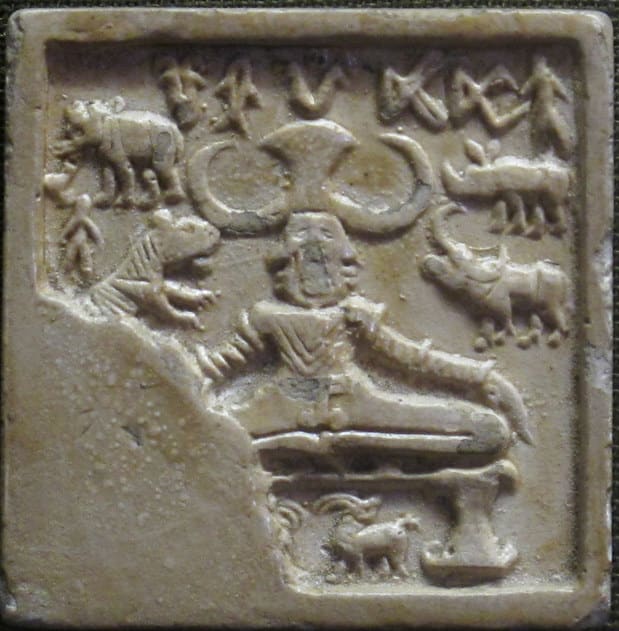
- Brahma was the most important god as he had horns sitting in a yogic posture
- Shiva was worshipped in the form of Linga and yoni
- Shiva was worshipped as Pashupati
- Shiva was worshipped in a temple
Answer
Shiva was worshipped as Pashupati
Reason — The picture shows the Pashupati seal from Mohenjodaro, which depicts a deity seated in a yogic posture surrounded by animals, identified as Shiva Pashupati. Since the deity is Shiva (not Brahma) and no temples were found, the seal signifies that Shiva was worshipped as Pashupati.
Which of the following was responsible for the destruction of Harappan Civilisation?
(i) Earthquakes
(ii) Floods
(iii) Climatic change
(iv) People died due to disease.
- (i), (ii), (iii) and (iv)
- only (i) and (iii)
- Only (ii), (iii) and (iv)
- only (i), (iii) and (iv)
Answer
(i), (ii), (iii) and (iv)
Reason — Scholars suggest several reasons for the collapse of the Harappan Civilisation, including floods, epidemics or disease, climatic change causing aridity, and earthquakes. Since all four factors are mentioned, (i), (ii), (iii) and (iv) is the correct answer.
Consider the two statements given below and select the option that shows the correct relationship between (A) and (R).
Assertion (A): The Great Bath at Mohenjodaro resembles a swimming pool.
Reason (R): It might have been used for religious purposes.
- Both (A) and (R) are true, and (R) is the correct explanation of (A)
- Both (A) and (R) are true, but (R) is not the correct explanation of (A)
- (A) is true but (R) is false
- (A) is false but (R) is true.
Answer
Both (A) and (R) are true, but (R) is not the correct explanation of (A)
Explanation — The Great Bath, unearthed at Mohenjodaro, resembles a large swimming pool, so (A) is true. Archaeologists agree that it might have been used for religious purposes, so (R) is also true. However, its possible religious use does not explain why it resembles a swimming pool, as the two statements refer to different aspects of the structure. Hence, (R) is not the correct explanation of (A).
Consider the two statements given below and select the option that shows the correct relationship between (A) and (R).
Assertion (A): Among the male gods, Pashupati was the most important.
Reason (R): He was surrounded by animals on the seal.
- Both (A) and (R) are true, and (R) is the correct explanation of (A)
- Both (A) and (R) are true, but (R) is not the correct explanation of (A)
- (A) is true but (R) is false
- (A) is false but (R) is true.
Answer
Both (A) and (R) are true, and (R) is the correct explanation of (A)
Explanation — Among the male gods, Shiva, identified as Shiva Pashupati, was the most prominent, so (A) is true. On the seal, this deity is shown seated in a yogic posture and surrounded by animals such as the elephant, tiger, buffalo and rhinoceros, so (R) is also true. Being surrounded by animals reflects his identity as Pashupati (the lord of animals), which explains his importance among the male gods. Hence, (R) is the correct explanation of (A).
What is the meaning of the term Civilisation?
Answer
Civilisation denotes a human society with well developed social, economic and cultural organisation.
Name any two important sites of the Harappan Civilisation.
Answer
Two important sites of the Harappan Civilisation are — Harappa and Mohenjodaro.
Identify the artefact shown in the image. Mention any two significant features of this artefact.

Answer
The artifact shown in the image is the stone figure of a shawl-clad man. Two significant features of this artefact are:
- The shawl covers the left shoulder and passes below the right shoulder.
- The stone figure is believed to be of a priest or a yogi.
Name any two features of the Great Bath.
Answer
Two features of the Great Bath are given below:
- There is a swimming pool in the centre, 12 metres long, 7 metres wide and 2.5 metres deep.
- There are galleries and rooms all round the swimming pool.
From where was the bronze statue of a dancing girl discovered ?
Answer
The bronze statue of a dancing girl was discovered at Mohenjodaro, a major site of the Indus Valley Civilization.
Read the lines given below and answer the question that follows:
"The earliest city discovered in India was that of Harappa, followed by Mohenjodaro on the bank of the Indus. As the chief centres of this civilisation lie around the river Indus and its tributaries, it is styled as the 'Harappan Valley Civilisation'."
Name the archaeologist who excavated Mohenjodaro.
Answer
In 1922, Mohenjodaro was excavated by Rakhaldas Banerjee.
What materials were used to construct Harappan houses?
Answer
Harappan Houses were made of burnt bricks and mud mortar.
What archaeological evidence indicates that Harappans believed in the life after death?
Answer
The graves of the dead contained items such as household pottery, ornaments, and mirrors, indicating that the Harappans believed in life after death.
What item found in Mesopotamia proves trade relations with the Harappan Civilisation?
Answer
Numerous Harappan seals bearing the script and the figure of a humped bull have been found at Mesopotamian sites, proving trade relations between the two civilisations.
How many pictographic letters are estimated to be in the Harappan script?
Answer
The Harappan script is estimated to have comprised about 375–400 pictographic signs, representing figures such as birds, fish, and human forms.
Why is the Indus Valley Civilisation sometimes called the Harappan Civilisation?
Answer
The Indus Valley Civilisation is sometimes called the Harappan Civilisation because Harappa was the first site of this civilisation to be excavated.
What is the approximate extent of the Harappan Civilisation?
Answer
The Harappan Civilisation extended from Ropar in the north to the valleys of the Narmada and Tapi in the south, and from Meerut in the Upper Ganga–Yamuna Doab in the east to Sutkagendor on the Makran Coast of south Baluchistan in the west.
What evidence is there to establish that the people of Mohenjodaro had a great concern for Sanitation and Town planning?
Answer
There is much evidence to show that the people of Mohenjodaro had a great concern for sanitation and town planning:
- The Harappan cities followed a grid pattern. All important buildings were built on the high ground.
- The streets crossed one another at right angles with rounded corners to allow carts to move easily.
- Some Houses had courtyards and ranged from having one up to twelve rooms. Some Houses had double storey.
- Every house had a bathroom, a storeroom, a kitchen, and a well. The kitchen had a fireplace, with an oven in the courtyard. Bathrooms had paved and slanting floors. Doors and windows opened on the streets.
- The Harappan Drainage system was constructed on scientific lines. Each house drain was directly connected with the street drain.
- There were manholes at regular intervals to facilitate inspection and maintenance of the drainage system
- Trash was thrown into the dustbins.
Read the following excerpt and answer the questions that follow:
"Although the script remains undeciphered, there is widespread consensus on the direction of writing in the script. Barring a few exceptions, the writing direction is predominantly right to left (i.e., left to right in seals and right to left in the impressions)."
(Source: https://www.harappa.com/sites/default/files/pdf/The-Indus-Script.pdf)
(a) What is the primary medium where Harappan script is found?
(b) Why is the Harappan script significant in understanding their culture?
Answer
(a) The primary medium where the Harappan script is found is on seals.
(b) The Harappan script is significant because once deciphered, it may reveal important information about the civilisation, especially its political life and administration.
What were the two main divisions of a Harappan city?
Answer
The two main divisions of a Harappan city were the Citadel and the Lower Town.
Read the line given below and answer the question that follows:
"The discovery of lamp-posts at intervals reveals the existence of street-lighting."
(a) What does the presence of lamp-posts indicate about Harappan cities?
(b) Name two other public facilities provided in Harappan cities.
Answer
(a) The presence of lamp-posts in the Harappan cities indicate that the towns were well-planned.
(b) Other public facilities in Harappan cities included an efficient water supply system and inns for travellers.
Why is the grid-patterned layout of Harappan cities considered a pioneering achievement in urban planning?
Answer
The grid-patterned layout of Harappan cities is considered a pioneering achievement in urban planning because it demonstrated remarkable organisation and foresight. This systematic arrangement made navigation easy, ensured efficient land use, and provided designated areas for residential and commercial activities.
What does the seal reveal about Harappan trade and religion? Mention the material used to make such seals.
Answer
The seals reveal both the religious beliefs and trade activities of the Harappan people:
- Pashupati seal has been discovered from Mohenjodaro. This reveals that the Harappans believed in Pashupati Mahadev.
- Seals of Mother Goddess have also been discovered.
- The Harappans also believed in offering sacrifices to Mother Goddess.
- Numerous seals of Indian origin with Harappan script and humped bulls have been found at various Sumerian (or Mesopotamian) sites. This indicates that the Harappans traded goods with the Mesopotamians.
Seals are made up of materials like pottery, steatite, faience, ivory, etc.
Read the excerpt given below and answer the question that follows:
"Seal depicting a deity with horned headdress and bangles on both arms, standing in a pipal (sacred fig) tree and looking down on a kneeling worshipper. A human head rests on a small stool."
(Source: https://www.harappa.com/answers/what-do-we-know-festivals-during-indus-period)
How does the worship of the Pipal tree reflect their religious beliefs?
Answer
The Pipal tree was regarded as the abode of Gods. In a particular seal, Mother Goddess has been shown standing in the bifurcated branches of a pipal tree and a worshipper is depicted bringing a goat in front of the deity, perhaps for offering a sacrifice to the Goddess. The tree was likely seen as a symbol of fertility, immortality, and divinity.
With reference to the picture given below answer the following questions.

(a) Where was the Harappan dockyard found?
(b) Why is the dockyard significant for understanding Harappan trade?
Answer
(a) The Harappan dockyard was discovered in Lothal, Gujarat, which was one of the southernmost cities of Harappan Civilisation.
(b) The dockyard at Lothal is significant because it provides valuable insights into the Harappan Civilization’s maritime capabilities, trade practices, and cultural exchanges.
How are Harappan religious practices similar to modern Hinduism?
Answer
The Harappan religious practices are similar to modern Hinduism in the following ways:
- The Harappans believed in Pashupati Shiva and Mother Goddess, much like in the modern Hinduism we worship Lord Shiva, and various forms of Goddess.
- The Harappans revered natural elements like trees, animals, and water. The Pipal tree was worshipped, much like modern Hinduism’s reverence for trees like the Bodhi tree and the Neem tree.
- They worshipped animals like bull, buffalo, tiger, rhinoceros, crocodile, snake, etc., while in the modern Hinduism bull are worshipped as Nandi, cows are worshipped as Mother, and so on.
The Harappan Civilisation contributed greatly to art and craft. Discuss examples like the "Dancing Girl" statue and the painted pot from Lothal. How do these show their artistic skills and craftsmanship?
Answer
Dancing Girl — The bronze figure of a dancing girl, with her right hand on her hip, is a masterpiece of the Indus Art of Sculpture. She is wearing necklaces, and some bangles in her left arm. Her hair is styled neatly into a bun, and her head is slightly tilted backward. This shows the excellent skills of the sculptors.
Painted Pot — The art of pottery had reached its high watermark. Pottery was made on the wheel, and was, therefore, regular in shape. The Harappan potter was a skilled craftsman and produced plain, coloured and glazed pottery.
Our knowledge of the Harappan Civilisation is based on excavations carried out in North-Western India. Explain the evidence discovered with regard to the following points:
(a) The extent of this civilisation
(b) Commercial relations
(c) Buildings
Answer
(a) More than 250 Harappan sites have been discovered. They were spread over Punjab, Sindh, Baluchistan, Gujarat, Rajasthan and the fringes of Western Uttar Pradesh. The civilisation extended from Ropar in the north to the valleys of the Narmada and Tapi in the south, and from Meerut in the east to Sutkagendor on the Makran Coast in the west.
(b) The Harappans had extensive trade relations within India and with foreign countries. They obtained gold from Karnataka, copper from Rajasthan and precious stones from Afghanistan and Iran. Harappan seals bearing their script and the figure of the humped bull have been found in Mesopotamia, while objects of Sumerian origin have been found at Harappan sites. This proves that the Harappans had flourishing trade relations with Sumer or Mesopotamia. They also had contacts with Egypt and Crete. The discovery of a dockyard at Lothal also indicates overseas trade.
(c) The excavations reveal that the Harappans were skilled builders and architects.
- Residential houses were generally built of burnt bricks and mud mortar. Many were double-storeyed and had courtyards, bathrooms, kitchens, wells and proper drains.
- Granaries have been found at Harappa, Mohenjodaro, Lothal and Kalibangan. At Harappa, two rows of six granaries were discovered.
- The Great Bath at Mohenjodaro was a large, strong and watertight public building with steps at both ends, rooms and galleries around it, a nearby well and a drain for discharging water. It was probably used for religious purposes.
How did the location of the Indus Valley help its trade?
Answer
The location of the Indus Valley played a crucial role in facilitating its trade, both overland and via the sea.
- Proximity to Key Rivers: The Indus River and its tributaries, such as the Sarasvati, provided an ideal transportation route for moving goods inland.
- Access to the Arabian Sea: The coastal locations, particularly at sites like Lothal, gave the Harappans access to the Arabian Sea, allowing for maritime trade. The river systems connected directly to ports, facilitating sea trade with regions like Mesopotamia, Egypt, and Persia.
- Strategic Land Routes: The valley's position in the north-western part of the Indian subcontinent made it an ideal crossroads for trade between the Indian subcontinent and Central Asia, as well as West Asia.
Read the excerpt given below and answer the questions that follow:
"Among the painted designs, conventionalised vegetable patterns are common, and the elaborate geometric designs of the painted pottery of Baluchistan give way to simpler motifs, such as intersecting circles or a scale pattern. Birds, animals, fish, and more interesting scenes are comparatively rare."
(Source: https://www.britannica.com/topic/Indus-civilization/Craft-technology-and-artifacts)
(a) Describe the significance of pottery in Harappan culture.
(b) How do the designs on Harappan pottery provide insights into their aesthetic sense and daily life?
Answer
(a) The art of pottery had reached its high watermark. Pottery was made on the wheel, and was, therefore, regular in shape. The Harappan potter was a skilled craftsman and produced plain, coloured and glazed pottery. It was then featured with intricate designs, geometrical patterns, and vibrant colours, showcasing their artistic talent. The Harappan pottery was famous for its colour, shape, rich design and perfect finish.
(b) The designs on Harappan pottery reflect their aesthetic sense through geometric patterns and their script, showing an appreciation for symmetry and order. The presence of animal and bird designs suggests a symbolic connection to nature. Pottery was both functional — used for storage, cooking, serving and decorative, likely playing a role in rituals. These designs highlight the Harappans’ blend of practicality and artistic expression in daily life.
Evaluate the significance of the Great Bath in Mohenjodaro as a reflection of Harappan engineering skills and its possible religious or social implications.
Answer
The Great Bath at Mohenjodaro is a large, watertight structure, measuring 12 meters long, 7 meters wide, and 2.5 meters deep. Surrounded by galleries and rooms, it was likely used for ritualistic purposes, possibly for purification. The pool was fed by a nearby well and had a drainage system to discharge dirty water. The hummam (hot air bath) near the southwest corner adds to its significance. The bath’s durability over 5,000 years highlights the advanced engineering and architectural skills of the Harappans in creating long-lasting, functional public spaces.