
Read the two statements given below about the Rigveda. Select the option that shows the correct relationship between (A) and (B).
(A) The Rigveda is regarded as the first testament of mankind.
(B) Historians place its period of composition as 1500 BCE.
- (B) contradicts (A)
- (B) is the reason for (A)
- (A) is true but (B) is false
- (A) and (B) are independent of each other
Answer
(B) is the reason for (A)
Explanation — The Rig Veda is the oldest Veda, composed as early as 1500 BCE, and it is because of this earliest date of composition that it is regarded as the 'first testament of mankind'. Hence, (B) is the reason for (A).
Identify the incorrectly matched pair related to the content and purpose of the Vedas:
- Rig Veda : Earliest Veda
- Sama Veda : Songs
- Yajur Veda : Rituals
- Atharva Veda : Earliest Veda
Answer
Atharva Veda : Earliest Veda
Reason — This pair is incorrectly matched because the Rig Veda is the earliest Veda.
Which archaeological evidence suggests the use of iron during the Later Vedic period?
- Painted Grey Ware pottery
- Iron implements such as hammers and ploughs
- Stone tools
- Copper utensils
Answer
Iron implements such as hammers and ploughs
Reason — The discovery of iron implements such as hammers, spearheads, saws and ploughs belonging to the Later Vedic phase clearly indicates that people had begun using iron during this period.
Identify the features of Painted Grey Ware pottery used by the Later Vedic people:
P : Made from high-quality clay
Q : Contains geometric patterns
R : Used only for religious rituals
S : Evidence found in Hastinapur
- P and Q
- R and S
- P and R
- Q and S
Answer
P and Q
Reason — Painted Grey Ware was made from high-quality clay and decorated with geometric patterns, so P and Q are its features. R is incorrect as PGW consisted of bowls and dishes and was not used only for religious rituals, and S refers to a site (Hastinapur) where PGW evidence was found rather than a feature of the pottery itself.
What aspect of Rig Vedic governance reflects democratic tendencies?
- The king's autocratic authority
- Importance of the Sabha and Samiti
- Hereditary succession of kings
- Commanders managing administrative duties
Answer
Importance of the Sabha and Samiti
Reason — The Sabha and the Samiti exercised control over the king and prevented him from turning into an autocrat, which reflects glimpses of democracy in the administrative system of the Rig Vedic Aryans.
Identify the practices related to Rig Vedic women that reflect their high status:
P : Participation in yajnas
Q : Freedom to remarry
R : Existence of female scholars
S : Practice of purdah system
- P and S
- P and Q
- P, Q, and R
- Q, R, and S
Answer
P, Q, and R
Reason — Women took active part in yajnas, widows had the freedom to remarry, and there were renowned female scholars such as Ghosha and Vishwara, all of which reflect their high status. S is incorrect because the purdah system was not practised during the Rig Vedic period.
Identify the incorrectly matched pair related to Rig Vedic society:
- Tribe : Jana
- Gramin : village headman
- Nishka : Pottery
- PGW : Painted Grey Ware
Answer
Nishka : Pottery
Reason — This pair is incorrectly matched because Nishka referred to a gold ornament used as a unit of value, not pottery.
Which intoxicating beverage was consumed by the Aryans and used in religious yajnas?
- Soma
- Ghee
- Milk
- Tea
Answer
Soma
Reason — Soma was a beverage consumed by the Aryans which was also offered to the gods and used in ritual sacrifices or Yajnas.
Read the two statements given below about the the conditions of women in the Rig Vedic society and select the option that shows the correct relationship between (A) and (B):
(A) : The Rig Vedic society was patriarchal, and the oldest male member of the family was called the Grihapati.
(B) : The Rig Vedic Aryans followed the purdah system, restricting women's participation in family matters.
- (B) contradicts (A).
- (A) is true, but (B) is false.
- (B) is the reason for (A).
- (A) and (B) are independent of each other.
Answer
(A) is true, but (B) is false.
Explanation — Rig Vedic families were patriarchal and the oldest male member was called the Grihapati, so (A) is true. However, the Rig Vedic Aryans did not follow the purdah system and women participated freely in family and social matters, so (B) is false.
Identify the odd one out among the Rig Vedic gods worshipped:
- Indra
- Agni
- Varuna
- Shiva
Answer
Shiva
Reason — Indra, Agni and Varuna were the chief gods of the Rig Vedic Age, whereas Rudra (later identified with Shiva) became more prominent during the Later Vedic period.
Read the lines given below and answer the question that follows:
"O Varuna! deliver us from the sin of our forefathers. Deliver us from our own sins." Which aspect of God Varuna is being worshipped in the above context?
- God of water and of seas
- God of rain and storm
- God of upholder of natural order and forgiver of sins
- God of war
Answer
God of upholder of natural order and forgiver of sins
Reason — The hymn seeks Varuna's forgiveness for one's sins, which reflects his aspect as the god who upheld the natural order and forgave sins.
Identify the statement that does NOT align with the picture below.
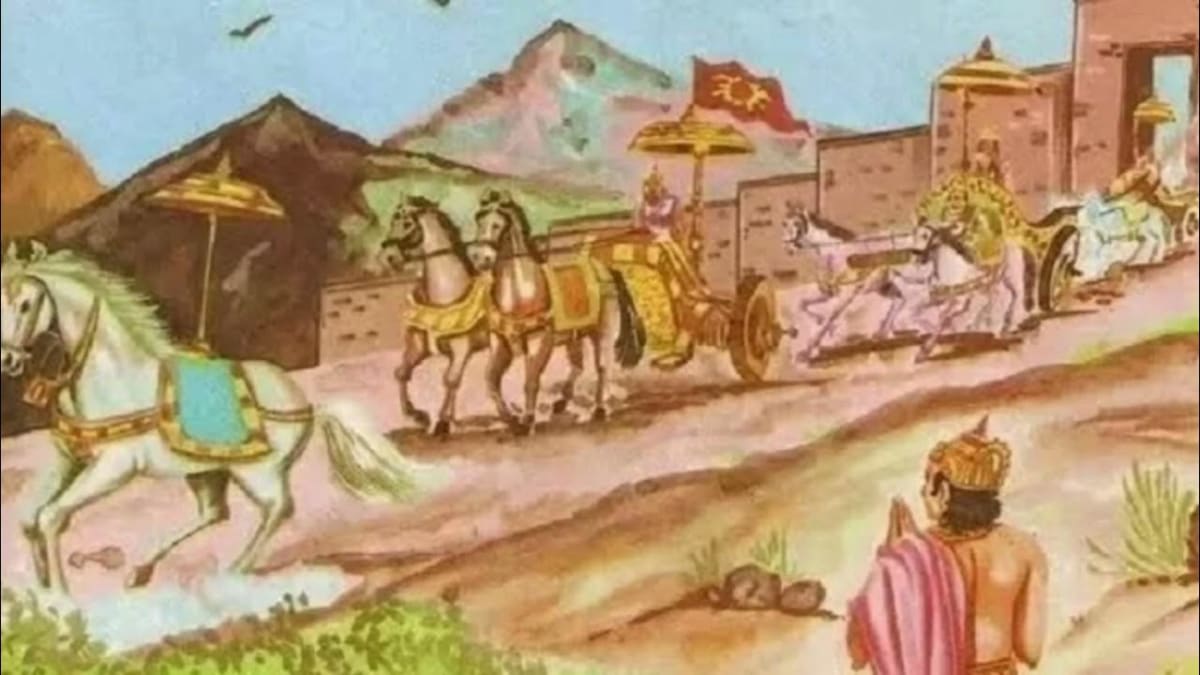
- The Ashwamedha Yajna involved territorial expansion.
- The king was granted the title of 'Samrat'.
- The ritual was performed to honour nature gods.
- It symbolised the king's supreme authority.
Answer
The ritual was performed to honour nature gods.
Reason — The Ashwamedha Yajna was performed by kings to bring conquered territories under subjugation and to assume the title of 'Samrat', symbolising their supreme authority. It was not performed to honour nature gods, so this statement does not align with the picture.
Consider the two statements given below and select the option that shows the correct relationship between (A) and (R).
Assertion (A): In the Vedic period a man's life was divided into four Ashramas.
Reason (R): These were Brahmins, Kshatriyas, Vaishyas and Shudras.
- Both (A) and (R) are true, and (R) is the correct explanation of (A)
- Both (A) and (R) are true, but (R) is not the correct explanation of (A)
- (A) is true but (R) is false
- (A) is false but (R) is true.
Answer
(A) is true but (R) is false
Explanation — In the Vedic period, a man's life was indeed divided into four Ashramas — Brahmacharya, Grihastha, Vanaprastha and Sanyasa, so (A) is true. However, Brahmins, Kshatriyas, Vaishyas and Shudras are the four varnas, not the Ashramas, so (R) is false.
Consider the two statements given below and select the option that shows the correct relationship between (A) and (R).
Assertion (A): The Nature-gods of the Rigvedic people became less important during the Later Vedic Age.
Reason (R): In Later Vedic Age gods such as Prajapati, Vishnu and Shiva became prominent.
- Both (A) and (R) are true, and (R) is the correct explanation of (A)
- Both (A) and (R) are true, but (R) is not the correct explanation of (A)
- (A) is true but (R) is false
- (A) is false but (R) is true.
Answer
Both (A) and (R) are true, and (R) is the correct explanation of (A)
Explanation — During the Later Vedic Age, the old nature-gods such as Indra, Varuna and Agni lost their prominence, while new gods such as Prajapati (Brahma), Vishnu and Shiva (Rudra) rose to importance. As the rise of these new gods is the very reason the nature-gods became less important, (R) correctly explains (A).
Read the following excerpt and answer the question that follow:
"By this period some of Vedic tribes had moved from the 'SaptaSindhava' region to the Upper - Ganga valley and other adjacent regions."
(Source : https://egyankosh.ac.in/bitstream/123456789/64790/1/BLOCK%203.pdf)
What is the Saptasindhu region, and why is it significant?
Answer
Saptasindhu is the land of the seven rivers in Punjab. The Aryans initially settled in Saptasindhu.
Name two crafts practised by the Rig Vedic Aryans.
Answer
The Aryans were engaged in building chariots, making ornaments and weapons, weaving, etc.
Who was a 'Gramini'?
Answer
The Gramini was the chief functionary in a village during the Rig Vedic Age. The whole village administration was his responsibility.
Name any two weapons of offence of the Aryans.
Answer
The chief weapons of war used by the Aryans were the bows and arrows, spears, axes, maces, etc.
What was the head of an Aryan family called?
Answer
The Aryans families were patriarchal and the oldest male member in the family was called 'Grihapati' or the master of the household. All other members had to obey him.
What subjects were included in the Later Vedic education?
Answer
The subjects that were included in the Later Vedic education were:
- The Vedas
- The Puranas
- Grammar
- Mathematics
- Ethics
- Logic
- Military Science
- Philosophy
- Vedangas
- Brahm-Vidya
- Nirukti
- Astronomy
- Music
- History
The education aimed to develop physical, mental, and spiritual faculties, with a focus on both religious and secular knowledge.
Name any two pastimes of the Aryans.
Answer
Two pastimes of the Aryans were hunting and chariot racing.
From which Veda we form an idea of the Early Vedic Civilisation?
Answer
We form an idea of the Early Vedic Civilisation from the Rig Veda. It is the oldest Veda and therefore known as the 'first testament of mankind'.
React the following excerpt and answer the question that follows:
"The Upanishads contain two basic principles of Indian philosophy viz., karma and the transmigration of soul, i.e., rebirth based on past deeds."
(Source:https://www.nios.ac.in/media/documents/SrSec315NEW/315_History_Eng/315_History_Eng_Lesson4.pdf)
- What is the importance of the Upanishads?
Answer
The Upanishads are a foundational source of Indian philosophy. They are an endeavour to explain numerous mysteries of life, to know about the relationship between the soul and the creator and to elucidate the theories of the Karma (Action), Maya (Illusion) and Mukti (Salvation) etc. They are of great historical importance because they contain valuable information about the social and religious condition of the Aryans.
What is meant by PGW?
Answer
PGW stands for Painted Grey Ware. It is a very fine, smooth pottery consisting mainly of open-mouthed bowls and dishes. Made from high-quality clay, it was decorated with various geometric patterns in black or deep chocolate brown.
Read the lines given below and answer the question that follows:
Drive away all disease and the Rakshasas-- Send down abundance of waters. From the ocean of the sky.
- Which god is likely being addressed in this hymn?
Answer
Indra is likely being addressed in this hymn. He was worshipped as the rain-bringer and as a protector from diseases and Rakshasas.
What were the primary professions of the Aryans?
Answer
The primary professions of the Aryans were agriculture and the domestication of animals.
What are the key differences between Early Vedic and Later Vedic Literature?
Answer
The key differences between the Early Vedic and Later Vedic Literature are as follows:
| Early Vedic Literature | Later Vedic Literature |
|---|---|
| Composed during the Rig Vedic period, 1500 BCE to 1000 BCE. | Composed during the Later Vedic Age, 1000 BCE to 600 BCE. |
| Its hymns praise Gods representing various aspects of nature. | Its hymns include chants, details about rituals, magic, charm, gyan, karma, upasana, medicines and spells. |
| They contain the original hymns. | Some verses have been taken from the Rig Veda. |
| Example - the Rig Veda. | Examples - the Samaveda, the Yajurveda, and the Atharvaveda. |
Name the four Vedas and briefly describe their focus.
Answer
The four Vedas are:
- The Rig Veda — It praises the various gods representing the various aspects of nature.
- The Samaveda — It mainly contains the chants recited by priests while performing Yajnas.
- The Yajurveda — It contains chiefly hymns that describe the rituals to be observed while performing Yajnas or sacrifices.
- The Atharvaveda — This Veda contains hymns about magic, charm, and discusses gyan (knowledge), karma (action), and upasana (prayer), as well as the power of spirits. Some hymns also describe medicines for treating diseases and include spells to drive away evil spirits and cure illnesses.
Read the following excerpt and answer the questions that follow:
"There is however the general point that the Later Vedic society reflected in archaeology was a society which had used iron. Iron objects are common to most of the PGW sites."
(Source: https://egyankosh.ac.in/bitstream/123456789/64790/1/BLOCK%203.pdf)
(a) Which iron tools were used to improve agricultural yield in the Later Vedic period?
(b) How did the use of iron tools impact the Later Vedic period?
Answer
(a) Heavier ploughs were designed to improve agricultural yield in the Later Vedic period.
(b) The use of iron tools in the Later Vedic period had several significant impacts:
- Improved Agriculture: Iron tools like ploughs made farming more efficient. These tools allowed for deeper plowing of the soil, leading to better cultivation of crops, especially in regions with tougher soil.
- Expansion of Settlements: With the help of more effective farming tools, the Aryans were able to cultivate larger areas of land, which led to the growth of settlements.
- Increased Productivity: The use of iron tools increased the productivity of agriculture, which supported the growing population and urbanization during the Later Vedic period.
- Military Advantages: Iron also contributed to the development of stronger weapons (like swords and spears), which played a role in the growth of the Kshatriya warrior class and the expansion of territories through conquests.
Read the following excerpt and answer the questions that follow:
"All aspects of life were discussed in these assemblies. These may include wars, distribution of the spoils of wars, judicial and religious activities etc. Thus these assemblies in a way limited the powers of the chiefs."
(Source: https://www.nios.ac.in/media/documents/SrSec315NEW/315_History_Eng/315_History_Eng_Lesson4.pdf)
(a) Define the Sabha and the Samiti.
(b) What was the primary role of the Sabha and Samiti in Rig Vedic administration?
Answer
(a) Sabha — 'Sabha' was a council composed of only the distinguished members to assist the king. Free discussions were held in the Sabha and the resolutions were passed by the majority vote. Its decisions were applicable to all and everybody had to abide by these decisions.
Samiti — The Samiti was the council for the whole tribe. There was freedom of expression to every member and the resolutions were carried by the majority of vote. Even the king had to seek the cooperation of the Samiti which helped him in strengthening his position.
(b) The Sabha and the Samiti were two councils of chosen members from among the people to assist the king. They had great importance and they exercised control over the king so that he did not turn into an autocrat.
Name any two gods worshipped by the Rig Vedic Aryans and the Later Vedic Aryans.
Answer
- Two gods worshipped by the Rig Vedic Aryans — Indra and Agni.
- Two gods worshipped by the Later Vedic Aryans — Brahma and Vishnu.
Read the lines given below and answer the questions that follows:
"The varna system had become rigid. Transformation from one varna to another had become difficult. Community lunch and inter-marriages had ceased to exist."
(a) Give the names of the four 'Varnas'.
(b) How did the varna system change during the Later Vedic period?
Answer
(a) Four varnas are — Brahmins, Kshatriyas, Vaishyas, and Shudras.
(b) During the Later Vedic Period, the Varna system became rigid, making movement between these difficult. Community meals disappeared, and a rigid varna system appeared. Only the three higher varnas were permitted to undergo upanayana (the sacred thread ceremony) as per Vedic traditions. Inter-varna marriages were not practised, further solidifying social divisions.
Why did the Aryans attach so much importance to the religious sacrifices?
Answer
The Aryans performed Yajnas or sacrifices to appease the gods, who were believed to bless the worshippers with peace and prosperity.
Name the two great Indian Epics. What cultural values do they reflect?
Answer
Two great Indian epics are the Ramayana and the Mahabharata. The Ramayana teaches us values such as duty (dharma), devotion, loyalty, and the triumph of good over evil, while the Mahabharata teaches us important moral and philosophical lessons about justice, fate, and the consequences of one's actions.
Read the following excerpt and answer the questions that follow:
"Despite the presence of some women philosophers and the references to a few queens participating in the coronation rituals, women were considered subordinate to men, and were not involved in any major decision making."
(Source : https://egyankosh.ac.in/bitstream/123456789/64790/1/BLOCK%203.pdf)
(a) What changes occurred in the status of women from the Rig Vedic to the Later Vedic period?
(b) Despite the decline in status, what rights or practices still honoured women during the Later Vedic period?
Answer
(a) By Later Vedic period, status of women had degraded as compared to their status in the Rig Vedic period. They had lost their position both in the religious, political and social fields. They were prohibited from actively participating in the affairs of the state. The kings and the nobles now began to keep several wives. Birth of a daughter was regarded as an unfortunate event.
(b) Despite this decline, certain rights and practices still honoured women during the Later Vedic period:
- Women from higher families continued to receive education.
- Women of higher classes could participate in rituals and choose their husbands through svayamvara.
Give one important feature of the economic activity during the Rig Vedic Civilisation.
Answer
The main occupations of people during the Rig Vedic Age were agriculture and domestication of animals.
What makes the Epics an important source for understanding ancient Indian values?
Answer
The epics provide important information about the political, social, and cultural structure of the Epic Age. They offer insights into Aryan kingdoms, military organization, and weapons. The epics highlight values like duty, loyalty, and righteousness, with heroes representing high moral ideals. The Bhagavad Gita, part of the Mahabharata, teaches timeless lessons on duty (karma), righteousness, and the immortality of the soul.
Discuss how the Aryans influenced the socio-economic structure in ancient India.
Answer
The Aryans influenced the socio-economic structure in ancient India in the following ways:
Social Life: - Society changed from a simple tribal society to a more organized one. The Varna system became rigid, the Ashrama system developed, and the status of women declined during the Later Vedic period.
Economic Life: - Agriculture became the chief occupation. Domestication of animals, trade, crafts and guilds developed, and towns such as Ayodhya and Indraprastha grew.
With reference to the early Vedic literature, explain the following:
(a) From which root word is the term 'Veda' derived?
(b) Why is the Rig Veda regarded as the "first testament of mankind"?
(c) How many mandalas are there in the Rig Veda?
(d) Explain how Rig Vedic hymns were preserved and transmitted through generations.
Answer
(a) The word 'Veda' itself is derived from the root 'Vid' which means 'to know'. Thus the Veda means wisdom or knowledge.
(b) The Rig Veda is the oldest Veda and therefore, it is known as the 'first testament of mankind'.
(c) The Rig Veda is divided into ten mandalas.
(d) The Rig Vedic hymns were passed on orally from teachers to disciples.
Read the following excerpt and answer the questions that follow:
"The Upanishads contain two basic principles of Indian philosophy viz., karma and the transmigration of soul, i.e., rebirth based on past deeds. According to these texts real happiness lies in getting moksha i.e. freedom from this cycle of birth and re-birth."
(Source :https://www.nios.ac.in/media/documents/SrSec315NEW/315_History_Eng/315_History_Eng_Lesson4.pdf)
(a) Explain concepts like Karma, Maya, and Mukti.
(b) Highlight their relevance in contemporary philosophy.
Answer
(a) Karma — Karma refers to the belief that every action has consequences. Good actions lead to positive outcomes, while bad actions result in suffering, influencing future rebirths.
Maya — Maya is the illusion of the material world, which distracts people from realizing the ultimate reality (Brahman). The world is seen as deceptive and not the true essence of existence.
Mukti — 'Mukti' means 'Salvation'. Mukti is the liberation from the cycle of birth and rebirth. It is the attainment of eternal peace and union with Brahman by transcending karma and Maya.
(b) The Upanishads are a foundational source of Indian philosophy. They are an endeavour to explain numerous mysteries of life, to know about the relationship between the soul and the creator and to elucidate the theories of the Karma (Action), Maya (Illusion) and Mukti (Salvation) etc.
Trade was another major occupation. Now the traders had organised themselves into various guilds or associations which looked after their interests. With reference to this, answer the following questions:
(a) How did the formation of trade guilds contribute to the economic development of the Later Vedic Period?
(b) What might have been the advantages of these guilds for traders and artisans?
(c) Discuss the significance of early forms of currency like Nishka and Satamana in trade.
Answer
(a) The formation of trade guilds during the Later Vedic period played a crucial role in the economic development of the time. Guilds organized traders and artisans into structured groups, allowing for better coordination and regulation of trade. These associations helped standardize prices, set quality benchmarks, and facilitated a more efficient marketplace. As a result, they fostered increased commercial activity and economic expansion, as they allowed for safer, more reliable transactions and encouraged both domestic and international trade. Vedic texts mention ships, showing active inland and coastal trade during this time. The guilds also helped build trust among traders, which was essential for the growth of markets and the long-distance exchange of goods.
(b) The guilds offered several key advantages to both traders and artisans. First, they provided a sense of security and mutual support. Traders and artisans could rely on guilds for protection against fraud, legal disputes, and financial assistance. By being part of a guild, they could also benefit from collective bargaining, ensuring better terms for goods and services. Guilds also helped to organize trade routes and created access to larger, more profitable markets. For artisans, guilds ensured that products met consistent standards, improving reputation and sales. They also helped in the transfer of skills, allowing artisans to learn from each other and improve the quality of their crafts.
(c) Nishka and Satamana were early forms of currency used as a medium of exchange during the Later Vedic period. With the introduction of such coinage, trade transactions became easier, though the barter system had not completely ceased.
Life during the Later Vedic Period was divided into four stages, known as the Ashramas. With reference to this, answer the following questions:
(a) What are the four Ashramas, and what duties were associated with each?
(b) How did the Ashrama system reflect the values of Later Vedic society?
(c) What challenges might people have faced in adhering to the Ashrama system?
Answer
(a) The four stages in the life of an Aryan, also known as the four Ashramas were:
- The Brahmacharya Ashrama — During this phase, a young man lived with a teacher, usually in a gurukul, where he received education and focused on personal discipline.
- The Grihastha Ashrama — It involved marriage, raising a family, and supporting them through work. During this stage, a man fulfilled his societal duties, which included maintaining the household and contributing to the community.
- The Vanaprastha Ashrama — It began when a man reached middle age. At this point, he would retire from worldly duties, leave home, and move to the forests. There, he would spend his time in spiritual practices, devotion to God, and meditation.
- The Sanyasa Ashrama — During this phase, a man renounced all worldly attachments and devoted himself to the service of others. This phase was centred around preaching religious ideals and seeking ultimate liberation (moksha) through meditation and asceticism.
(b) The four Ashram stages reflected a holistic view of life, guiding individuals from education and family life to spiritual and selfless service.
- The Brahmacharya Ashrama reflected the Vedic value of spiritual and intellectual development, highlighting the role of gurus (teachers) and the pursuit of wisdom.
- The second stage Grihastha Ashrama involved marriage, family life, and responsibility. It reflected the values of social stability, family obligations, and the continuity of traditions.
- The Vanaprastha Ashrama reflected detachment from material world and the idea of seeking spiritual knowledge through contemplation, meditation, and self-reflection.
- The Sanyasa Ashrama highlighted the supreme value placed on selflessness, asceticism, and spiritual enlightenment, reflecting the goal of transcending the cycle of birth and rebirth.
(c) People might have faced the following challenges in adhering to the Ashrama system:
- Social and Economic Pressures — Economic pressures such as poverty, lack of resources, or political instability could have made it difficult for individuals to focus on spiritual growth or social duties. For instance, during the Grihastha (householder) stage, providing for a family might have been a constant struggle, making it hard to follow the prescribed duties of the stage.
- Rigid Transitions Between Stages — Transitioning from the Brahmacharya (student) stage to Grihastha (householder) required significant lifestyle changes. Similarly, moving from Grihastha to Vanaprastha (retirement) or Sannyasa (renunciation) meant detaching from material responsibilities, which might have been difficult for people who had strong familial or social attachments.
- Spiritual Challenges — Achieving the goal of moksha (liberation) required intense discipline and spiritual dedication, particularly in the later stages of the Ashrama system. Many might have struggled with self-discipline or felt unprepared for the demanding spiritual practices required in the Sannyasa stage, where complete detachment from worldly life was expected.