
Which of the following books contains the teachings of Lord Mahavira?
- Tripitakas
- Vyakhya Pragnapti
- Jataka
- Bhagavad Gita
Answer
Vyakhya Pragnapti
Reason — Vyakhya Pragnapti is one of the Jain sacred texts that contains the teachings of Lord Mahavira.
Which part of the Sutta Pitaka contains Buddha's teachings?
- Dhammapada
- Therigatha
- Vinaya Pitaka
- Abhidhamma Pitaka
Answer
Dhammapada
Reason — The Dhammapada, an important part of the Sutta Pitaka, contains mainly Buddha's teachings, emphasising moral principles and the path to truth.
Identify the features of the Vinaya Pitaka as described in Buddhist literature:
P : Describes rules for monks and nuns.
Q : Explains the human mind and states of matter.
R : Documents Buddha's life events.
S : Provides moral lessons through stories.
- P and Q
- R and S
- P and R
- Q and S
Answer
P and R
Reason — The Vinaya Pitaka contains the rules and regulations for the daily living of the monks and nuns (P). Statement Q describes the Abhidhamma Pitaka, which explains the human mind and Buddhist metaphysical concepts, and statement S describes the Jatakas, which give moral lessons through stories. Note: The chapter states that the Vinaya Pitaka describes "some important aspects of ancient Indian history, arts, crafts, customs and tradition" but does not explicitly say it documents Buddha's life events (R), so the inclusion of R in the answer key may need manual verification.
Which of the following statements is true?
(i) People who have faith in Jainism, follow class distinction.
(ii) Jains refused to accept the authority of the Vedas.
(iii) Jains believed that the chief aim of a man is to attain salvation.
- Only (i) and (iii)
- Only (i)
- Only (ii) and (iii)
- Only (i), (ii) and (iii)
Answer
Only (ii) and (iii)
Reason — Jainism rejected the caste system and class distinctions, so statement (i) is false. Jainism rejects the authority of the Vedas, and the Jains believe the chief aim of a man is to attain moksha or salvation, making statements (ii) and (iii) true.
Identify the incorrectly matched pair related to Buddhist teachings:
- Dhammapada : Buddha's teachings on ethics
- Therigatha : Compositions by bhikkhunis (nuns)
- Vinaya Pitaka : Buddha's birth stories
- Sutta Pitaka : Discourses delivered by Buddha
Answer
Vinaya Pitaka : Buddha's birth stories
Reason — The Vinaya Pitaka contains the rules and regulations for monastic life, not Buddha's birth stories. The birth stories of the Buddha in his previous lives are found in the Jatakas, so this pair is incorrectly matched.
Which of the following is a major teaching of Buddhism?
- Ritualistic animal sacrifices
- Emphasis on caste distinctions
- Non-violence and ethical living
- Sanskrit prayers
Answer
Non-violence and ethical living
Reason — Buddhism laid great stress on non-violence towards all living beings and on ethical, righteous living, unlike the Vedic religion which involved ritualistic animal sacrifices, caste distinctions and Sanskrit prayers.
Which of the following does not comprise the Triratna of Jainism?
- Right faith
- Right knowledge
- Ahimsa
- Right conduct
Answer
Ahimsa
Reason — The Triratna (Three Jewels) of Jainism are right faith, right knowledge and right conduct. Ahimsa is a core principle of Jainism but is not part of the Triratna.
Which social tension influenced Kshatriyas to support Buddhism?
- Economic disparity
- Ritualistic dominance of Brahmanas
- Decline in Sanskrit literacy
- Prohibition of animal sacrifices
Answer
Ritualistic dominance of Brahmanas
Reason — The Varna based society generated social tensions, and the Kshatriyas reacted strongly against the ritualistic domination of the Brahmanas. This opposition to the privileges claimed by the priestly class made them support Buddhism.
Two great religions arose in India in the 6th century BCE. Which of the following correctly describes the reason for the same?
- General public were bored of Hinduism
- Complicated rituals, excessive animal sacrifice and predominance of the Brahmanas led people away to the new religions
- Rising importance of Shudras led people away to new religions
- Both the religions were set up by Kshatriyas, hence those who hated the predominance of Brahmanas gravitated towards the new sects
Answer
Complicated rituals, excessive animal sacrifice and predominance of the Brahmanas led people away to the new religions
Reason — The rise of the two new religions was caused by the complications and ritualism in the Vedic religion, the excess of animal sacrifice, and the predominance of the priesthood (Brahmanas), which drove the common people away towards these simpler faiths.
Which of the following statements correctly describes the given picture.
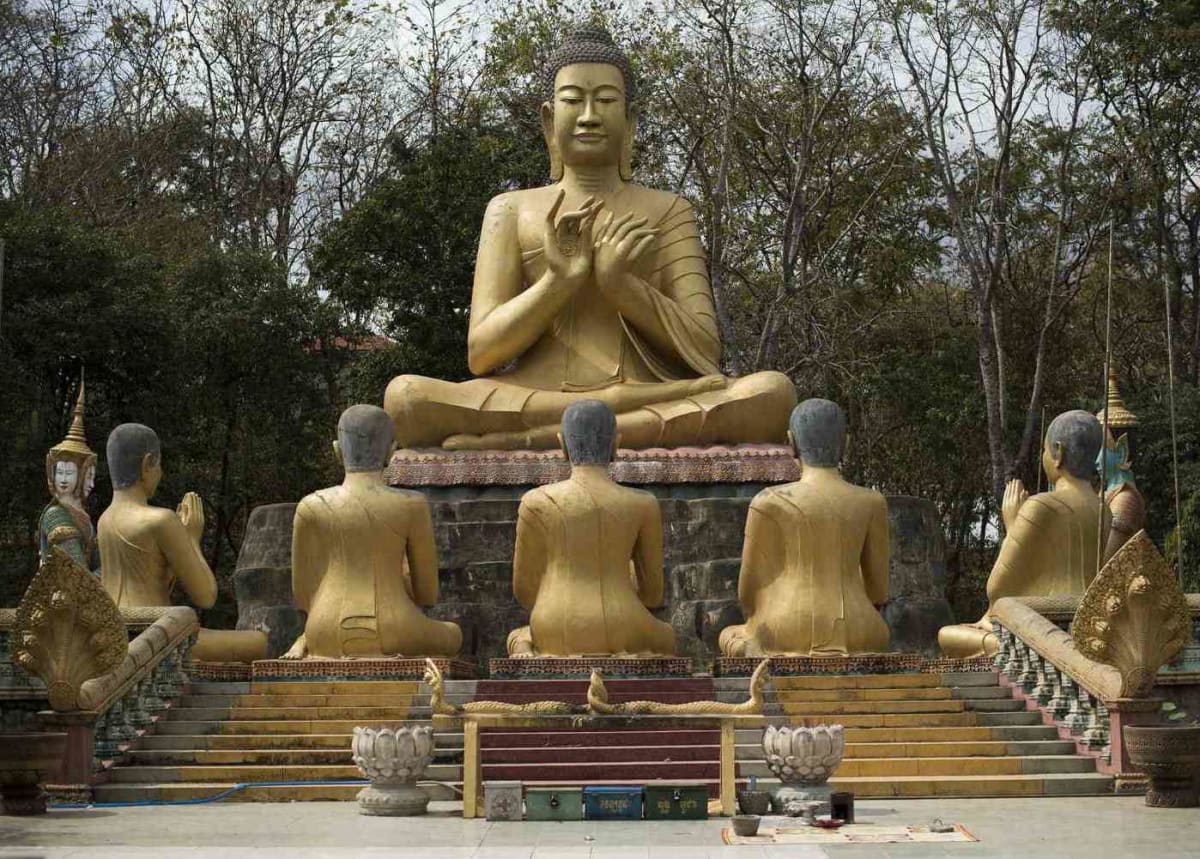
- Buddha found five disciples who followed him at Sarnath where he delivered his first sermon
- Mahavira chose five disciples at Sarnath to preach Jain doctrines
- Buddha delivered his first sermon to five kings of Magadha
- This picture depicts the event of Great Renunciation
Answer
Buddha found five disciples who followed him at Sarnath where he delivered his first sermon
Reason — The picture shows the Buddha with his five disciples at Sarnath, where, after attaining enlightenment, he delivered his first sermon known as Dharmachakrapravartana or 'Turning of the Wheel of Law'.
Identify the principles of Jainism that align with its ethical philosophy:
P : Ahimsa (non-violence)
Q : Aparigraha (non-possessiveness)
R : Ritual sacrifices
S : Asteya (non-stealing)
- P and Q
- P, Q, and S
- Q, R, and S
- P, R, and S
Answer
P, Q, and S
Reason — Ahimsa (non-violence), Aparigraha (non-possessiveness) and Asteya (non-stealing) are among the five vows of Jainism and reflect its ethical philosophy. Ritual sacrifices (R) are rejected by Jainism, which had no faith in Yajnas and sacrificial practices, so R does not align with its principles.
Read the two statements given below about Jainism's stance on rituals. Select the option that shows the correct relationship between (A) and (B).
(A) : Jainism rejects Yajnas and sacrificial rituals of the Vedic tradition.
(B) : Jainism promotes equality and rejects caste-based discrimination.
- (B) contradicts (A)
- (B) is the reason for (A)
- (A) is true but (B) is false
- (A) and (B) are independent of each other
Answer
(A) and (B) are independent of each other
Reason — Both statements are true, but statement (A) concerns Jainism's rejection of Yajnas and rituals, while statement (B) concerns its social outlook of equality and rejection of caste discrimination. Since neither causes nor explains the other, the two statements are independent of each other.
Which Buddhist council led to the division of Buddhism into Hinayana and Mahayana?
- First Council
- Second Council
- Third Council
- Fourth Council
Answer
Fourth Council
Reason — During the deliberations of the 4th Buddhist Council, Buddhism split into two sects, the Hinayana and the Mahayana.
Identify the odd one out among the reasons for the decline of Buddhism:
- Corruption and luxury among Buddhist monks
- Shift from Pali to Sanskrit for Buddhist texts
- Revival of Hindu rituals and practises
- Getting royal patronage
Answer
Getting royal patronage
Reason — The decline of Buddhism was caused by factors such as corruption among the monks, the shift from Pali to Sanskrit, and the revival of Hindu practices. It was the loss of royal patronage, not gaining it, that led to decline, so 'Getting royal patronage' is the odd one out.
Consider the two statements given below and select the option that shows the correct relationship between (A) and (R).
Assertion (A): Buddha taught that the world is full of suffering.
Reason (R): He taught that the main cause of suffering is desire.
- Both (A) and (R) are true, and (R) is the correct explanation of (A)
- Both (A) and (R) are true, but (R) is not the correct explanation of (A)
- (A) is true but (R) is false
- (A) is false but (R) is true.
Answer
Both (A) and (R) are true, and (R) is the correct explanation of (A)
Explanation — The Buddha's first Noble Truth (Dukkha) states that the world is full of suffering, and the second Noble Truth (Samudaya) states that desire is the main cause of suffering. Both statements are therefore true, and the Reason correctly explains why the world is full of suffering, so (R) is the correct explanation of (A).
Consider the two statements given below and select the option that shows the correct relationship between (A) and (R).
Assertion (A): Every Jain has to take five vows.
Reason (R): The first four vows were enunciated by Parshvanath, while the fifth one was added by Mahavira.
- Both (A) and (R) are true, and (R) is the correct explanation of (A)
- Both (A) and (R) are true, but (R) is not the correct explanation of (A)
- (A) is true but (R) is false
- (A) is false but (R) is true.
Answer
Both (A) and (R) are true, but (R) is not the correct explanation of (A)
Explanation — It is true that every Jain has to take five vows, and it is also true that the first four vows were enunciated by Parshvanath while the fifth vow of Brahmacharya (chastity) was added by Mahavira. However, the historical origin of the vows does not explain why every Jain must take them, so (R) is not the correct explanation of (A).
Who was the founder of Buddhism?
Answer
Gautam Buddha was the founder of Buddhism.
What are the Dwadashangi and why are they significant in Jainism?
Answer
The teachings of Lord Mahavira were compiled by his disciples in 12 parts called Angas (meaning 'parts'). These Angas are together called Dwadashangi.
Read the following excerpt and answer the question that follows:
"The Sutta Pitaka centres particularly on the basic principles of Buddhist thought and practise. And it, therefore, is the foundation for the study of Buddhist doctrine throughout the Theravada Buddhist world."
What is the focus of the Sutta Pitaka, and how does it contribute to Buddhist teachings?
Answer
The Sutta Pitaka focuses on the basic principles of Buddhist thought and practice. It is a central text in the Theravada Buddhist tradition and serves as a foundation for understanding Buddhist doctrine.
Which period saw the construction of the Chaitya Hall at Karle?
Answer
The Chaitya Hall at Karle was constructed in the beginning of the Common Era during the Satavahana period.
What does the term "Sakya Muni" mean?
Answer
Sakya Muni means the sage of the Sakya clan. Since Gautam Buddha belonged to the Sakya clan, he was known as 'Sakya Muni'.
Which language was the Vedic literature written in, and why did it create a problem?
Answer
The Vedic literature was written in Sanskrit, which was difficult for the common people to understand. The Brahman priests recited mantras and conducted rituals in Sanskrit language, making the religion less understandable.
What are the Triratnas of Jainism?
Answer
The Triratnas of Jainism are — right faith, right knowledge, and right conduct.
Read the following excerpt and answer the question that follows:
"At the age of thirty he left his wife, child, and family and started a life of total renunciation and asceticism.
(Source: https://egyankosh.ac.in/handle/123456789/35227)
What practise did Mahavira undertake after renunciation?
Answer
After renunciation, Mahavira practised severe penance and asceticism for twelve years in search of truth before attaining Kevala Jnana (supreme knowledge).
Name two places where Buddhist and Jain rock-temples have been found.
Answer
Two places where Buddhist rock-temples have been found are — Nasik and Karle.
Two places where Jain rock-temples have been found are — Odisha (the Hathi Gumpha Cave), and Ellora (the Indra Sabha Cave).
Who led the Shwetambaras sect, and where were they based?
Answer
The Shwetambara sect was led by Sthulabhadra, and they were based in Magadha.
What event is referred to as 'Turning of the Wheel of Law'?
Answer
After attaining enlightenment, Gautam Buddha went to Sarnath and delivered his first sermon at the Deer Park. This event is known as Dharmachakrapravartana or 'Turning of the Wheel of Law'.
Read the following excerpt and answer the question that follows:
"He taught about the nobility of a religion. The four Noble Truths are the essence of the Buddha's teachings, which he explained in his first sermon to his old colleagues at Isipattana."
(Source : https://egyankosh.ac.in/handle/123456789/35229)
What are the Four Noble Truths of Buddhism?
Answer
The Four Noble Truths of Buddhism are:
- World is full of sorrows.
- Desires are the main source of sorrows.
- One can get rid of sorrows by killing desires.
- The desires can be killed by following the EightFold Path or the Middle Path.
Compare the core teachings of Mahayana and Hinayana Buddhism regarding salvation and the concept of Buddha.
Answer
| Mahayana | Hinayana |
|---|---|
| Mahayana means the greater vehicle of Salvation. It believes that Buddha was an incarnation of God. According to Mahayana, Bodhisattvas are holy Buddhists who had not yet attained Nirvana like the Buddha but were proceeding rapidly towards it. | Hinayana means the Lesser vehicle for salvation. It denies the existence of God, holds that the Eight-Fold path is the only means of salvation. |
Why has Shravanbelagola become an important Jain pilgrimage site?
Answer
The colossal statue of Bahubali (Gommateswara) which is situated at Shravanbelagola in Karnataka is known for its huge height (57 feet) and grandeur. That's why this place has become an important Jain pilgrimage site.
What are the "Four Great Sights" that changed Gautama's perspective on life?
Answer
The "Four Great Sights" that changed Gautama's perspective on life are an old man, a sick man, a dead body, and an ascetic.
Read the following excerpt and answer the questions that follow:
"After preaching and teaching for many years, Buddha attained Nirvana at the age of eighty at Kushinagara in eastern Uttar Pradesh. Buddha was the only religious founder who did not make any super natural claim."
(Source: https://egyankosh.ac.in/hand/e/123456789/35229)
(a) What is "Mahaparinirvana," and where did Gautama Buddha attain it?
(b) What happened to Gautama Buddha's sacred remains after his death?
Answer
(a) Mahaparinirvana refers to the final Nirvana attained by Gautama Buddha at the time of his death. Gautama Buddha attained Mahaparinirvana at Kushinagar (Kushinagara), near Gorakhpur in present-day Uttar Pradesh.
(b) Gautama Buddha's sacred remains were distributed among his followers and taken to eight different places, where large mounds, called stupas, were built over them.
With reference to the picture given below answer the following questions:

(a) Where is the famous Stupa located, and who built it?
(b) What purpose did stupas serve in the spread of Buddhism, and what do they symbolise?
Answer
(a) The Sanchi Stupa, located in Madhya Pradesh, is believed to have been originally built in the 3rd century BCE by Emperor Ashoka to enshrine the Buddha's relics.
(b) Stupas played a central role in the spread and symbolism of Buddhism, serving both religious and cultural purposes.
State the five vows which every Jain has to take.
Answer
Every Jain has to take the following five vows :
- Not to injure life (Ahimsa)
- Not to tell a lie (Satya)
- Not to steal (Asteya)
- Not to possess any property (Aparigraha)
- To practise chastity (Brahmacharya)
Read the following excerpt and answer the questions that follow:
"These twelve compilations are therefore called the twelve Angas and are collectively known as Dwadashangi. The foremost of these Angas is the Aacharang Sutra. Other well known Angas are Sutrakritang, Samavayang, Sthanang, and Vyakhya Pragnapti which is more popularly known as Bhagavati Sutra."
(Source: https://egyankosh.ac.in/handle/123456789/35227)
(a) What are the Angas? Where and when were they compiled?
(b) What does the Aacharang Sutra deal with?
Answer
(a) The teachings of Lord Mahavira were compiled by his disciples in 12 parts called Angas. They were compiled at Vallabhi in Gujarat in the sixth century CE.
(b) The Aacharang Sutra deals with the code of conduct to be followed by Jain monks.
Why did Jainism fail to spread actively to other countries compared to Buddhism?
Answer
Jainism failed to spread actively to other countries compared to Buddhism due to the following reasons:
- Strict rules: The rigid practices of Jainism like severe penance and extreme non-violence, were hard for common people to follow.
- Division into sects: After Mahavira's death, Jainism split into two groups - Shwetambaras and Digambaras, which weakened unity and efforts to spread the religion.
- Lack of missionary effort: Unlike Buddhism, Jainism did not actively spread to other countries and remained limited to certain areas in India.
- Loss of Royal Patronage: Jainism did not receive much royal patronage compared to Buddhism, which was supported by rulers like Ashoka and Harsha.
- Social inequality: Although Jainism promoted equality, it did not completely remove social hierarchies, which reduced its appeal.
- Rise of Hinduism: During the Gupta period, the resurgence of Hinduism with royal patronage confined Jainism to smaller regions.
How did the Sangha contribute to the growth of Buddhism in ancient India?
Answer
To spread his teachings, Buddha formed the Sangha, a community of monks and nuns who lived disciplined lives in monasteries. They travelled from place to place, preached the Buddha’s message in the local languages, and lived simply so common people could connect with them. In this way, the Sangha played a key role in the growth and spread of Buddhism across India.
How did the caste system help in the rise of Jainism and Buddhism?
Answer
The caste system greatly affected the Vedic religion. People from higher caste began to discriminate against those from the lower castes, especially the Shudras. Such treatment led to resentment among common people, who sought a religion free of caste based discrimination. They sought and promoted love and harmony instead of caste distinctions and social divisions.
What were the social and linguistic factors that made Jainism and Buddhism more accessible to the masses?
Answer
Social factors that made Jainism and Buddhism more accessible to the masses are:
- Both Jainism and Buddhism rejected the caste system and emphasized equality. They accepted followers from all varnas and backgrounds.
- The people sought and promoted love and harmony instead of caste distinctions and social divisions.
Linguistic factors that made Jainism and Buddhism more accessible to the masses are:
- The Vedic literature, written in Sanskrit, was difficult for the common people to understand. Jains and Buddhists rejected Sanskrit, the elite language of Vedic rituals.
- Buddhism primarily used Pali and Jainism used Prakrit, which were the language of the people. This made their teachings understandable and relatable to the general population.
With reference to the life and teachings of Mahavira, explain the following :
(a) When and where was Mahavira born?
(b) For how many years did Mahavira practise self-discipline?
(c) Describe any two of his teachings.
Answer
(a) Mahavira was born at Kundagrama near Vaishali (in present-day Bihar) in the second half of the sixth century BCE.
(b) Mahavira practised severe discipline and self-mortification for 12 years.
(c) Two teachings of Lord Mahavira are given below:
- Nine Truths : According to Jaina philosophy, the realisation of these Nine Truths is essential. These are : Jiva (living beings), Ajiva (Non-living things), Punya (results of good deeds), Papa (sin), Ashrav (good deeds), Sanvar (hindrance to karma), Bandha (bondage), Nirjara (destruction of karmas) and Moksha (Salvation).
- Believe in equality : Jainism rejected the caste system and class distinctions, advocating the equality for all. Mahavira strongly believed in the equality of all people and opposed caste discrimination. He supported women's freedom, allowing them to join the Jain Sangha, and emphasised equality between men and women. Mahavira promoted universal brotherhood, recognising all individuals as equal, regardless of caste or creed. He taught that virtuous actions lead to ultimate salvation (moksha) and that compassion should be shown to all living beings, from the smallest insect to the highest forms of life.
Analyse the importance of the Dharmachakrapravartana at Sarnath in spreading Buddha's teachings.
Answer
After attaining enlightenment, Gautam Buddha went to Sarnath and delivered his first sermon at the Deer Park. This event is known as Dharmachakrapravartana or 'Turning of the Wheel of Law'. Here, he found five disciples who followed him, and he travelled across the country, spreading his teachings.
Jainism's decline was due to strict practices, limited missionary efforts, and the rise of Hinduism. Despite this, Jainism made significant cultural contributions. With reference to this, answer the following questions:
(a) What were the reasons for Jainism's decline?
(b) Discuss Jainism's contributions to Indian art, architecture, and literature.
Answer
(a) The reasons for Jainism's decline are given below:
- Strict rules: The rigid practices of Jainism like severe penance and extreme non-violence, were hard for common people to follow.
- Division into sects: After Mahavira's death, Jainism split into two groups - Shwetambaras and Digambaras, which weakened unity and efforts to spread the religion.
- Lack of missionary effort: Unlike Buddhism, Jainism did not actively spread to other countries and remained limited to certain areas in India.
- Loss of Royal Patronage: Jainism did not receive much royal patronage compared to Buddhism, which was supported by rulers like Ashoka and Harsha.
- Social inequality: Although Jainism promoted equality, it did not completely remove social hierarchies, which reduced its appeal.
- Rise of Hinduism: During the Gupta period, the resurgence of Hinduism with royal patronage confined Jainism to smaller regions.
(b) Jainism's contributions to Indian art, architecture, and literature were significant.
- They built monasteries and temples to perpetuate the memory of their saints and sages. They also decorated their buildings with stone railings, beautiful gateways, stone umbrellas and finely carved pillars.
- They built beautiful temples and images at their sacred places like the Parasnath Hill, Pawapuri (Bihar), Rajgriha, Girnar and Mount Abu. The Dilwara Jain temple at Mount Abu in Rajasthan is a fine specimen of Jain temple architecture.
- The Jains also cut rocks to build caves and rock-temples. The Hathi Gumpha Cave in Odisha, the Indra Sabha Cave at Ellora and the Lion Cave in Udayagiri are the fine specimens of the Jain art.
- The colossal statue of Bahubali (Gommateswara) which is situated at Shravanbelagola in Karnataka is known for its huge height (57 feet) and grandeur. This place has become an important Jain pilgrimage site.
- Their chief works called the Angas, are written in Prakrit. They also wrote some other texts in Apabhramsa. They also took to Sanskrit and wrote legends, fables, and several valuable books on grammar and poetics which contributed richly to the development of the Sanskrit language.
While Jainism and Buddhism have many similarities, they differ significantly in their origins, approaches to life, and spread. Jainism emphasises severe asceticism and remains confined to India, while Buddhism followed a moderate path and spread worldwide. With reference to this, answer the following questions:
(a) Compare the approach of Jainism and Buddhism towards non-violence and asceticism.
(b) How did the focus on the laity in Jainism differ from the reliance on the Sangha in Buddhism?
(c) Discuss the reasons why Buddhism spread beyond India, while Jainism remained limited to the Indian subcontinent.
Answer
(a) The approaches of Jainism and Buddhism towards non-violence and asceticism are similar but differ in strictness:
| Jainism | Buddhism |
|---|---|
| Jainism supported Ahimsa, or non-violence, which means not harming any living being, including humans, animals, plants, and even microorganisms. | Buddhism laid great stress on non-violence towards all living beings. He believed that man should neither kill nor harm animals. However, unlike Mahavira, he did not extend his concept of non-violence to objects such as plants and stones. |
| Jainism advocates severe asceticism. Renunciation of all worldly pleasures, rigorous fasting, self-discipline, and enduring physical hardship are essential for spiritual liberation (moksha). | Buddhism promotes the Middle Path — a balanced approach between indulgence and extreme asceticism. |
(b) The focus on the laity in Jainism differs from the reliance on the Sangha in Buddhism in the following ways:
| Laity | Sangha |
|---|---|
| Jains emphasise the role of laity (non-monastic followers) in supporting religious activities. | Buddhists rely more on the monastic Sangha for their religious practices. |
(c) Buddhism spread beyond India, while Jainism remained limited to the Indian subcontinent. This is due to the following reasons:
- Strict rules: The rigid practices of Jainism like severe penance and extreme non-violence, were hard for common people to follow.
- Division into sects: After Mahavira's death, Jainism split into two groups - Shwetambaras and Digambaras, which weakened unity and efforts to spread the religion.
- Lack of missionary effort: Unlike Buddhism, Jainism did not actively spread to other countries and remained limited to certain areas in India.
- Loss of Royal Patronage: Jainism did not receive much royal patronage compared to Buddhism, which was supported by rulers like Ashoka and Harsha.
- Social inequality: Although Jainism promoted equality, it did not completely remove social hierarchies, which reduced its appeal.
- Rise of Hinduism: During the Gupta period, the resurgence of Hinduism with royal patronage confined Jainism to smaller regions.
Read the following excerpt and answer the questions that follow:
"This is also known as the 'middle path' because it avoids the extremes - happiness through sense pleasures and happiness through severe asceticism. The entire teaching of Buddha can be summarised into the eight-fold noble path."
(Source: https://egyankosh.ac.in/handle/123456789/35229)
(a) What is the Middle Path, and how does it differ from extreme asceticism and indulgence?
(b) Explain the relationship between the Four Noble Truths and the Eightfold Path in achieving salvation.
Answer
(a) The Middle Path or the Eight-fold path consists of the following principles:
- Right Belief
- Right Thought
- Right Speech
- Right Action
- Right Living
- Right Effort
- Right Recollection
- Right Meditation
This path is also called the 'Middle Path', as the Buddha on the one hand condemned the life of pleasure as practised by the Brahmana or priests, while on the other hand he opposed the life of severe penance, such as dying by starvation as preached by the Jains.
(b) Buddha was more focused on ethical conduct than metaphysical beliefs, advocating a way of life that anyone could follow. His Four Noble Truths, introduced in his first sermon at Sarnath, form the core of his teachings. They are:
- Dukkha : This world is full of sufferings.
- Samudaya : Desires are the main cause of sufferings.
- Nirodhe : One can get rid of sufferings by removing desires.
- Megga : The desires can be removed only by following the Eight-fold Path or the Middle Path.
The Four Noble Truths explain the nature and cause of suffering, while the Eightfold Path provides the method to overcome it and attain nirvana (liberation or salvation).