Find the distance between the following pair of points :
(2, 3), (4, 1)
Answer
By distance formula,
d = ( x 2 − x 1 ) 2 + ( y 2 − y 1 ) 2 \sqrt{(x_2 - x_1)^2 + (y_2 - y_1)^2} ( x 2 − x 1 ) 2 + ( y 2 − y 1 ) 2
Let P(x1 , y1 ) and Q(x2 , y2 ) be the given points
Co-ordinates of P = (2, 3)
Co-ordinates of Q = (4, 1)
P Q = ( 4 − 2 ) 2 + ( 1 − 3 ) 2 = 2 2 + ( − 2 ) 2 = 4 + 4 = 8 = 2 2 . PQ = \sqrt{(4 - 2)^2 + (1 - 3)^2} \\[1em] = \sqrt{2^2 + (-2)^2} \\[1em] = \sqrt{4 + 4}\\[1em] = \sqrt{8} \\[1em] = 2\sqrt{2}. PQ = ( 4 − 2 ) 2 + ( 1 − 3 ) 2 = 2 2 + ( − 2 ) 2 = 4 + 4 = 8 = 2 2 .
Hence, distance between (2, 3) and (4, 1) = 2 2 2\sqrt{2} 2 2
Find the distance between the following pair of points :
(0, 0), (36, 15)
Answer
By distance formula,
d = ( x 2 − x 1 ) 2 + ( y 2 − y 1 ) 2 \sqrt{(x_2 - x_1)^2 + (y_2 - y_1)^2} ( x 2 − x 1 ) 2 + ( y 2 − y 1 ) 2
Let P(x1 , y1 ) and Q(x2 , y2 ) be the given points
Co-ordinates of P = (0, 0)
Co-ordinates of Q = (36, 15)
P Q = ( 36 − 0 ) 2 + ( 15 − 0 ) 2 = 36 2 + 15 2 = 1296 + 225 = 1521 = 39. PQ = \sqrt{(36 - 0)^2 + (15 - 0)^2} \\[1em] = \sqrt{36^2 + 15^2} \\[1em] = \sqrt{1296 + 225}\\[1em] = \sqrt{1521} \\[1em] = 39. PQ = ( 36 − 0 ) 2 + ( 15 − 0 ) 2 = 3 6 2 + 1 5 2 = 1296 + 225 = 1521 = 39.
Hence, distance between (0, 0) and (36, 15) = 39 units.
Find the distance between the following pair of points :
(a, b), (-a, -b)
Answer
By distance formula,
d = ( x 2 − x 1 ) 2 + ( y 2 − y 1 ) 2 \sqrt{(x_2 - x_1)^2 + (y_2 - y_1)^2} ( x 2 − x 1 ) 2 + ( y 2 − y 1 ) 2
Let P(x1 , y1 ) and Q(x2 , y2 ) be the given points
Co-ordinates of P = (a, b)
Co-ordinates of Q = (-a, -b)
P Q = ( − a − a ) 2 + ( − b − b ) 2 = ( − 2 a ) 2 + ( − 2 b ) 2 = 4 a 2 + 4 b 2 = 4 ( a 2 + b 2 ) = 2 a 2 + b 2 . PQ = \sqrt{(-a - a)^2 + (-b - b)^2} \\[1em] = \sqrt{(-2a)^2 + (-2b)^2} \\[1em] = \sqrt{4a^2 + 4b^2}\\[1em] = \sqrt{4(a^2 + b^2)} \\[1em] = 2\sqrt{a^2 + b^2}. PQ = ( − a − a ) 2 + ( − b − b ) 2 = ( − 2 a ) 2 + ( − 2 b ) 2 = 4 a 2 + 4 b 2 = 4 ( a 2 + b 2 ) = 2 a 2 + b 2 .
Hence, distance between (a, b) and (-a, -b) = 2 a 2 + b 2 2\sqrt{a^2 + b^2} 2 a 2 + b 2
A is a point on y-axis whose ordinate is 4 and B is a point on x-axis whose abscissa is -3. Find the length of the line segment AB.
Answer
Since, point A is on y-axis so its x-coordinate = 0.
Given,
Ordinate of A = 4.
∴ A = (0, 4).
Since, point B is on x-axis so its y-coordinate = 0.
Given,
Abscissa of B = -3.
∴ B = (-3, 0).
By distance formula,
⇒ d = ( x 2 − x 1 ) 2 + ( y 2 − y 1 ) 2 ∴ A B = ( − 3 − 0 ) 2 + ( 0 − 4 ) 2 = ( − 3 ) 2 + ( − 4 ) 2 = 9 + 16 = 25 = 5. \Rightarrow d = \sqrt{(x_2 - x_1)^2 + (y_2 - y_1)^2} \\[1em] \therefore AB = \sqrt{(-3 - 0)^2 + (0 - 4)^2} \\[1em] = \sqrt{(-3)^2 + (-4)^2} \\[1em] = \sqrt{9 + 16} \\[1em] = \sqrt{25} \\[1em] = 5. ⇒ d = ( x 2 − x 1 ) 2 + ( y 2 − y 1 ) 2 ∴ A B = ( − 3 − 0 ) 2 + ( 0 − 4 ) 2 = ( − 3 ) 2 + ( − 4 ) 2 = 9 + 16 = 25 = 5.
Hence, AB = 5 units.
Find the value of a, if the distance between the points A (-3, -14) and B (a, -5) is 9 units.
Answer
By distance formula,
d = ( x 2 − x 1 ) 2 + ( y 2 − y 1 ) 2 \sqrt{(x_2 - x_1)^2 + (y_2 - y_1)^2} ( x 2 − x 1 ) 2 + ( y 2 − y 1 ) 2
⇒ A B = [ a − ( − 3 ) ] 2 + [ ( − 5 ) − ( − 14 ) ] 2 ⇒ 9 = ( a + 3 ) 2 + ( − 5 + 14 ) 2 ⇒ 9 = a 2 + 9 + 6 a + ( 9 ) 2 ⇒ 9 = a 2 + 6 a + 9 + 81 \Rightarrow AB = \sqrt{[a - (-3)]^2 + [(-5) - (-14)]^2} \\[1em] \Rightarrow 9 = \sqrt{(a + 3)^2 + (-5 + 14)^2} \\[1em] \Rightarrow 9 = \sqrt{a^2 + 9 + 6a + (9)^2} \\[1em] \Rightarrow 9 = \sqrt{a^2 + 6a + 9 + 81} ⇒ A B = [ a − ( − 3 ) ] 2 + [( − 5 ) − ( − 14 ) ] 2 ⇒ 9 = ( a + 3 ) 2 + ( − 5 + 14 ) 2 ⇒ 9 = a 2 + 9 + 6 a + ( 9 ) 2 ⇒ 9 = a 2 + 6 a + 9 + 81
On squaring both sides,
⇒ a 2 + 6 a + 90 = ( 9 ) 2 ⇒ a 2 + 6 a + 90 = 81 ⇒ a 2 + 6 a + 90 − 81 = 0 ⇒ a 2 + 6 a + 9 = 0 ⇒ a 2 + 3 a + 3 a + 9 = 0 ⇒ a ( a + 3 ) + 3 ( a + 3 ) = 0 ⇒ ( a + 3 ) ( a + 3 ) = 0 ⇒ a + 3 = 0 ⇒ a = − 3. \Rightarrow a^2 + 6a + 90 = (9)^2 \\[1em] \Rightarrow a^2 + 6a + 90 = 81 \\[1em] \Rightarrow a^2 + 6a + 90 - 81 = 0 \\[1em] \Rightarrow a^2 + 6a + 9 = 0 \\[1em] \Rightarrow a^2 + 3a + 3a + 9 = 0 \\[1em] \Rightarrow a(a + 3) + 3(a + 3) = 0 \\[1em] \Rightarrow (a + 3)(a + 3) = 0 \\[1em] \Rightarrow a + 3 = 0 \\[1em] \Rightarrow a = -3. ⇒ a 2 + 6 a + 90 = ( 9 ) 2 ⇒ a 2 + 6 a + 90 = 81 ⇒ a 2 + 6 a + 90 − 81 = 0 ⇒ a 2 + 6 a + 9 = 0 ⇒ a 2 + 3 a + 3 a + 9 = 0 ⇒ a ( a + 3 ) + 3 ( a + 3 ) = 0 ⇒ ( a + 3 ) ( a + 3 ) = 0 ⇒ a + 3 = 0 ⇒ a = − 3.
Hence, value of a = -3.
Find points on the x-axis which are at a distance of 5 units from the point (5, -4).
Answer
We know that,
y-coordinate of any point on x-axis = 0.
Let point on x-axis which is at a distance of 5 units from (5, -4) be P(x, 0).
By distance formula,
⇒ d = ( x 2 − x 1 ) 2 + ( y 2 − y 1 ) 2 ⇒ 5 = ( x − 5 ) 2 + [ 0 − ( − 4 ) ] 2 ⇒ 5 = x 2 + 25 − 10 x + 16 ⇒ ( 5 ) 2 = x 2 − 10 x + 41 \Rightarrow d = \sqrt{(x_2 - x_1)^2 + (y_2 - y_1)^2} \\[1em] \Rightarrow 5 = \sqrt{(x - 5)^2 + [0 - (-4)]^2} \\[1em] \Rightarrow 5 = \sqrt{x^2 + 25 - 10x + 16} \\[1em] \Rightarrow (5)^2 = x^2 - 10x + 41 ⇒ d = ( x 2 − x 1 ) 2 + ( y 2 − y 1 ) 2 ⇒ 5 = ( x − 5 ) 2 + [ 0 − ( − 4 ) ] 2 ⇒ 5 = x 2 + 25 − 10 x + 16 ⇒ ( 5 ) 2 = x 2 − 10 x + 41
On squaring both sides,
⇒ 25 = x 2 − 10 x + 41 ⇒ x 2 − 10 x + 41 − 25 = 0 ⇒ x 2 − 10 x + 16 = 0 ⇒ x 2 − 8 x − 2 x + 16 = 0 ⇒ x ( x − 8 ) − 2 ( x − 8 ) = 0 ⇒ ( x − 2 ) ( x − 8 ) = 0 ⇒ x − 2 = 0 or x − 8 = 0 ⇒ x = 2 or x = 8. \Rightarrow 25 = x^2 - 10x + 41 \\[1em] \Rightarrow x^2 - 10x + 41 - 25 = 0 \\[1em] \Rightarrow x^2 - 10x + 16 = 0 \\[1em] \Rightarrow x^2 - 8x - 2x + 16 = 0 \\[1em] \Rightarrow x(x - 8) - 2(x - 8) = 0 \\[1em] \Rightarrow (x - 2)(x - 8) = 0 \\[1em] \Rightarrow x - 2 = 0 \text{ or } x - 8 = 0 \\[1em] \Rightarrow x = 2 \text{ or } x = 8. ⇒ 25 = x 2 − 10 x + 41 ⇒ x 2 − 10 x + 41 − 25 = 0 ⇒ x 2 − 10 x + 16 = 0 ⇒ x 2 − 8 x − 2 x + 16 = 0 ⇒ x ( x − 8 ) − 2 ( x − 8 ) = 0 ⇒ ( x − 2 ) ( x − 8 ) = 0 ⇒ x − 2 = 0 or x − 8 = 0 ⇒ x = 2 or x = 8.
∴ P = (x, 0) = (2, 0) or (8, 0).
Hence, points on the x-axis which are at a distance of 5 units from the point (5, -4) are (2, 0) or (8, 0).
Find points on the y-axis which are at a distance of 10 units from the point (8, 8).
Answer
We know that,
x-coordinate of any point on y-axis = 0.
Let point on y-axis which is at a distance of 10 units from (8, 8) be P(0, y).
By distance formula,
⇒ d = ( x 2 − x 1 ) 2 + ( y 2 − y 1 ) 2 ⇒ 10 = ( 0 − 8 ) 2 + ( y − 8 ) 2 ⇒ 10 = ( − 8 ) 2 + y 2 + 8 2 − 16 y ⇒ 10 = 64 + y 2 + 64 − 16 y \Rightarrow d = \sqrt{(x_2 - x_1)^2 + (y_2 - y_1)^2} \\[1em] \Rightarrow 10 = \sqrt{(0 - 8)^2 + (y - 8)^2} \\[1em] \Rightarrow 10 = \sqrt{(-8)^2 + y^2 + 8^2 - 16y} \\[1em] \Rightarrow 10 = \sqrt{64 + y^2 + 64 - 16y} \\[1em] ⇒ d = ( x 2 − x 1 ) 2 + ( y 2 − y 1 ) 2 ⇒ 10 = ( 0 − 8 ) 2 + ( y − 8 ) 2 ⇒ 10 = ( − 8 ) 2 + y 2 + 8 2 − 16 y ⇒ 10 = 64 + y 2 + 64 − 16 y
On squaring both sides,
⇒ 10 2 = 64 + y 2 + 64 − 16 y ⇒ 100 = y 2 + 128 − 16 y ⇒ y 2 − 16 y + 128 − 100 = 0 ⇒ y 2 − 16 y + 28 = 0 ⇒ y 2 − 14 y − 2 y + 28 = 0 ⇒ y ( y − 14 ) − 2 ( y − 14 ) = 0 ⇒ ( y − 2 ) ( y − 14 ) = 0 ⇒ y − 2 = 0 or y − 14 = 0 ⇒ y = 2 or y = 14. \Rightarrow 10^2 = 64 + y^2 + 64 - 16y \\[1em] \Rightarrow 100 = y^2 + 128 - 16y \\[1em] \Rightarrow y^2 - 16y + 128 - 100 = 0 \\[1em] \Rightarrow y^2 - 16y + 28 = 0 \\[1em] \Rightarrow y^2 - 14y - 2y + 28 = 0 \\[1em] \Rightarrow y(y - 14) - 2(y - 14) = 0 \\[1em] \Rightarrow (y - 2)(y - 14) = 0 \\[1em] \Rightarrow y - 2 = 0 \text{ or } y - 14 = 0 \\[1em] \Rightarrow y = 2 \text{ or } y = 14. ⇒ 1 0 2 = 64 + y 2 + 64 − 16 y ⇒ 100 = y 2 + 128 − 16 y ⇒ y 2 − 16 y + 128 − 100 = 0 ⇒ y 2 − 16 y + 28 = 0 ⇒ y 2 − 14 y − 2 y + 28 = 0 ⇒ y ( y − 14 ) − 2 ( y − 14 ) = 0 ⇒ ( y − 2 ) ( y − 14 ) = 0 ⇒ y − 2 = 0 or y − 14 = 0 ⇒ y = 2 or y = 14.
∴ P = (0, y) = (0, 2) or (0, 14).
Hence, points on the y-axis which are at a distance of 10 units from the point (8, 8) are (0, 2) or (0, 14).
Find point (or points) which are at distance of 10 \sqrt{10} 10
Answer
Given,
Ordinate of the point is twice the abscissa.
Let abscissa of point be k, then ordinate = 2k
Let the required point be P.
∴ P = (k, 2k).
By distance formula,
d = ( x 2 − x 1 ) 2 + ( y 2 − y 1 ) 2 \sqrt{(x_2 - x_1)^2 + (y_2 - y_1)^2} ( x 2 − x 1 ) 2 + ( y 2 − y 1 ) 2
Given,
Distance between (4, 3) and (k, 2k) = 10 \sqrt{10} 10
⇒ 10 = ( k − 4 ) 2 + ( 2 k − 3 ) 2 ⇒ 10 = k 2 + ( 4 ) 2 − 8 k + ( 2 k ) 2 + ( 3 ) 2 − 12 k ⇒ 10 = k 2 + 16 − 8 k + 4 k 2 + 9 − 12 k \Rightarrow \sqrt{10} = \sqrt{(k - 4)^2 + (2k - 3)^2} \\[1em] \Rightarrow \sqrt{10} = \sqrt{k^2 + (4)^2 - 8k + (2k)^2 + (3)^2 - 12k} \\[1em] \Rightarrow \sqrt{10} = \sqrt{k^2 + 16 - 8k + 4k^2 + 9 - 12k} ⇒ 10 = ( k − 4 ) 2 + ( 2 k − 3 ) 2 ⇒ 10 = k 2 + ( 4 ) 2 − 8 k + ( 2 k ) 2 + ( 3 ) 2 − 12 k ⇒ 10 = k 2 + 16 − 8 k + 4 k 2 + 9 − 12 k
On squaring both sides
⇒ 10 = k 2 + 16 − 8 k + 4 k 2 + 9 − 12 k ⇒ 10 = 5 k 2 − 20 k + 25 ⇒ 10 = 5 ( k 2 − 4 k + 5 ) ⇒ k 2 − 4 k + 5 = 2 ⇒ k 2 − 4 k + 5 − 2 = 0 ⇒ k 2 − 4 k + 3 = 0 ⇒ k 2 − 3 k − k + 3 = 0 ⇒ k ( k − 3 ) − 1 ( k − 3 ) = 0 ⇒ ( k − 1 ) ( k − 3 ) = 0 ⇒ k − 1 = 0 or k − 3 = 0 ⇒ k = 1 or k = 3. \Rightarrow 10 = k^2 + 16 - 8k + 4k^2 + 9 - 12k \Rightarrow 10 = 5k^2 - 20k + 25 \\[1em] \Rightarrow 10 = 5(k^2 - 4k + 5) \\[1em] \Rightarrow k^2 - 4k + 5 = 2 \\[1em] \Rightarrow k^2 - 4k + 5 - 2 = 0 \\[1em] \Rightarrow k^2 - 4k + 3 = 0 \\[1em] \Rightarrow k^2 - 3k - k + 3 = 0 \\[1em] \Rightarrow k(k - 3) - 1(k - 3) = 0 \\[1em] \Rightarrow (k - 1)(k - 3) = 0 \\[1em] \Rightarrow k - 1 = 0 \text{ or } k - 3 = 0 \\[1em] \Rightarrow k = 1 \text{ or } k = 3. ⇒ 10 = k 2 + 16 − 8 k + 4 k 2 + 9 − 12 k ⇒ 10 = 5 k 2 − 20 k + 25 ⇒ 10 = 5 ( k 2 − 4 k + 5 ) ⇒ k 2 − 4 k + 5 = 2 ⇒ k 2 − 4 k + 5 − 2 = 0 ⇒ k 2 − 4 k + 3 = 0 ⇒ k 2 − 3 k − k + 3 = 0 ⇒ k ( k − 3 ) − 1 ( k − 3 ) = 0 ⇒ ( k − 1 ) ( k − 3 ) = 0 ⇒ k − 1 = 0 or k − 3 = 0 ⇒ k = 1 or k = 3.
When k = 1,
P = (k, 2k) = (1, 2).
When k = 3,
P = (k, 2k) = (3, 6).
Hence, required points are (1, 2) or (3, 6).
Find the point on the x-axis which is equidistant from the points (2, -5) and (-2, 9).
Answer
We know that,
y-coordinate of any point on x-axis = 0.
By distance formula,
d = ( x 2 − x 1 ) 2 + ( y 2 − y 1 ) 2 \sqrt{(x_2 - x_1)^2 + (y_2 - y_1)^2} ( x 2 − x 1 ) 2 + ( y 2 − y 1 ) 2
Let point on x-axis which is equidistant from the points (2, -5) and (-2, 9) be P(x, 0).
∴ Distance between (2, -5) and (x, 0) = Distance between (-2, 9) and (x, 0).
⇒ ( x − 2 ) 2 + [ 0 − ( − 5 ) ] 2 = [ x − ( − 2 ) ] 2 + ( 0 − 9 ) 2 ⇒ x 2 + 4 − 4 x + 5 2 = ( x + 2 ) 2 + ( − 9 ) 2 ⇒ x 2 − 4 x + 25 + 4 = x 2 + 4 + 4 x + 81 \Rightarrow \sqrt{(x - 2)^2 + [0 - (-5)]^2} = \sqrt{[x - (-2)]^2 + (0 - 9)^2} \\[1em] \Rightarrow \sqrt{x^2 + 4 - 4x + 5^2} = \sqrt{(x + 2)^2 + (-9)^2} \\[1em] \Rightarrow \sqrt{x^2 - 4x + 25 + 4} = \sqrt{x^2 + 4 + 4x + 81} \\[1em] ⇒ ( x − 2 ) 2 + [ 0 − ( − 5 ) ] 2 = [ x − ( − 2 ) ] 2 + ( 0 − 9 ) 2 ⇒ x 2 + 4 − 4 x + 5 2 = ( x + 2 ) 2 + ( − 9 ) 2 ⇒ x 2 − 4 x + 25 + 4 = x 2 + 4 + 4 x + 81
On squaring both sides,
⇒ x 2 − 4 x + 29 = x 2 + 4 x + 85 ⇒ x 2 − x 2 + 4 x + 4 x = 29 − 85 ⇒ 8 x = − 56 ⇒ x = − 7. \Rightarrow x^2 - 4x + 29 = x^2 + 4x + 85 \\[1em] \Rightarrow x^2 - x^2 + 4x + 4x = 29 - 85 \\[1em] \Rightarrow 8x = -56 \\[1em] \Rightarrow x = -7. ⇒ x 2 − 4 x + 29 = x 2 + 4 x + 85 ⇒ x 2 − x 2 + 4 x + 4 x = 29 − 85 ⇒ 8 x = − 56 ⇒ x = − 7.
P = (x, 0) = (-7, 0).
Hence, required point is (-7, 0).
Find the value of x such that PQ = QR where the coordinates of P, Q and R are (6, -1), (1, 3) and (x, 8) respectively.
Answer
By distance formula,
d = ( x 2 − x 1 ) 2 + ( y 2 − y 1 ) 2 \sqrt{(x_2 - x_1)^2 + (y_2 - y_1)^2} ( x 2 − x 1 ) 2 + ( y 2 − y 1 ) 2
Given, PQ = QR.
∴ Distance between (6, -1) and (1, 3) = Distance between (1, 3) and (x, 8).
⇒ ( 1 − 6 ) 2 + [ 3 − ( − 1 ) ] 2 = ( x − 1 ) 2 + ( 8 − 3 ) 2 ⇒ ( − 5 ) 2 + [ 4 ] 2 = x 2 + 1 − 2 x + ( 5 ) 2 ⇒ 25 + 16 = x 2 − 2 x + 1 + 25 ⇒ 41 = x 2 − 2 x + 26 \Rightarrow \sqrt{(1 - 6)^2 + [3 - (-1)]^2} = \sqrt{(x - 1)^2 + (8 - 3)^2} \\[1em] \Rightarrow \sqrt{(-5)^2 + [4]^2} = \sqrt{x^2 + 1 - 2x + (5)^2} \\[1em] \Rightarrow \sqrt{25 + 16} = \sqrt{x^2 - 2x + 1 + 25} \\[1em] \Rightarrow \sqrt{41} = \sqrt{x^2 - 2x + 26} ⇒ ( 1 − 6 ) 2 + [ 3 − ( − 1 ) ] 2 = ( x − 1 ) 2 + ( 8 − 3 ) 2 ⇒ ( − 5 ) 2 + [ 4 ] 2 = x 2 + 1 − 2 x + ( 5 ) 2 ⇒ 25 + 16 = x 2 − 2 x + 1 + 25 ⇒ 41 = x 2 − 2 x + 26
On squaring both sides,
⇒ 41 = x 2 − 2 x + 26 ⇒ x 2 − 2 x + 26 − 41 = 0 ⇒ x 2 − 2 x − 15 = 0 ⇒ x 2 − 5 x + 3 x − 15 = 0 ⇒ x ( x − 5 ) + 3 ( x − 5 ) = 0 ⇒ ( x + 3 ) ( x − 5 ) = 0 ⇒ x = − 3 or x = 5. \Rightarrow 41 = x^2 - 2x + 26 \\[1em] \Rightarrow x^2 - 2x + 26 - 41 = 0 \\[1em] \Rightarrow x^2 - 2x - 15 = 0 \\[1em] \Rightarrow x^2 - 5x + 3x - 15 = 0 \\[1em] \Rightarrow x(x - 5) + 3(x - 5) = 0 \\[1em] \Rightarrow (x + 3)(x - 5) = 0 \\[1em] \Rightarrow x = -3 \text{ or } x = 5. ⇒ 41 = x 2 − 2 x + 26 ⇒ x 2 − 2 x + 26 − 41 = 0 ⇒ x 2 − 2 x − 15 = 0 ⇒ x 2 − 5 x + 3 x − 15 = 0 ⇒ x ( x − 5 ) + 3 ( x − 5 ) = 0 ⇒ ( x + 3 ) ( x − 5 ) = 0 ⇒ x = − 3 or x = 5.
Hence, x = -3 or 5.
If Q(0, 1) is equidistant from P(5, -3) and R(x, 6), find the values of x.
Answer
By distance formula,
d = ( x 2 − x 1 ) 2 + ( y 2 − y 1 ) 2 \sqrt{(x_2 - x_1)^2 + (y_2 - y_1)^2} ( x 2 − x 1 ) 2 + ( y 2 − y 1 ) 2
Given,
∴ Distance between Q(0, 1) and P(5, -3) = Distance between Q(0, 1) and R(x, 6).
⇒ ( 5 − 0 ) 2 + ( − 3 − 1 ) 2 = ( x − 0 ) 2 + ( 6 − 1 ) 2 ⇒ 5 2 + ( − 4 ) 2 = x 2 + 5 2 ⇒ 25 + 16 = x 2 + 25 \Rightarrow \sqrt{(5 - 0)^2 + (-3 - 1)^2} = \sqrt{(x - 0)^2 + (6 - 1)^2} \\[1em] \Rightarrow \sqrt{5^2 + (-4)^2} = \sqrt{x^2 + 5^2} \\[1em] \Rightarrow \sqrt{25 + 16} = \sqrt{x^2 + 25} ⇒ ( 5 − 0 ) 2 + ( − 3 − 1 ) 2 = ( x − 0 ) 2 + ( 6 − 1 ) 2 ⇒ 5 2 + ( − 4 ) 2 = x 2 + 5 2 ⇒ 25 + 16 = x 2 + 25
On squaring both sides,
⇒ 25 + 16 = x 2 + 25 ⇒ x 2 = 16 ⇒ x = 16 ⇒ x = ± 4. \Rightarrow 25 + 16 = x^2 + 25 \\[1em] \Rightarrow x^2 = 16 \\[1em] \Rightarrow x = \sqrt{16} \\[1em] \Rightarrow x = \pm 4. ⇒ 25 + 16 = x 2 + 25 ⇒ x 2 = 16 ⇒ x = 16 ⇒ x = ± 4.
Hence, x = ±4.
Find a relation between x and y such that point (x, y) is equidistant from the points (7, 1) and (3, 5).
Answer
By distance formula,
d = ( x 2 − x 1 ) 2 + ( y 2 − y 1 ) 2 \sqrt{(x_2 - x_1)^2 + (y_2 - y_1)^2} ( x 2 − x 1 ) 2 + ( y 2 − y 1 ) 2
Given,
∴ Distance between (x, y) and (7, 1) = Distance between (x, y) and (3, 5).
∴ ( 7 − x ) 2 + ( 1 − y ) 2 = ( 3 − x ) 2 + ( 5 − y ) 2 ⇒ 49 + x 2 − 14 x + 1 + y 2 − 2 y = 9 + x 2 − 6 x + 25 + y 2 − 10 y \therefore \sqrt{(7 - x)^2 + (1 - y)^2} = \sqrt{(3 - x)^2 + (5 - y)^2} \\[1em] \Rightarrow \sqrt{49 + x^2 - 14x + 1 + y^2 - 2y} = \sqrt{9 + x^2 - 6x + 25 + y^2 - 10y} ∴ ( 7 − x ) 2 + ( 1 − y ) 2 = ( 3 − x ) 2 + ( 5 − y ) 2 ⇒ 49 + x 2 − 14 x + 1 + y 2 − 2 y = 9 + x 2 − 6 x + 25 + y 2 − 10 y
On squaring both sides,
⇒ 49 + x 2 − 14 x + 1 + y 2 − 2 y = 9 + x 2 − 6 x + 25 + y 2 − 10 y ⇒ x 2 + y 2 − 14 x − 2 y + 50 = x 2 + y 2 − 6 x − 10 y + 34 ⇒ x 2 + y 2 − x 2 − y 2 − 6 x + 14 x = 10 y − 2 y + 50 − 34 ⇒ 8 x = 8 y + 16 ⇒ 8 x = 8 ( y + 2 ) ⇒ x = y + 2 ⇒ x − y = 2. \Rightarrow 49 + x^2 - 14x + 1 + y^2 - 2y = 9 + x^2 - 6x + 25 + y^2 - 10y \\[1em] \Rightarrow x^2 + y^2 - 14x - 2y + 50 = x^2 + y^2 - 6x - 10y + 34 \\[1em] \Rightarrow x^2 + y^2 - x^2 - y^2 - 6x + 14x = 10y - 2y + 50 - 34 \\[1em] \Rightarrow 8x = 8y + 16 \\[1em] \Rightarrow 8x = 8(y + 2) \\[1em] \Rightarrow x = y + 2 \\[1em] \Rightarrow x - y = 2. ⇒ 49 + x 2 − 14 x + 1 + y 2 − 2 y = 9 + x 2 − 6 x + 25 + y 2 − 10 y ⇒ x 2 + y 2 − 14 x − 2 y + 50 = x 2 + y 2 − 6 x − 10 y + 34 ⇒ x 2 + y 2 − x 2 − y 2 − 6 x + 14 x = 10 y − 2 y + 50 − 34 ⇒ 8 x = 8 y + 16 ⇒ 8 x = 8 ( y + 2 ) ⇒ x = y + 2 ⇒ x − y = 2.
Hence, relation between x and y is x - y = 2.
The x-coordinate of a point P is twice its y-coordinate. If P is equidistant from the points Q(2, -5) and R(-3, 6), then find the coordinates of P.
Answer
Let y-coordinate of point P be k.
∴ x-coordinate = 2k.
P = (2k, k)
By distance formula,
d = ( x 2 − x 1 ) 2 + ( y 2 − y 1 ) 2 \sqrt{(x_2 - x_1)^2 + (y_2 - y_1)^2} ( x 2 − x 1 ) 2 + ( y 2 − y 1 ) 2
Given,
P is equidistant from the points Q(2, -5) and R(-3, 6).
⇒ ( 2 − 2 k ) 2 + ( − 5 − k ) 2 = ( − 3 − 2 k ) 2 + ( 6 − k ) 2 ⇒ 4 + 4 k 2 − 8 k + 25 + k 2 + 10 k = 9 + 4 k 2 + 12 k + 36 + k 2 − 12 k ⇒ 5 k 2 + 2 k + 29 = 5 k 2 + 45 \Rightarrow \sqrt{(2 - 2k)^2 + (-5 - k)^2} = \sqrt{(-3 - 2k)^2 + (6 - k)^2} \\[1em] \Rightarrow \sqrt{4 + 4k^2 - 8k + 25 + k^2 + 10k} = \sqrt{9 + 4k^2 + 12k + 36 + k^2 - 12k} \\[1em] \Rightarrow \sqrt{5k^2 + 2k + 29} = \sqrt{5k^2 + 45} ⇒ ( 2 − 2 k ) 2 + ( − 5 − k ) 2 = ( − 3 − 2 k ) 2 + ( 6 − k ) 2 ⇒ 4 + 4 k 2 − 8 k + 25 + k 2 + 10 k = 9 + 4 k 2 + 12 k + 36 + k 2 − 12 k ⇒ 5 k 2 + 2 k + 29 = 5 k 2 + 45
On squaring both sides,
⇒ 5 k 2 + 2 k + 29 = 5 k 2 + 45 ⇒ 5 k 2 − 5 k 2 + 2 k = 45 − 29 ⇒ 2 k = 16 ⇒ k = 16 2 ⇒ k = 8. \Rightarrow 5k^2 + 2k + 29 = 5k^2 + 45 \\[1em] \Rightarrow 5k^2 - 5k^2 + 2k = 45 - 29 \\[1em] \Rightarrow 2k = 16 \\[1em] \Rightarrow k = \dfrac{16}{2} \\[1em] \Rightarrow k = 8. ⇒ 5 k 2 + 2 k + 29 = 5 k 2 + 45 ⇒ 5 k 2 − 5 k 2 + 2 k = 45 − 29 ⇒ 2 k = 16 ⇒ k = 2 16 ⇒ k = 8.
P = (2k, k) = (16, 8).
Hence, coordinates of P = (16, 8).
If the points A(4, 3) and B(x, 5) are on a circle with center C(2, 3), find the values of x.
Answer
Given,
A(4, 3) and B(x, 5) are on a circle with center C(2, 3).
∴ AC = BC [Radius of same circle]
By distance formula,
d = ( x 2 − x 1 ) 2 + ( y 2 − y 1 ) 2 \sqrt{(x_2 - x_1)^2 + (y_2 - y_1)^2} ( x 2 − x 1 ) 2 + ( y 2 − y 1 ) 2
Substituting values in above equation, we get :
⇒ ( 2 − 4 ) 2 + ( 3 − 3 ) 2 = ( 2 − x ) 2 + ( 3 − 5 ) 2 ⇒ ( − 2 ) 2 = 4 + x 2 − 4 x + ( − 2 ) 2 ⇒ 4 = 4 + x 2 − 4 x + 4 \Rightarrow \sqrt{(2 - 4)^2 + (3 - 3)^2} = \sqrt{(2 - x)^2 + (3 - 5)^2} \\[1em] \Rightarrow \sqrt{(-2)^2} = \sqrt{4 + x^2 - 4x + (-2)^2} \\[1em] \Rightarrow \sqrt{4} = \sqrt{4 + x^2 - 4x + 4} ⇒ ( 2 − 4 ) 2 + ( 3 − 3 ) 2 = ( 2 − x ) 2 + ( 3 − 5 ) 2 ⇒ ( − 2 ) 2 = 4 + x 2 − 4 x + ( − 2 ) 2 ⇒ 4 = 4 + x 2 − 4 x + 4
On squaring both sides,
⇒ 4 = x 2 − 4 x + 8 ⇒ x 2 − 4 x + 4 = 0 ⇒ x 2 − 2 x − 2 x + 4 = 0 ⇒ x ( x − 2 ) − 2 ( x − 2 ) = 0 ⇒ ( x − 2 ) ( x − 2 ) = 0 ⇒ x − 2 = 0 ⇒ x = 2. \Rightarrow 4 = x^2 - 4x + 8 \\[1em] \Rightarrow x^2 - 4x + 4 = 0 \\[1em] \Rightarrow x^2 - 2x - 2x + 4 = 0 \\[1em] \Rightarrow x(x - 2) - 2(x - 2) = 0 \\[1em] \Rightarrow (x - 2)(x - 2) = 0 \\[1em] \Rightarrow x - 2 = 0 \\[1em] \Rightarrow x = 2. ⇒ 4 = x 2 − 4 x + 8 ⇒ x 2 − 4 x + 4 = 0 ⇒ x 2 − 2 x − 2 x + 4 = 0 ⇒ x ( x − 2 ) − 2 ( x − 2 ) = 0 ⇒ ( x − 2 ) ( x − 2 ) = 0 ⇒ x − 2 = 0 ⇒ x = 2.
Hence, value of x = 2.
If a point A(0, 2) is equidistant from the points B(3, p) and C(p, 5), then find the value of p.
Answer
By distance formula,
d = ( x 2 − x 1 ) 2 + ( y 2 − y 1 ) 2 \sqrt{(x_2 - x_1)^2 + (y_2 - y_1)^2} ( x 2 − x 1 ) 2 + ( y 2 − y 1 ) 2
Given,
AB = AC.
⇒ ( 3 − 0 ) 2 + ( p − 2 ) 2 = ( p − 0 ) 2 + ( 5 − 2 ) 2 ⇒ 3 2 + p 2 + 4 − 4 p = p 2 + 3 2 ⇒ 9 + p 2 + 4 − 4 p = p 2 + 3 2 \Rightarrow \sqrt{(3 - 0)^2 + (p - 2)^2} = \sqrt{(p - 0)^2 + (5 - 2)^2} \\[1em] \Rightarrow \sqrt{3^2 + p^2 + 4 - 4p} = \sqrt{p^2 + 3^2} \\[1em] \Rightarrow \sqrt{9 + p^2 + 4 - 4p} = \sqrt{p^2 + 3^2} ⇒ ( 3 − 0 ) 2 + ( p − 2 ) 2 = ( p − 0 ) 2 + ( 5 − 2 ) 2 ⇒ 3 2 + p 2 + 4 − 4 p = p 2 + 3 2 ⇒ 9 + p 2 + 4 − 4 p = p 2 + 3 2
On squaring both sides,
⇒ p 2 + 13 − 4 p = p 2 + 9 ⇒ p 2 − p 2 + 4 p = 13 − 9 ⇒ 4 p = 4 ⇒ p = 1. \Rightarrow p^2 + 13 - 4p = p^2 + 9 \\[1em] \Rightarrow p^2 - p^2 + 4p = 13 - 9 \\[1em] \Rightarrow 4p = 4 \\[1em] \Rightarrow p = 1. ⇒ p 2 + 13 − 4 p = p 2 + 9 ⇒ p 2 − p 2 + 4 p = 13 − 9 ⇒ 4 p = 4 ⇒ p = 1.
Hence, p = 1.
Using distance formula, show that (3, 3) is the center of the circle passing through the points (6, 2), (0, 4) and (4, 6).
Answer
Given,
Center (O) = (3, 3)
Let, A = (6, 2), B = (0, 4) and C = (4, 6).
By distance formula,
d = ( x 2 − x 1 ) 2 + ( y 2 − y 1 ) 2 ⇒ A O = ( 6 − 3 ) 2 + ( 2 − 3 ) 2 = ( 3 ) 2 + ( − 1 ) 2 = 9 + 1 = 10 . ⇒ B O = ( 0 − 3 ) 2 + ( 4 − 3 ) 2 = ( − 3 ) 2 + 1 2 = 9 + 1 = 10 . ⇒ C O = ( 4 − 3 ) 2 + ( 6 − 3 ) 2 = 1 2 + 3 2 = 1 + 9 = 10 . d = \sqrt{(x_2 - x_1)^2 + (y_2 - y_1)^2} \\[1em] \Rightarrow AO = \sqrt{(6 - 3)^2 + (2 - 3)^2} \\[1em] = \sqrt{(3)^2 + (-1)^2} \\[1em] = \sqrt{9 + 1} \\[1em] = \sqrt{10}. \\[1em] \Rightarrow BO = \sqrt{(0 - 3)^2 + (4 - 3)^2} \\[1em] = \sqrt{(-3)^2 + 1^2} \\[1em] = \sqrt{9 + 1} \\[1em] = \sqrt{10}. \\[1em] \Rightarrow CO = \sqrt{(4 - 3)^2 + (6 - 3)^2} \\[1em] = \sqrt{1^2 + 3^2} \\[1em] = \sqrt{1 + 9} \\[1em] = \sqrt{10}. \\[1em] d = ( x 2 − x 1 ) 2 + ( y 2 − y 1 ) 2 ⇒ A O = ( 6 − 3 ) 2 + ( 2 − 3 ) 2 = ( 3 ) 2 + ( − 1 ) 2 = 9 + 1 = 10 . ⇒ BO = ( 0 − 3 ) 2 + ( 4 − 3 ) 2 = ( − 3 ) 2 + 1 2 = 9 + 1 = 10 . ⇒ CO = ( 4 − 3 ) 2 + ( 6 − 3 ) 2 = 1 2 + 3 2 = 1 + 9 = 10 .
Since, AO = BO = CO.
Hence, proved that (3, 3) is the center of the circle passing through the points (6, 2), (0, 4) and (4, 6).
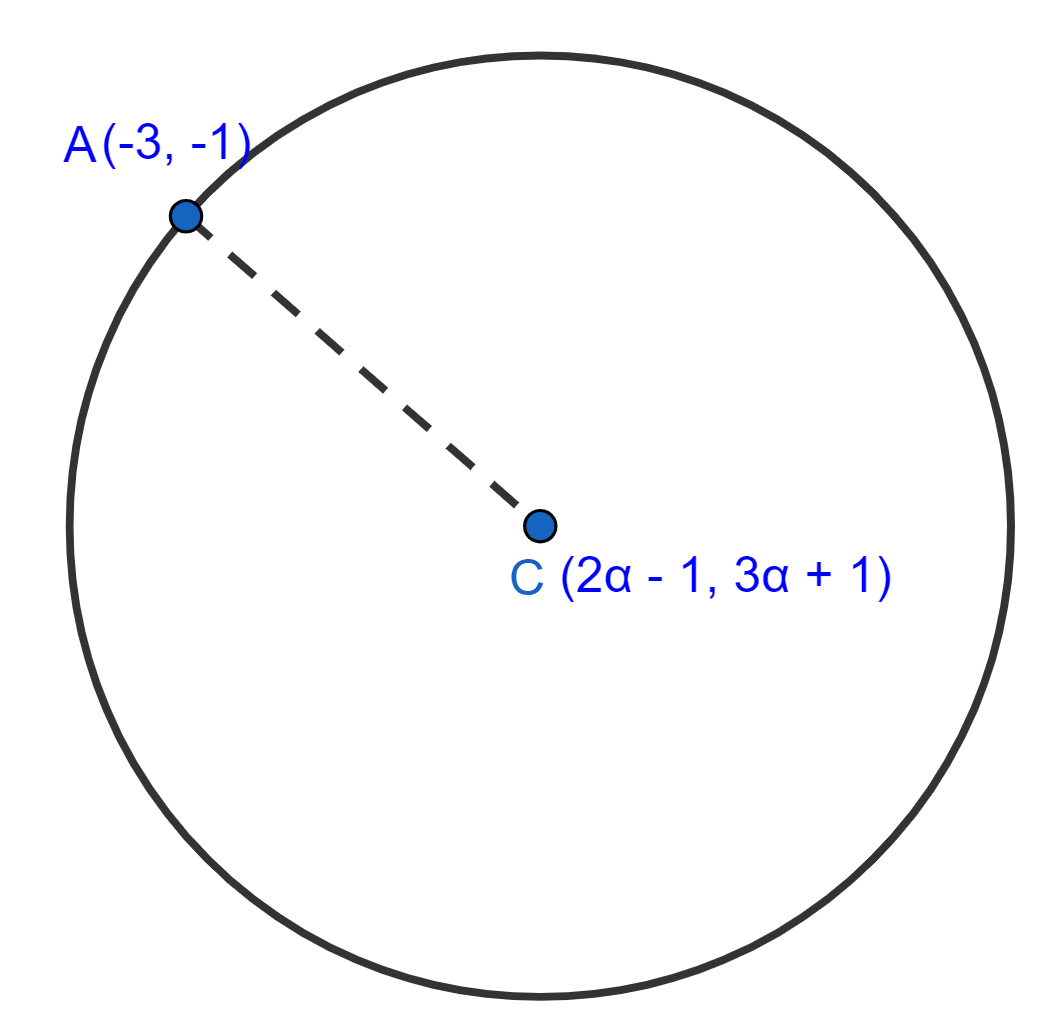
The center of a circle is C(2α - 1, 3α + 1) and it passes through the point A(-3, -1). If a diameter of the circle is of length 20 units, find the value(s) of α.
Answer
Given,
Diameter = 20 units
Radius = Diameter 2 = 20 2 \dfrac{\text{Diameter}}{2} = \dfrac{20}{2} 2 Diameter = 2 20
∴ AC = 10 units
⇒ [ − 3 − ( 2 α − 1 ) ] 2 + [ − 1 − ( 3 α + 1 ) ] 2 = 10 ⇒ ( − 3 − 2 α + 1 ) 2 + ( − 1 − 3 α − 1 ) 2 = 10 ⇒ ( − 2 − 2 α ) 2 + ( − 3 α − 2 ) 2 = 10 ⇒ 4 + 4 α 2 + 8 α + 9 α 2 + 4 + 12 α = 10 ⇒ 13 α 2 + 20 α + 8 = 10 \Rightarrow \sqrt{[-3 - (2α - 1)]^2 + [-1 - (3α + 1)]^2} = 10 \\[1em] \Rightarrow \sqrt{(-3 - 2α + 1)^2 + (-1 - 3α - 1)^2} = 10 \\[1em] \Rightarrow \sqrt{(-2 - 2α)^2 + (-3α - 2)^2} = 10 \\[1em] \Rightarrow \sqrt{4 + 4α^2 + 8α + 9α^2 + 4 + 12α} = 10 \\[1em] \Rightarrow \sqrt{13α^2 + 20α + 8} = 10 ⇒ [ − 3 − ( 2 α − 1 ) ] 2 + [ − 1 − ( 3 α + 1 ) ] 2 = 10 ⇒ ( − 3 − 2 α + 1 ) 2 + ( − 1 − 3 α − 1 ) 2 = 10 ⇒ ( − 2 − 2 α ) 2 + ( − 3 α − 2 ) 2 = 10 ⇒ 4 + 4 α 2 + 8 α + 9 α 2 + 4 + 12 α = 10 ⇒ 13 α 2 + 20 α + 8 = 10
On squaring both sides,
⇒ 13 α 2 + 20 α + 8 = 10 2 ⇒ 13 α 2 + 20 α + 8 = 100 ⇒ 13 α 2 + 20 α + 8 − 100 = 0 ⇒ 13 α 2 + 20 α − 92 = 0 ⇒ 13 α 2 + 46 α − 26 α − 92 = 0 ⇒ α ( 13 α + 46 ) − 2 ( 13 α + 46 ) = 0 ⇒ ( 13 α + 46 ) ( α − 2 ) = 0 ⇒ 13 α + 46 = 0 or α − 2 = 0 ⇒ 13 α = − 46 or α = 2 ⇒ α = − 46 13 or α = 2. \Rightarrow 13α^2 + 20α + 8 = 10^2 \\[1em] \Rightarrow 13α^2 + 20α + 8 = 100 \\[1em] \Rightarrow 13α^2 + 20α + 8 - 100 = 0 \\[1em] \Rightarrow 13α^2 + 20α - 92 = 0 \\[1em] \Rightarrow 13α^2 + 46α - 26α - 92 =0 \\[1em] \Rightarrow α(13α + 46) - 2(13α + 46) = 0 \\[1em] \Rightarrow (13α + 46)(α - 2) = 0 \\[1em] \Rightarrow 13α + 46 = 0 \text{ or } α - 2 = 0 \\[1em] \Rightarrow 13α = -46 \text{ or } α = 2 \\[1em] \Rightarrow α = -\dfrac{46}{13} \text{ or } α = 2. ⇒ 13 α 2 + 20 α + 8 = 1 0 2 ⇒ 13 α 2 + 20 α + 8 = 100 ⇒ 13 α 2 + 20 α + 8 − 100 = 0 ⇒ 13 α 2 + 20 α − 92 = 0 ⇒ 13 α 2 + 46 α − 26 α − 92 = 0 ⇒ α ( 13 α + 46 ) − 2 ( 13 α + 46 ) = 0 ⇒ ( 13 α + 46 ) ( α − 2 ) = 0 ⇒ 13 α + 46 = 0 or α − 2 = 0 ⇒ 13 α = − 46 or α = 2 ⇒ α = − 13 46 or α = 2.
Hence, α = − 46 13 -\dfrac{46}{13} − 13 46
Using distance formula, show that the points A(3, 1), B(6, 4) and C(8, 6) are collinear.
Answer
By distance formula,
d = ( x 2 − x 1 ) 2 + ( y 2 − y 1 ) 2 \sqrt{(x_2 - x_1)^2 + (y_2 - y_1)^2} ( x 2 − x 1 ) 2 + ( y 2 − y 1 ) 2
A B = ( 6 − 3 ) 2 + ( 4 − 1 ) 2 = 3 2 + 3 2 = 9 + 9 = 18 = 3 2 . B C = ( 8 − 6 ) 2 + ( 6 − 4 ) 2 = 2 2 + 2 2 = 4 + 4 = 8 = 2 2 . A C = ( 8 − 3 ) 2 + ( 6 − 1 ) 2 = 5 2 + 5 2 = 25 + 25 = 50 = 5 2 . ⇒ A B + B C = 3 2 + 2 2 = 5 2 = A C . AB = \sqrt{(6 - 3)^2 + (4 - 1)^2} \\[1em] = \sqrt{3^2 + 3^2} \\[1em] = \sqrt{9 + 9} \\[1em] = \sqrt{18} \\[1em] = 3\sqrt{2}. \\[1em] BC = \sqrt{(8 - 6)^2 + (6 - 4)^2} \\[1em] = \sqrt{2^2 + 2^2} \\[1em] = \sqrt{4 + 4} \\[1em] = \sqrt{8} \\[1em] = 2\sqrt{2}. \\[1em] AC = \sqrt{(8 - 3)^2 + (6 - 1)^2} \\[1em] = \sqrt{5^2 + 5^2} \\[1em] = \sqrt{25 + 25} \\[1em] = \sqrt{50} \\[1em] = 5\sqrt{2}. \\[1em] \Rightarrow AB + BC = 3\sqrt{2} + 2\sqrt{2} = 5\sqrt{2} = AC. A B = ( 6 − 3 ) 2 + ( 4 − 1 ) 2 = 3 2 + 3 2 = 9 + 9 = 18 = 3 2 . BC = ( 8 − 6 ) 2 + ( 6 − 4 ) 2 = 2 2 + 2 2 = 4 + 4 = 8 = 2 2 . A C = ( 8 − 3 ) 2 + ( 6 − 1 ) 2 = 5 2 + 5 2 = 25 + 25 = 50 = 5 2 . ⇒ A B + BC = 3 2 + 2 2 = 5 2 = A C .
Thus, AC = AB + BC.
Hence, proved that A, B and C are collinear.
Check whether the points (5, -2), (6, 4) and (7, -2) are the vertices of an isosceles triangle.
Answer
Let points be A(5, -2), B(6, 4) and C(7, -2).
By distance formula,
d = ( x 2 − x 1 ) 2 + ( y 2 − y 1 ) 2 \sqrt{(x_2 - x_1)^2 + (y_2 - y_1)^2} ( x 2 − x 1 ) 2 + ( y 2 − y 1 ) 2
A B = ( 6 − 5 ) 2 + [ 4 − ( − 2 ) ] 2 = 1 2 + 6 2 = 1 + 36 = 37 . B C = ( 7 − 6 ) 2 + [ − 2 − 4 ] 2 = 1 2 + ( − 6 ) 2 = 37 . AB = \sqrt{(6 - 5)^2 + [4 - (-2)]^2} \\[1em] = \sqrt{1^2 + 6^2} \\[1em] = \sqrt{1 + 36} \\[1em] = \sqrt{37}. \\[1em] BC = \sqrt{(7 - 6)^2 + [-2 - 4]^2} \\[1em] = \sqrt{1^2 + (-6)^2} \\[1em] = \sqrt{37}. A B = ( 6 − 5 ) 2 + [ 4 − ( − 2 ) ] 2 = 1 2 + 6 2 = 1 + 36 = 37 . BC = ( 7 − 6 ) 2 + [ − 2 − 4 ] 2 = 1 2 + ( − 6 ) 2 = 37 .
Since, AB = BC.
Hence, proved that (5, -2), (6, 4) and (7, -2) are the vertices of an isosceles triangle.
Name the type of triangle formed by the points A(-5, 6), B(-4, -2) and C(7, 5).
Answer
By distance formula,
d = ( x 2 − x 1 ) 2 + ( y 2 − y 1 ) 2 \sqrt{(x_2 - x_1)^2 + (y_2 - y_1)^2} ( x 2 − x 1 ) 2 + ( y 2 − y 1 ) 2
A B = [ − 4 − ( − 5 ) ] 2 + [ − 2 − 6 ] 2 = ( − 4 + 5 ) 2 + ( − 8 ) 2 = 1 2 + 64 = 65 . B C = [ 7 − ( − 4 ) ] 2 + [ 5 − ( − 2 ) ] 2 = 11 2 + 7 2 = 121 + 49 = 170 . A C = [ 7 − ( − 5 ) ] 2 + ( 5 − 6 ) 2 = 12 2 + ( − 1 ) 2 = 144 + 1 = 145 . AB = \sqrt{[-4 - (-5)]^2 + [-2 - 6]^2} \\[1em] = \sqrt{(-4 + 5)^2 + (-8)^2} \\[1em] = \sqrt{1^2 + 64} \\[1em] = \sqrt{65}. \\[1em] BC = \sqrt{[7 - (-4)]^2 + [5 - (-2)]^2} \\[1em] = \sqrt{11^2 + 7^2} \\[1em] = \sqrt{121 + 49} \\[1em] = \sqrt{170}. \\[1em] AC = \sqrt{[7 - (-5)]^2 + (5 - 6)^2} \\[1em] = \sqrt{12^2 + (-1)^2} \\[1em] = \sqrt{144 + 1} \\[1em] = \sqrt{145}. A B = [ − 4 − ( − 5 ) ] 2 + [ − 2 − 6 ] 2 = ( − 4 + 5 ) 2 + ( − 8 ) 2 = 1 2 + 64 = 65 . BC = [ 7 − ( − 4 ) ] 2 + [ 5 − ( − 2 ) ] 2 = 1 1 2 + 7 2 = 121 + 49 = 170 . A C = [ 7 − ( − 5 ) ] 2 + ( 5 − 6 ) 2 = 1 2 2 + ( − 1 ) 2 = 144 + 1 = 145 .
Since, AB ≠ BC ≠ AC.
Hence, ABC is a scalene triangle.
Show that the points A(1, 1), B(-1, -1) and C(-3 , 3 \sqrt{3}, \sqrt{3} 3 , 3
Answer
By distance formula,
d = ( x 2 − x 1 ) 2 + ( y 2 − y 1 ) 2 \sqrt{(x_2 - x_1)^2 + (y_2 - y_1)^2} ( x 2 − x 1 ) 2 + ( y 2 − y 1 ) 2
A B = ( − 1 − 1 ) 2 + ( − 1 − 1 ) 2 = ( − 2 ) 2 + ( − 2 ) 2 = 4 + 4 = 8 = 2 2 . B C = [ − 3 − ( − 1 ) ] 2 + [ 3 − ( − 1 ) ] 2 = [ − 3 + 1 ] 2 + [ 3 + 1 ] 2 = 3 + 1 − 2 3 + 3 + 1 + 2 3 = 8 = 2 2 . A C = [ − 3 − 1 ] 2 + [ 3 − 1 ] 2 = 3 + 1 + 2 3 + 3 + 1 − 2 3 = 8 = 2 2 . AB = \sqrt{(-1 - 1)^2 + (-1 - 1)^2} \\[1em] = \sqrt{(-2)^2 + (-2)^2} \\[1em] = \sqrt{4 + 4} \\[1em] = \sqrt{8} \\[1em] = 2\sqrt{2}. \\[1em] BC = \sqrt{[-\sqrt{3} - (-1)]^2 + [\sqrt{3} - (-1)]^2} \\[1em] = \sqrt{[-\sqrt{3} + 1]^2 + [\sqrt{3} + 1]^2} \\[1em] = \sqrt{3 + 1 - 2\sqrt{3} + 3 + 1 + 2\sqrt{3}} \\[1em] = \sqrt{8} \\[1em] = 2\sqrt{2}. \\[1em] AC = \sqrt{[-\sqrt{3} - 1]^2 + [\sqrt{3} - 1]^2} \\[1em] = \sqrt{3 + 1 + 2\sqrt{3} + 3 + 1 - 2\sqrt{3}} \\[1em] = \sqrt{8} \\[1em] = 2\sqrt{2}. \\[1em] A B = ( − 1 − 1 ) 2 + ( − 1 − 1 ) 2 = ( − 2 ) 2 + ( − 2 ) 2 = 4 + 4 = 8 = 2 2 . BC = [ − 3 − ( − 1 ) ] 2 + [ 3 − ( − 1 ) ] 2 = [ − 3 + 1 ] 2 + [ 3 + 1 ] 2 = 3 + 1 − 2 3 + 3 + 1 + 2 3 = 8 = 2 2 . A C = [ − 3 − 1 ] 2 + [ 3 − 1 ] 2 = 3 + 1 + 2 3 + 3 + 1 − 2 3 = 8 = 2 2 .
Since, AB = BC = AC.
Hence, ABC is an equilateral triangle.
Show that the points (7, 10), (-2, 5) and (3, -4) are the vertices of an isosceles right triangle.
Answer
Let points be A(7, 10), B(-2, 5) and C(3, -4).
By distance formula,
d = ( x 2 − x 1 ) 2 + ( y 2 − y 1 ) 2 \sqrt{(x_2 - x_1)^2 + (y_2 - y_1)^2} ( x 2 − x 1 ) 2 + ( y 2 − y 1 ) 2
A B = ( − 2 − 7 ) 2 + ( 5 − 10 ) 2 = ( − 9 ) 2 + ( − 5 ) 2 = 81 + 25 = 106 units . B C = [ 3 − ( − 2 ) ] 2 + [ − 4 − 5 ] 2 = 5 2 + ( − 9 ) 2 = 25 + 81 = 106 units . A C = ( 3 − 7 ) 2 + ( − 4 − 10 ) 2 = ( − 4 ) 2 + ( − 14 ) 2 = 16 + 196 = 212 units . AB = \sqrt{(-2 - 7)^2 + (5 - 10)^2} \\[1em] = \sqrt{(-9)^2 + (-5)^2} \\[1em] = \sqrt{81 + 25} \\[1em] = \sqrt{106} \text{ units}. \\[1em] BC = \sqrt{[3 - (-2)]^2 + [-4 - 5]^2} \\[1em] = \sqrt{5^2 + (-9)^2} \\[1em] = \sqrt{25 + 81} \\[1em] = \sqrt{106} \text{ units}. \\[1em] AC = \sqrt{(3 - 7)^2 + (-4 - 10)^2} \\[1em] = \sqrt{(-4)^2 + (-14)^2} \\[1em] = \sqrt{16 + 196} \\[1em] = \sqrt{212} \text{ units}. A B = ( − 2 − 7 ) 2 + ( 5 − 10 ) 2 = ( − 9 ) 2 + ( − 5 ) 2 = 81 + 25 = 106 units . BC = [ 3 − ( − 2 ) ] 2 + [ − 4 − 5 ] 2 = 5 2 + ( − 9 ) 2 = 25 + 81 = 106 units . A C = ( 3 − 7 ) 2 + ( − 4 − 10 ) 2 = ( − 4 ) 2 + ( − 14 ) 2 = 16 + 196 = 212 units .
⇒ AB2 + BC2 = ( 106 ) 2 + ( 106 ) 2 (\sqrt{106})^2 + (\sqrt{106})^2 ( 106 ) 2 + ( 106 ) 2
= 106 + 106
= 212
= AC2 .
Since, AB = BC and AB2 + BC2 = AC2 .
∴ ABC is an isosceles right angle triangle, right angled at B.
Hence, proved that (7, 10), (-2, 5) and (3, -4) are the vertices of an isosceles triangle.
The points A(0, 3), B(-2, a) and C(-1, 4) are the vertices of a right angled triangle at A, find the value of a.
Answer
By distance formula,
d = ( x 2 − x 1 ) 2 + ( y 2 − y 1 ) 2 \sqrt{(x_2 - x_1)^2 + (y_2 - y_1)^2} ( x 2 − x 1 ) 2 + ( y 2 − y 1 ) 2
A B = ( − 2 − 0 ) 2 + ( a − 3 ) 2 = ( − 2 ) 2 + a 2 + 9 − 6 a = 4 + a 2 + 9 − 6 a = a 2 − 6 a + 13 . B C = [ − 1 − ( − 2 ) ] 2 + ( 4 − a ) 2 = ( − 1 + 2 ) 2 + ( 4 − a ) 2 = ( 1 ) 2 + 16 + a 2 − 8 a = 1 + 16 + a 2 − 8 a = a 2 − 8 a + 17 . A C = ( − 1 − 0 ) 2 + ( 4 − 3 ) 2 = ( − 1 ) 2 + ( 1 ) 2 = 1 + 1 = 2 . AB = \sqrt{(-2 - 0)^2 + (a - 3)^2} \\[1em] = \sqrt{(-2)^2 + a^2 + 9 - 6a} \\[1em] = \sqrt{4 + a^2 + 9 - 6a} \\[1em] = \sqrt{a^2 - 6a + 13}. \\[1em] BC = \sqrt{[-1 - (-2)]^2 + (4 - a)^2} \\[1em] = \sqrt{(-1 + 2)^2 + (4 - a)^2} \\[1em] = \sqrt{(1)^2 + 16 + a^2 - 8a} \\[1em] = \sqrt{1 + 16 + a^2 - 8a} \\[1em] = \sqrt{a^2 - 8a + 17}. \\[1em] AC = \sqrt{(-1 - 0)^2 + (4 - 3)^2} \\[1em] = \sqrt{(-1)^2 + (1)^2} \\[1em] = \sqrt{1 + 1} \\[1em] = \sqrt{2}. A B = ( − 2 − 0 ) 2 + ( a − 3 ) 2 = ( − 2 ) 2 + a 2 + 9 − 6 a = 4 + a 2 + 9 − 6 a = a 2 − 6 a + 13 . BC = [ − 1 − ( − 2 ) ] 2 + ( 4 − a ) 2 = ( − 1 + 2 ) 2 + ( 4 − a ) 2 = ( 1 ) 2 + 16 + a 2 − 8 a = 1 + 16 + a 2 − 8 a = a 2 − 8 a + 17 . A C = ( − 1 − 0 ) 2 + ( 4 − 3 ) 2 = ( − 1 ) 2 + ( 1 ) 2 = 1 + 1 = 2 .
By pythagoras theorem,
AB2 + AC2 = BC2
⇒ ( a 2 − 6 a + 13 ) 2 + ( 2 ) 2 = ( a 2 − 8 a + 17 ) 2 ⇒ a 2 − 6 a + 13 + 2 = a 2 − 8 a + 17 ⇒ a 2 − a 2 − 6 a + 8 a = 17 − 15 ⇒ 2 a = 2 ⇒ a = 1. \Rightarrow \Big(\sqrt{a^2 - 6a + 13}\Big)^2 + \Big(\sqrt{2}\Big)^2 = \Big(\sqrt{a^2 - 8a + 17}\Big)^2 \\[1em] \Rightarrow a^2 - 6a + 13 + 2 = a^2 - 8a + 17 \\[1em] \Rightarrow a^2 - a^2 - 6a + 8a = 17 - 15 \\[1em] \Rightarrow 2a = 2 \\[1em] \Rightarrow a = 1. ⇒ ( a 2 − 6 a + 13 ) 2 + ( 2 ) 2 = ( a 2 − 8 a + 17 ) 2 ⇒ a 2 − 6 a + 13 + 2 = a 2 − 8 a + 17 ⇒ a 2 − a 2 − 6 a + 8 a = 17 − 15 ⇒ 2 a = 2 ⇒ a = 1.
Hence, value of a = 1.
Show that the points (0, -1), (-2, 3), (6, 7) and (8, 3), taken in order, are the vertices of a rectangle. Also find its area.
Answer
Let A(0, -1), B(-2, 3), C(6, 7) and D(8, 3).
By distance formula,
d = ( x 2 − x 1 ) 2 + ( y 2 − y 1 ) 2 \sqrt{(x_2 - x_1)^2 + (y_2 - y_1)^2} ( x 2 − x 1 ) 2 + ( y 2 − y 1 ) 2
A B = ( − 2 − 0 ) 2 + [ 3 − ( − 1 ) ] 2 = ( − 2 ) 2 + [ 3 + 1 ] 2 = 4 + 4 2 = 4 + 16 = 20 . B C = [ 6 − ( − 2 ) ] 2 + ( 7 − 3 ) 2 = [ 6 + 2 ] 2 + ( 4 ) 2 = 8 2 + 4 2 = 64 + 16 = 80 . C D = ( 8 − 6 ) 2 + ( 3 − 7 ) 2 = 2 2 + ( − 4 ) 2 = 4 + 16 = 20 A D = ( 8 − 0 ) 2 + [ 3 − ( − 1 ) ] 2 = 8 2 + [ 3 + 1 ] 2 = 64 + 4 2 = 64 + 16 = 80 . AB = \sqrt{(-2 - 0)^2 + [3 - (-1)]^2} \\[1em] = \sqrt{(-2)^2 + [3 + 1]^2}\\[1em] = \sqrt{4 + 4^2} \\[1em] = \sqrt{4 + 16} \\[1em] = \sqrt{20}. \\[1em] BC = \sqrt{[6 - (-2)]^2 + (7 - 3)^2} \\[1em] = \sqrt{[6 + 2]^2 + (4)^2} \\[1em] = \sqrt{8^2 + 4^2} \\[1em] = \sqrt{64 + 16} \\[1em] = \sqrt{80}. \\[1em] CD = \sqrt{(8 - 6)^2 + (3 - 7)^2} \\[1em] = \sqrt{2^2 + (-4)^2} \\[1em] = \sqrt{4 + 16} \\[1em] = \sqrt{20} \\[1em] AD = \sqrt{(8 - 0)^2 + [3 - (-1)]^2} \\[1em] = \sqrt{8^2 + [3 + 1]^2} \\[1em] = \sqrt{64 + 4^2} \\[1em] = \sqrt{64 + 16} \\[1em] = \sqrt{80}. A B = ( − 2 − 0 ) 2 + [ 3 − ( − 1 ) ] 2 = ( − 2 ) 2 + [ 3 + 1 ] 2 = 4 + 4 2 = 4 + 16 = 20 . BC = [ 6 − ( − 2 ) ] 2 + ( 7 − 3 ) 2 = [ 6 + 2 ] 2 + ( 4 ) 2 = 8 2 + 4 2 = 64 + 16 = 80 . C D = ( 8 − 6 ) 2 + ( 3 − 7 ) 2 = 2 2 + ( − 4 ) 2 = 4 + 16 = 20 A D = ( 8 − 0 ) 2 + [ 3 − ( − 1 ) ] 2 = 8 2 + [ 3 + 1 ] 2 = 64 + 4 2 = 64 + 16 = 80 .
Since, AB = CD and BC = AD.
∴ ABCD is a rectangle.
Area of rectangle ABCD = AB × BC
= 20 × 80 = 2 5 × 4 5 = 8 × 5 = 40 sq. units . = \sqrt{20} \times \sqrt{80} \\[1em] = 2\sqrt{5} \times 4\sqrt{5} \\[1em] = 8 \times 5 \\[1em] = 40 \text{ sq. units}. = 20 × 80 = 2 5 × 4 5 = 8 × 5 = 40 sq. units .
Hence, area of rectangle = 40 sq. units.
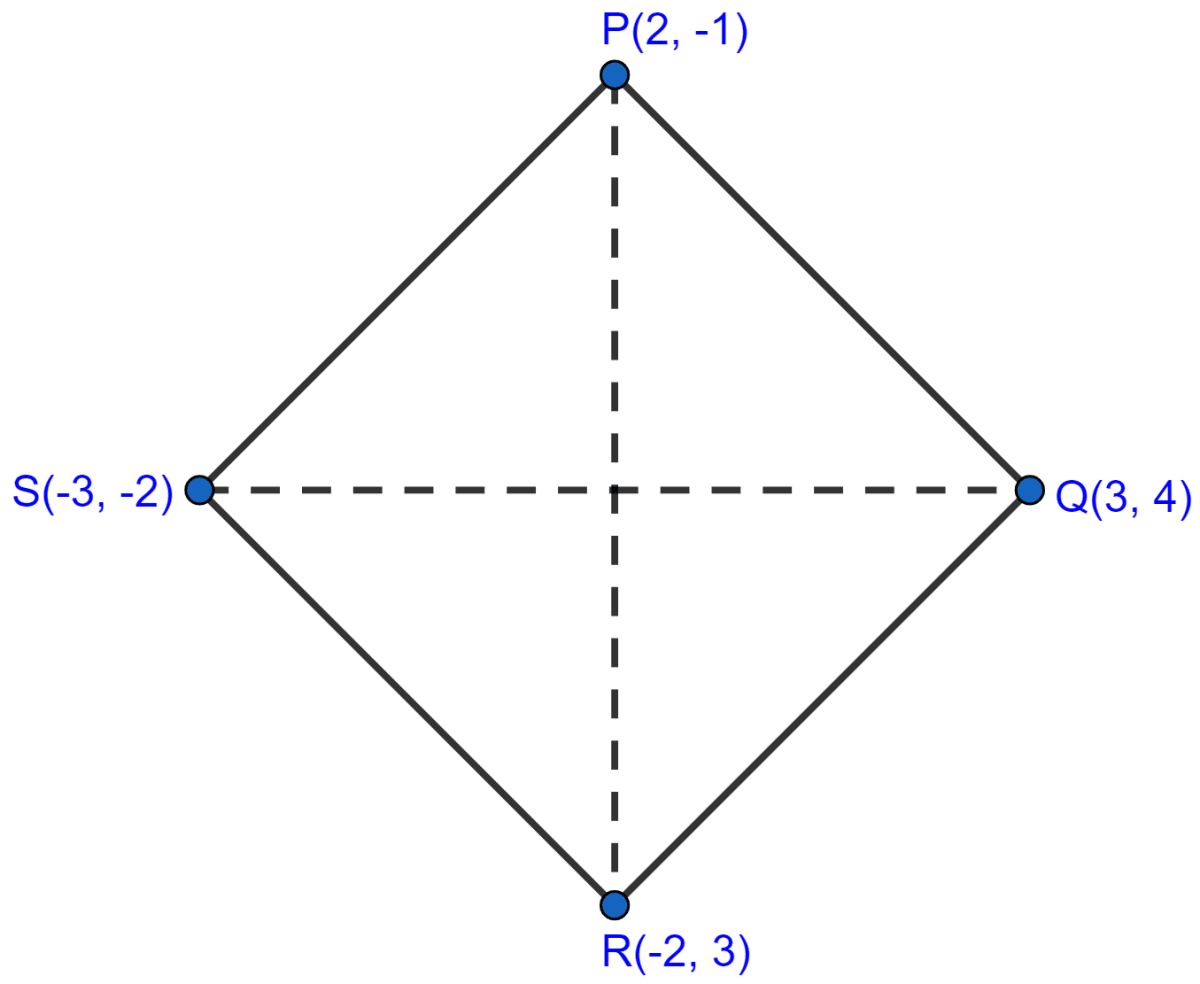
If P(2, -1), Q(3, 4), R(-2, 3) and S(-3, -2) be four points in a plane, show that PQRS is a rhombus but not a square. Find the area of the rhombus.
Answer
By distance formula,
d = ( x 2 − x 1 ) 2 + ( y 2 − y 1 ) 2 \sqrt{(x_2 - x_1)^2 + (y_2 - y_1)^2} ( x 2 − x 1 ) 2 + ( y 2 − y 1 ) 2
P Q = ( 3 − 2 ) 2 + [ 4 − ( − 1 ) ] 2 = 1 2 + [ 4 + 1 ] 2 = 1 + 5 2 = 1 + 25 = 26 . Q R = ( − 2 − 3 ) 2 + ( 3 − 4 ) 2 = ( − 5 ) 2 + ( − 1 ) 2 = 25 + 1 = 26 . R S = [ − 3 − ( − 2 ) ] 2 + [ − 2 − 3 ] 2 = [ − 3 + 2 ] 2 + [ − 5 ] 2 = [ − 1 ] 2 + 25 = 26 . P S = [ − 3 − 2 ] 2 + [ − 2 − ( − 1 ) ] 2 = [ − 5 ] 2 + [ − 2 + 1 ] 2 = 25 + [ − 1 ] 2 = 25 + 1 = 26 . PQ = \sqrt{(3 - 2)^2 + [4 - (-1)]^2} \\[1em] = \sqrt{1^2 + [4 + 1]^2} \\[1em] = \sqrt{1 + 5^2} \\[1em] = \sqrt{1 + 25} \\[1em] = \sqrt{26}. \\[1em] QR = \sqrt{(-2 - 3)^2 + (3 - 4)^2} \\[1em] = \sqrt{(-5)^2 + (-1)^2} \\[1em] = \sqrt{25 + 1} \\[1em] = \sqrt{26}. \\[1em] RS = \sqrt{[-3 - (-2)]^2 + [-2 - 3]^2} \\[1em] = \sqrt{[-3 + 2]^2 + [-5]^2} \\[1em] = \sqrt{[-1]^2 + 25} \\[1em] = \sqrt{26}. \\[1em] PS = \sqrt{[-3 - 2]^2 + [-2 - (-1)]^2} \\[1em] = \sqrt{[-5]^2 + [-2 + 1]^2} \\[1em] = \sqrt{25 + [-1]^2} \\[1em] = \sqrt{25 + 1} \\[1em] = \sqrt{26}. PQ = ( 3 − 2 ) 2 + [ 4 − ( − 1 ) ] 2 = 1 2 + [ 4 + 1 ] 2 = 1 + 5 2 = 1 + 25 = 26 . QR = ( − 2 − 3 ) 2 + ( 3 − 4 ) 2 = ( − 5 ) 2 + ( − 1 ) 2 = 25 + 1 = 26 . RS = [ − 3 − ( − 2 ) ] 2 + [ − 2 − 3 ] 2 = [ − 3 + 2 ] 2 + [ − 5 ] 2 = [ − 1 ] 2 + 25 = 26 . PS = [ − 3 − 2 ] 2 + [ − 2 − ( − 1 ) ] 2 = [ − 5 ] 2 + [ − 2 + 1 ] 2 = 25 + [ − 1 ] 2 = 25 + 1 = 26 .
Here, PQ = QR = RS = PS.
So, PQRS can be a square or rhombus.
Calculating diagonal,
P R = ( − 2 − 2 ) 2 + [ 3 − ( − 1 ) ] 2 = ( − 4 ) 2 + [ 3 + 1 ] 2 = 16 + 4 2 = 16 + 16 = 32 = 4 2 . Q S = ( − 3 − 3 ) 2 + ( − 2 − 4 ) 2 = ( − 6 ) 2 + ( − 6 ) 2 = 36 + 36 = 72 = 6 2 . PR = \sqrt{(-2 - 2)^2 + [3 - (-1)]^2} \\[1em] = \sqrt{(-4)^2 + [3 + 1]^2} \\[1em] = \sqrt{16 + 4^2} \\[1em] = \sqrt{16 + 16} \\[1em] = \sqrt{32} \\[1em] = 4\sqrt{2}. \\[1em] QS = \sqrt{(-3 - 3)^2 + (-2 - 4)^2} \\[1em] = \sqrt{(-6)^2 + (-6)^2} \\[1em] = \sqrt{36 + 36} \\[1em] = \sqrt{72} \\[1em] = 6\sqrt{2}. PR = ( − 2 − 2 ) 2 + [ 3 − ( − 1 ) ] 2 = ( − 4 ) 2 + [ 3 + 1 ] 2 = 16 + 4 2 = 16 + 16 = 32 = 4 2 . QS = ( − 3 − 3 ) 2 + ( − 2 − 4 ) 2 = ( − 6 ) 2 + ( − 6 ) 2 = 36 + 36 = 72 = 6 2 .
PR ≠ QS.
Since, diagonal of rhombus are not equal,
∴ PQRS is a rhombus
Area of rhombus = 1 2 × d 1 × d 2 \dfrac{1}{2} \times d_1 \times d_2 2 1 × d 1 × d 2
= 1 2 × 4 2 × 6 2 \dfrac{1}{2} \times 4\sqrt{2} \times 6\sqrt{2} 2 1 × 4 2 × 6 2
= 48 2 \dfrac{48}{2} 2 48
Hence, PQRS is a rhombus and area = 24 sq. units.
Prove that the points A(2, 3), B(-2, 2), C(-1, -2) and D(3, -1) are the vertices of a square ABCD.
Answer
By distance formula,
d = ( x 2 − x 1 ) 2 + ( y 2 − y 1 ) 2 \sqrt{(x_2 - x_1)^2 + (y_2 - y_1)^2} ( x 2 − x 1 ) 2 + ( y 2 − y 1 ) 2
A B = ( − 2 − 2 ) 2 + ( 2 − 3 ) 2 = ( − 4 ) 2 + ( − 1 ) 2 = 16 + 1 = 17 . B C = [ − 1 − ( − 2 ) ] 2 + [ − 2 − 2 ] 2 = [ − 1 + 2 ] 2 + [ − 4 ] 2 = 1 2 + 16 = 17 . C D = [ 3 − ( − 1 ) ] 2 + [ − 1 − ( − 2 ) ] 2 = [ 3 + 1 ] 2 + [ − 1 + 2 ] 2 = 4 2 + 1 2 = 16 + 1 = 17 . A D = ( 3 − 2 ) 2 + ( − 1 − 3 ) 2 = 1 2 + ( − 4 ) 2 = 1 + 16 = 17 . AB = \sqrt{(-2 - 2)^2 + (2 - 3)^2} \\[1em] = \sqrt{(-4)^2 + (-1)^2} \\[1em] = \sqrt{16 + 1} \\[1em] = \sqrt{17}. \\[1em] BC = \sqrt{[-1 - (-2)]^2 + [-2 - 2]^2} \\[1em] = \sqrt{[-1 + 2]^2 + [-4]^2} \\[1em] = \sqrt{1^2 + 16} \\[1em] = \sqrt{17}. \\[1em] CD = \sqrt{[3 - (-1)]^2 + [-1 - (-2)]^2} \\[1em] = \sqrt{[3 + 1]^2 + [-1 + 2]^2} \\[1em] = \sqrt{4^2 + 1^2} \\[1em] = \sqrt{16 + 1} \\[1em] = \sqrt{17}. \\[1em] AD = \sqrt{(3 - 2)^2 + (-1 - 3)^2} \\[1em] = \sqrt{1^2 + (-4)^2} \\[1em] = \sqrt{1 + 16} \\[1em] = \sqrt{17}. A B = ( − 2 − 2 ) 2 + ( 2 − 3 ) 2 = ( − 4 ) 2 + ( − 1 ) 2 = 16 + 1 = 17 . BC = [ − 1 − ( − 2 ) ] 2 + [ − 2 − 2 ] 2 = [ − 1 + 2 ] 2 + [ − 4 ] 2 = 1 2 + 16 = 17 . C D = [ 3 − ( − 1 ) ] 2 + [ − 1 − ( − 2 ) ] 2 = [ 3 + 1 ] 2 + [ − 1 + 2 ] 2 = 4 2 + 1 2 = 16 + 1 = 17 . A D = ( 3 − 2 ) 2 + ( − 1 − 3 ) 2 = 1 2 + ( − 4 ) 2 = 1 + 16 = 17 .
Calculating diagonals,
A C = ( − 1 − 2 ) 2 + ( − 2 − 3 ) 2 = ( − 3 ) 2 + ( − 5 ) 2 = 9 + 25 = 34 . B D = [ 3 − ( − 2 ) ] 2 + ( − 1 − 2 ) 2 = [ 3 + 2 ] 2 + ( − 3 ) 2 = 5 2 + 9 = 25 + 9 = 34 . AC = \sqrt{(-1 - 2)^2 + (-2 - 3)^2} \\[1em] = \sqrt{(-3)^2 + (-5)^2} \\[1em] = \sqrt{9 + 25} \\[1em] = \sqrt{34}. \\[1em] BD = \sqrt{[3 - (-2)]^2 + (-1 - 2)^2} \\[1em] = \sqrt{[3 + 2]^2 + (-3)^2} \\[1em] = \sqrt{5^2 + 9} \\[1em] = \sqrt{25 + 9} \\[1em] = \sqrt{34}. A C = ( − 1 − 2 ) 2 + ( − 2 − 3 ) 2 = ( − 3 ) 2 + ( − 5 ) 2 = 9 + 25 = 34 . B D = [ 3 − ( − 2 ) ] 2 + ( − 1 − 2 ) 2 = [ 3 + 2 ] 2 + ( − 3 ) 2 = 5 2 + 9 = 25 + 9 = 34 .
Since, AB = BC =CD = AD and AC = BD.
Hence, proved that A, B, C and D are the vertices of a square.
Name the type of quadrilateral formed by the following points and give reasons for your answer :
(-1, -2), (1, 0), (-1, 2), (-3, 0).
Answer
Let coordinates be A(-1, -2), B(1, 0), C(-1, 2) and D(-3, 0).
A B = [ 1 − ( − 1 ) ] 2 + [ 0 − ( − 2 ) ] 2 = [ 1 + 1 ] 2 + [ 0 + 2 ] 2 = 2 2 + 2 2 = 4 + 4 = 8 . B C = ( − 1 − 1 ) 2 + ( 2 − 0 ) 2 = ( − 2 ) 2 + ( 2 ) 2 = 4 + 4 = 8 . C D = [ − 3 − ( − 1 ) ] 2 + [ 0 − 2 ] 2 = [ − 3 + 1 ] 2 + [ − 2 ] 2 = [ − 2 ] 2 + [ − 2 ] 2 = 4 + 4 = 8 . A D = [ − 3 − ( − 1 ) ] 2 + [ 0 − ( − 2 ) ] 2 = [ − 3 + 1 ] 2 + [ 2 ] 2 = [ − 2 ] 2 + [ 2 ] 2 = 4 + 4 = 8 . AB = \sqrt{[1 - (-1)]^2 + [0 - (-2)]^2} \\[1em] = \sqrt{[1 + 1]^2 + [0 + 2]^2}\\[1em] = \sqrt{2^2 + 2^2} \\[1em] = \sqrt{4 + 4} \\[1em] = \sqrt{8}. \\[1em] BC = \sqrt{(-1 - 1)^2 + (2 - 0)^2} \\[1em] = \sqrt{(-2)^2 + (2)^2} \\[1em] = \sqrt{4 + 4} \\[1em] = \sqrt{8}. \\[1em] CD = \sqrt{[-3 - (-1)]^2 + [0 - 2]^2} \\[1em] = \sqrt{[-3 + 1]^2 + [-2]^2} \\[1em] = \sqrt{[-2]^2 + [-2]^2} \\[1em] = \sqrt{4 + 4} \\[1em] = \sqrt{8}. \\[1em] AD = \sqrt{[-3 - (-1)]^2 + [0 - (-2)]^2} \\[1em] = \sqrt{[-3 + 1]^2 + [2]^2} \\[1em] =\sqrt{[-2]^2 + [2]^2} \\[1em] = \sqrt{4 + 4} \\[1em] = \sqrt{8}. A B = [ 1 − ( − 1 ) ] 2 + [ 0 − ( − 2 ) ] 2 = [ 1 + 1 ] 2 + [ 0 + 2 ] 2 = 2 2 + 2 2 = 4 + 4 = 8 . BC = ( − 1 − 1 ) 2 + ( 2 − 0 ) 2 = ( − 2 ) 2 + ( 2 ) 2 = 4 + 4 = 8 . C D = [ − 3 − ( − 1 ) ] 2 + [ 0 − 2 ] 2 = [ − 3 + 1 ] 2 + [ − 2 ] 2 = [ − 2 ] 2 + [ − 2 ] 2 = 4 + 4 = 8 . A D = [ − 3 − ( − 1 ) ] 2 + [ 0 − ( − 2 ) ] 2 = [ − 3 + 1 ] 2 + [ 2 ] 2 = [ − 2 ] 2 + [ 2 ] 2 = 4 + 4 = 8 .
Since, AB = BC = CD = AD.
So, ABCD can be square or rhombus.
Calculating diagonal,
A C = [ − 1 − ( − 1 ) ] 2 + [ 2 − ( − 2 ) ] 2 = [ − 1 + 1 ] 2 + [ 2 + 2 ] 2 = 0 + 4 2 = 16 = 4. B D = ( − 3 − 1 ) 2 + ( 0 − 0 ) 2 = ( − 4 ) 2 + 0 2 = 16 = 4. AC = \sqrt{[-1 - (-1)]^2 + [2 - (-2)]^2} \\[1em] = \sqrt{[-1 + 1]^2 + [2 + 2]^2} \\[1em] = \sqrt{0 + 4^2} \\[1em] = \sqrt{16} \\[1em] = 4. \\[1em] BD = \sqrt{(-3 - 1)^2 + (0 - 0)^2} \\[1em] = \sqrt{(-4)^2 + 0^2} \\[1em] = \sqrt{16} \\[1em] = 4. A C = [ − 1 − ( − 1 ) ] 2 + [ 2 − ( − 2 ) ] 2 = [ − 1 + 1 ] 2 + [ 2 + 2 ] 2 = 0 + 4 2 = 16 = 4. B D = ( − 3 − 1 ) 2 + ( 0 − 0 ) 2 = ( − 4 ) 2 + 0 2 = 16 = 4.
Since, diagonals are also equal.
Hence, (-1, -2), (1, 0), (-1, 2), (-3, 0) are the vertices of a square.
Name the type of quadrilateral formed by the following points and give reasons for your answer :
(4, 5), (7, 6), (4, 3), (1, 2)
Answer
Let A(4, 5), B(7, 6), C(4, 3), D(1, 2) are the given points.
By distance formula,
d = ( x 2 − x 1 ) 2 + ( y 2 − y 1 ) 2 ∴ A B = ( 7 − 4 ) 2 + ( 6 − 5 ) 2 = 3 2 + 1 2 = 9 + 1 = 10 units . B C = ( 4 − 7 ) 2 + ( 3 − 6 ) 2 = ( − 3 ) 2 + ( − 3 ) 2 = 9 + 9 = 18 = 3 2 units . C D = ( 1 − 4 ) 2 + ( 2 − 3 ) 2 = ( − 3 ) 2 + ( − 1 ) 2 = 9 + 1 = 10 units . A D = ( 1 − 4 ) 2 + ( 2 − 5 ) 2 = 3 2 + ( − 3 ) 2 = 9 + 9 = 18 = 3 2 units . d = \sqrt{(x_2 - x_1)^2 + (y_2 - y_1)^2} \\[1em] \therefore AB = \sqrt{(7 - 4)^2 + (6 - 5)^2} \\[1em] = \sqrt{3^2 + 1^2} \\[1em] = \sqrt{9 + 1} \\[1em] = \sqrt{10} \text{ units}. \\[1em] BC = \sqrt{(4 - 7)^2 + (3 - 6)^2} \\[1em] = \sqrt{(-3)^2 + (-3)^2} \\[1em] = \sqrt{9 + 9} \\[1em] = \sqrt{18} \\[1em] = 3\sqrt{2} \text{ units}. \\[1em] CD = \sqrt{(1 - 4)^2 + (2 - 3)^2} \\[1em] = \sqrt{(-3)^2 + (-1)^2} \\[1em] = \sqrt{9 + 1} \\[1em] = \sqrt{10} \text{ units}. \\[1em] AD = \sqrt{(1 - 4)^2 + (2 - 5)^2} \\[1em] = \sqrt{3^2 + (-3)^2} \\[1em] = \sqrt{9 + 9} \\[1em] = \sqrt{18} \\[1em] = 3\sqrt{2} \text{ units}. d = ( x 2 − x 1 ) 2 + ( y 2 − y 1 ) 2 ∴ A B = ( 7 − 4 ) 2 + ( 6 − 5 ) 2 = 3 2 + 1 2 = 9 + 1 = 10 units . BC = ( 4 − 7 ) 2 + ( 3 − 6 ) 2 = ( − 3 ) 2 + ( − 3 ) 2 = 9 + 9 = 18 = 3 2 units . C D = ( 1 − 4 ) 2 + ( 2 − 3 ) 2 = ( − 3 ) 2 + ( − 1 ) 2 = 9 + 1 = 10 units . A D = ( 1 − 4 ) 2 + ( 2 − 5 ) 2 = 3 2 + ( − 3 ) 2 = 9 + 9 = 18 = 3 2 units .
Calculating diagonals :
A C = ( 4 − 4 ) 2 + ( 3 − 5 ) 2 = 0 + ( − 2 ) 2 = 4 = 2 units . B D = ( 1 − 7 ) 2 + ( 2 − 6 ) 2 = ( − 6 ) 2 + ( − 4 ) 2 = 36 + 16 = 52 units . AC = \sqrt{(4 - 4)^2 + (3 - 5)^2} \\[1em] = \sqrt{0 + (-2)^2} \\[1em] = \sqrt{4} \\[1em] = 2 \text{ units}. \\[1em] BD = \sqrt{(1 - 7)^2 + (2 - 6)^2}\\[1em] = \sqrt{(-6)^2 + (-4)^2} \\[1em] = \sqrt{36 + 16} \\[1em] = \sqrt{52} \text{ units}. A C = ( 4 − 4 ) 2 + ( 3 − 5 ) 2 = 0 + ( − 2 ) 2 = 4 = 2 units . B D = ( 1 − 7 ) 2 + ( 2 − 6 ) 2 = ( − 6 ) 2 + ( − 4 ) 2 = 36 + 16 = 52 units .
Since, opposite sides are equal and diagonals are not equal.
Hence, (4, 5), (7, 6), (4, 3), (1, 2) are the vertices of a parallelogram.
Find the coordinates of the circumcentre of the triangle whose vertices are (8, 6), (8, -2) and (2, -2). Also, find its circumradius.
Answer
Let O(x, y) be the circumcentre of the circle.
Let A(8, 6), B(8, -2) and C(2, -2) be the vertices of the triangle.
OB = OC [Radii of same circle]
By distance formula,
⇒ ( x − 8 ) 2 + [ y − ( − 2 ) ] 2 = ( x − 2 ) 2 + [ y − ( − 2 ) ] 2 ⇒ x 2 + 64 − 16 x + [ y + 2 ] 2 = x 2 + 4 − 4 x + [ y + 2 ] 2 \Rightarrow \sqrt{(x - 8)^2 + [y - (-2)]^2} = \sqrt{(x - 2)^2 + [y - (-2)]^2} \\[1em] \Rightarrow \sqrt{x^2 + 64 - 16x + [y + 2]^2} = \sqrt{x^2 + 4 - 4x + [y + 2]^2} ⇒ ( x − 8 ) 2 + [ y − ( − 2 ) ] 2 = ( x − 2 ) 2 + [ y − ( − 2 ) ] 2 ⇒ x 2 + 64 − 16 x + [ y + 2 ] 2 = x 2 + 4 − 4 x + [ y + 2 ] 2
Squaring both sides we get,
⇒ x 2 + 64 − 16 x + [ y + 2 ] 2 = x 2 + 4 − 4 x + [ y + 2 ] 2 ⇒ x 2 − x 2 + [ y + 2 ] 2 − [ y + 2 ] 2 + 64 − 4 = 16 x − 4 x ⇒ 12 x = 60 ⇒ x = 60 12 ⇒ x = 5. \Rightarrow x^2 + 64 - 16x + [y + 2]^2 = x^2 + 4 - 4x + [y + 2]^2 \\[1em] \Rightarrow x^2 - x^2 + [y + 2]^2 - [y + 2]^2 + 64 - 4 = 16x - 4x \\[1em] \Rightarrow 12x = 60 \\[1em] \Rightarrow x = \dfrac{60}{12} \\[1em] \Rightarrow x = 5. ⇒ x 2 + 64 − 16 x + [ y + 2 ] 2 = x 2 + 4 − 4 x + [ y + 2 ] 2 ⇒ x 2 − x 2 + [ y + 2 ] 2 − [ y + 2 ] 2 + 64 − 4 = 16 x − 4 x ⇒ 12 x = 60 ⇒ x = 12 60 ⇒ x = 5.
Also,
OA = OB [Radii of same circle]
By distance formula,
⇒ ( x − 8 ) 2 + ( y − 6 ) 2 = ( x − 8 ) 2 + [ y − ( − 2 ) ] 2 ⇒ ( x − 8 ) 2 + y 2 + 36 − 12 y = ( x − 8 ) 2 + [ y + 2 ] 2 \Rightarrow \sqrt{(x - 8)^2 + (y - 6)^2} = \sqrt{(x - 8)^2 + [y - (-2)]^2} \\[1em] \Rightarrow \sqrt{(x - 8)^2 + y^2 + 36 - 12y} = \sqrt{(x - 8)^2 + [y + 2]^2} ⇒ ( x − 8 ) 2 + ( y − 6 ) 2 = ( x − 8 ) 2 + [ y − ( − 2 ) ] 2 ⇒ ( x − 8 ) 2 + y 2 + 36 − 12 y = ( x − 8 ) 2 + [ y + 2 ] 2
On squaring both sides,
⇒ ( x − 8 ) 2 + y 2 + 36 − 12 y = ( x − 8 ) 2 + [ y + 2 ] 2 ⇒ ( x − 8 ) 2 + y 2 + 36 − 12 y = ( x − 8 ) 2 + y 2 + 4 + 4 y ⇒ ( x − 8 ) 2 − ( x − 8 ) 2 + y 2 − y 2 + 4 y + 12 y = 36 − 4 ⇒ 16 y = 32 ⇒ y = 32 16 ⇒ y = 2. \Rightarrow (x - 8)^2 + y^2 + 36 - 12y = (x - 8)^2 + [y + 2]^2 \\[1em] \Rightarrow (x - 8)^2 + y^2 + 36 - 12y = (x - 8)^2 + y^2 + 4 + 4y \\[1em] \Rightarrow (x - 8)^2 - (x - 8)^2 + y^2 - y^2 + 4y + 12y = 36 - 4 \\[1em] \Rightarrow 16y = 32 \\[1em] \Rightarrow y = \dfrac{32}{16} \\[1em] \Rightarrow y = 2. ⇒ ( x − 8 ) 2 + y 2 + 36 − 12 y = ( x − 8 ) 2 + [ y + 2 ] 2 ⇒ ( x − 8 ) 2 + y 2 + 36 − 12 y = ( x − 8 ) 2 + y 2 + 4 + 4 y ⇒ ( x − 8 ) 2 − ( x − 8 ) 2 + y 2 − y 2 + 4 y + 12 y = 36 − 4 ⇒ 16 y = 32 ⇒ y = 16 32 ⇒ y = 2.
O = (x, y) = (5, 2).
Radius = OA.
O A = ( 8 − 5 ) 2 + ( 6 − 2 ) 2 = 3 2 + 4 2 = 9 + 16 = 25 = 5 units . OA = \sqrt{(8 - 5)^2 + (6 - 2)^2} \\[1em] = \sqrt{3^2 + 4^2} \\[1em] = \sqrt{9 + 16} \\[1em] = \sqrt{25} \\[1em] = 5 \text{ units}. O A = ( 8 − 5 ) 2 + ( 6 − 2 ) 2 = 3 2 + 4 2 = 9 + 16 = 25 = 5 units .
Hence, circumcenter = (5, 2) and circumradius = 5 units.