
Three angles of a quadrilateral are 75°, 90° and 75°. The fourth angle is
90°
95°
105°
120°
Answer
Sum of angles of quadrilateral = 360°
Let fourth angle be x then,
75° + 90° + 75° + x = 360°
x + 240° = 360°
x = 360° - 240°
x = 120°.
Hence, Option 4 is the correct option.
A quadrilateral ABCD is a trapezium if
AB = DC
AD = BC
∠A + ∠C = 180°
∠B + ∠C = 180°
Answer
In a trapezium the sum of co-interior adjacent angles = 180°.
From figure,

∠B and ∠C are adjacent angles.
∴ ∠B + ∠C = 180°
Hence, Option 4 is the correct option.
If PQRS is a parallelogram, then ∠Q - ∠S is equal to
90°
120°
0°
180°
Answer
The opposite angles are equal in a parallelogram.
From figure,

∠Q and ∠S are opposite angles.
∴ ∠Q - ∠S = 0°
Hence, Option 3 is the correct option.
A diagonal of a rectangle is inclined to one side of the rectangle at 25°. The acute angle between the diagonals is
55°
50°
40°
25°
Answer
From figure,

In △OBC,
OB = OC (Since diagonals bisect each other)
∠OCB = ∠OBC = 25°
⇒ ∠OBC + ∠OCB + ∠BOC = 180°
⇒ 25° + 25° + ∠BOC = 180°
⇒ ∠BOC = 130°.
Since, AC is a straight line,
⇒ ∠AOB + ∠BOC = 180°
⇒ ∠AOB = 180° - 130° = 50°.
Hence, Option 2 is the correct option.
ABCD is a rhombus such that ∠ACB = 40°. Then ∠ADB is
40°
45°
50°
60°
Answer
From figure,
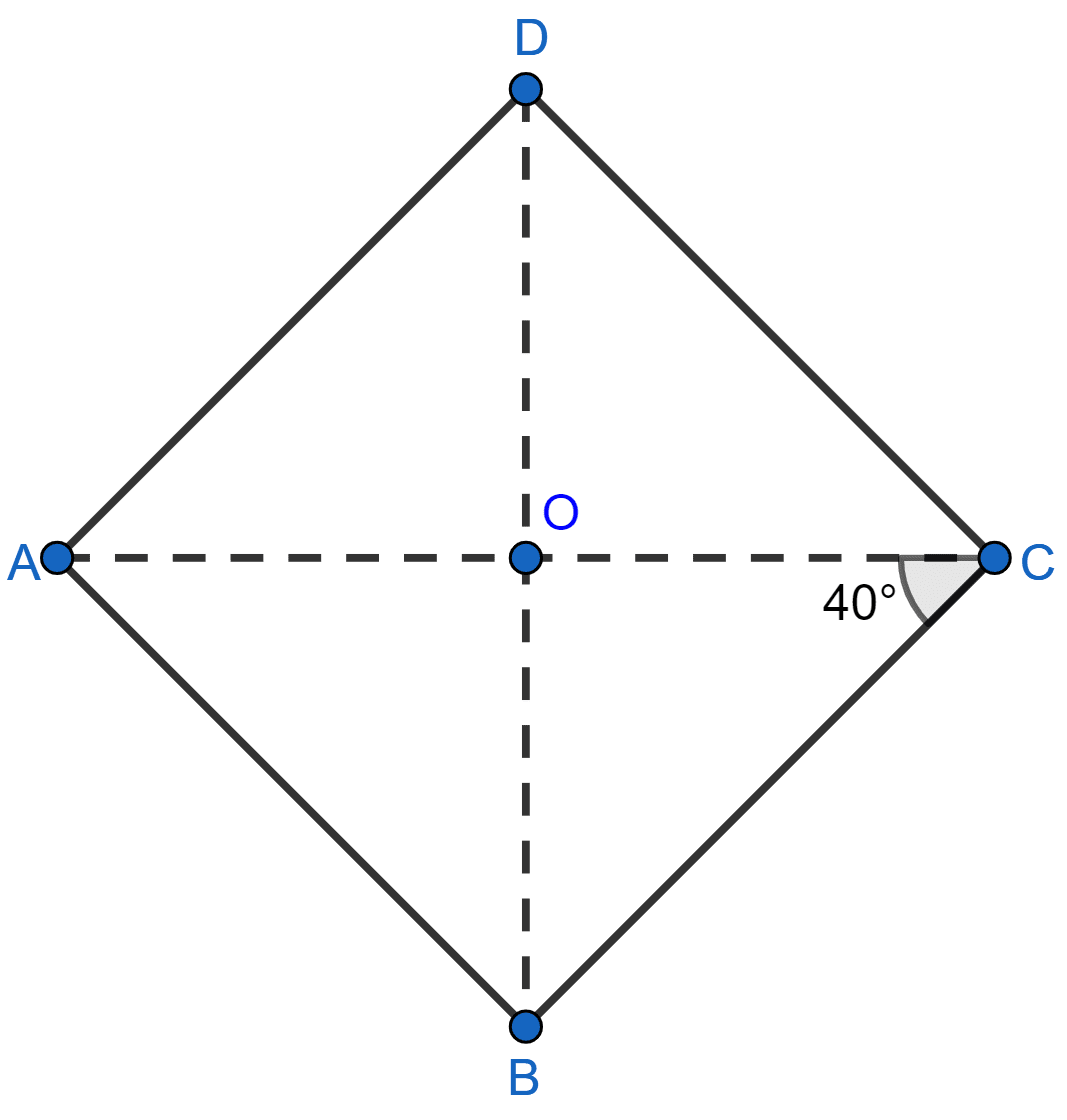
⇒ ∠DAO = ∠OCB = 40° (Alternate angles are equal.)
In △ADO,
⇒ ∠DAO + ∠AOD + ∠ODA = 180°
⇒ 40° + 90° + ∠ODA = 180°
⇒ ∠ODA = 180° - 130° = 50°.
From figure,
∠ADB = ∠ODA = 50°.
Hence, Option 3 is the correct option.
The diagonals AC and BD of a parallelogram ABCD intersect each other at the point O. If ∠DAC = 32° and ∠AOB = 70°, then ∠DBC is equal to
24°
86°
38°
32°
Answer
From figure,

∠ACB = ∠DAC = 32° (Alternate angles are equal)
AC is a straight line.
⇒ ∠AOB + ∠BOC = 180°
⇒ 70° + ∠BOC = 180°
⇒ ∠BOC = 180° - 70°
⇒ ∠BOC = 110°.
In △OBC,
⇒ ∠BOC + ∠OBC + ∠OCB = 180°
From figure,
⇒ ∠OCB = ∠ACB = 32°
⇒ 110° + ∠OBC + 32° = 180°
⇒ ∠OBC = 180° - 142° = 38°.
From figure,
∠DBC = ∠OBC = 38°.
Hence, Option 3 is the correct option.
If the diagonals of a square ABCD intersect each other at O, then △OAB is
an equilateral triangle
a right angled but not an isosceles triangle
an isosceles but not right angles triangle
an isosceles right angled triangle.
Answer
Since, diagonals of square bisect each other at 90°.
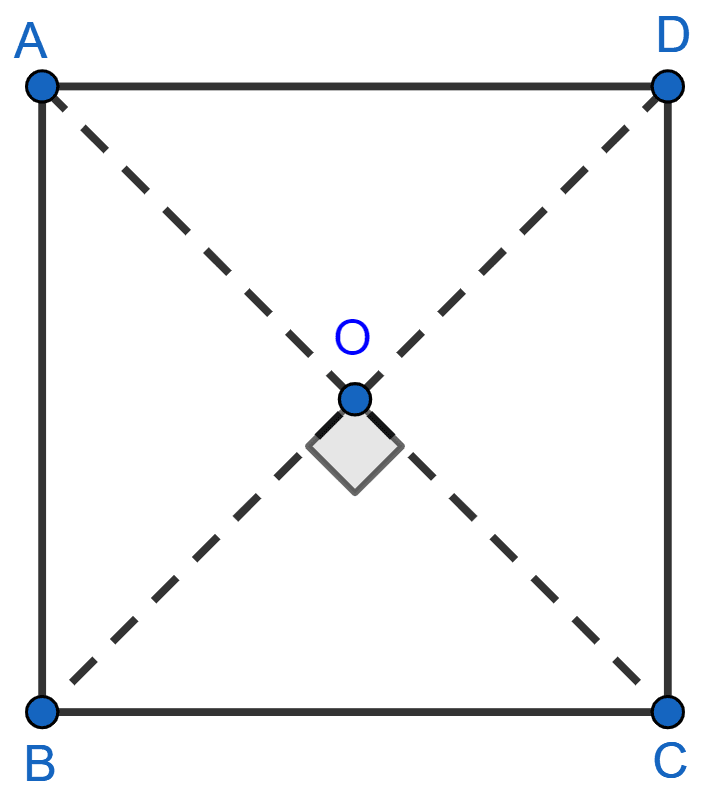
In △OAB,
AO = OB and ∠AOB = 90°.
Hence, it is an isosceles right angled triangle.
Hence, Option 4 is the correct option.
If the diagonals of a quadrilateral PQRS bisect each other, then the quadrilateral PQRS must be a
parallelogram
rhombus
rectangle
square
Answer
If the diagonals of a quadrilateral PQRS bisect each other, then the quadrilateral PQRS must be a parallelogram.
All the shapes rhombus, rectangle and square are parallelogram but not vice-versa.
Hence, they have all the properties of a parallelogram.
Hence, Option 1 is the correct option.
If the diagonals of a quadrilateral PQRS bisect each other at right angles, then the quadrilateral PQRS must be a
parallelogram
rectangle
rhombus
square
Answer
Diagonals of square and rhombus bisect each other at 90°.
Since, each square is a rhombus but not vice-versa.
Hence, if the diagonals of a quadrilateral PQRS bisect each other at right angles, then the quadrilateral PQRS must be a rhombus.
Hence, Option 3 is the correct option.
Which of the following statement is true for a parallelogram?
Its diagonals are equal.
Its diagonals are perpendicular to each other.
The diagonals divide the parallelogram into four congruent triangles.
The diagonals bisect each other.
Answer
Property of parallelogram is that its diagonal bisect each other.
Hence, Option 4 is the correct option.
Which of the following is not true for a parallelogram?
opposite sides are equal
opposite angles are equal
opposite angles are bisected by the diagonals
diagonals bisect each other
Answer
1, 2 and 4 are the properties of a parallelogram.
Hence, Option 3 is the correct option.
A quadrilateral in which the diagonals are equal and bisect each other at right angles is a
rectangle which is not a square
rhombus which is not a square
kite which is not a square
square
Answer
In square the diagonals are equal and bisect each other at right angles.
Hence, Option 4 is the correct option.
Consider the following two statements:
Statement 1: Sum of interior angles of any polygon in 360°.
Statement 2: Sum of interior angles of a rhombus in 360°.
Which of the following is valid?
Both the statements are true.
Both the statements are false.
Statement 1 is true, and Statement 2 is false.
Statement 1 is false, and Statement 2 is true.
Answer
The general formula for the sum of the interior angles of a polygon with n sides is (n - 2) x 180°.
For example:
For triangle (n = 3),
Sum of interior angles : (3 - 2) x 180° = 1 x 180° = 180°.
∴ Statement 1 is false.
For rhombus (n = 4),
Sum of interior angles : (4 - 2) x 180° = 2 x 180° = 360°.
∴ Statement 2 is true.
∴ Statement 1 is false, and Statement 2 is true.
Hence, option 4 is the correct option.