
Calculate the area of the shaded region.

Answer
From figure,
Area of △AOB = × base × height
= × AO × OB
= × 12 × 5
= 30 cm2.
In right angle triangle AOB,
Using pythagoras theorem,
⇒ AB2 = AO2 + OB2
⇒ AB2 = 122 + 52
⇒ AB2 = 144 + 25
⇒ AB2 = 169
⇒ AB = = 13 cm.
In △ABC,
Let a = BC = 14 cm, b = AC = 15 cm and c = AB = 13 cm.
s = = 21 cm.
By Heron's formula,
Area =
Substituting values we get,
Area of shaded region = Area of △ABC - Area of △AOB
= 84 - 30 = 54 cm2.
Hence, area of shaded region = 54 cm2.
If the sides of a square are lengthened by 3 cm, the area becomes 121 cm3. Find the perimeter of the original square.
Answer
Let length of square be x cm.
New length = (x + 3) cm.
According to the question,
⇒ (x + 3)(x + 3) = 121
⇒ x2 + 3x + 3x + 9 = 121
⇒ x2 + 6x = 112
⇒ x2 + 6x - 112 = 0
⇒ x2 + 14x - 8x - 112 = 0
⇒ x(x + 14) - 8(x + 14) = 0
⇒ (x - 8)(x + 14) = 0
⇒ x - 8 = 0 or x + 14 = 0
⇒ x = 8 or x = -14.
Since, length cannot be negative.
∴ x ≠ -14.
Perimeter of original square = 4 × side = 4x
= 4 × 8 = 32 cm.
Hence, perimeter of original square = 32 cm.
Find the area enclosed by the figure (i) given below. All measurements are in centimeters.

Answer
From figure,

Area of shaded region = Area of square ABCD - Area of △EFG - Area of △HIJ ........(1)
In △EFG and △HIJ,
FG = HI
IJ = EF
∠HIJ = ∠GFE (Both equal to 90°).
Hence, △EFG ≅ △HIJ by SAS axiom.
∴ Area of △EFG = Area of △HIJ.
Area of △EFG = × base × height
= × EF × FG
= × 5 × 6 = 15 cm2.
Area of △HIJ = Area of △EFG = 15 cm2
Area of square ABCD = (side)2 = (9)2 = 81 cm2.
Substituting values in (1) we get,
Area of shaded region = 81 - 15 - 15 = 51 cm2.
Hence, area of shaded region = 51 cm2.
Find the area of the quadrilateral ABCD shown in figure (ii) given below. All measurements are in centimeters.

Answer
In right angle △ABD,
⇒ BD2 = AB2 + AD2
⇒ BD2 = 62 + 82
⇒ BD2 = 36 + 64
⇒ BD2 = 100
⇒ BD = = 10 cm.
In right angle △BDC,
⇒ BC2 = BD2 + DC2
⇒ 262 = 102 + DC2
⇒ DC2 = 676 - 100
⇒ DC2 = 576
⇒ DC = = 24 cm.
Area of △ABD = × base × height
= × AD × AB
= × 8 × 6
= 24 cm2.
Area of △BDC = × base × height
= × DC × BD
= × 24 × 10
= 120 cm2.
Area of quadrilateral ABCD = Area of △ABD + Area of △BDC
= 24 + 120 = 144 cm2.
Hence, area of quadrilateral ABCD = 144 cm2.
Calculate the area of the shaded region shown in figure (iii) given below. All measurements are in meters.

Answer
The points are labelled as shown in the figure below:

Area of right angle △AEH = × base × height
= × AH × AE
= × 5 × 5
= 12.5 m2.
Area of right angle △EBF = × base × height
= × BF × EB
= × 5 × 7
= 17.5 m2.
Area of trapezium GDCF = × (sum of parallel sides) × distance between them
= × (GD + FC) × DC
= × (3 + 7) × 12
= 60 m2.
Area of square ABCD = (side)2 = (12)2 = 144 m2.
From figure,
Area of shaded region = Area of square ABCD - (Area of right angle △AEH + Area of right angle △EBF + Area of trapezium GDCF)
= 144 - (12.5 + 17.5 + 60)
= 144 - 90 = 54 m2.
Hence, area of shaded region = 54 m2.
Asifa cut an aeroplane from a coloured chart paper (as shown in the adjoining figure). Find the total area of the chart paper used, correct to 1 decimal place.

Answer
The points are labelled as shown in the figure below:

In △ABK,
a = BK = 1 cm, b = AK = 5 cm and c = AB = 5 cm.
s = = 5.5 cm.
Area of △ABK =
Substituting values we get,
Area of △KIJ = base × height
= × KI × KJ
= × 1.5 × 6
= 4.5 cm2.
Area of △CBD = base × height
= × BD × CB
= × 1.5 × 6
= 4.5 cm2.
Area of rectangle BKHE = length × breadth
= BE × EH
= 6.5 × 1 = 6.5 cm2.
Let EL and HM be perpendicular to LM.
Since, EFGH is an isosceles trapezium so,
FL = MG = = 0.5 cm.
In right angle △EFL,
⇒ EF2 = EL2 + FL2
⇒ 12 = EL2 + (0.5)2
⇒ EL2 = 12 - (0.5)2
⇒ EL2 = 1 - 0.25
⇒ EL2 = 0.75
⇒ EL = = 0.87 cm.
Area of trapezium EFGH = × (sum of parallel sides) × distance between them
= × (EH + FG) × EL
= × (1 + 2) × 0.87
= 1.3 cm2.
Area of chart paper used = Area of aeroplane = Area of △ABK + Area of △KIJ + Area of △CBD + Area of rectangle BKHE + Area of trapezium EFGH
= 2.5 + 4.5 + 4.5 + 6.5 + 1.3
= 19.3 cm2.
Hence, area of chart paper used = 19.3 cm2.
If the area of a circle is 78.5 cm2, find its circumference. (Take π = 3.14)
Answer
By formula,
Area of circle = πr2
⇒ πr2 = 78.5
⇒ 3.14r2 = 78.5
⇒ r2 = = 25
⇒ r = = 5 cm.
Circumference = 2πr = 2 × 3.14 × 5 = 31.4 cm.
Hence, circumference = 31.4 cm.
From a square cardboard, a circle of biggest area was cut out. If the area of the circle is 154 cm2, calculate the original area of the cardboard.
Answer
Let radius of the circle be r cm.
Given,
Area of the circle = 154 cm2
πr2 = 154
The biggest circle that can be cut from a square has the diameter equal to the side of the square.
Side = 2r = 2 × 7 = 14 cm.
Area of cardboard = (side)2 = 142 = 196 cm2.
Hence, area of cardboard = 196 cm2.
From a sheet of paper of dimensions 2 m × 1.5 m, how many circles of radius 5 cm can be cut? Also find the area of the paper wasted. (Take π = 3.14)
Answer
Length of sheet = 2 m = 200 cm,
Breadth of sheet = 1.5 m = 150 cm.
Given,
Radius of each circle = 5 cm,
Diameter of each circle = 2 × 5 = 10 cm.
No. of circles lengthwise to be cut = = 20.
No. of circles breadthwise to be cut = = 15.
Total no. of circles that can be cut = 20 × 15 = 300.
Area of paper wasted = Area of sheet - Area of circles
= l × b - 300 × πr2
= 200 × 150 - 300 × 3.14 × (5)2
= 30000 - 23550
= 6450 cm2.
Hence, total no. of circles that can be cut = 300 and area of paper wasted = 6450 cm2.
If the diameter of a semi-circular protractor is 14 cm, then find its perimeter.
Answer
Diameter of semi-circular protractor = 14 cm
Radius = = 7 cm.
Perimeter of semi-circular protractor = πr + 2r = = 22 + 14 = 36 cm.
Hence, perimeter of semi-circular protractor = 36 cm.
A road 3.5 m wide surrounds a circular park whose circumference is 88 m. Find the cost of paving the road at the rate of ₹60 per square metre.
Answer
Given,
Circumference of circular park = 88 m
Let radius of circular park be r meters.

2πr = 88
From figure,
Radius of outer circle (R) = Radius of circular park + Width of road = 14 + 3.5 = 17.5 m
Area of road = Area of outer circle - Area of circular park
= πR2 - πr2
= π(17.5)2 - π(14)2
= π[306.25 - 196]
= 110.25π
= = 346.5 m2.
Cost of paving the road = Area of road × Rate = 346.5 × 60 = ₹ 20790.
Hence, cost of paving road = ₹ 20790.
The adjoining sketch shows a running track 3.5 m wide all around which consists of two straight paths and two semicircular rings. Find the area of the track.
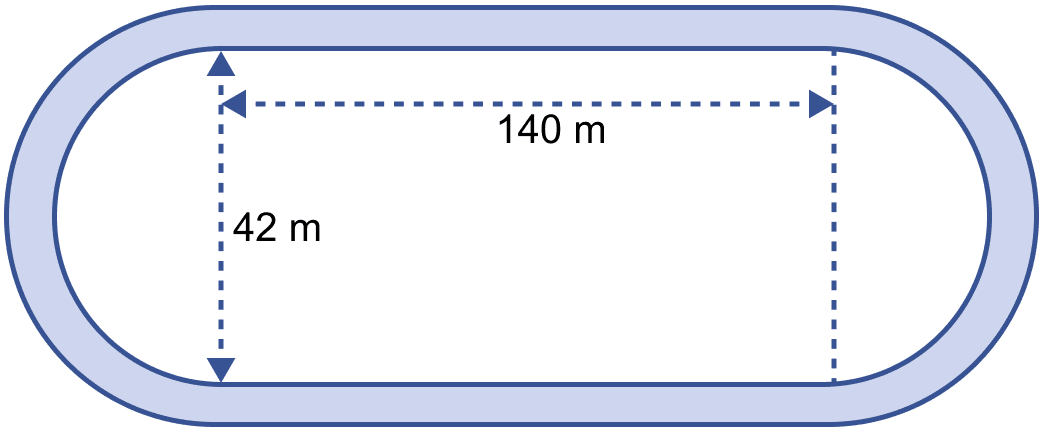
Answer
From figure,
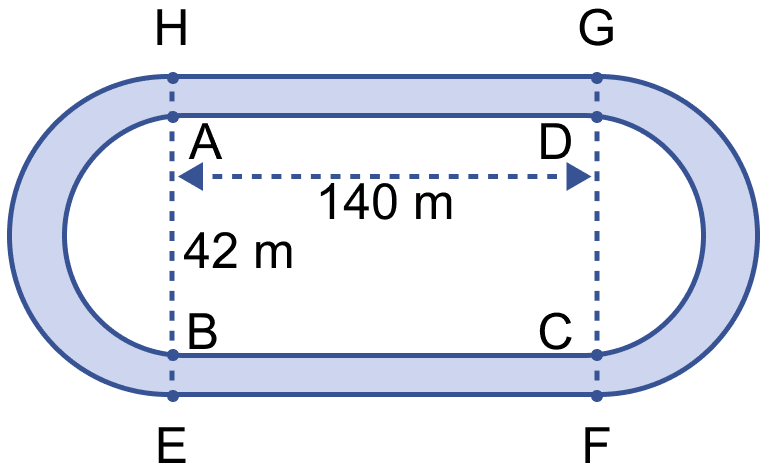
Length of inner rectangle ABCD = 140 m
Breadth of inner rectangle ABCD = 42 m
Diameter of inner semi-circle = 42 m
Radius of inner semi-circle (r) = = 21 m.
Length of outer rectangle = Length of inner rectangle = 140 m
Breadth of outer rectangle = Breadth of inner rectangle + 2 × Width of outer track = 42 + 2 × 3.5 = 42 + 7 = 49 m.
Diameter of outer semi-circle = 49 m
Radius of outer semi-circle (R) = = 24.5 m.
Area of track = Area of outer rectangle - Area of inner rectangle + 2(Area of outer semi-circle - Area of inner semi-circle)
Hence, area of track = 1480.5 m2.
In the adjoining figure, O is the center of a circular arc and AOB is a line segment. Find the perimeter and the area of the shaded region correct to one decimal place. (Take π = 3.142)
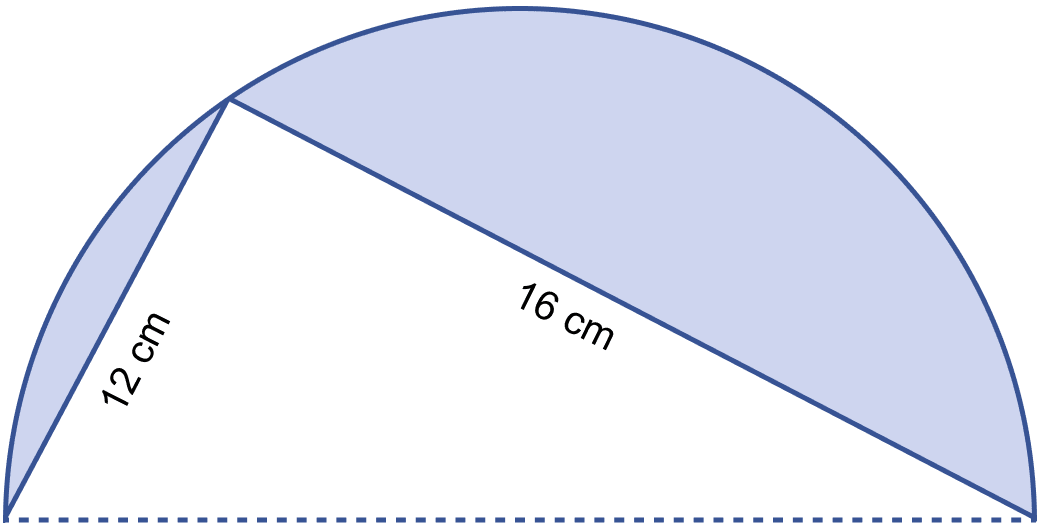
Answer
Angle in semi-circle = 90°
∴ ∠ACB = 90°
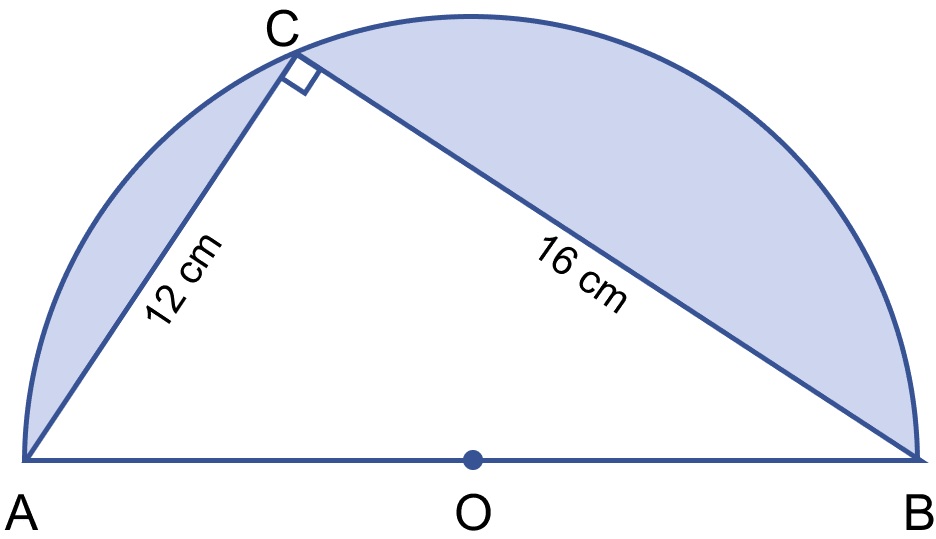
Using pythagoras theorem,
⇒ AB2 = AC2 + BC2
⇒ AB2 = 122 + 162
⇒ AB2 = 144 + 256
⇒ AB2 = 400
⇒ AB = = 20 cm.
AB is the diameter of circle,
∴ Radius = = = 10 cm.
Area of shaded region = Area of semi-circle - Area of triangle
Perimeter of shaded region = Circumference of semi-circle + AC + CB
= πr + 12 + 16
= 3.142 × 10 + 28
= 31.42 + 28
= 59.42 cm.
Hence, perimeter of shaded region = 59.42 cm and area of semi-circle = 61.1 cm2.
In the figure (i) given below, the radius is 3.5 cm. Find the perimeter of the quarter of the circle.

Answer
Perimeter of quarter of circle =
Substituting values we get,
Hence, perimeter of quarter of circle = 12.5 cm.
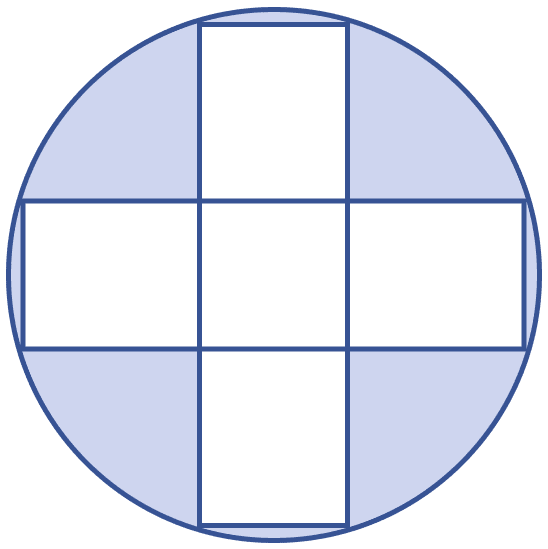
In the figure (ii) given below, there are five squares each of side 2 cm.
(i) Find the radius of the circle.
(ii) Find the area of the shaded region. (Take π = 3.14).
Answer
(i) Let O be the center of the circle.
B be the mid-point of side of square.
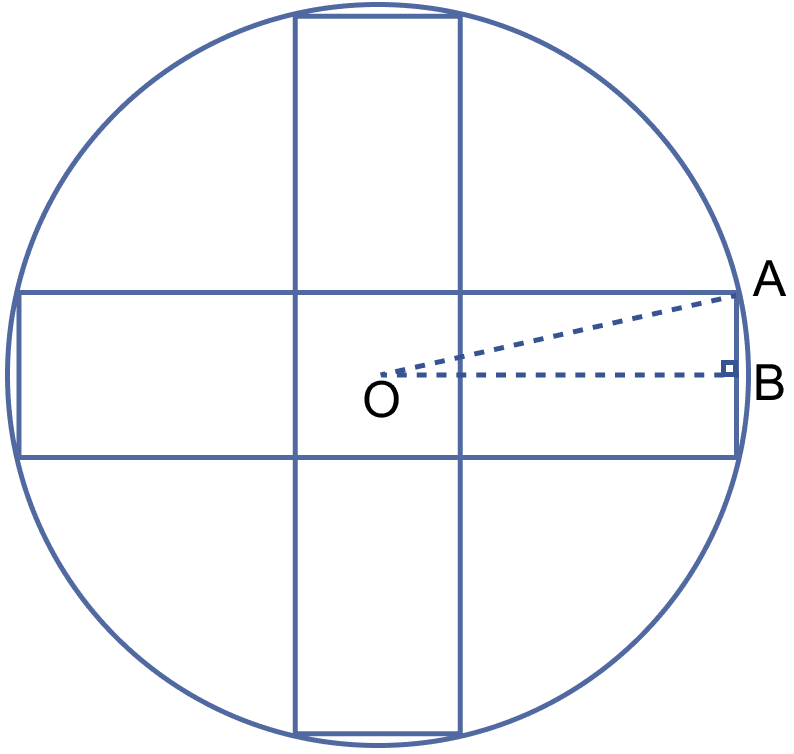
From figure,
OB = 2 + 1 = 3 cm
AB = 1 cm
Using Pythagoras theorem,
OA =
OA = .
So, the radius of the circle = cm.
Hence, the radius of circle = cm.
(ii) We know that,
Area of the circle = πr2.
= 3.14 ×
= 3.14 × 10
= 31.4 cm2.
Area of 5 square of side 2 cm each = 22 × 5
= 4 × 5
= 20 cm2.
So, the area of shaded portion = 31.4 – 20 = 11.4 cm2.
Hence, area of shaded portion = 11.4 cm2.
In the figure (i) given below, a piece of cardboard in the shape of a quadrant of a circle of radius 7 cm is bounded by the perpendicular radii OX and OY. Points A and B lie on OX and OY respectively such that OA = 3 cm and OB = 4 cm. The triangular part OAB is removed. Calculate the area and the perimeter of the remaining piece.

Answer
Area of quadrant =
Area of △OAB = × base × height
Area of shaded region = Area of quadrant - Area of △OAB
= 38.5 - 6 = 32.5 cm2.
From figure,
BY = OY - OB = 7 - 4 = 3 cm.
AX = OX - OA = 7 - 3 = 4 cm.
In right angle triangle OAB,
⇒ AB2 = OA2 + OB2
⇒ AB2 = 32 + 42
⇒ AB2 = 9 + 16
⇒ AB2 = 25
⇒ AB = = 5 cm.
Perimeter of shaded region = AB + BY + AX + Circumference of quadrant
= 5 + 3 + 4 +
= 12 +
= 12 + 11
= 23 cm.
Hence, area of shaded region = 32.5 cm2 and perimeter of remaining piece = 23 cm.
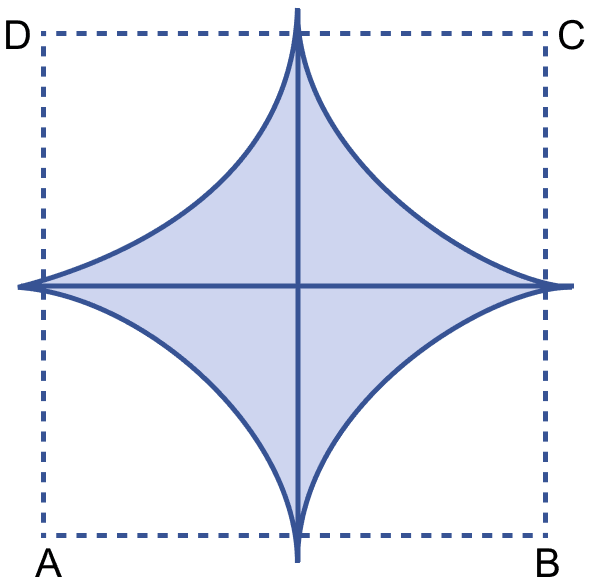
In the figure (ii) given below, ABCD is a square. Points A, B, C and D are centres of quadrants of circles of the same radius. If the area of the shaded portion is cm2, find the radius of the quadrants.
Answer
Let radius be r cm of each quadrant.
Area of each quadrant =
So, area of 4 quadrants =
From figure,
Side of square = r + r = 2r
Area of square ABCD = (Side)2 = (2r)2 = 4r2.
Area of shaded region = Area of square ABCD - Area of 4 quadrants
Hence, radius of quadrant = 5 cm.
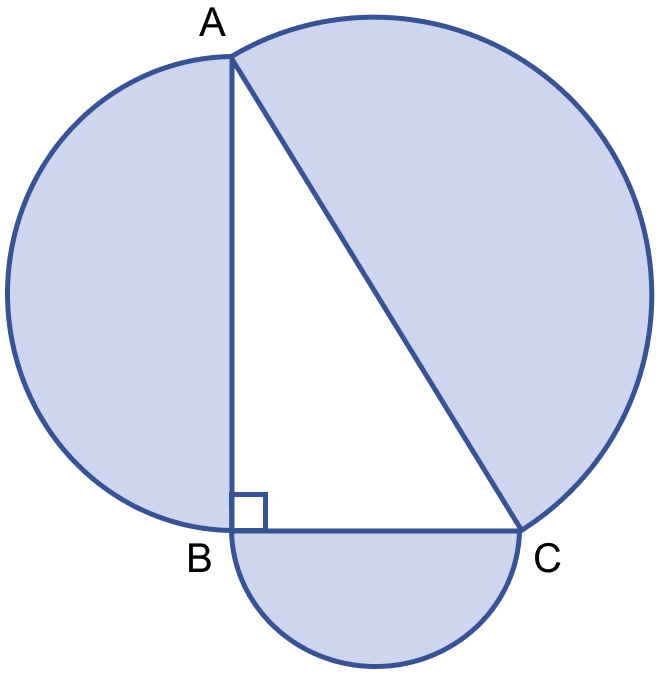
In the adjoining figure, ABC is a right angled triangle right angled at B. Semicircles are drawn on AB, BC and CA as diameter. Show that the sum of areas of semicircles drawn on AB and BC as diameter is equal to the area of the semicircle drawn on CA as diameter.
Answer
Since, ABC is a right angled triangle.
Using pythagoras theorem,
AC2 = AB2 + BC2 .........(1)
Area of semi-circle with diameter AB =
= .........(2)
Area of semi-circle with diameter BC =
= ..........(3)
Area of semi-circle with diameter AC =
= ..........(4)
Adding equations (2) and (3) we get,
Area of semi-circle with diameter AB + Area of semi-circle with diameter BC =
=
From Eq 1,
Area of semi-circle with diameter AB + Area of semi-circle with diameter BC =
From Eq 4,
Area of semi-circle with diameter AB + Area of semi-circle with diameter BC = Area of semi-circle with diameter AC
Hence, proved that the sum of areas of semicircles drawn on AB and BC as diameter is equal to the area of the semicircle drawn on CA as diameter.
The length of minute hand of a clock is 14 cm. Find the area swept by the minute hand in 15 minutes.
Answer
Let minute hand be at A and after 15 minute it reaches B.
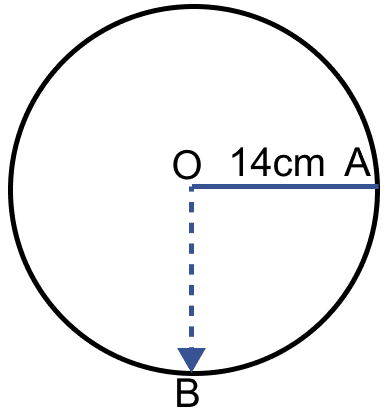
From figure,
Area of sector OAB =
Hence, area swept by minute hand in 15 minutes = 154 cm2.
Find the radius of a circle if a 90° arc has a length of 3.5π cm. Hence, find the area of the sector formed by this arc.
Answer
From figure,
AOB is a quadrant, with ∠AOB = 90°.
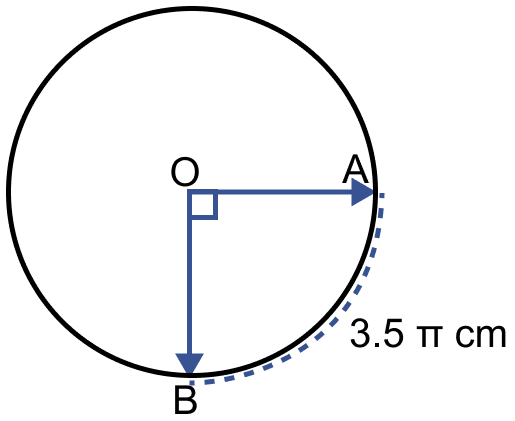
Let radius of circle be r cm,
Circumference of quadrant = .
Given,
Circumference of quadrant = 3.5π
Area of sector =
Hence, radius = 7 cm and area of sector = 38.5 cm2.
A cube whose each edge is 28 cm long has a circle of maximum radius on each of its face painted red. Find the total area of the unpainted surface of the cube.
Answer
Maximum diameter of circle can be 28 cm (Since, each edge is 28 cm).
So, radius = = 14 cm.
Area of each unpainted face = Area of square - Area of circle
= side2 - πr2
= 282 -
= 784 - 616
= 168 cm2.
Since, there are 6 faces in cube.
Total area of unpainted face = 6 × 168 = 1008 cm2.
Hence, total area of unpainted surface = 1008 cm2.
Can a pole 6.5 m long fit into the body of a truck with internal dimensions of 3.5 m, 3 m and 4 m?
Answer
Length of diagonal of cuboid =
Since, length of pole cannot be more than the length of diagonal.
Hence, 6.5 m pole cannot be fit into the body of a truck with internal dimensions of 3.5 m, 3 m and 4 m.
A car has a petrol tank 40 cm long, 28 cm wide and 25 cm deep. If the fuel consumption of the car averages 13.5 km per litre, how far can the car travel with a full tank of petrol?
Answer
Volume of tank = l × b × h
= 40 × 28 × 25
= 28000 cm3.
Since, 1 l = 1000 cm3.
∴ 28000 cm3 = 28 l.
Since, car travels 13.5 km per litre.
So, in 28 l car will travel 28 × 13.5 = 378 km.
Hence, car will travel 378 km in full tank of petrol.
An aquarium took 96 minutes to completely fill with water. Water was filling the aquarium at a rate of 25 litres every 2 minutes. Given that the aquarium was 2 m long and 80 cm wide, compute the height of the aquarium.
Answer
Let height of aquarium be h cm.
Volume of aquarium = l × b × h
= 2 m × 80 cm × h cm
= 200 cm × 80 cm × h cm
= 16000h cm3
= litres
= 16h litres.
Given,
Water was filling the aquarium at a rate of 25 litres every 2 minutes i.e., 12.5 litres per minute.
So, in 96 minutes, water filled = 96 × 12.5 = 1200 litres.
So, volume of aquarium = 1200 litres.
∴ 16h = 1200
h = = 75 cm.
Hence, height of aquarium = 75 cm.
The lateral surface area of a cuboid is 224 cm2. Its height is 7 cm and the base is a square. Find
(i) a side of the square, and
(ii) the volume of the cuboid.
Answer
(i) Since, base is a square.
Length = Breadth = x cm (let).
By formula,
Lateral surface area = 2(l + b) × h
⇒ 224 = 2(x + x) × 7
⇒ 224 = 2(2x) × 7
⇒ 28x = 224
⇒ x = = 8 cm.
Hence, the side of square = 8 cm.
(ii) Volume of cuboid = l × b × h
= 8 × 8 × 7
= 448 cm3.
Hence, volume of cuboid = 448 cm3.
If the volume of a cube is V m3, its surface area is S m2 and the length of a diagonal is d metres, prove that V = Sd.
Answer
Let side of cube = a m.
By formula,
Volume of cube (V) = (side)3 = a3,
Surface area (S) = 6(side)2 = 6a2.
Length of diagonal (d) = side = .
∴
Hence, proved that V = Sd.
The adjoining figure shows a victory stand, each face is rectangular. All measurements are in centimetres. Find its volume and surface area (the bottom of the stand is open).

Answer
By formula,
Volume of cuboid = l × b × h.
We know that,
Volume of part (3) = 50 × 40 × 12 = 24000 cm3
Volume of part (1) = 50 × 40 × (16 + 24)
= 50 × 40 × 40
= 80000 cm3.
Volume of part (2) = 50 × 40 × 24 = 48000 cm3.
So, the total volume = 24000 + 80000 + 48000 = 152000 cm3.
We know that
Total surface area = Area of front and back + Area of vertical faces + Area of top faces
Substituting the values we get,
= 2(50 × 12 + 50 × 40 + 50 × 24) cm2 + (12 × 40 + 28 × 40 + 16 × 40 + 24 × 40) cm2 + 3(50 × 40) cm2
= 2(600 + 2000 + 1200) cm2 + (480 + 1120 + 640 + 960) cm2 + (3 × 2000) cm2
= 2(3800) + 3200 + 6000 cm2
= 7600 + 3200 + 6000 cm2
= 16800 cm2.
Hence, volume = 152000 cm3 and surface area = 16800 cm2.
The external dimensions of an open rectangular wooden box are 98 cm by 84 cm by 77 cm. If the wood is 2 cm thick all around, find
(i) the capacity of the box
(ii) the volume of the wood used in making the box, and
(iii) the weight of the box in kilograms correct to one decimal place, given that 1 cm3 of wood weighs 0.8 g.
Answer
It is given that
External dimensions of open rectangular wooden box = 98 cm, 84 cm and 77 cm
Thickness = 2 cm
So, the internal dimensions of open rectangular wooden box = (98 - 2 × 2) cm, (84 - 2 × 2) cm and (77 - 2) cm
= (98 - 4) cm, (84 - 4) cm, 75 cm
= 94 cm, 80 cm, 75 cm.
(i) We know that,
Capacity of the box = Internal volume of box = 94 cm × 80 cm × 75 cm
= 564000 cm3.
Hence, capacity of the box = 564000 cm3.
(ii) Internal volume of box = 564000 cm3
External volume of box = 98 cm × 84 cm × 77 cm = 633864 cm3.
Volume of wood used in making the box = External volume - Internal volume
= 633864 – 564000 = 69864 cm3.
Hence, volume of box used in making the box = 69864 cm3.
(iii) Weight of 1 cm3 wood = 0.8 gm
So the weight of 69864 cm3 wood = 0.8 × 69864 gm
= kg
= kg
= 55.89 kg = 55.9 kg.
Hence, weight of box = 55.9 kg.
A cuboidal block of metal has dimensions 36 cm by 32 cm by 0.25 m. It is melted and recast into cubes with an edge of 4 cm.
(i) How many such cubes can be made?
(ii) What is the cost of silver coating the surfaces of the cubes at the rate of ₹1.25 per square centimeter?
Answer
(i) Given,
Dimensions of cuboidal block = 36 cm, 32 cm and 0.25 m.
Volume of cuboidal box = 36 cm × 32 cm × (0.25 × 100) cm
= (36 × 32 × 25) cm3
= 28800 cm3.
Volume of cube having edge 4 cm = 4 × 4 × 4 = 64 cm3.
We know that,
Number of cubes =
Hence, 450 cubes can be made.
(ii) By formula,
Total surface area of one cube = 6(side)2
= 6.(4)2
= 6 × 4 × 4
= 96 cm2.
So, the total surface area of 450 cubes = 450 × 96 = 43200 cm2
Cost of silver coating the surface for 1 cm2 = ₹1.25
Cost of silver coating the surface for 43200 cm2 = 43200 × 1.25 = ₹54000.
Hence, cost of silver coating the surface of cube = ₹54000.
Three cubes of silver with edges 3 cm, 4 cm and 5 cm are melted and recast into a single cube. Find the cost of coating the surface of the new cube with gold at the rate of ₹3.50 per square centimeter.
Answer
By formula,
Volume of cube = (edge)3
Volume of first cube = (3)3
= 3 × 3 × 3
= 27 cm3.
Volume of second cube = (4)3
= 4 × 4 × 4
= 64 cm3
Volume of third cube = (5)3
= 5 × 5 × 5
= 125 cm3.
Total volume = 27 + 64 + 125 = 216 cm3.
So, new cube's volume = 216 cm3
Let length of edge of new cube = x cm.
⇒ (x)3 = 216
⇒ (x)3 = (6)3
⇒ x = 6 cm.
Surface area of new cube = 6(x)2
= 6.(6)2
= 6 × 6 × 6
= 216 cm2.
Given,
Cost of coating the surface for 1 cm2 = ₹3.50
So, the cost of coating the surface for 216 cm2 = ₹3.50 × 216 = ₹756.
Hence, cost of coating the surface of new cube = ₹756.