
Classify the rational and irrational numbers from the following :
(i) 5
(ii)
(iii)
(iv) π
(v) 3.1416
(vi)
(vii)
(viii)
(ix)
(x)
(xi)
(xii) 0.202202220...
(xiii)
(xiv)
Answer
(i) 5 can be expressed in the form , where p and q are integers and q ≠ 0.
Hence, 5 is a rational number.
(ii) can be expressed in the form , where p and q are integers and q ≠ 0.
Hence, is a rational number.
(iii) is square root of non-perfect square i.e. 3.
Hence, is an irrational number.
(iv) π is a non-terminating and non-repeating decimal.
Hence, π is a irrational number.
(v) 3.1416 is a terminating decimal, so it can be expressed in the form of , where p and q are integers and q ≠ 0.
Hence, 3.1416 is a rational number.
(vi) is square root of perfect square i.e. 4.
.
Hence, is a rational number.
(vii) is square root of non-perfect square.
Hence, is an irrational number.
(viii) Given,
.
∴ can be expressed in the form of , where p and q are integers and q ≠ 0.
Hence, is a rational number.
(ix) is cube root of non-perfect cube.
Hence, is an irrational number.
(x)
Here, is square root of a non-perfect square i.e. 6, thus it is an irrational number.
The product of a non-zero rational number and an irrational number is always an irrational number.
Hence, is an irrational number.
(xi) is a repeating decimal.
Thus, can be expressed as a fraction with an integer numerator and a non-zero integer denominator.
Hence, is a rational number.
(xii) 0.2022022220... is a non-terminating and non-repeating decimal.
Hence, 0.2022022220... is an irrational number.
(xiii) .
2 is rational number and is an irrational number.
Since, on dividing a rational number by irrational number the solution is always an irrational number.
Hence, is an irrational number.
(xiv) can be expressed in the form of , where p and q are integers and q ≠ 0.
Hence, is a rational number.
Separate the rationals and irrationals from among the following numbers :
(i) -8
(ii)
(iii)
(iv)
(v) 0
(vi) π
(vii)
(viii)
(ix)
Answer
(i) -8 can be expressed in the form of , where p and q are integers and q ≠ 0.
Hence, -8 is a rational number.
(ii)
Thus, can be expressed in the form of , where p and q are integers and q ≠ 0.
Hence, is a rational number.
(iii) can be expressed in the form of , where p and q are integers and q ≠ 0.
Hence, is a rational number.
(iv) is square root of non-perfect square i.e. 8.
Hence, is an irrational number.
(v) 0 can be expressed in the form of , where p and q are integers and q ≠ 0.
Hence, 0 is a rational number.
(vi) π is a non-terminating and non-repeating decimal.
Hence, π is an irrational number.
(vii) is cube root of non-perfect cube i.e. 5.
Hence, is an irrational number.
(viii) is a repeating decimal.
Hence, is a rational number.
(ix) is square root of non-perfect square i.e. 3.
Hence, is an irrational number.
Represent each of the following on the real number line.
(i)
(ii)
(iii)
(iv)
Answer
(i) = 1.732..
(ii) = 2.236..
(iii) = 2.449..
(iv) = 3.162..
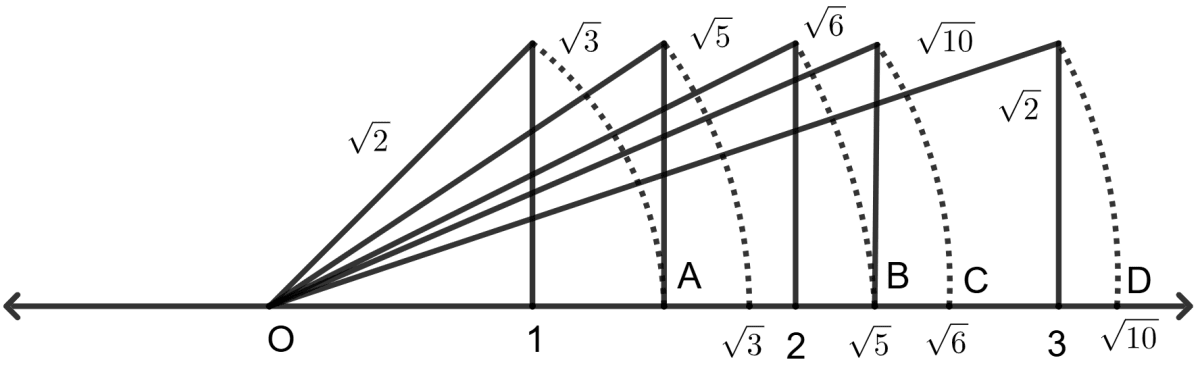
Write down the values of :
(i)
(ii)
(iii)
(iv)
(v)
(vi)
(vii)
(viii)
Answer
(i) Solving,
⇒ 4 × 3
⇒ 12.
Hence, = 12.
(ii) Solving,
Hence, .
(iii) Solving,
Hence, .
(iv) Solving,
Hence, .
(v) Solving,
Hence, .
(vi) Solving,
Hence, .
(vii) Solving,
Hence, .
(viii) Solving,
Hence, .
State, giving reason, wether the given number is rational or irrational:
(i)
(ii)
(iii)
(iv)
(v)
(vi)
(vii)
Answer
(i) Given,
3 is a rational number as it can be expressed in the form of , where p and q are integers and q ≠ 0.
is an irrational number as it is a square root of a non-perfect square i.e. 5.
The sum of a rational number and an irrational number is always irrational.
Hence, is a irrational number.
(ii) Given,
-1 is a rational number as it can be expressed in the form of , where p and q are integers and q ≠ 0.
is an irrational number as it is a square root of a non-perfect square i.e. 3.
The sum of a rational number and an irrational number is always irrational.
Hence, is a irrational number.
(iii) Given,
5 is a rational number as it can be expressed in the form of , where p and q are integers and q ≠ 0.
is an irrational number as it is a square root of a non-perfect square i.e. 6.
The product of a rational number and an irrational number is always irrational.
Hence, is an irrational number.
(iv) Given,
, is an irrational number as it is a square root of a non-perfect square i.e. 7.
∴ is an irrational number.
Hence, is an irrational number.
(v) Given,
4 is a rational number as it can be expressed in the form of , where p and q are integers and q ≠ 0.
is an irrational number as it is a square root of a non-perfect square i.e. 6.
The division of a rational number and an irrational number is always irrational.
Hence, is an irrational number.
(vi) Given,
3 is a rational number as it can be expressed in the form of , where p and q are integers and q ≠ 0.
is an irrational number as it is a square root of a non-perfect square i.e. 2.
The division of a rational number and an irrational number is always irrational.
Hence, is an irrational number.
(vii) Given,
3 is a rational number as it can be expressed in the form of , where p and q are integers and q ≠ 0.
Hence, is a rational number.
Show that each of the following is irrational :
(i)
(ii)
(iii)
(iv)
Answer
(i) Given,
9 is a rational number as it can be expressed in the form of , where p and q are integers and q ≠ 0.
4 is a rational number as it can be expressed in the form of , where p and q are integers and q ≠ 0.
is an irrational number as it is a square root of a non-perfect square i.e. 5.
The product of a rational number and an irrational number is always irrational. i.e.
The sum of a rational number and an irrational number is always irrational. i.e.
Hence, is an irrational number.
(ii) Given,
12 is a rational number as it can be expressed in the form of , where p and q are integers and q ≠ 0.
6 is a rational number as it can be expressed in the form of , where p and q are integers and q ≠ 0.
is an irrational number as it is a square root of a non-perfect square i.e. 3.
The product of a rational number and an irrational number is always irrational. i.e.
The difference between a rational number and an irrational number is always irrational. i.e. .
Hence, is an irrational number.
(iii) Given,
8 is a rational number as it can be expressed in the form of , where p and q are integers and q ≠ 0.
2 is a rational number as it can be expressed in the form of , where p and q are integers and q ≠ 0.
is an irrational number as it is a square root of a non-perfect square i.e. 15.
The product of a rational number and an irrational number is always irrational. i.e.
The sum of a rational number and an irrational number is always irrational. i.e.
Hence, is an irrational number.
(iv) Given,
6 is a rational number as it can be expressed in the form of , where p and q are integers and q ≠ 0.
is an irrational number as it is a square root of a non-perfect square i.e. 3.
The division of a rational number and an irrational number is always irrational. i.e.
Hence, is an irrational number.
Prove that is irrational number.
Answer
Let be rational.
Thus, can be expressed in the form of .
As 5 divides 5q2, so 5 divides p2 but 5 is prime,
Thus, 5 divides p.
Let p = 5m for some positive integer m.
Then, p = 5m
Substituting this value of p in (1), we get :
As 5 divides 5m2, so 5 divides q2 but 5 is prime.
Thus, 5 divides q.
This shows that 5 is a common factor of p and q. This contradicts the hypothesis that p and q have no common factor, other than 1.
is not a rational number.
Hence, proved that is a irrational number.
Write down the examples of 4 distinct irrational numbers.
Answer
We know that,
Square root of non-perfect squares are irrational numbers.
Since, 2, 3, 5 and 6 are non-perfect squares.
∴ are irrational numbers.
Hence, are 4 distinct irrational numbers.
Prove that is irrational.
Answer
Let us assume is a rational number.
Let,
Squaring both sides, we get :
Here, x is rational,
∴ x2 is rational .........(1)
⇒ x2 - 10 is rational (As difference between two rational numbers is always rational)
⇒ is rational (Dividing two rational numbers results in a rational number)
But, is irrational.
is irrational.
Thus, x2 - 10 is irrational and so x2 is irrational ........(2)
(1) and (2) do not match with each other.
∴ We arrive at a contradiction.
So, our assumption that is a rational number is wrong.
∴ is irrational.
Hence, proved that is an irrational number.
Prove that is irrational.
Answer
Let us assume is a rational number.
Let,
Squaring on both sides, we get :
Here, x is rational,
∴ x2 is rational .........(1)
⇒ x2 - 5 is rational (Difference between two rational numbers is always rational)
So, is rational (Dividing two rational numbers results in a rational number)
But is irrational,
is irrational
Thus, x2 - 5 is irrational and so x2 is irrational ........(2)
(1) and (2) do not match with each other.
∴ We arrive at a contradiction.
So, our assumption that is a rational number is wrong.
∴ is irrational.
Hence, proved that is an irrational number.
Write two irrational numbers between
Answer
We want two irrational numbers between .
Consider any two numbers between 14 and 19 such that they are not perfect squares.
Let us take 15 and 17 as they are not perfect squares.
We know that square root of a non-perfect square is an irrational number.
∴ are irrational numbers.
Thus, we have :
Hence, two irrational numbers between
.
Write three irrational numbers between
Answer
We want three irrational numbers between .
Consider any three numbers between 2 and 7 such that they are not perfect squares.
Let us take 3, 5 and 6 as they are not perfect squares.
We know that square root of a non-perfect square is an irrational number.
∴ are irrational numbers.
Thus, we have :
Hence, three irrational numbers between
.
State in each case, whether true or false :
(i) The sum of two rationals is a rational.
(ii) The sum of two irrationals is an irrational.
(iii) The product of two rationals is a rational.
(iv) The product of two irrationals is an irrational.
(v) The sum of a rational and an irrational is an irrational.
(vi) The product of a rational and an irrational is a rational.
Answer
(i) Adding two rational numbers will always result in rational number.
Hence, above statement is true.
(ii) Adding two irrational numbers can be rational as well as irrational.
Hence, above statement is false.
(iii) Multiplying two rational numbers will always result in rational number.
Hence, above statement is true.
(iv) Multiplying two irrational numbers can be rational as well as irrational.
Hence, above statement is false.
(v) Adding a rational and an irrational will always result irrational number.
Hence, above statement is true.
(iv) Multiplying a rational and an irrational can be rational as well as irrational.
Hence, above statement is false.
What are rational numbers? Give ten examples.
Answer
The numbers of the form , where p and q are integers and q is not equal to zero, are called rational numbers.
Examples:
(i)
(ii)
(iii) 7
(iv) 0
(v) -9
(vi)
(vii) -1.25
(viii) 3.75
(ix) 10000
(x)
What are irrational numbers? Give ten examples.
Answer
A number which when expressed in decimal form is expressible as a non-terminating and non-repeating decimal, is called an irrational number.
Examples:
π