
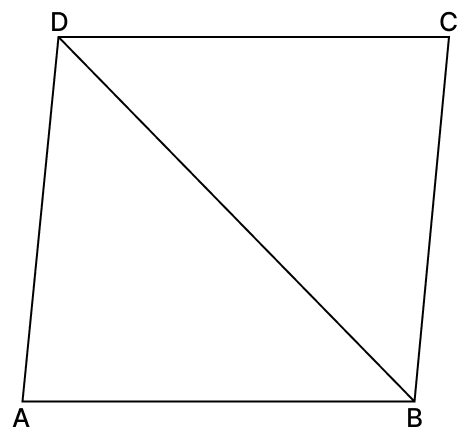
Assertion (A) : In the figure, ABCD is a parallelogram. Area of ΔABD = Area of ∥ gm ABCD.
Reason (R) : If a triangle and a parallelogram are on the same base and between the same parallels, then area of the triangle is equal to half of the area of the parallelogram.
A is true, R is false
A is false, R is true
Both A and R are true
Both A and R are false
Answer
In a parallelogram ABCD, the diagonal BD divides it into two triangles ΔABD and ΔBCD of equal area.
Area of △ABD = × Area of parallelogram ABCD
Assertion (A) is true.
The statement is a standard area theorem:
If a triangle and a parallelogram are on the same base and between the same parallels, then the area of the triangle is half the area of the parallelogram.
Reason (R) is true.
Both A and R are true.
Hence, option 3 is the correct option.
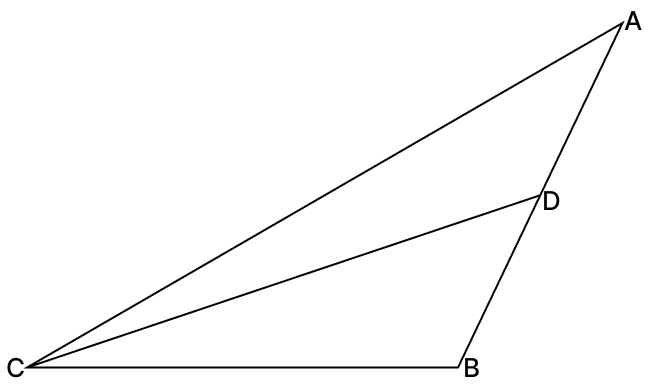
Assertion (A) : In ΔABC, if D is the mid-point of side AB, then area of ΔBCD = area of ΔACD.
Reason (R) : A triangle and a parallelogram on the same base and between the same parallels are equal in area.
A is true, R is false
A is false, R is true
Both A and R are true
Both A and R are false
Answer
In ΔABC, point D is the midpoint of AB.
Thus, CD is the median of trinagle ABC.
A median of a triangle divides it into two triangles of equal area.
Thus, area of ΔBCD = area of ΔACD.
Assertion (A) is true.
We know that,
If a triangle and a parallelogram lie on the same base and between the same parallels then area of triangle is equal to half the area of parallelogram.
Area of the triangle = area of the parallelogram.
Reason (R) is false.
A is true, R is false.
Hence, option 1 is the correct option.