
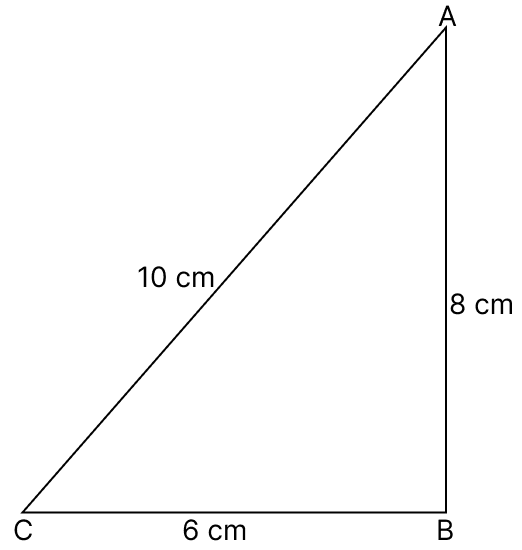
Assertion (A): In the figure, △ ABC is right angled at B.
Reason (R): In a right angled triangle, the square on the hypotenuse is equal to the sum of the other two sides.
A is true, R is false
A is false, R is true
Both A and R are true
Both A and R are false.
Answer
We know that,
In a right angled triangle, the square on the hypotenuse is equal to the sum of the squares of the other two sides.
∴ Reason (R) is false.
From figure,
Choose the greatest length. Check whether the square of greatest length is equal to the sum of squares of other two lengths.
Here greatest length is 10 cm and other lengths are 8 cm, 6 cm.
Note that 102 = 100 and 82 + 62 = 64 + 36 = 100.
Thus, 102 = 82 + 62
⇒ Hypotenuse2 = Perpendicular2 + Base2
⇒ AC is the hypotenuse and triangle ABC is right angled at B.
∴ Assertion (A) is true.
Hence, Option 1 is the correct option.
Assertion (A): In a right angled triangle, the longest side is called hypotenuse and the other two sides are called its legs. Also, the sum of lengths of legs is less than the length of the hypotenuse.
Reason (R): In a right angled triangle, the side opposite to the right angle is called its hypotenuse.
A is true, R is false
A is false, R is true
Both A and R are true
Both A and R are false.
Answer
In a right angled triangle, the longest side is called hypotenuse and the other two sides are called its legs. Also, the sum of any two sides is always greater than the third side.
∴ Assertion (A) is false.
In a right angled triangle, the side opposite to the right angle is called its hypotenuse.
∴ Reason (R) is true.
Hence, Option 2 is the correct option.