
Case Study
The length, breadth and height of Kavita's bedroom are 6 m, 4 m and 3 m respectively. It has two equal windows, each of dimensions 1 m × 0.5 m. It also has a door of dimensions 2 m × 1 m.
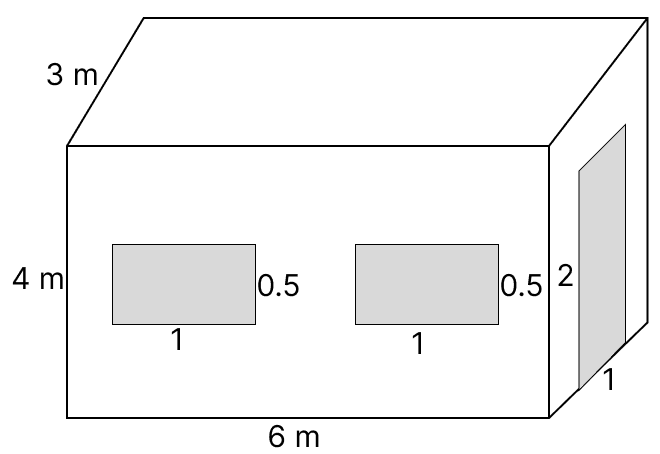
Based on the above information, answer the following questions:
Area occupied by the door and the two windows is :
(a) 1 m2
(b) 2 m2
(c) 2.5 m2
(d) 3 m2Kavita wants to whitewash the four walls of the room. Area to be whitewashed is :
(a) 60 m2
(b) 57 m2
(c) 55 m2
(d) 50 m2Square tiles each of side 50 cm are laid on the floor of the room. The number of such tiles laid is :
(a) 100
(b) 98
(c) 96
(d) 72Volume of air contained in the room is :
(a) 72 m3
(b) 70 m3
(c) 60 m3
(d) 52 m3The length of the longest rod (to the nearest m) that can be placed in the room is :
(a) 4 m
(b) 5 m
(c) 8 m
(d) 7 m
Answer
Given,
Length (l) = 6 m
Breadth (b) = 4 m
Height (h) = 3 m
Dimension of each window = 1 m × 0.5 m
Dimension of door = 2 m × 1 m
1. Area of one window = 1 × 0.5 = 0.5 m2
∴ Area of two windows = 2 (1 × 0.5) = 1 m2
Area of one door = 2 × 1 = 2 m2.
Total area = 2 + 1 = 3 m2.
Hence, option (d) is the correct option.
2. Area to be whitewashed = Area of four walls - Area of two windows and a door.
Calculating the area of four walls,
We know that,
Area of four walls = 2h(l + b)
= 2 × 3 × (6 + 4)
= 6 × 10
= 60 m2.
Area of two windows and a door = 3 m2.
Area to be whitewashed = 60 - 3 = 57 m2.
Hence, option (b) is the correct option.
3. Given,
Tile side = 50 cm = 0.5 m
Calculating the floor area,
Area of floor = Length × Breadth
= 6 × 4
= 24 m2.
Area of square tile = (side)2
= (0.5)2
= 0.25 m2
Number of tiles =
=
= 96.
Hence, option (c) is the correct option.
4. Volume of air contained in the room = l × b × h
= 6 × 4 × 3
= 72 m3.
Hence, option (a) is the correct option.
5. Length of the longest rod that can be placed in the room = Diagonal of room
Hence, option (c) is the correct option.
Case Study
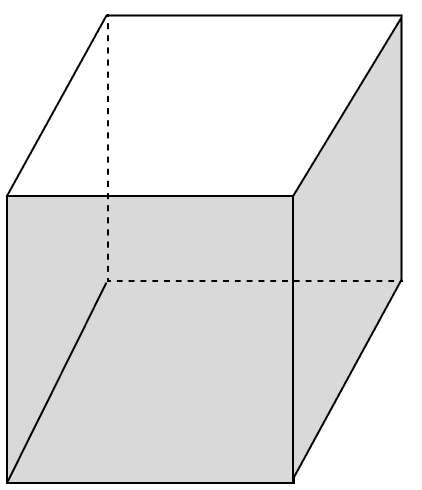
Manish is a carpenter. One day, he made an open cubical box of internal edge 18 cm. The thickness of the plywood is 1 cm. He painted the inner surface of the box black and the outer lateral surfaces as green.
Based on the above information, answer the following questions:
Total area to be painted black is :
(a) 1600 cm2
(b) 1620 cm2
(c) 1650 cm2
(d) 1680 cm2Length of the outer edge of the box is :
(a) 20 cm
(b) 19 cm
(c) 18 cm
(d) 18.5 cmTotal outer lateral surface area to be painted green is :
(a) 1500 cm2
(b) 1510 cm2
(c) 1520 cm2
(d) 1600 cm2Total outer surface area of the box (excluding the top) is :
(a) 1900 cm2
(b) 1920 cm2
(c) 2000 cm2
(d) 2320 cm2Length of the longest rod that can fit inside the box is :
(a) 18 cm
(b) 19 cm
(c) 20 cm
(d) 3 cm
Answer
Given,
Internal edge of cube = 18 cm
Thickness of plywood = 1 cm
1. Inside the open cubical box there are 5 faces (4 sides + 1 bottom)
Calculating area of one face,
Area = (side)2
= (18)2
= 324 cm2.
Calculating total inner area,
Total inner area = 5 × 324 = 1620 cm2.
Thus, the total area to be painted black is 1620 cm2.
Hence, option (b) is the correct option.
2. Thickness 1 cm will be on both sides of the box.
∴ Outer edge = Internal edge of cube + 2(Thickness)
= 18 + 2(1)
= 18 + 2 = 20 cm.
Hence, option (a) is the correct option.
3. Outer edge = 20 cm
Lateral surface area refers to the 4 side walls only (not the bottom).
Outer lateral area = 4 × (outer edge)2
= 4 × (20)2
= 4 × 400
= 1600 cm2.
Hence, option (d) is the correct option.
4. Total outer surface area of the box (excluding the top)
Total faces excluding the top = 5
Area of one face = (20)2 = 400 cm2.
Calculating the area of all the faces,
Area of all the faces = 5 × 400 = 2000 cm2.
Hence, option (c) is the correct option.
5. The rod must lie completely inside the open box, so the maximum straight length inside the box equals the internal edge length = 18 cm.
Hence, option (a) is the correct option.