
The area of an equilateral triangle is cm2. The length of its each side is :
4 cm
6 cm
8 cm
9 cm
Answer
Let each side of equilateral triangle be a cm.
Area of equilateral triangle = a2
⇒ a2
⇒ 64 = a2
⇒ a =
⇒ a = 8 cm.
Hence, option 3 is the correct option.
The length of the base and the area of an isosceles triangle are respectively 8 cm and 12 cm2. The length of each equal side is :
15 cm
10 cm
6 cm
5 cm
Answer
ABC is an isosceles triangle with AB = AC and base (BC) = 8 cm.
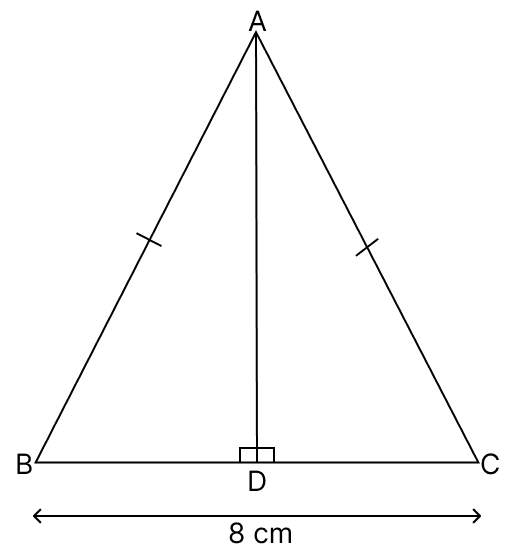
Area of a triangle = × base × height
Area of triangle ABC = × BC × AD
⇒ 12 = × 8 × AD
⇒ AD = = 3 cm.
In an isosceles triangle, the perpendicular from the common vertex to the base, bisects the base.
∴ BD = DC = = 4 cm.
In triangle ABD,
⇒ Hypotenuse2 = Base2 + Height2
⇒ AB2 = BD2 + AD2
⇒ AB2 = 42 + 32
⇒ AB2 = 16 + 9
⇒ AB2 = 25
⇒ AB =
⇒ AB = 5 cm.
∴ AB = AC = 5 cm.
Hence, option 4 is the correct option.
The length of the base of an isosceles triangle is 24 cm and the length of each equal side is 13 cm. The area of the triangle is :
60 cm2
120 cm2
156 cm2
164 cm2
Answer
Given,
Length of each equal side (a) = 13 cm and base (b) = 24 cm.
By formula,
Hence, option 1 is the correct option.
One side of a parallelogram is 6 m. If the area of a parallelogram is 30 m2, then its height corresponding to the side is :
10 m
5 m
12 m
14 m
Answer
Area of //gm = Base × Height
⇒ 30 = 6 × Height
⇒ Height = = 5 m.
Hence, option 2 is the correct option.
The length of a diagonal of a square is 8 cm. The area of the square is :
64 cm2
32 cm2
128 cm2
256 cm2
Answer
Area of square = × (diagonals)2
= × (8)2
= × 64
= 32 cm2.
Hence, option 2 is the correct option.
The length of one diagonal of a rhombus of area 24 cm2 is 6 cm. The length of the other diagonal is :
4 cm
8 cm
12 cm
16 cm
Answer
By formula,
Area of rhombus = × d1 × d2
⇒ 24 = × 6 × d2
⇒ d2 = = 8 cm.
Hence, option 2 is the correct option.
The distance between the parallel sides of a trapezium of area 27.5 cm2 is 5 cm. If the length of one of those two parallel sides is 7.5 cm, then the length of the other side is :
3.5 cm
7 cm
8.5 cm
9 cm
Answer
Let the length of other parallel side be a cm.
By formula,
Area of trapezium = × (sum of parallel sides) × distance between parallel sides
⇒ 27.5 = × (7.5 + a) × 5
⇒ 55 = (7.5 + a) × 5
⇒ 7.5 + a =
⇒ 7.5 + a = 11
⇒ a = 11 - 7.5 = 3.5 cm.
Hence, option 1 is the correct option.
The area of the triangle whose three sides are 13 cm, 14 cm and 15 cm, is :
72 cm2
84 cm2
92 cm2
96 cm2
Answer
Let a = 13 cm, b = 14 cm and c = 15 cm.
s =
=
= = 21.
By formula,
Area of triangle =
Hence, option 2 is the correct option.
The area of the equilateral triangle of side 4 cm is :
6.928 cm2
6.298 cm2
5.928 cm2
5.528 cm2
Answer
Side (a) = 4 cm.
Area of an equilateral triangle = × a2
= × (4)2
= × 16
=
= 4 × 1.732 = 6.928 cm2.
Hence, option 1 is the correct option.
If the height of an equilateral triangle is cm, then its area is :
cm2
cm2
cm2
cm2
Answer
Let the length of each side of the equilateral triangle be a cm.
We know that,
Height of an equilateral triangle = side
⇒
⇒ a = 24 cm.
Hence, option 2 is the correct option.
The lengths of two adjacent sides of a parallelogram are 12 cm and 10 cm respectively. If the distance between the longer sides be 8 cm, then the distance between two shorter sides will be :
9.1 cm
9.2 cm
9.4 cm
9.6 cm
Answer
Longer side = 12 cm
Shorter side = 10 cm
Distance between longer sides (height corresponding to 12 cm) = 8 cm
Area of //gm = Base × Height
= 12 × 8 = 96 cm2.
Distance between the shorter side be h cm.
Area of //gm = Base × Height
⇒ 96 = 10 × h
⇒ h = = 9.6 cm.
Hence, option 4 is the correct option.
The ratio of heights of two triangles is 2 : 3 and the ratio of their areas 3 : 2. The ratio of their bases is :
1 : 4
2 : 8
9 : 4
4 : 9
Answer
Let b1 and b2 be the bases of the triangles.
Heights (h1 : h2) = 2 : 3
Areas (A1 : A2) = 3 : 2
Area of a triangle = × Base × Height
Hence, option 3 is the correct option.
The perimeter of a rectangle is 26 m. If the length of the rectangle is 3 m more than its breadth, then its area will be :
36 m2
38 m2
40 m2
42 m2
Answer
By formula,
Perimeter of a rectangle = 2(l + b)
⇒ 26 = 2(3 + b + b)
⇒ 26 = 2(3 + 2b)
⇒ 3 + 2b =
⇒ 3 + 2b = 13
⇒ 2b = 13 - 3
⇒ 2b = 10
⇒ b = = 5 m.
⇒ l = 3 + b = 3 + 5 = 8 m.
Area of rectangle = l × b
= 8 × 5 = 40 m2.
Hence, option 3 is the correct option.
If the length of two diagonals of a rhombus are 6 cm and 4 cm, then its area is :
10 cm2
12 cm2
14 cm2
16 cm2
Answer
Area of rhombus = × d1 × d2
= × 6 × 4
= 3 × 4 = 12 cm2.
Hence, option 2 is the correct option.