
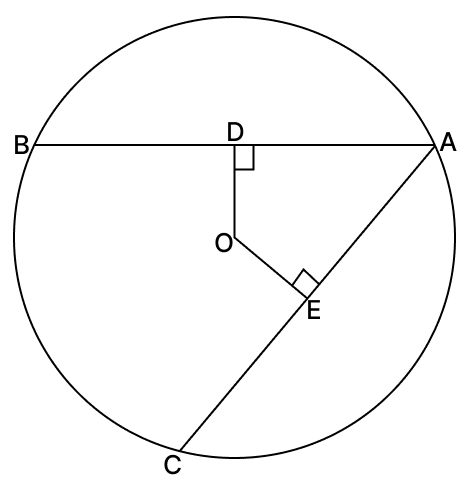
Assertion (A): In the figure, AB and AC are equal chords of a circle with centre O. If OD = 4 cm, then OE is also 4 cm.
Reason (R): Equal chords of a circle are equidistant from the centre.
A is true, R is false
A is false, R is true
Both A and R are true
Both A and R are false
Answer
We know that,
Equal chords of a circle are equidistant from the centre.
Reason (R) is true.
Since, AB = AC [Chords of circle are equal]
∴ OD = OE = 4 cm
Assertion (A) is true.
Both A and R are true.
Hence, option 3 is the correct option.
Assertion (A): Longer is the chord, longer is its distance from the centre.
Reason (R): Chords of a circle that are equidistant from the centre of the circle are parallel to each other.
A is true, R is false
A is false, R is true
Both A and R are true
Both A and R are false
Answer
The longer the chord, the closer it is to the center.
The shorter the chord, the farther it is from the center.
Assertion (A) is false.
If two chords are equidistant from the center, they must be equal in length, but they do not have to be necessarily parallel.
Reason (R) is false.
Both A and R are false.
Hence, option 4 is the correct option.
Assertion (A): Equal chords of a circle subtend equal angles at the centre of the circle.
Reason (R): One and only one circle can be drawn passing through three points.
A is true, R is false
A is false, R is true
Both A and R are true
Both A and R are false
Answer
Let AB and CD are two equal chords of a circle with center O.
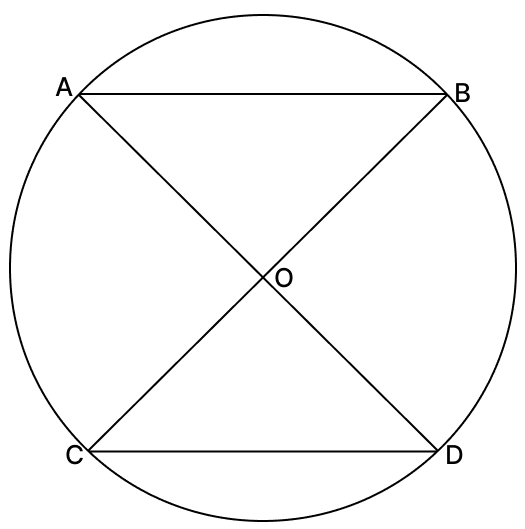
In Δ AOB and Δ COD,
OA = OC (Radii of a circle)
OB = OD (Radii of a circle)
AB = CD (Given)
By SSS congruency criterion,
Δ AOB ≅ Δ COD
Using corresponding parts of congruent triangles,
∠AOB = ∠COD
Assertion (A) is true.
Through three non-collinear points, exactly one circle can pass.
Through three collinear points, no circle can be drawn.
Reason (R) is false.
A is true, R is false.
Hence, option 1 is the correct option.