KnowledgeBoat Logo
|
OPEN IN APP

Chapter 5

Simultaneous Linear Equations — Exercise 5(B)

Class - 9 RS Aggarwal Mathematics Solutions


Exercise 5B

Question 1

Solve the following system of equations by using the method of cross multiplication:

2x − 5y + 8 = 0, x − 4y + 7 = 0

Answer

Given,

Equations:

⇒ 2x − 5y + 8 = 0

⇒ x − 4y + 7 = 0

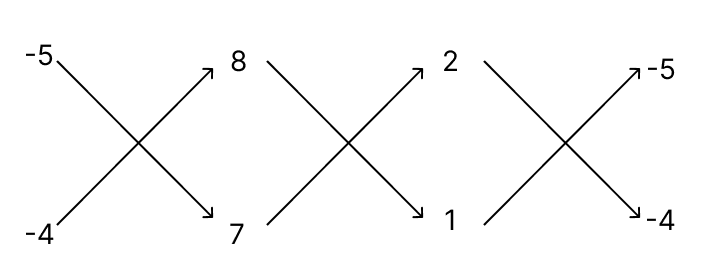
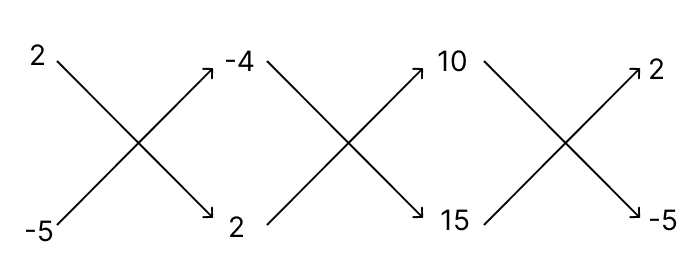
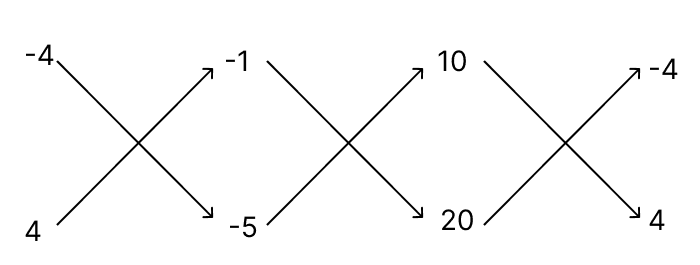
By cross-multiplication method,

Solve the following system of equations by using the method of cross multiplication: R.S. Aggarwal Mathematics Solutions ICSE Class 9.

x(5)×(7)(4)×(8)=y(8)×(1)(7)×(2)=1(2)×(4)(1)×(5)x(35)+32=y814=18+5x3=y6=13x3=13 and y6=13x=33 and y=63x=1 and y=2.\Rightarrow \dfrac{x}{(-5) \times (7) - (-4) \times (8)} = \dfrac{y}{(8) \times (1) - (7) \times (2)} = \dfrac{1}{(2) \times (-4) - (1) \times (-5)} \\[1em] \Rightarrow \dfrac{x}{(-35) + 32} = \dfrac{y}{8 - 14} = \dfrac{1}{-8 + 5} \\[1em] \Rightarrow \dfrac{x}{-3} = \dfrac{y}{-6} = \dfrac{1}{-3} \\[1em] \Rightarrow \dfrac{x}{-3} = \dfrac{1}{-3} \text{ and } \dfrac{y}{-6} = \dfrac{1}{-3} \\[1em] \Rightarrow x = \dfrac{-3}{-3} \text{ and } y = \dfrac{-6}{-3} \\[1em] \Rightarrow x = 1 \text{ and } y = 2.

Hence, x = 1 and y = 2.

Question 2

Solve the following system of equations by using the method of cross multiplication:

5x − 4y + 2 = 0, 2x + 3y = 13

Answer

Given,

Equations :

⇒ 5x − 4y + 2 = 0

⇒ 2x + 3y - 13 = 0

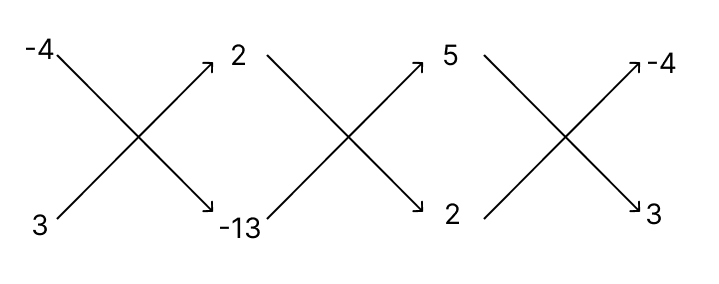
By cross-multiplication method,

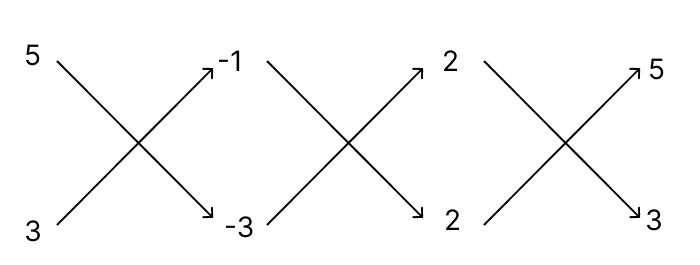
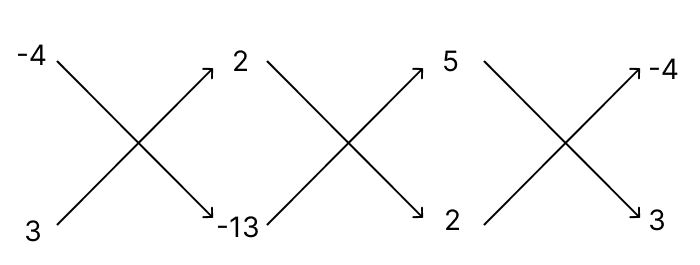
Solve the following system of equations by using the method of cross multiplication: R.S. Aggarwal Mathematics Solutions ICSE Class 9.

x(4)×(13)(3)×(2)=y(2)×(2)(13)×(5)=1(5)×(3)(2)×(4)x(52)6=y4+65=115+8x46=y69=123x46=123 and y69=123x=4623 and y=6923x=2 and y=3.\Rightarrow \dfrac{x}{(-4) \times (-13) - (3) \times (2)} = \dfrac{y}{(2) \times (2) - (-13) \times (5)} = \dfrac{1}{(5) \times (3) - (2) \times (-4)} \\[1em] \Rightarrow \dfrac{x}{(52) - 6} = \dfrac{y}{4 + 65} = \dfrac{1}{15 + 8} \\[1em] \Rightarrow \dfrac{x}{46} = \dfrac{y}{69} = \dfrac{1}{23} \\[1em] \Rightarrow \dfrac{x}{46} = \dfrac{1}{23} \text{ and } \dfrac{y}{69} = \dfrac{1}{23} \\[1em] \Rightarrow x = \dfrac{46}{23} \text{ and } y = \dfrac{69}{23} \\[1em] \Rightarrow x = 2 \text{ and } y = 3.

Hence, x = 2 and y = 3.

Question 3

Solve the following system of equations by using the method of cross multiplication:

3x − 5y = 19, 7x − 3y = 1

Answer

Given,

Equations:

⇒ 3x − 5y - 19 = 0

⇒ 7x − 3y - 1 = 0

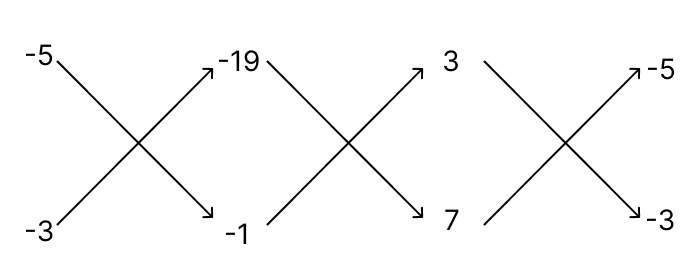
By cross-multiplication method,

Solve the following system of equations by using the method of cross multiplication: R.S. Aggarwal Mathematics Solutions ICSE Class 9.

x(5)×(1)(3)×(19)=y(19)×(7)(1)×(3)=1(3)×(3)(7)×(5)x557=y133+3=19+35x52=y130=126x52=126 and y130=126x=5226 and y=13026x=2 and y=5.\Rightarrow \dfrac{x}{(-5) \times (-1) - (-3) \times (-19)} = \dfrac{y}{(-19) \times (7) - (-1) \times (3)} = \dfrac{1}{(3) \times (-3) - (7) \times (-5)} \\[1em] \Rightarrow \dfrac{x}{5 - 57} = \dfrac{y}{-133 + 3} = \dfrac{1}{-9 + 35} \\[1em] \Rightarrow \dfrac{x}{-52} = \dfrac{y}{-130} = \dfrac{1}{26} \\[1em] \Rightarrow \dfrac{x}{-52} = \dfrac{1}{26} \text{ and } \dfrac{y}{-130} = \dfrac{1}{26} \\[1em] \Rightarrow x = \dfrac{-52}{26} \text{ and } y = \dfrac{-130}{26} \\[1em] \Rightarrow x = -2 \text{ and } y = -5.

Hence, x = -2 and y = -5.

Question 4

Solve the following system of equations by using the method of cross multiplication:

2x + 3y = 17, 3x − 2y = 6

Answer

Given,

Equations:

⇒ 2x + 3y - 17 = 0

⇒ 3x - 2y - 6 = 0

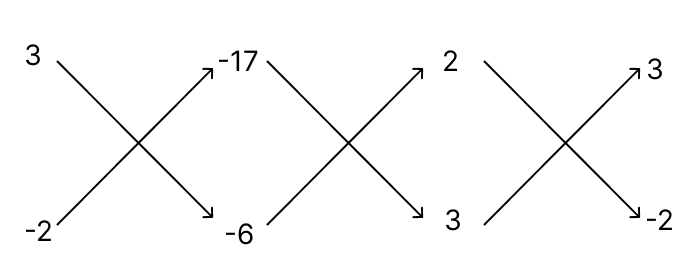
By cross-multiplication method,

Solve the following system of equations by using the method of cross multiplication: R.S. Aggarwal Mathematics Solutions ICSE Class 9.

x(3)×(6)(2)×(17)=y(17)×(3)(6)×(2)=1(2)×(2)(3)×(3)x(18)34=y51+12=149x52=y39=113x52=113 and y39=113x=5213 and y=3913x=4 and y=3.\Rightarrow \dfrac{x}{(3) \times (-6) - (-2) \times (-17)} = \dfrac{y}{(-17) \times (3) - (-6) \times (2)} = \dfrac{1}{(2) \times (-2) - (3) \times (3)} \\[1em] \Rightarrow \dfrac{x}{(-18) - 34} = \dfrac{y}{-51 + 12} = \dfrac{1}{-4 - 9} \\[1em] \Rightarrow \dfrac{x}{-52} = \dfrac{y}{-39} = \dfrac{1}{-13} \\[1em] \Rightarrow \dfrac{x}{-52} = \dfrac{1}{-13} \text{ and } \dfrac{y}{-39} = \dfrac{1}{-13} \\[1em] \Rightarrow x = \dfrac{-52}{-13} \text{ and } y = \dfrac{-39}{-13} \\[1em] \Rightarrow x = 4 \text{ and } y = 3.

Hence, x = 4 and y = 3.

Question 5

Solve the following system of equations by using the method of cross multiplication:

x + 2y + 1 = 0, 2x − 3y = 12

Answer

Given,

Equations:

⇒ x + 2y + 1 = 0

⇒ 2x − 3y - 12 = 0

By cross-multiplication method,

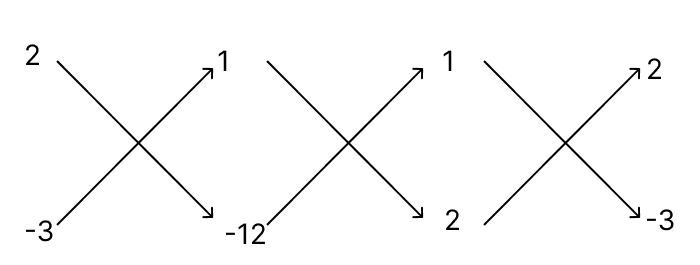
Solve the following system of equations by using the method of cross multiplication: R.S. Aggarwal Mathematics Solutions ICSE Class 9.

x(2)×(12)(3)×(1)=y(1)×(2)(12)×(1)=1(1)×(3)(2)×(2)x(24)+3=y2+12=134x21=y14=17x21=17 and y14=17x=217 and y=147x=3 and y=2.\Rightarrow \dfrac{x}{(2) \times (-12) - (-3) \times (1)} = \dfrac{y}{(1) \times (2) - (-12) \times (1)} = \dfrac{1}{(1) \times (-3) - (2) \times (2)} \\[1em] \Rightarrow \dfrac{x}{(-24) + 3} = \dfrac{y}{2 + 12} = \dfrac{1}{-3 - 4} \\[1em] \Rightarrow \dfrac{x}{-21} = \dfrac{y}{14} = \dfrac{1}{-7} \\[1em] \Rightarrow \dfrac{x}{-21} = \dfrac{1}{-7} \text{ and } \dfrac{y}{14} = \dfrac{1}{-7} \\[1em] \Rightarrow x = \dfrac{-21}{-7} \text{ and } y = \dfrac{14}{-7} \\[1em] \Rightarrow x = 3 \text{ and } y = -2.

Hence, x = 3 and y = -2.

Question 6

Solve the following system of equations by using the method of cross multiplication:

2x + 5y = 1, 2x + 3y = 3

Answer

Given,

Equations:

⇒ 2x + 5y - 1 = 0

⇒ 2x + 3y - 3 = 0

By cross-multiplication method,

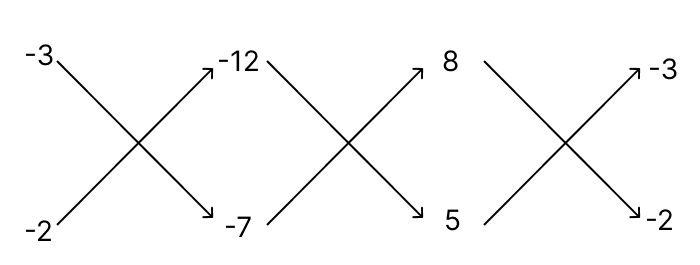
Solve the following system of equations by using the method of cross multiplication: R.S. Aggarwal Mathematics Solutions ICSE Class 9.

x(5)×(3)(3)×(1)=y(1)×(2)(3)×(2)=1(2)×(3)(2)×(5)x(15)+3=y2+6=1610x12=y4=14x12=14 and y4=14x=124 and y=44x=3 and y=1.\Rightarrow \dfrac{x}{(5) \times (-3) - (3) \times (-1)} = \dfrac{y}{(-1) \times (2) - (-3) \times (2)} = \dfrac{1}{(2) \times (3) - (2) \times (5)} \\[1em] \Rightarrow \dfrac{x}{(-15) + 3} = \dfrac{y}{-2 + 6} = \dfrac{1}{6 - 10} \\[1em] \Rightarrow \dfrac{x}{-12} = \dfrac{y}{4} = \dfrac{1}{-4} \\[1em] \Rightarrow \dfrac{x}{-12} = \dfrac{1}{-4} \text{ and } \dfrac{y}{4} = \dfrac{1}{-4} \\[1em] \Rightarrow x = \dfrac{-12}{-4} \text{ and } y = \dfrac{4}{-4} \\[1em] \Rightarrow x = 3 \text{ and } y = -1.

Hence, x = 3 and y = -1.

Question 7

Solve the following system of equations by using the method of cross multiplication:

8x − 3y = 12, 5x = 2y + 7

Answer

Given,

Equations:

⇒ 8x − 3y - 12 = 0

⇒ 5x - 2y - 7 = 0

By cross-multiplication method,

Solve the following system of equations by using the method of cross multiplication: R.S. Aggarwal Mathematics Solutions ICSE Class 9.

x(3)×(7)(2)×(12)=y(12)×(5)(7)×(8)=1(8)×(2)(5)×(3)x2124=y60+56=116+15x3=y4=11x3=11 and y4=11x=31 and y=41x=3 and y=4.\Rightarrow \dfrac{x}{(-3) \times (-7) - (-2) \times (-12)} = \dfrac{y}{(-12) \times (5) - (-7) \times (8)} = \dfrac{1}{(8) \times (-2) - (5) \times (-3)} \\[1em] \Rightarrow \dfrac{x}{21 - 24} = \dfrac{y}{-60 + 56} = \dfrac{1}{-16 + 15} \\[1em] \Rightarrow \dfrac{x}{-3} = \dfrac{y}{-4} = \dfrac{1}{-1} \\[1em] \Rightarrow \dfrac{x}{-3} = \dfrac{1}{-1} \text{ and } \dfrac{y}{-4} = \dfrac{1}{-1} \\[1em] \Rightarrow x = \dfrac{-3}{-1} \text{ and } y = \dfrac{-4}{-1} \\[1em] \Rightarrow x = 3 \text{ and } y = 4.

Hence, x = 3 and y = 4.

Question 8

Solve the following system of equations by using the method of cross multiplication:

7x − 2y = 20, 11x + 15y + 23 = 0

Answer

Given,

Equations:

⇒ 7x − 2y - 20 = 0

⇒ 11x + 15y + 23 = 0

By cross-multiplication method,

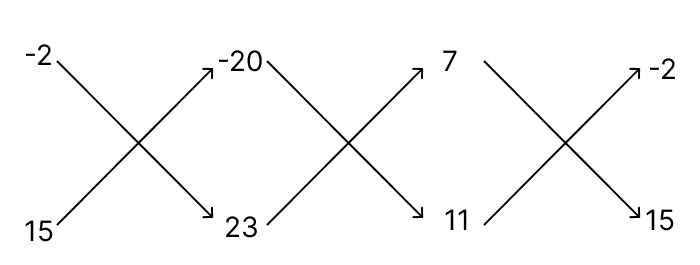
Solve the following system of equations by using the method of cross multiplication: R.S. Aggarwal Mathematics Solutions ICSE Class 9.

x(2)×(23)(15)×(20)=y(20)×(11)(23)×(7)=1(7)×(15)(11)×(2)x(46)+300=y220161=1105+22x254=y381=1127x254=1127 and y381=1127x=254127 and y=381127x=2 and y=3.\Rightarrow \dfrac{x}{(-2) \times (23) - (15) \times (-20)} = \dfrac{y}{(-20) \times (11) - (23) \times (7)} = \dfrac{1}{(7) \times (15) - (11) \times (-2)} \\[1em] \Rightarrow \dfrac{x}{(-46) + 300} = \dfrac{y}{-220 - 161} = \dfrac{1}{105 + 22} \\[1em] \Rightarrow \dfrac{x}{254} = \dfrac{y}{-381} = \dfrac{1}{127} \\[1em] \Rightarrow \dfrac{x}{254} = \dfrac{1}{127} \text{ and } \dfrac{y}{-381} = \dfrac{1}{127} \\[1em] \Rightarrow x = \dfrac{254}{127} \text{ and } y = \dfrac{-381}{127} \\[1em] \Rightarrow x = 2 \text{ and } y = -3.

Hence, x = 2 and y = -3.

Question 9

Solve the following system of equations by using the method of cross multiplication:

ax + by = (a − b), bx − ay = (a + b)

Answer

Given,

Equations:

⇒ ax + by - (a − b) = 0

⇒ bx − ay - (a + b) = 0

By cross-multiplication method,

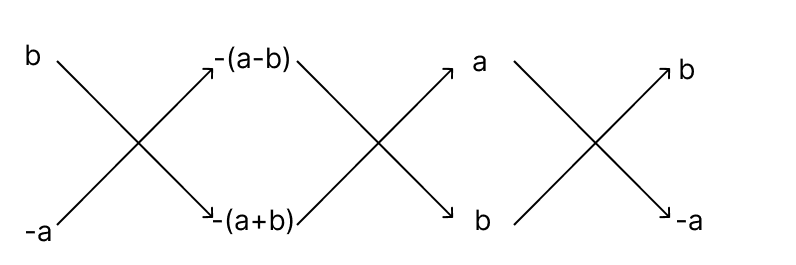
Solve the following system of equations by using the method of cross multiplication: R.S. Aggarwal Mathematics Solutions ICSE Class 9.

x(b)×(a+b)[(a)×(ab)]=y(ab)×(b)[(a+b)]×(a)=1(a)×(a)(b)×(b)x(b)×(ab)[(a)×(a+b)]=y(ab)×(b)(ab)×(a)=1(a)×(a)(b)×(b)xabb2(a2ab)=yab+b2(a2ab)=1a2b2x(abb2a2+ab)=yab+b2+a2+ab=1a2b2xa2b2=ya2+b2=1a2b2xa2b2=1a2b2 and ya2+b2=1a2b2x=a2b2a2b2 and y=a2+b2a2b2=a2+b2(a2+b2)x=1 and y=1.\Rightarrow \dfrac{x}{(b) \times -(a + b) - [(-a) \times -(a - b)]} = \dfrac{y}{-(a - b) \times (b) - [-(a + b)] \times (a)} = \dfrac{1}{(a) \times (-a) - (b) \times (b)}\\[1em] \Rightarrow \dfrac{x}{(b) \times (-a - b) - [(-a) \times (-a + b)]} = \dfrac{y}{-(a - b) \times (b) - (-a - b) \times (a)} = \dfrac{1}{(a) \times (-a) - (b) \times (b)}\\[1em] \Rightarrow \dfrac{x}{-ab - b^2 - (a^2 - ab)} = \dfrac{y}{-ab + b^2 - (-a^2 - ab)} = \dfrac{1}{-a^2 - b^2} \\[1em] \Rightarrow \dfrac{x}{(-ab - b^2 - a^2 + ab)} = \dfrac{y}{-ab + b^2 + a^2 + ab} = \dfrac{1}{-a^2 - b^2} \\[1em] \Rightarrow \dfrac{x}{-a^2 - b^2} = \dfrac{y}{a^2 + b^2} = \dfrac{1}{-a^2 - b^2} \\[1em] \Rightarrow \dfrac{x}{-a^2 - b^2} = \dfrac{1}{-a^2 - b^2} \text{ and } \dfrac{y}{a^2 + b^2} = \dfrac{1}{-a^2 - b^2} \\[1em] \Rightarrow x = \dfrac{-a^2 - b^2}{-a^2 - b^2} \text{ and } y = \dfrac{a^2 + b^2}{-a^2 - b^2} = \dfrac{a^2+ b^2}{-(a^2 + b^2)} \\[1em] \Rightarrow x = 1 \text{ and } y = -1.

Hence, x = 1 and y = -1.

Question 10

Solve the following system of equations by using the method of cross multiplication:

3x + 2y + 25 = 0, 2x + y + 10 = 0

Answer

Given,

Equations :

⇒ 3x + 2y + 25 = 0

⇒ 2x + y + 10 = 0

By cross-multiplication method,

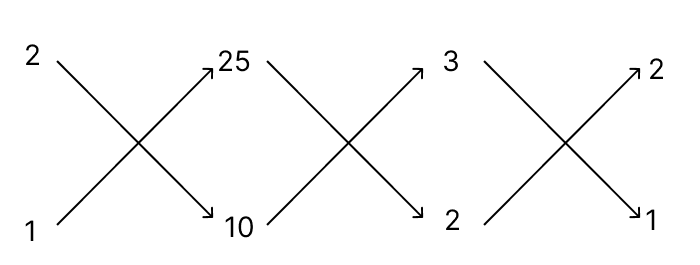
Solve the following system of equations by using the method of cross multiplication: R.S. Aggarwal Mathematics Solutions ICSE Class 9.

x(2)×(10)(1)×(25)=y(25)×(2)(10)×(3)=1(3)×(1)(2)×(2)x2025=y5030=134x5=y20=11x5=11 and y20=11x=51 and y=201x=5 and y=20.\Rightarrow \dfrac{x}{(2) \times (10) - (1) \times (25)} = \dfrac{y}{(25) \times (2) - (10) \times (3)} = \dfrac{1}{(3) \times (1) - (2) \times (2)} \\[1em] \Rightarrow \dfrac{x}{20 - 25} = \dfrac{y}{50 - 30} = \dfrac{1}{3 - 4} \\[1em] \Rightarrow \dfrac{x}{-5} = \dfrac{y}{20} = \dfrac{1}{-1} \\[1em] \Rightarrow \dfrac{x}{-5} = \dfrac{1}{-1} \text{ and } \dfrac{y}{20} = \dfrac{1}{-1} \\[1em] \Rightarrow x = \dfrac{-5}{-1} \text{ and } y = \dfrac{20}{-1} \\[1em] \Rightarrow x = 5 \text{ and } y = -20.

Hence, x = 5 and y = -20.

Question 11

Solve the following system of equations by using the method of cross multiplication:

5x4y+2=0,2x+3y=13\dfrac{5}{x} - \dfrac{4}{y} + 2 = 0, \dfrac{2}{x} + \dfrac{3}{y} = 13, (x ≠ 0, y ≠ 0)

Answer

Substituting 1x=a,1y=b\dfrac{1}{x}= a, \dfrac{1}{y} = b in 5x4y+2=0\dfrac{5}{x} - \dfrac{4}{y} + 2 = 0, we get:

⇒ 5a - 4b + 2 = 0     ..........(1)

Substituting 1x=a,1y=b\dfrac{1}{x} = a, \dfrac{1}{y} = b in 2x+3y=13\dfrac{2}{x} + \dfrac{3}{y} = 13, we get :

⇒ 2a + 3b = 13

⇒ 2a + 3b - 13 = 0     ........(2)

Applying cross-multiplication method for solving equations (1) and (2), we get :

Solve the following system of equations by using the method of cross multiplication: R.S. Aggarwal Mathematics Solutions ICSE Class 9.

a(4)×(13)(3)×(2)=b(2)×(2)(13)×(5)=1(5)×(3)(2)×(4)a526=b4+65=115+8a46=b69=123a46=123 and b69=123a=4623 and b=6923a=2 and b=3.\Rightarrow \dfrac{a}{(-4) \times (-13) - (3) \times (2)} = \dfrac{b}{(2) \times (2) - (-13) \times (5)} = \dfrac{1}{(5) \times (3) - (2) \times (-4)} \\[1em] \Rightarrow \dfrac{a}{52 - 6} = \dfrac{b}{4 + 65} = \dfrac{1}{15 + 8} \\[1em] \Rightarrow \dfrac{a}{46} = \dfrac{b}{69} = \dfrac{1}{23} \\[1em] \Rightarrow \dfrac{a}{46} = \dfrac{1}{23} \text{ and } \dfrac{b}{69} = \dfrac{1}{23} \\[1em] \Rightarrow a = \dfrac{46}{23} \text{ and } b = \dfrac{69}{23} \\[1em] \Rightarrow a = 2 \text{ and } b = 3.

Now we have a = 2 and b = 3,

1x=a1x=2x=121y=b1y=3y=13.\Rightarrow \dfrac{1}{x} = a \\[1em] \Rightarrow \dfrac{1}{x} = 2 \\[1em] \Rightarrow x = \dfrac{1}{2} \\[1em] \Rightarrow \dfrac{1}{y} = b \\[1em] \Rightarrow \dfrac{1}{y} = 3 \\[1em] \Rightarrow y = \dfrac{1}{3}.

Hence, x=12x = \dfrac{1}{2} and y=13y = \dfrac{1}{3}.

Question 12

Solve the following system of equations by using the method of cross multiplication:

1x+1y=7,2x+3y=17\dfrac{1}{x} + \dfrac{1}{y} = 7, \dfrac{2}{x} + \dfrac{3}{y} = 17 (x ≠ 0, y ≠ 0)

Answer

Substituting 1x=a,1y=b\dfrac{1}{x}= a, \dfrac{1}{y} = b in 1x+1y=7\dfrac{1}{x} + \dfrac{1}{y} = 7, we get :

⇒ a + b = 7

⇒ a + b - 7 = 0     .........(1)

Substituting 1x=a,1y=b\dfrac{1}{x} = a, \dfrac{1}{y} = b in 2x+3y=17\dfrac{2}{x} + \dfrac{3}{y} = 17, we get :

⇒ 2a + 3b = 17

⇒ 2a + 3b - 17 = 0     .........(2)

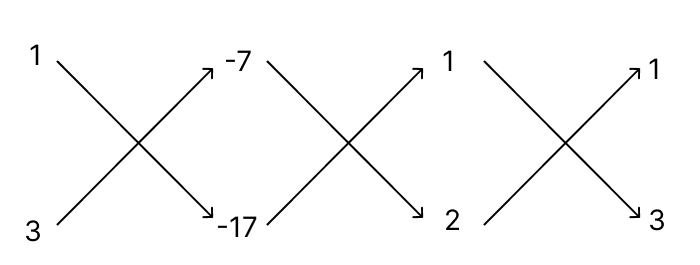
Applying cross-multiplication method for solving equations (1) and (2), we get :

Solve the following system of equations by using the method of cross multiplication: R.S. Aggarwal Mathematics Solutions ICSE Class 9.

a(1)×(17)(3)×(7)=b(7)×(2)(17)×(1)=1(1)×(3)(2)×(1)a(17)+21=b14+17=132a4=b3=11a4=1 and b3=11a=41 and b=31a=4 and b=3.\Rightarrow \dfrac{a}{(1) \times (-17) - (3) \times (-7)} = \dfrac{b}{(-7) \times (2) - (-17) \times (1)} = \dfrac{1}{(1) \times (3) - (2) \times (1)} \\[1em] \Rightarrow \dfrac{a}{(-17) + 21} = \dfrac{b}{-14 + 17} = \dfrac{1}{3 - 2} \\[1em] \Rightarrow \dfrac{a}{4} = \dfrac{b}{3} = \dfrac{1}{1} \\[1em] \Rightarrow \dfrac{a}{4} = 1 \text{ and } \dfrac{b}{3} = \dfrac{1}{1} \\[1em] \Rightarrow a = \dfrac{4}{1} \text{ and } b = \dfrac{3}{1} \\[1em] \Rightarrow a = 4 \text{ and } b = 3.

Now we have a = 4 and b = 3,

1x=a1x=4x=141y=b1y=3y=13.\Rightarrow \dfrac{1}{x} = a \\[1em] \Rightarrow \dfrac{1}{x} = 4 \\[1em] \Rightarrow x = \dfrac{1}{4} \\[1em] \Rightarrow \dfrac{1}{y} = b \\[1em] \Rightarrow \dfrac{1}{y} = 3 \\[1em] \Rightarrow y = \dfrac{1}{3}.

Hence, x=14x = \dfrac{1}{4} and y=13y = \dfrac{1}{3}.

Question 13

Solve the following system of equations by using the method of cross multiplication:

10x+y+2xy=4,15x+y5xy+2=0\dfrac{10}{x + y} + \dfrac{2}{x - y} = 4, \dfrac{15}{x + y} - \dfrac{5}{x - y} + 2 = 0, where x ≠ -y and x ≠ y

Answer

Substituting 1x+y=a,1xy=b\dfrac{1}{x + y}= a, \dfrac{1}{x - y} = b in 10x+y+2xy=4\dfrac{10}{x + y} + \dfrac{2}{x - y} = 4, we get:

⇒ 10a + 2b = 4

⇒ 10a + 2b - 4 = 0     .....(1)

Substituting 1x+y=a,1xy=b\dfrac{1}{x + y}= a, \dfrac{1}{x - y} = b in 15x+y5xy+2=0\dfrac{15}{x + y} - \dfrac{5}{x - y} + 2 = 0, we get:

⇒ 15a - 5b + 2 = 0     ....(2)

Applying cross-multiplication method for solving equations (1) and (2), we get :

Solve the following system of equations by using the method of cross multiplication: R.S. Aggarwal Mathematics Solutions ICSE Class 9.

a(2)×(2)(5)×(4)=b(4)×(15)(2)×(10)=1(10)×(5)(15)×(2)a(4)20=b6020=15030a16=b80=180a16=180 and b80=180a=1680 and b=8080a=15 and b=1.\Rightarrow \dfrac{a}{(2) \times (2) - (-5) \times (-4)} = \dfrac{b}{(-4) \times (15) - (2) \times (10)} = \dfrac{1}{(10) \times (-5) - (15) \times (2)} \\[1em] \Rightarrow \dfrac{a}{(4) - 20} = \dfrac{b}{-60 - 20} = \dfrac{1}{-50 - 30} \\[1em] \Rightarrow \dfrac{a}{-16} = \dfrac{b}{-80} = \dfrac{1}{-80} \\[1em] \Rightarrow \dfrac{a}{-16} = \dfrac{1}{-80} \text{ and } \dfrac{b}{-80} = \dfrac{1}{-80} \\[1em] \Rightarrow a = \dfrac{-16}{-80} \text{ and } b = \dfrac{-80}{-80} \\[1em] \Rightarrow a = \dfrac{1}{5} \text{ and } b = 1.

Now we have a = 15\dfrac{1}{5} and b = 1,

1x+y=a1x+y=15x+y=5 ..........(3)1xy=b1xy=1xy=1 ........(4)\Rightarrow \dfrac{1}{x + y} = a \\[1em] \Rightarrow \dfrac{1}{x + y} = \dfrac{1}{5} \\[1em] \Rightarrow x + y = 5 \text{ ..........(3)} \\[1em] \Rightarrow \dfrac{1}{x - y} = b \\[1em] \Rightarrow \dfrac{1}{x - y} = 1 \\[1em] \Rightarrow x - y = 1 \text{ ........(4)}

On adding equations (3) and (4) we get,

⇒ (x + y) + (x - y) = 5 + 1

⇒ 2x = 6

⇒ x = 62=3\dfrac{6}{2} = 3.

Substituting value of x in equation (4) we get,

⇒ x - y = 1

⇒ 3 - y = 1

⇒ y = 3 - 1 = 2.

Hence, x = 3, y = 2.

Question 14

Solve the following system of equations by using the method of cross multiplication:

5x+12y1=12,10x+1+2y1=52\dfrac{5}{x + 1} - \dfrac{2}{y - 1} = \dfrac{1}{2},\dfrac{10}{x + 1} + \dfrac{2}{y - 1} = \dfrac{5}{2}, where x ≠ -1 and x ≠ 1.

Answer

5x+12y1=12,10x+1+2y1=52\dfrac{5}{x + 1} - \dfrac{2}{y - 1} = \dfrac{1}{2},\dfrac{10}{x + 1} + \dfrac{2}{y - 1} = \dfrac{5}{2}

Substituting 1x+1=u,1y1=v\dfrac{1}{x + 1}= u, \dfrac{1}{y - 1} = v in 5x+12y1=12\dfrac{5}{x + 1} - \dfrac{2}{y - 1} = \dfrac{1}{2}, we get:

⇒ 5u - 2v = 12\dfrac{1}{2}

⇒ 5u - 2v - 12\dfrac{1}{2} = 0     ....(1)

Substituting 1x+1=u,1y1=v\dfrac{1}{x + 1}= u, \dfrac{1}{y - 1} = v in 10x+1+2y1=52\dfrac{10}{x + 1} + \dfrac{2}{y - 1} = \dfrac{5}{2}, we get:

⇒ 10u + 2v = 52\dfrac{5}{2}

⇒ 10u + 2v - 52\dfrac{5}{2} = 0     ....(2)

Multiply equation (1) and (2) by 2, we get,

2(5u2v12)2\Big(5u - 2v - \dfrac{1}{2}\Big)= 0

⇒ 10u - 4v - 1 = 0     .......(3)

2(10u+2v52)2\Big(10u + 2v - \dfrac{5}{2}\Big) = 0

⇒ 20u + 4v - 5 = 0     .........(4)

Applying cross-multiplication method for solving equations (3) and (4), we get :

Solve the following system of equations by using the method of cross multiplication: R.S. Aggarwal Mathematics Solutions ICSE Class 9.

u(4)×(5)(4)×(1)=v(1)×(20)(5)×(10)=1(10)×(4)(20)×(4)u(20)+4=v20+50=140+80u24=v30=1120u24=1120 and v30=1120u=24120 and v=30120u=15 and v=14.\Rightarrow \dfrac{u}{(-4) \times (-5) - (4) \times (-1)} = \dfrac{v}{(-1) \times (20) - (-5) \times (10)} = \dfrac{1}{(10) \times (4) - (20) \times (-4)} \\[1em] \Rightarrow \dfrac{u}{(20) + 4} = \dfrac{v}{-20 + 50} = \dfrac{1}{40 + 80} \\[1em] \Rightarrow \dfrac{u}{24} = \dfrac{v}{30} = \dfrac{1}{120} \\[1em] \Rightarrow \dfrac{u}{24} = \dfrac{1}{120} \text{ and } \dfrac{v}{30} = \dfrac{1}{120} \\[1em] \Rightarrow u = \dfrac{24}{120} \text{ and } v = \dfrac{30}{120} \\[1em] \Rightarrow u = \dfrac{1}{5} \text{ and } v = \dfrac{1}{4}.

Now we have u = 15 and v=14\dfrac{1}{5} \text{ and } v = \dfrac{1}{4},

1x+1=u1x+1=15x+1=5x=51=41y1=v1y1=14y1=4y=4+1=5.\Rightarrow \dfrac{1}{x + 1} = u \\[1em] \Rightarrow \dfrac{1}{x + 1} = \dfrac{1}{5} \\[1em] \Rightarrow x + 1 = 5 \\[1em] \Rightarrow x = 5 - 1 = 4 \\[1em] \Rightarrow \dfrac{1}{y - 1} = v \\[1em] \Rightarrow \dfrac{1}{y - 1} = \dfrac{1}{4} \\[1em] \Rightarrow y - 1 = 4 \\[1em] \Rightarrow y = 4 + 1 = 5.

Hence, x = 4, y = 5.

PrevNext