KnowledgeBoat Logo
|
OPEN IN APP

Chapter 21

Co-ordinate Geometry — Case-Study Based Questions

Class - 9 RS Aggarwal Mathematics Solutions


Case Study Based Questions

Question 1

Case Study:

One day during the rehearsal for Republic Day programmes, the teacher arranged five students Dinesh, Mamta, Kavita, Rishabh and Seema on the ground using the concept of coordinate geometry. On the graph, the position of a student is represented by the first letter of his/her name, e.g., D for Dinesh, M for Mamta and so on.

Based on the above information answer the following questions:
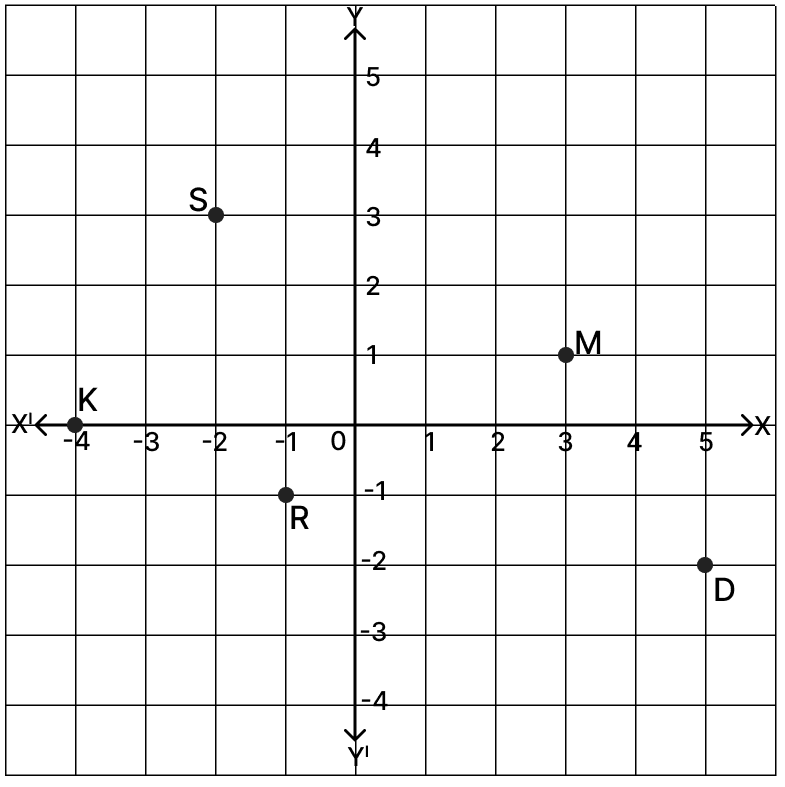
One day during the rehearsal for Republic Day programmes, the teacher arranged five students Dinesh, Mamta, Kavita, Rishabh and Seema on the ground using the concept of coordinate geometry. On the graph, the position of a student is represented by the first letter of his/her name, e.g., D for Dinesh, M for Mamta and so on. Co-ordinate Geometry, R.S. Aggarwal Mathematics Solutions ICSE Class 9.
  1. The coordinates of S are :
    (a) (-2, 3)
    (b) (2, -3)
    (c) (3, -2)
    (d) (-2, -3)

  2. The abscissa of the point M is :
    (a) 2
    (b) 3
    (c) -2
    (d) -3

  3. The perpendicular distance of the position of Dinesh from x-axis is :
    (a) 1 unit
    (b) 5 units
    (c) 2 units
    (d) 3 units

  4. The sum of the abscissa and ordinate of the position of Rishabh is :
    (a) 0
    (b) 1
    (c) 2
    (d) -2

  5. The student who is nearest to the x-axis :
    (a) Mamta
    (b) Kavita
    (c) Rishabh
    (d) Dinesh

Answer

1. From graph,

The coordinates of S are (-2, 3).

Hence, option (a) is the correct option.

2. As abscissa is the x-coordinate of a point.

M = (3, 1).

So, the abscissa of the point M is 3.

Hence, option (b) is the correct option.

3. As Dinesh is represented by D.

Coordinates of D = (5, -2)

The perpendicular distance from the x-axis is the absolute value of the y-coordinate = 2 units.

Hence, option (c) is the correct option.

4. Rishabh is represented by R.

The coordinates of R = (-1, -1)

Sum = Abscissa + ordinate = -1 + (-1) = -2.

Hence, option (d) is the correct option.

5. Kavita's position is on the x-axis and coordinates are (-4, 0).

Therefore, Kavita is nearest to the x-axis.

Hence, option (b) is the correct option.

Question 2

Case Study:

Saumya studies in class IX. One day, she drew the sketch of table tennis racket on a graph paper, as shown alongside. Observe these sketches and answer the questions given below :

Based on the above information answer the following questions:
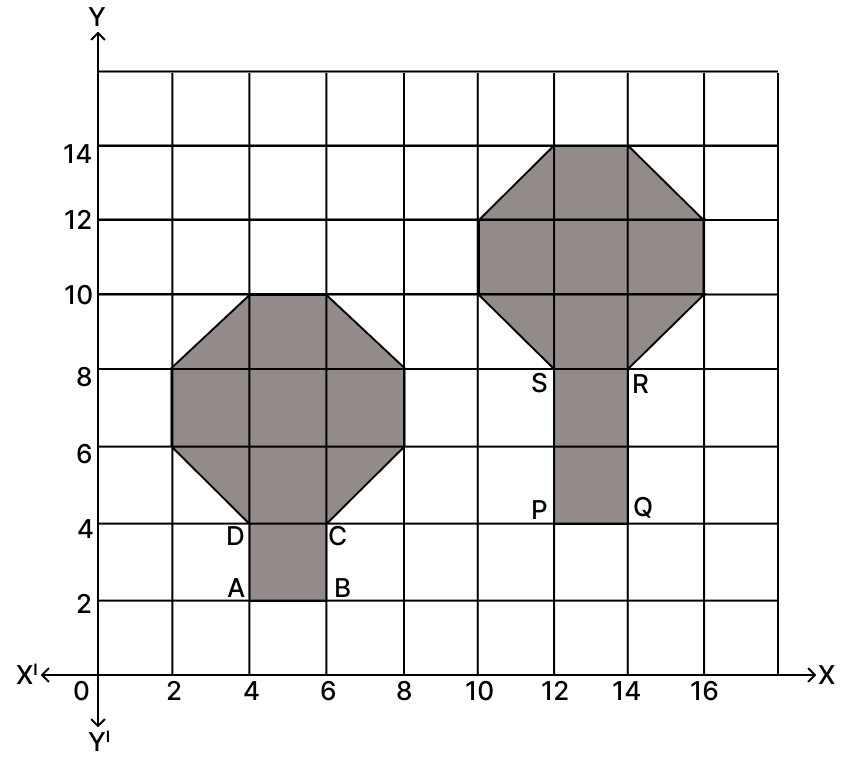
Saumya studies in class IX. One day, she drew the sketch of table tennis racket on a graph paper, as shown alongside. Observe these sketches and answer the questions given below. Co-ordinate Geometry, R.S. Aggarwal Mathematics Solutions ICSE Class 9.
  1. The distance of the point S from y-axis is :
    (a) 10 units
    (b) 8 units
    (c) 6 units
    (d) 12 units

  2. The distance between the points D and R is :
    (a) 116 units
    (b) 116\sqrt{116} units
    (c) 2302\sqrt{30} units
    (d) 29229\sqrt{2} units

  3. The length of diagonal SQ is :
    (a) 525\sqrt{2} units
    (b) 232\sqrt{3} units
    (c) 252\sqrt{5} units
    (d) 272\sqrt{7} units

  4. ABCD is a :
    (a) square
    (b) rectangle
    (c) rhombus
    (d) kite

  5. PQRS is a :
    (a) square
    (b) rectangle
    (c) rhombus
    (d) kite

Answer

1. The distance of a point from the y-axis is given by the absolute value of its x-coordinate.

Coordinates of S = (12, 8)

⇒ Distance of the point S from y-axis is 12 units.

Hence, option (d) is the correct option.

2. Coordinates of D = (4, 4)

Coordinates of R = (14, 8)

We will find distance between the points D and R by using distance formula,

Distance between two points = (x2x1)2+(y2y1)2\sqrt{(x_2 - x_1)^2 + (y_2 - y_1)^2}

Substituting values we get :

DR=(144)2+(84)2=(10)2+(4)2=100+16=116 unitsDR = \sqrt{(14 - 4)^2 + (8 - 4)^2}\\[1em] = \sqrt{(10)^2 + (4)^2}\\[1em] = \sqrt{100 + 16} \\[1em] = \sqrt{116} \text{ units}

DR = 116\sqrt{116} units

Hence, option (b) is the correct option.

3. Coordinates of S = (12, 8)

Coordinates of Q = (14, 4)

We will find the length of diagonal SQ by using distance formula,

Distance between two points = (x2x1)2+(y2y1)2\sqrt{(x_2 - x_1)^2 + (y_2 - y_1)^2}

Substituting values we get :

SQ=(1412)2+(48)2=(2)2+(4)2=4+16=20=25SQ = \sqrt{(14 - 12)^2 + (4 - 8)^2}\\[1em] = \sqrt{(2)^2 + (-4)^2}\\[1em] = \sqrt{4 + 16}\\[1em] = \sqrt{20}\\[1em] = 2\sqrt{5}

SQ = 252\sqrt{5} units

Hence, option (c) is the correct option.

4. As,

Coordinates of A = (4, 2)

Coordinates of B = (6, 2)

Coordinates of C = (6, 4)

Coordinates of D = (4, 4)

We will find out the length of all sides of ABCD by using distance formula,

AB=(64)2+(22)2=(2)2+(0)2=4+0=4=2BC=(66)2+(42)2=(0)2+(2)2=4=2CD=(46)2+(44)2=(2)2+(0)2=4+0=4=2AD=(44)2+(42)2=(0)2+(2)2=0+4=4=2\Rightarrow AB = \sqrt{(6 -4)^2 + (2 - 2)^2}\\[1em] = \sqrt{(2)^2 + (0)^2}\\[1em] = \sqrt{4 + 0} = \sqrt{4} \\[1em] = 2 \\[1em] \Rightarrow BC = \sqrt{(6 -6)^2 + (4 -2)^2}\\[1em] = \sqrt{(0)^2 + (2)^2}\\[1em] = \sqrt{4} \\[1em] = 2\\[1em] \Rightarrow CD = \sqrt{(4 - 6)^2 + (4 - 4)^2}\\[1em] = \sqrt{(-2)^2 + (0)^2}\\[1em] = \sqrt{4 + 0} = \sqrt{4} \\[1em] = 2\\[1em] \Rightarrow AD = \sqrt{(4 - 4)^2 + (4 - 2)^2}\\[1em] = \sqrt{(0)^2 + (2)^2}\\[1em] = \sqrt{0 + 4} = \sqrt{4} \\[1em] = 2

⇒ AB = BC = CD = AD

Now we will check for Diagonals,

AC=(64)2+(42)2=(2)2+(2)2=4+4=8=22BD=(46)2+(42)2=(2)2+(2)2=4+4=8=22\Rightarrow AC = \sqrt{(6 -4)^2 + (4 - 2)^2}\\[1em] = \sqrt{(2)^2 + (2)^2}\\[1em] = \sqrt{4 + 4} = \sqrt{8} \\[1em] = 2\sqrt{2}\\[1em] \Rightarrow BD = \sqrt{(4 - 6)^2 + (4 - 2)^2}\\[1em] = \sqrt{(-2)^2 + (2)^2}\\[1em] = \sqrt{4 + 4} = \sqrt{8} \\[1em] = 2\sqrt{2}\\[1em]

⇒ Diagonal AC and BD are also equal.

⇒ ABCD is a square.

Hence, option (a) is the correct option.

5. As,

Coordinates of P = (12, 4)

Coordinates of Q = (14, 4)

Coordinates of R = (14, 8)

Coordinates of S = (12, 8)

We will find out the length of all sides of PQRS by using distance formula,

PQ=(1412)2+(44)2=(2)2+(0)2=4+0=4=2QR=(1414)2+(84)2=(0)2+(4)2=16=4RS=(1214)2+(88)2=(2)2+(0)2=4+0=4=2SP=(1212)2+(84)2=(0)2+(4)2=0+16=16=4\Rightarrow PQ = \sqrt{(14 - 12)^2 + (4 - 4)^2}\\[1em] = \sqrt{(2)^2 + (0)^2}\\[1em] = \sqrt{4 + 0} = \sqrt{4} \\[1em] = 2 \\[1em] \Rightarrow QR = \sqrt{(14 - 14)^2 + (8 - 4)^2}\\[1em] = \sqrt{(0)^2 + (4)^2}\\[1em] = \sqrt{16} \\[1em] = 4\\[1em] \Rightarrow RS = \sqrt{(12 - 14)^2 + (8 - 8)^2}\\[1em] = \sqrt{(-2)^2 + (0)^2}\\[1em] = \sqrt{4 + 0} = \sqrt{4} \\[1em] = 2\\[1em] \Rightarrow SP = \sqrt{(12 - 12)^2 + (8 - 4)^2}\\[1em] = \sqrt{(0)^2 + (4)^2}\\[1em] = \sqrt{0 + 16} = \sqrt{16} \\[1em] = 4

⇒ PQ = RS and QR = SP

⇒ Opposite sides are equal.

Now we will check for Diagonals,

PR=(1412)2+(84)2=(2)2+(4)2=4+16=20=25SQ=(1412)2+(48)2=(2)2+(4)2=4+16=20=25\Rightarrow PR = \sqrt{(14 - 12)^2 + (8 - 4)^2}\\[1em] = \sqrt{(2)^2 + (4)^2}\\[1em] = \sqrt{4 + 16}\\[1em] = \sqrt{20} \\[1em] = 2\sqrt{5}\\[1em] \Rightarrow SQ = \sqrt{(14 - 12)^2 + (4 - 8)^2}\\[1em] = \sqrt{(2)^2 + (-4)^2}\\[1em] = \sqrt{4 + 16}\\[1em] = \sqrt{20} \\[1em] = 2\sqrt{5}\\[1em]

⇒ Diagonal PR and SQ are also equal.

⇒ PQRS is a rectangle.

Hence, option (b) is the correct option.

PrevNext