
Any change in the natural quality of the environment brought about chemical, physical or biological factors:
- Pollution
- Dust
- Humidity
- Pollutants
Answer
Pollution
Reason — Pollution is any undesirable change in the natural quality of the environment caused by chemical, physical, or biological agents. Such changes adversely affect living organisms and the environment.
The products which are released into the biosphere in large quantities and which affect the normal functioning of ecosystems:
- Pollution
- Dust
- Humidity
- Pollutants
Answer
Pollutants
Reason — Pollutants are substances released into the biosphere in large quantities that disrupt the normal functioning of ecosystems and adversely affect plants, animals, and humans. They contaminate the air, water, or soil when present in harmful concentrations.
Unfavourable alteration of our surroundings, wholly or largely as a by-product of man's actions:
- Pollution
- Environmental Pollution
- Humidity
- Pollutants
Answer
Environmental Pollution
Reason — Environmental pollution refers to any unfavourable alteration of our surroundings, wholly or largely as a by-product of man's actions. These changes may affect man and other organisms.
The alteration in characteristics of water, making it unsuitable for designated use in its natural state:
- Air Pollution
- Water Pollution
- Soil Pollution
- Radioactive Pollution
Answer
Water Pollution
Reason — Water pollution is the alteration of the physical, chemical, or biological characteristics of water, making it unsuitable for its intended use in its natural state. Polluted water often has reduced dissolved oxygen, making it harmful to aquatic life and unsuitable for human use.
The pollutants which are formed from the chemical reaction of primary pollutants in the environment:
- Biodegradable pollutants
- Secondary pollutants
- Quantitative pollutants
- Non-Biodegradable pollutants
Answer
Secondary pollutants
Reason — Secondary pollutants are pollutants that are formed in the environment by the chemical reactions of primary pollutants. For example, nitrogen oxides and hydrocarbons emitted from automobile react in the presence of sunlight to form ozone and peroxyacetyl nitrate (PAN), which are more harmful than the primary pollutants from which they are formed.
The excessive concentration of foreign matter in the air which adversely affects the well-being of human beings, animals, plants and their environment:
- Air Pollution
- Pollution
- Soil Pollution
- Radioactive Pollution
Answer
Air Pollution
Reason — Air pollution is defined as the excessive concentration of foreign matter in the air which adversely affects the well-being of human beings, animals, plants and their environment. Its two elements are the concentration of foreign matter in the air and the adverse effect of this matter on living and non-living things.
The pollutants which are not degraded by microbes or degrade at a very slow rate:
- Biodegradable pollutants
- Primary pollutants
- Quantitative pollutants
- Non-Biodegradable pollutants
Answer
Non-Biodegradable pollutants
Reason — On the basis of degradation, the pollutants which are not degraded by microbes or degrade at a very slow rate are known as non-biodegradable pollutants, e.g., glass, plastics, radioactive substances, pesticides, etc.
Unwanted sound that is an irritant and source of stress:
- Air pollution
- Radioactive pollution
- Noise pollution
- Soil pollution
Answer
Noise pollution
Reason — Noise pollution is unwanted or unpleasant sound that acts as an irritant and a source of stress. While moderate sound may be pleasant, excessive or loud sound is considered noise and can adversely affect human health and well-being.
Which of the following is an example of soil pollution?
- Disposal of solid waste in the open
- Dumping sewage in the open
- Overuse of fertilizers
- All of the above.
Answer
All of the above
Reason — Soil pollution is the deterioration of the physical, chemical, and biological properties of soil due to human activities. Open disposal of solid waste, dumping of sewage, and excessive use of fertilizers all contaminate the soil, reducing its quality and productivity.
Nuclear fuels produce pollution by
- heat
- end products
- wastes in coolants
- All of the above.
Answer
All of the above
Reason — Nuclear fuels produce radioactive pollution through heat (thermal pollution), radioactive end products (fission products), and radioactive wastes present in coolants used in nuclear reactors.
Assertion (A): Eighty per cent of marine pollution comes from land.
Reason (R): Mining for materials such as copper and gold is a major source of contamination in the ocean.
- Both A and R are true and R is one of the reasons for A.
- Both A and R are true but R does not explain A.
- A is true but R is false.
- A is false but R is true.
Answer
Both A and R are true but R does not explain A.
Explanation — About 80% of marine pollution originates from land-based sources, such as untreated sewage, industrial effluents, agricultural run-off, plastics, and other solid wastes. Although mining activities (e.g., copper and gold mining) can contribute to ocean contamination, they account for only a small part of land-based pollution. Therefore, the Reason is true but is not the correct explanation of the Assertion.
Given below are pictures of pollutants, classify them on the basis of degradation.
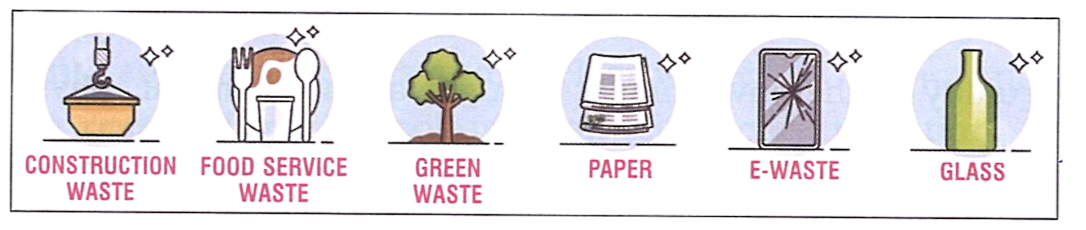
Answer
- Construction Waste — Non-Biodegradable pollutant
- Food Service Waste — Non-Biodegradable pollutant
- Green Waste — Biodegradable pollutant
- Paper — Biodegradable pollutant
- E-Waste — Non-Biodegradable pollutant
- Glass — Non-Biodegradable pollutant
What is environmental pollution? What is a pollutant?
Answer
Environmental pollution is any undesirable change in the natural environment, wholly or largely caused by human activities, that adversely affects human beings and other living organisms.
A pollutant is any substance released into the biosphere in harmful quantities that disrupts the normal functioning of ecosystems and has adverse effects on plants, animals, human beings, and the environment.
Give the difference between natural and man-made pollutants.
Answer
| Natural pollutants | Man-made pollutants |
|---|---|
| The natural pollutants are produced as a result of natural phenomena. | Man-made pollutants are produced as a result of human activities. |
| Example: Volcanic eruptions and wild fires. | Example: Industrial pollution and vehicular emissions. |
What is air pollution? Give a source of air pollution.
Answer
Air pollution is the excessive concentration of foreign matter in the air which adversely affects the well being of human beings, animals, plants and their environment.
Fumes released by automobile like cars, scooters etc are one of the causes of air pollution.
Define water pollution.
Answer
Water pollution can be defined as alteration in physical, chemical or biological characteristics of water, making it unsuitable for designated use in its natural state.
What is soil pollution? Why should we avoid soil pollution?
Answer
Soil pollution is the deterioration of the physical, chemical, and biological properties of soil due to human activities, resulting in a decline in its quality and productivity.
We should avoid soil pollution because:
- Pollutants enter the food chain through plants and become biomagnified at higher trophic levels, posing risks to humans and animals.
- Many pollutants remain in the soil for long periods, reducing soil fertility and harming microorganisms, plants, and other living organisms.
What is radioactive pollution?
Answer
Radioactive pollution is the increase in natural background radiation caused by human activities involving naturally occurring or artificially produced radioactive materials.
What is noise pollution?
Answer
Noise pollution is defined as an unwanted sound that is an irritant and a source of stress.
What are man-made causes of radioactive pollution? Why is radioactive pollution more harmful than other types of pollution?
Answer
There are mainly two man-made causes of radioactive pollution:
- Nuclear fuels used in atomic reactor — Nuclear reactors produce radioactive wastes such as:
- Fission products remaining in the nuclear fuel.
- Radioactive wastes in the reactor coolant.
- Nuclear Weapons — The development, testing, and use of nuclear weapons release radioactive materials into the environment. For example, the atomic bombings of Hiroshima and Nagasaki caused widespread destruction and long-lasting environmental and health effects.
Radioactive pollution is more harmful than other types of pollution because:
- Radioactive wastes remain active for hundreds or even thousands of years, contaminating the environment for a very long time.
- Exposure to radiation can cause severe health problems, including cancer, genetic mutations, birth defects, and even death.
- Leakages from nuclear reactors can contaminate air, water, and soil, affecting both present and future generations.
How is noise a source of pollution? Why do we need to look at the problem of noise pollution seriously?
Answer
Noise is a physical form of pollution which is not directly harmful to the life supporting systems. It is not fatal to human life, yet its effects cannot be overlooked because repeated exposure to noise reduces the sleeping hours, productivity or efficiency of a human being and it affects the peace of mind and invades the privacy of a human being.
Give a geographical reason for each of the following:
(i) Music is relaxing but playing it loud is a source of pollution.
(ii) Secondary pollutants are toxic.
(iii) Pesticides are qualitative pollutants.
Answer
(i) Music is pleasant and relaxing when played at a moderate volume. However, when played loudly, it becomes noise, which causes stress, disturbs sleep and concentration, reduces efficiency, and invades people's peace and privacy. Hence, loud music is a source of noise pollution.
(ii) Secondary pollutants are formed by the chemical reactions of primary pollutants in the atmosphere. They react in the presence of sunlight, water vapour, or other chemicals to produce substances such as ozone and peroxyacetyl nitrate (PAN), which are often more toxic than the primary pollutants.
(iii) Pesticides are qualitative pollutants because they are synthetic toxic chemicals introduced into the environment by human activities. They degrade environmental quality by adding harmful substances that are not naturally present in the environment.
List the main sources of pollution of ocean waters.
Answer
The main sources of pollution of ocean waters are — oil, plastic, industrial and agricultural waste, chemical particles and waste from mining for materials such as copper and gold.
Which type/types of pollution is/are more prominent in the city where you live? List the causes and possible remedies?
Answer
Air pollution is one of the most prominent types of pollution in my city. Causes:
- Vehicular emissions due to the large number of vehicles on the roads.
- Industrial emissions releasing pollutants such as particulate matter, sulphur dioxide, and nitrogen oxides.
- Construction activities, which generate large amounts of dust.
- Deforestation and loss of green cover due to urban expansion.
- Open burning of waste, which releases harmful smoke into the atmosphere.
Various measures that can be taken to check air pollution in the city are:
- Encourage the use of public transport, carpooling, and electric vehicles.
- Enforce strict emission standards for industries and vehicles.
- Control dust from construction sites by regular sprinkling of water and covering construction materials.
- Increase tree plantation and develop more green spaces.
- Ban the open burning of waste and promote proper waste management.
Environmental pollution is an incurable disease which can only be prevented. Justify this statement giving examples.
Answer
Environmental pollution is called an incurable disease because once the environment is polluted, it is very difficult, costly, and sometimes impossible to restore it completely. Therefore, prevention is more effective than cure.
This can be justified by the following examples:
- Air pollution — Once harmful gases and particulate matter are released into the atmosphere, they cannot be completely removed. Hence, controlling emissions from industries and vehicles is the best preventive measure.
- Water pollution — When rivers, lakes, or oceans are contaminated by sewage, industrial waste, or oil spills, restoring them to their original condition is difficult and expensive. Proper waste treatment and disposal are essential to prevent water pollution.
- Soil pollution — Excessive use of pesticides, fertilizers, and improper disposal of wastes contaminates the soil. Such pollutants may remain in the soil for many years, reducing its fertility and entering the food chain. Therefore, pollution should be prevented through responsible agricultural practices and proper waste management.
Thus, preventing pollution is far easier and more effective than trying to reverse its harmful effects after the environment has been contaminated.
Write down five harmful effects of using non-biodegradable products like plastic bags. Suggest measures that can help to replace plastic bags with eco-friendly products.
Answer
Harmful effects of using non-biodegradable products like plastic bags are:
- Environmental pollution — Plastic bags do not decompose easily and accumulate on land and in water bodies.
- Harm to animals and marine life — Animals may swallow plastic bags or become entangled in them, causing injury or death.
- Soil degradation — Plastic bags reduce soil fertility by preventing proper aeration and water infiltration.
- Health hazards — Plastics release harmful chemicals and microplastics that contaminate water and enter the food chain.
- Drainage blockage — Plastic bags clog drains and sewers, leading to waterlogging and flooding during heavy rains.
Some measures that can help to replace plastic bags with eco-friendly products are:
- Use reusable cloth, jute, or canvas bags instead of plastic bags.
- Promote the use of biodegradable and compostable bags.
- Enforce bans or restrictions on single-use plastic bags.
- Create public awareness about the harmful effects of plastic pollution.
- Improve waste management and recycling to reduce plastic waste.