
The molten material thrown up by volcanoes rises to the surface of the earth from the ............... .
- Magnum chamber
- Magma chamber
- Magnum
- Magma
Answer
Magma chamber
Reason — The magma chamber is an underground reservoir of molten rock beneath a volcano. During an eruption, magma rises from the magma chamber through vents and reaches the Earth's surface as lava.
Meteors are rocks from outer space. They hold special significance for scientists because
- they contain radioactive materials.
- the earth is made of same materials.
- they give an idea of other planets.
- they pass through the atmosphere of earth.
Answer
the earth is made of same materials.
Reason — The earth is said to be constituted of the same materials as the meteorites. Hence, scientists study the meteorites that fall on the earth's surface to know about the materials that make up the interior of the earth.
The earth is made up of several concentric layers. The correct order of the layers from the centre to the surface is
- Crust — Mantle — Core
- Core — Mantle — Crust
- Mantle — Crust — Core
- Mantle — Core — Crust.
Answer
Core — Mantle — Crust
Reason — The earth is made up of several concentric layers. The core lies at the centre, the mantle lies above the core and the crust forms the outermost layer.
Name the two broad divisions the earth's crust is divided, depending on chemical composition.
- Lithosphere, hydrosphere
- SIAL, SIMA
- Core, Mantle
- Crust, Asthenosphere
Answer
SIAL, SIMA
Reason — On the basis of chemical composition, the Lithosphere (crust) can be divided into two broad divisions — the SIAL and the SIMA. Sial is named after Silica (Si) and Aluminium (Al), while Sima is named after Silica (Si) and Magnesium (Mg).
Study the figure on the right and complete the analogy:
Continents : SIAL :: ............... : SIMA
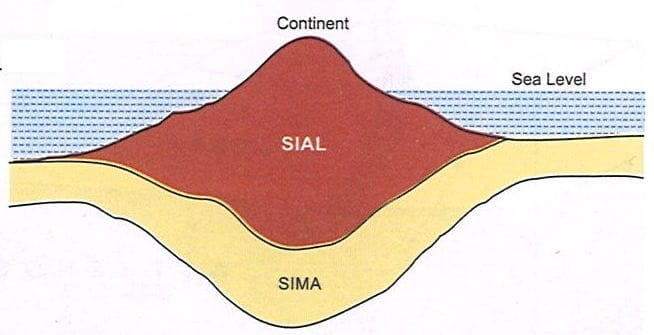
- Mountains tops
- Ocean floor
- Plains
- Volcanoes
Answer
Ocean floor
Reason — The SIAL layer forms the continents, while the SIMA layer makes up the ocean floor. Hence, just as Continents correspond to SIAL, the Ocean floor corresponds to SIMA.
This is the densest part of the earth believed to be composed of iron and nickel which is responsible for earth's magnetism. Identify it.
- Mantle
- Core
- Crust
- None of the above
Answer
Core
Reason — The core is the densest part of the earth. It is generally believed to be composed of iron and nickel, which is responsible for the earth's magnetism. Hence, the layer identified is the Core.
Assertion (A): Sial appears to float above Sima.
Reason (R): Sial has lower density than Sima.
- Both A and R are true and R is the correct explanation of A.
- Both A and R are true but R does not explain A.
- A is true but R is false.
- A is false but R is true.
Answer
Both A and R are true and R is the correct explanation of A.
Explanation — The name Sial is taken from Silica (Si) and Aluminium (Al). Sima is named after Silica (Si) and Magnesium (Mg). Sial appears to float above Sima because it has lower density.
Which of the following is the correct order as we move towards the interior of the earth.
- SIAL - SIMA - NIFE
- NIFE - SIMA - SIAL
- NIFE - SIAL - SIMA
- None of the above.
Answer
SIAL - SIMA - NIFE
Reason — As we move towards the interior of the earth, we first reach the Sial (outer crust), then the Sima below it, and finally the Nife which forms the core at the centre.
Which of the following is incorrect about the inner core?
- It is in a molten state.
- It is a region of high density.
- It is a region of high pressure.
- It is composed of iron and nickel.
Answer
It is in a molten state.
Reason — The inner core is in a solid state due to high density and pressure which have compressed the molten rock material. It is the outer core that is in a molten state. Hence, the statement that the inner core is in a molten state is incorrect.
At the depth of around 100-410 km, mantle is partially molten and is known as:
- Asthenosphere
- Mantlenosphere
- Moltenosphere
- None of the above
Answer
Asthenosphere
Reason — At the depth of around 100-410 km, the mantle is partially molten and is known as the asthenosphere.
What is the temperature variation in the mantle in °C?
- 1500 to 3700
- 1500 to 2500
- 1000 to 3700
- 1000 to 4000
Answer
1000 to 3700
Reason — In the mantle, the temperature varies between about 1000°C to around 3700°C.
Name the mantle-core interface where primary seismic waves slow down and secondary seismic waves disappear completely.
- Gutenberg Discontinuity
- Mantlic Discontinuity
- Core Discontinuity
- Mohorovicic Discontinuity
Answer
Gutenberg Discontinuity
Reason — The boundary between the mantle and the core, i.e. the mantle-core interface, is known as the Gutenberg Discontinuity. Here, primary seismic waves (P waves) decrease in velocity while secondary seismic waves (S waves) disappear completely.
Name the boundary between the crust and the mantle which has characteristics of both layers.
- Gutenberg Discontinuity
- Crust Discontinuity
- Mantlic Discontinuity
- Mohorovicic Discontinuity
Answer
Mohorovicic Discontinuity
Reason — The discontinuity between the crust and the mantle is known as the Mohorovicic Discontinuity. It forms the boundary between the crust and the mantle and has the characteristics of both these layers.
Assertion (A): The thickness of the lithosphere is very fragile compared to the nature and composition of the earth.
Reason (R): There are continuous changes in the earth's crust due to forces of nature.
- Both A and R are true and R is the correct explanation of A.
- Both A and R are true but R does not explain A.
- A is true but R is false.
- A is false but R is true.
Answer
Both A and R are true and R is the correct explanation of A.
Explanation — The lithosphere, though solid, is thin and constantly affected by natural forces like earthquakes and volcanic activity, leading to its fragile state.
What life sustaining unit contains only one per cent of the earth's mass?
- biosphere
- lithosphere
- crust
- mantle
Answer
crust/lithosphere
Reason — The crust is also called Lithosphere. Crust is only 1% of Earth's mass and contains all known life in the universe.
Mohorovicic discontinuity is found at about ............... beneath the oceans and ............... beneath the continents.
- 8 km, 32 km
- 36 km, 10 km
- 60 km, 6 km
- 40 km, 4 km
Answer
8 km, 32 km
Reason — The Mohorovicic Discontinuity does not exist at a uniform depth. It is found at about 8 km beneath the oceans and about 32 km beneath the continents.
Extending upwards, the earth is enveloped by a blanket of gases. Name it.
- Lithosphere
- Hydrosphere
- Atmosphere
- Chamber
Answer
Atmosphere
Reason — Extending upwards, the earth is enveloped by a blanket of gases which make up the atmosphere.
The diameter of the core is about ............... km.
- 5000
- 6000
- 7000
- 8000
Answer
7000
Reason — The entire core is about 7000 km in diameter.
Name the layer of the earth that is fragile as compared to the rest of the layers of the earth. Different theories suggest that this layer undergoes changes to give earth a new shape.
- Mantle
- Core
- Crust
- Asthenosphere
Answer
Crust
Reason — The Earth's crust is the most fragile layer. According to the Continental Drift and Plate Tectonic theories, plate movements continuously reshape the Earth's surface over millions of years.
In which part of the earth is NIFE found? What is it composed of?
Answer
The core of the earth is called NIFE. It is composed of Nickel (Ni) and Iron (Fe).
What are the consequences of the pressure and temperature in the interior of the earth?
Answer
The temperature in the core ranges from 4400°C to about 6000°C. Pressure and density increases towards the interior of the earth. The inner core is in solid state due to high pressure and density which compresses the molten rock material.
How do the meteorites help scientists to know about the interior of the earth?
Answer
The earth is said to be constituted of the same materials as the meteorites. So, scientists study meteorites to know more about the interior of the earth.
What is the composition of the earth's crust?
Answer
The crust of the earth is a sphere of solid rocks. It is only 1% of earth's mass. It is made up of rocks with large content of silicates, feldspar, mica etc.
The crust is divided into two broad divisions- SIAL and SIMA. SIAL is composed of Silica and Aluminium while SIMA is composed of Silica and Magnesium.
What is the Lithosphere?
Answer
The crust of the earth is called lithosphere as it is a sphere of solid rocks with a thickness of 60 km below high mountains and just 5-10 km below the oceans.
Name the three layers of the earth's interior. Name their boundaries.
Answer
The three layers of the earth's interior are Core, Mantle and Crust.
The boundaries between the three layers of the earth's interior are:
- Gutenberg Discontinuity — It lies between the mantle and the core.
- Mohorovicic Discontinuity — It lies between the crust and the mantle.
Describe the mantle. State its two chief characteristics.
Answer
Mantle lies below the crust. It makes up 84% of the earth's total volume. Mantle is divided into two parts — the upper mantle and the lower mantle.
Two chief characteristics of mantle are-
- Its average thickness is 2900 km.
- The temperature varies between about 1000°C to around 3700°C.
Where is asthenosphere found? In which form does it exist?
Answer
Asthenosphere is found at the depth of around 100-410 km. It exists in partially molten form.
What happens to the P and S waves at the Gutenberg Discontinuity?
Answer
At the Gutenberg Discontinuity, there is an abrupt change in the seismic waves (generated by earthquakes or explosions) that travel through the earth. Primary seismic waves (P waves) decrease in velocity while secondary seismic waves (S waves) disappear completely.
Why is the earth's interior in most part found in a solid state despite great heat and pressure?
Answer
The solid state of the inner core is due to high density and pressure which have compressed molten rock material.
Crust and Core
Answer
| Crust | Core |
|---|---|
| The crust is the outermost layer of the earth. | The core is the innermost layer of the earth. |
| Crust is about 60 km thick below high mountains and just 5-10 km below the oceans. | Core is about 7000 km in diameter. |
| Crust has relatively low temperatures. | Core has very high temperature ranging from 4400°C to about 6000°C. |
| Crust is inhabited by living organisms. | Core is uninhabitable. |
Sial and Sima
Answer
| Sial | Sima |
|---|---|
| Sial floats on top of Sima. | Sima lies under Sial. |
| Sial has less density. | Sima has more density. |
| Sial is composed of Silica and Aluminium. | Sima is composed of Silica and Magnesium. |
| Sial forms the continents. | Sima makes up the ocean floor. |
Gutenberg Discontinuity and Mohorovicic Discontinuity.
Answer
| Gutenberg Discontinuity | Mohorovicic Discontinuity |
|---|---|
| Gutenberg Discontinuity is the boundary between mantle and core. | Mohorovicic Discontinuity is the boundary between crust and mantle. |
| It begins at a depth of 2800 km. | It is found at about 8 km beneath the oceans and about 32 km beneath the continents. |
Describe the layers of the interior of the earth and their chemical composition.
Answer
The layers of the interior of the earth are as follows:
1. Crust — It is the topmost layer of the earth. It is made up of rock with large content of silicates, feldspar, mica etc. It also contains silica and aluminium.
2. Mantle — It lies between the crust and core. It can be divided into upper and lower mantle. The upper mantle is solid while the lower mantle is partially molten. It is mainly composed of oxygen, silicon and magnesium.
3. Core — Core is the innermost inaccessible part of the earth. It is mainly composed of Nickel and Iron.
There are two transitional zones between the two consecutive layers of the interior of the earth. Name them and state their chief characteristics.
Answer
The transitional zone between crust and mantle is Moho Discontinuity which is the dividing zone between solid and semi-solid state of rocks due to the increasing temperature as the depth increases. It is found at about 8 km beneath the oceans and about 32 km beneath the continents.
The boundary between mantle and core is known as Gutenberg Discontinuity. it begins at the depth of 2800 km. Below this zone, both density and temperature goes on increasing.
Give a geographical reason for each of the following:
(i) Temperature starts rising gradually towards the interior of the earth.
(ii) The asthenosphere is in a semi-molten state.
(iii) The inner core of the earth is in a solid state.
Answer
(i) Due to enhancing density and pressure the temperature goes on increasing gradually towards inside of the interior of the earth.
(ii) The asthenosphere is in a semi-molten state because of high temperature, pressure and density.
(iii) The inner core of the earth is in a solid state due to high density and pressure.
Look at the figure on the side and answer the questions:
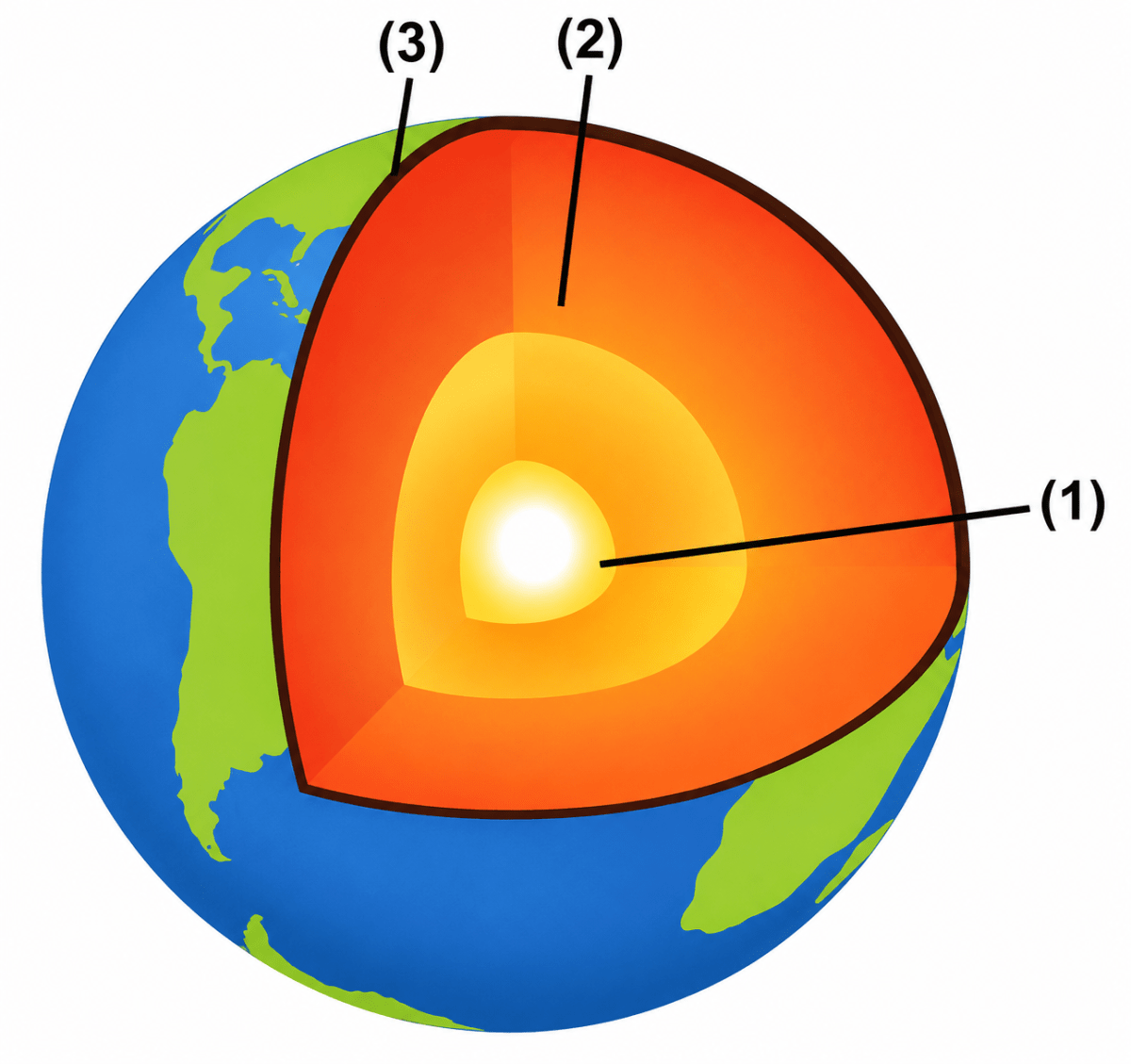
(i) Label the parts: (1), (2) and (3).
(ii) Name the state (solid, liquid or gas) in which each part exists.
(iii) Which part of the earth is suitable for human habitation? Why?
Answer
(i) The parts are:
(1) Core
(2) Mantle
(3) Crust
(ii) The states are:
(1) Core - The outer core is in liquid (molten) state and the inner core is in solid state.
(2) Mantle - Semi-molten and solid state
(3) Crust - Solid state
(iii) Crust is suitable for human habitation due to favourable conditions for survival, i.e. atmosphere for air, lithosphere for settlement due to ideal temperature, hydrosphere for hydrological cycle for providing rainfall and fresh water bodies on the earth and oceans for navigation and trade routes etc.
State two chief characteristics of the earth's crust.
Answer
Two chief characteristics of the earth's crust are-
- It is a sphere of solid rocks with a thickness of 60 km below high mountains and just 5-10 km below the oceans.
- It is made up of rocks with large content of silicates, feldspar, mica etc.
Which layer is responsible for earth's magnetic field? Why?
Answer
The core of the earth is responsible for earth's magnetic field as it is composed of iron and nickel.
Give a geographical reason for each of the following:
(i) NIFE is so called.
(ii) The core of the earth is the most inaccessible part of the earth.
(iii) The earth's crust undergoes many changes.
Answer
(i) Nife is so called as Ni stands for Nickel and Fe stands for Iron.
(ii) The core of the earth is the most inaccessible part of the earth because it lies thousands of kilometers deep inside the earth.
(iii) The earth's crust undergoes many changes due to the forces of nature.
Draw a well labelled diagram to show the interior of the earth.
Answer

The earth's crust is only one percent of earth's mass yet it is a large reservoir of resources for mankind. Justify this statement with examples.
Answer
Despite being only one percent of the Earth's mass, the Earth's crust contains a wealth of resources that are essential to human civilization, including:
- Mineral resources such as iron, copper, gold, and silver which are used in a variety of applications ranging from electronics to construction.
- Fossil fuels like coal, oil, and natural gas which are used to generate electricity, heat homes, and fuel transportation.
- Freshwater resources that are essential for human survival.
- Geothermal energy which is used to generate electricity and heat buildings.
What would happen if the earth's core no longer remain hot and the magma cools and hardens inside the earth? Give reasons to support your answer.
Answer
If the Earth's core were to cool down and the magma inside the Earth were to cool and harden, it would have serious consequences.
- The Earth's magnetic field, generated by the molten iron in the outer core, would weaken or disappear, leaving the surface exposed to harmful cosmic radiation.
- Tectonic activity would halt, which could cause earthquakes and volcanic eruptions to cease. This will impact nutrient recycling. Over time, this could also lead to the formation of a supercontinent, as there would be no mechanism to break apart the continents.
- Geothermal energy availability would be affected.
- The Earth's rotation would slow down, leading to longer days and shorter nights. This would have significant effects on the climate and the seasons.