
Which of the following is not correct about the Angas?
- They are 12 in number and called Dwadashangi
- They were originally composed in Pali.
- Acharang Sutra deals with the code of conduct for a Jain monk
- Vyakhya Pragnapti is popularly known as Bhagavati Sutra.
Answer
They were originally composed in Pali.
Reason — The Angas were composed in Prakrit (Ardhmagadhi), the language of the Jains, and not in Pali. Pali was the language of the Buddhist canon.
Which of the following means "Three Baskets" of Buddhist canon?
- Jataka
- Tripitikas
- Angas
- Dwadashangi
Answer
Tripitikas
Reason — The word 'Tripitika' means 'Three Baskets' of the Buddhist canon. The earliest writings of these texts were stored in baskets, and hence they came to be called The Three Baskets.
Besides the five vows and other general doctrines of Jainism, Jains are expected to have knowledge of the ............... truths.
- seven
- five
- ten
- nine
Answer
nine
Reason — Jains are expected to have the knowledge of the Nine Truths, which have a central place in Jain philosophy.
Jataka tales give information about
- Buddha's previous births
- Socio-economic conditions
- Climatic conditions
- None of the above.
Answer
Buddha's previous births
Reason — Jatakas refer to the tales which describe the previous births of Buddha, in both human and animal form. Each tale highlights some virtue exhibited by the future Buddha in his earlier lives.
Vardhamana Mahavira was the
- Twenty fourth tirthankara
- Sixth tirthankara
- First tirthankara
- Tenth tirthankara
Answer
Twenty fourth tirthankara
Reason — Mahavira was the twenty-fourth and the last of the tirthankaras. He made Jainism popular and systematic, and is therefore considered the founder of Jainism.
Which is not a Tri-ratna according to Jain belief?
- Right faith
- Right speech
- Right knowledge
- Right conduct
Answer
Right speech
Reason — The tri-ratnas or three jewels of Jainism are right faith, right knowledge and right conduct. Right speech is not a Tri-ratna; it is a part of the Eightfold Path of Buddhism.
Tirthankaras are
- saints preaching doctrines of Hinduism.
- saints preaching doctrines of Buddhism.
- saints preaching doctrines of Jainism.
- None of the above.
Answer
saints preaching doctrines of Jainism
Reason — The doctrines of the Jains were preached by saints or acharyas called tirthankaras, literally meaning those who guide men and women across the river of existence.
What is salvation better known as?
- Moksha
- Karma
- Dharma
- Atma
Answer
Moksha
Reason — In Jainism, salvation or freedom from the cycle of birth and rebirth is known as Moksha.
Buddha's Great Renunciation was a result of
- The four great sights
- His marriage to a princess
- His turning into an ascetic
- All of the above
Answer
The four great sights
Reason — The sight of an old man, a sick man, a dead body and an ascetic, together known as the Four Great Sights, made Gautama think about man's destiny. This led him to leave his home in search of a solution, an event known as the Great Renunciation.
Which of the following is incorrect?
- Mahabhiskramana : The Great Renunciation
- Dharmachakrapravartana : Turning of the wheel of sacred law
- Chaudharma : Four Noble Truths
- Ashtangika Marg : Eightfold Path
Answer
Chaudharma : Four Noble Truths
Reason — The Four Noble Truths are not known as 'Chaudharma', so this pairing is incorrect.
The members of the monastic orders of Buddhism are called ............... and ............... .
- Bhikshus; Bhikshunis
- Bikhu; Bikani
- Sangha; Sanghi
- Vinaya; Vinayaka
Answer
Bhikshus; Bhikshunis
Reason — The members of the Buddhist monastic order (Sangha) were called Bhikshus (monks) and Bhikshunis (nuns).
Buddhist texts were mainly composed in
- Sanskrit
- Pali
- Prakrit
- All of the above
Answer
Pali
Reason — Buddhist texts, including the Tripitikas and the Jatakas, were mainly composed in Pali, the language of the masses.
Semi-circular solid domes are called ...............; monasteries are called ............... and ............... are large rectangular prayer halls.
- Stupas, viharas, chaityas
- Viharas, Chaityas, stupas
- Chaityas, viharas, stupas
- Stupas, chaityas, viharas
Answer
Stupas, viharas, chaityas
Reason — Stupas are semi-spherical solid dome-like structures containing the relics of Buddha; Viharas are the monasteries where the monks lived; and Chaityas are the large rectangular halls meant for worship.
Which of the following vows means "practising chastity"?
- Asteya
- Ahimsa
- Aparigraha
- Brahmacharya
Answer
Brahmacharya
Reason — Among the five vows of Jainism, Brahmacharya means practising chastity.
(A) During this period, Jainism and Buddhism emerged as important religious reform movements.
(R) In the sixth century BCE, orthodox religious beliefs and practices were challenged by the new sects.
- (R) contradicts (A)
- (R) is the reason for (A)
- (A) is true but (R) is false.
- (A) and (R) are independent of each other.
Answer
(R) is the reason for (A)
Explanation — Jainism and Buddhism emerged as important religious reform movements against the orthodox religious beliefs.
(A) Angas and Upangas are Jain texts which were orally passed on by religious leaders to their pupils.
(R) Tripitikas are the most important literary works of Jains.
- (R) contradicts (A)
- (R) is the reason for (A)
- (A) is true but (R) is false
- (A) and (R) are independent of each other.
Answer
(A) is true but (R) is false.
Explanation — Tripitikas are the most important literary works of Buddhists.
(A) Jainism and Buddhism grew and spread as a reaction against ritualism prevalent in the existing religious practises.
(R) Most of the Vedic literature was composed in Sanskrit and difficult to be understood by the common people.
- (R) contradicts (A)
- (R) is the reason for (A)
- (A) is true but (R) is false.
- (A) and (R) are independent of each other.
Answer
(R) is the reason for (A)
Explanation — Most of the Vedic literature was composed in Sanskrit and difficult to be understood by the common people. This led to need of a religion that was easy to understand and follow. Jainism and Buddhism used languages like Prakrit and Pali, which was easily understood by common people.
(A) Mahavira attained salvation at Pavapuri in Bihar.
(R) Mahavira gave his first sermon at Deer Park in Sarnath near Varanasi.
- (R) contradicts (A)
- (R) is the reason for (A)
- (A) is true but (R) is false.
- (A) and (R) are independent of each other.
Answer
(A) is true but (R) is false.
Explanation — Mahavira gave his first sermon at Mount Vipul situated in Rajgriha, the capital of Magadha.
(A) Jains believe in Moksha or freedom from the cycle of births and rebirth.
(R) According to Jainism, good deeds alone liberate a man from the cycle of birth and death.
- (R) contradicts (A)
- (R) is the reason for (A)
- (A) is true but (R) is false.
- (A) and (R) are independent of each other.
Answer
(R) is the reason for (A)
Explanation — Moksha or freedom from the cycle of births and rebirths is the ultimate goal of Jainism. Good deeds, which includes non-violence, truth, non-stealing, chastity, and non-attachment, are believed to help in achieving that goal.
(A) Mahavira adopted the language of the common people, i.e., Prakrit to preach his doctrines.
(R) Buddhists adopted Pali language in their literature.
- (R) contradicts (A)
- (R) is the reason for (A)
- (A) is true but (R) is false.
- (A) and (R) are independent of each other.
Answer
(A) and (R) are independent of each other.
Explanation — Use of Prakrit and Pali was the reason behind the popularity of Buddhism and Jainism.
(A) Jains believed in Nine Truths and Tri-ratnas.
(R) Buddhists believed in Four Noble Truths and the Eightfold Path.
- (R) contradicts (A)
- (R) is the reason for (A)
- (A) is true but (R) is false.
- (A) and (R) are independent of each other.
Answer
(A) and (R) are independent of each other.
Explanation — In Jainism, nine truths are re the foundational realities of the universe and the Tri-ratnas or Three Jewels are are the practical path or methodology used to interact with those truths. In Buddhism, the Four Noble Truths explain the nature of suffering and the Eightfold Path provides a way to achieve freedom from suffering and enlightenment.
(A) Both Jainism and Buddhism do not accept the Vedas.
(R) Buddhism believes in the middle path whereas Jainism believes in hard penance.
- (R) contradicts (A)
- (R) is the reason for (A)
- (A) is true but (R) is false.
- (A) and (R) are independent of each other.
Answer
(A) and (R) are independent of each other.
Explanation — Both Jainism and Buddhism did not accept the authority of the Vedas. Buddhism believes in the Middle Way, which avoids the extremes of self-indulgence and self-mortification. Whereas, Doctrines of Jainism includes Belief in Penance.
What are Angas? What is the subject matter of these Angas?
Answer
The teachings of Lord Mahavira after gaining omniscience, was compiled by his disciples in 12 parts called Angas.
The Angas discuss religious rites, stages of householder's life, the vows of chastity, rules of conduct and other features of Jain philosophy.
What are Tripitikas? Name the three Tripitikas.
Answer
Tripitikas are most important literary works of Buddhists which were written on long and narrow leaves in Pali language and were stored in baskets. The word Tripitikas means "The Three Baskets".
The three Tripitikas are:
- The Vinaya Pitaka
- The Sutta Pitaka
- The Abhidhamma Pitaka
State two important causes for the rise of Jainism and Buddhism.
Answer
The two important causes for the rise of Jainism and Buddhism are:
- Corruption in religion — Priests were extracting money from common people in the name of rituals. Brahmins had become stronger and their hold on society needed to be weakened.
- Rigid caste system — The rigid caste system had resulted in so many restrictions and did not allow social mobility. People were in need of a liberal religion.
Who was Vardhamana Mahavira? Give the significance of both parts of his name.
Answer
Vardhamana Mahavira was the twenty-fourth and the last tirthankara. He is considered as the founder of Jainism.
He was called Mahavira because he was very brave and had also saved his colleagues. At the time of his birth, his father's kingdom was very prosperous and so he was called Vardhamana, meaning prosperity.
List any four vows prescribed for the Jains.
Answer
The four vows prescribed for the Jains are:
- Ahimsa: Non-violence
- Achaurya or Asteya: Not stealing
- Satya: Not telling a lie
- Aparigraha: Not possessing property
What are known as the Triratnas?
Answer
The Triratnas or the Three Jewels are the principles to be followed to attain the ultimate goal of salvation. The Triratnas are:
- Right faith
- Right knowledge
- Right conduct or action
Name a reason for Jainism having few followers.
Answer
Jainism preached rigid austerity. It laid so much stress on severe penance that very few people could lead such an austere life. This is why Jainism had few followers.
Who was Gautam Buddha? Where was he born?
Answer
Gautam Buddha was the founder of Buddhism. He was born at Lumbini near Kapilavastu, in Nepal.
What are known as the Four Great Sights?
Answer
The sights that led to Great Renunciation of Gautama Buddha are called Four Great Sights. They are:
- An Old Man
- A Sick Man
- A Dead Man
- An Ascetic
How did Buddha attain enlightenment?
Answer
After leaving home, Gautam Buddha studied under renowned teachers of Rajgriha and then went to Gaya. He practised severe penance and led a life of extreme austerity and at the age of thirty-five he attained enlightenment at Bodh Gaya in Bihar.
Give four Noble Truths of Buddhism.
Answer
The four Noble Truths of Buddhism are:
- The world is full of suffering.
- The suffering has a cause.
- Desire is the cause of suffering.
- If desire is stopped, suffering can also be stopped.
Give any four points of the Eightfold Path of Buddha.
Answer
The way to Nirvana or the path that leads to removal of suffering is known as the eightfold path. The four points of the Eightfold Path of Buddha are:
- Right action — To remain away from theft, luxuries and violence
- Right thought — To remain away from empty rituals and worldly evils.
- Right belief — To give up desire.
- Right speech — Speak the truth and do not think ill of others.
Buddha delivered his first sermon at Sarnath. What is this event called? What is the literal meaning of the name of the event.
Answer
Buddha delivered his first sermon at the Deer park in Sarnath near Varanasi in the presence of five ascetics.This event was known as Dharmachakraparivartan. The literal meaning of the name of the event is 'the turning of the wheel of sacred law'.
State any two features of Buddhism that attracted people towards it.
Answer
The two features of Buddhism that attracted people towards it are:
- The importance given to conduct and values rather than claims of superiority based on birth.
- Compassion for the young and the weak .
With reference to the sources of information about Jainism and Buddhism, state the significance of the following:
(a) Angas
(b) Tripitikas
(c) Jatakas
Answer
(a) The Angas are the most important Jain doctrines, compiling Lord Mahavira’s teachings into 12 parts collectively called Dwadashangi. They cover Jain philosophies, religious rites, and rules of conduct. Notable among them are the Aacharang Sutra (monastic code of conduct) and the Bhagavati Sutra (comprehensive doctrines). Based on these, seers later compiled 12 auxiliary works called Upangas. Together, the Angas and Upangas provide a detailed foundation of Jainism.
(b) The Tripitakas are the most important Buddhist literary texts, consisting of three parts:
- The Vinaya Pitaka — Rules and regulations for monks and nuns, along with insights into ancient history and customs.
- The Sutta Pitaka — Discourses and teachings of the Buddha and his disciples. It includes the Dhammapada (Way of Truth).
- The Abhidhamma Pitaka — Explanations of Buddhist philosophy, the human mind, and matter.
Beyond their religious value, the Tripitakas offer a reliable glimpse into the social, economic, and political life of the period.
(c) Jatakas are tales describing the previous births of the Buddha in various human and animal forms (such as a king, an elephant, or a God). In each life, he exhibits a core virtue that the story highlights. While they offer little biography about Gautama Buddha himself, these tales provide valuable insight into the social, economic, and political conditions from the 5th to the 2nd century BC, while reflecting Buddhist morals and ethics.
With reference to Jainism and Buddhism, answer the following questions:
(a) Give briefly the background of the socio-economic conditions in 6th century BCE.
(b) State any three causes for the rise of Jainism and Buddhism.
(c) How are the religions similar?
Answer
(a) The 6th century BCE was a period of rapid socio-economic transition in ancient India:
- Political Shift — As Aryan settlements expanded eastward, tribal systems gave way to larger territories. Warring tribes merged to form Janapadas, which eventually grew into powerful, independent kingdoms known as Mahajanapadas.
- Economic Growth — Surplus production and expanding trade allowed people to transition into a stable, settled lifestyle. Materialism and spiritualism coexisted during this boom.
- Religious Evolution — This period of intense social change led people to challenge orthodox Vedic rituals, paving the way for the rise of new reformist sects like Buddhism and Jainism.
(b) The three causes for the rise of Jainism and Buddhism were:
- Reaction against Ritualism — Religious ceremonies had become very expensive and were beyond the means of ordinary people. This gave rise to faiths that were simple and inexpensive.
- Corruption in Religion — The Priests used to extract money from people on the name of yajnas, rites and rituals. Kshatriya rulers protested against such practices. Both Jainism and Buddhism were founded by Kshatriya princes.
- Rigid Caste System — The caste system had become so rigid that it was not allowing any social mobility. Interchange of caste was impossible. Jainism and Buddhism gave a simple and liberal society to the people of that period.
(c) Jainism and Buddhism were similar in the following ways:
- The founders of both religions, Mahavira and Gautam Buddha, had similar backgrounds. Both of them belonged to the Kshatriya clan and followed the same path.
- Both sought the attainment of salvation (moksha) from the cycle of birth and death.
- Both did not accept the Vedas.
- Non-violence was the creed of both religions.
- Monks and nuns of both Buddhism and Jainism had to renounce family life and the world. They had to lead a life of chastity.
With reference to Jainism answer the following questions:
(a) Who was Mahavira? Why was he called Jina?
(b) State the five vows which a Jain householder has to take.
(c) State the Jains' view on Karma and Salvation.
Answer
(a) Mahavira was the twenty-fourth and last of the tirthankaras. He is considered as the founder of Jainism because he made Jainism popular and systematic.
Mahavira was called Jina because after obtaining the supreme knowledge, he subdued his desires and became the conqueror. The term jina was used for those who have conquered their desires.
(b) The five vows which a Jain householder has to take are:
- Ahimsa: non violence.
- Achaurya or Asteya: not stealing.
- Satya: not telling a lie.
- Aparigraha: not possessing property.
- Brahmacharya: practising chastity.
(c) Jains view on Karma and salvation are:
- Karma — The Jains believed that one should be responsible for one's own Karma or actions and good deeds alone liberate a man from the cycle of life and death.
- Salvation — Jains believed in salvation or Moksha. According to them it was necessary to practice the tri-ratnas of right faith, right knowledge and right action to attain salvation.
With reference to Buddhism, answer the following questions:
(a) Who was Gautama Buddha? How did he achieve enlightenment?
(b) What is known as 'Dharmachakrapravartana'?
(c) Why did Buddha have a large following?
Answer
(a) Gautama Buddha was the founder of Buddhism. He was a Kshatriya prince who left his home to find solution for pain and sufferings of men.
After leaving home, Gautama studied under renowned teachers of Rajgriha and then went to Gaya. He practised severe penance and led a life of extreme austerity and at the age of thirty-five he attained enlightenment.
(b) After enlightenment, Gautama Buddha delivered his first sermon at Deer Park in Sarnath near Varanasi in presence of five ascetics. This event in the history of Buddhism is known as 'Dharamachakrapravartana' meaning the turning of the wheel of sacred law.
(c) Buddha gave importance to conduct and values rather than claims of superiority based on births. Buddha insisted on feeling of compassion for the young and weak. He preached universal brotherhood of mankind. He wanted people to live in peace, setting aside all their difference. He gave people a simple and inexpensive way to salvation. These are a few ways by which Lord Buddha got a large following.
With reference to the given pictures, answer the questions that follow:
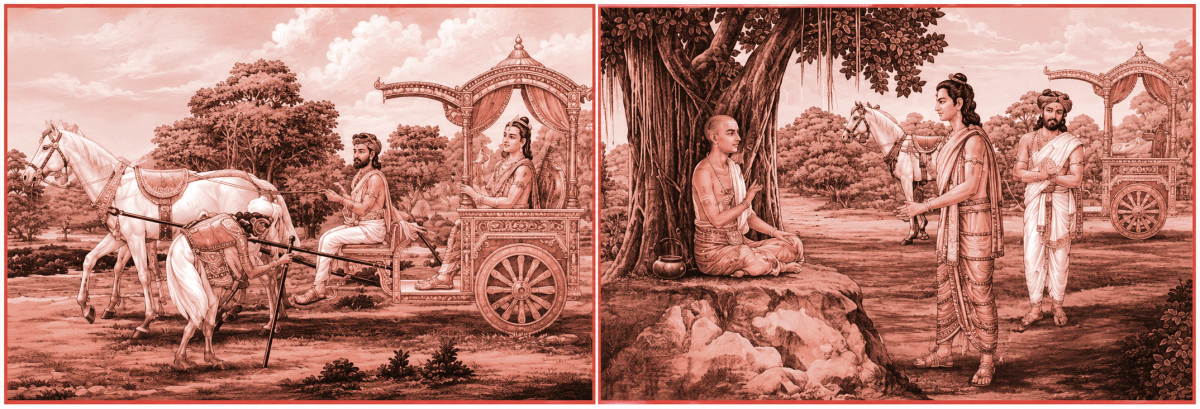
(a) State the other two scenes associated with these pictures. What are the four scenes together called?
(b) Explain briefly the impact of each of these scenes on Gautam Buddha.
(c) What was the final outcome of these scenes on Gautam Buddha? State the two events which followed the final outcome.
Answer
(a) The other two scenes associated with these pictures are:
- A sick man groaning in pain.
- A dead body of a man being carried for cremation.
The four scenes together are called the Four Great Sights.
(b) The impact of each of these scenes on Gautam Buddha was as follows:
- The Old Man — The sight of an old man bent with age moved Gautama and made him think about old age.
- The Sick Man — The sight of a sick man groaning in pain was pathetic and made Gautama reflect on human suffering caused by disease.
- The Dead Man — The sight of a dead body being carried for cremation made Gautama think about man's destiny and the reality of death.
- The Ascetic — The sight of an ascetic in search of salvation consoled Gautama and showed him a possible path to overcome suffering.
(c) The final outcome of these scenes was that Gautama left his home, his wife and his child in order to find a solution to the sufferings of the world.
The two events which followed the final outcome were:
- Mahabhiskramana (The Great Renunciation) — Gautama renounced his worldly life and comforts in search of the truth.
- Enlightenment — After wandering and practising severe penance, Gautama attained enlightenment at Bodh Gaya at the age of thirty-five and came to be called the Buddha or the Enlightened One.
With reference to the given pictures, answer the questions that follow:
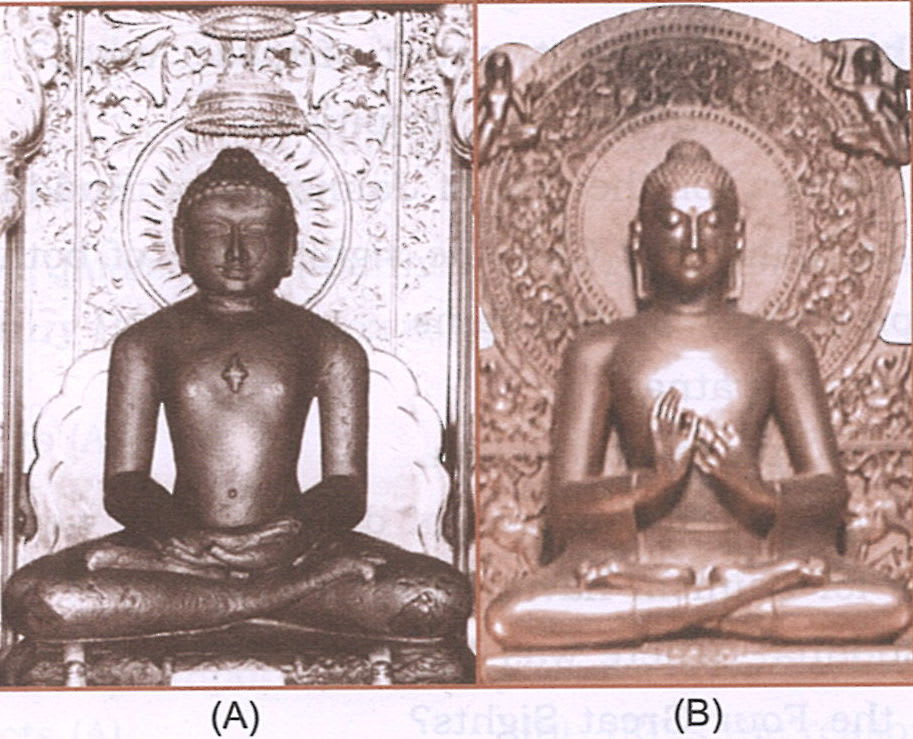
(a) Identify the two preachers, whose images are given. Name the religions founded by them.
(b) Mention three main teachings of each of the two religions founded by these preachers.
(c) Mention any two similarities and two dissimilarities between the two religions founded by them.
Answer
(a) The given images and religion founded by them are:
- A → Mahavira, founder of Jainism.
- B → Gautama Buddha, founder of Buddhism.
(b) Three main teachings of Buddhism are:
- Four Noble Truths — the essence of Buddhism lies in Four Noble Truth. They are:
- The world is full of suffering.
- The sufferings has a cause.
- Desire is the cause of suffering.
- If desire is stopped, suffering can also be stopped
- Nirvana — The ultimate goal of life is to attain Nirvana or Salvation which is freedom from the cycle of birth and death.
- Eightfold Path — The way to nirvana is a midway between luxurious living and hard penance. It includes:
- Right action
- Right thought
- Right belief
- Right living
- Right speech
- Right effort
- Right recollection
- Right meditation
Three main teachings of Jainism are:
- The Five Vows — A Jain householder has to take the following five vows:
- Ahimsa: Non-violence
- Achaurya or Asteya: Not stealing
- Satya: Not telling a lie
- Aparigraha: Not possessing property
- Brahmacharya: practising chastity
- Nine truths — According to Jainism ,the knowledge of Nine Truths is essential and only renunciation is the shortest way to salvation. These nine truths are:
- Jiva (Living Things)
- Ajiva (non-living things)
- Punya (results of good deeds)
- Pap (sin)
- Ashrav (good deeds)
- Sanvar (hindrances in the way of karma)
- Bandha (bondage)
- Nirjara (destruction of karmas)
- Moksha (salvation)
- Tri-ratnas — The ultimate goal of man as preached by Mahavira is to attain moksha, which can be obtained by following tri-ratnas or three jewels. These are right faith, right knowledge, and right conduct.
(c) Similarities:
- The founders of both the religions belonged to Kshatriya clan and followed the similar path of renunciation.
- Both of them did not accept the Vedas.
Dissimilarities:
- Buddhism was completely new religion in 6th century BC while Jainism was founded long before Mahavira.
- Buddhism followed a middle path but Jainism believed in hard penance.
The most important precept of Jainism is ahimsa or non-violence. It was popularised by Mahatma Gandhi during India's freedom struggle. Do you think the philosophy of ahimsa is as relevant today as it was in the era of Mahavira?
Answer
Philosophy of Ahimsa or non-violence is as relevant today as it was in the era of Mahavira. It is so because the world today is experiencing violence in form of terrorism, war, domestic violence etc. In todays world of pain and suffering there is dire need of the philosophy of non-violence which literally means 'non-injury' and 'non-killing'.
List the similarities and differences in the religions — Jainism, Buddhism and Hinduism.
Answer
Similarities
- All the three — Jainism, Buddhism and Hinduism originated in ancient India and have influenced each other.
- They believe in reincarnation or rebirth after death.
- Their ultimate goal is to attain Moksha.
- Karma is an important concept in all three religions.
Differences
| S. No. | Hinduism | Buddhism | Jainism |
|---|---|---|---|
| 1. | No founder | Founded by Gautam Buddha | Founded by Rishabdeva |
| 2. | Offers multiple paths to liberation | Advocates for the Middle Way for liberation | Massive emphasis on rigorous asceticism and Ahimsa to obtain liberation |
| 3. | Strict and expensive Rituals | Simple and inexpensive faith | Very strict regarding non-violence |
| 4. | Rigid caste system | No caste system but divided into two sects- Hinayana and Mahayana | No caste system but divided into two sects- Shvetambaras and Digambaras |
Buddhism which emerged in ancient India against the Brahmanical social order, is becoming quite popular because of its secular beliefs in contemporary India. State your views giving examples.
Answer
Buddhism, which emerged in ancient India as a response to the Brahmanic social order is indeed becoming quite popular because of its secular beliefs in contemporary India. There are several reasons for this, some of which are:
- Emphasis on non-violence — Buddhism has always emphasized non-violence and compassion towards all living beings, which has become increasingly relevant in contemporary India. With the rise of communal and sectarian violence, many people have turned to Buddhism as a way of promoting peace and harmony.
- Influence on modern Indian leaders — Several modern Indian leaders, such as Dr. B.R. Ambedkar were deeply influenced by Buddhism. Ambedkar, in particular, converted to Buddhism in 1956, and his followers have continued to promote the religion as a means of empowerment for Dalits, who have historically faced discrimination in India.
- Interest in meditation and mindfulness — Buddhism has also gained popularity in India due to its emphasis on meditation and mindfulness practices. Many people in contemporary India are turning to these practices as a means of coping with stress and anxiety in their daily lives.
Write the script of a play on the life and times of Gautam Buddha.
Answer
Title: The Enlightened One
Characters:
Gautama Buddha
Queen Maya (Buddha's mother)
King Suddhodana (Buddha's father)
Ananda (Buddha's disciple and cousin)
Mara (the demon of illusion)
Act 1:
Scene 1: The birth of Gautama Buddha
The play opens with Queen Maya giving birth to Prince Siddhartha Gautama. The king and queen celebrate his birth, with the king envisioning a bright future for his son. However, a prophecy is revealed that the prince will either become a great king or a great sage, causing King Suddhodana to worry about his son's future.
Scene 2: The young prince
The play fast-forwards to Prince Siddhartha's teenage years, where he is depicted as a curious and introspective youth. He becomes increasingly interested in the nature of suffering and the meaning of life, much to the confusion of his father and the courtiers.
Act 2:
Scene 1: The Great Renunciation
Prince Siddhartha, now a young man, is married and has a child. One day as his charioteer is driving him through the town, he sees an old man bent with age. Then he sees a sick man groaning in pain. After that he witnesses a dead body of a man being carried for cremation. He is consoled when he sees an ascetic in search of salvation. He becomes disillusioned with his life of luxury and decides to renounce his material possessions and seek the truth. This decision causes great distress to his family, particularly his father, who wants him to become a great king.
Scene 2: The search for enlightenment
The prince embarks on a journey to find enlightenment, seeking the advice of several spiritual teachers along the way. However, he remains dissatisfied with their teachings and continues his search.
Act 3:
Scene 1: Enlightenment
After several years of meditation and self-reflection, Prince Siddhartha attains enlightenment under a Bodhi tree. He becomes known as the Buddha, or the enlightened one. Ananda, his cousin and disciple, witnesses the event.
Scene 2: The first sermon
The Buddha travels to the Deer Park in Sarnath and delivers his first sermon, known as the Four Noble Truths. Ananda and other disciples listen intently as the Buddha explains the nature of suffering and the path to liberation.
Act 4:
Scene 1: The spread of Buddhism
The Buddha continues to travel and teach, gathering a large following of monks and laypeople. He performs several miracles and attracts the attention of Mara, the demon of illusion, who tries to distract him from his mission.
Scene 2: The Mahaparinirvana
The play ends with the Buddha's death, known as the Mahaparinirvana. Ananda and the other disciples mourn his passing, but the Buddha reminds them that his teachings will live on through the Dharma. The play concludes with Ananda reciting one of the Buddha's famous quotes, "All conditioned things are impermanent. Strive on with diligence."