
Chandragupta Maurya established a vast empire overthrowing
- Guptas and Chalukyas
- Nandas and Greek Satraps
- Rashtrakutas and Nandas
- Greek Satraps and Guptas
Answer
Nandas and Greek Satraps
Reason — Chandragupta Maurya overthrew the Nandas of Magadha and the Greek Satraps from the North-West Frontier, thereby founding the Mauryan Empire.
Which of the following is correct?
- Bindusara : Slayer of foes
- Chandragupta : The most beautiful one
- Bindusara : Favourite of gods
- Ashoka : The greatest one
Answer
Bindusara : Slayer of foes
Reason — The Greek historian Athenacus called Bindusara a 'slayer of foes'. Ashoka took the titles 'Devanamapriya' (The Beloved of the Gods) and 'Priyadarshi' (The Beautiful One).
Ashoka abandoned ............... and embraced ............... .
- Bherigosha, Digvijay
- Dhammagosha, Bherigosha
- Bherigosha, Dhammagosha
- Dhammagosha, Digvijay
Answer
Bherigosha, Dhammagosha
Reason — After the Kalinga War, Ashoka abandoned the policy of 'conquest by force' (Bherigosha) and embraced the policy of religion (Dhammagosha), the call to non-violence and universal peace.
What was an advantage of the Mauryan administration having a Pan-Indian character?
- More attention paid to socio-economic life of people
- Increased uprising in small provinces
- Increased area to be protected from foreign invaders
- All of the above.
Answer
More attention paid to socio-economic life of people
Reason — After Ashoka's victory over Kalinga, the era of conquests and wars was over. This helped the Mauryan kings pay more attention to the social and economic life of the people, resulting in all-round economic prosperity.
Identify the correct chronology of Mauryan Kings.
- Chandragupta—Chanakya–Bindusara–Ashoka
- Bindusara–Ashoka–Chandragupta–Dasharatha
- Bindusara–Chandragupta–Ashoka–Dasharatha
- Chandragupta–Bindusara–Ashoka–Dasharatha
Answer
Chandragupta–Bindusara–Ashoka–Dasharatha
Reason — In the chronological order of Mauryan kings, Chandragupta Maurya was succeeded by Bindusara, followed by Ashoka and then Dasharatha Maurya. Chanakya was Chandragupta's advisor, not a king.
Identify the provinces in the Mauryan Empire.
- Magadha, Avanti, Kalinga and Cholamandalam
- Magadha, Gandhara, Avanti, Kalinga and Southern Province
- Magadha, Takshila, Ujjain and Tosali
- None of the above
Answer
Magadha, Gandhara, Avanti, Kalinga and Southern Province
Reason — During Ashoka's time there were five provinces — Magadha, Gandhara, Avanti, the Southern Province and Kalinga (added after its conquest). Takshila, Ujjain and Tosali were provincial capitals, not provinces.
Which of the following were officers in the Provincial Government?
- Purohit, Senapati, Sannidhata, Samaharta
- Mahamatra, Pradeshika, Rajuka, Yukta
- Pradeshika, Rajuka, Yukta
- Bali, Bhaga, Shulka
Answer
Pradeshika, Rajuka, Yukta
Reason — In the provincial administration, Pradeshika collected taxes, Rajuka acted as the revenue officer and Yukta was the treasurer.
(A) The Mauryan Empire was founded by Chandragupta Maurya in 4th century BCE.
(R) Chandragupta Maurya was succeeded by Ashoka.
- (R) contradicts (A)
- (R) is the reason for (A)
- (A) is true but (R) is false.
- (A) and (R) are independent of each other.
Answer
(A) is true but (R) is false.
Explanation — Chandragupta Maurya was succeeded by Bindusara and Bindusara was succeeded by Ashoka.
(A) Most of the Ashokan Edicts are engraved in the Brahmi lipi, written from left to right.
(R) The Ashokan edicts provide a useful insight into the life and ideals of Ashoka.
- (R) contradicts (A)
- (R) is the reason for (A)
- (A) is true but (R) is false.
- (A) and (R) are independent of each other.
Answer
(A) and (R) are independent of each other.
Explanation — Ashokan Edicts are indeed engraved in the Brahmi script, which is written from left to right. The Ashokan edicts do provide a useful insight into the life and ideals of Ashoka. They are the oldest, best preserved, and precisely dated records of India.
(A) Ashoka prohibited the killing of animals for sacrifices.
(R) After the Kalinga war, Ashoka made a resolve not to take up arms and to shun violence.
- (R) contradicts (A)
- (R) is the reason for (A)
- (A) is true but (R) is false.
- (A) and (R) are independent of each other.
Answer
(R) is the reason for (A)
Explanation — After the Kalinga war, Ashoka was deeply moved by the sufferings and atrocities of the war. He made a solemn resolve not to take up arms any more and prohibited killing of animal sacrifices.
(A) The Buddhist Stupa represents the spiritual body of Buddha containing his relics like hair, teeth or bones.
(R) Buddha is represented by symbols like the peepal tree, lotus or wheel on the Sanchi Stupa.
- (R) contradicts (A)
- (R) is the reason for (A)
- (A) is true but (R) is false.
- (A) and (R) are independent of each other.
Answer
(A) and (R) are independent of each other.
Explanation — A stupa is a mound-like or hemispherical structure containing relics like hair, teeth or bones. It is used as a place of meditation. On the Sanchi Stupa, Buddha is indeed represented by symbols like the peepal tree, lotus or wheel. These symbols are used to depict the Buddha. For example, the lotus represents the Buddha’s birth, the wheel represents his first sermon, and the Bodhi tree represents his enlightenment.
(A) Chandragupta Maurya defeated Greek general Seleucus.
(R) The Greek historian Athenacus called Ashoka a ‘slayer of foes.’
- (R) contradicts (A)
- (R) is the reason for (A)
- (A) is true but (R) is false.
- (A) and (R) are independent of each other.
Answer
(A) is true but (R) is false.
Explanation — The Greek historian Athenacus called Bindusara a ‘slayer of foes.’
(A) The land revenue was the chief source of income in the Mauryan empire.
(R) Bhaga was a religious tribute in the Mauryan empire.
- (R) contradicts (A)
- (R) is the reason for (A)
- (A) is true but (R) is false.
- (A) and (R) are independent of each other.
Answer
(A) is true but (R) is false
Explanation — Bhaga was levied on agricultural produce and cattle at the rate of one-sixth whereas Bali was a religious tribute.
State any two sources of information about the Mauryan Empire.
Answer
Two sources of information about the Mauryan Empire are:
- Arthashastra — It was written by Kautilya or Chanakya, the advisor and Prime minister of Chandragupta Maurya. It is a comprehensive manual that deals with politics, rules of diplomacy, principles of administration and other political topics.
- Indika — This book was written by Magasthenes, a Greek ambassador at the court of Chandragupta Maurya. This book contains his impressions of what he heard and saw during his stay in India.
Who wrote Arthashastra? What is its importance?
Answer
Arthashastra was written by Kautilya, also known as Chanakya and Vishnugupta. He was advisor and Prime Minister of Chandragupta Maurya.
Arthashastra is one of the most important source of information about Mauryan times. It is a comprehensive manual that deals with politics, rules of diplomacy, principles of administration and other such political topics.
What is the importance of Ashoka's edicts?
Answer
The edicts of Ashoka form the most important source of Mauryan history. They are the oldest, best preserved and precisely dated records of India. The Ashoka's edicts provide an insight into the life and ideals of Ashoka in particular and about the history of the Mauryas in general. Details about Kalinga war, call for non-violence and peace are mentioned on these edicts.
Who wrote the Indika? What does it contain?
Answer
Indika was written by Megasthenes, a greek ambassador. It contains his impressions of what he heard and saw during his stay in India.
What is a Stupa? Name one Stupa built by Ashoka.
Answer
A Stupa is a semi-spherical solid dome like structure made of unburnt bricks and stones. It represents the spiritual body of Buddha containing his relics such as hair, teeth or bones.
Ashoka built the Sanchi Stupa in Madhya Pradesh.
How did Chandragupta Maurya establish the Mauryan dynasty?
Answer
Chandragupta Maurya was dismissed from the service of Nandas who ruled before him. He then met Kautilya, a Brahmin at Takshila. They joined hands to destroy the Nanda dynasty. After a long series of battles with Chandragupta, the Nanda capital at Pataliputra fell. This led to the emergence of Mauryan Dynasty with Chandragupta Maurya as the emperor.
What was the impact of Ashoka's act of embracing the policy of Dhammagosha?
Answer
By embracing Dhammaghosha, Ashoka abandoned the policy of military expansion (bherigosha) and luxury, shifting his state policy toward Buddhist principles of non-violence, religious tolerance, and the rejection of empty rituals. He actively propagated Buddhism by sending global missionaries, including his children to Sri Lanka and erecting pillars and stupas across his empire.
Name the two taxes mentioned in the Edicts of Ashoka.
Answer
The two taxes mentioned in the Edicts of Ashoka are:
- Bhaga — It was levied on agricultural produce and cattles.
- Bali — It was religious tribute.
How did the king keep himself abreast with whatever was happening in his kingdom?
Answer
The king has a wide network of spies in his empire. They kept the king informed about the important developments in his kingdom. The king was always kept informed of the working of the bureaucracy.
What is meant by Ashoka's Dhamma?
Answer
Ashoka's Dhamma was a 'Common Code of Conduct' or a 'Moral Law' or an 'Ethical Order' that was based on the unifying principles of all major religions of the world. It was not a religion or religious system. He wanted his subjects to follow this Dhamma instead of imposing any religion on them.
Give the basic principles of Ashoka's Dhamma.
Answer
The basic principles of Ashoka's Dhamma were:
- Respect for elders and love for children.
- Ahimsa or non-violence.
- Good deeds or good karma would give happiness to man in the next birth.
- He taught people to respect all religions.
- He disapproved empty rituals.
What was the impact of Dhamma on Ashoka's policies?
Answer
The impacts of Dhamma on Ashoka's policies were:
- Religious unity — People belonging to different religions followed their emperor's policy of religious tolerance.
- Moral values — People under the influence of Dhamma started living a moral life.
- End of crimes — Due to policy of Ahimsa, thefts, crimes and other such activities almost came to an end.
- Public welfare — With the policy of conquests and wars having come to an end, officials undertook public welfare and public work schemes. This resulted in prosperity and helped people to lead a peaceful life.
Study the picture given below and answer the following questions:
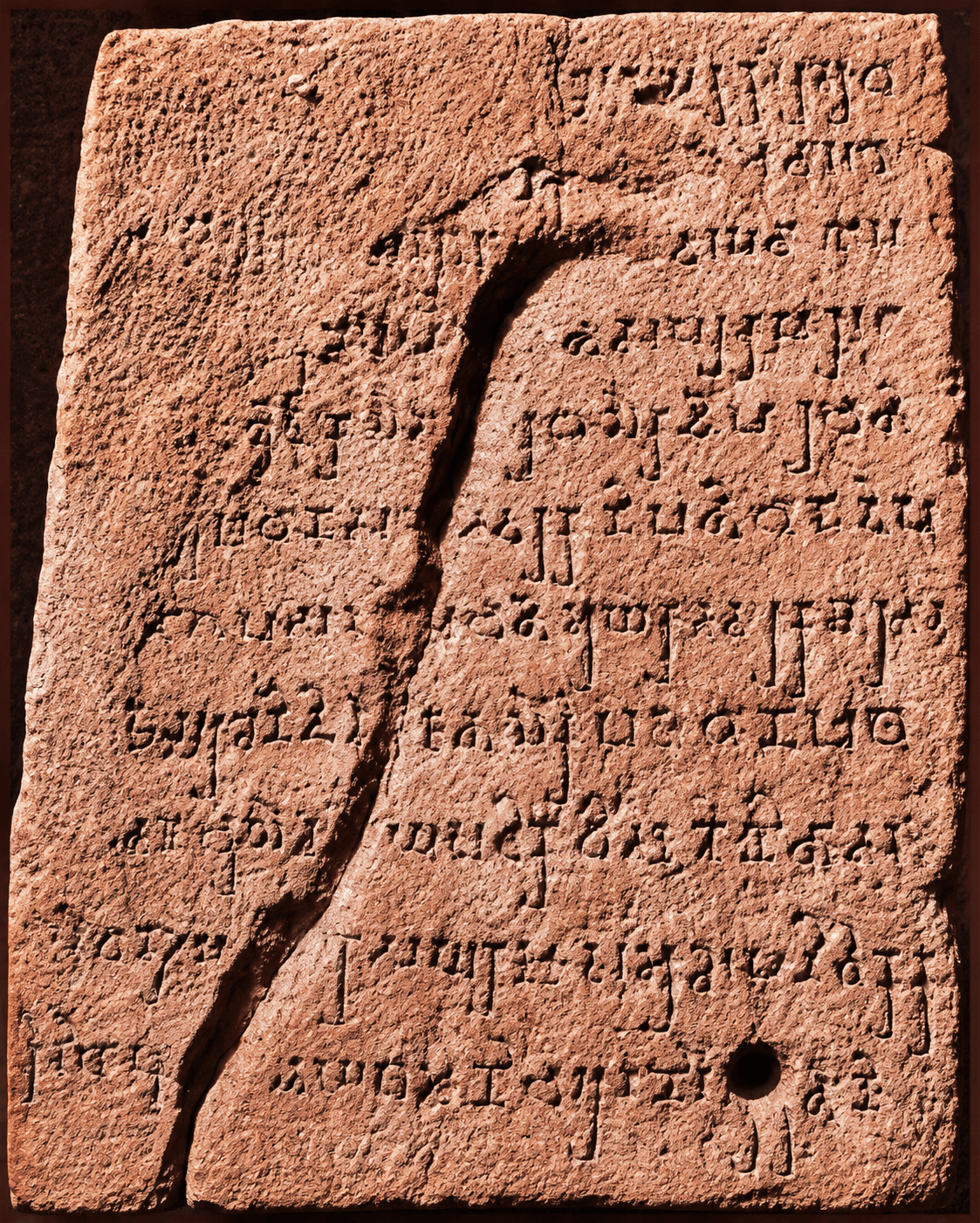
(a) What is depicted in the picture? Where are these found?
(b) What is their significance as a source of information?
(c) Explain briefly their importance in terms of Ashoka's rule, giving example from one of his edicts.
Answer
(a) Ashokan edict is depicted in the given picture.
These edicts are inscribed on rocks and pillars throughout the country and include 14 major rock edicts, 7 pillar edicts and a number of minor rock edicts.
(b) The significance of edicts as a source of information lies in the fact that they provide us useful insight into the life and ideals of Ashoka in particular and about the history of Mauryans in general. They are most precisely dated records of Mauryan period.
(c) Ashokan inscriptions provide the most accurate records of the Mauryan Empire's political scenario and Ashoka’s personal ideals. For instance, Rock Edict-I highlights his commitment to non-violence by prohibiting animal sacrifices, restricting the slaughter of animals for food, protecting specific species, and universally condemning cruelty against animals.
With reference to the sources of information on the Mauryan Empire, explain briefly the significance of the following:
(a) Arthashastra
(b) Indika
(c) Sanchi Stupa
Answer
(a) Arthashastra — Discovered in 1909, it is the most important of all the sources on the history of Mauryas. It was written by Kautilya also known as Chanakya and Vishnugupta. Written in sanskrit, Arthashastra is a comprehensive manual that deals with politics, rules of diplomacy, principles and art of administration and other such political topics.
(b) Indika — It was written by Megasthenes, who was a Greek ambassador sent by Seleucus, at the court of Chandragupta Maurya. Although original Indika has been lost but its fragments are available in the writings of later Greek authors like Strabo, Arrian and Diodorus. Indika contains whatever Megasthenes saw and heard during his stay. It tells us about the administration and political conditions of Mauryans.
(c) Sanchi Stupa — It is located at Sanchi, 45 km from Bhopal in Madhya Pradesh. Its foundation was laid by Ashoka. It represents the spiritual body of Buddha containing his relics such as hair, teeth or bones. There are four gateways in four directions. They have carved panels depicting events from the life of Buddha and some tales from Jataka stories. Buddha is represented by Symbols like the peepal tree, lotus or a wheel. The pillars are surmounted by capitals which contain sculptures of lions. Sanchi Stupa reflects information about architecture and importance of Buddhism during Mauryan period.
With reference to Mauryan Empire, answer the following questions:
(a) Give a brief account of how Chandragupta established the Mauryan Empire.
(b) Give a brief account of Ashoka's change of heart and consequences of the same.
(c) Name four important ways in which Buddhism spread under the royal patronage during the Mauryan times.
Answer
(a) Chandragupta Maurya worked with Nandas, who ruled before him. He was dismissed from the services by Nandas. He then met Kautilya,at Takshilla (Kautilya later became famous as Chanakya). Kautilya too was wronged by the Nandas. They joined hands with each other to destroy Nandas. After a long series of Battles, Chandragupta Maurya defeated Nandas and established the Mauryan Empire. Chandragupta Maurya took over the territories conquered by Alexander in the North-Western part of India after Alexander's death. Later on he defeated Seleucus and got Kabul, Kandahar, Herat and Baluchistan from him. His empire extended from Kabul and Kandahar in the North-West to Mysore in the south; and from Bengal in the east to Saurashtra in the west.
(b) The death and destruction caused by the Kalinga war had a profound effect on the policies and personality of Ashoka.
Ashoka's Change of Heart and Its Consequences —
- He abandoned the policy of 'conquest by force' (bherigosha) and ambition of 'victory in all directions' (Digvijay) and embraced the policy of religion (Dhammagosha).
- Ashoka stopped hunting and eating meat and abandoned the life of luxury.
- The prisoners of war were used for agricultural work. It resulted in an increase in production and brought about economic prosperity in his empire.
- Ashoka, after the Kalinga war, embraced Buddhism and followed the Buddhist principles in his state policy like non-violence and disapproval of empty rituals. He also sent various missionaries to various parts of the world to propagate Buddhism.
- On account of abandonment of war, there was a decline in military preparedness and efficiency.
(c) Four important ways in which Buddhism spread under the royal patronage during the Mauryan times were:
- Huge donations were given by Mauryan kings to Buddhist Viharas.
- Ashoka got erected several pillars and edicts to spread the teachings of Buddhism. These pillars had Buddhist teachings engraved on them. Ashoka ordered for construction of 84,000 Stupas to keep the relics of Buddha.
- Ashoka himself went on tours to preach Buddhism to people. He also sent missionaries to various parts of the world.
- Ashoka sent his daughter, Sanghamitra and son, Mahindra to Sri Lanka to propagate Buddhism.
With reference to Mauryan administration, answer the following questions:
(a) Why is Chandragupta Maurya regarded as the chief architect of the system of administration?
(b) Briefly describe the main features of civil and military administration under Mauryan rule.
(c) Explain briefly the Pan-Indian character of Mauryan administration.
Answer
(a) Chandragupta Maurya is regarded as the chief architect of the system of administration because he laid the foundation of an elaborate system of administration, under the guidance of Chanakya. Chanakya wrote a book Arthashastra in which he describes the principles of politics and the art of administration.
(b) The main features of civil and military administration under Mauryan rule are described below:
Civil Administration
- The civil administration had two main divisions - the Central Government and the Provincial Government.
- The Mauryan Government was centralised and was managed by several officials at different ranks.
- The king was supreme authority and supreme judge. His throne was hereditary.
- The king was assisted by the council of ministers headed by prime minister.
- The provincial government was headed by Kumar or Aryaputra and the district administration was looked after by Pradeshika, Rajuka and Yukta. There were Mahamatras to assist Kumars.
- There was an efficient Spy system to keep the king informed.
- Two kinds of taxes, namely Bali and Bhaga were levied.
Military Administration
- There was a huge army consisting of infantry, cavalry, elephants and chariots. The army had 6,00,000 infantry, 30,000 cavalry, 9000 war elephants and 8000 chariots.
- The chief weapon used were bows, arrows, shields, swords etc.
- The king was the commander in chief of army.
- The whole army was under a military commission of thirty members and they had a well laid recruitment policy.
- The soldiers were paid in cash.
- The Mauryan king had built forts at strategic places for safety and security of empire.
(c) The Pan-Indian character of Mauryan Empire were the following:
- It marked the end of small states.
- It helped in establishing trade links with foreign countries.
- It made India strong and helped the Mauryan kings face foreign aggressions successfully.
- This helped the Mauryan kings to pay more attention to social and economic life of the people. Hence, there was an all-round economic prosperity.
With reference to the Mauryan administration, write short notes on the following:
(a) The Central Government
(b) District Administration
(c) Revenue system
Answer
(a) The Central Government —
- Centralised Autocracy: The Mauryan government was highly centralised, with the king holding supreme authority as both the ultimate ruler and the highest judge. The throne was hereditary.
- The Mantri Parishad: The king was assisted by a council of ministers (Mantri Parishad), which was headed by the Prime Minister.
- Key Ministerial Roles: The council included prominent figures such as the Purohit (Priest), Senapati (Commander-in-Chief for war), Sannidhata (Treasurer), and Samaharta (Taxation Expert).
- Specialised Bureaucracy: A vast network of specialized officers managed state affairs, including an Accountant General and superintendents for Agriculture, Mines, and Ports.
(b) District Administration — During Mauryan period, the provinces were further divided into Districts also known as Janapadas. Officers like Pradeshika (tax collector), Rajuka (revenue officer) and Yukta (the treasurer) looked after the administration of districts.
(c) Revenue System — The Revenue System of Mauryan period was regulated by Samaharta in the ministerial council. The land revenue was the main source of income. Two kinds of taxes were imposed namely Bali and Bhaga. Bhaga was levied on agricultural produce and cattles at the rate of one-sixth while Bali was religious tribute. Toll tax was imposed on articles which were brought for sale. Taxes were also imposed on liquor shops, gambling houses, forests and mines. The income from the revenue collected was used to develop various facilities like roads, irrigation, hospitals and meet expenses of the state.
Study the picture given below and answer the following questions:
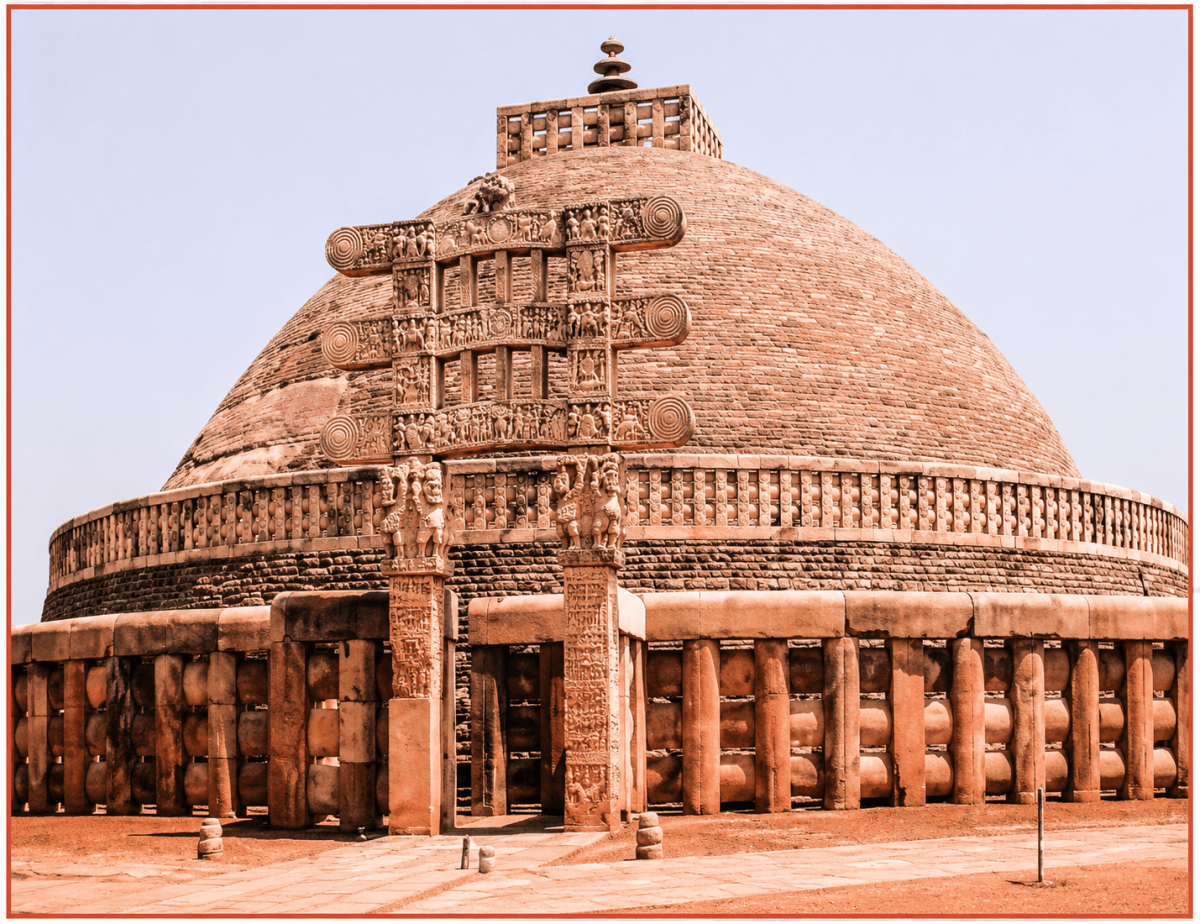
(a) Name the structure given in the picture. Name the dynasty and the king who built it.
(b) Where is it located? Mention any two architectural features of this structure.
(c) What is the significance of a Buddhist Stupa?
Answer
(a) The structure given in the picture is Sanchi Stupa. It was built by King Ashoka of Mauryan dynasty.
(b) It is located at Sanchi, 45km from Bhopal in Madhya Pradesh.
Two architectural features of this structure are:
- Stupa has a semi-spherical solid dome-like structure made of unburnt bricks and stones.
- There are four gateways in four directions. They have carved panels depicting events from the life of Buddha and some tales from Jataka stories.
(c) A Buddhist Stupa has special significance. It represents the spiritual body of Buddha containing his relics such as hair, teeth or bones. A casket containing these relics is placed at the base of the dome.
Imagine that you met a person, whose family suffered the consequences of the Kalinga War waged by Ashoka. Describe the horrors of the war as told by him. State the differences which you find between the Kalinga War and the modern warfare.
Answer
I met a person, who fought in the Kalinga war along with his two brothers. He told me that he lost both his brothers in the war. The war left him handicapped. There was no one to earn and feed the family. Many others lost their lives, many wounded. The loss was unprecedented.
The description about Kalinga war has been mentioned in Rock Edict XIII. The Kalinga war involved the use of infantry, cavalary and elephants. On the contrary mordern warfare include use of guns, tanks, missiles, fighter aircrafts, etc. Modern warfare has the potential for even greater destruction and loss of life.
Explain the symbolism preached by the sculpture on the Emblem of India.
Answer
The Emblem of India is an adaptation of the Lion Capital of Ashoka. The Emblem features four lions standing back to back, with the Ashoka Chakra in the center. The lions are said to represent power, courage, pride, and confidence, and they are standing on a circular base which represents the Dharma Chakra or the wheel of law.
The Ashoka Chakra, which is at the center of the Emblem, represents the constant motion and progress of the country. It has 24 spokes which are said to represent the 24 hours of the day.
The Emblem of India represents the country's rich cultural heritage and its commitment to principles of justice, truth, and non-violence, which were important to Ashoka and are enshrined in the country's constitution.
You are given an opportunity to pen the text of an Ashokan Edict. Briefly list what would you write.
Answer
Below is the text of the Ashokan Edict that I will write:
"I have always been concerned about the welfare of my subjects, and I am always seeking new ways to improve their lives. To this end, I have established hospitals and clinics throughout my empire to provide free medical care to those in need. I have also built rest houses and shelters along the roads for the use of travellers and pilgrims. These are places where they can rest and find food and water, and where they can be safe from harm.
In addition, I have issued orders to my officials to act with fairness and justice in all their dealings with the people. They must not take bribes or engage in corruption, and they must always be mindful of their duty to serve the public. I have also ordered that taxes be levied fairly and that the burden be distributed equally among all sections of society.
I hope that my subjects will take inspiration from my example and strive to lead virtuous and compassionate lives. Let them show kindness and generosity to all, and let them work to build a just and harmonious society. This is the path to true happiness and fulfilment."
Of the literary sources i.e., the Arthashastra and Indika, which was written first, in your opinion? Give reasons to support your answer.
Answer
In my opinion, the Arthashastra was written first.
The Arthashastra was written by Kautilya (Chanakya), who was the advisor and Prime Minister of Chandragupta Maurya. He was associated with Chandragupta from the very beginning and guided him in establishing the Mauryan Empire, so the Arthashastra reflects the foundational period of Mauryan rule.
The Indika, on the other hand, was written by Megasthenes, the Greek ambassador sent to Chandragupta's court by Seleucus Nicator. Megasthenes came to India only after Chandragupta defeated Seleucus around 305 BCE, which was a later stage of Chandragupta's reign.
Since Kautilya was with Chandragupta right from the founding of the empire while Megasthenes arrived only after 305 BCE, the Arthashastra was, in my opinion, written before the Indika.