
Which Revolution preceded the Industrial Revolution in England?
- Green Revolution
- Agrarian Revolution
- Demographic Revolution
- Happiness Revolution
Answer
Agrarian Revolution
Reason — The Agrarian Revolution came just before the Industrial Revolution in England. The breakdown of the feudal system during it left a large number of peasants unemployed, who shifted to cities and became available as labour for the new factories.
Who invented 'The Flying Shuttle' which increased the speed of weaving?
- John Kay
- James Hargreaves
- Richard Arkwright
- Jenny
Answer
John Kay
Reason — John Kay, a weaver of Lancashire, invented 'The Flying Shuttle' which increased the speed of weaving and made possible the weaving of broad cloth by only one person.
Which amongst the following did not lead to the Rise of Capitalism?
- Legal Requirement
- Trade Union Movement
- Mass Production
- Disappearance of Small Farmers
Answer
Trade Union Movement
Reason — Increase in population, legal requirement, growth of towns, mass production and disappearance of small farmers led to the rise of Capitalism. The Trade Union Movement was a cause for the rise of Socialism, not Capitalism.
Which of the following is not a cause for the rise of socialism?
- Trade Union Movement
- Chartist Movement
- Reaction to Capitalism
- Rise of nation states
Answer
Rise of nation states
Reason — Reaction to the evils of Capitalism, the Trade Union Movement and the Chartist Movement were causes for the rise of Socialism. The rise of nation states was not among these causes.
Who considered Capitalist society as a society divided between two classes—the working class and the employing class?
- Karl Marx
- Babeuf
- Saint-Simon
- Frederick Engels
Answer
Karl Marx
Reason — Karl Marx considered capitalist society as one divided between the working class, which produces all value, and the owning and employing class, which exploits the value or profits without producing anything.
(A) The Industrial Revolution first began in England and then spread to many other countries of the world.
(R) England had a large colonial empire to provide raw material at cheaper rates for her factories and to serve as a market for her manufactured goods.
- (R) contradicts (A)
- (R) is one of the reasons for (A)
- (A) is true but (R) is false.
- (A) and (R) are independent of each other.
Answer
(R) is one of the reasons for (A)
Explanation — Easily available raw material and market favoured the industrial revolution in England.
(A) Capitalism is the economic system that generates and gives power to the capitalists.
(R) In capitalism, the means of production such as labour, raw material, tools and machines are owned and controlled by public.
- (R) contradicts (A)
- (R) is the reason for (A)
- (A) is true but (R) is false.
- (A) and (R) are independent of each other.
Answer
(A) is true but (R) is false.
Explanation — In capitalism, the means of production such as labour, raw material, tools and machines are owned and controlled by Capitalists and not by the public.
(A) Due to the Industrial Revolution, skilled labourers lost their jobs as new machines replaced them.
(R) Women and children were recruited in factories as they could be hired for very low wages.
- (R) contradicts (A)
- (R) is the reason for (A)
- (A) is true but (R) is false.
- (A) and (R) are independent of each other.
Answer
(R) is the reason for (A)
Explanation — Loss of traditional jobs was one of the effects of industrial revolution. It also led to exploitation of women and children as they were hired as labourers for very low wages.
(A) Socialism is an economic system in which the means of production are owned by the community and in which all share fairly the wealth produced.
(R) The evil effects of Capitalism and the spirit of improving the conditions of workers gave rise to socialism.
- (R) contradicts (A)
- (R) is the reason for (A)
- (A) is true but (R) is false.
- (A) and (R) are independent of each other.
Answer
(R) is the reason for (A)
Explanation — The negative effects of capitalism, such as wealth inequality and poor working conditions, along with a desire to improve the condition of workers, did contribute to the rise of socialism.
What is meant by the term, 'Industrial Revolution'?
Answer
The Industrial Revolution refers to the shift from handmade, small-scale production to large-scale, machine-powered manufacturing. This transformation dramatically reshaped the industrial landscape between the mid-18th and mid-19th centuries.
Name any two consequences of the Industrial Revolution in the economic field.
Answer
Two consequences of the Industrial Revolution in the economic field were:
- By 1820s, income level for most workers began to improve.
- The economy was expanding at a rate that was more than twice the pace at which it had grown before Industrial Revolution.
What is Capitalism?
Answer
The economic system which generates and gives power to capitalists (owner of wealth or capital) is known as Capitalism.
Who was Karl Marx? Name his outstanding work.
Answer
Karl Marx was a German political philosopher and economist who gave revolutionary socialist ideas.
His outstanding works are Communist Manifesto and Das Kapital.
What is meant by Socialism?
Answer
Socialism is an economic system where the community, rather than private individuals, owns the resources and factories so wealth can be shared fairly. It arose to counter the harsh effects of capitalism and improve workers' lives.
How did the evil effects of Industrial Revolution help in the rise of Socialism?
Answer
The Industrial Revolution divided society into two conflicting classes: the capitalists (owners) and the workers, supported by socialists.
To amass immense wealth, capitalists exploited workers through low wages and long hours, widening the gap between the rich and the poor. This growing inequality caused severe social unrest and sparked a class struggle, prompting socialists to champion the workers' cause and fight capitalist exploitation.
Mention any two effects of the Industrial Revolution on the general public.
Answer
Two effects of the Industrial Revolution on the general public were:
- Loss of traditional jobs — Women in households, who had earned income from spinning, found the new factories taking away their source of income. Skilled labourers lost their jobs as new machines replaced them.
- Exploitation — In the factories, people had to work for long hours under harsh conditions. Factory owners and managers paid the minimum amount necessary for a workforce, often recruiting women and children at low wages.
Mention any two advantages of Industrialisation.
Answer
Two advantages of Industrialisation are:
- Industrialisation increased the national wealth, raised the standard of living, made life more comfortable. The economy was expanding at a rate that was more than twice the pace at which it had grown before Industrial Revolution.
- The widespread poverty and constant threat of mass starvation that had haunted the pre-industrial age were reduced.
Mention two negative effects of the Industrial Revolution on labourers.
Answer
Two bad effects of the Industrial Revolution on labourers were:
- Exploitation — People had to work for long hours and under harsh condition. Factory owners and managers paid the minimum amount necessary for a workforce, often recruiting women and children to tend the machines because they could be hired for very low wages.
- Stress and Strain — Division of labour boosted productivity but made jobs highly repetitive and boring. Workers endured gruelling 12–14 hour days, six days a week, under strict managerial supervision and unsafe factory conditions that frequently led to fatal accidents.
Mention any two differences between 'Capitalism and Socialism'.
Answer
| Sl. No. | Capitalism | Socialism |
|---|---|---|
| 1 | Capitalism refers to the economic system in which the means of production like labour, raw material, tools and machines are owned by private individuals or groups of them for profit. | Socialism refers to the economic system in which the government owns and controls the means of production (as factories) and distribution of goods. |
| 2 | In Capitalism production is for profit; useful goods and services are a by-product of pursuing profit. | In Socialism production is for use; useful goods and services are produced specifically for their usefulness. |
With reference to the picture of a factory given below answer the questions that follow:
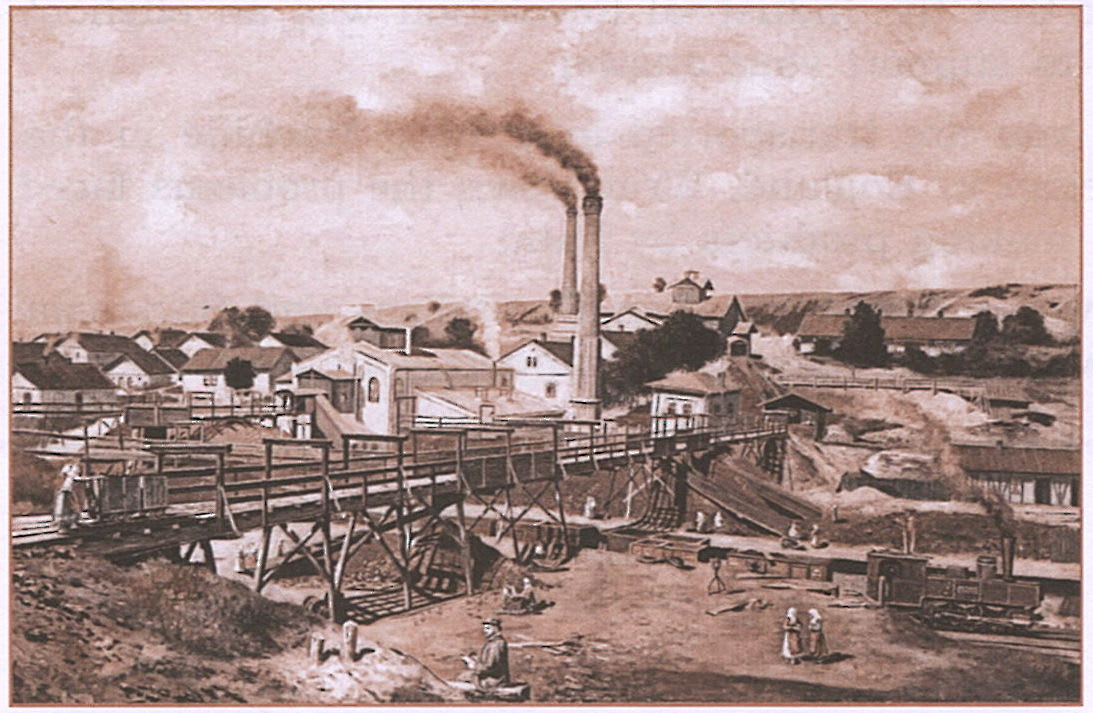
(a) Name the revolution that brought about the existence of this. Where did it begin? Why is it an important event in history?
(b) Explain the two factors responsible for its beginning in that particular country.
(c) Explain how did it lead to the growth of an economic system quite different from the domestic system of production.
Answer
(a) The given picture shows a factory scene which came into existence due to the Industrial Revolution. It began in England around mid-eighteenth century by mass production of goods.
It is an important event in history because it brought a transition from production by hand to production by machine, from small-scale production to large-scale production, from handmade goods to machine-made goods. Thus, within a hundred years, it brought in revolutionary changes in the political, social and economic life of the people.
(b) Two important factors responsible for its origin in England were:
Colonial Empire: England had a large colonial empire. From her colonies she could get raw material at cheaper rates for her factories. These colonies also served as markets for the British manufactured goods.
Increase in the Demand for Goods: Two factors drove the incentive to increase production: the massive profits from expanding trade and the unique impacts of the Napoleonic Wars. While the wars devastated industries across continental Europe, Britain's domestic peace kept its factories secure, active, and perfectly positioned to meet global demand.
(c) Mass production destroyed the domestic system of production. In domestic system, production was carried out manually by craftsmen in small spaces with simple tools, and the scale of production was small. However, during Industrial revolution, the growth of industries and the use of huge machines gave rise to factories. The people of villages shifted to towns for employment in the factories. The factory system increased efficiency and output, and led to the growth of economy based on mass production and profit.
The Industrial Revolution marked a change from handwork to machine work and from domestic system of production to factory system of production. In this context, discuss the role of the following factors in ushering in the Industrial Revolution:
(a) Invention of machines.
(b) Availability of coal and iron.
(c) Improved Transportation.
Answer
(a) Invention of machines — The Industrial Revolution began with machinery that automated textile production. Three key inventions transformed the industry:
- The Flying Shuttle (John Kay): Sped up weaving and allowed a single worker to weave wide cloth.
- The Spinning Jenny (James Hargreaves): Revolutionized spinning by producing eight threads simultaneously instead of just one.
- The Water Frame (Richard Arkwright): Used water power to spin stronger yarn, marking the transition from home-based work to the modern factory system.
(b) Availability of coal and iron — Natural resources such as iron and coal were available in England. The iron and coal mines were situated close to each other. Iron was used in making machines. The coal provided cheap fuel. Both these factors helped in the development of industries.
(c) Improved Transportation — In the late 18th century, pioneering breakthroughs in power and infrastructure revolutionized England's transportation system:
- Roads & Waterways: The introduction of tarcoal and tar enabled the construction of durable, all-weather roads, while steamboats and steamships transformed water transport.
- The Steam Engine: James Watt’s invention of the steam engine provided a reliable source of power that drove machinery and fuelled transit across both land and sea.
- Railways: George Stephenson built the first locomotive engine to haul coal, setting the foundation for the railway revolution.
With reference to the rise of Capitalism, answer the following questions:
(a) What were the causes for the rise of Capitalism?
(b) What was the impact of Capitalism on the working class?
(c) How did it give rise to Socialism?
Answer
(a) The causes for the rise of Capitalism were:
- Increase in population — People from the rural areas migrated to the urban areas for employment, education, cultural benefits, better freedom and enjoyment.
- Legal Requirement — There was the new enclosure law which required farmers to put fences or hedges around their fields to prevent common grazing on the land. That's why small farmers had to sell their fields as it was expensive to put fences and search for work elsewhere. These factors combined to provide a ready workforce for the new industries.
- Growth of Towns — New manufacturing towns and cities grew dramatically. Many of these cities were located close to the coalfields that supplied fuel to the factories.
- Mass Production — Mass production destroyed the domestic system of production. The growth of industries and use of huge machines gave rise to factories.
- Disappearance of Small Farmers — Small farmers shifted to new industrial towns. They were forced to seek employment in the factories because they were replaced by big landlords.
(b) The impact of Capitalism on the working class is summarised below:
- There was loss of traditional jobs. Women in households earning income from spinning and traditional handloom weavers were impacted as they could no longer compete with mechanised production. Skilled labourers lost their jobs as new machines replaced them.
- People worked long hours under harsh conditions. Factory owners and managers often recruited women and children and paid very low wages.
- Jobs were repetitive and boring. The labourers had to work more than 12 to 14 hours a day and six days a week. Safety was not a matter of concern. They faced strict rules and supervision with their life ruled by the clock.
- Working people moved to cities and cities became over crowded. The working poor lived in crowded areas in the centre of cities in shoddy houses.
- By 1820s, income levels of workers began to improve and people adjusted to the different circumstances and conditions.
(c) The capitalists had their selfish interests and the began to exploit the workers. They paid them low wages and made them work for long hours. They amassed great wealth and began to lead a luxurious life at the cost of the workers. The rich were becoming richer and the poor, still poorer. This gulf went on widening and created social disharmony and ultimately led to rise of Socialism. The evil effects of Capitalism and the spirit of improving the condition of workers gave birth to Socialism.
With reference to Capitalism and Socialism, state the following:
(a) Difference between Capitalism and Socialism in terms of control over means of production and profit.
(b) Two key proponents of Capitalism and Socialism. Give examples of two countries where each economic system is prevalent.
(c) What according to you is better of the two economic systems? Give reasons to support your answer.
Answer
(a) In Capitalism, the means of production like labour, raw material, tools and machines are owned by private individuals or groups of them for profit whereas in Socialism, the government owns and controls the means of production (as factories) and distribution of goods.
(b) The two key proponents of Capitalism were Richard Cantillon and Adam Smith while the two key proponents of Socialism were Karl Marx and Fredrick Engels.
Two examples of countries where Capitalism is prevalent are the USA and the UK while two examples of countries where Socialism is prevalent are China and Denmark.
(c) Capitalism is better of the two economic systems. It believes in free market and is opposed to government intervention. Many Capitalist countries like the USA, the UK, Canada and Australia are developed and successful. To prevent the drawbacks of Capitalism, the government should enforce laws in favour of labourers and working class to prevent their exploitation. Government should enforce laws of fair minimum wages and reasonable working hours. Labour laws relating to safety of labourers and protection against exploitation should be enforced to check the evil effects of the Capitalist economic system.
With reference to the picture given, answer the following questions:

(a) Identify the person in the picture. Name his long time associate and co-author. Name one famous publication of this person and his associate.
(b) What were the causes for the rise of the economic system propounded by these two individuals?
(c) Briefly describe the type of society they envisioned.
Answer
(a) The person in the given picture is Karl Marx. Frederick Engels was his longtime associate and co-author. One of their famous publications was 'Das Kapital'.
(b) The causes for the rise of the socialist economic system are:
- Rise in evils of capitalism — The capitalist economy was exploiting the worker class due to which there was resentment in them.
- Trade union movements — These movements aimed at recognition of the rights of workers. The vast difference between rich and poor was brought into sharp focus.
- The Chartist Movement — It was started to achieve social and political equality.
(c) They had envisioned a society without exploitation. In a socialist society, private property in the means of production would be headed by co-operative ownership. A socialist economy would not base production on the creation of private profits, but would instead base production and economic activity on the criteria of satisfying human needs. Karl Marx had envisioned a classless and stateless system.
Do you think that the Industrial revolution was an offshoot of the Renaissance? Give reasons to support your answer.
Answer
Yes, the Industrial revolution can be considered as an offshoot of the Renaissance. After the Renaissance and the Reformation, Englishmen began to enjoy the freedom of thought and expression. There was scope for experimentation and the government did not interfere in their daily life. It was in this atmosphere that the Englishmen thought of new methods of production. Therefore, we can say that the industrial revolution started as a result of congenial environment provided after Renaissance.
Imagine that you are transported in a Time Machine in the era when Industrial Revolution began in England. Write down the problems faced by the workers who were used to making products by hand.
Answer
Industrial revolution has made the lives of people miserable, specially skilled workers and traditional weavers. As I can see, the traditional weavers are not weaving clothes anymore because there are no buyers for hand woven clothes. People are buying factory made clothes that are available at cheaper price. They have lost their jobs and means of their livelihood. Skilled workers have lost their jobs to machines that are faster and more efficient. Women are most affected as they are mostly confined to unpaid household works. Iron smelters and wood craftsmen have also left their jobs and most of them have migrated to cities to work as labourers. Agriculture sector has also been affected as the farmers have left farming and have moved to cities in a hope to earn money.
Overall, I can feel the painful and miserable lives of the traditional workers. They are in dire need of some help from the government or system so that they can restart their lives.
If you are given a choice between Capitalism and Socialism, which one will you choose and why? Give reasons to support your answer.
Answer
I will choose Capitalism as it has proven to be the most effective system for generating wealth, creating jobs, and improving standards of living for people around the world.
Capitalism provides a framework for a dynamic, efficient, and innovative economy that respects individual freedom and choice. It believes in free market and is opposed to government intervention. Many Capitalist countries like the USA, the UK, Canada and Australia; are developed and successful.
To prevent the drawbacks of Capitalism, the government should enforce laws in favour of labourers and working class to prevent their exploitation. Government should enforce laws of fair minimum wages and reasonable working hours. Labour laws relating to safety of labourers and protection against exploitation should be enforced to check the evil effects of the Capitalist economic system.
While socialism has its own advantages, it often involves government control of the means of production, distribution, and exchange, which can lead to inefficiencies and a lack of innovation. This can stifle individual initiative, creativity, and entrepreneurship.