
Constitution is a comprehensive document containing the set of rules that describe the rights and duties of its citizens and the way the governance is to be carried out. Which of the following statements correctly describes the same?
- It ensures smooth governance for the welfare of its citizens.
- It regulates the position of the citizens.
- It dictates terms to the states working under the central government.
- It provides rules and regulations for the smooth functioning of various commercial establishment in the country.
Answer
It ensures smooth governance for the welfare of its citizens.
Reason — The aim of a Constitution is to ensure smooth governance for the welfare of its citizens. It regulates the position and powers of the three organs of government, not merely the citizens.
The Constituent Assembly was truly national in character. In this context, identify the categories which were given membership of the Constituent Assembly.
(P) : General Category, Muslims and Sikhs.
(Q) : Christians, Anglo-Indians and Parsees.
(R) : General Category and Sikhs.
(S) : Christians and Parsees.
- P and Q
- R and S
- P and R
- Q and S
Answer
P and Q
Reason — The Cabinet Mission plan ensured representation to the General Category, Muslims and Sikhs (P), while the Indian National Congress ensured that Christians, Anglo-Indians and Parsees (Q) were also given representation. Hence both P and Q were given membership, whereas options R and S list these categories only partially.
How were members of the Constituent Assembly selected?
- Directly elected by the people
- Nominated by the Viceroy
- Indirectly elected by Provincial Legislative Assemblies
- Indirectly elected by the Provincial Council
Answer
Indirectly elected by Provincial Legislative Assemblies
Reason — The members of the Constituent Assembly were to be elected indirectly by the Provincial Legislative Assemblies (Lower House only). They were neither directly elected by the people nor nominated by the Viceroy.
The Constituent Assembly of undivided India consisted of ............... members.
- 390
- 292
- 389
- 384
Answer
389
Reason — The Constituent Assembly of undivided India consisted of 389 members — 292 elected, 93 nominated by the Princely States, three from the Chief Commissioner Provinces and one from the British.
When was the first sitting of the Constituent Assembly held?
- December 5, 1946
- December 25, 1945
- December 9, 1946
- December 24, 1946
Answer
December 9, 1946
Reason — The first sitting of the Constituent Assembly was held on December 9, 1946, in the Central Hall of Parliament.
Who presided over the first sitting of the Constituent Assembly?
- Pt. Jawaharlal Nehru
- Dr. B.R. Ambedkar
- Dr. Sachidananda Sinha
- Dr. Rajendra Prasad
Answer
Dr. Sachidananda Sinha
Reason — The first sitting of the Constituent Assembly was presided over by Dr. Sachidananda Sinha, the oldest sitting member of the Central Assembly. Dr. Rajendra Prasad was elected President of the Assembly later, on December 11, 1946.
Arrange the following events in chronological order.
(A) : Independence of India
(B) : Setting up of the Drafting Committee
(C) : First sitting of the Constituent Assembly
(D) : Election to Provincial Assembly
- DCAB
- BACD
- ADCB
- DCBA
Answer
DCAB
Reason — The correct chronological order is Election to the Provincial Assembly (July 1946), First sitting of the Constituent Assembly (December 9, 1946), Independence of India (August 15, 1947) and Setting up of the Drafting Committee (August 29, 1947).
With reference to the picture of the members of the Constituent Assembly, who was elected Chairman of the Drafting Committee?

- Dr. B.R. Ambedkar
- B.N. Rao
- Kewal Kishan
- S.N. Mookerji
Answer
Dr. B.R. Ambedkar
Reason — The Drafting Committee, set up on August 29, 1947, was under the Chairmanship of Dr. B.R. Ambedkar, who was entrusted with the task of drafting the Constitution.
Who proposed the 'Objectives Resolution'?
- Dr. Rajendra Prasad
- Mahatma Gandhi
- Subhas Chandra Bose
- Jawaharlal Nehru
Answer
Jawaharlal Nehru
Reason — The 'Objectives Resolution', which laid down the national goals, was proposed by Pt. Jawaharlal Nehru on December 13, 1946.
The 'Objectives Resolution', proposed on December 13, 1946 and passed by the Constituent Assembly on January 22, 1947 highlighted the objectives of the Constitution. Which of the following were the national goals laid down?
- Free India would be a republic.
- Fundamental Rights to all citizens.
- Ideals of social, political and economic democracy to all citizens.
- All of the above.
Answer
All of the above.
Reason — The national goals laid down by the Objectives Resolution included that free India would be a republic, that Fundamental Rights would be granted to all citizens, and that the ideals of social, political and economic democracy would be guaranteed to all people. Hence all of the given options are correct.
Name the legal sanction that allowed the Constituent Assembly to function post Partition.
- Objectives Resolution, 1946
- Indian Independence Act, 1947
- Poorna Swaraj Declaration, 1929
- Government of India Act, 1942
Answer
Indian Independence Act, 1947
Reason — The Indian Independence Act, 1947 recognised the existence of the Constituent Assembly and made it a sovereign body, thus giving it the legal sanction to function after India's independence.
The Cabinet Mission Plan had ensured representation to General Category and
- Anglo-Indians and Muslims
- Muslims and Sikhs
- Muslims, Christians and Sikhs
- Scheduled Castes and Scheduled tribes
Answer
Muslims and Sikhs
Reason — The Cabinet Mission plan ensured representation to only three categories — the General Category, Muslims and Sikhs. The other communities were given representation through the efforts of the Indian National Congress.
On the basis of which plan was the Constituent Assembly constituted?
- Cabinet Mission Plan
- Mountbatten Plan
- Cripps Mission
- None of the above
Answer
Cabinet Mission Plan
Reason — The Constituent Assembly was constituted on the basis of the Cabinet Mission Plan, whose proposals in 1946 provided for the setting up of the Assembly.
(A) The Constitution protects the interests of the citizens by restraining the government from taking arbitrary decisions.
(R) The Constitution regulates the position and powers of the three organs of the government— the legislative, the executive and the judiciary.
- (A) is true but (R) is false.
- (A) is false, but (R) is true.
- Both (A) and (R) are true, but (R) is not the correct explanation of (A).
- Both (A) and (R) are false.
Answer
Both (A) and (R) are true, but (R) is not the correct explanation of (A).
Explanation — The Constitution safeguards citizens by preventing arbitrary government actions through fundamental rights, judicial review, and other safeguards, making A true. While it also sets out the powers and functions of the Legislature, Executive, and Judiciary (making R true), this alone does not fully explain how it protects citizens, hence R is not the correct explanation of A.
(A) The Constitution of India was adopted and passed by the Constituent Assembly on November 26, 1949.
(R) After signing of the Constitution, all the clauses came into force with immediate effect.
- (A) is true but (R) is false
- (A) is false, but (R) is true.
- Both (A) and (R) are true, but (R) is not the correct explanation of (A).
- Both (A) and (R) are false.
Answer
(A) is true but (R) is false
Explanation — After the signing of the Constitution, only the clauses relating to citizenship and some others came into force immediately. This was to enable persons displaced as a result of the Partition, to register themselves as Indian citizens. So, the Constitution as a whole came into force with effect from January 26, 1950.
What is meant by the term Constitution?
Answer
A constitution is a comprehensive document containing a set of rules that describe the rights and duties of citizens and define how a country is governed. It regulates the position and powers of the three organs of government i.e., the legislature, the executive, and the judiciary and establishes how they relate to one another.
Refer to the excerpt given below what do you understand by the headline 'New Constitution Adopted'? When did this event occur?

Answer
The headline "New Constitution Adopted" signifies that the Constituent Assembly successfully passed and adopted the Constitution of India on November 26, 1949, marking the completion of its framing by the nation's foremost leaders.
What is known as the 'Objectives Resolution'? By whom was the 'Objectives Resolution' proposed?
Answer
When the Constituent Assembly started the work of drafting the Constitution, Pt. Jawaharlal Nehru proposed the 'Objectives Resolution' on December 13, 1946. The Resolution highlighted the objectives and laid down the national goals. The main points of the Objectives Resolution were:
- Free India will be nothing but a 'republic'.
- The ideals of social, political and economic democracy would be guaranteed to all people.
- The republic would grant Fundamental Rights to citizens.
- The state would safeguard the rights of minorities and backward classes.
The Objectives Resolution was proposed by Pt. Jawaharlal Nehru.
Why was January 26 chosen for the commencement of the constitution?
Answer
January 26 was chosen for the Constitution's enforcement to preserve its historical importance. At the 1929 Lahore Session, the Congress declared Poorna Swaraj (Complete Independence) and celebrated January 26, 1930, as India's first symbolic Independence Day.
Write a short note on Dr. Ambedkar's contribution to the Indian Constitution.
Answer
As Chairman of the Drafting Committee, Dr. B.R. Ambedkar shaped India into a Sovereign Democratic Republic by incorporating key constitutional protections and structural principles:
- Civil & Social Rights: Guaranteed freedom of religion, abolished untouchability, secured social rights for women, and introduced the job reservation system for Scheduled Castes and Tribes.
- Minority Safeguards: Provided special protections for minorities and socially and educationally backward classes.
- Right to Constitutional Remedies: Ensured individuals could legally protect their Fundamental Rights from state infringement.
- Strong Central Structure: Designed a flexible, resilient framework to hold the nation together during peace and war, featuring a strong Center, single citizenship, a single judiciary, and uniform fundamental laws.
- Directive Principles: Included guidelines to secure welfare alongside social and economic democracy.
With reference to the making of Indian Constitution explain the following:
(a) Name the plan which proposed to set up the Constituent Assembly. How were the members of the Constituent Assembly elected?
(b) How was the membership of the Constituent Assembly reduced as a result of Partition of the country?
(c) How can you say that the Constituent Assembly gave adequate representation to all sections of the Indian society?
Answer
(a) The Cabinet Mission Plan (1946) proposed to set up the Constituent Assembly.
The members of the Constituent Assembly were elected indirectly by the Provincial Legislative Assemblies (Lower House only). Elections to the Provincial Assembly were completed by July 1946. The princely states were represented by the members nominated by the rulers of these States. The Constituent Assembly of undivided India consisted of 389 members (292 elected, 93 nominated by the Princely states, 3 from Chief Commissioner Provinces and one from the British).
(b) The Muslim League boycotted the Constituent Assembly to demand the creation of a separate state called Pakistan. Consequently the members representing the territories which went to Pakistan withdrew from the Constituent Assembly of India. As a result, the membership of the Constituent Assembly of India stood at 299 against the original number of 389 members.
(c) The wide-ranging membership of the Constituent Assembly gave representation to all shades of public opinion. The Cabinet Mission plan had ensured representation to only three categories — the General category, Muslims and Sikhs. The Congress leaders had, however, ensured that other communities like Anglo-Indians, Indian Christians Scheduled Castes and Scheduled tribes got representation.
With reference to the 'Objectives Resolution' explain the following:
(a) Who proposed the 'Resolution'? When was the Resolution passed by the Constituent Assembly? Name the Act that gave legal sanctity to the Constituent Assembly.
(b) State any three points of the 'Objectives Resolution'.
(c) List four principles that Babasaheb Ambedkar incorporated in the Constitution.
Answer
(a) Proposed by Pandit Jawaharlal Nehru on December 13, 1946, the Objectives Resolution was formally passed by the Constituent Assembly on January 22, 1947. The Assembly later gained full legal sanctity through the Indian Independence Act of 1947.
(b) Three points of the Objectives Resolution are :
- Free India will be nothing but a 'republic'.
- The ideals of social, political and economic democracy would be guaranteed to all people.
- The Republic would grant Fundamental Rights to citizens.
(c) The four principles that Babasaheb Ambedkar incorporated in the Constitution are:
- Made the Indian Constitution workable, flexible and strong enough to hold the country together both in peace and in war.
- Provided special safeguards to the minorities and certain classes, who are socially and educationally backward.
- Incorporated the Right to Constitutional Remedies to ensure that the Fundamental Rights of the individuals are not infringed by the Centre or the State governments.
- Incorporated Directive Principles to ensure social and economic democracy and welfare of the people of India.
With reference to the given excerpt, answer the questions that follow.
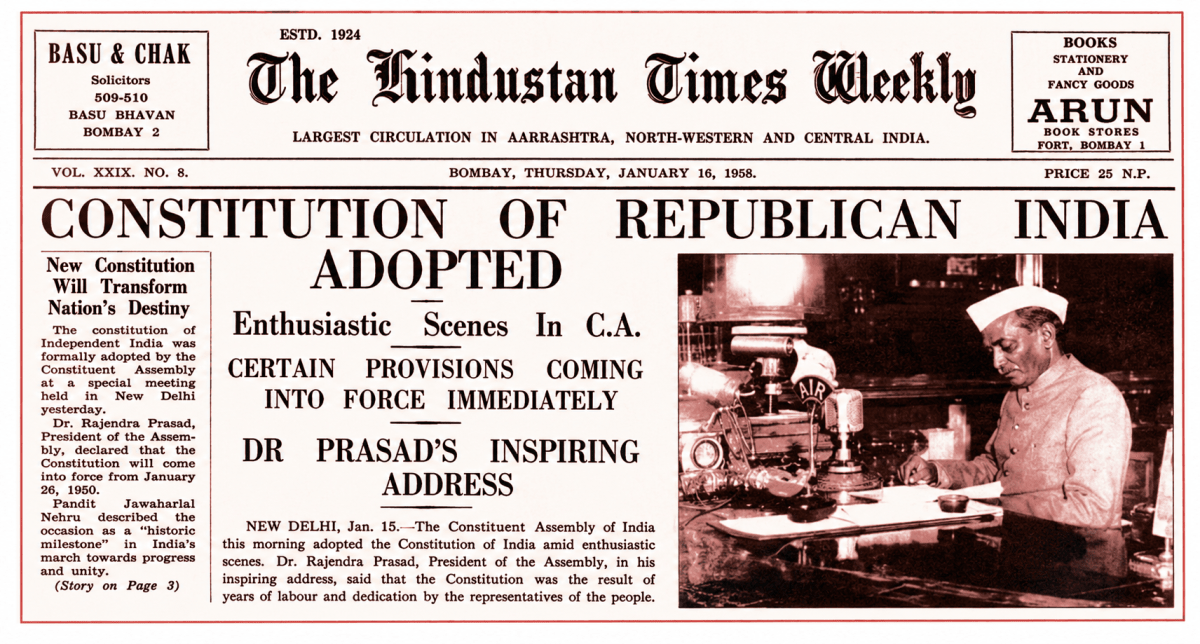
(a) What major national event is reported here?
(b) What form of government is indicated by the word Republican?
(c) Explain the significance of the adoption of this Constitution for India.
Answer
(a) The excerpt reports the adoption of the Constitution of India by the Constituent Assembly on November 26, 1949, by which India became a sovereign democratic republic.
(b) The word 'Republican' indicates a republic — a form of government in which the head of the State is an elected President instead of a hereditary monarch, and supreme power rests with the people through their elected representatives.
(c) The adoption of the Constitution was a decisive turning point in India's history from colonial rule to a sovereign democratic republic. Its significance can be seen as follows:
- It ended British rule completely and replaced colonial laws with a system framed by the Indians for the Indians.
- India formally became a sovereign democratic republic, with the head of the State being an elected President instead of the British monarch.
- It established India as a democracy by granting Universal Adult Franchise, ensuring political equality regardless of caste, gender, religion or wealth.
- It guaranteed Fundamental Rights such as Equality before Law, Freedom of Speech and Freedom of Religion, providing protection and dignity to every citizen.
- It laid the foundation for social justice by abolishing untouchability, prohibiting discrimination and introducing safeguards for backward and marginalised communities.
- It brought unity and stability to a diverse country by clearly defining the structure of government, federal relations and the role of an independent judiciary.
With reference to the given excerpt, answer the questions that follow:
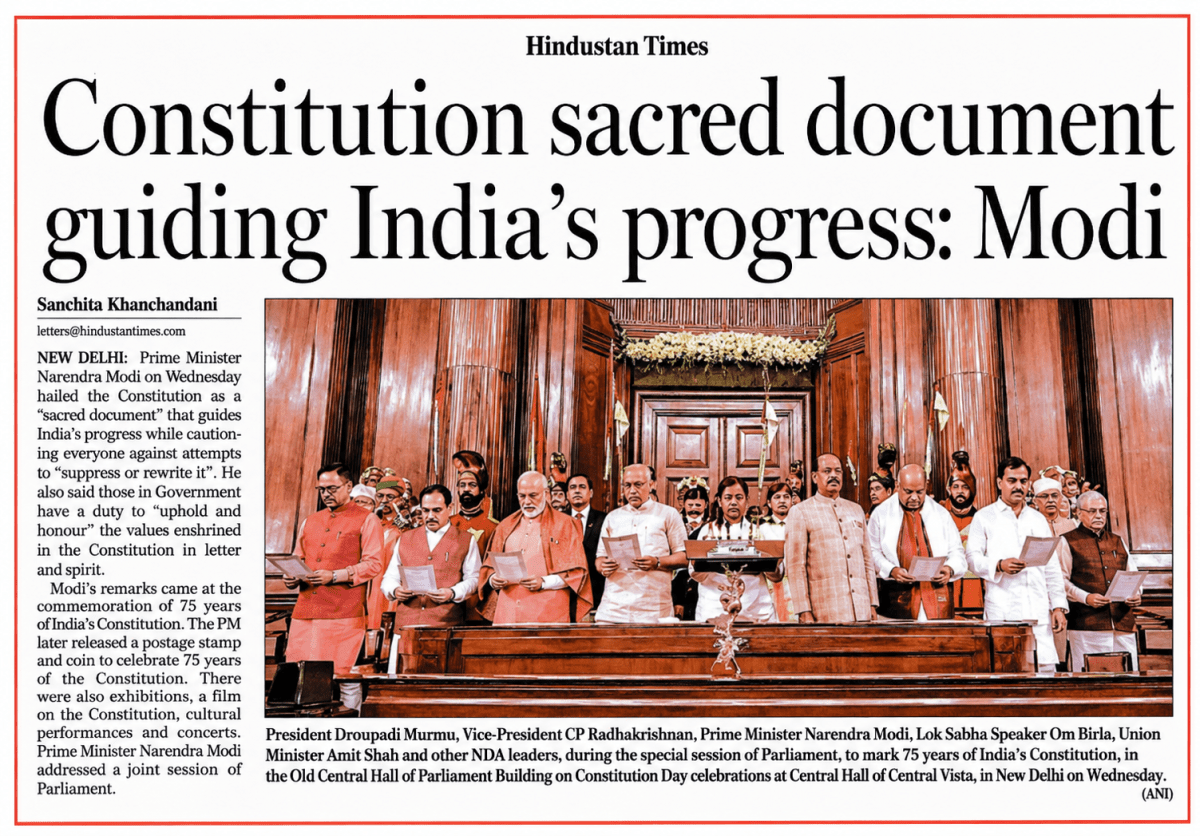
(a) Which day is being celebrated in the picture? When is it celebrated and why?
(b) What is the purpose of celebrating this day?
(c) Why is the Constitution described as 'sacred document guiding India's progress'?
Answer
(a) The day being celebrated in the picture is Constitution Day (Samvidhan Divas). It is celebrated on November 26 every year. It is celebrated because on November 26, 1949, the Constitution of India was adopted and passed by the Constituent Assembly.
(b) The purpose of celebrating this day is to promote the values enshrined in the Constitution of India among the citizens of India.
(c) The Constitution is described as a 'sacred document guiding India's progress' because it is not merely a legal document but a living guide that reflects the nation's ideals of justice, liberty, equality and fraternity. It provides the newly independent nation a clear political, legal and moral framework for governance, guarantees Fundamental Rights, ensures social justice and unity, and continues to serve and guide the country's progress even today.
The Constitution of India is the longest written Constitution in the world. What would have been the consequences if the Constitution of India was not written? Give reasons to support your answer.
Answer
The written Constitution enables to specify the structure, organisation, powers and functions of Central as well as State government. The written form of the constitution avoids any kind of misunderstanding and disagreements. If our constitution was not written there would have been scuffle, related to distribution of powers, subjects etc. Our rights would have been at risk. Policy makers may not have fairly represented the public opinion.
Do you think that the Constitution of India has an important role in maintaining the unity and integrity of India? Give reasons to support your answer.
Answer
India is a country of diversity. The constitution of India plays an important role to maintain the unity and integrity of India by its following principles:
- The Indian constitution is workable, flexible and strong enough to hold the country together both in peace and in war.
- It provides special safeguards to the minorities and certain classes, who are socially and educationally backward.
- Incorporates the Right to constitutional remedies to ensure that the fundamental rights of the individuals are not infringed by the Center or the State governments.
- Single citizenship, single judiciary and uniformity in fundamental laws to integrate Indian society. Therefore, a strong centre was proposed to maintain territorial integrity.
Dr. Bhimrao Ambedkar was a learned man with great foresight. Make a list of instances where his foresight came to our nation’s aid in times of crisis.
Answer
Dr. Bhimrao Ambedkar was a visionary leader and one of the most influential figures in India's struggle for independence and post-independence nation-building. He had a keen understanding of the socio-political landscape of India and made several contributions that proved to be invaluable for the nation. Here are a few instances where his foresight came to the nation's aid in times of crisis:
- Drafting the Indian Constitution — As Chairman of the Drafting Committee, he built a resilient democratic framework designed specifically to unite India’s diverse cultural, linguistic, and religious landscapes.
- Reservation policy — He institutionalized affirmative action in the Constitution, securing equal opportunities to help marginalized communities overcome centuries of systemic discrimination.
- Labour laws — He championed protective workplace legislation, successfully anticipating and preventing the widespread exploitation of industrial workers in post-independence India.
- Women's rights — He systematically integrated gender equality into the constitutional framework, laying the groundwork for equal rights and women’s empowerment.
- Social reforms — He drove major societal transformations by spearheading the legal abolition of untouchability and actively promoting inter-caste marriages to build an egalitarian society.
The Indian Constitution has taken the best features from the Constitutions of countries around the world. Make a list of few of these features stating which country inspired them and how have they been modified to suit the needs of our country.
Answer
The Indian Constitution has taken following features from the Constitutions of countries around the world:
- Concurrent list (Australia)
- Joint-sitting of two houses of parliament (Australia)
- Directive principles of state policy (Ireland)
- Nomination of Rajya Sabha Members (Ireland)
- Fundamental Duties (Russia)
- Parliamentary Government (UK)
- Single Citizenship (UK)
- Ideals of Liberty, equality and fraternity (France)
Makers of our constitution gathered the best features of all the existing constitutions and modified them with a view to avoid the faults that have been disclosed in their constitution. The ideas have been modified as per the need of our country. For example, to avoid the dead lock condition arising due to differences between Rajya Sabha and Lok Sabha, provision of joint sitting was incorporated.
Trace how the Republic Day has been celebrated over the years.
Answer
Republic Day celebrations in India have evolved over the years, reflecting the changing priorities and aspirations of the nation. However, the underlying spirit of national pride and patriotism has remained constant throughout the years. Here is a brief history of how Republic Day has been celebrated in India over the years:
- First Republic Day Celebration (1950) — The first Republic Day was celebrated on January 26, 1950, with a grand parade held at Rajpath in New Delhi. The parade showcased India's diverse cultural heritage, and it was attended by representatives from various countries.
- First Chief Guest (1951) — The first chief guest at the Republic Day parade was Indonesian President Sukarno in 1951. Since then, India has invited guests from different countries each year to attend the celebrations.
- Integration of States (1956) — In 1956, India celebrated Republic Day with the theme of "Integration of States." This was a significant event in India's history, as it marked the reorganization of states on linguistic lines.
- Beating Retreat (1950s) — The Beating Retreat ceremony, which marks the end of the Republic Day celebrations, was introduced in the 1950s. It is held on January 29th every year and features a display of military bands.
- First Presidential Address (1952) — The first Presidential address on Republic Day was delivered by Dr. Rajendra Prasad in 1952. Since then, it has become a tradition for the President of India to address the nation on this occasion.
- Cultural Programmes (1960s) — In the 1960s, Republic Day celebrations included cultural programs from different parts of the country. These programs showcased the rich diversity of India's cultural heritage.
- Military Parade (1970s) — In the 1970s, the Republic Day parade became more focused on the display of India's military might. The parade included a display of tanks, missiles, and other weapons.
- Technology Showcase (1990s) — In the 1990s, the Republic Day parade began to showcase India's technological advancements. This included displays of satellites, space vehicles, and other technological innovations.
- Women Empowerment (2019) — In 2019, the theme of Republic Day was "Nari Shakti," which means "Women's Power." The parade showcased women's achievements in various fields, including the armed forces, science, and sports.
- Azadi ka Amrit Mahotsav (2022) — In 2022, as India celebrated 75 years of independence the theme of Republic Day was "Azadi ka Amrit Mahotsav".
- Jan-Bhagidari (2023) — The theme of Republic Day in 2023 was Jan-Bhagidari which means participation of people.