
How has the idea of democracy evolved over time and shaped our understanding of it today?
Answer
Democratic thinking in India started long ago with traditional assemblies like the Sabha, Samiti, gaṇas, saṁghas, and Bauddha Saṁghas, where people discussed issues and made group decisions. Although British rule later restricted people's involvement, the struggle for independence brought these democratic ideas back to life. Combined with global democratic values, these traditions helped shape the Constitution of India. Today, democracy means a system run by the power of the people, built on liberty, equality, justice, rights, the rule of law, government accountability, and active public involvement.
What are the different forms of democracy, and how are they practised in India and other parts of the world?
Answer
Democracy does not offer a single model of government, and its features vary from country to country. The main forms are:
- Direct Democracy — Citizens directly participate in most decision-making processes. It is difficult to follow in large countries. Example — Switzerland.
- Representative Democracy (Indirect Democracy) — People elect their representatives and do not directly govern. Elections are held periodically and the government is accountable to the people. Example — India.
- Parliamentary Democracy (a form of representative democracy) — Members of the executive are also part of the legislature, the executive is accountable to the legislature, and people elect the legislature but not the executive. Examples — India and Canada.
- Presidential Democracy (a form of representative democracy) — The executive is independent of the legislature, the President is elected by the people and is accountable to them. Example — United States of America.
How these forms are practised:
- India is a representative parliamentary system with a multi-party setup, federal structure, written constitution, and Fundamental Rights. Executive power rests with the Prime Minister and Council of Ministers (Head of Government), while the President is the Head of State.
- Canada is a parliamentary democracy where executive power lies with the Prime Minister. The Monarch is the Head of State and is represented federally by the Governor General.
- The United Kingdom is also a parliamentary system with a constitutional monarchy. Executive authority belongs to the Prime Minister, the Monarch is Head of State, and governance relies on an unwritten constitution.
- Switzerland practises direct democracy alongside a written constitution, multi-party system, and governance by a Federal Council.
- The United States of America is a presidential democracy with a written constitution and two major political parties, where the President serves as Head of Government.
What are the essential features of a democracy and how do they extend beyond government institutions?
Answer
Essential features of a democracy:
- Popular Sovereignty: Real power belongs to the people, who choose their leaders through free elections using the Universal Adult Franchise.
- Rule of Law: Every person is equal under the law, and no one is above it.
- Fundamental Rights: Six core rights protect citizens' freedoms and dignity, enforceable through courts.
- Separation of Powers: The legislature makes laws, the executive implements them, and the judiciary interprets them, helping to maintain checks and balances.
- Accountability & Transparency: Citizens check government actions through elections, debates, oversight bodies (CAG, CIC, Lokpal, CVC), and the Right to Information (RTI) Act.
- Multi-Party System: Multiple parties compete, giving voters diverse choices and viewpoints.
- Protecting Vulnerable Groups: The State works to ensure equal opportunities and equitable distribution of resources for vulnerable sections, as reflected in Article 46.
Extending Beyond Government:
- Democracy appears in daily life through personal responsibility, open decision-making, and community participation.
- Groups like cooperatives, trade unions, civil society, and local bodies run on democratic principles.
- The media acts as the "fourth pillar" by informing the public and voicing citizen concerns.
- Citizens participate through local bodies such as Gram Sabhas and public consultations, and can also seek justice through Public Interest Litigations (PILs).
What are the challenges faced by Indian democracy?
Answer
- Low literacy, social inequality, and economic poverty limit equal political participation.
- The spread of fake news on social media creates public confusion, misinforms voters, and risks triggering conflicts.
- Issues such as regionalism, gender inequality, and social discrimination create barriers to equal participation and adequate representation.
- Gaps in the effective implementation of laws and policies may reduce public trust in institutions.
- Unlawful acts (like damaging public property) and citizen indifference hurt the health of democracy.
- Historical shocks, such as the 1975–77 Emergency, where fundamental rights were suspended and the press was censored, show how democratic frameworks can come under strain.
The Constitution not only guarantees Fundamental Rights to citizens but also outlines their Fundamental Duties and the Directive Principles of State Policy. Discuss their significance and identify the differences among them.
Answer
Significance:
- Fundamental Rights protect the rights, freedom and dignity of citizens and help ensure equality and justice.
- Fundamental Duties remind citizens that they also have responsibilities, such as respecting others’ rights, following laws and protecting public property.
- Directive Principles of State Policy guide the government in making policies for the welfare of the people, especially the weaker sections of society.
Differences:
- Fundamental Rights are rights guaranteed by the Constitution and can be enforced by courts.
- Fundamental Duties are constitutional responsibilities of citizens that encourage responsible conduct and respect for democratic values.
- Directive Principles of State Policy guide the government in making laws and policies for social welfare and justice. They are not enforceable by courts.
The Right to Education (Article 21A) was added in 2009, ensuring free and compulsory education for children aged 6 to 14. Discuss its significance.
Answer
- By adding the Right to Education as Article 21A, education became a Fundamental Right, making it enforceable through courts.
- It provides free and compulsory education to children aged 6 to 14 years, helping promote equal educational opportunities.
- It helps reduce illiteracy and social inequality by improving access to elementary education, especially for disadvantaged children.
- Education creates informed and responsible citizens, enabling them to understand public issues and participate effectively in democratic processes.
- It supports the constitutional objective of promoting the educational and economic interests of weaker sections.
The first column of the table below lists some key features of democracy in India. Fill in the second column with suitable examples from your state, town, or village. One row has been completed for you.
| Features of Democracy | Examples |
|---|---|
| Popular Sovereignty | |
| Rule of Law | |
| Separation of Powers | |
| Fundamental Rights | |
| Accountability and Transparency | Parliamentary procedures such as Question Hour and the auditing of government accounts ensure accountability. Laws like the Right to Information provide transparency. |
| Multi-Party System |
Answer
| Features of Democracy | Examples |
|---|---|
| Popular Sovereignty | Citizens aged 18 and older in my town cast secret ballots during Lok Sabha, Assembly, and local elections to choose their representatives. |
| Rule of Law | Traffic and civic laws apply to everyone equally, and violators face standard court procedures regardless of their status. |
| Separation of Powers | The State Assembly passes state laws, administrative departments enforce them, and local courts interpret them and review executive actions. |
| Fundamental Rights | Children from different social backgrounds study together in local schools, and residents freely express opinions and practice their chosen faith. |
| Accountability and Transparency | Parliamentary tools like Question Hour and account audits ensure accountability, while the RTI Act gives citizens access to government records. |
| Multi-Party System | Multiple political parties contest Lok Sabha and State Assembly elections, giving voters different political choices. |
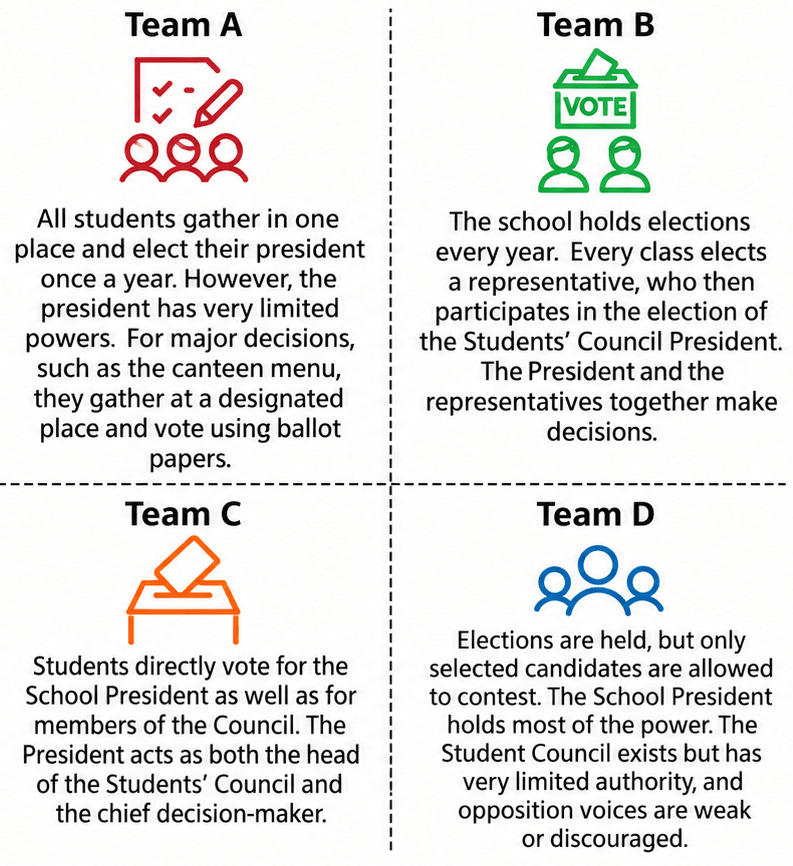
Select your ideal team from Fig. 6.5 and give reasons for your selection.
Imagine your school is celebrating a 'Youth for Democracy' festival. Students' Councils from different countries are visiting your school. Each follows its own model of functioning, similar to how countries around the world practise democracy. Let us see what we can learn from them. These examples show that systems may differ in how power is shared, who participates in decision-making, and whether checks and balances are in place.
Answer
I would select Team B as the ideal team because:
- It follows a more representative and balanced democratic system, as every class elects a representative.
- The elected representatives take part in choosing the Students’ Council President, so students are represented in the decision-making process.
- The President and the representatives make decisions together, which encourages consultation and shared responsibility.
- Power is not concentrated in one person, which helps maintain checks and balances in decision-making.
- Therefore, Team B reflects important democratic values such as representation, participation, consultation and collective decision-making.
Work in pairs or small groups. Choose any two of India's neighbouring countries (Afghanistan, Bangladesh, Bhutan, China, Maldives, Myanmar, Nepal, Pakistan, or Sri Lanka) and find out the following:
a. Does the country hold regular elections?
b. Who chooses the Head of the Government?
c. Is there more than one political party?
d. How much freedom do citizens have to express their opinions and criticise the government?
How would you describe this system? Give reasons for your answer.
- Democratic
- Partially democratic
- Non-democratic
Answer
The two countries chosen for this activity are Bhutan and China.
Bhutan
a. Yes, Bhutan holds regular elections. It became a parliamentary democracy in 2008, and elections to the National Assembly are held at fixed intervals.
b. The Prime Minister, who is the Head of the Government, is the leader of the party that wins a majority in the National Assembly. The King is the Head of State in this constitutional monarchy.
c. Yes, more than one political party exists and parties contest elections, although the number of parties is small.
d. Citizens can express their opinions and take part in public discussion, though the freedom to criticise the government is more limited than in India.
System Type — Democratic. Bhutan holds regular elections, has an elected legislature, more than one political party and a written constitution, so power is derived from the people through periodic elections.
China
a. China holds elections for some local people's congresses, but citizens do not directly choose the national government through competitive multiparty elections.
b. The Premier is the Head of the Government. The Premier is formally chosen through the National People's Congress, while the Communist Party of China plays the dominant role in selecting the country's leadership.
c. China has the Communist Party of China and several other recognised political parties. However, these parties do not compete with the Communist Party for political power in the way parties do in a multiparty democracy.
d. Citizens have limited freedom to criticise the government. Political expression and the media are subject to government controls and censorship.
System Type — Non-democratic. Although elections are held at some levels, China does not have competitive multiparty elections for national political power, the Communist Party remains dominant, and freedom of political criticism is restricted.
A democratic system seeks to promote participation, ensure fairness, limit the concentration of power, and resolve disagreements peacefully. Identify examples from the above case study that reflect these features.
Answer
- Participation — Jethipura organised Gram Sabhas, Special Gram Sabhas and Mahila Sabhas, ensuring the participation of women and marginalised groups. South Manubankul promotes women’s participation in decision-making and supports community programmes and self-help groups.
- Fairness — Jethipura addressed issues related to education, sanitation and the welfare of women and children, while South Manubankul focuses on health, sanitation, livelihoods and inclusive development.
- Limiting the concentration of power — The use of Gram Sabhas and Mahila Sabhas provides opportunities for different sections of the community to participate in local decision-making, rather than leaving participation to a few individuals.
- Resolving disagreements peacefully — The case study does not provide a specific example of this feature, so no direct example can be identified from the given text.
These examples show that democracy extends beyond elections. Active citizen participation in grassroots institutions makes democracy more responsive, inclusive and effective.
India continues to work towards more inclusive institutions. Discuss in class about the advantages of increased representation of women in the legislature.
Answer
- Empowerment — Greater representation enables women to participate in decision-making and shape laws and policies.
- Representation of women’s issues — Women representatives can raise issues concerning women, such as health, sanitation, education and livelihoods, as seen in the South Manubankul Gram Panchayat.
- Overcoming social barriers — Although universal adult franchise was introduced in 1950, social prejudices can still limit women’s political representation. Greater representation can help overcome these barriers.
- Building on local representation — Articles 243D and 243T provide for at least one-third reservation for women in Panchayats and Municipalities. Several States and Union Territories have provided 50 per cent reservation at the local level.
- Inclusive democracy — Greater representation makes democratic institutions more inclusive and representative.
- Role models — Women leaders can encourage more girls and women to participate in public life.
In small groups, identify two or three examples of information shared on social media that you believe may be misleading or false. Discuss what made you question their reliability and how such information can influence people's opinions. Reflect on why access to accurate and authentic information is important in a democracy.
Answer
Examples of misleading or false information:
- A message claiming that a home remedy can cure a serious disease.
- An old photograph or video presented as a recent event.
- A message falsely claiming that a government scheme is giving money to everyone who forwards it.
What made us question their reliability:
- No credible or official source is mentioned.
- The language is sensational and urges immediate forwarding.
- The information cannot be verified through reliable news or official websites.
- Important details such as the date or place are missing or inconsistent.
How such information can influence people’s opinions:
- It can create confusion, panic or conflict.
- It can lead people to form false opinions about a community, leader or policy.
- It can result in wrong decisions about health, safety or money.
Importance of accurate information in a democracy:
- Accurate information helps citizens form informed opinions and participate responsibly in democracy.
- It enables citizens to question the government and hold it accountable; the Right to Information Act, 2005 allows citizens to seek information from government authorities.
- Media literacy and responsible use of social media help reduce the harmful effects of misinformation.
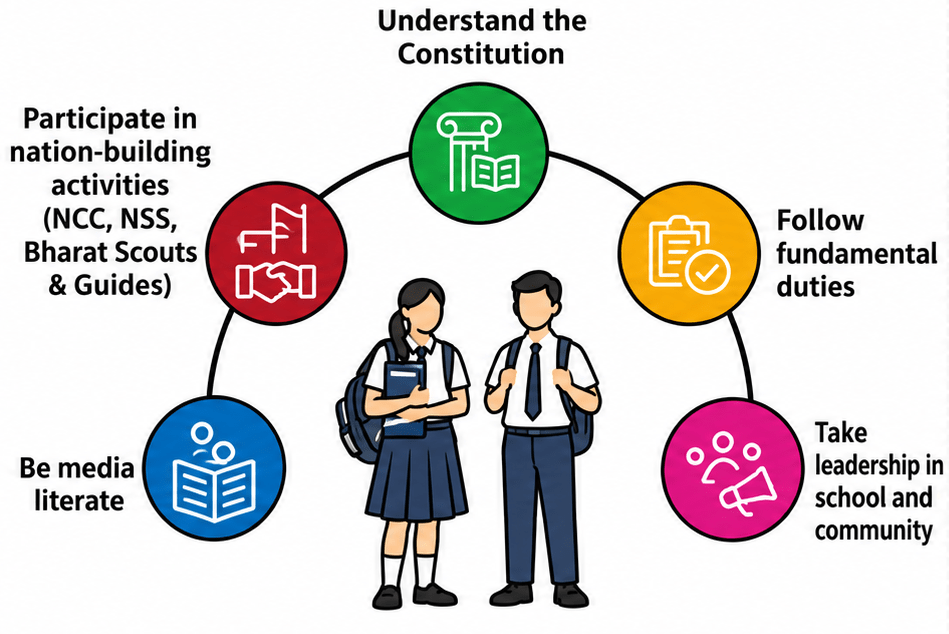
Observe Fig. 6.9 and explore the various other digital and non-digital ways through which you can participate in a democracy.
Answer
The ways shown in Fig. 6.9 are being media literate, understanding the Constitution, following Fundamental Duties, taking leadership in school and community, and participating in nation-building activities such as the NCC, NSS and Bharat Scouts & Guides.
Other digital ways of participating in a democracy:
- Reading news on authentic websites and watching news programmes to stay aware of national and international events.
- Using the internet and social media responsibly to share correct information and raise public issues.
- Filing applications online under the Right to Information Act, 2005 to seek information from government departments.
- Using official government portals and mobile applications to give suggestions, register complaints or take part in public consultations.
Other non-digital ways of participating in a democracy:
- Voting in elections on attaining the age of 18 years and helping family members to vote.
- Attending Gram Sabha or ward meetings and taking part in discussions on local issues.
- Writing to elected representatives about problems in the locality.
- Taking part in community service, cleanliness drives and awareness campaigns.
- Reading newspapers, joining school debates and student council elections, and respecting the rights and opinions of others in everyday life.
Why is it important that the ultimate source of power rests with the people in a democracy?
Answer
- In a democracy, the state derives its authority from the people, which is the idea of popular sovereignty.
- When power rests with the people, the government is formed through free and fair elections and works according to the will of the people.
- It ensures that the government remains accountable to citizens, because people can evaluate its actions and change it through elections.
- It prevents the misuse of power by any individual or group, since authority is exercised on behalf of the people and within the limits of the Constitution.
- It gives every citizen an equal share in decision-making through the Universal Adult Franchise, which supports equality, justice and dignity.
How does people's participation through voting strengthen popular sovereignty?
Answer
- Every citizen of 18 years of age and above has the right to vote through a secret ballot under the Universal Adult Franchise, and by exercising this right people choose their governments and representatives.
- A government elected through free and fair elections formulates policies and implements laws, so the authority it exercises comes directly from the people.
- Periodic elections allow people to review the work of the government and either continue with it or replace it, which keeps authority in the hands of the people.
- In India, elections become a collective national exercise in which voices from different regions and communities are expressed through the ballot, reinforcing the position of the people as the source of power.
- The general elections held after the Emergency was lifted in 1977 allowed people to express their will through the ballot, and the defeat of the ruling government showed the strength of popular sovereignty.
What do you think would happen if the same organ of the government made laws, implemented them, and enforced them? Share your thoughts with your classmates.
Answer
- Power would be concentrated in one organ of the government, which the separation of powers is meant to prevent.
- There would be no checks and balances among the legislature, the executive and the judiciary, and the misuse of power would become easy.
- There would be no impartial authority to interpret laws or to declare a law unconstitutional if it were inconsistent with constitutional provisions.
- Citizens’ Fundamental Rights would be unprotected, because the same organ that made an unjust law would also decide disputes arising from it.
- Decisions could be taken by force or personal influence rather than through the procedure established by law, and people would lose the fair opportunity to defend their rights against arbitrary action.
- Justice, accountability and public trust in the democratic system would weaken, and democracy itself would be endangered.
As we studied in earlier grades, the village serves as a unit of grassroots democracy in India, empowering rural communities to participate in decision-making processes. Many Indian leaders, such as Chaudhary Charan Singh and Babu Jagjivan Ram, who emerged from these rural backgrounds, advocated for the rights of the rural poor and other marginalised sections of society.
Explore and discuss the contributions of eminent Indian leaders who worked towards strengthening grassroots democracy.
Answer
Contributions of eminent Indian leaders towards grassroots democracy:
- Mahatma Gandhi strongly supported the idea of Gram Swaraj, in which villages would govern themselves through active participation of local people.
- Vinoba Bhave worked for rural upliftment through the Bhoodan Movement, encouraging landowners to donate land to the landless and promoting social justice in villages.
- Jayaprakash Narayan supported decentralisation of power and greater participation of people in local governance. He believed that democracy should be strengthened from the grassroots level.
- Nanaji Deshmukh worked for village development, self-reliance and community participation, especially in rural areas.
These leaders strengthened grassroots democracy by promoting participation, social justice, rural development and local self-government.
Think: How do your actions as a student contribute to your school community and to democracy in a larger context?
Answer
As a student, I can contribute to my school community by following rules, respecting others’ rights, protecting public property, and taking responsibility in school activities. I can participate in discussions, take leadership roles and work with others to solve common problems. By being media literate, understanding the Constitution, and following my Fundamental Duties, I develop responsible citizenship. Such actions promote participation, cooperation, respect, and civic responsibility, which help strengthen democracy in the larger society.
Discuss: Talk to your classmates about a social or community issue that you care about. How can you, as a student, make a difference?
Answer
One social issue I care about is cleanliness in the school and neighbourhood. As a student, I can make a difference by keeping my surroundings clean, avoiding littering, spreading awareness among classmates, and encouraging others to protect public property. I can also participate in school or community cleanliness drives and work with others to solve the problem.
Act: Choose one activity to fulfil your civic responsibility this month. Reflect on how your actions contribute to strengthening democracy and community spirit.
Answer
One activity I can undertake this month is to participate in a cleanliness drive in my school or neighbourhood. By keeping public spaces clean, encouraging others not to litter and taking care of public property, I fulfil my civic responsibility. Such participation develops cooperation, responsibility and concern for the community. It also strengthens democracy because active and responsible citizens contribute to the well-being of society and promote a strong community spirit.
Read the passage and answer the questions that follow:
A school cabinet was responsible for planning a Republic Day celebration, and members had different opinions on which activities to include. After a discussion, they decided to vote, and the activities supported by the majority were selected.
a. Which democratic values are reflected in this situation?
b. How does voting help resolve differences of opinion?
c. Why is the majority decision important in a democracy?
d. Mention responsibilities of elected representatives after a decision is made.
Answer
a. Which democratic values are reflected in this situation?
- Deliberation and debate, because the members first discussed the different activities.
- Respect for diverse opinions and dissent, because members with different views were allowed to express them.
- Participation and equality, because every member took part and each vote counted equally.
- Collective decision-making and the peaceful resolution of disagreements through voting rather than force.
b. How does voting help resolve differences of opinion?
- When members hold different opinions, voting gives each of them an equal say in the final decision.
- The option supported by most members is accepted, so a clear decision is reached without quarrel or the use of force or personal influence.
- Since everyone has taken part in the process, even those who disagreed accept the outcome as fair.
c. Why is the majority decision important in a democracy?
- It provides a fair and practical way for a group to reach a common decision.
- It reflects the choice of the greater number of participants while allowing minority opinions to be respected and expressed.
d. Mention responsibilities of elected representatives after a decision is made.
- To implement the decision honestly and carry out the work assigned to them.
- To remain accountable to those who elected them and to explain their actions when questioned.
- To work with transparency and maintain proper records of the decisions taken.
- To respect the opinions of the minority and work for the benefit of all members, not only those who supported them.
How would democracy be affected if citizens stopped following laws and civic responsibilities? Explain with an example.
Answer
- Democracy requires constant care, awareness and active participation from both institutions and citizens. If citizens stopped following laws and civic responsibilities, democratic values would weaken.
- The Rule of Law would break down, disputes would be settled by force or personal influence instead of the procedure established by law, and people’s rights would no longer be protected.
- Indifference towards public issues would adversely affect the health of a democracy, and public trust in institutions would fall.
- Example — If people damage public property such as buses, street lights and school buildings during a protest, the resources of the whole community are destroyed and the money meant for development has to be spent on repairs. Similarly, if citizens spread misinformation on social media, it can influence public opinion, create confusion and sometimes even lead to conflict.
- Therefore, the strength of a democracy depends not only on its institutions and laws but also on informed and responsible citizens who actively participate in shaping their society.
Which situation best reflects the idea of popular sovereignty and why?
- A law is passed without public discussion
- Citizens vote to choose their representatives
- A court gives a final judgment
- A minister takes an independent decision
Answer
Citizens vote to choose their representatives.
Reason — Popular sovereignty means that the ultimate source of power lies with the people. By voting in free and fair elections, citizens choose their representatives and exercise their authority in a democracy.
The Rule of Law is violated when:
- Laws are applied equally to all
- Courts review government actions
- Powerful individuals are treated above the law
- Citizens challenge laws through legal means
Answer
Powerful individuals are treated above the law.
Reason — The Rule of Law establishes that no one is above the law, so treating powerful individuals as an exception violates it. Applying laws equally to all reflects equality before the law, the review of government actions by courts is a part of checks and balances, and challenging laws through legal means is the use of procedures established by law — all three uphold the Rule of Law rather than violate it.
Why is the Rule of Law essential for protecting democracy?
Answer
The Rule of Law is essential for protecting democracy because:
- It ensures equality before the law and establishes that no one is above the law.
- It ensures that disputes and violations are dealt with through lawful procedures, rather than force or personal influence.
- It prevents the arbitrary exercise of power and protects people’s rights.
- It ensures that citizens are not deprived of their rights except through procedures established by law and provides legal safeguards against arbitrary action.
- Judicial review enables courts to examine government actions and laws for consistency with the Constitution.
- Thus, the Rule of Law promotes justice, accountability and public trust in democracy.
Is voting alone enough to make a country democratic? Support your answer with examples from the chapter.
Answer
No, voting alone is not enough to make a country democratic.
- Democracy involves participation, institutions, rules and practices that enable people to take part in decision-making; it is not limited to elections.
- A democracy also requires the Rule of Law, Fundamental Rights, accountability, transparency, separation of powers and protection of vulnerable groups.
- In Fig. 6.5, Team D holds regular elections, but only selected candidates can contest, the President holds most of the power and opposition voices are discouraged. This shows that elections alone do not ensure democracy.
- The Emergency of 1975–77 showed how democratic institutions can be weakened when Fundamental Rights are suspended, the press is censored and political leaders are arrested.
- The Jethipura and South Manubankul Gram Panchayats show that democracy is strengthened by citizens’ participation in Gram Sabhas, Mahila Sabhas and local self-government.
Thus, democracy requires not only elections but also effective institutions, protection of rights, accountability and active, responsible citizens.
Social media allows people to express opinions freely.
a. How can this strengthen democracy?
b. How can it weaken democracy if used irresponsibly?
Answer
a. How can this strengthen democracy?
- Social media allows citizens to express opinions and discuss public issues.
- It can spread useful information quickly and make people more aware of current events.
- It enables citizens to raise concerns, share viewpoints and take part in public debate.
- When used responsibly, it can support accountability by drawing attention to issues that affect the public.
b. How can it weaken democracy if used irresponsibly?
- The spread of fake news through social media and other digital platforms has emerged as a major concern in recent times.
- Such misinformation can influence public opinion, create confusion and sometimes even lead to conflict.
- Irresponsible use can disrespect others’ rights and damage the trust between citizens and institutions.
- Therefore, civic responsibility includes using social media responsibly and being media literate so that only accurate and authentic information is shared.
Write a paragraph on what democracy means to you as a young citizen.
Answer
As a young citizen, democracy means more to me than voting in elections. It means that people are the source of political power and that the government remains accountable to them. It ensures equality before the law, protects Fundamental Rights and allows me to express my opinions while respecting those of others. Democracy also involves responsibility—following the Constitution and Fundamental Duties, protecting public property, being media literate and avoiding misinformation. I can practise democracy by participating in school elections, discussions and community service, and later by voting when I turn 18. Thus, democracy means living together with freedom, equality, justice and cooperation as an informed and responsible citizen.
Choose any one democratic institution in India (such as Parliament, Election Commission, Judiciary, or Panchayat).
Prepare a short note explaining:
a. Its role in democracy
b. How it ensures accountability and participation.
Answer
Parliament
a. Role in democracy:
- Parliament is the main legislative institution at the national level and is responsible for making laws.
- It represents the people through their elected representatives.
- Parliamentary discussions and debates promote representation, deliberation and dissent in a democracy.
b. How it ensures accountability and participation:
- Parliament holds the government accountable through procedures such as Question Hour and discussion of government actions.
- Government accounts are audited by the Comptroller and Auditor General (CAG), and Parliament examines such reports to help ensure accountability and transparency.
- Citizens participate in democracy by electing their representatives, who raise public issues and take part in decision-making in Parliament.
What role does the Constitution play in strengthening democracy in India?
Answer
- The Constitution provides the framework for democracy in India, safeguarding citizens’ rights and establishing democratic principles. It was adopted on 26 November 1949 and came into force on 26 January 1950.
- It provides for popular sovereignty, universal adult franchise, Fundamental Rights, Fundamental Duties, the Rule of Law and separation of powers.
- It protects Fundamental Rights and prohibits discrimination on grounds such as religion, race, caste, sex and place of birth. Citizens can seek constitutional remedies under Articles 32 and 226.
- It promotes citizen participation through elections and strengthens democracy at the national, state and local levels.
- It divides powers among the legislature, executive and judiciary and provides for judicial review of laws and government actions.
- Article 368 provides a procedure for amending the Constitution, allowing it to respond to changing needs while preserving its fundamental values.
- It promotes the interests of weaker sections, with Article 46 directing the State to give special care to their educational and economic interests, particularly those of the Scheduled Castes and Scheduled Tribes.
- It strengthens local self-government and provides for reservation for women in Panchayats and Municipalities under Articles 243D and 243T, as well as Autonomous District Councils for certain tribal areas.
What challenges do you think democracy in India faces today?
Answer
- Illiteracy remains a challenge, as it limits people’s ability to understand issues and participate fully in democratic processes.
- Misinformation and the spread of fake news, especially through social media and other digital platforms, can influence public opinion, create confusion and sometimes even lead to conflict.
- Inequality, poverty and social discrimination create barriers to equal participation.
- Regionalism can weaken the sense of unity among people from different parts of the country.
- Gender inequality persists, and social prejudices continue to affect women’s adequate representation in politics.
- Gaps in the effective implementation of laws and policies may reduce public trust in institutions.
- Actions such as damaging public property, spreading misinformation or violating public rules weaken democratic values, and indifference towards public issues affects the health of a democracy.
- Ensuring deeper inclusion and representation continues to be a challenge even though India has made significant progress in this direction.