
Komal, a biology student of class X observed that the smell of freshly cut grass in her garden spread rapidly in the air around it. This phenomenon is an example of:
- diffusion
- osmosis
- imbibition
- capillarity
Answer
diffusion
Reason — Diffusion is the movement of molecules from a region of their higher concentration to a region of their lower concentration. The scent molecules of the freshly cut grass move from the region where they are concentrated into the surrounding air, just as the fragrance of a lighted incense stick spreads through a room.
While playing cricket on a hot, summer afternoon, Rohan felt a little dizzy though he had a balanced meal. The doctor advised him to take an oral rehydration solution. What was most likely the reason for Rohan’s condition?
- Excessive urination
- Asphyxiation
- Low blood glucose level
- Excessive perspiration
Answer
Excessive perspiration
Reason — While playing on a hot afternoon, a large amount of water and salts is lost from the body as sweat. This loss leads to dehydration, which causes dizziness. An oral rehydration solution replaces the water and salts that have been lost.
Assertion (A): Plants do not have sense organs but still respond to different stimuli.
Reason (R): Plants have a well-developed hormonal system to respond to sunlight, gravity, water, etc.
- (A) is true and (R) is false.
- (A) is false and (R) is true.
- Both (A) and (R) are true and (R) is the correct explanation of (A).
- Both (A) and (R) are true, but (R) is not the correct explanation of (A).
Answer
Both (A) and (R) are true and (R) is the correct explanation of (A).
Reason — Plants have neither sense organs nor a nervous system, yet they respond to stimuli such as light, gravity and water. These responses are brought about by phytohormones like auxins. Hence the hormonal system correctly explains why plants are able to respond to stimuli.
Which of the following correctly describes the level of urea in the two blood vessels after a meal containing protein?
- Renal Artery - High; Renal Vein - High
- Renal Artery - High; Renal Vein - Low
- Renal Artery - Low; Renal Vein - Low
- Renal Artery - Low; Renal Vein - High
Answer
Renal Artery - High; Renal Vein - Low
Reason — The excess amino acids of a protein meal are deaminated in the liver to form urea. The renal artery brings this urea rich blood to the kidney, where urea is filtered out and removed in the urine. So the blood leaving the kidney through the renal vein contains much less urea.
A patient suffering with severe cholera:
- passes very little urine due to severe dehydration.
- passes excessive urine due to kidney overactivity.
- has blood in the urine as the first symptom.
- produces normal amounts of urine despite severe fluid loss.
Answer
passes very little urine due to severe dehydration.
Reason — In cholera, a large quantity of water is lost from the body through severe diarrhoea and vomiting. To conserve the little water that is left, the kidney tubules reabsorb more water, so only a small quantity of concentrated urine is passed.
Which of the following statements are correct?
P – Cobalt ions help in the opening of stomata.
Q – Strawberry leaves show guttation.
R – Duplicated chromosomes are joined at centrosome.
S – Conversion of ADP to ATP occurs in the light dependent phase.
- P and R
- Q and R
- P and S
- Q and S
Answer
Q and S
Reason — Guttation is the loss of water as droplets along the margins of leaves through hydathodes. It can be observed in many plants and is quite common in banana, nasturtium and strawberry so Q is correct. ADP is converted to ATP during the light dependent phase of photosynthesis, so S is correct. P is wrong because stomatal opening takes place by potassium ion exchange and not by cobalt ions. R is wrong because duplicated chromosomes are joined at the centromere and not at the centrosome.
Meena’s mother prepared a cucumber salad and garnished it with salt and pepper. After some time, she noticed that a lot of water had accumulated in the salad bowl. The cucumber slices underwent:
- active transport
- transpiration
- exosmosis
- endosmosis
Answer
exosmosis
Reason — The salt sprinkled on the cucumber makes the solution outside the cells more concentrated, that is hypertonic. Water therefore moves out of the cucumber cells through their semipermeable membranes and collects in the bowl. This outward movement of water is called exosmosis.
Which parts of the nephrons are present in the renal cortex and renal medulla?
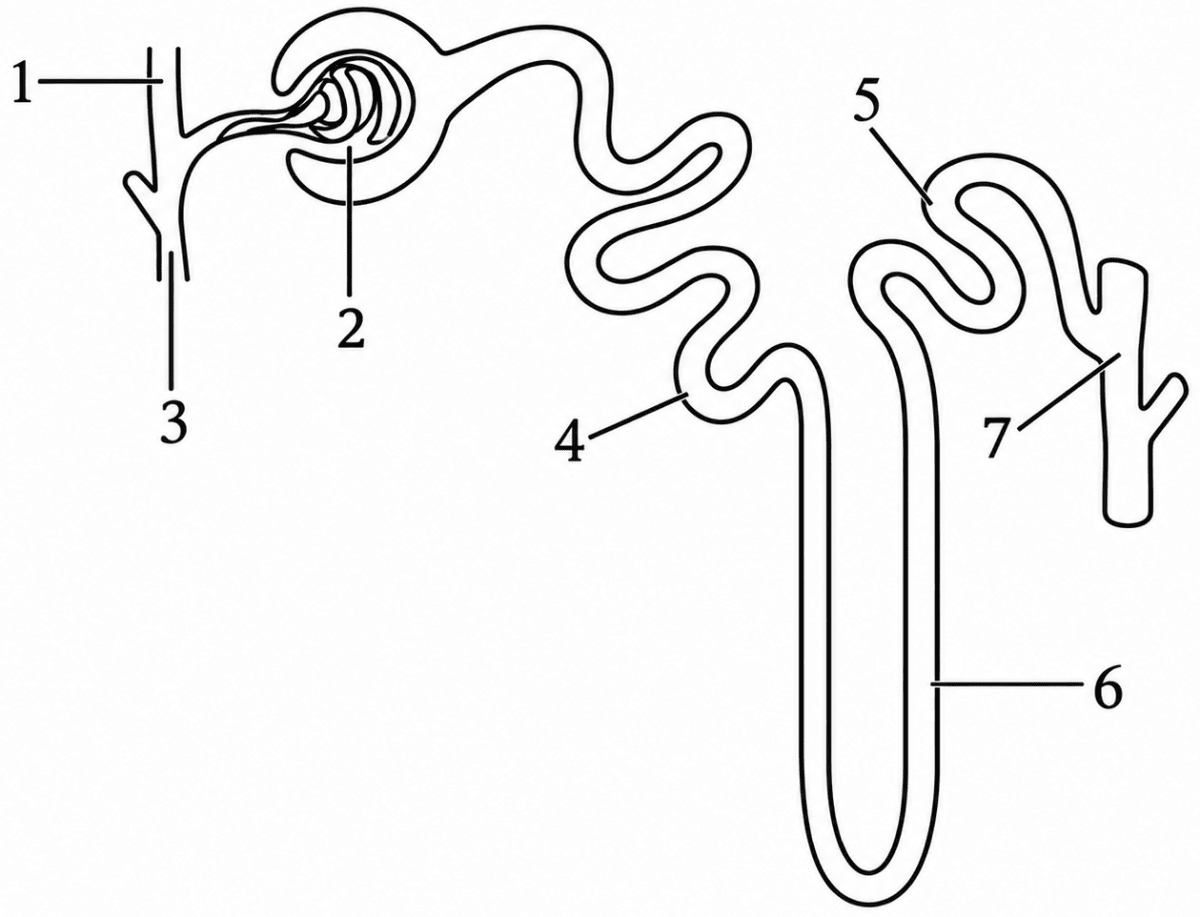
- Renal Cortex – 1, 2, 3; Renal Medulla – 4, 5, 6, 7
- Renal Cortex – 1, 2, 3, 4, 5; Renal Medulla – 6, 7
- Renal Cortex – 4, 5, 6, 7; Renal Medulla – 1, 2, 3
- Renal Cortex – 1, 2, 3, 4; Renal Medulla – 5, 6, 7
Answer
Renal Cortex – 1, 2, 3, 4, 5; Renal Medulla – 6, 7
Reason — In the figure, 1 is the afferent arteriole, 2 the glomerulus, 3 the efferent arteriole, 4 the proximal convoluted tubule and 5 the distal convoluted tubule. All of these lie in the renal cortex. The loop of Henle (6) and the collecting duct (7) run down into the renal medulla.
As the school bell rang for the lunch break, Tina’s mouth started watering thinking of her favourite food in the lunch box. This is a/an:
- voluntary action
- somatic reflex
- acquired reflex
- natural reflex
Answer
acquired reflex
Reason — Watering of the mouth at the mere sound of the school bell is a learnt response, formed by associating the bell with food. Such learnt responses are called acquired or conditioned reflexes, as shown by Pavlov in his experiment on a dog.
The path of blood flow during pulmonary circulation is:
- Right auricle, Right ventricle, Pulmonary artery, Lungs, Pulmonary veins, Left auricle.
- Left auricle, Left ventricle, Pulmonary veins, Lungs, Pulmonary artery, Right auricle.
- Left auricle, Left ventricle, Aorta, Tissues, Vena cava, Right auricle.
- Right auricle, Right ventricle, Pulmonary veins, Lungs, Pulmonary artery, Left auricle.
Answer
Right auricle, Right ventricle, Pulmonary artery, Lungs, Pulmonary veins, Left auricle.
Reason — In pulmonary circulation, deoxygenated blood is pumped from the right ventricle through the pulmonary artery to the lungs. After being oxygenated in the lungs, the blood returns to the left auricle through the pulmonary veins.
A rabbit in a food chain occupies the position of:
- producer
- primary consumer
- secondary consumer
- tertiary consumer
Answer
primary consumer
Reason — A rabbit is a herbivore and feeds directly on green plants, which are the producers. Organisms that feed directly on producers occupy the position of primary consumers in a food chain.
Assertion (A): Pericardial fluid is present between the heart and pericardium.
Reason (R): The human heart has four chambers.
- (A) is true and (R) is false.
- (A) is false and (R) is true.
- Both (A) and (R) are true and (R) is the correct explanation of (A).
- Both (A) and (R) are true, but (R) is not the correct explanation of (A).
Answer
Both (A) and (R) are true, but (R) is not the correct explanation of (A).
Reason — Pericardial fluid is present between the heart wall and the pericardium, and the human heart does have four chambers. However, the number of chambers has nothing to do with the presence of this fluid. The pericardial fluid protects the heart from shocks and reduces friction during its beating.
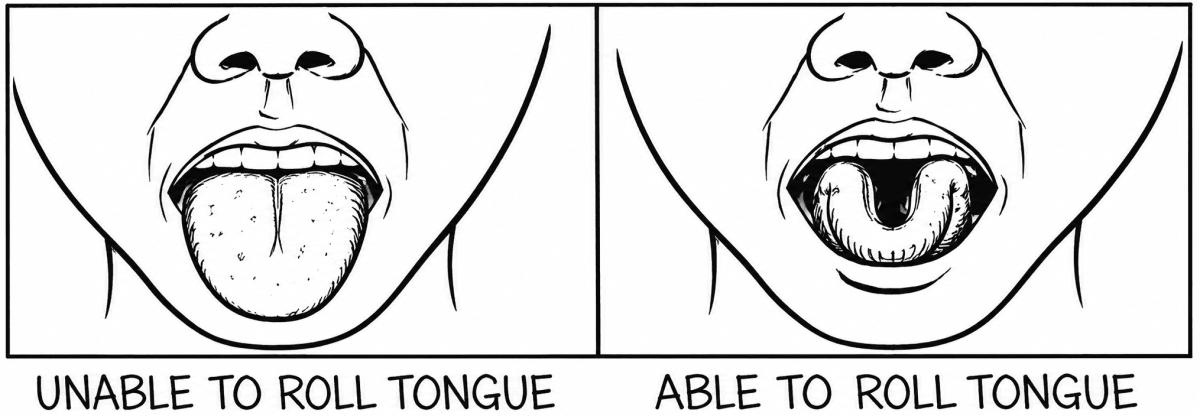
Tongue rolling is a dominant trait. Arun who cannot roll his tongue, marries a woman who is a carrier of the trait. What percentage of their children can roll their tongue?
- 25%
- 50%
- 75%
- 100%
Answer
50%
Reason — Arun cannot roll his tongue, so he is homozygous recessive (tt). His wife is a carrier, so she is heterozygous (Tt). The cross tt × Tt gives 50% Tt children, who can roll their tongue, and 50% tt children, who cannot.
For the past few years there has been irregular rainfall, leading to crop failures and water shortages. This is a result of:
- climate change
- soil erosion
- earth rotation
- acid rain
Answer
climate change
Reason — A long term change in the pattern of rainfall and temperature, leading to crop failure and water shortage, is an effect of climate change brought about by global warming.
Root hairs are epidermal outgrowths of the outermost layer of roots. They are well suited for absorption of water from the soil due to:
P – Large surface area
Q – Lower concentration of cell sap
R – Higher concentration of cell sap
S – Freely permeable cell membrane
- P and S
- Q and S
- P and R
- R and S
Answer
P and R
Reason — Root hairs are very fine and numerous, which gives them a large surface area for absorption. The cell sap inside them is more concentrated than the soil water, so water enters by endosmosis. Q is wrong because the cell sap is more concentrated, not less, and S is wrong because the cell membrane of the root hair is semipermeable, not freely permeable.
Give the biological / technical terms for the following:
(a) Respiratory openings present on the stems of woody plants.
(b) The fluid present between the cornea and lens of the eye.
(c) The canal through which the testes descend into scrotum just before the birth of a male baby.
(d) The type of cell division for the formation of gametes in humans.
(e) The neurotransmitter stored in the axon endings of neurons.
Answer
(a) Lenticels
(b) Aqueous humour
(c) Inguinal canal
(d) Meiosis
(e) Acetylcholine
The ovaries are a pair of small oval-shaped reproductive organs situated in the pelvic cavity of a female. They perform two main functions – production of female gametes and secretion of hormones. These hormones regulate the menstrual cycle and bring about the development of secondary sexual characteristics in females.
Select the correct terms to fill in the blanks:
[fertilisation, 280, uterus, oviduct, ova, 40, ovulation, ovules, parturition]
(a) The gametes produced by ovaries are called ................
(b) The release of a mature ovum from graafian follicle is known as ................
(c) Menstrual flow occurs when ............... of the female gamete fails to occur.
(d) Implantation of the embryo is in the ................
(e) The gestation period lasts for ............... weeks.
Answer
(a) ova
(b) ovulation
(c) fertilisation
(d) uterus
(e) 40
Choose the ODD term out from each of the following set of terms. Mention the category to which the remaining three belong:
(a) Neutrophil, Monocyte, Eosinophil, Basophil
(b) TSH, ADH, ACTH, FSH
(c) Wisdom tooth, Pinna, Tongue, Vermiform appendix
(d) Haemoglobin, Fibrin, Prothrombin, Fibrinogen
(e) Vas deferens, Endometrium, Seminiferous tubule, Vas efferens
Answer
(a) Odd term — Monocyte
Category of the remaining terms — Granulocytes.
(b) Odd term — ADH
Category of the remaining terms — Hormones secreted by the anterior lobe of the pituitary gland.
(c) Odd term — Tongue
Category of the remaining terms — Vestigial organs.
(d) Odd term — Haemoglobin
Category of the remaining terms — Components involved in blood clotting.
(e) Odd term — Endometrium
Category of the remaining terms — Parts of the male reproductive system.
Tanya, a ten-year-old girl had a severe earache. Her mother took her to an E.N.T. doctor for a checkup. The doctor noticed that she had a throat infection which had spread to her ear. Answer the following questions:
(a) Name the structure that connects the throat and ear.
(b) What is the collective term for the three cartilaginous structures present in the middle ear?
(c) Which is the sensory organ located in cochlea?
(d) What is the significance of the tiny hair present in the auditory canal?
(e) What is the function of auditory nerve?
Answer
(a) Eustachian tube.
(b) Ossicles.
(c) Organ of Corti.
(d) The tiny hairs, along with the wax secreting glands of the auditory canal, prevent dust and other small foreign particles from entering the ear and reaching the ear drum.
(e) The auditory nerve carries nerve impulses from the inner ear to the brain, for hearing and for maintaining body balance.
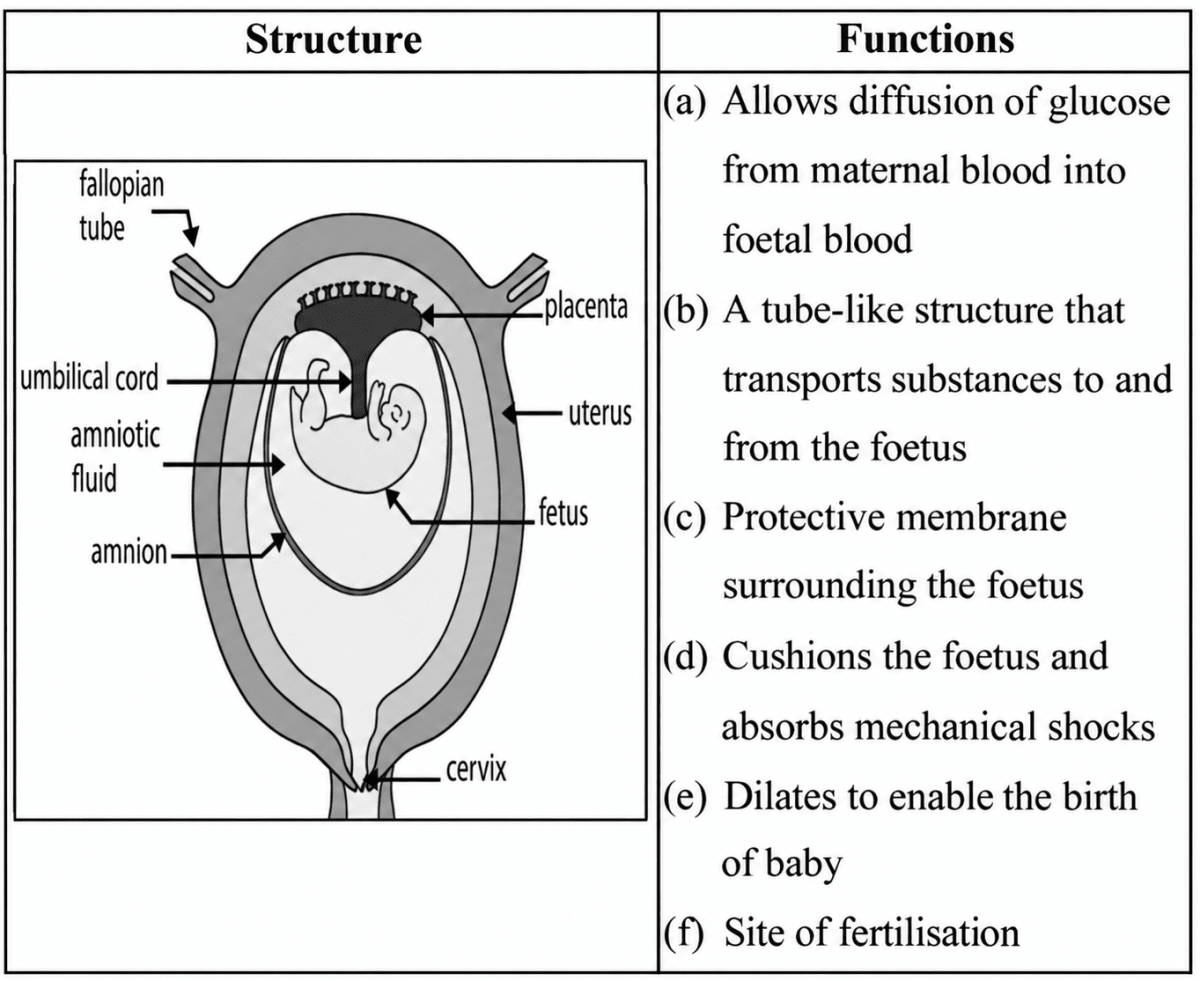
Study the diagram given below and match the structure with its function:
Example: Fallopian tube – (f)
Answer
(a) Placenta - Allows diffusion of glucose from maternal blood into foetal blood
(b) Umbilical cord - A tube-like structure that transports substances to and from the foetus
(c) Amnion - Protective membrane surrounding the foetus
(d) Amniotic fluid - Cushions the foetus and absorbs mechanical shocks
(e) Cervix - Site of fertilisation
Avinash placed a potted plant on a windowsill on a hot summer morning. By afternoon, the leaves had wilted though the soil was well watered. He moved the plant indoors and the leaves regained their turgidity.
Name the process responsible for the wilting of leaves.
Answer
Transpiration
Define the above process.
Answer
Transpiration is the loss of water in the form of water vapour from the aerial parts of a plant, mainly from the leaves.
Explain how the process will differ on a rainy day.
Answer
On a rainy day the atmosphere is highly humid. As there is very little difference between the amount of water vapour inside the leaf and that in the surrounding air, the diffusion of water vapour out of the leaf becomes slow. Hence the rate of transpiration is much lower on a rainy day.
Which are the primary pores through which the above process takes place? Where are they located?
Answer
The primary pores are the stomata.
They are present mainly on the surface of the leaves and also on young green stems.
List three adaptations in plants to reduce this process.
Answer
Three adaptations in plants to reduce transpiration are:
- A thick waxy cuticle develops over the epidermis, as in the banyan tree.
- The number of stomata is reduced and they are placed on the lower surface of the leaf.
- The stomata are sunken in pits and covered with hair, as in Nerium.
Pallavi, a 30-year-old woman showed certain male characteristics such as growth of moustache, beard and hair on her chest. The endocrinologist diagnosed it as a hormonal disorder.
(a) Mention the biological term for the disorder.
(b) Which hormone is responsible for this disorder? Name the gland which secretes this hormone.
(c) Explain the term hormone.
(d) Expand the following abbreviations:
- TSH
- ACTH
Answer
(a) Adrenal virilism.
(b) Cortical hormones, that is the sex corticoids or androgens, are responsible for this disorder. They are secreted by the adrenal gland.
(c) Hormones are chemical messengers secreted in very small amounts by the ductless or endocrine glands directly into the blood. They are carried by the blood to the target organs, where they regulate physiological processes.
(d) 1. TSH — Thyroid Stimulating Hormone
2. ACTH — Adreno Cortico Tropic Hormone
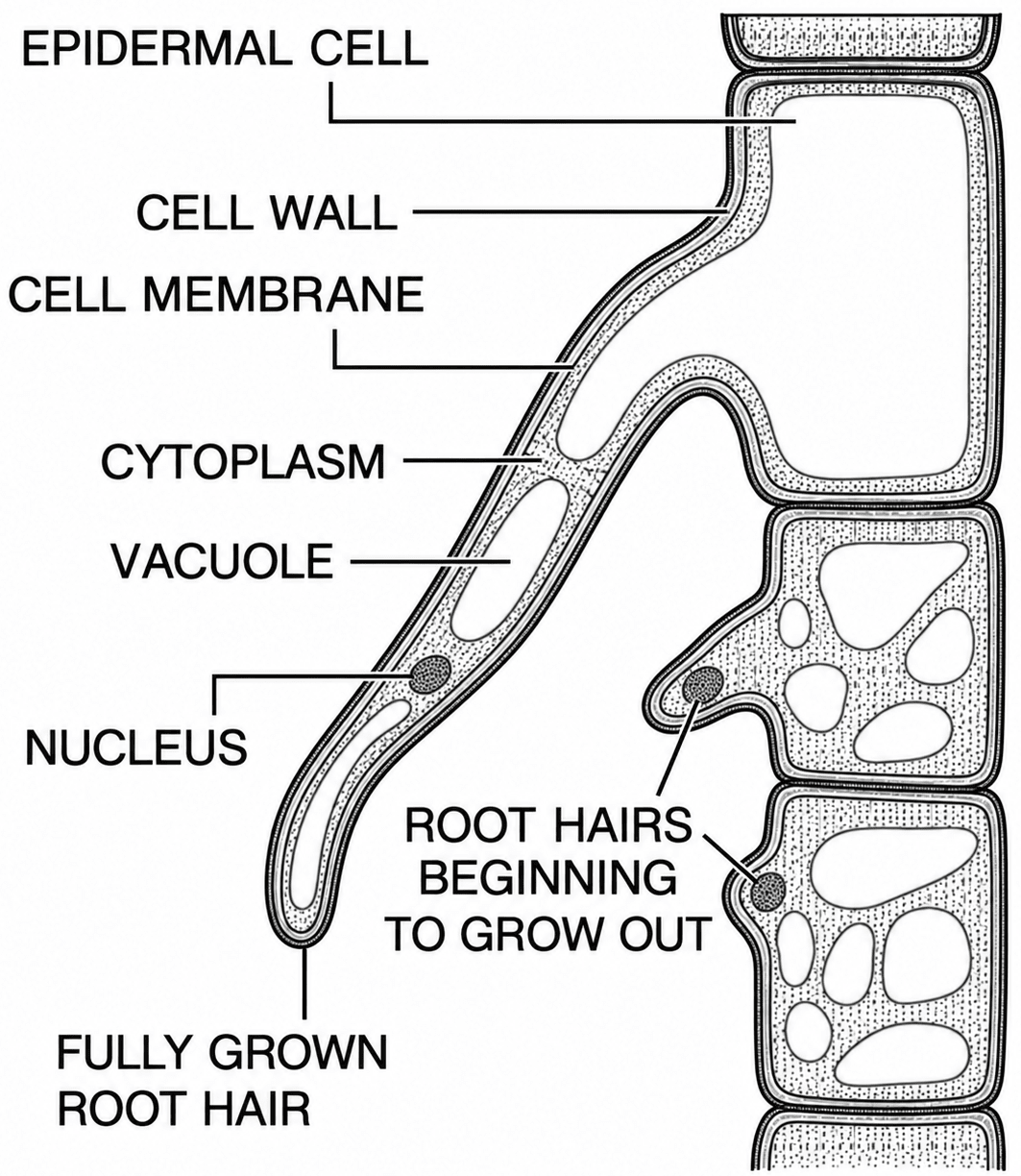
Draw a neat, labelled diagram of a turgid root hair cell.
Answer
A neat, labelled diagram of a turgid root hair cell is shown below:
Kiran lived with his family in the outskirts of a city which had a lot of greenery around. After a few years, a number of factories mushroomed which affected the quality of life of the people living there.
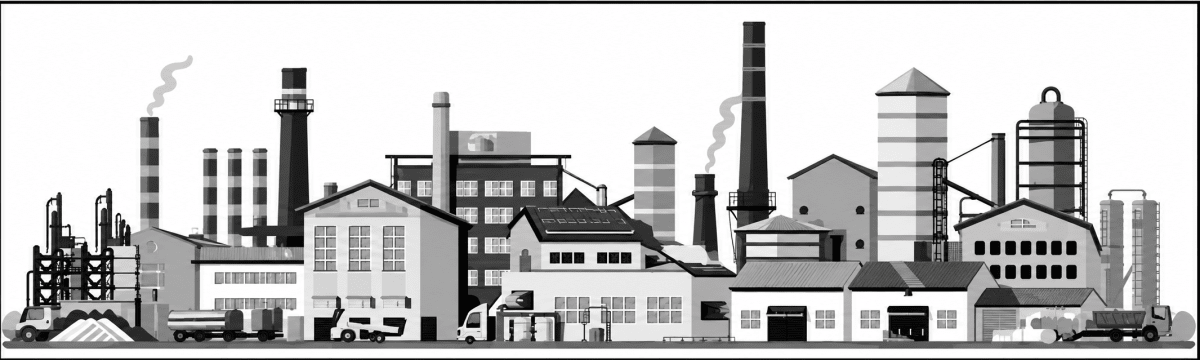
What message does the picture convey to you?
Answer
The picture shows a large number of factories giving out smoke into the air. It conveys the message that factories should not be built close to residential areas, and that industrial growth should not be allowed to spoil the environment.
Name any two types of pollution caused by the factories.
Answer
Air pollution and water pollution.
Mention two reasons for population explosion in India.
Answer
Two reasons for population explosion in India are:
- High birth rate.
- Lack of education and awareness about family planning methods.
State any two health problems that the residents may face in this case.
Answer
Two health problems that the residents may face are:
- Respiratory diseases such as asthma and bronchitis.
- Allergies and skin infections.
List any three resources that come under pressure due to rising population.
Answer
Three resources that come under pressure due to rising population are:
- Food
- Fossil fuels
- Minerals
Rahul fell down while riding a bicycle and injured his knee. The injury healed within a few days due to a kind of cell division.
Name the type of cell division responsible for the healing of wound.
Answer
Mitosis
How many chromosomes are present in each cell of the human body? What will be number of chromosomes in the daughter cells during the healing process?
Answer
Each cell of the human body contains 46 chromosomes, that is 23 pairs.
The wound heals by mitosis, in which the daughter cells receive the same number of chromosomes as the parent cell. So each daughter cell will also contain 46 chromosomes.
State Mendel’s Law of Segregation of gametes.
Answer
Mendel’s Law of Segregation of gametes states that during the formation of gametes (sperm or eggs), the two alleles for a given gene separate, or segregate, so that each gamete carries only one allele for each gene. When gametes fuse during fertilization, the resulting offspring inherits one allele from each parent, restoring the diploid number of alleles for that gene.
Why is haemophilia uncommon in human females?
Answer
Haemophilia is a sex linked recessive disorder carried on the X chromosome. A female has two X chromosomes, so she will suffer from the disease only if both of them carry the recessive gene. If only one X chromosome carries it, the normal dominant gene on the other X chromosome suppresses the disease and she remains a carrier. A male has only one X chromosome, so a single recessive gene expresses itself and he shows the disease. This is why haemophilia is uncommon in human females.
Draw a neat, labelled diagram of an animal cell having 4 chromosomes in the metaphase stage.
Answer
A neat, labelled diagram of an animal cell having 4 chromosomes in the metaphase stage is shown below:

A potted plant under a bell jar with a watch glass containing potassium hydroxide is placed under sunlight for three hours. After exposure to sunlight none of the leaves of the plant “X” turned blue black when tested with iodine, while the leaves of the control plant “Y” did.
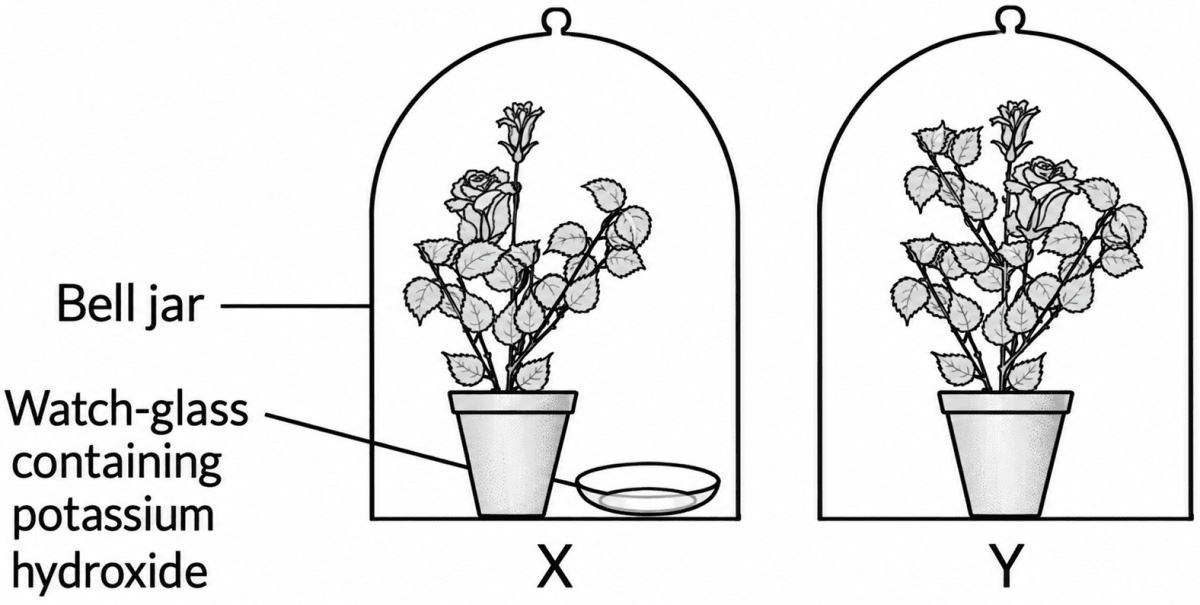
What is the aim of the experiment?
Answer
The aim of the experiment is to prove that carbon dioxide is necessary for photosynthesis.
Write the balanced equation for photosynthesis. Name the mineral element essential for the formation of chlorophyll.
Answer
The mineral element essential for the formation of chlorophyll is magnesium.
Explain the conclusion drawn from this experiment after the iodine test.
Answer
In plant X, the potassium hydroxide kept in the watch glass absorbed all the carbon dioxide present inside the bell jar. In the absence of carbon dioxide, photosynthesis could not take place, so no starch was formed and the leaves did not turn blue black with iodine.
In the control plant Y, carbon dioxide was available, so photosynthesis took place and starch was formed. Hence its leaves turned blue black with iodine.
This proves that carbon dioxide is essential for photosynthesis.
Which hormone promotes the growth of plants towards sunlight? What is this tropic movement called?
Answer
Auxin is the hormone that promotes the growth of plants towards sunlight.
This tropic movement is called phototropism.
Draw a neat, labelled diagram of a stomatal apparatus surrounded by epidermal cells.
Answer
Below diagram shows the stomatal apparatus found in the epidermis of leaves with all the different parts labelled:

Who proposed the theory of ‘Natural Selection’?
Answer
Charles Darwin
Mention two characteristic features of Australopithecus.
Answer
Two characteristic features of Australopithecus are:
- Absence of chin.
- Body covered with hair.
What is the reason for Hyperopia? How can it be corrected?
Answer
Hyperopia or hypermetropia is caused either by the shortening of the eyeball from front to back or by the lens becoming too flat. As a result, the image of nearby objects is formed behind the retina and near vision becomes blurred.
It is corrected by using spectacles with convex (biconvex) lenses.
State one difference between identical twins and fraternal twins.
Answer
One difference between identical twins and fraternal twins is:
| Identical Twins | Fraternal Twins |
|---|---|
| They develop from a single fertilised egg which splits into two, so they are always of the same sex. | They develop from two separate eggs fertilised by two different sperms, so they may be of the same or of different sexes. |
Draw a neat, labelled diagram of a human blood smear.
Answer
A neat, labelled diagram of a human blood smear is shown below:
