
The surgical method of sterilisation in a male involves ligation of the:
- Oviduct
- Sperm Duct
- Testis
- Uterus
Answer
Sperm Duct
Reason — The surgical method of sterilisation in males is called vasectomy. In this operation a small cut is made in the scrotum, the vas deferens (sperm duct) is ligated and a small piece between the two ligatures is removed, so that the semen contains no spermatozoa.
Which one of the following does NOT affect the rate of photosynthesis?
- Oxygen
- Carbon dioxide
- Water
- Temperature
Answer
Oxygen
Reason — Carbon dioxide and water are the raw materials of photosynthesis and temperature affects the enzymes involved, so all three influence the rate of photosynthesis. Oxygen is an end product of the process and is not a factor that controls its rate.
A gland which is both endocrine and exocrine in function is:
- Pituitary
- Thyroid
- Pancreas
- Adrenal
Answer
Pancreas
Reason — Pancreas is a heterocrine gland. As an exocrine gland it pours pancreatic juice into the duodenum through a duct, and as an endocrine gland its Islets of Langerhans secrete insulin, glucagon and somatostatin directly into the blood.
What is one way women can contribute to controlling population explosion in India?
- By having more children to contribute to the workforce.
- By making informed choices about family planning methods.
- By ignoring health care services.
- By relying on men to make decisions about family size.
Answer
By making informed choices about family planning methods.
Reason — Population growth can be checked by voluntary family planning. When women are educated and make informed choices about the methods of contraception available to them, the number and spacing of children can be regulated and the birth rate comes down.
A 60-year-old man met with an accident and had difficulty in hearing. It was due to a damage to the sensory cells in the cochlea. Which structure has been affected?
- Auditory canal
- Vestibule
- Ear drum
- Organ of Corti
Answer
Organ of Corti
Reason — The organ of Corti lies inside the cochlea and carries the sensory hair cells of hearing. Vibrations of the basilar membrane stimulate these cells, which send impulses to the brain through the auditory nerve.
Assertion (A): Plants growing in shade tend to have larger leaves.
Reason (R): This is because they need to capture more sunlight for photosynthesis.
- (A) is true and (R) is false.
- (A) is false and (R) is true.
- Both (A) and (R) are true and (R) is the correct explanation of (A).
- Both (A) and (R) are true, but (R) is not the correct explanation of (A).
Answer
Both (A) and (R) are true and (R) is the correct explanation of (A).
Reason — Light intensity is a limiting factor for photosynthesis. Plants growing in shade receive less light, so they develop a larger leaf surface area to trap the maximum amount of the available sunlight.
Sonu’s grandmother keeps mangoes in a rice bin to ripen. The mangoes ripen after a few days because of the phytohormone:
- Auxin
- Ethylene
- Abscisic acid
- Gibberellin
Answer
Ethylene
Reason — Ethylene is a gaseous phytohormone which aids in the ripening of fruits. In a closed rice bin the ethylene given out by the fruit is trapped around it, so the mangoes ripen faster.
Assertion (A): The loop of Henle helps concentrate or dilute urine.
Reason (R): The loop of Henle regulates the amount of water, reabsorbed into the bloodstream.
- (A) is true and (R) is false.
- (A) is false and (R) is true.
- Both (A) and (R) are true and (R) is the correct explanation of (A).
- Both (A) and (R) are true, but (R) is not the correct explanation of (A).
Answer
Both (A) and (R) are true and (R) is the correct explanation of (A).
Reason — Water and sodium ions are reabsorbed along the loop of Henle. By varying the quantity of water returned to the blood, the loop of Henle decides whether the urine leaving the nephron is concentrated or dilute.
According to Charles Darwin’s theory of evolution, what drives the process of natural selection?
- Genetic mutations
- Human intervention
- Survival of the fittest
- Random chance
Answer
Survival of the fittest
Reason — Darwin observed that more offspring are produced than can survive, which leads to a struggle for existence. Individuals with favourable variations are better fitted to their surroundings, survive and reproduce. This is the survival of the fittest, which drives natural selection.
During atrial systole, the tricuspid valve (P) ............... and semilunar valve (Q) ................
- closes, opens
- closes, closes
- opens, closes
- opens, opens
Answer
opens, closes
Reason — During atrial systole the atria contract and push blood into the ventricles, so the tricuspid and bicuspid valves open. The semilunar valves at the base of the pulmonary artery and aorta remain closed at this stage to prevent blood from flowing back into the ventricles.
Some raisins were added to a rice pudding. After a while, it was observed that the raisins had swollen up. What is the scientific phenomenon behind the swelling of these raisins?
- Isotonic, Endosmosis
- Hypotonic, Exosmosis
- Hypertonic, Exosmosis
- Hypotonic, Endosmosis
Answer
Hypotonic, Endosmosis
Reason — The pudding around the raisins has a lower solute concentration than the cell sap of the dried raisins, so it is hypotonic to them. Water therefore moves into the raisins through their semi-permeable membranes by endosmosis and they swell up.
In a dividing cell, the nuclear membrane reappears during:
- Prophase
- Metaphase
- Anaphase
- Telophase
Answer
Telophase
Reason — Telophase is essentially the reverse of prophase. The chromosomes reach the poles and uncoil, the nucleolus reappears and a new nuclear membrane is formed around each group of chromosomes.
A person under the influence of alcohol has difficulty in maintaining body balance and coordinating movements while walking. Which part of the brain is affected in such cases?
- Cerebellum
- Cerebrum
- Medulla oblongata
- Thalamus
Answer
Cerebellum
Reason — The cerebellum maintains posture, equilibrium and muscle tone and coordinates voluntary muscular movements. Under the influence of alcohol the cerebellum cannot coordinate these movements, so balance and walking are affected.
Surya’s father was diagnosed with Diabetes Insipidus. What are the primary symptoms of Diabetes Insipidus that Surya’s father must have experienced?
P: Weight gain
Q: More-urine formation
R: Joint pain
S: Excessive thirst
- P and Q
- Q and R
- Q and S
- P and R
Answer
Q and S
Reason — Diabetes insipidus is caused by the hyposecretion of ADH (vasopressin). As very little water is reabsorbed, the patient passes frequent and copious urine and consequently suffers from excessive thirst. No glucose is lost in the urine of such patients.
Assertion (A): Transpiration decreases the amount of moisture in the atmosphere.
Reason (R): A dense forest contributes to bringing rain due to transpiration.
- (A) is true and (R) is false.
- (A) is false and (R) is true.
- Both (A) and (R) are true and (R) is the correct explanation of (A).
- Both (A) and (R) are true, but (R) is not the correct explanation of (A).
Answer
(A) is false and (R) is true.
Reason — Transpiration adds water vapour to the air and therefore increases the moisture of the atmosphere, so (A) is false. It is because of this large-scale loss of water vapour that a dense forest raises the humidity of the region and helps in bringing rainfall, so (R) is true.
Give the biological / technical terms for the following:
(a) The respiratory pigment found in RBCs.
(b) The veins which start with capillaries and end in capillaries.
(c) The part of the eye grafted during eye donation.
(d) Collective term for the protective coverings of the brain and spinal cord.
(e) The epidermal pores through which guttation takes place.
Answer
(a) Haemoglobin
(b) Portal veins (e.g. hepatic portal vein)
(c) Cornea
(d) Meninges
(e) Hydathodes (water stomata)
Given below is the transverse section of the human ear. Read the information below the diagram and fill in the blanks:
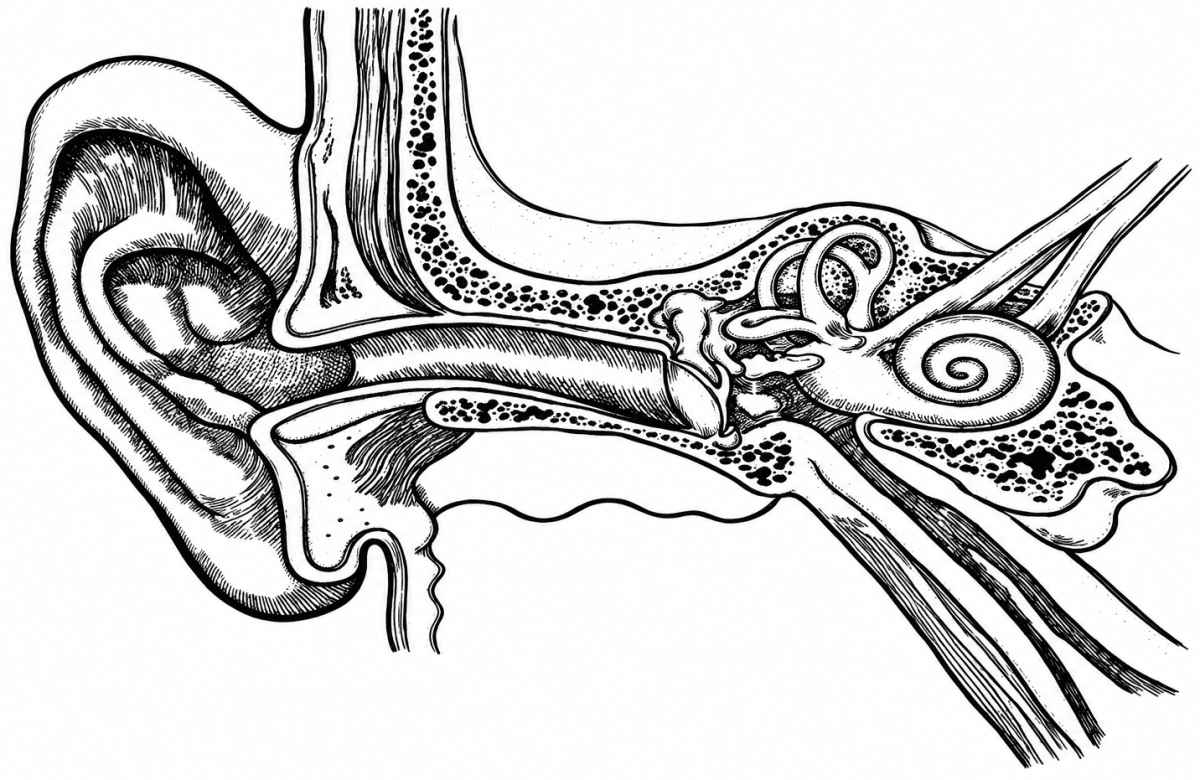
The sense organs enable us to be aware of the conditions of our external and internal environment. The human ear is concerned with two functions, hearing and body balance.
The outer ear consists of the projecting part (a) ............... (pinna, pharynx) and the passage auditory canal leading to the (b) ............... (thrombus, tympanum). The middle ear contains three bones and a (c) ............... (eustachian tube, effector) which connects the cavity of the middle ear with the throat. The three bones are collectively called the (d) ............... (organelles, ossicles). The inner ear has three parts. One of them is spiral-shaped and looks like a snail shell which is called the (e) ............... (cochlea, canine).
Answer
The outer ear consists of the projecting part (a) pinna and the passage auditory canal leading to the (b) tympanum. The middle ear contains three bones and a (c) eustachian tube which connects the cavity of the middle ear with the throat. The three bones are collectively called the (d) ossicles. The inner ear has three parts. One of them is spiral-shaped and looks like a snail shell which is called the (e) cochlea.
Choose the ODD one out from the following terms and name the category to which the others belong:
(a) Mitochondria, Nucleotide, Gene, Chromatid
(b) Urea, Bile, Ammonia, Creatinine
(c) Hepatic artery, Renal artery, Pulmonary artery, Dorsal aorta
(d) Oxygen, Hydrogen, Glucose, Starch
(e) Kidney, Skin, Heart, Lungs
Answer
(a) Odd one — Mitochondria. The others are parts of the hereditary material (chromosome and DNA).
(b) Odd one — Bile. The others are nitrogenous excretory wastes.
(c) Odd one — Pulmonary artery. The others are arteries carrying oxygenated blood.
(d) Odd one — Starch. The others are small, diffusible substances which can pass through a semi-permeable membrane.
(e) Odd one — Heart. The others are excretory organs of the human body.
A potted plant is kept in sunlight and the plant is covered with a polythene cover. Water droplets appear inside the cover after few hours. Answer the following questions:
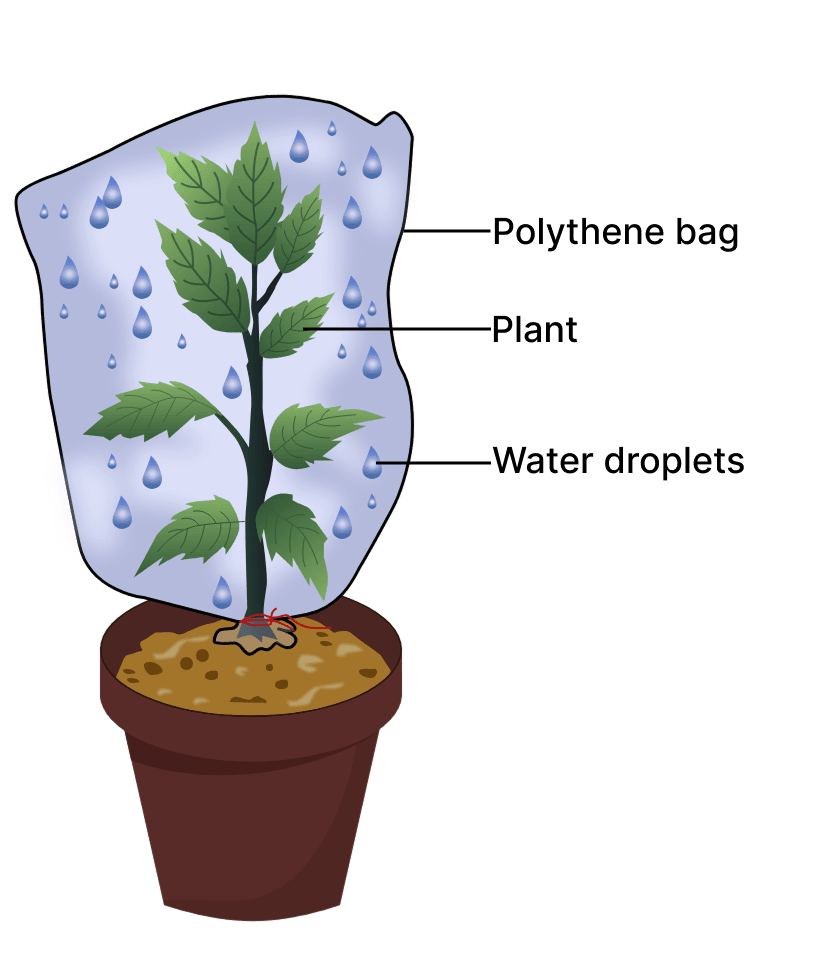
(a) Name the process that is observed in the above experiment.
(b) From which part of the plant does water loss mainly occur?
(c) How does this process help in water conduction?
(d) Name one environmental factor that can increase the process mentioned in (a).
(e) What will happen if the process in (a) stops?
Answer
(a) Transpiration
(b) Water loss occurs mainly from the leaves, through the stomata.
(c) The loss of water vapour from the leaves creates a suction force called transpiration pull. This pull draws a continuous column of water upwards through the xylem from the roots to the leaves, bringing about the ascent of sap.
(d) High temperature.
(e) If transpiration stops, the transpiration pull will be lost and the upward conduction of water and dissolved minerals will slow down. The plant will also not be able to cool itself, and excess water in the plant may be given out as droplets by guttation.
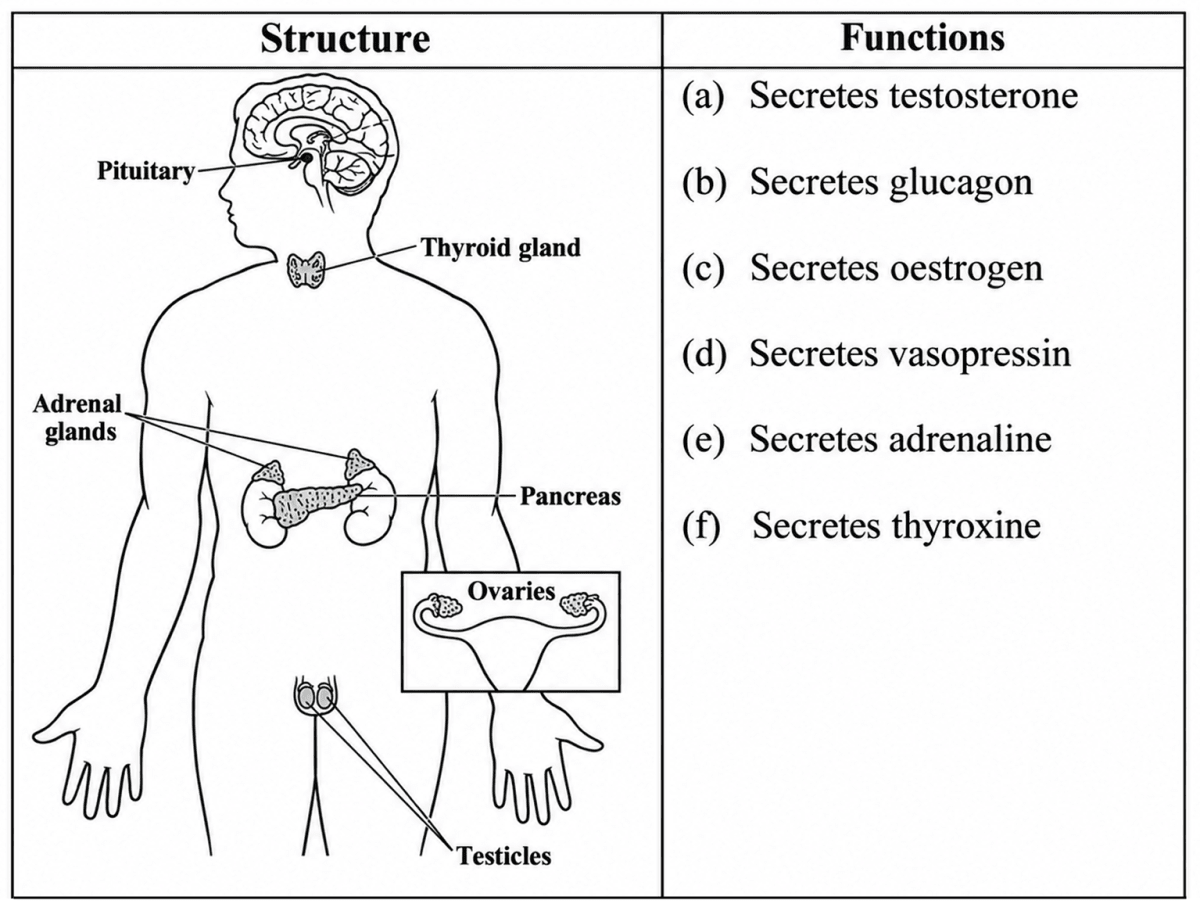
Study the diagram given below and match the gland with its functions:
Example: Thyroid gland – (f) secretes thyroxine
Answer
Pituitary gland – (d) secretes vasopressin
Adrenal glands – (e) secretes adrenaline
Pancreas – (b) secretes glucagon
Ovaries – (c) secretes oestrogen
Testicles – (a) secretes testosterone
Define mutation.
Answer
Mutation is a sudden random change in the genetic material of a cell that may cause it to differ in appearance or behaviour from the normal type.
Give one difference between the number of chromosomes passed on to each daughter cell in mitosis and meiosis.
Answer
| Mitosis | Meiosis |
|---|---|
| Each daughter cell receives the same number of chromosomes as the parent cell, i.e. the diploid number (46 in humans). | Each daughter cell receives half the number of chromosomes of the parent cell, i.e. the haploid number (23 in humans). |
Hema, a 25-year-old woman has normal vision, but is a carrier of colour blindness (XoX). Her husband is colour blind (XoY).
(a) What percentage of their sons will be colour blind?
(b) Can a daughter be colour blind in this case?
Answer
(a) 50% of their sons will be colour blind. The mother gives either Xo or X, while the father gives Y to all sons, so half the sons are XoY (colour blind) and half are XY (normal).
(b) Yes. The father passes Xo to every daughter, so a daughter who receives Xo from the mother will be XoXo and colour blind, and a daughter who receives X from the mother will be XXo and a carrier. Therefore half the daughters will be colour blind and half will be carriers.
Mention the functions of the following:
(a) Scrotum
(b) Epididymis
Answer
(a) Scrotum — It is a pouch of skin that holds the testes outside the abdominal cavity and keeps them at a temperature about 2°C lower than the body temperature, which is necessary for the production of sperms.
(b) Epididymis — It is a highly coiled tube in which the spermatids mature into functional spermatozoa. It also serves as a temporary storage site for the sperms.
Ratan, a 10-year-old boy was going home from school on a rainy day. He hears a loud thunderbolt and closes his ears suddenly.
(a) What kind of reflex action is this?
(b) Which part of the brain is involved in this action?
(c) Which sense organ triggered it?
Answer
(a) It is natural (inborn) reflex action, as it is an automatic protective response which is not learnt.
(b) Medulla oblongata
(c) Ear
State Mendel’s law of dominance.
Answer
Law of dominance states that when a pair of contrasting characters is present together, only one of them is able to express itself in the F1 generation while the other remains suppressed. The character that is expressed is called the dominant character and the suppressed one is called the recessive character.
Expand the biological abbreviations:
(a) TSH
(b) CNG
Answer
(a) TSH — Thyroid Stimulating Hormone
(b) CNG — Compressed Natural Gas
Differentiate between an artery and a vein with reference to size of lumen.
Answer
| Artery | Vein |
|---|---|
| It has a narrow lumen. | It has a wide lumen. |
We urinate fewer times in summer than in winter and the urine is generally thicker. Explain with reasons.
Answer
In summer a large amount of water is lost from the body as sweat, in order to keep the body temperature normal.
To make up for this loss, the kidneys reabsorb more water from the filtrate. As a result less urine is formed, we urinate fewer times, and the urine that is passed is more concentrated or thicker.
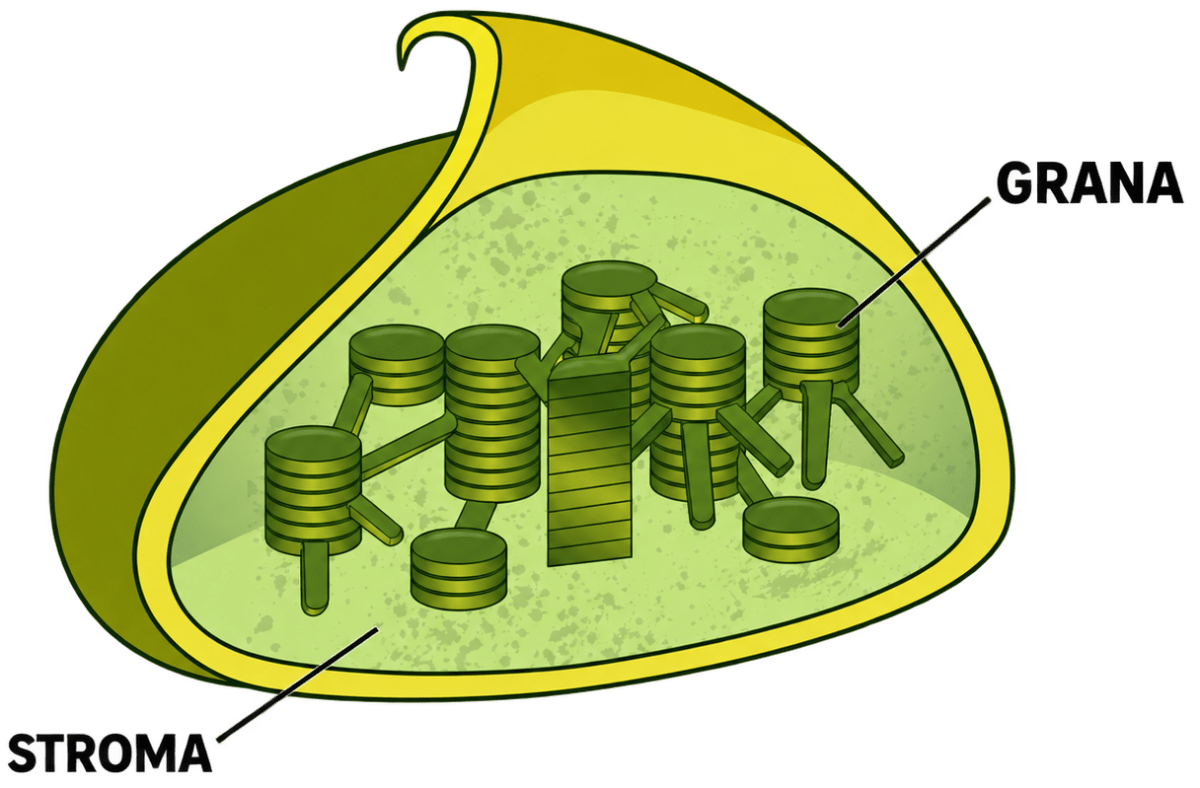
Draw a neat, labelled diagram of the cell organelle which is responsible for photosynthesis and label the following parts:
(a) Stroma
(b) Grana
Answer
The cell organelle responsible for photosynthesis is the chloroplast. Below diagram shows the structure of a chloroplast with its parts labelled:
What is Parturition?
Answer
Parturition is the childbirth in viviparous mammals, i.e. the expulsion of the fully developed young one from the uterus of the mother at the end of the gestation period. In humans it occurs after about 280 days and is brought about by labour pains caused by the contraction of the uterine wall.
Sanjay, a 14-year-old boy observed droplets of water on the grass when he went for a walk in the morning.
(a) What is this phenomenon of formation of water droplets on grass called?
(b) Name the structures through which the water droplets come out.
Answer
(a) Guttation
(b) Hydathodes (water stomata)
Write any two objectives of ‘Swachh Bharat Abhiyan’.
Answer
Two objectives of Swachh Bharat Abhiyan are:
- To eliminate open defecation: The mission aims to ensure that all households have access to toilets and promote the construction and use of sanitary latrines.
- To promote cleanliness and hygiene: It seeks to create awareness about sanitation and cleanliness practices, improve waste management systems, and maintain cleanliness in public spaces.
Mention the function of the following plant hormones:
(a) Abscisic acid
(b) Gibberellins
Answer
(a) Abscisic acid — It acts as a growth inhibitor. It prevents or slows down seed germination, causes closure of stomata and promotes the abscission of leaves, flowers and fruits. It also increases the tolerence of plants to various kinds of stresses. Therefore it is also called the "stress harmone".
(b) Gibberellins — They bring about elongation of the internodes of the stem, overcome genetic dwarfism in plants and help in breaking the dormancy of seeds and buds.
Given below is a diagram depicting a defect of the human eye. Study the same and answer the questions that follow:
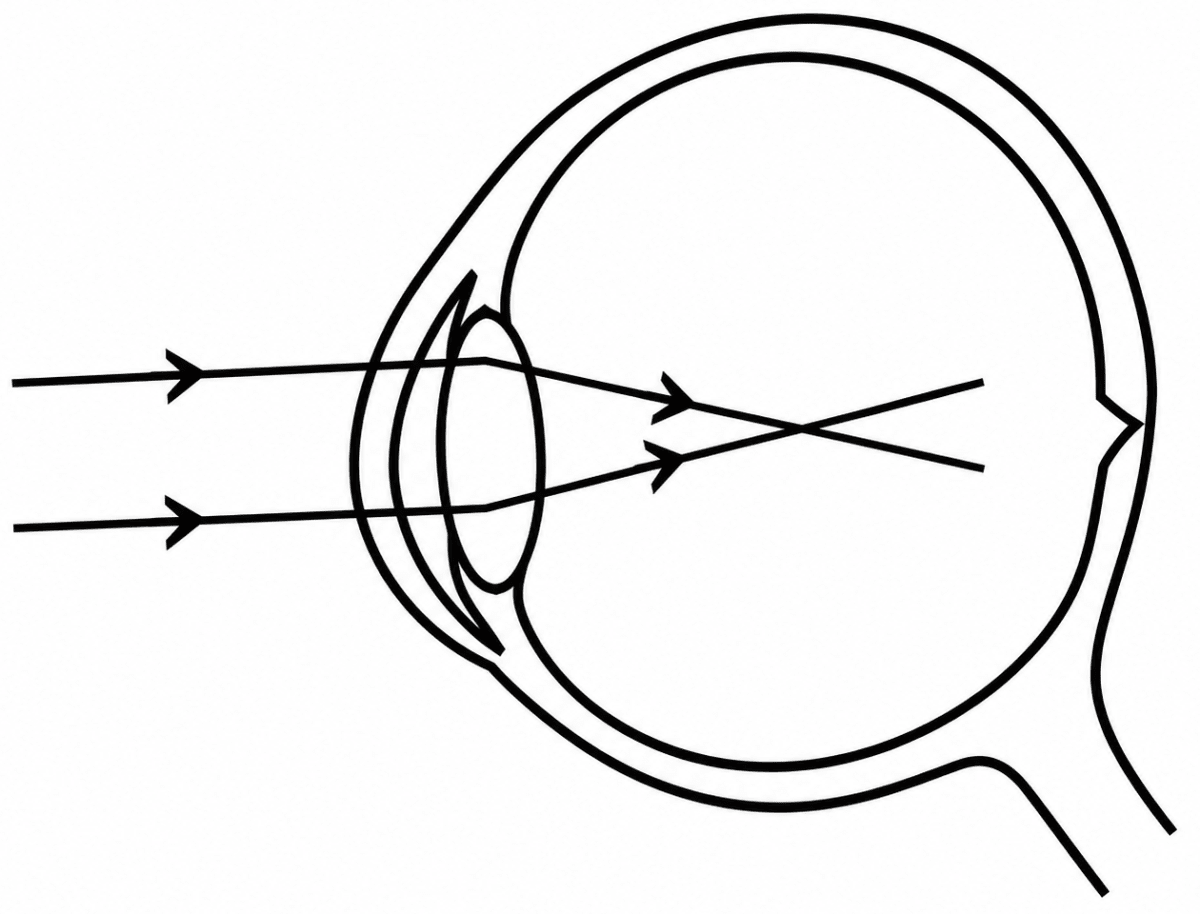
(a) Name the defect shown in the diagram.
(b) What is the possible reason that causes this defect?
(c) Name the type of lens used to correct this defect.
Answer
(a) Myopia (short-sightedness or near-sightedness)
(b) The image of a distant object is formed in front of the retina, either because the eyeball has become elongated from front to back or because the lens has become too convex.
(c) Concave lens
What do you understand by the term birth rate in population?
Answer
Birth rate, also called natality, is the number of births per 1000 individuals in a population per year.
State two differences between Fraternal twins and Identical twins.
Answer
Two differences between Fraternal twins and Identical twins are:
| Fraternal twins | Identical twins |
|---|---|
| They are formed when two ova released at the same time are fertilised by two different sperms. | They are formed when a single fertilised ovum splits into two embryos. |
| They are genetically different and may be of the same or different sexes. | They are genetically alike and are always of the same sex. |
The experiment below shows the thistle funnel containing sugar solution.
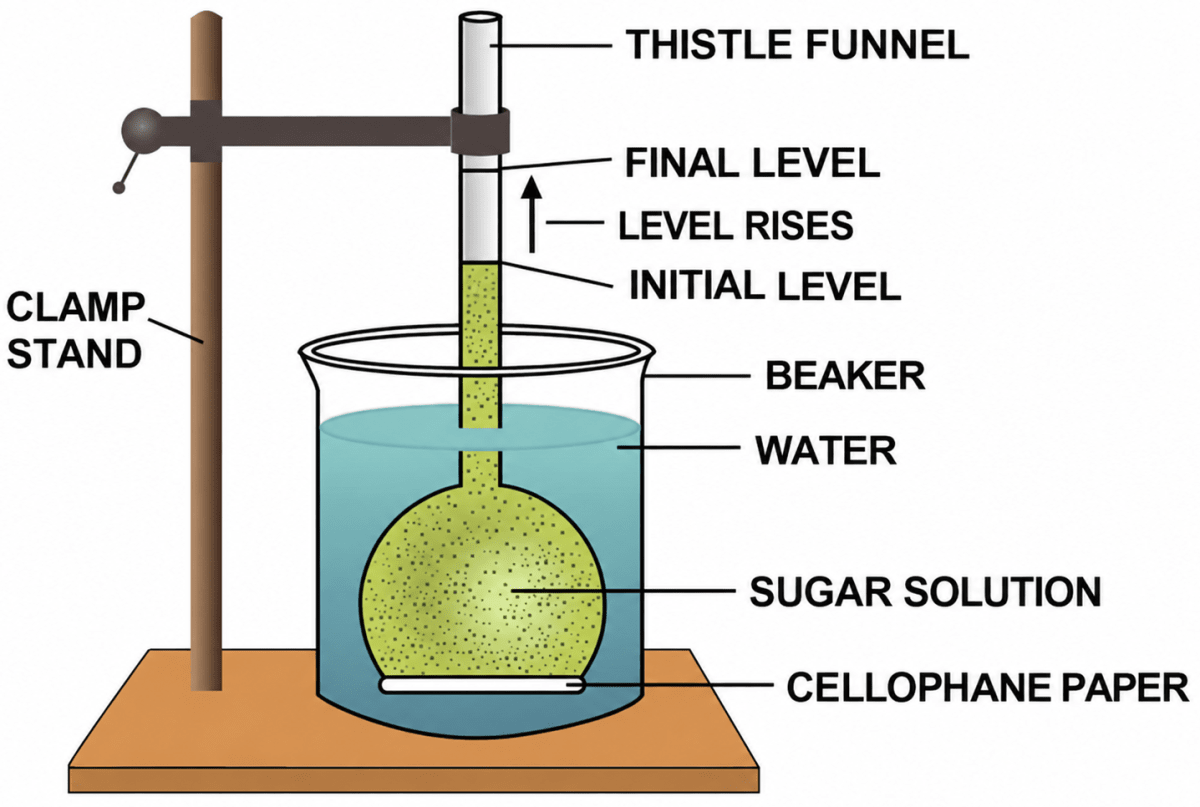
Define the phenomenon taking place in the above experiment.
Answer
The phenomenon taking place is osmosis, more precisely endosmosis.
Osmosis is the net movement of water molecules from a region of their higher concentration to a region of their lower concentration through a semi-permeable membrane. Here water from the beaker passes through the cellophane paper into the sugar solution, so the level in the thistle funnel rises.
What would happen if the cellophane was replaced by the following in the above experiment?
(a) A rubber sheet
(b) A muslin cloth
Answer
(a) A rubber sheet is impermeable, so water molecules cannot pass through it. No osmosis will take place and the level of the sugar solution in the thistle funnel will not rise.
(b) A muslin cloth is freely permeable, so both water and sugar molecules can pass through it in either direction. Osmosis will not take place; the sugar solution will simply diffuse out into the beaker and the level in the thistle funnel will not rise.
Homozygous pea plant bearing red coloured flowers (R) is crossed with a homozygous pea plant bearing white flowers (r):
(a) Give the phenotype of the F1 generation.
(b) Write the monohybrid ratio of the offsprings of the F2 generation.
(c) What is the genotype obtained in F2 generation?
Answer
(a) All the plants of the F1 generation bear red flowers, as red is dominant over white.
(b) The monohybrid phenotypic ratio of the F2 generation is 3 red : 1 white, i.e. 3 : 1.
(c) The genotypes obtained in the F2 generation are RR, Rr and rr in the ratio 1 : 2 : 1.
Explain the term Fertilization.
Answer
Fertilisation is the fusion of a haploid male gamete (sperm) with a haploid female gamete (ovum) to form a diploid cell called the zygote. In human beings fertilisation is internal and usually takes place in the ampulla of the fallopian tube.
Nitin, a student of class 10, learnt that sperms produced in the testes move into a highly coiled tube and stays there temporarily.
(a) Name this highly coiled tube.
(b) What is the function of this coiled tube?
Answer
(a) Epididymis
(b) In the epididymis the spermatids mature into functional spermatozoa. It also acts as a temporary storage site for the sperms before they pass into the vas deferens.
Name any two vestigial organs found in humans.
Answer
Two vestigial organs found in humans are:
- Vermiform appendix
- Wisdom teeth
Arrange the following food chains in a proper sequence beginning with the term that is underlined:
(a) Corn, Eagle, Fox, Rat
(b) Nectar, Crow, Bee, Lizard
Answer
(a) Corn → Rat → Fox → Eagle
(b) Nectar → Bee → Lizard → Crow
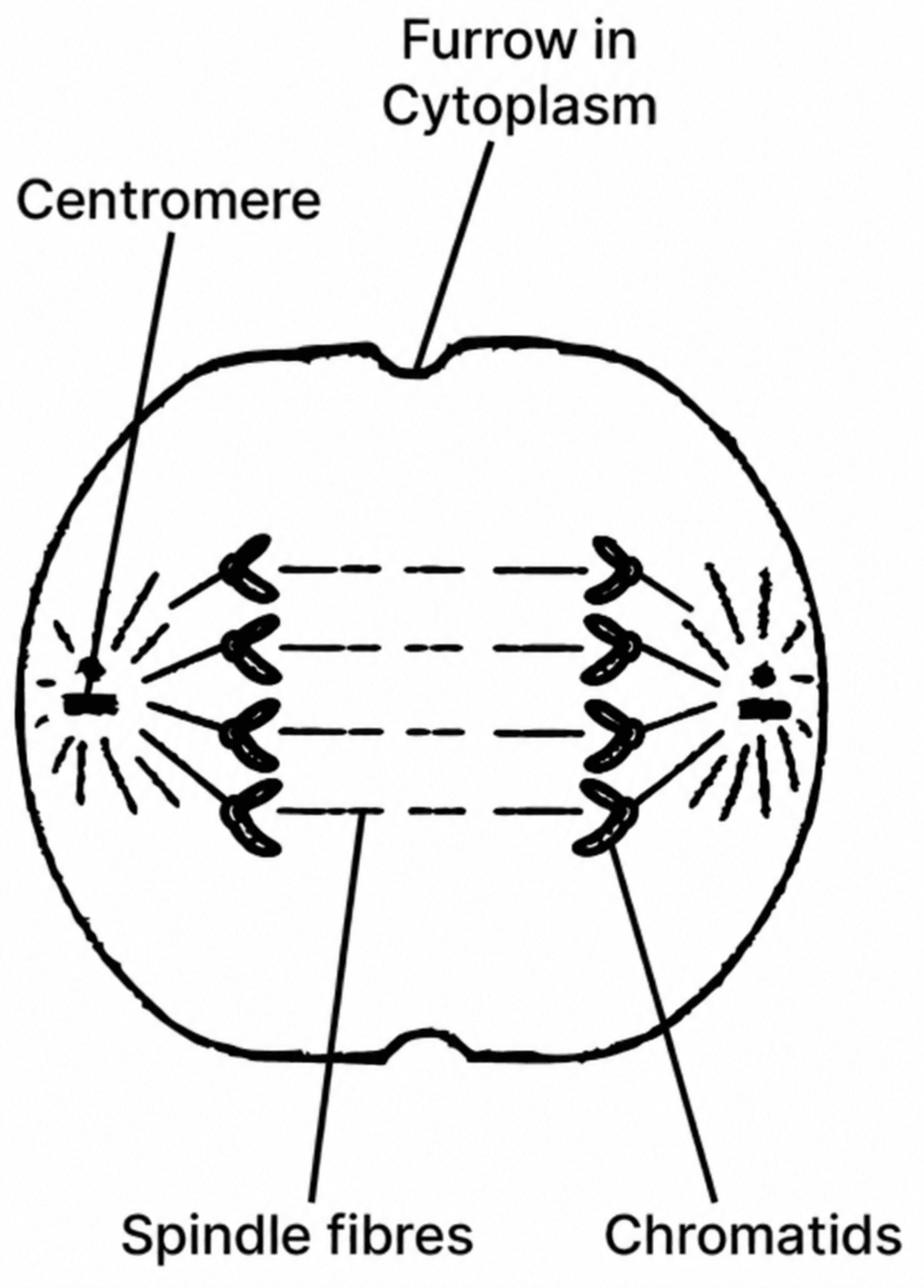
Draw a neat, labelled diagram to show Anaphase stage of mitosis in an animal cell having 4 chromosomes.
Answer
Below diagram shows the anaphase stage of mitosis in an animal cell having 4 chromosomes, with all the parts labelled:
Mention the number of Cranial nerves in a man.
Answer
There are 12 pairs of cranial nerves in a man.
Study the diagram given below and answer the questions that follow:
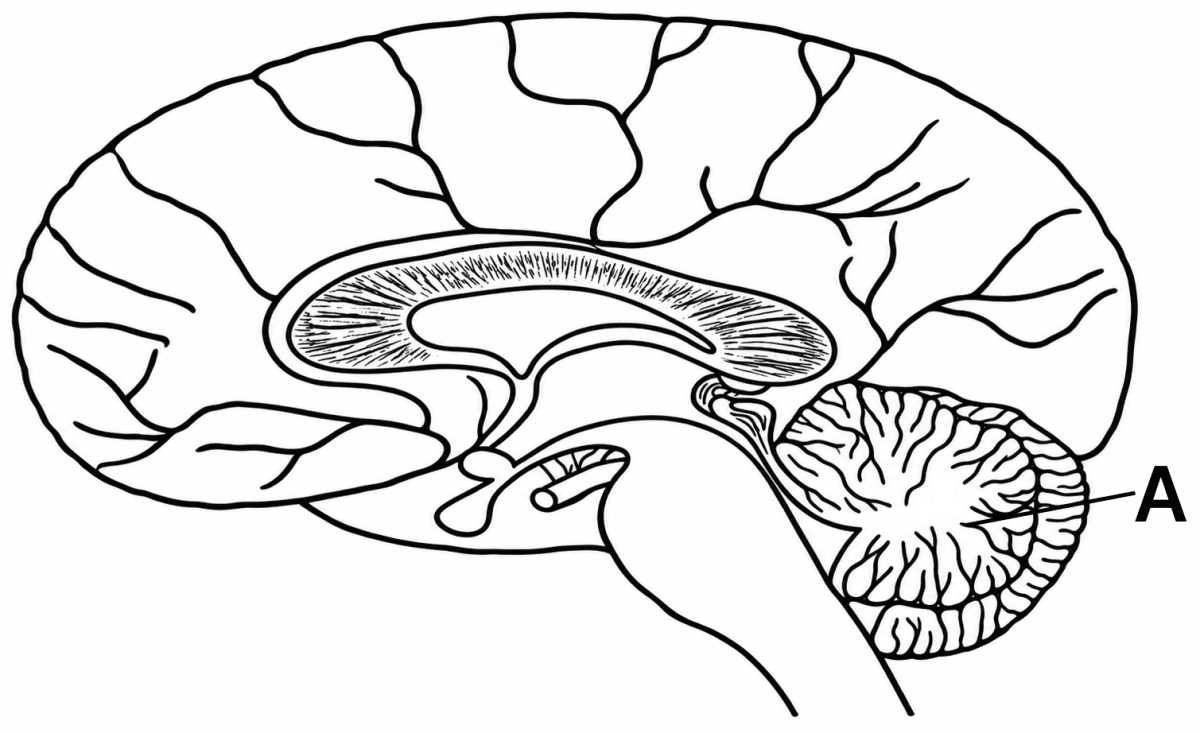
(a) Identify the part labelled A.
(b) What is its function?
Answer
(a) A is the cerebellum.
(b) The cerebellum maintains posture, equilibrium and muscle tone of the body, and coordinates the voluntary muscular movements initiated by the cerebrum.
Mention the two main processes in urine formation.
Answer
The two main processes in urine formation are:
- Ultrafiltration — In the glomerulus the blood is filtered under pressure, so that water, mineral salts, glucose, amino acids and nitrogenous wastes pass into the Bowman's capsule while blood cells and large molecules like proteins are retained.
- Selective reabsorption — As the filtrate passes along the renal tubule, useful materials such as most of the water, all the glucose and amino acids and some mineral salts are taken back into the surrounding blood capillaries.
Give the exact location of:
(a) Amniotic fluid
(b) Fovea centralis
Answer
(a) Amniotic fluid is present inside the amnion, the sac which surrounds and encloses the developing embryo in the uterus.
(b) Fovea centralis, also called the yellow spot, is present on the retina of the eye, directly behind the centre of the lens along the visual axis.
People living in congested cities often complain of breathing problems. Visibility is also reduced due to smog.
(a) What is the type of pollution that is being referred to?
(b) What is smog?
(c) Name one harmful gas released from motor vehicles.
Answer
(a) Air pollution
(b) Smog is a thick haze formed near the ground when smoke and other particulate pollutants of the air mix with fog. It reduces visibility and causes breathing problems.
(c) Carbon monoxide (CO)