
A non-metal which reacts with concentrated sulphuric acid to form two gases which turn lime water milky is ............... .
- Sulphur
- Carbon
- Oxygen
- Nitrogen
Answer
Carbon
Reason — Carbon (a non-metal) reacts with hot concentrated sulphuric acid to form two gases — carbon dioxide (CO2) and sulphur dioxide (SO2). Both these gases turn lime water milky.
C + 2H2SO4 [conc.] ⟶ CO2 + 2H2O + 2SO2
Which of the following element pairs will form an ionic bond?
| Pair | |
|---|---|
| P | Elements of Group 1 & Group 2 |
| Q | Elements of Group 14 & Group 16 |
| R | Elements of Group 2 & Group 17 |
| S | Elements of Group 15 & Group 18 |
- P
- Q
- R
- S
Answer
R
Reason — An ionic bond is formed between a metal (low ionisation potential) and a non-metal (high electron affinity). Group 2 elements are metals which lose 2 electrons, while Group 17 elements are non-metals which gain 1 electron. Hence, the elements of Group 2 and Group 17 form ionic bond (e.g., MgCl2, CaCl2).
Pair P consists of two metals (no bond formation), Q consists of two non-metals (covalent bond), and S consists of a non-metal and a noble gas (no bond formed).
The electronic configuration of an element is 2,8,2. The hydroxide of this element can produce ............... hydroxyl ions per molecule.
- 3
- 2
- 1
- 0
Answer
2
Reason — An element with electronic configuration 2, 8, 2 is magnesium (Mg) with valency 2. Its hydroxide is Mg(OH)2, which contains 2 hydroxyl (OH-) ions per molecule.
Mg(OH)2 ⟶ Mg2+ + 2OH-
With respect to the electrolysis of copper (II) sulphate solution using copper electrodes, which statement is correct?
- Copper metal is deposited at the negative electrode.
- Oxygen gas is produced at the positive electrode.
- The positive electrode increases in mass.
- The negative electrode decreases in mass.
Answer
Copper metal is deposited at the negative electrode.
Reason — During electrolysis of copper(II) sulphate solution using copper electrodes:
- At the cathode (negative electrode): Cu2+ + 2e- ⟶ Cu, so copper is deposited here and the cathode increases in mass.
- At the anode (positive electrode): Cu - 2e- ⟶ Cu2+, so copper of the anode dissolves and the anode decreases in mass.
No oxygen gas is produced because the copper is preferentially oxidised over the OH- ions.
Identify the equation that shows the reaction of ethane with chlorine in the presence of ultraviolet light.
- C2H6 + Cl2 ⟶ C2H6Cl2
- C2H6 + Cl2 ⟶ C2H4Cl2 + H2
- C2H6 + Cl2 ⟶ C2H5Cl + HCl
- C2H6 + Cl2 ⟶ 2CH3Cl
Answer
C2H6 + Cl2 ⟶ C2H5Cl + HCl
Reason — In the presence of ultraviolet (UV) light, ethane (a saturated hydrocarbon) undergoes a substitution reaction with chlorine. One hydrogen atom of ethane is replaced by a chlorine atom forming chloroethane (C2H5Cl) and hydrogen chloride (HCl) is released.
C2H6 + Cl2 C2H5Cl + HCl
A hydrocarbon X undergoes the reaction under suitable conditions as shown below:
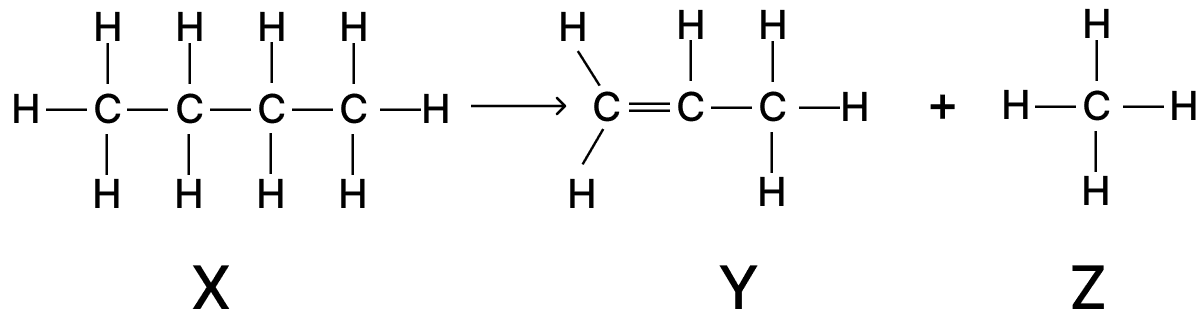
Which compound(s) is/are unsaturated?
- X only
- Y only
- X and Z
- Y and Z
Answer
Y only
Reason — The reaction shown is cracking (thermal decomposition) of butane (X = C4H10), a saturated hydrocarbon, into propene (Y = C3H6) and methane (Z = CH4).
- X (butane, C4H10) — saturated (only single bonds).
- Y (propene, C3H6) — unsaturated (contains one C=C double bond).
- Z (methane, CH4) — saturated (only single bonds).
Hence, only Y is unsaturated.
Rita added dilute hydrochloric acid to four metals. She recorded her observations in the table given below. While noting her observations she made some errors.
| Metals | Observations | |
|---|---|---|
| 1 | copper | a gas was given off |
| 2 | iron | a gas was given off |
| 3 | magnesium | no gas was given off |
| 4 | zinc | a gas was given off |
Which observation(s) made by Rita is/are correct?
- 1 only
- 3 only
- Both 1 and 4
- Both 2 and 4
Answer
Both 2 and 4
Reason — The reactivity of these metals with dilute HCl depends on their position in the activity series:
- Copper lies below hydrogen in the activity series, so it does not react with dilute HCl. Hence, no gas is given off — observation (1) is incorrect.
- Iron is above hydrogen in the activity series, hence it reacts with dilute HCl liberating hydrogen gas — observation (2) is correct.
Fe + 2HCl ⟶ FeCl2 + H2 ↑ - Magnesium is highly reactive and reacts vigorously with dilute HCl liberating hydrogen gas — observation (3) is incorrect.
Mg + 2HCl ⟶ MgCl2 + H2 ↑ - Zinc is above hydrogen in the activity series and reacts with dilute HCl liberating hydrogen gas — observation (4) is correct.
Zn + 2HCl ⟶ ZnCl2 + H2 ↑
Hence, observations 2 and 4 are correct.
An atom of X forms an ion according to the equation X ⟶ X+2.
The atomic number of the atom X is:
- 16
- 10
- 12
- 14
Answer
12
Reason — An element with atomic number 12 has the electronic configuration 2, 8, 2. It loses its 2 valence electrons easily to attain a stable octet configuration (2, 8) and forms a divalent positive ion X2+. This element is magnesium (Mg).
Mg ⟶ Mg2+ + 2e-
Whereas, atomic number 16 (Sulphur) gains 2 electrons to form S2-, atomic number 10 (Neon) is a noble gas which doesn't form ions, and atomic number 14 (Silicon) shares electrons.
Salts can be prepared by the action of dilute acid on:
- bases
- carbonates
- metals
- sulphites
The method which cannot be used for the preparation of copper salts is:
- 1
- 2
- 3
- 4
Answer
3
Reason — Copper lies below hydrogen in the activity series, so it does not displace hydrogen from dilute acids. Hence, copper salts cannot be prepared by the action of dilute acids on the metal copper.
However, copper salts can be prepared from copper bases like Cu(OH)2, copper carbonate (CuCO3), and copper sulphite by the action of dilute acid.
The compound that has the highest melting point amongst the following is:
- Methane
- Sodium chloride
- Ammonia
- Ethanol
Answer
Sodium chloride
Reason — Sodium chloride (NaCl) is an ionic compound. Ionic compounds have very strong electrostatic forces of attraction between oppositely charged ions, requiring a large amount of energy to break, so they have very high melting points.
Whereas, methane, ammonia and ethanol are covalent compounds with weak intermolecular forces, so they have low melting points.
Assertion (A): Dilute Sulphuric acid is a stronger electrolyte than concentrated Sulphuric acid.
Reason (R): Dilute Sulphuric acid has a higher concentration of mobile ions.
- (A) is true but (R) is false.
- (A) is false but (R) is true.
- Both (A) and (R) are true and (R) is the correct explanation of (A).
- Both (A) and (R) are true, but (R) is not the correct explanation of (A).
Answer
Both (A) and (R) are true and (R) is the correct explanation of (A).
Reason — Dilute sulphuric acid is a stronger electrolyte because the presence of water causes greater ionisation, producing more mobile ions. Concentrated sulphuric acid contains comparatively fewer free ions, hence Assertion (A) is true.
The strength of an electrolyte depends on the concentration of mobile ions. In dilute sulphuric acid greater ionisation and ion mobility make it a better conductor of electricity, hence Reason (R) is true and is the correct explanation of (A).
H2SO4 ⟶ 2H+ + SO42-
What volume of carbon dioxide is produced at STP when 5 litres of propane is burnt completely according to the equation given below?
C3H8 + 5O2 ⟶ 3CO2 + 4H2O
- 10 litres
- 15 litres
- 20 litres
- 25 litres
Answer
15 litres
Reason — According to Gay-Lussac's law of gaseous volumes, when gases react they do so in volumes which bear a simple whole number ratio to one another, given temperature and pressure remain constant.
From the equation: 1 volume of C3H8 produces 3 volumes of CO2.
∴ 5 litres of C3H8 will produce 5 × 3 = 15 litres of CO2.
An unsaturated hydrocarbon with three atoms of carbon and six atoms of hydrogen is:
- propyne
- propane
- propene
- propanol
Answer
propene
Reason — Propene is an alkene with molecular formula C3H6, which contains 3 carbon atoms and 6 hydrogen atoms with a C=C double bond, making it unsaturated. It follows the general formula of alkenes (CnH2n).
CH2=CH-CH3 (propene)
Whereas, propyne (C3H4) has 4 hydrogens, propane (C3H8) is saturated, and propanol (C3H8O) is an alcohol containing oxygen.
Assertion (A): In the electrolysis of acidified water, the volume of hydrogen liberated is twice the volume of oxygen formed.
Reason (R): Water has hydrogen and oxygen in the ratio of 1:2 by volume.
- (A) is true but (R) is false.
- (A) is false but (R) is true.
- Both (A) and (R) are true and (R) is the correct explanation of (A).
- Both (A) and (R) are true, but (R) is not the correct explanation of (A).
Answer
(A) is true but (R) is false.
Reason — During the electrolysis of acidified water:
- At cathode: 4H+ + 4e- ⟶ 2H2
- At anode: 4OH- - 4e- ⟶ 2H2O + O2
The ratio of H2 to O2 liberated is 2:1, so the volume of hydrogen liberated is twice the volume of oxygen formed. Hence, assertion (A) is true.
However, on electrolysis water gives hydrogen and oxygen in the ratio of 2:1 by volume, and not 1:2 as stated. Hence, reason (R) is false.
In the electrolysis of molten aluminium oxide for extraction of aluminium, the following reactions take place:
- Al3+ + 3e- ⟶ Al
- 2O2- ⟶ O2 + 4e-
- C + O2 ⟶ CO2
- Al2O3 ⇌ 2Al3+ + 3O2-
The reaction that takes place at the negative electrode is:
- 1
- 2
- 3
- 4
Answer
1
Reason — The negative electrode is the cathode where reduction takes place. At the cathode, the positively charged Al3+ ions get attracted, gain 3 electrons, and get deposited as aluminium metal.
Al3+ + 3e- ⟶ Al
Reaction (2) takes place at the anode (oxidation), reaction (3) is the reaction of carbon anode with oxygen, and reaction (4) is the dissociation of alumina.
Given below is the industrial process for the manufacture of ammonia gas. Study the schematic diagram to answer the following questions.
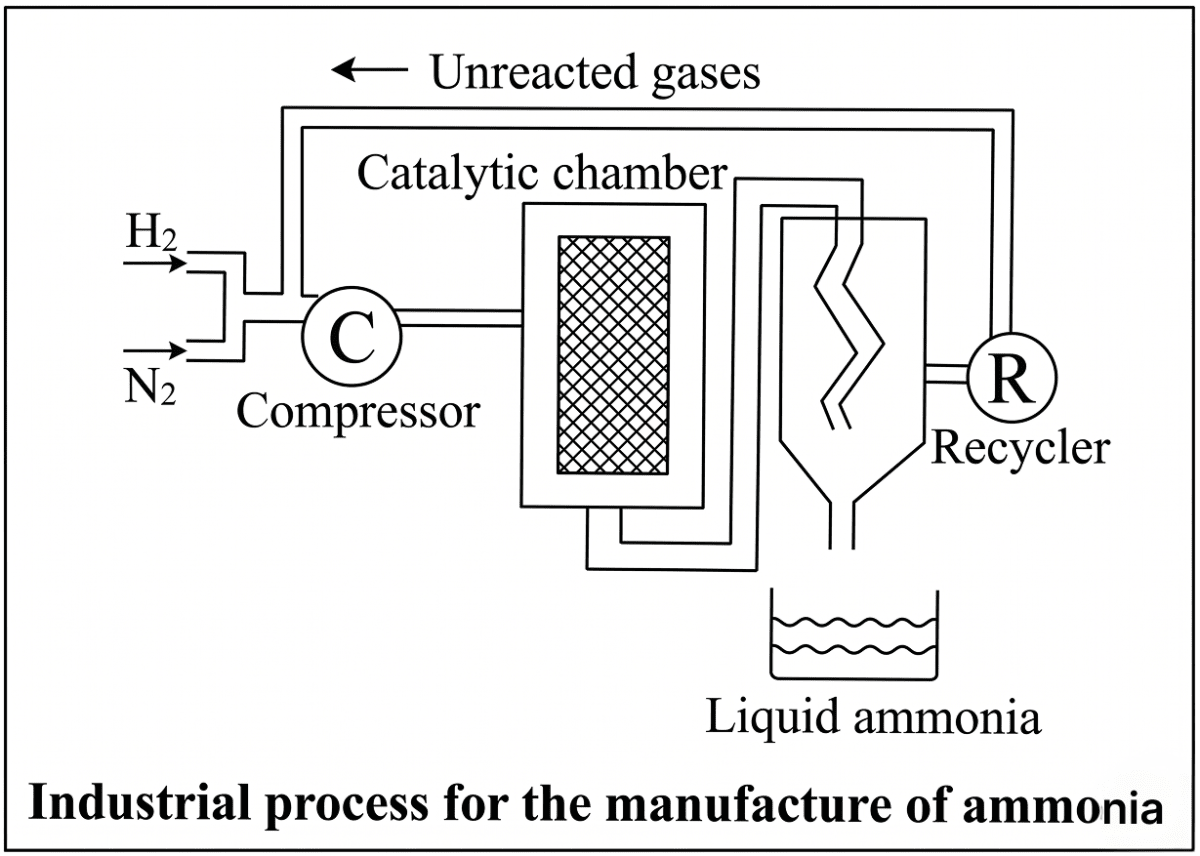
(a) Name the process.
(b) Which catalyst is used in the above process?
(c) In the above diagrammatic setup, how is ammonia gas separated from the unreacted gases to obtain liquid ammonia?
(d) Which two properties of ammonia gas can be demonstrated by the Fountain Experiment?
Answer
(a) Haber's process.
(b) Finely divided iron.
(c) The mixture of ammonia and unreacted gases (N2 and H2) coming out of the catalytic chamber is passed through the cooling pipes (condenser). Ammonia liquefies first, whereas nitrogen and hydrogen do not liquefy easily. The ammonia produced is stored as liquid under pressure.
(d) The two properties of ammonia gas demonstrated by the Fountain Experiment are:
- Ammonia gas is highly soluble in water.
- Ammonia is a basic gas (its aqueous solution turns red litmus blue / phenolphthalein turns pink).
Identify the following terms / compounds:
(a) A compound which reacts with water to give acetylene gas.
(b) The gas evolved when sodium propanoate is heated with soda lime.
(c) A reddish-brown precipitate formed when ferric chloride solution reacts with an alkali.
(d) A pair of electrons present in an atom which is not shared with any other atom during bond formation.
(e) The relative molecular mass of a substance expressed in grams.
Answer
(a) Calcium carbide (CaC2)
(b) Ethane (C2H6)
(c) Ferric hydroxide [Fe(OH)3]
(d) Lone pair of electrons
(e) Gram molecular mass
Match Column A with Column B:
| Column A | Column B |
|---|---|
| (a) CuO + C ⟶ Cu + CO | 1. Oxidation |
| (b) Al3+ + 3e- ⟶ Al | 2. Ionisation |
| (c) PbBr2 ⟶ Pb2+ + 2Br1- | 3. Reduction |
| (d) 2O2- - 2e- ⟶ O2 | 4. Redox |
| (e) HCl ⟶ H+ + Cl1- | 5. Electrolytic dissociation |
Answer
| Column A | Column B |
|---|---|
| (a) CuO + C ⟶ Cu + CO | 4. Redox |
| (b) Al3+ + 3e- ⟶ Al | 3. Reduction |
| (c) PbBr2 ⟶ Pb2+ + 2Br1- | 5. Electrolytic dissociation |
| (d) 2O2- - 2e- ⟶ O2 | 1. Oxidation |
| (e) HCl ⟶ H+ + Cl1- | 2. Ionisation |
Complete the following sentences by choosing the correct option from the brackets:
(a) The oxide that dissolves in caustic potash (KOH) is ............... . [ZnO / CuO]
(b) The reaction that takes place at the anode during the electrolysis of molten lead bromide is ............... . [2Br - 2e– ⟶ 2Br– / 2Br– - 2e– ⟶ Br2]
(c) The volume occupied by 8 grams of oxygen gas at STP is ............... litres. [5.6 / 8.96] [Atomic weight of O = 16]
(d) ............... does not give hydrogen gas when it reacts with cold and very dilute nitric acid. [Cu / Mn]
(e) ............... is a polar covalent compound. [HCl / CCl4]
Answer
(a) The oxide that dissolves in caustic potash (KOH) is ZnO.
Reason — ZnO is amphoteric in nature, so it dissolves in both acids and alkalis like KOH.
ZnO + 2KOH ⟶ K2ZnO2 + H2O
(b) The reaction that takes place at the anode during the electrolysis of molten lead bromide is 2Br- - 2e- ⟶ Br2.
(c) The volume occupied by 8 grams of oxygen gas at STP is 5.6 litres.
Reason —
Molar mass of O2 = 32 g
32 g of O2 at STP occupies 22.4 L
∴ 8 g of O2 occupies × 8 = 5.6 L
(d) Cu does not give hydrogen gas when it reacts with cold and very dilute nitric acid.
Reason — Copper lies below hydrogen in the activity series, so it does not liberate hydrogen with nitric acid.
(e) HCl is a polar covalent compound.
Reason — HCl is formed by sharing of electrons between H and Cl, but due to large electronegativity difference, the bonding electrons are unequally shared, giving the molecule a polar character. CCl4 is a non-polar covalent compound due to symmetric structure.
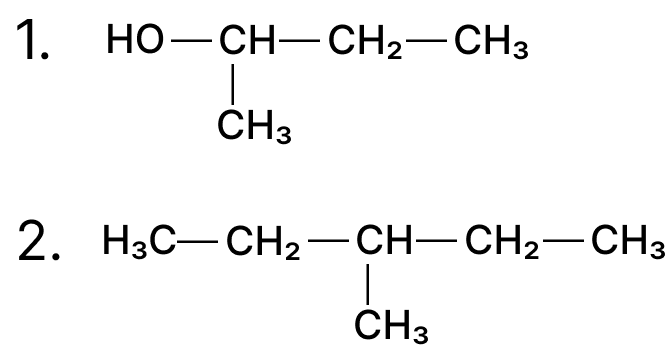
(a) Give the IUPAC name for the following organic compounds:
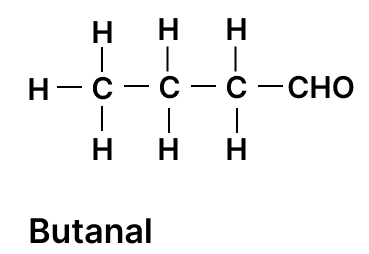
(b) Draw the structural diagram for each of the following organic compounds:
- butanal
- pent-2-yne
- The isomer of n-butane
Answer
(a) IUPAC names of the given compounds:
- Butan-2-ol
- 3-methylpentane
(b) Structural diagrams:
1. butanal
2. Pent-2-yne (CH3—C≡C—CH2—CH3)
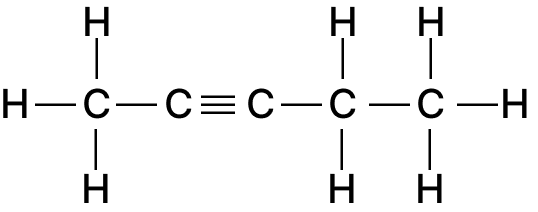
3. The isomer of n-butane is 2-methylpropane (iso-butane).

Alex was given a solution of an unknown salt Y for analysis. He performed the following tests and recorded his observations:
- To a part of the solution Y, he added silver nitrate solution and obtained a white precipitate which was soluble in ammonium hydroxide solution.
- To the remaining solution he added a few drops of sodium hydroxide solution and obtained a pale blue precipitate.
Based on the observations made by Alex, identify:
(a) the anion and
(b) the cation present in salt Y.
Answer
(a) Anion — Chloride (Cl-)
(b) Cation — Copper(II) (Cu2+)
Reason —
(a) The white precipitate formed with silver nitrate solution which is soluble in ammonium hydroxide is silver chloride (AgCl). This indicates the presence of chloride ion (Cl-) as the anion.
AgNO3 + Cl- ⟶ AgCl ↓ [white ppt.] + NO3-
AgCl + 2NH4OH ⟶ [Ag(NH3)2]Cl + 2H2O
(b) The pale blue precipitate formed with sodium hydroxide solution is copper(II) hydroxide [Cu(OH)2]. This indicates the presence of copper(II) ion (Cu2+) as the cation.
Cu2+ + 2NaOH ⟶ Cu(OH)2 ↓ [pale blue ppt.] + 2Na+
Hence, the salt Y is copper(II) chloride (CuCl2).
Study the reaction given below and answer the questions that follow:
NaNO3 + H2SO4 (Conc.) NaHSO4 + HNO3
(a) Give one reason for maintaining the temperature below 200°C.
(b) Why is concentrated Sulphuric acid used in the above reaction?
Answer
(a) The temperature is maintained below 200°C because nitric acid decomposes at higher temperature to give nitrogen dioxide, water and oxygen.
4HNO3 ⟶ 4NO2 + 2H2O + O2
(b) Concentrated sulphuric acid is used because it is a non-volatile acid with a high boiling point. It displaces the more volatile nitric acid from sodium nitrate and does not distil over with nitric acid vapours.
Element A belongs to group 15 and period 2 of the Periodic Table.
(a) Identify the element A.
(b) Write the formula of the compound formed when element A combines with hydrogen.
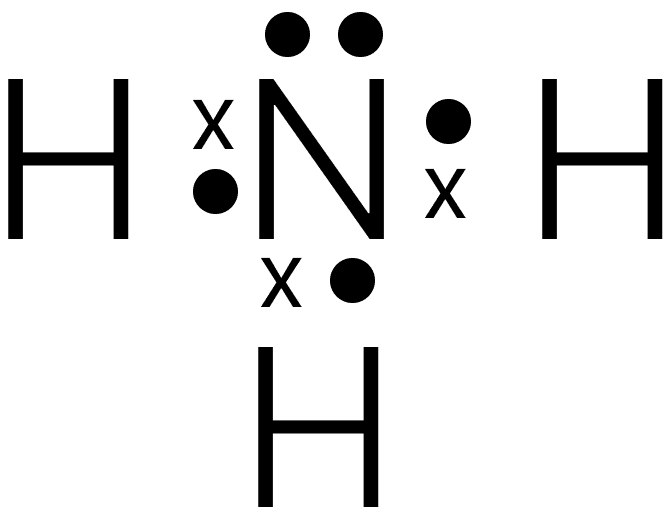
(c) Draw the dot (•) and cross (×) structure of the compound formed in (b) above.
Answer
(a) Element A is Nitrogen (N) with electronic configuration 2, 5.
(b) Nitrogen has a valency of 3 and combines with hydrogen (valency 1) to form ammonia (NH3).
(c) Dot (•) and cross (×) structure of NH3:
Complete and balance the following equations:
(a) C2H4Br2 + KOH (alcoholic) ⟶
(b) NH3 (excess) + Cl2 ⟶
(c) C12H22O11
Answer
(a) C2H4Br2 + 2KOH (alcoholic) ⟶ C2H2 + 2KBr + 2H2O
(b) 8NH3 (excess) + 3Cl2 ⟶ N2 + 6NH4Cl
(c) C12H22O11 12C + 11H2O
Differentiate between the following pairs based on the criteria given in the bracket:
(a) Acetic acid and Sulphuric acid (number of replaceable hydrogen ion per molecule)
(b) Electrolyte and Metallic conductor (the particles conducting electricity)
Answer
(a)
| Acetic acid | Sulphuric acid |
|---|---|
| Acetic acid (CH3COOH) is a monobasic acid, having only one replaceable hydrogen ion per molecule. | Sulphuric acid (H2SO4) is a dibasic acid, having two replaceable hydrogen ions per molecule. |
(b)
| Electrolyte | Metallic conductor |
|---|---|
| In an electrolyte, electricity is conducted by the movement of ions (cations and anions) in the molten state or in aqueous solution. | In a metallic conductor, electricity is conducted by the movement of free electrons through the metal lattice. |
Equal volumes of ammonia gas and chlorine gas are kept in two different containers under the same conditions of temperature and pressure.
Find the number of molecules contained in chlorine gas when the mass of ammonia is 34 g.
[Atomic weight: Cl=35.5, H=1, N=14]
Answer
According to Avogadro's Law, equal volumes of all gases under the same conditions of temperature and pressure contain the same number of molecules.
Hence, the number of molecules of chlorine gas = number of molecules of ammonia gas.
Molar mass of NH3 = 14 + 3(1) = 17 g
Number of moles of NH3 = = = 2 moles
Number of molecules in 1 mole = 6.022 × 10²³
∴ Number of molecules in 2 moles of NH3 = 2 × 6.022 × 1023 = 1.2044 × 1024 molecules
Hence, the number of molecules in chlorine gas = 1.2044 × 1024 molecules.
Elements P, Q, and R are in the same period of the modern periodic table.
- P readily loses its one valence electron to form a stable ion.
- Q shares its electrons in bonding but does not form ions easily.
- R has high electronegativity.
Answer the following questions based on the above information:
(a) Which element would be most difficult to reduce among P, Q and R?
(b) Which element is expected to have the smallest atomic radius among P, Q and R?
(c) Arrange P, Q and R in order of decreasing ionisation potential.
Answer
P loses one valence electron, so P is a Group 1 metal (most electropositive). R has high electronegativity, so R is a non-metal on the right side of the periodic table. Q shares electrons (covalent), so Q is in Group 14 (between P and R).
(a) P would be most difficult to reduce.
Reason — Reduction means gain of electrons. Element P readily loses its valence electron and is the most electropositive (strongest reducing agent itself). Hence, its tendency to gain electrons (be reduced) is the lowest, so it is most difficult to reduce.
(b) R has the smallest atomic radius.
Reason — Across a period from left to right, the atomic radius decreases due to increasing nuclear charge. R is on the rightmost side, so it has the smallest atomic radius.
(c) Decreasing ionisation potential: R > Q > P
Reason — Across a period, ionisation potential increases from left to right because atomic size decreases and the effective nuclear charge increases.
Given below are some chemicals.
| Lead nitrate, Copper, Hydrochloric acid, Lead oxide, Iron, Sodium carbonate, Copper carbonate, Chlorine |
Using suitable chemicals from the box given above, write balanced chemical equations for the preparation of the following salts.
(Note: The chemicals may be used more than once, if needed.)
(a) Lead (II) carbonate
(b) Copper (II) chloride
(c) Iron (II) chloride
Answer
(a) Pb(NO3)2 + Na2CO3 ⟶ PbCO3 ↓ + 2NaNO3
(b) CuCO3 + 2HCl ⟶ CuCl2 + H2O + CO2 ↑
(c) Fe + 2HCl ⟶ FeCl2 + H2 ↑
An unsaturated hydrocarbon having two carbon atoms was made to react with two moles of hydrogen gas in the presence of a catalyst to give a saturated hydrocarbon. Using the above information, answer the following questions:
(a) The type of reaction that occurred is ............... . (addition / substitution)
(b) Name a suitable catalyst which is used in the reaction.
(c) Write a balanced chemical equation for the above reaction.
Answer
(a) The type of reaction that occurred is addition.
(b) Nickel (Ni)
(c) C2H2 + 2H2 C2H6
During the manufacture of sulphuric acid, a chemist collected the gas formed after catalytic oxidation of sulphur dioxide.
(a) Name the gas collected.
(b) Which acid is formed when the gas collected by the chemist is dissolved directly in water?
(c) Why should we not dissolve this gas directly in water?
Answer
(a) Sulphur trioxide
(b) Sulphuric acid (H2SO4)
(c) Sulphur trioxide (SO3) does not dissolve in water satisfactorily and it gives a lot of heat and forms misty droplets of sulphuric acid which are difficult to condense and escape into the atmosphere. Hence, it is not directly dissolved in water.
The diagram given below shows the electroplating of a spoon with silver. With reference to the diagram, answer the following questions:
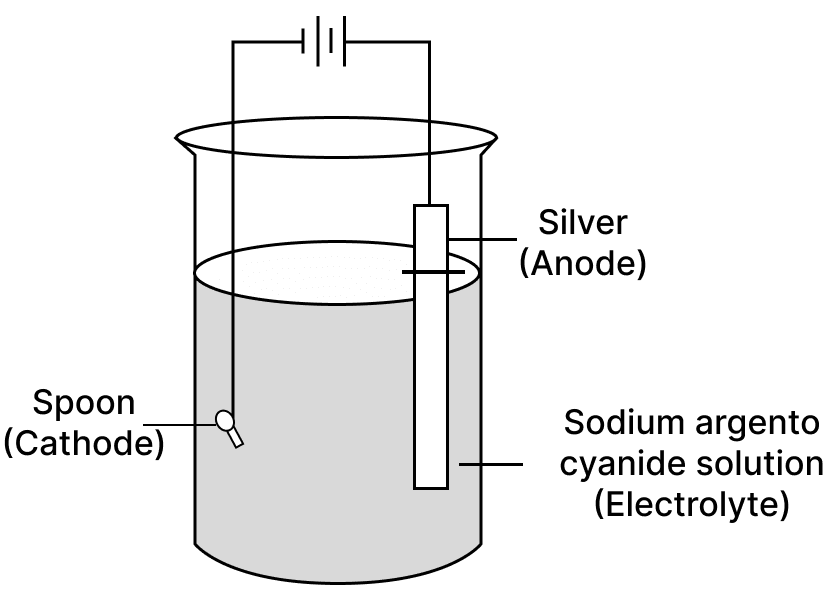
(a) Write an equation for the reaction that occurs at the cathode.
(b) Silver nitrate solution is not preferred as an electrolyte in the above process. Give a reason.
(c) Why is alternating current not used in the process?
(d) What is the observation at the anode?
Answer
(a) Ag+ + e- ⟶ Ag
(b) Silver nitrate solution is not preferred because it ionises very readily releasing a high concentration of Ag+ ions. This causes silver to be deposited too rapidly on the spoon, producing a non-uniform, loose, and rough coating with poor adhesion. Sodium argentocyanide, on the other hand, releases Ag+ ions slowly, producing a smooth, uniform, and shiny coating.
(c) Alternating current (AC) is not used because in AC, the polarity of electrodes keeps changing. As a result, silver deposited on the spoon at one moment would dissolve back into the electrolyte at the next moment. Hence, direct current (DC) is used to ensure uni-directional flow of ions and continuous deposition of silver on the spoon.
(d) The silver anode gradually dissolves into the electrolyte as silver ions:
Ag - e- ⟶ Ag+
The mass of the anode decreases during the process.
Give reasons why:
(a) Hydrochloric acid cannot form an acid salt.
(b) Electronegativity increases across a period.
Answer
(a) Hydrochloric acid (HCl) is a monobasic acid, i.e., it has only one replaceable hydrogen ion per molecule. Acid salts are formed by the partial replacement of replaceable hydrogen ions of an acid by a metal, which requires the acid to be at least dibasic (with two or more replaceable H+). Since HCl has only one replaceable hydrogen, it can only form normal salts and not acid salts.
(b) On moving across a period from left to right, the nuclear charge increases while the number of shells (energy levels) remains the same. As a result, the atomic radius decreases and the effective pull of the nucleus on the bonding electrons increases. Hence, the tendency of an atom to attract the shared pair of electrons (electronegativity) increases across a period.
State whether the following statements are True or False:
(a) Organic compounds having different molecular formula, but same structural formula are called isomers.
(b) A salt is a compound formed by partial or complete replacement of the hydrogen ion of an acid by a metal or electropositive ion.
Answer
(a) False
Reason — Isomers are organic compounds having the same molecular formula but different structural formulae.
(b) True
Reason — A salt is indeed formed when the hydrogen ion of an acid is partially or completely replaced by a metal or electropositive radical (such as the ammonium ion).
Anil is a laboratory assistant in a college. He prepared nitric acid but stored it in a transparent container exposed to sunlight. After a few days, brown fumes were observed in the container and the acid turned slightly yellowish in colour.
(a) What was the error made by Anil while storing the acid?
(b) Why were brown fumes observed in the container?
(c) How can the yellowish tinge in the acid be removed?
Answer
(a) The error made by Anil was that he stored the nitric acid in a transparent container exposed to sunlight. Nitric acid should be stored in a dark-coloured (brown) reagent bottle kept in a cool and dark place to prevent decomposition.
(b) Nitric acid is unstable and decomposes on exposure to light and heat to release reddish-brown nitrogen dioxide (NO2) gas, water and oxygen:
4HNO3 4NO2 ↑ + 2H2O + O2 ↑
The brown fumes seen in the container are due to NO2 gas.
(c) The yellowish tinge in nitric acid (caused by dissolved NO2) can be removed by bubbling air or carbon dioxide gas through the acid. This drives out the dissolved nitrogen dioxide and the acid becomes colourless again.
Zn + 4HNO3 ⟶ Zn(NO3)2 + 2H2O + 2NO2
32.5 g of zinc reacts with concentrated nitric acid as given in the above equation.
(a) How many moles of zinc was required in the reaction?
(b) Find the mass of nitric acid needed to react with 32.5 g of zinc.
(c) Find the volume of nitrogen dioxide liberated in (b).
[Atomic weight: H=1, N=14, O=16, Zn=65]
Answer
(a) Number of moles of Zn = = = 0.5 mole
(b) From the equation, 65 g of Zn reacts with 252 g of HNO3
∴ 32.5 g of Zn reacts with × 32.5 = 126 g of HNO3
(c) From the equation, 65 g of Zn produces 2 × 22.4 = 44.8 L of NO2 at STP
∴ 32.5 g of Zn produces × 32.5 = 22.4 L of NO2 at STP
Hence, 0.5 mole of zinc is required, 126 g of nitric acid is needed, and 22.4 L of NO2 is liberated at STP.
Carbon reacts with an acid to form carbon dioxide, water and nitrogen dioxide.
(a) Name the acid used in the reaction.
(b) Write a balanced chemical equation for the reaction that occurs.
Answer
(a) Concentrated Nitric Acid (HNO3)
(b) C + 4HNO3 [conc.] ⟶ CO2 + 2H2O + 4NO2
Bauxite is the principal ore used in the commercial extraction of aluminium. The Bayer's process is used to refine bauxite into pure alumina, with caustic soda playing a crucial role in the initial stage of the process.
Based on this, answer the following questions:
(a) Explain the reason behind the addition of caustic soda during the Bayer's process.
(b) Write a balanced chemical equation representing the reaction between bauxite and caustic soda during the Bayer's process.
Answer
(a) Bauxite contains alumina along with impurities such as ferric oxide and sand. Alumina is amphoteric and dissolves in hot concentrated caustic soda to form soluble sodium meta-aluminate, while the insoluble impurities remain as red mud and are removed by filtration.
(b) Al2O3·2H2O + 2NaOH ⟶ 2NaAlO2 + 3H2O
Give one relevant observation for the following:
(a) Sodium hydroxide is added dropwise to Calcium nitrate solution.
(b) Dilute Hydrochloric acid is added to Iron (II) sulphide.
(c) An amphoteric metal is added to hot concentrated alkali.
Answer
(a) A white precipitate of calcium hydroxide is formed, which is insoluble in excess sodium hydroxide.
(b) A colourless gas with the smell of rotten eggs, hydrogen sulphide (H2S), is evolved with effervescence.
FeS + 2HCl ⟶ FeCl2 + H2S ↑
(c) The amphoteric metal (e.g., zinc or aluminium) dissolves in the hot concentrated alkali showing vigorous effervescence (bubbling) due to the evolution of a colourless, odourless gas. This gas burns with a "pop" sound when a burning splinter is brought near the mouth of the test tube, confirming it is hydrogen.
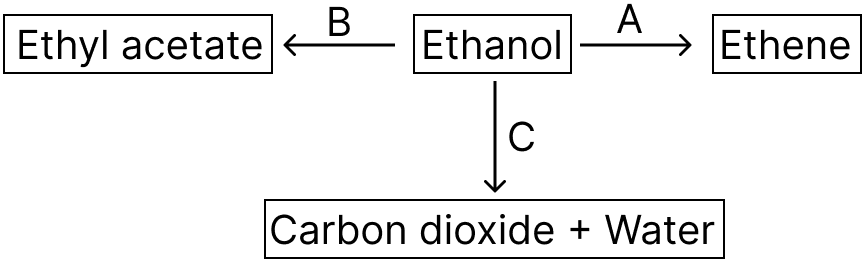
Study the reaction scheme shown below and identify the reactants A, B and C.
Answer
A → Concentrated Sulphuric Acid (conc. H2SO4)
B → Acetic acid (CH3COOH)
C → Oxygen (O2)
Explanation
Ethanol ⟶ Ethene (with reactant A): This is dehydration of ethanol. A is concentrated sulphuric acid (conc. H2SO4) at 170°C.
C2H5OH C2H4 + H2OEthanol ⟶ Ethyl acetate (with reactant B): This is esterification. B is acetic acid (CH3COOH) in the presence of conc. H2SO4 (acts as a catalyst).
C2H5OH + CH3COOH CH3COOC2H5 + H2OEthanol ⟶ Carbon dioxide + Water (with reactant C): This is combustion. C is oxygen (O2).
C2H5OH + 3O2 ⟶ 2CO2 + 3H2O
Hence, A = Concentrated H2SO4, B = Acetic acid (CH3COOH), and C = Oxygen (O2).
5.6 litres of gas Z weighs 32 g at STP. What is the molecular weight and vapour density of Z?
Answer
At STP, 22.4 L of any gas = 1 mole
∴ Number of moles of Z = = 0.25 mole
Molecular weight of Z = = = 128 g/mol
Vapour density = = = 64
Hence, the molecular weight of Z is 128 and its vapour density is 64.
Name the following:
(a) The most electronegative element of Period 2.
(b) The largest atom of Period 3.
Answer
(a) Fluorine (F)
(b) Sodium (Na)
Given below are a few elements.
Identify the element which:
(a) has the least atomic radius.
(b) has two valence electrons.
(c) is the most electropositive.
Answer
(a) Fluorine (F)
(b) Calcium (Ca)
(c) Potassium (K)
Explanation
(a) Fluorine (F) has the least atomic radius. It is on the rightmost side of period 2, where atomic radius is minimum.
(b) Calcium (Ca) has two valence electrons (electronic configuration: 2, 8, 8, 2). It belongs to Group 2 of the periodic table.
(c) Potassium (K) is the most electropositive. Within Group 1, electropositive character increases down the group; potassium is below lithium and hence is more electropositive.
K, L and M are beakers containing three different solutions as shown below.
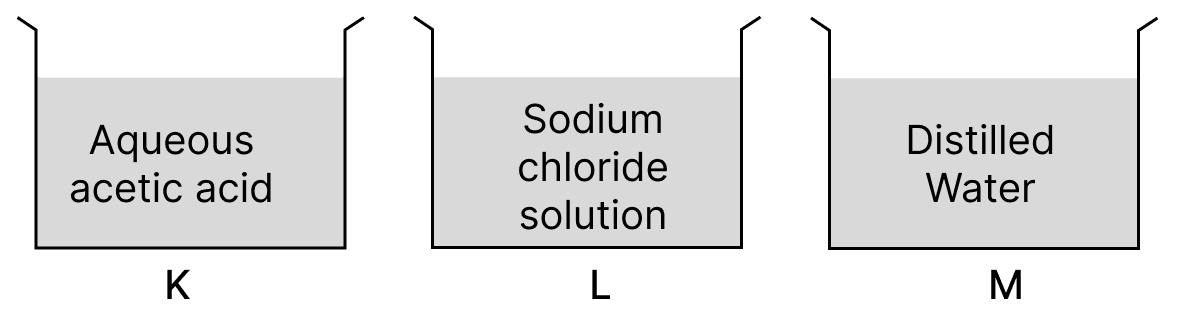
Name the beaker which:
(a) contains only ions.
(b) contains only molecules.
(c) has pH less than 7.
Answer
(a) L — Sodium chloride is a strong electrolyte and ionises completely in water, dissociating fully into Na+ and Cl- ions.
NaCl ⟶ Na+ + Cl-
(b) M — Distilled water consists almost entirely of H2O molecules and contains no ions (its self-ionisation is negligible).
(c) K — Aqueous acetic acid is acidic in nature (it is a weak acid which partially ionises to give H+ ions), and hence has a pH less than 7.
CH3COOH ⇌ CH3COO- + H+