
The salaries and allowances of the ministers are decided by the:
- Parliament
- Finance Minister
- President
- Prime Minister
Answer
Parliament
Reason — The Parliament decides the salaries and allowances of its members and other dignitaries such as the ministers.
Civil Cases : Court of District Judge : : Criminal Cases :
- Revenue Court
- Family Court
- Sessions Court
- Commissioner’s Court
Answer
Sessions Court
Reason — The Court of District Judge is the highest Civil Court of the district, whereas Sessions Court is the highest Criminal Court of the district.
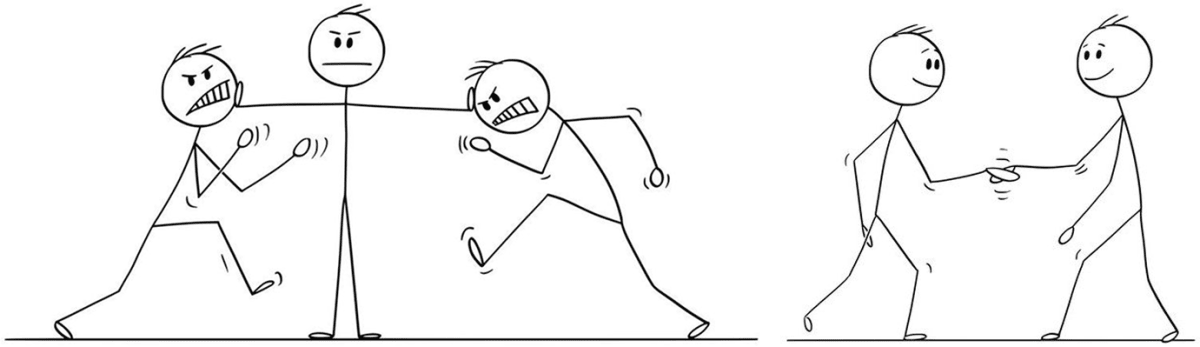
The Lok Adalat has many advantages. Which of the following statements about the advantages of the Lok Adalat is best described in the picture given below?
- It is inexpensive
- It is organised in various parts of the country
- It works on the spirit of compromise
- It reduces the burden of the higher courts
Answer
It works on the spirit of compromise
Reason — Lok Adalat works on the spirit of compromise as shown the given case, the counselling parties agreed to put aside their differences and came to a mutual agreement.
Given below are details of Indian citizens. Select the ones who are eligible for appointment as a High Court Judge:
| Candidate | Age | Details |
|---|---|---|
| P | 65 | Is a distinguished jurist |
| Q | 61 | Has been a High Court Advocate for 10 years |
| R | 67 | Has been a High Court Advocate for 5 years |
| S | 56 | Has held a judicial office for at least 10 years |
- P and R
- Q and S
- R and P
- Q and R
Answer
Q and S
Reason — A person is eligible for appointment as a Judge of a High Court if he has held a judicial office in India for at least ten years or has been an advocate of a High Court (or High Courts) continuously for ten years. Therefore, Q and S satisfy the prescribed qualifications, whereas R has only five years' experience as an advocate.
The strength of the house is 550. On a particular day 50 members are present. The speaker decides to adjourn the house. Identify the MOST LIKELY reason for the adjournment.
- Disorder in the house
- Lack of quorum
- Breach of privilege
- Contempt of the House
Answer
Lack of quorum
Reason — The quorum of the Lok Sabha is one-tenth of its total membership. This means that the House cannot conduct its proceedings and pass Bills and resolutions without the presence of at least one-tenth of its total membership. In the given case, one-tenth of 550 is 55. Since the quorum is not met, the speaker decides to adjourn the house.
During a hung assembly when no party gets the majority, the President appoints the Prime Minister. What power is the President exercising?
- Legislative
- Executive
- Discretionary
- Judicial
Answer
Discretionary
Reason — The President uses discretionary judgement to appoint the Prime Minister when no party has a clear majority in the Lok Sabha.
Read the two statements given below and select the option that shows the correct relationship between (A) and (R):
Assertion (A): Forward Bloc had the objective of abolishing Zamindari System.
Reason (R): Subhash Chandra Bose wanted to establish a socialist state.
- A is true but R is false
- R is the reason for A
- Both A and R are false
- Only R is true, A is false
Answer
R is the reason for A
Explanation — Forward Bloc was founded by Subash Chandra Bose on May 3, 1939. It had the objective of abolishing Zamindari System to establish a socialist state.
The ............... aimed to introduce equality between British and Indian Judges.
- Vernacular Press Act
- Gagging Act
- Indian Universities Act
- Ilbert Bill
Answer
Ilbert Bill
Reason — Ilbert Bill (1883) provided for the trial of British or European persons by Indians. By this Act, the British tried to introduce equality between British and Indian judges in India.
The Rowlatt Act was called the Black Act because the Indians:
- could not possess any arms
- could not export any goods
- could be arrested without a warrant
- could be sent overseas on duty
Answer
could be arrested without a warrant
Reason — The Rowlatt Act (1919) authorised the Government to imprison any person without trial and convict him in a court. It implied:
- Arrest of a person without warrant.
- In camera trial (trial in seclusion).
- Restrictions on movements of individuals.
- Suspension of the Right of Habeas Corpus.
Who organised the Grand Delhi Durbar?
- Lord Curzon
- Lord Canning
- Lord Lytton
- Lord Dalhousie
Answer
Lord Lytton
Reason — Lord Lytton organised a Grand Delhi Durbar in 1877 to proclaim Queen Victoria as the Empress of India.
Tina is inspired by the methods of the Early Nationalists and wants to follow them. She notices that the road leading to her school is damaged and has many potholes. Which of the following methods is she MOST LIKELY to follow, to solve this problem?
- Boycott the civic authorities
- Gather a group of students and protest
- Write a petition to the authorities highlighting the problem
- Block the entrance to the road
Answer
Write a petition to the authorities highlighting the problem
Reason — The Early Nationalists believed in the British government and relied on constitutional and peaceful methods to achieve their aims. So, Tina will opt the peaceful approach, i.e. writing a petition to the authorities highlighting the problem.
Given below are the objectives of the Indian National Army. Identify the odd one out of the following:
- To organise a provisional government of Free India
- Total mobilisation of Indian manpower and money
- Unity, faith and sacrifice
- To train and organise public opinion in the country
Answer
To train and organise public opinion in the country
Reason — To train and organise public opinion in the country is not the main objective of the Indian National Army.
Tahir is preparing to give a speech about the Sati system in India. Which of the following Indian leader’s contribution MUST he mention in his speech?
- Raja Rammohan Roy
- W. C. Bonerjee
- Bipin Chandra Pal
- Jyotiba Phule
Answer
Raja Rammohan Roy
Reason — Due to the efforts made by Rammohan Roy that William Bentinck, the Governor-General of India, passed a law in 1829 making the practice of Sati illegal and punishable by law. He was a strong supporter of women's rights.
Which of the following is NOT a consequence of the Second World War?
- Austria and Hungary became separate states
- Defeat of the Axis powers
- Beginning of the Cold War
- Formation of the United Nations
Answer
Austria and Hungary became separate states
Reason — Austria and Hungary becoming separate independent states is a consequence of the First World War.
Identify the principle of Panchsheel.
- Mutual non-aggression
- Regulate armaments
- Take action against aggressor
- Recommend admission of members
Answer
Mutual non-aggression
Reason — Mutual non-aggression is one of the five principles of Panchsheel. The other four are — mutual respect for sovereignty and territorial integrity, equality for mutual benefit, non-interference in each other's internal affairs and peaceful co-existence.
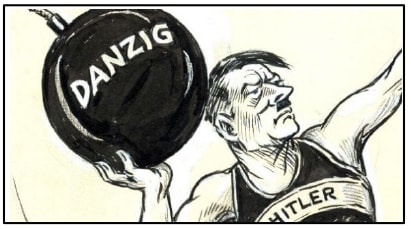
Which incident depicted in the below cartoon led to the beginning of the Second World War?
- Hitler’s policy of Imperialism
- Hitler’s attack on Poland
- Hitler’s annexation of Austria
- Hitler’s attack on Czechoslovakia
Answer
Hitler’s attack on Poland
Reason — In September 1939, Hitler attacked Poland to regain the Danzing port. Germany wanted to regain her lost territories.
Mention any two writs issued by the High Court.
Answer
Two writs issued by the High Court are —
- Habeas Corpus
- Mandamus
Imagine you are an Indian ruler who has signed the Subsidiary Alliance. Mention any two conditions of this agreement which will affect you.
Answer
If I were an Indian ruler who had signed a Subsidiary Alliance with the British East India Company, two major conditions that would affect me are:
Stationing of British Troops: I would be required to maintain a British army within my territory and bear the cost of its maintenance. This would strain my treasury and reduce my control over my own kingdom’s affairs.
No Alliances or Wars Without British Consent: I would lose the right to negotiate treaties or go to war with any other power without the prior permission of the British. This would severely affect my sovereignty and independence in foreign affairs.
These terms would reduce me to a puppet ruler, dependent on British support, and erode my authority over both internal and external matters.
Mention any two causes of the Quit India Movement.
Answer
Two causes of the Quit India Movement were:
- Failure of the Cripps Mission
- Japanese threat
In which year did the Surat Split happen? What was the result of this split?
Answer
Surat Split happened in the year 1907. The Surat Split of the Indian National Congress (INC) resulted in the party’s division into two groups, i.e., the Early Nationalists and the Assertive Nationalists, due to different ideologies and methods. The Split in the Congress gave an opportunity to the British to exploit the situation and it weakened the national movement.
Mention any two common ideologies of Fascism and Nazism.
Answer
Two common ideologies of Fascism and Nazism are:
- To have faith in the totalitarian rule.
- To hold that the state is supreme and it could suppress the fundamental rights and freedoms of individuals.
Name the two cities of Japan which were bombed by America in the year 1945.
Answer
The two cities of Japan bombed by America in 1945 were:
- Hiroshima
- Nagasaki
Read the given news carefully and answer the question that follows:
Govt's power to promulgate, repromulgate Ordinances why and how
An Ordinance "shall have the same force and effect as an Act of Parliament". But the government is required to bring an Ordinance before Parliament for ratification and failure to do so will lead to its lapsing "at the expiration of six weeks from the reassembly of Parliament".
The Indian Express - May 25, 2023
Mention any two points regarding an ordinance that can be deduced from the above news.
Answer
From the given news excerpt, we can deduce that:
- The ordinances can only be promulgated when both Houses of the Parliament are not in session.
- All Ordinances must be put up before both the Houses for their approval. Ordinances cease to operate after six weeks from the re-assembly of Parliament, unless they are approved by the Houses.
The Union Parliament is the supreme legislative body in the country. With reference to the Indian Parliament answer the following questions:
(i) The Rajya Sabha is called a Permanent House. Explain this statement.
(ii) Explain the composition of the Rajya Sabha.
(iii) Mention any two exclusive powers of the Lok Sabha and two powers exclusive to the Rajya Sabha.
Answer
(i) The Rajya Sabha is a permanent House as it cannot be dissolved like the Lok Sabha. Each member of the Rajya Sabha is elected for a period of six years. One-third of the total members of the House retire after every two years.
(ii) Composition of the Rajya Sabha — The maximum strength of the Rajya Sabha can be 250 members, out of which -
- 12 members are nominated by the President from among persons having special knowledge or practical experience in matters such as literature, science, art and social service.
- 238 members are elected by the States in the Union. Seats are allocated to the States and the Union Territories on the basis of their population.
(iii) Two exclusive powers of the Lok Sabha —
- Motions of No-confidence against the government can only be introduced and passed in the Lok Sabha. If passed by a majority vote, the Prime Minister and the Council of Ministers resign collectively. The Rajya Sabha has no power over such a motion, and hence no real power over the executive.
- Money bills can only be introduced in the Lok Sabha, and upon being passed, are sent to the Rajya Sabha, where it can be deliberated on for up to 14 days.
Two exclusive powers of the Rajya Sabha —
- Though the Parliament cannot, in normal times, make laws on a states subject, the Constitution states that under Article 249, the Rajya Sabha may, by resolution adopted by two-thirds majority empower the Parliament should make laws with respect to a matter in the State List. The Lok Sabha has no authority to assert itself in such matters.
- The other special power enjoyed by the Rajya Sabha is that it may declare that the creation of new All-India Services be made in the national interest. There upon Parliament may create new services.
The Council of Ministers headed by the Prime Minister aids and advises the President. In this context, answer the following questions:
(i) Mention any three points to distinguish between the Council of Ministers and the Cabinet.
(ii) Who appoints the Cabinet Ministers? Mention any two administrative powers of the Cabinet.
(iii) The President is the nominal head of the Indian Union. Mention any four functions of the Prime Minister with reference to the President.
Answer
(i) Difference between the Council of Ministers and the Cabinet —
| Council of Ministers | Cabinet |
|---|---|
| The Council of Ministers consists of all categories of Ministers Cabinet Ministers, Ministers of State and Deputy Ministers. | The 'Cabinet' is a smaller group consisting of senior Ministers holding important portfolios such as Defence, Finance, Home, etc. |
| The Prime Minister may or may not consult the other Ministers, below the rank of Cabinet Ministers. | They are the most trusted colleagues of the Prime Minister. The Prime Minister always consults them. The decisions of the Cabinet are binding on all the ministers. |
| In the day-to-day working of the government, the Council of Ministers as a whole rarely meets. | The Cabinet is a small cohesive group of senior Ministers who determine the policy and programme of the Government; so they meet as frequently as possible. |
(ii) The President appoints the Cabinet ministers as per the advice of the Prime Minister. Two administrative powers of the Cabinet are:
- Policy making: The Cabinet formulates both external and domestic policies and decides on crucial government matters concerning various domains like defense, economy and foreign affairs.
- Coordination: The Cabinet ensures smooth collaboration and coordination between different government departments for effective policy implementation.
(iii) The President of India is referred to as a nominal head of the Indian Union because of the following reasons -
- All authority vested in the President is exercised by the Prime Minister. He/She is the principal advisor of the President. Thus, the President is the nominal head and the Prime Minister is the real executive of the Indian Union.
- It is on the advice of the Prime Minister that the President summons and prorogues the Parliament and dissolves the Lok Sabha.
- The Prime Minister chooses the ministers and, on his/her advice, the President appoints them. The ministers may be dismissed on the advice of the Prime Minister.
- He/She advises the President on various appointments to important posts such as the Judges of the Supreme Court, the Governors and Ambassadors.
The judiciary is the system of courts that interprets and guards the Indian Constitution. With reference to the Supreme Court of India, answer the following:
(i) What is the composition of the Supreme Court? Why is it called the Court of Record?
(ii) Explain the power of Judicial Review.
(iii) What is meant by the term Original Jurisdiction? Mention any three cases which come under this jurisdiction.
Answer
(i) The Supreme Court of India consists of a Chief Justice of India and not more than 33 other judges, until Parliament by law prescribes a larger number of judges.
A Court of Record is a court whose judgements are recorded for evidence and testimony.
- The judgements are in the nature of 'precedents', i.e., the High Courts and other Courts are bound to give a similar decision in a similar case. They are not to be questioned when they are produced before any subordinate court.
- The Supreme Court shall be a "Court of Record" and shall have all the powers of such a court including the power to punish for contempt of itself.
- The Court of Record has two implications:
- Its judgements and orders are preserved as record. These can be produced in any court as precedents.
- If a person commits a contempt of court, the court has the authority to punish him. No authority can deprive the court of this right.
(ii) The Supreme Court is the interpreter of the Constitution and its decision is final.
- It has the power to review laws passed by the Union or State legislatures.
- The Supreme Court can declare a law 'ultra vires' or null and void, if it is against the letter and spirit of the Constitution or contravenes any provision of the Constitution. This power is referred to as the power of judicial review.
(iii) Original Jurisdiction means the power to hear and determine a dispute in the first instance; i.e., those cases which cannot be moved in any court other than the Supreme Court.
The Supreme Court exercises the power of the Original jurisdiction in the following cases:
- The Supreme Court has original jurisdiction in all disputes between the Union and States as well as between the States.
- Protection of Fundamental Rights.
- Final Interpretation of the Constitution.
The Revolt of 1857 was the beginning of the independence struggle against the colonial rule of the British. With reference to the consequences of the Revolt, answer the following:
(i) Mention any three changes made in the administration with the end of the Company's Rule.
(ii) State any three policies promised to Indians in Queen Victoria's Proclamation.
(iii) Mention any four changes made in the army after the Revolt.
Answer
(i) Three changes made in the administration with the end of the Company's Rule are:
- The Company's Board of Control and Court of Directors were abolished. A member of the British Cabinet was appointed Secretary of State for India and made responsible for all matters related to the governance of India. He was given a Council to advise him, called the Indian Council. Thus, the ultimate power over India remained with the British Parliament.
- Actual governance was to be carried on, as before, by the Governor-General who was also given the title of Viceroy, that is, a personal representative of the Crown. Lord Canning was appointed as the first Viceroy under this Act.
- Appointments to the Civil Service were to be made by open competition under rules made by the Secretary of State.
(ii) Queen Victoria's Proclamation promised that the government of India would — ;
- follow a policy of non-intervention in social and religious matters of Indians.
- treat all subjects-Indians and Europeans-as equals (education and ability would be the basis of all appointments).
- grant a general pardon to all those who had taken part in the War except those who were found guilty of murder of British subjects.
(iii) The India army was reorganised after 1858, to prevent the reoccurrence of another uprising, in the following manner:
- The strength of European troops in India was increased. The ratio of European to Indian troops was fixed at 1:2 (Bengal army) and 2:5 (Madras and Bombay armies). Practically the same ratio was maintained till the First World War. The general principle adopted was that the number of Indian sepoys should not exceed twice that of the European troops.
- European troops were kept in key geographical and military positions.
- To desist the Indian soldiers from rising again against the British rule, the sophisticated weapons and ammunition were never placed under the charge of Indians. All Indian artillery units, with the exceptions of a few mountain units, were disbanded.
- Newspapers, journals and nationalist publications were prevented from reaching the soldiers to keep the Indian army separated from the life of the rest of the population.
The Indian National Movement is divided into three phases. With reference to the Second Phase of the Indian National Movement, answer the following questions:
(i) Who partitioned Bengal? Mention any two points to explain the perspective of the Nationalists regarding the actual motive behind the decision of Partition.
(ii) What was the objective of the Assertive Nationalists? Mention any two contributions of Bal Gangadhar Tilak.
(iii) In which year was the Muslim League formed? Mention any three objectives of the Muslim League.
Answer
(i) Lord Curzon, the Viceroy of India was responsible for the Partition of Bengal in 1905. The actual motives behind the partition from the perspective of the Nationalists were:
- The Partition of the state was intended to curb Bengali influence by not only placing Bengalis under two administrations but by reducing them to a minority in Bengal itself.
- The Partition was meant to foster division on the basis of religion. East Bengal would be predominantly a Muslim majority state and West Bengal would have a Hindu majority.
(ii) The main objective of the Assertive Nationalists was the immediate attainment of complete independence or 'Swaraj'. Two contributions of Bal Gangadhar Tilak are:
- Demand for Swaraj: Tilak was the first to openly declare the demand for Swaraj. "Swaraj is my birth right," he said, "and I shall have iť".
- Established Home Rule League: Tilak set up a Home Rule League at Pune in 1916 to attain home rule or a dominion status for India under the British Empire along the lines of countries like Canada and Australia.
(iii) Muslim League was formed in 1906.
Objectives of the Muslim League —
- To promote, among the Muslims of India, support for the British government and to remove any misconceptions regarding the intention of the government in relation to Indian Muslims.
- To protect and advance the political rights and interests of the Muslims and to represent their needs and aspirations to the government in mild and moderate language.
- To prevent the rise of feelings of hostility between the Muslims of India and other communities.
Look at the picture given and answer the following questions:
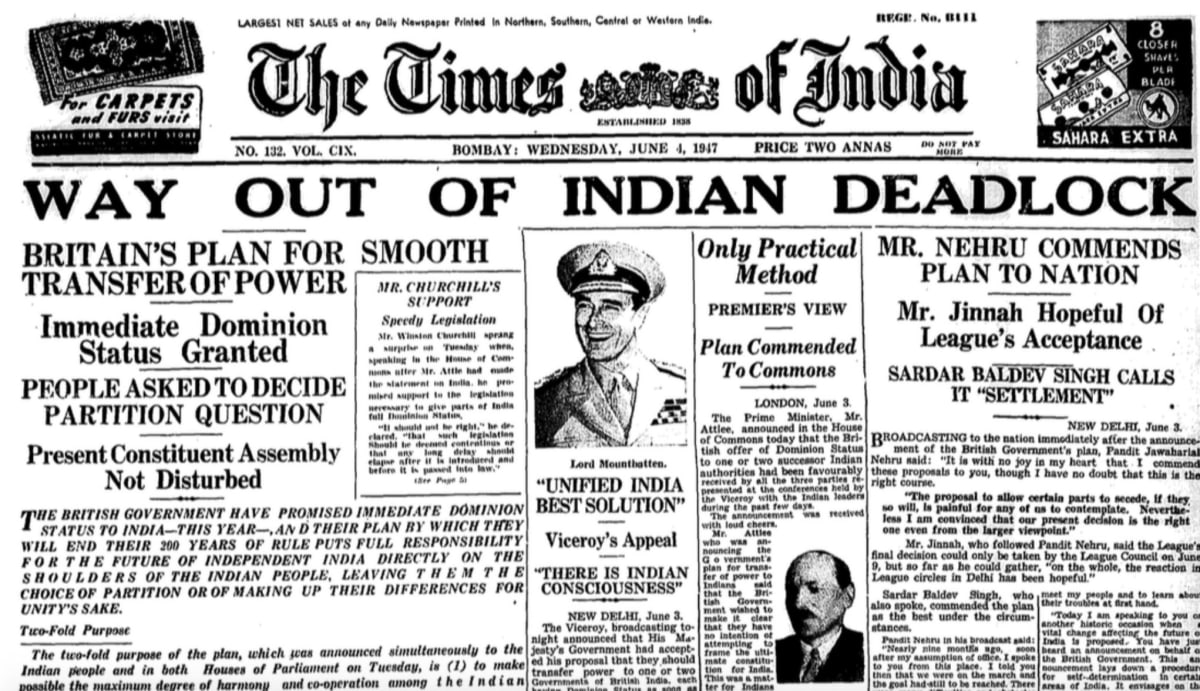
(i) Name the Viceroy who announced the plan for smooth transfer of power. Mention any two clauses of his plan with reference to the Princely States.
(ii) Mention any three reasons for the acceptance of his plan by the Congress.
(iii) Mention any four provisions of the Indian Independence Act of 1947.
Answer
(i) Lord Mountbatten announced the Mountbatten Plan on June 3, 1947, for smooth transfer of power.
Two clauses of Mountbatten Plan with reference to the Princely states are:
- The Mountbatten Plan stated that the treaties with them would come to an end.
- They would be free to associate themselves with either of the Dominions or to remain independent.
(ii) The reasons due to which All-India Congress Committee finally accepted the Mountbatten Plan may be summarised as follows:
- The large-scale communal riots that engulfed the whole country convinced all that the only solution to the communal problem lay in the Partition of India. In the words of Sardar Patel, "Refusal of the demand for Pakistan will amount to dividing the country into so many Pakistans."
- The League had joined the Interim Government to obstruct and not to cooperate. Experience of working with the League had convinced the Congress that it could not have a joint administration with the League.
- The only alternative to Partition was a Federation with a weak Centre. A smaller India with a strong central authority was better than a bigger State with a weak Centre.
(iii) Four provisions of the Indian Independence Act of 1947 are:
Two New Dominions: India would be partitioned and two independent Dominions-India and Pakistan-would be created from August 15, 1947. The Act provided legislative supremacy of both the Dominions. The territories of the two Dominions were divided in such terms that Pakistan would comprise Sindh, British Baluchistan, North West Frontier Province, the West Punjab and East Bengal. India was to comprise all the remaining territories included in the British India. The exact boundaries of the Dominions would be determined by a Boundary Commission.
Constituent Assemblies to Serve as Central Legislatures: The Constituent Assemblies of both the dominions were to act as the Central Legislatures and would have full powers to make laws for their respective Dominion. They would act as sovereign bodies for legislative purposes.
Princely States: The Princely States would become independent and all the powers exercised by the British authority were to be terminated. All treaties and agreements made by the British with reference to States would lapse from August 15, 1947. They would be free to associate themselves with either Dominion or to remain independent.
Division of the Army and the Assets: Provisions were made for the division of the Indian army between the two Dominions and steps were to be taken to share the assets and liabilities between the two Dominions.
The final act of the long-drawn-out negotiations took place at Versailles on Saturday afternoon, and to-day Germany and the Allies - always with the exception of America - are at peace. Peace is a blessed word, and both the word and the fact are welcome to-day. So far as Germany is concerned there is for the present an end of strife, and at least a formal return to the decent relations of civilised states.
Editorial: Peace in force (12 January 1920)
The Guardian
(i) Mention any three causes of the World War which ended with the signing of the treaty being discussed in the passage above.
(ii) Name the organization which was established in 1920 to maintain peace after this war. Mention any two of its objectives.
(iii) Mention any four clauses of the Treaty which affected Germany.
Answer
(a) Three causes of the First World War were —
- Division of Europe into two hostile groups — the Triple Alliance and the Triple Entente.
- The armament race, in which every major power began stockpiling arms in the name of self-defence.
- Militant/aggressive nationalism and imperialism, which filled the atmosphere with mutual hatred and international rivalry. (The immediate cause was the Sarajevo Crisis.)
(b) The organisation established in 1920 to maintain peace after the war was the League of Nations. Two of its objectives were —
- To maintain international peace and security and establish international relations based on justice and honour.
- To promote material and intellectual co-operation between the nations of the world so that people's life may become happier and nobler.
(c) Four clauses of the Treaty of Versailles which affected Germany were —
- Germany and her allies were held guilty for aggression and hence she was forced to cede certain parts of her pre-war territories to Denmark, Belgium, Poland and Czechoslovakia.
- Alsace and Lorraine were returned to France, and the Saar Valley was ceded to France for 15 years.
- Germany had to lose all her colonial empire, which was divided among the victors.
- The German army was reduced to 1,00,000, she was deprived of any air force and submarines, and she was compelled to pay 33 billion dollars as war-indemnity.
Both the United Nations Organisation and the Non-Aligned Movement aim to achieve international peace and security. In this context, answer the following:
(i) Mention any three functions of the Security Council.
(ii) Mention any three functions of the World Health Organisation.
(iii) Name any two founders of the Non-Aligned Movement. Mention any two of its objectives.
Answer
(i) The functions of the Security Council related to maintaining world peace are as follows:
- To maintain international peace and security in accordance with the principles and purposes of the United Nations.
- To investigate any dispute or situation which might lead to international friction and to take military action against an aggressor.
- To recommend methods of adjusting such disputes or the terms of settlement.
(ii) Three functions of the World Health Organisation are:
- It helps countries to improve their health system by building up infrastructure especially manpower, institutions and services for the individual and community.
- It gives important drugs needed for medical care. The WHO launched a programme to immunise children against six major diseases-Measles, Diphtheria, Tetanus, Tuberculosis, Polio and Whooping Cough.
- It promotes research to cure and prevent diseases. For example, it arranged for the investigation of cancer and heart diseases in laboratories in many countries to identify disease-causing organisms, to improve vaccines and to train research workers.
(iii) Two founders of the Non-Aligned Movement are — Prime Minister Nehru of India, and President Nasser of Egypt.
Two objectives of Non-Aligned Movement are:
- To oppose colonialism, imperialism and racial discrimination.
- To advocate peaceful settlement of international disputes.