
On May 19, 2023, the President of India exercised legislative power under Article 123 of the Constitution, during the period Parliament was in recess, to promulgate The Government of National Capital Territory of Delhi Ordinance, 2023.
- The Hindu, May 26, 2023
What information about an ordinance can we obtain from the above passage?
- The ordinance must be approved within six weeks
- Only the Cabinet can prepare an ordinance.
- It is issued when the Parliament is not functioning.
- If the Parliament does not approve it within six weeks it becomes inoperative.
Answer
It is issued when the Parliament is not functioning.
Reason — As mentioned in the given excerpt, The Government of National Capital Territory of Delhi Ordinance, 2023 was promulgated by the President of India as the Parliament was in the recess period.
Given below are details of few Indian citizens:
| Person | Age [In years] | Description |
|---|---|---|
| W | 34 | Is a Professor in the Government College |
| X | 35 | Has taken up the citizenship of the United States of America |
| Y | 27 | Is a reputed sportsperson |
| Z | 36 | Is a scientist |
Select the person who fulfils the eligibility criteria to become the President of India.
- W
- X
- Y
- Z
Answer
Z
Reason — To become the President of India, one must be a citizen of India, must have completed 35 years of age, and should not hold an office of profit under the government. Thus, Person Z fulfills the eligibility criteria to become the President of India.
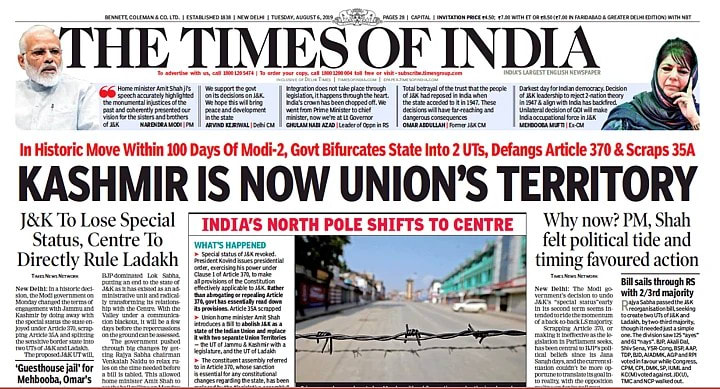
Who made the amendment which resulted in the below headline?
- The Supreme Court
- The President
- The Parliament
- The Prime Minister
Answer
The Parliament
Reason — The Central Government took an important political and constitutional step on August 5, 2019 by abrogating Article 370 and bifurcating Jammu and Kashmir into two separate Union Territories (UTs), i.e., Jammu and Kashmir with a Legislative Assembly and Ladakh without a Legislative Assembly.
Residents of Jodhpur, X and Y got married in the year 2014 and after 4 months of wedlock, petty family issues and arguments resulted in their separation for 6 years. The matter was placed before the Bench of Lok Adalat Family Court, Jodhpur wherein all efforts were made to reunite the family again. With constant efforts of counselling parties agreed to live together and withdraw their Divorce Petition
Case Study, Lok Adalat, District — Jodhpur
Which advantage of the Lok Adalat is highlighted in the above case?- Saves money
- Speedy justice
- Works on the spirit of compromise
- Reduces the burden on High Courts
Answer
Works on the spirit of compromise
Reason — Lok Adalat works on the spirit of compromise as shown in the given case. The counselling parties agreed to put aside their differences and came to a mutual agreement.
District Judge : ............... cases :: Sessions Judge : Criminal Cases
- Advisory
- Civil
- Constitutional
- Appellate
Answer
Civil
Reason — When a judge decides civil cases, he is called the District judge, and when he decides criminal cases, he is called the Sessions judge.
Identify the exclusive powers of the Rajya Sabha
P: Can introduce a new All India Service
Q: Can impeach the President
R: Can never be dissolved as a whole
S: Can introduce a Money Bill
- P and Q
- R and S
- P and R
- Q and S
Answer
P and R
Reason — The Rajya Sabha has the exclusive power to declare the creation of new All India Services in accordance with national interest. Also, it is a permanent house and cannot be dissolved as each member is elected for a period of six years, which means that one-third of the total members retire after every two years.
Read the two statements given below about the Civil Disobedience Movement and select the option that shows the correct relationship between (A) and (R).
Assertion (A): The Civil Disobedience Movement was renewed by Mahatma Gandhi.
Reason (R): The Second Round Table Conference was a failure.
- (R) contradicts (A).
- (R) is the reason for (A).
- (A) is true but (R) is false.
- (A) and (R) are independent of each other.
Answer
(R) is the reason for (A).
Explanation — Since the Second Round Table Conference was a failure and the British government refused to concede the immediate grant of dominion status, Gandhiji returned to India disappointed. Paired up with the fact that Viceroy Willingham refused an interview demand put up by Gandhiji during the Great Depression of 1930s, the Civil Disobedience Movement was renewed by Mahatma Gandhi.
The government of Country X has introduced a law similar to Ilbert Bill introduced in 1883. Who will be impacted by this Bill?
- The Farmers
- The Artisans
- The Soldiers
- The Judges
Answer
The Judges
Reason — Ilbert Bill (1883) provided for the trial of British or European persons by Indians. By this Act, the British tried to introduce equality between British and Indian judges in India.
The area in which Anand stays has had no water supply for three days in spite of repeated complaints. The residents have a meeting and discuss a few methods to resolve this problem. Being a follower of the beliefs and methods of the Early Nationalists, which of the following methods is Anand NOT LIKELY to approve?
- Peaceful procession by the residents
- Follow the method of boycott
- Write a petition to the government
- Write an article in the newspaper highlighting the problem.
Answer
Follow the method of boycott
Reason — The Early Nationalists believed in moderate politics. They believed in the British government and relied on constitutional and peaceful methods to achieve their aims. They believed in patience and reconciliation rather than in violence and confrontation. So, Anand is unlikely to follow the assertive method of boycott.
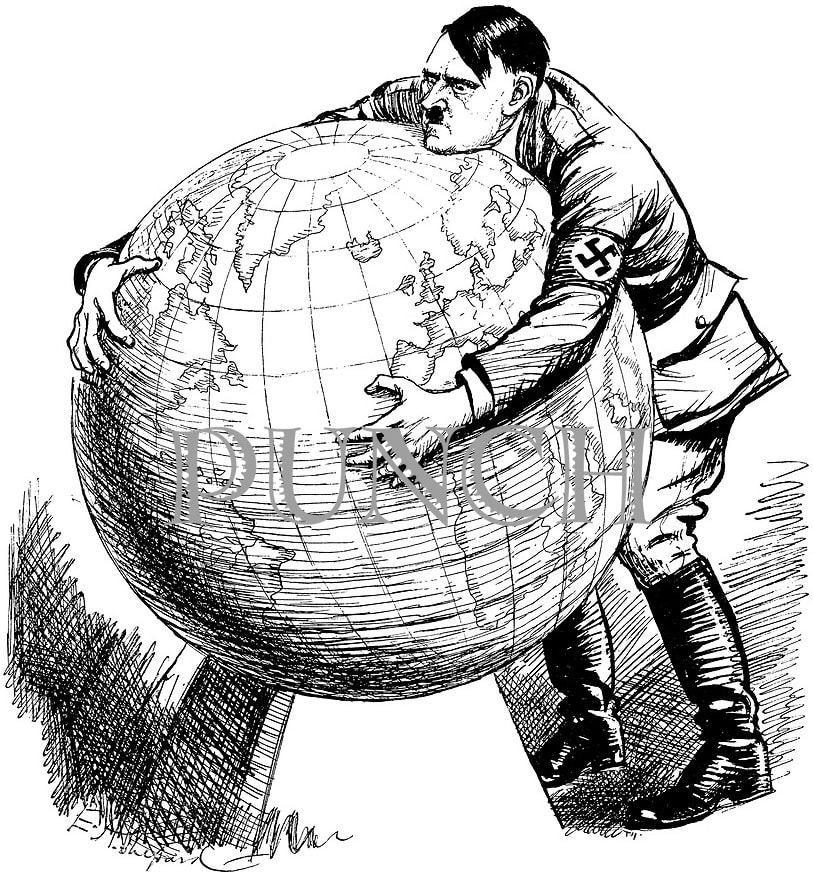
Which of the given policies is NOT aligned with the ideologies of the leader seen in the picture?
- prioritising military expansion
- promoting racist policies
- hosting an anti-communist seminar
- holding pro-democracy rallies
Answer
holding pro-democracy rallies
Reason — The given picture shows Hitler. He opposed democracy and suppressed opposition, banning free speech, and eliminating democratic institutions. Therefore, holding pro-democracy rallies is not aligned with his ideologies.
Identify the ODD ONE out of the following objectives of the Muslim League:
- To promote among Muslims of India, support for the British
- To promote cultural and socio-economic cooperation among Muslims
- To protect and advance political rights and interests of the Muslims
- To present the needs and demands of the Muslims to the government
Answer
To promote cultural and socio-economic cooperation among Muslims
Reason — To promote cultural and socio-economic cooperation among Muslims is not an objective for the formation of the Muslim League.
Your school has organized a poster making competition on the topic Education empowerment for Girls in India. Which of the following leaders would MOST LIKELY be part of the poster?
- Surendranath Banerjee
- Pherozeshah Mehta
- Dadabhai Naoroji
- Jyotiba Phule
Answer
Jyotiba Phule
Reason — Jyotiba Phule worked for the upliftment of women. In 1848, Jyotiba Phule along with his wife, Savitribai Phule started one of the first girls school in Pune. Over the years, he opened more schools for girls.
Read the description and identify the person —
He established the Forward Bloc and coined the slogan, 'Delhi Chalo'.
- Mahatma Gandhi
- Subash Chandra Bose
- Bal Gangadhar Tilak
- Dadabhai Naoroji
Answer
Subash Chandra Bose
Reason — Subash Chandra Bose laid the formation of a new party within the Congress, called the Forward Bloc on May 3, 1939. He also coined the slogan, 'Delhi Chalo'.
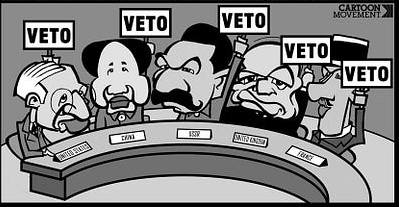
Which of the following countries will NOT be part of this cartoon?
- China
- Japan
- Russia
- Britain
Answer
Japan
Reason — VETO power is enjoyed by the permanent members of the UN. Since, Japan is not the permanent member of the UN, it does not enjoy VETO power.
Identify the cities most affected by American action in World War II.
- Rome, Berlin
- Tokyo, Berlin
- Hiroshima, Nagasaki
- Tokyo, Rome
Answer
Hiroshima, Nagasaki
Reason — During World War II, the United States dropped atomic bombs on the Japanese cities of Hiroshima (on August 6, 1945) and Nagasaki (on August 9, 1945). These two bombings were the most significant American military actions in terms of civilian impact and destruction, ultimately leading to Japan’s surrender and the end of World War II.
Which of the following scenarios describes the Non-Alignment Policy (NAM)?
- A country forms a military alliance only with the United States.
- A country maintains relations with both factions during the Cold War and does not take sides.
- A country is part of a religious movement advocating non-violence
- A country aligns with Soviet Union and receives military aid.
Answer
A country maintains relations with both factions during the Cold War and does not take sides.
Reason — Non-alignment is the international policy of a sovereign state according to which it does not align itself with any of the power blocs and at the same time actively participates in the world affairs to promote international peace, harmony and cooperation.
Read the extract given below and answer the question which follows:
Congress member's adjournment motion disallowed. The notice, along with another moved demanding a discussion on China, was disallowed in the Lok Sabha.
The Times of India, Feb 10, 2023
Who can allow or disallow the above motion? What does this motion mean?
Answer
The Speaker of the Lok Sabha has the right to allow or disallow an Adjournment motion.
An Adjournment Motion means a proposal to lay aside all other business and take up a 'definite matter of urgent importance'. Such a motion leads to the interruption of normal business of the House.
Which category of power is being exercised by the President in the following:
(a) Approval of Bills
(b) Appointment of the Supreme Court judges
Answer
(a) Approval of bills — Legislative power.
(b) Appointment of the Supreme Court judges — Executive power.
Imagine you were an artisan, in the year 1856. Mention any two ways in which the economic policies of the British would have affected you.
Answer
The economic exploitation at the hands of the British made my life very difficult as an artisan in the year 1856. Some of the difficulties I faced were:
- British rule had a damaging effect on Indian handicrafts. Heavy duties were imposed on goods exported into England from India. On the other hand, the cheaper machine-made products were imported from Britain almost duty free. This forced me into unemployment.
- Due to British economic policies, India became a source of raw material for the British industries and a market for its finished products. This destroyed the business of Artisans like me.
Give two reasons for the acceptance of the Mountbatten Plan by the Congress.
Answer
Two reasons for the acceptance of the Mountbatten Plan were:
- Large scale communal riots engulfed the whole country. The only solution to the communal problem was the Partition of India.
- The only alternative to Partition was a Federation with a weak centre. A smaller India with a strong central authority was better than a bigger state with a weak centre.
Mention any two leaders of the Assertive Nationalists.
Answer
Bal Gangadhar Tilak and Lala Lajpat Rai.
Mention any two objectives of the League of Nations.
Answer
Two objectives of the League of Nations were:
- All States were to refer their mutual disputes, if any, to the League of Nations for a peaceful settlement.
- The member-States were to take necessary action as directed by the League against any state which tried to disturb world peace and order.
Name the two alliances formed in Europe before the beginning of the First World War.
Answer
Before the beginning of the First World War, two major alliances formed in Europe were:
- Triple Alliance which included Germany, Austria-Hungary, and Italy.
- Triple Entente which included France, Russia, and the United Kingdom.
The Union Legislature of India is not only the law-making body, but the center of all democratic political process. With reference to the Parliament, answer the following questions:
(i) The Lok Sabha is more powerful than the Rajya Sabha. Justify this by mentioning any three points.
(ii) Rajya Sabha adjourned sine die, overall productivity at 79 percent.
- Deccan Herald, 21 December 2023.
Who can adjourn the above session? Explain the composition of this house.
(iii) Mention any four legislative powers of the Parliament.
Answer
(i) The Lok Sabha has special powers which make it more powerful than the Rajya Sabha. These special powers are:
- Motions of No-confidence against the government can only be introduced and passed in the Lok Sabha. If passed by a majority vote, the Prime Minister and the Council of Ministers resign collectively. The Rajya Sabha has no power over such a motion, and hence no real power over the executive.
- Money bills can only be introduced in the Lok Sabha, and upon being passed, are sent to the Rajya Sabha, where it can be deliberated on for up to 14 days.
- In case of a deadlock between the two Houses over a non-financial (ordinary) bill, the will of the Lok Sabha normally prevails, as its strength is more than double that of the Rajya Sabha.
(ii) The Chairman of the Rajya Sabha, who is the Vice President of India, has the authority to adjourn a Rajya Sabha session.
Composition of the Rajya Sabha — The maximum strength of the Rajya Sabha can be 250 members, out of which-
- 12 members are nominated by the President from among persons having special knowledge or practical experience in matters such as literature, science, art and social service.
- 238 members are elected by the States in the Union. Seats are allocated to the States and the Union Territories on the basis of their population.
(iii) Four legislative powers of the Union Parliament are-
- Matters in the Union List — The Parliament has exclusive powers to make laws on all the subjects mentioned in the Union List, including important subjects like Defence, Banking, Communications, Foreign Affairs, etc.
- Matters in the Concurrent List — Parliament and State Legislative Assemblies can both make laws on Concurrent List subjects like education, forests, succession, etc. In case of a conflict, the Union law overrides the State law.
- Residuary Powers — Parliament can make laws on subjects not listed in the Union, State, or Concurrent Lists.
- Powers during Emergency — When a State faces a breakdown of Constitutional machinery, Parliament takes over its legislative and financial powers, including passing the State budget.
The President is the nominal head of the executive, the first citizen of the country, as well as the commander-in-chief of the Indian Armed Forces. With reference to this, answer the following questions:
(i) The President is the nominal head of the country and cannot act independently. Mention any three legislative powers of the President which justifies the nominal position.
(ii) Mention any three financial powers of the President.
(iii) Describe the procedure of impeachment of the President.
Answer
(i) Three legislative powers of the President which justifies his/her nominal position are:
Dissolve the Lok Sabha: He/She can dissolve the Lok Sabha and order fresh elections.
Assent to Bills: Once a Bill is passed by both the Houses, it is sent to the President for his/her approval. The President may give his/her assent, or withhold the Bill or send it back to the House concerned with recommendations. If the same bill is passed again, the President has to give his/her assent.
Promulgate Ordinances: The President can promulgate an Ordinance, which has the same status as an Act of Parliament when:
- Certain circumstances need immediate action.
- Both Houses of Parliament are not in session.
- All Ordinances must be put up before both the Houses for their approval. Ordinances cease to operate after six weeks from the re-assembly of Parliament, unless they are approved by the Houses.
- The Ordinance lapses if it is replaced by an Act of Parliament.
(ii) Three financial powers of the President are:
Money Bills can be introduced only on the recommendation of the President.
The President can authorise withdrawal of advances from the Contingency Fund of India to meet unforeseen expenditure. Such expenditure should be subsequently approved by Parliament.
Every five years, the President appoints a Finance Commission comprising a Chairman and four other members to give recommendations on financial matters.
(iii) PROCEDURE FOR IMPEACHMENT OF THE PRESIDENT
In case of violation of the Constitution or grave misconduct, either House may frame charges against the President as follows:
- Resolution which is moved after at least fourteen days' notice in writing signed by not less than one-fourth of the total number of members of the House; and
- The resolution is passed by a majority of not less than two-thirds of the total membership of the House.
The other House investigates the charges and the President has the right to appear and to be represented at such an investigation.
If the President is found guilty, a resolution is passed by a majority of not less than two-thirds of the total membership of the investigating House, and the President is removed from his/her office.
The Supreme Court of India is the supreme judicial authority and the highest court of the Republic of India. It is the final court of appeal for all civil and criminal cases. With reference to the Supreme Court, answer the following questions:
(i) Who appoints the judges of the Supreme Court?
Mention any two qualifications required for a person to be appointed as a judge of the Supreme Court.
(ii) Under Article 129, the Supreme Court of India is called a Court of Record. Justify this statement with any three points.
(iii) Explain the following terms:
(a) Revisory Jurisdiction
(b) Advisory Jurisdiction
Answer
(i) The President of India appoints the judges of the Supreme Court.
Two qualifications required for a person to be appointed as a judge of the Supreme Court are:
- He/she should be a citizen of India.
- He/she has been for at least five years a Judge of a High Court or of two or more such courts in succession.
(ii) Under Article 129, the Supreme Court is called a Court of Record. This can be justified in the following ways—
- Permanent Records of Judgments – The Supreme Court maintains records of its decisions and proceedings. These serve as legal references for future cases and cannot be questioned in any court.
- Power to Punish for Contempt – As a Court of Record, the Supreme Court has the authority to punish individuals for contempt of court if they disobey its orders or show disrespect.
- Precedent Value – The decisions of the Supreme Court act as precedents. Lower courts are bound to follow its judgments, helping maintain uniformity in the application of law.
(iii)
(a) Revisory Jurisdiction — The Supreme Court has the power to review its own judgments to correct any mistakes, as its decisions are treated as laws.
(b) Advisory Jurisdiction — The Supreme Court can give its opinion on any question of law or fact of public importance as may be referred to it for consideration by the President. This advice is not binding on the Government and cannot be enforced like a judgment.
The Indian Rebellion of 1857 was a major uprising against the rule of the British East India Company, which functioned as a sovereign power on behalf of the British Crown. With reference to this, answer the following questions:
(i) The British used many policies of expansion. Mention any three such policies.
(ii) How did the failure of this Revolt impact the Mughals and the Peshwas?
(iii) The India army was reorganised after 1858, to prevent the reoccurrence of another uprising. Analyse this statement by stating any four changes made in the army after the Revolt.
Answer
(i) The British tried to expand their political power in India by many ways, such as:
- By outright wars
- By the system of Subsidiary Alliance
- By adopting the Doctrine of Lapse.
(ii) The uprising of 1857 ended the Mughal and Peshwa rule in India. The Mughal dynasty came to an end with the death of Bahadur Shah II and Nana Saheb, the last Peshwa, fled to Nepal after the failure of the uprising.
(iii) The India army was reorganised after 1858, to prevent the reoccurrence of another uprising, in the following manner:
- The strength of European troops in India was increased. The ratio of European to Indian troops was fixed at 1:2 (Bengal army) and 2:5 (Madras and Bombay armies). Practically the same ratio was maintained till the First World War. The general principle adopted was that the number of Indian sepoys should not exceed twice that of the European troops.
- European troops were kept in key geographical and military positions.
- To desist the Indian soldiers from rising again against the British rule, the sophisticated weapons and ammunition were never placed under the charge of Indians. All Indian artillery units, with the exceptions of a few mountain units, were disbanded.
- Newspapers, journals and nationalist publications were prevented from reaching the soldiers to keep the Indian army separated from the life of the rest of the population.
Nationalism refers to the feeling of oneness that emerges when people consider themselves as one nation. With reference to the growth of nationalism, answer the following:
(i) Name the first President of the Congress. Mention any two of its objectives.
(ii) The press played an important role in the growth of Indian Nationalism. Thus, the British saw the need for curbs on the press. Mention any three points to analyse the role of the press in the growth of nationalism.
(iii) Lord Lytton's repressive policies led to the growth of Nationalism. Mention any four policies enforced by him.
Answer
(i) The first President of the Indian National Congress was W.C. Bonnerjee. Two objectives of the Indian National Congress are given below:
- To promote friendly relations between nationalist political workers from different parts of the country.
- To formulate popular demands and present them before the government.
(ii) The press played an important role in the growth of Indian Nationalism in the following ways:
- The press helped spread the ideals of patriotism, modern liberal ideas of liberty, freedom, and equality.
- The Press criticised the British policies, and made the Indians aware of the happenings in the world.
- The Press helped Indians exchange views, and played an important role in the Indian freedom struggle.
(iii) Four repressive policies enforced by Lord Lytton that led to the rise of nationalism were:
- Vernacular Press Act (1878) – This Act banned Indian-language newspapers from publishing anti-British content, curbing freedom of expression. English newspapers were exempt.
- Indian Arms Act (1878) – Indians were prohibited from possessing arms without a licence, while Europeans faced no such restriction, highlighting racial discrimination.
- ICS Age Limit Reduction – The maximum age limit for the Indian Civil Service exam was reduced from 21 to 19. Since the exam was held in London, this move made it harder for Indians to qualify.
- Removal of Cotton Import Duties – Import duties on British cotton textiles were abolished, harming India's textile industry and causing economic distress among Indian weavers.
Read the excerpt given below and answer the questions that follow-
The March, which took place in India, was led by Mohandas Gandhi to protest British rule in India. During the march, thousands of Indians followed Gandhi from his religious retreat near Ahmedabad to the Arabian Sea coast, a distance of some 240 miles. The march resulted in the arrest of nearly 60,000 people, including Gandhi himself."
— The Marion (Ohio) Star [Edited]
(i) Name the march being discussed above. Which movement did this march lead to? In which year was that movement launched?
(ii) The movement which began with this march made a considerable impact on the social and political surroundings of the country. Analyse this statement by mentioning any three impacts.
(iii) Mention any four clauses of the Gandhi Irwin Pact.
Answer
(i) The march being discussed in the given excerpt is known as the Dandi March. This march led to the beginning of the Civil Disobedience Movement of 1930.
(ii) The Civil Disobedience Movement made a considerable impact on the social and political surroundings of the country, in the following ways:
- It widened the base of freedom struggle by mobilising various social groups like merchants, peasants, tribals, and workers across the country.
- It inspired the youth to follow Gandhi's path of non-violence in the freedom struggle instead of using violence as a political weapon.
- It marked greater participation of women in politics, inspiring many to step out and join the freedom struggle.
(iii) Four clauses of Gandhi Irwin Pact were:
- The government agreed to release all political prisoners, except those guilty of violence.
- The government agreed to permit the free collection or manufacture of salt by persons near the sea coast.
- The Congress agreed to suspend the Civil Disobedience Movement.
- The Congress agreed to participate in the second session of the Round Table Conference.
Look at the picture given and answer the following questions:
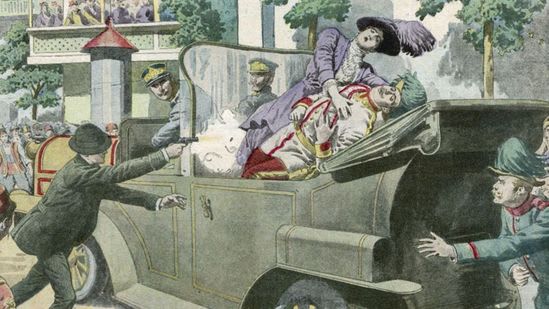
(i) Describe the incident depicted in the cartoon.
(ii) Mention any three points to analyse how Europe was rearranged as a consequence of the war caused by this incident.
(iii) The Germans described the Treaty of Versailles as harsh and humiliating. Give any four reasons that justify this statement.
Answer
(i) The incident depicted in the cartoon is known as the Sarjevo Crisis, which was the immediate cause of the World War I.
Archduke Francis Ferdinand was assassinated on June 28, 1914, in Sarajevo by members of the Serbian secret society 'Union of Death'. Austria sent an ultimatum with 11 demands to Serbia; Serbia accepted most but rejected those affecting its sovereignty. Austria declared war on Serbia on July 28, 1914, marking the start of the First World War.
(ii) The World War I gave a serious blow to the autocratic monarchial system and led to the development of democracy in Europe.
Austria and Hungary became separate independent States. Czechoslovakia and Yugoslavia emerged as independent States.
European supremacy came to an end. The United States surpassed Europe economically and militarily. Ruling dynasties of Europe were destroyed, the Hohenzollern in Germany and the Hapsburg in Austria-Hungary.
The political instability and economic crisis in post-war Europe led to the rise of dictatorships in countries like Germany and Italy, where people turned to totalitarian rule for stability and national revival.
(iii) The Treaty of Versailles was signed to prevent Germany from going to war again. So, its terms were extremely harsh and humiliating towards Germany.
- Germany was declared guilty of aggression and had to pay war reparation of 33 billion dollars.
- The Saar coal mines were given to France for 15 years and the area was to be governed by the League of Nations.
- The area of the Rhine valley was demilitarized and the German territory west of Rhine was to be occupied by the Allied troops for 15 years.
- The German Army was restricted to a force of 1,00,000 soldiers and the Navy was limited to 15,000 men and 24 ships. The Air Force and submarines were banned.
The United Nations Organisation aims to maintain international peace. With reference to its organs and agencies, answer the following:
(i) What is the composition of the International Court of Justice?
(ii) Mention any three functions of the General Assembly.
(iii) Gujarat's famed garba dance received the intangible heritage tag. Which agency of the United Nations is authorized to give this tag? Mention any three other contributions of that agency in the preservation of culture.
Answer
(i) Composition of the International Court of Justice —
The Court is composed of 15 judges, each of different nationality elected to nine-year terms of office by the United Nations General Assembly and Security Council sitting independently of each other. Elections are held every three years for one-third of the seats, and retiring judges may be re-elected.
The Members of the Court do not represent their governments but are independent magistrates. The judges must possess the qualifications required in their respective countries for appointment to the highest judicial offices, or be jurists of recognised competence in international law. The composition of the Court has also to reflect the main forms of civilisation and the principal legal systems of the world.
The Court elects its President and Vice-President for a three-year term. They may, when their term expires, be re-elected. The Court has the power to appoint its Registrar.
(ii) Three functions of the General Assembly are:
- To consider and make recommendations on the principles of cooperation, in the maintenance of international peace and security.
- To consider and approve the budget of the United Nations and to apportion the contributions among members.
- To elect the non-permanent members of the Security Council, the Economic and Social Council and the Trusteeship Council, and to elect the judges of the International Court of Justice.
(iii) The United Nations Educational, Scientific and Cultural Organization (UNESCO) is the agency authorized to designate intangible cultural heritage tag.
Three contributions of UNESCO in the preservation of culture are:
- UNESCO provides technical advice and assistance, equipment and funds for the preservation of monuments and other works of art. It has prepared a World Heritage List to identify the monuments and sites which are to be protected.
- It aims to protect the world inheritance of books, works of art and rare manuscripts.
- It gives encouragement to artistic creations in literature and fine arts.