
The Council of Ministers is collectively responsible to the ............... .
- Lok Sabha
- President
- Rajya Sabha
- Prime Minister
Answer
Lok Sabha
Reason — The ministers remain in office until they enjoy the confidence of majority of members in the Lok Sabha. If a vote of no-confidence is passed in the Lok Sabha against the Prime Minister, or the Ministry as a whole or any of its members, the whole Ministry has to resign.
Given below are details of a few Indian Citizens.
| Person | Age (In years) | Description |
|---|---|---|
| W | 25 | Is a famous journalist |
| X | 45 | Is an industrialist |
| Y | 35 | Has declared insolvency |
| Z | 50 | Has taken citizenship of another country |
Select the one who is eligible to be a member of the Rajya Sabha.
- X
- W
- Y
- Z
Answer
X
Reason — In order to seek membership of the Rajya Sabha, a person :
(a) must be a citizen of India.
(b) must not be less than 30 years of age and an industrialist.
(c) must not be a proclaimed criminal.
(d) must have his/her name in the electoral list.
(e) must not hold any office of profit under the Government of India.
(f) should not be in debt.
(g) should not be of unsound mind.
Person X is 45 years old, a citizen of India, and has no disqualifications. Hence, X is eligible.
With reference to the Supreme Court of India, complete the following:
Advisory Jurisdiction : Advice the President : : Judicial Review : ...............
- Review its own judgements.
- Review the judgements of the High Court.
- Review the laws passed by the Parliament.
- Review the administration of the Government.
Answer
Review the laws passed by the Parliament.
Reason — The Supreme Court is the guardian and sole interpreter of the Constitution. The Supreme Court can declare law passed by the Parliament null and void if found unconstitutional.
Observe the given picture. In case of a similar unruly situation in the Lok Sabha, choose the action that may be taken by the Speaker.
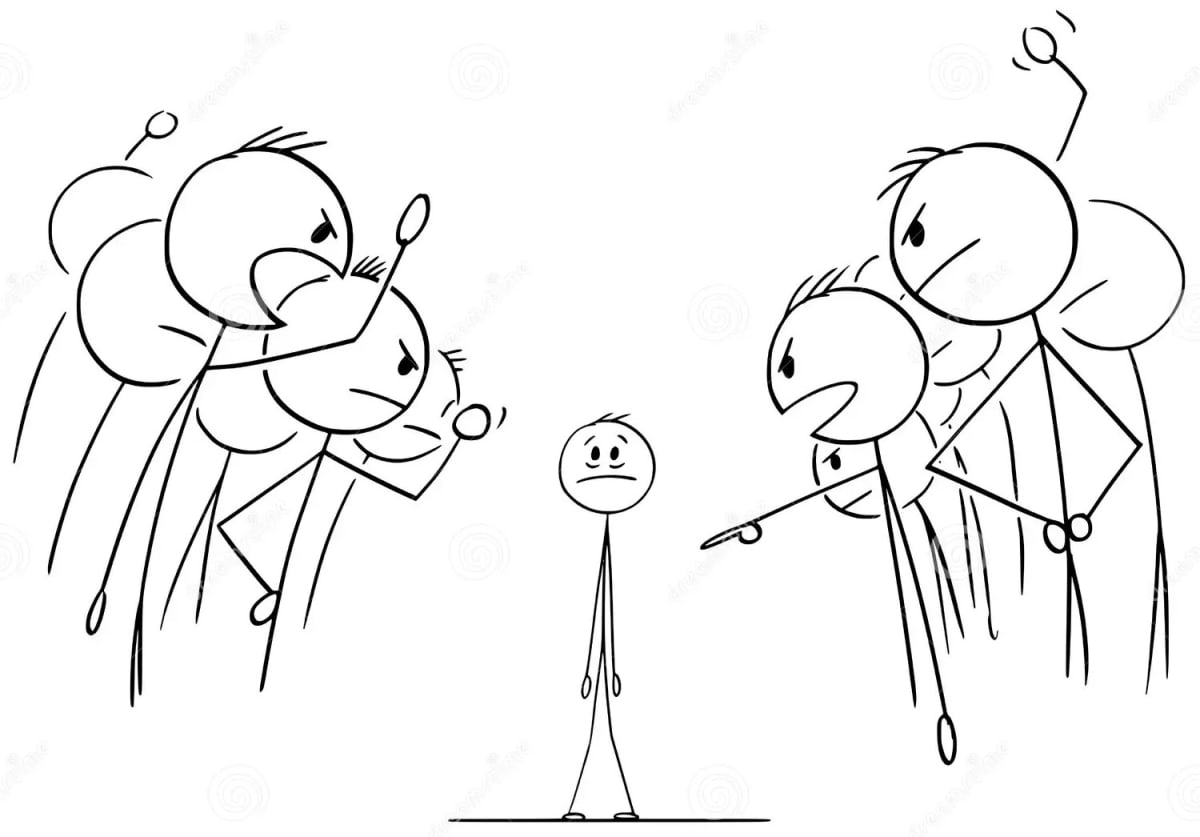
- adjourn the house for lack of quorum.
- dissolve the Lok Sabha.
- adjourn the house for lack of discipline.
- disqualify the members under Anti-defection law.
Answer
adjourn the house for lack of discipline.
Reason — It is the duty of the Speaker to maintain order and discipline in the Lok Sabha. He can adjourn the House for lack of discipline.
If an Adjournment Motion is passed in the Lok Sabha ............... .
- the Lok Sabha will be dissolved.
- the House will discuss a matter of urgent public importance.
- the President ends the session.
- the Government will fall.
Answer
the House will discuss a matter of urgent public importance.
Reason — An Adjournment Motion is passed by the Lok Sabha to discuss a matter of urgent public importance. Such a Motion leads to the interruption of the normal business of the House.
Which emergency will be declared by the President if the security of the Nation is under threat?
- General Emergency
- Financial Emergency
- Constitutional Emergency
- President’s Rule
Answer
General Emergency
Reason — The President can declare a national or general emergency in case of danger of foreign aggression or danger to the peace and security of the country because of a civil war, insurgency or any other such cause.
Read the statements given below and select the option that shows the correct relationship between (A) and (R).
Assertion (A): Lord Curzon partitioned Bengal in 1905.
Reason (R): The Nationalists felt that the British wanted to divide the Hindus and the Muslims.
- (A) is true and (R) is false.
- (R) is true but (A) is false.
- Both (A) and (R) are independent of each other.
- (A) is the reason for (R).
Answer
(A) is the reason for (R).
Explanation — Lord Curzon partitioned Bengal in 1905. The nationalists believed that the real motive behind the partition was to divide the Hindus and Muslims and weaken Indian nationalism. Therefore, the partition mentioned in (A) led to the belief expressed in (R).
Read the description and identify the person.
He introduced the Subsidiary Alliance to expand the British control over India.
- Lord Dalhousie
- Lord Canning
- Lord Wellesley
- Lord Curzon
Answer
Lord Wellesley
Reason — Subsidiary alliance was an agreement between the British East India Company and the Indian Princely States by virtue of which these states lost their sovereignty to the British. This policy was introduced by Lord Wellesley.
Identify the odd one out of the following Assertive Nationalists Leaders.
- Bipin Chandra Pal
- Lala Lajpat Rai
- Dadabhai Naoroji
- Bal Gangadhar Tilak
Answer
Dadabhai Naoroji
Reason — Lala Lajpat Rai, Bal Gangadhar Tilak, and Bipin Chandra Pal were Assertive Nationalist leaders, whereas Dadabhai Naoroji was a leader of the Early Nationalists (Moderates).
Who among the following is MOST associated with this picture?

- Jyotiba Phule
- Raja Ram Mohan Roy
- Swami Dayanand Saraswati
- Aurobindo Ghosh
Answer
Jyotiba Phule
Reason — Jyotiba Phule played a crucial role in advancing girls' education in India. He established the first school for girls in Pune in 1848.
Identify the contributions of Subhash Chandra Bose:
P. Was the Supreme Commander of INA
Q. Signed the Lucknow Pact
R. Led the Quit India Movement
S. Founded the Forward Bloc
- P and Q
- Q and R
- P and S
- R and S
Answer
P and S
Reason — Statements P and S are correct: Subhas Chandra Bose was the Supreme Commander of the INA and founded the Forward Bloc in 1939. Statement Q is wrong, as he did not sign the Lucknow Pact, and Statement R is wrong, as the Quit India Movement was led by Gandhiji, not Bose.
The market of a small industrial town X has been dominated by many products of foreign companies. The local residents decide to save the Indian industries by helping them increase their sales. Which method of the Assertive Nationalists must they follow to become self-reliant?
- Passive Resistance
- National Education
- Swadeshi
- Revivalism
Answer
Swadeshi
Reason — Swadeshi meant producing and using goods made in one's own country in preference to imported goods. It encouraged Indians to support indigenous industries and boycott foreign goods.
Which of the following is NOT an objective of the United Nations Organisation?
- Disarm
- Disengage
- Decolonise
- Develop
Answer
Disengage
Reason — Disengagement, meaning to withdraw or detach, is contrary to the UN’s objective of fostering collaboration and resolving conflicts.
Which agency of the United Nations Organisation is associated with this picture?

- UNESCO
- UNICEF
- WHO
- ILO
Answer
UNESCO
Reason — UNESCO is responsible for preserving heritage sites worldwide by ensuring their protection and conservation.
Which of the following is a common cause for the rise of dictatorship?
- Faith in Democracy
- Economic Crisis
- Freedom of Press
- Political Stability
Answer
Economic Crisis
Reason — Financial instability leading to economic crisis often creates conditions for the rise of dictatorship. Dictatorship provides strong leadership to the citizens.
Which of the following causes of the First World War is connected to this headline?
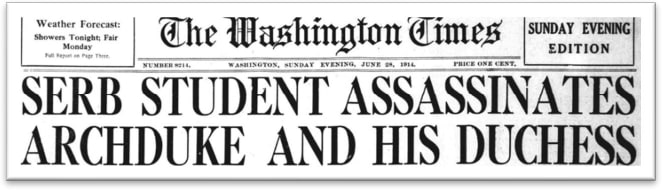
- Imperialism
- Aggressive Nationalism
- Armament Race
- Sarajevo Crisis
Answer
Sarajevo Crisis
Reason — The headline refers to the assassination of Archduke Francis Ferdinand by a Serbian at Sarajevo, which is connected to the Sarajevo Crisis — the immediate cause of the First World War.
Mention any two powers of the Prime Minister with reference to the Cabinet.
Answer
Two powers of the Prime Minister with reference to the Cabinet are:
- The Prime Minister is the head of the Cabinet.
- His resignation implies the resignation of the whole Cabinet.
- He appoints and removes ministers, calls meetings of Cabinet, allots portfolios, co-ordinates all departments and presides over Cabinet meetings.
Imagine you are an Early Nationalist leader. Mention any two methods you would follow to fight against the British.
Answer
As an Early Nationalist leader, the two methods I would follow to fight against the British are:
- I would draft petitions and memorandums and submit them to the Government to gradually bring the authorities around to our point of view.
- I would organise annual sessions, processions and public meetings to educate the people, arouse political consciousness and create a powerful public opinion in favour of our demands.
Mention any two factors that led to the formation of the Muslim League.
Answer
Two factors that led to the formation of the Muslim League are given below:
- British Policy of 'Divide and Rule': After the uprising of 1857, the British treated the Muslims with suspicion and encouraged communalism to sow the seeds of disunity between the Hindus and the Muslims.
- Economic Backwardness of the Muslims: The Muslims were not recruited to civil and military services and remained poor and unemployed. This economic backwardness gave birth to feelings of resentment and separatism among them.
Mention any two objectives of the Forward Bloc.
Answer
Two objectives of the Forward Bloc were:
- Liberation of India with the support of workers, peasants, youth, and other organizations.
- After independence, establishment of a socialist state through measures such as reorganisation of agriculture and industry on socialist lines and abolition of the Zamindari system.
Mention any two ways in which the Treaty of Versailles affected the German Military Force.
Answer
Two ways in which the Treaty of Versailles affected the German Military Force are:
- The German Army was restricted to a force of 1,00,000 soldiers and the Navy was limited to 15,000 men and 36 ships.
- The Air Force and submarines of German Navy were banned.
What is meant by the term Non-Alignment?
Answer
Non-Alignment means a country does not align itself with any major power blocs, while actively participating in world affairs to promote international peace and cooperation.
When a judicial system is correctly calibrated, the law is applied by judges fearlessly, without favour or fear and with respect. That is why judicial security of tenure is so fundamental. It is also why judges must be properly paid without any interference from the Executive or Legislature.
— (The Need for Independent Judiciary) UNODC
From the passage, deduce and mention any two ways in which the Constitution ensures the independence of the Judiciary.
Answer
Two ways in which the Constitution ensures the independence of the Judiciary are:
- Security of Service — Judges cannot be removed by the President at his pleasure. They can be removed only by impeachment by Parliament on the grounds laid down in the Constitution.
- Security of Pay and Allowances — Their salaries and allowances are charged on the Consolidated Fund of India and cannot be changed to their disadvantage during their term of office.
The Parliament of India comprises the President and the two houses. With reference to the Indian Parliament, answer the following questions:
(i) Mention any three circumstances under which the Parliament can make laws on subjects in the state list.
(ii) Explain the following terms:
(a) Question Hour
(b) Quorum
(c) No Confidence Motion
(iii) When can the term of the Lok Sabha be extended?
Mention any three powers of the Lok Sabha which show its superiority over the Rajya Sabha.
Answer
(i) Three circumstances under which the Parliament can make laws on subjects in the state list are:
- During a National Emergency: During a national emergency, Parliament has the power to make laws on any matter in the State List for the whole or any part of the territory of India.
- When Two or More States Pass a Resolution: If two or more states pass a resolution requesting Parliament to legislate on a subject in the State List, Parliament can make laws regulating that matter. Such laws apply only to the states that have passed the resolution.
- Agreement Between States: If two or more states request Parliament to legislate on a State List subject, the Parliament can make laws on that particular subject.
(ii) (a) Question Hour — The first hour of a sitting in both Houses is allotted for asking and answering of questions. The questions are asked to obtain information on a matter of public importance or to highlight a grievance. It is a valuable device against injustice and slackness of the government.
(b) Quorum — The Quorum means the minimum number of members required to be present in order to conduct a sitting or enable the business of the House. It is fixed at 1/10th of the total membership of each House.
(c) No Confidence Motion — If a Government acts against the Constitutional provisions, it can be voted out of office by passing a vote of no-confidence against the Prime Minister, or the Ministry as a whole or any of its members. In such a case, the whole Ministry has to resign.
(iii) During the proclamation of an emergency the period of the Lok Sabha may be extended by Parliament for one year at a time.
Three powers of the Lok Sabha which show its superiority over the Rajya Sabha are:
- The Prime Minister and his Council of Ministers are responsible to the Lok Sabha. If the Lok Sabha passes a vote of no-confidence against the Council of Ministers, they must resign. However, the Rajya Sabha (Upper House) cannot pass a vote of no-confidence against the Council of Ministers. The no-confidence motion is exclusively a power of the Lok Sabha.
- A Money Bill can only be introduced in the Lok Sabha. The Rajya Sabha may only offer suggestions which may or may not be accepted by Lok Sabha. If the Money Bill is not returned by the Rajya Sabha within 14 days, it is taken as it has been passed by the Rajya Sabha.
- Any ordinary law needs to be passed by both the Houses, but in case of conflict, the view of Lok Sabha prevails because it has a large number of members.
The Executive Power of the country is vested in the President and Vice President. With reference to this answer the following questions:
(i) Explain the impeachment process through which the Parliament can remove the President from power.
(ii) Mention any three powers of the Vice President in her/his role as the Chairman of the Rajya Sabha.
(iii) With reference to the powers of President, mention:
(a) Any two Financial Powers
(b) Any two Executive Powers
Answer
(i) The President can be impeached and removed from office for violation of the Constitution by the process of Impeachment.
- Charges can be introduced in either House of the Parliament. A 14 days notice should be given to the President in writing, signed by at least one–fourth of the total members of the House that framed the charges.
- After the lapse of 14 days, a resolution is moved which is to be passed by a majority of not less than two-third of the total strength of the House.
- The resolution then moves to the other House, which should investigate the charges during the process. The impeached President has the right to appear and to represent himself during investigation. If the resolution is passed by the second House with a majority of not less than two-thirds of its total membership of the House (investigating), the President will stand impeached and removed from office.
(ii) Three powers of the Vice President as the Chairman of the Rajya Sabha are:
- The Vice-President is the ex-officio Chairman of the Rajya Sabha.
- The Vice-President of India performs similar functions in the Rajya Sabha as the Speaker in the Lok Sabha. His/her salary is also paid in this capacity.
- In case of a tie on any issue or motion, the Vice President, as Chairman, has the casting vote. This means that the Chairman can cast a vote to break the deadlock.
(iii) (a) Two financial powers of the President are:
- Money bills can be introduced in the Parliament only with President’s recommendation.
- He/she can withdraw money out of the Contingency Fund of India to meet any unforeseen expenditure. Such expenditure should be subsequently approved by the Parliament.
(b) Two executive powers of the President are:
- The President is the executive head of the country and executive authority vested in him, and all executive orders are issued in his/her name.
- The administration of Union Territories and Border Areas is the responsibility of the President.
The High Courts of India are the highest courts of appeal in each state. With reference to the High Courts of India, answer the following questions:
(i) What is meant by the term Original Jurisdiction of the High Court? Mention any two cases which fall under this jurisdiction.
(ii) Mention any two advantages of the Lok Adalat. Mention any one difference between the Sessions Court and the Court of the District Judge.
(iii) Explain the following with reference to the High Court:
(a) Revisory Jurisdiction
(b) Court of Record
Answer
(i) High Courts have original jurisdiction, that is, the power to hear and decide cases at the first instance. It has original jurisdiction in the following cases:
- Matters relating to State revenue and its collection.
- Cases regarding wills, divorce, marriage, company law and contempt of court may be referred or brought before the High Court directly.
(ii) Two advantages of the Lok Adalat are:
- Lok Adalats deliver fast and inexpensive justice. Any person can move Lok Adalat by an application on a plain paper or using the format available with Legal Service Authorities and expect speedy justice.
- The Lok Adalats reduce the workload of other courts enabling them to deal with more serious matters. This reduces delays in higher courts.
Sessions Court decides Criminal cases while the Court of the District Judge decides civil cases.
(iii) (a) Revisory Jurisdiction — Revisory Jurisdiction means that the High Court can call for the record of a case which has been decided by a subordinate court. This is done because the High Court feels that the Subordinate Court has exercised a jurisdiction not vested in it or the latter has not followed proper procedure.
Therefore, the High Court can review the case and take appropriate action on it. This is known as the Revisory Jurisdiction of the High Court.
(b) Court of Record — The High Court is a 'Court of Record' like the Supreme Court. It means:
- All the judgements and orders are preserved as a record to be referred to by its courts in future cases. They can be produced as precedents.
- The law laid down by the High Court is binding on all subordinate courts in the State concerned. But it does not bind the other High Courts, although it is of great significance and can be produced in support of an argument.
- The High Court can punish anyone who commits a contempt of its orders.
The Revolt of 1857 was conscious beginning of the independence struggle against the British. With reference to this, answer the following questions:
(i) What was the Doctrine of Lapse? Who introduced it?
(ii) The British Government interfered in the social and religious matters of the Indians. Mention any three socio religious causes to justify this statement.
(iii) Mention any four military causes which led to this Revolt.
Answer
(i) According to Doctrine of Lapse, if an Indian ruler died without a male heir his kingdom would come under the Company's territory in India. It was introduced by Lord Dalhousie.
(ii) Three socio-religious causes that show that the British Government interfered in the social and religious matters of the Indians are:
- The reforms like the Abolition of Sati (1829), the introduction of the Widow Remarriage Act (1856) and the opening of Western education to girls were not welcomed by the masses.
- In the 19th century, the British began to interfere with the local religious and social customs. They denounced idol worship and dubbed local beliefs as ignorance. The Indians did not like this interference in their religious matters.
- Religious sentiments of the Indians were hurt by the official policy of taxing lands belonging to the temples and mosques.
(iii) Four military causes that led to the Great Uprising of 1857 were:
Ill-treatment of Indian soldiers — Indian soldiers were poorly paid, ill-fed and badly housed. British military authorities forbade the sepoys from wearing caste or sectarian marks, beards or turbans; and they showed disregard for the sentiments of the sepoys.
General Service Enlistment Act (1856) — As per this Act, Indian soldiers could be sent overseas on duty. The Act did not take into account the sentiment of the Indian soldiers. This led to a feeling of resentment among them.
Lower Salaries — The wages of the Indian soldiers were inadequate to support their families. On the other hand, the British soldiers received more than eight times the salary of the Indian soldiers.
Bleak Prospects of Promotion — No Indian soldier could rise above the rank of a Subedar. All high positions were reserved for the British soldiers only.
The oppressive British colonial rule led to the growth of nationalism in India. With reference to this, answer the following questions:
(i) The repressive policies of Lord Lytton became a catalyst to the growth of nationalism. Mention any three of his repressive policies to justify this statement.
(ii) Mention any three ways in which the Press promoted nationalism.
(iii) Who presided over the second session of the Indian National Congress?
Mention any three objectives of the Congress.
Answer
(i) Three repressive policies of Lord Lytton are:
- Vernacular Press Act — This act, enacted in 1878, forbade vernacular papers to publish any material that might incite feelings of dissatisfaction against the British Government. This act was not applicable to English newspapers.
- Arms Act — The Arms Act of 1878 made it a criminal offence for Indians to carry arms without licence. This act did not apply to British.
- Famine Policies — Lord Lytton’s handling of the Great Indian Famine of 1876-1878 has been heavily criticized. Despite the famine, he convened a grand durbar to proclaim Queen Victoria as the Empress of India.
(ii) Three ways in which the Press promoted nationalism are:
- It served as a crucial medium for disseminating information and raising awareness about socio-political issues.
- It helped spread modern ideas of self-government, democracy, civil rights etc.
- The press fostered national unity by spreading ideas and information that united people towards the common goal of independence. It popularized the ideas of nationalist organizations and leader.
(iii) Dadabhai Naoroji presided over the second session of the Indian National Congress in 1886 at Kolkata.
Three objectives of the Indian National Congress were:
- To promote friendly relations between nationalist political workers from different parts of the country.
- To formulate popular demands and present them before the government.
- To train and organise public opinion in the country.
Look at the given picture and answer the questions that follows:

(i) Identify the above incident. Which Gandhian movement did it lead to? Which incident led to the suspension of that movement?
(ii) Mention any three repressive provisions of the Rowlatt Act.
(iii) Mention the following:
(a) Any two causes of the Quit India Movement.
(b) Any two causes of the Civil Disobedience Movement.
Answer
(i) The given picture shows the Jallianwala Bagh Tragedy that happened on April 13, 1919 in Amritsar. It led to the start of the Non-Cooperation Movement in 1920, and was suspended by Gandhiji after the Chauri-Chaura incident.
(ii) The Rowlatt Act authorised the Government to imprison any person without trial and convict him in a court. It implied:
- Arrest of a person without warrant.
- In camera trial (trial in seclusion).
- Restrictions on movements of individuals.
(iii) (a) Two causes of the Quit India Movement were:
- Failure of the Cripps Mission — The Cripps Mission was a complete failure as almost all the parties and all sections of the society rejected it.
- Japanese threat of Invasion — There was a growing threat of Japanese invasion on India. The Congress leaders believed that to save India, the British must handover power to the Indians and quit the country.
(b) Two causes of the Civil Disobedience Movement were:
- Opposition to the Salt Tax — The British imposed the salt tax, which made salt production and sale by Indians illegal. The tax was seen as deeply unfair because it affected all sections of society, especially the poor, who relied on salt for everyday consumption. Gandhi’s Salt March (Dandi March) in 1930 directly challenged this oppressive tax.
- Demand for Poorna Swaraj (Complete Freedom) — When the British Government gave no positive response to the Nehru Report, then the Congress, under the presidentship of Jawaharlal Nehru in 1929 (at Lahore Session), passed a resolution declaring Poorna Swaraj (Complete Freedom) as the ultimate objective of the Congress.
Read the passage given and answer the following questions:
In an effort to secure resources for its expanding industries, Japan invaded the northern Chinese province of Manchuria. Although many Western nations protested the Japanese action, most members of the League of Nations, including Canada, opposed any form of military intervention to defend Chinese sovereignty. A League of Nations commission, headed by the British diplomat Lord Lytton, was dispatched to Manchuria to investigate.
— Loyal Edmonton Regiment Museum
(i) How did the incident being described above become a cause for the Second World War?
(ii) Mention any three reasons for Hitler’s attack on Poland.
(iii) Mention any four reasons for the failure of the League of Nations.
Answer
(i) Japan's expansionist policy after World War I was a key cause of the Second World War. In 1931, Japan invaded Manchuria, defying the League of Nations, and later waged an undeclared war on China. Despite China's appeal for sanctions, Britain and France, key League members, ignored it. Japan then joined the Berlin-Rome-Tokyo Axis to further its ambitions. In 1933, Japan left the League and began occupying British and American properties in China. Britain and France followed a policy of appeasement, hoping Japan would weaken China, which contributed to the inevitability of war.
(ii) Hitler invaded Poland in September 1939 for the following reasons:
- By the Treaty of Versailles, Germany was divided into two parts in order to give a land-route to Poland upto the sea and the Port of Danzing was also given to Poland. Germany wanted to regain her lost territories.
- The city of Danzing was inhabited mainly by the Germans and by occupying Danzing Corridor, Germany could connect with East Prussia.
- Germany signed a Non-Aggression Pact with Russia in August 1939, Poland was left vulnerable because of the pact, enabling Germany to invade without fear of Soviet opposition.
(iii) Four reasons for the failure of the League of Nations were:
- The League suffered an early blow when the USA did not join the League. Even those who joined the League were not interested in the principle of collective security.
- The League did nothing when Poland, with the backing of France, seized a part of Lithuania in 1920.
- In 1923, there was a threat of war between Italy and Greece. Italy refused to submit to the League's intervention and the dispute was settled by direct mediation of Great Britain and France. Thereafter, in every crisis, the League was either defied or ignored.
- The authority of the League was flouted by Japan when it seized Manchuria; and by Italy when it conquered Ethiopia.
- Moreover, the member states were not willing to apply economic sanctions as it affected their economy as well.
Hence, the League failed to maintain international peace and the countries of Europe lost faith in its usefulness.
The organs and the agencies of the United Nation Organisation work towards the development of the world. With reference to this answer the following questions:
(i) What is the composition of the General Assembly?
(ii) Mention any three functions of the International Court of Justice.
(iii) Give the full form of UNICEF. Mention any three of its functions.
Answer
(i) All members of the United Nations are members of the General Assembly.
- Each State has five representatives in the General Assembly, but each State has one vote.
- At the start of each regular session, the Assembly elects a new President, 21 Vice-Presidents and the Chairmen of the Assembly's six Main Committees.
- To ensure equitable geographical representation, the presidency of the Assembly rotates each year among five groups of States: Africa, Asia, Eastern Europe, Latin America and Caribbean, and Western Europe and other States.
- Decisions on important matters are made by a two-third majority.
(ii) Three functions of the International Court of Justice are:
- The International Court of Justice is the principal judicial organ of the United Nations.
- The Court settles, in accordance with international law, the legal disputes submitted to it by the States.
- It gives advisory opinions on legal questions referred to it by duly authorised international organs and agencies.
(iii) UNICEF stands for United Nations International Children’s Emergency Fund. Three functions of UNICEF are:
- UNICEF works for the protection of children in respect of their survival, health, and well-being. This is done in cooperation with individuals, civic groups, governments and the private sector.
- It provides funds for training personnel, including health and sanitation workers, teachers and nutritionists. Universal Child Immunisation against preventable diseases was one of the leading goals of UNICEF.
- It assists governments to plan, develop and extend community-based services in the fields of maternal and child health, nutrition, clean water and sanitation.
- It provides help to children and mothers in emergencies arising from natural calamities, civil strifes and epidemics.