
A customer pays a total GST of ₹ 600 on an article in an intra-state sale, and the tax rate is 12%. The price of the article is :
₹2,000
₹3,000
₹5,000
₹7,200
Answer
Given,
Total GST paid = ₹ 600
Rate of GST = 12%
Let the price of the article be ₹ .
By formula,
GST = Rate of GST × Price of the article
Thus, the price of the article = ₹ 5,000.
Hence, option 3 is the correct option.
Assertion (A): In a recurring deposit account, a man deposits ₹ 1000 per month for 1 year. On maturity he receives ₹ 13500. The amount of interest he earns is ₹ 1500.
Reason (R): Interest earned = Maturity value − Total amount deposited.
(A) is true and (R) is false.
(A) is false and (R) is true.
Both (A) and (R) are true, and (R) is the correct explanation for (A).
Both (A) and (R) are true, but (R) is not the correct explanation for (A).
Answer
Given,
Deposit per month (P) = ₹ 1000
Time (n) = 1 year = 12 months
Maturity value = ₹ 13,500
Total amount deposited = P × n
= 1000 × 12
= ₹ 12,000
By formula,
Interest earned = Maturity value − Total amount deposited
= 13500 − 12000
= ₹ 1,500
So assertion (A) is true.
We know that,
Maturity value = Total amount deposited + Interest earned
⇒ Interest earned = Maturity value − Total amount deposited
So reason (R) is true and it correctly explains the assertion (A).
Thus, Both (A) and (R) are true, and (R) is the correct explanation for (A).
Hence, option 3 is the correct option.
A man buys 50, ₹ 100 shares of a company at ₹ 125 paying 6% dividend per annum. At the end of the year, the company will pay a total dividend on :
₹100
₹125
₹5000
₹6250
Answer
Given,
Number of shares bought = 50
Nominal value (N.V.) of each share = ₹ 100
Market value (M.V.) of each share = ₹ 125
Rate of dividend = 6%
We know that,
Dividend is always paid by the company on the nominal value (face value) of the shares and not on their market value.
Total nominal value of the shares = No. of shares × N.V. of 1 share
= 50 × 100
= ₹ 5,000
Thus, the company will pay the total dividend on ₹ 5,000.
Hence, option 3 is the correct option.
If the roots of the quadratic equation = 0 are equal, then the positive value of is :
16
8
4
2
Answer
Given,
The roots of the quadratic equation = 0 are equal.
Comparing the given equation with = 0, we get :
We know that,
For equal roots, discriminant (D) = 0.
Since, the positive value of is required.
∴ .
Hence, option 3 is the correct option.
12, 18 and are in continued proportion. The value of is :
24
27
30
36
Answer
Given,
12, 18 and are in continued proportion.
We know that,
If and are in continued proportion, then .
Hence, option 2 is the correct option.
and are the factors of . The third factor of the given polynomial is :
Answer
Given,
and are the factors of .
⇒
Thus, is also the factor of .
Thus,
Thus, the third factor of the given polynomial is .
Hence, option 1 is the correct option.
Given two matrices A and B, where and , then product AB is :
5
Answer
Given,
Matrix A is of order 1 × 2 and matrix B is of order 2 × 1.
We know that,
If matrix A is of order and matrix B is of order , then the order of the product AB is .
∴ Order of AB = 1 × 1
Calculating,
Hence, option 3 is the correct option.
If the term of a Geometric Progression (G.P.) is given by then the common ratio is :
2
5
10
20
Answer
Given,
Replacing by , we get :
⇒
By formula,
Hence, option 1 is the correct option.
The line passes through which pair of coordinates?
(0, 0) and (2, 2)
(0, 2) and (2, 4)
(1, 2) and (−1, −2)
(2, 2) and (−2, −2)
Answer
Given,
Equation of the line is .
A point lies on the line only if its coordinates satisfy the equation of the line.
Substituting the coordinates (1, 2) in , we get :
⇒ 2 = 2 × 1
⇒ 2 = 2
Since, L.H.S. = R.H.S., the point (1, 2) lies on the line.
Substituting the coordinates (−1, −2) in , we get :
⇒ −2 = 2 × (−1)
⇒ −2 = −2
Since, L.H.S. = R.H.S., the point (−1, −2) lies on the line.
Thus, the line passes through the points (1, 2) and (−1, −2).
Hence, option 3 is the correct option.
On a map of scale 1 : 50,000, a rectangular plot has sides 4 cm by 3 cm. The actual area of the plot on ground is :
3 km2
9 km2
12 km2
16 km2
Answer
Given,
Scale of the map = 1 : 50,000
Length of the plot on the map = 4 cm
Breadth of the plot on the map = 3 cm
Actual length of the plot = 4 × 50000 = 2,00,000 cm
= = 2 km [∵ 1 km = 1,00,000 cm]
Actual breadth of the plot = 3 × 50000 = 1,50,000 cm
= = 1.5 km
Actual area of the plot = Actual length × Actual breadth
= 2 × 1.5
= 3 km2.
Hence, option 1 is the correct option.
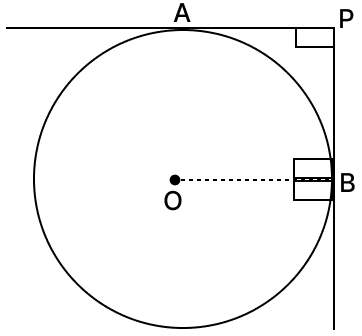
In the given diagram, the radius of the circle with centre O is 3 cm. PA and PB are the tangents to the circle which are at right angle to each other. The length of OP is:
cm
3 cm
cm
cm
Answer
Join OA and OP.
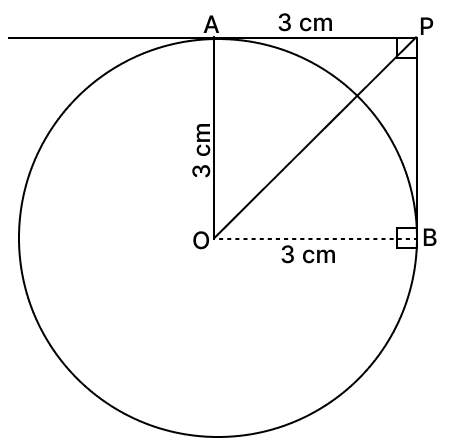
Given,
Radius of circle (OB) = 3 cm
PB and AP are at right angles.
We know that,
Radius and tangent at point of contact are perpendicular to each other.
OA ⊥ AP
From figure,
⇒ OA = OB = 3 cm [Radius of circle]
⇒ OB is perpendicular to PB
⇒ ∠OBP = 90°
This shows APBO is square.
OA = PB = AP = OB = 3 cm.
In right angled triangle OBP,
⇒ OP2 = OB2 + PB2
⇒ OP2 = 32 + 32
⇒ OP2 = 9 + 9
⇒ OP2 = 18
⇒ OP =
⇒ OP = cm.
Hence, option 3 is the correct option.
A conical tent with a capacity of 616 m3 has a base area 154 m2. The height of the tent is :
3 m
4 m
7 m
12 m
Answer
Given,
Capacity (volume) of the conical tent = 616 m3
Base area of the conical tent = 154 m2
By formula,
Volume of cone =
Substituting values, we get :
Thus, the height of the tent = 12 m.
Hence, option 4 is the correct option.
Assertion (A): If and then .
Reason (R):
(A) is true and (R) is false.
(A) is false and (R) is true.
Both (A) and (R) are true and (R) is the correct explanation of (A).
Both (A) and (R) are true, but (R) is not the correct explanation of (A).
Answer
Given,
So assertion (A) is true.
We know that,
⇒
This is a fundamental trigonometric identity.
Thus, Both (A) and (R) are true and (R) is the correct explanation of (A).
Hence, option 3 is the correct option.
Consider the following distribution 30, 34, 35, 36, 37, 38, 39, 40. If the value 35 is removed from the given data, then the median changes by :
0.5
1.0
1.5
2.0
Answer
Given,
The distribution is 30, 34, 35, 36, 37, 38, 39, 40.
The data is already arranged in ascending order.
Here, , which is even.
By formula,
On removing the value 35, the distribution becomes 30, 34, 36, 37, 38, 39, 40.
Here, , which is odd.
By formula,
Change in median = 37 − 36.5 = 0.5.
Hence, option 1 is the correct option.
A game of chance consists of spinning an arrow which is equally likely to come to rest pointing to one of the numbers 1, 2, 3……12. The probability that it will point to an odd number is :
Answer
Given,
The arrow can come to rest pointing to one of the numbers 1, 2, 3, ......, 12.
Total number of possible outcomes = 12
Favourable outcomes = Arrow pointing to an odd number
{1, 3, 5, 7, 9, 11}
Number of favourable outcomes = 6
By formula,
Probability =
=
= .
Hence, option 3 is the correct option.
Three students A, B and C of Class 10 are each given an equal amount of Play-Dough to form different shaped solids for a mathematics project. A forms a cone of radius 7 cm and height 28 cm. B forms a sphere of radius and C forms a cylinder of radius 14 cm. Find the :
(a) radius of the sphere so formed.
(b) height of the cylinder so formed.
(c) Volume of the dough given to each of them.
Give your answers to (b) and (c) correct to the nearest whole number.
Answer
Given,
For the cone formed by A,
Radius (R) = 7 cm
Height (H) = 28 cm
Since, all the three students are given an equal amount of Play-Dough, the volumes of the cone, the sphere and the cylinder are equal.
(a) Volume of sphere = Volume of cone
Hence, radius of the sphere = 7 cm.
(b) Given,
Radius of the cylinder (R') = 14 cm
Let height of cylinder be H'.
Volume of cylinder = Volume of sphere
Hence, height of the cylinder = 2 cm.
(c) By formula,
Volume of the dough given to each of them = Volume of cone
Hence, volume of the dough given to each of them = 1437 cm3.
Solve the quadratic equation = 0 and give your answer correct to 3 significant figures.
Answer
Given,
Comparing the above equation with = 0, we get :
By quadratic formula,
Solving further,
Correct to 3 significant figures,
.
Hence, = 0.405 or = −7.41.
A line is formed joining the two points P(−4, 1) and Q(11, −2). Straight line PQ intersects the x-axis at R. Find the :
(a) ratio PR : RQ.
(b) coordinates of the point R.
(c) equation of the line perpendicular to PQ at R.
Answer
(a) Since, R lies on the x-axis, its ordinate is zero.
Let the point R divide the line segment joining P(−4, 1) and Q(11, −2) in the ratio .
By section formula,
Substituting values, we get :
Hence, PR : RQ = 1 : 2.
(b) From part (a),
P(−4, 1), Q(11, −2) and = 1 : 2
By section formula,
Substituting values, we get :
R = = (1, 0).
Hence, the coordinates of the point R are (1, 0).
(c) By formula,
Substituting values, we get :
We know that,
The product of the slopes of two perpendicular lines is −1.
∴ Slope of the line perpendicular to PQ = = 5
By point-slope form,
Equation of the line perpendicular to PQ and passing through R(1, 0) is :
Hence, the equation of the line perpendicular to PQ at R is .
A shopkeeper marked an article at ₹ 2000. The rate of GST on the article is 18%. The customer has only ₹ 1888 with him and he requests the shopkeeper to reduce the price so that he can buy the article at ₹ 1888 including GST. What percent discount must the shopkeeper give to do so?
Answer
Given,
Marked price of the article = ₹ 2000
Rate of GST = 18%
Amount available with the customer = ₹ 1888 (including GST)
Let the reduced price of the article be ₹ .
⇒
Reduced price of the article = ₹ 1,600
Reduction in price = ₹ 2000 − ₹ 1600 = ₹ 400
By formula,
Discount % =
=
= 20%.
Hence, the shopkeeper must give a discount of 20%.
An Arithmetic Progression (A.P.) consists of all whole numbers which are divisible by 3 and 5.
(a) Write its first term and the common difference.
(b) Find the 10th term of the A.P.
(c) Find the sum of the first 10 terms of the A.P.
Answer
(a) Given,
The A.P. consists of all whole numbers which are divisible by 3 and 5.
A number which is divisible by both 3 and 5 is divisible by their L.C.M.
L.C.M. of 3 and 5 = 15
Thus, the A.P. is 15, 30, 45, 60, ......
First term (a) = 15
Common difference (d) = 30 − 15 = 15.
Hence, first term = 15 and common difference = 15.
(b) By formula,
tn = a + (n - 1)d
Substituting values, we get :
⇒ t10 = 15 + (10 − 1) × 15
⇒ t10 = 15 + 9 × 15
⇒ t10 = 15 + 135
⇒ t10 = 150.
Hence, the 10th term of the A.P. = 150.
(c) By formula,
Substituting values, we get :
⇒ S10 =
⇒ S10 = 5[30 + 9 × 15]
⇒ S10 = 5[30 + 135]
⇒ S10 = 5 × 165
⇒ S10 = 825.
Hence, the sum of the first 10 terms of the A.P. = 825.
Study the graph and answer the given questions :

(a) Write down the coordinates of A, B, C, D and E.
(b) Write down the image of A under reflection on the y-axis.
(c) Name the point, with its coordinates, which is the image of C under reflection through the origin.
(d) What is the image of the polygon ABCDEFGHI when reflected on the y-axis?
(e) Write down the equation of the line joining the points N and D.
Answer
(a) From the graph,
The coordinates of the points are A(0, 3), B(1, 2), C(2, 2), D(2, 1) and E(3, 0).
(b) We know that,
The image of a point under reflection on the y-axis is .
∴ Image of A(0, 3) on reflection in y-axis is (0, 3).
Since, A lies on the y-axis, it remains invariant under reflection on the y-axis.
Hence, the image of A under reflection on the y-axis is A(0, 3).
(c) We know that,
The image of a point under reflection through the origin is .
∴ Image of C(2, 2) on reflection in origin is (−2, −2).
From the graph, the point (−2, −2) is the point K.
Hence, the image of C under reflection through the origin is K(−2, −2).
(d) We know that,
The image of a point under reflection on the y-axis is .
So, on reflecting the polygon ABCDEFGHI on the y-axis, each vertex is mapped to the point lying at the same distance from the y-axis but on the opposite side of it.
Since, the vertices A and I lie on the y-axis, they remain invariant under reflection on the y-axis.
From the graph, the images of the vertices of the polygon under reflection in y-axis are :
A → A, B → P, C → O, D → N, E → M, F → L, G → K, H → J and I → I
Thus, on joining these image points in order, we get the polygon APONMLKJI, which is the mirror image of the polygon ABCDEFGHI in the y-axis.
Hence, the image of the polygon ABCDEFGHI under reflection on the y-axis is the polygon APONMLKJI.
(e) From the graph,
N = (−2, 1) and D = (2, 1)
Since, both the points have the same ordinate (y-coordinate) equal to 1, the line joining them is parallel to the x-axis.
Hence, the equation of the line joining the points N and D is = 1.
A man opened a recurring deposit account in a bank. He deposits ₹ 1000 per month for 2 years. The matured value is equal to 26 times the amount he pays per month. Find the :
(a) interest paid by the bank.
(b) rate of interest per annum that the bank was paying for the recurring deposit account.
Answer
Given,
Deposit per month (P) = ₹ 1000
Time (n) = 2 years = 24 months
Maturity value = 26 × ₹ 1000 = ₹ 26,000
(a) Total amount deposited = P × n
= 1000 × 24
= ₹ 24,000
By formula,
Interest = Maturity value − Total amount deposited
= ₹ 26,000 − ₹ 24,000
= ₹ 2,000.
Hence, interest paid by the bank = ₹ 2,000.
(b) Let the rate of interest be r% per annum.
By formula,
Substituting values, we get :
Hence, rate of interest (r%) = 8% per annum.
Given, matrix and , such that AB is a null matrix. Find the :
(a) order of the null matrix.
(b) value of , given that .
Answer
(a) Given,
Matrix A is of order 2 × 2 and matrix B is of order 2 × 1.
We know that,
If matrix A is of order and matrix B is of order , then the order of the product AB is .
∴ Order of AB = 2 × 1
Since, AB is a null matrix, the order of the null matrix is the same as the order of AB.
Hence, the order of the null matrix is 2 × 1.
(b) Calculating AB,
Since, AB is a null matrix,
Comparing the corresponding elements, we get :
Also,
The value of which satisfies both the equations and is greater than 0 is 1.
Hence, = 1.
Prove the following trigonometric identity :
Answer
Solving L.H.S.,
Since, L.H.S. = R.H.S.
Hence, proved that .
Ms. Kaur invested ₹ 8,000 in buying ₹100 shares of a company paying 6% dividend at ₹ 80. After a year, she sold these shares at ₹75 each and invested the proceeds including the dividend received during the first year in buying ₹ 20 shares, paying 15% dividend at ₹ 27 each. Find the :
(a) dividend received by her during the first year.
(b) number of shares she purchased using the total proceeds including the dividend.
Answer
Given,
For initial investment,
Investment = ₹ 8,000
Face Value = ₹ 100
Market Value = ₹ 80
Dividend Rate = 6%
By formula,
Number of shares =
=
= 100
By formula,
Dividend for the first year = No. of shares × Rate of div. × N.V. of 1 share
= 100 × × 100
= ₹ 600
Hence, dividend for first year = ₹ 600.
(b) Given,
Number of shares sold = 100
Selling price per share = ₹ 75
Proceeds from sale = Number of shares × selling price
= 100 × 75
= ₹ 7,500
Total proceeds = Proceeds from sale + Dividend received = 7500 + 600 = ₹ 8,100
Total investment = ₹ 8,100
Market value per share = ₹ 27
Number of new shares =
=
= 300.
Hence, number of shares purchased by Ms. Kaur = 300.
Solve the following inequation, write the solution set and represent it on the real number line.
Answer
Solving L.H.S. of the inequation, we get :
Solving R.H.S. of the inequation, we get :
From equation (1) and (2),
Solution set =

Hence, solution set = { ∈ R}.
In the given figure, O is the centre of the circle and AD = AB. If ∠ABC = 32°, find the angles and .

Answer
Given,
O is the centre of the circle, AD = AB and ∠ABC = 32°.
From the figure, BC passes through the centre O and hence BC is a diameter of the circle.
We know that,
Angle in a semi-circle is a right angle.
∴ ∠BAC = 90°
In ∆ABC,
⇒ ∠ACB + ∠BAC + ∠ABC = 180° [Angle sum property of triangle]
We know that,
The angle between a chord and a tangent at the point of contact is equal to the angle in the alternate segment.
We know that,
Angles in the same segment of a circle are equal.
Here, ∠ADB and ∠ACB are the angles in the same segment subtended by the chord AB.
In ∆ADB,
⇒ AD = AB [Given]
⇒ ∠ABD = ∠ADB [Angles opposite to equal sides are equal]
⇒
By angle sum property of triangle,
In cyclic quadrilateral ADEB,
We know that,
The sum of the opposite angles of a cyclic quadrilateral is 180°.
Hence, and .
Using Remainder and Factor Theorem, factorise the following polynomial :
Answer
Given,
Substituting in , we get :
Since, the remainder is zero.
∴ is a factor of .
Dividing by , we get :
∴
Factorising , we get :
Hence, .
In the given diagram, AD ∥ GE ∥ BC, DE = 18 cm, EC = 3 cm, AD = 35 cm. Find :

(a) AF : FC and AG : GB
(b) length of EF
(c) area (trapezium ADEF) : area (∆ EFC)
Answer
Given,
AD ∥ GE ∥ BC, DE = 18 cm, EC = 3 cm and AD = 35 cm
(a) In ∆ADC,
Since, GE ∥ AD, we have FE ∥ AD.
By Basic Proportionality Theorem (B.P.T.),
∴ AF : FC = 6 : 1
In ∆ABC,
Since, GE ∥ BC, we have GF ∥ BC.
By Basic Proportionality Theorem (B.P.T.),
∴ AG : GB = 6 : 1.
Hence, AF : FC = 6 : 1 and AG : GB = 6 : 1.
(b) In ∆ADC and ∆FEC,
⇒ ∠ADC = ∠FEC [Corresponding angles as AD ∥ FE]
⇒ ∠ACD = ∠FCE [Common angle]
∴ ∆ADC ~ ∆FEC (By A.A. axiom)
We know that,
Corresponding sides of similar triangles are proportional.
Hence, length of EF = 5 cm.
(c) We know that,
The ratio of the areas of two similar triangles is equal to the ratio of the squares of their corresponding sides.
⇒
From the figure,
Area of trapezium ADEF = Area of ∆ADC − Area of ∆EFC
Dividing each side by Area of ∆EFC,
Hence, area (trapezium ADEF) : area (∆ EFC) = 48 : 1.
Use ruler and compass for this question :
(a) Draw line segment AB of length 6 cm.
(b) Construct the locus of points which are equidistant from A and B. Mark a point on the locus which is 4.5 cm from A. Name this point as O.
(c) Construct the locus of all points which are 4.5 cm from O.
(d) Mark the point of intersection of loci (b) and (c) as P, which is on the same side of AB as O.
(e) Construct the locus of points which are equidistant from AP and AB.
Answer
Steps of construction :
Draw a line segment AB of length 6 cm.
Draw XY, the perpendicular bisector of AB. XY is the locus of points which are equidistant from A and B.
With A as centre and radius 4.5 cm, draw an arc cutting XY at the point O. Thus, O is the point on the locus which is 4.5 cm from A.
With O as centre and radius 4.5 cm, draw a circle. This circle is the locus of all points which are 4.5 cm from O.
Mark P, the point of intersection of the perpendicular bisector XY and the circle, which lies on the same side of AB as O.
Join AP.
Draw AZ, the bisector of ∠PAB. AZ is the locus of points which are equidistant from AP and AB.

A bag contains identical cards numbered 1 to 50. A card is selected randomly. Find the probability that the card selected, is :
(a) divisible by 6.
(b) not divisible by 2 and 3.
Answer
Given,
The bag contains identical cards numbered 1 to 50.
Total number of possible outcomes = 50
(a) Favourable outcomes = Getting a card with a number divisible by 6.
Numbers divisible by 6 = {6, 12, 18, 24, 30, 36, 42, 48}
Number of favourable outcomes = 8
By formula,
Probability =
P(card divisible by 6) = .
Hence, probability that the card selected is divisible by 6 = .
(b) We know that,
A number which is divisible by both 2 and 3 is divisible by 6.
∴ P(card divisible by 2 and 3) = P(card divisible by 6) =
By formula,
P(card not divisible by 2 and 3) = 1 − P(card divisible by 2 and 3)
Hence, probability that the card selected is not divisible by 2 and 3 = .
In the given figure, the parallelogram ABCD circumscribes a circle, touching the circle at P, Q, R and S. Prove that :

(a) AB = BC
(b) diagonals AC and BD bisect each other at right angles.
Answer
Join AC and BD.

(a) We know that,
If two tangents are drawn to a circle from an exterior point, the tangents are equal in length.
∴ AP = AS, BP = BQ, CR = CQ and DR = DS
Adding the equations, we get :
⇒ AP + BP + CR + DR = AS + BQ + CQ + DS
⇒ (AP + BP) + (CR + DR) = (AS + DS) + (BQ + CQ)
⇒ AB + CD = AD + BC ......(1)
We know that,
Opposite sides of a parallelogram are equal.
∴ AB = CD and AD = BC
Substituting the above values in equation (1), we get :
⇒ AB + AB = BC + BC
⇒ 2AB = 2BC
⇒ AB = BC.
Hence, proved that AB = BC.
(b) From part (a),
⇒ AB = BC
Also, AB = CD and AD = BC [Opposite sides of a parallelogram are equal]
∴ AB = BC = CD = AD
Since, all the four sides of the parallelogram ABCD are equal, ABCD is a rhombus.
We know that,
The diagonals of a rhombus bisect each other at right angles.
Hence, proved that the diagonals AC and BD bisect each other at right angles.
Given,
Using properties of proportion, find the value of .
Answer
Given,
Applying componendo and dividendo, we get :
Hence, .
The mean of the following distribution is 27 and the sum of all the frequencies is 50. Find the missing frequencies x and y.
| Class | Frequency |
|---|---|
| 0 – 10 | 8 |
| 10 – 20 | x |
| 20 – 30 | 12 |
| 30 – 40 | 13 |
| 40 – 50 | y |
Answer
Given,
Mean = 27 and sum of all the frequencies = 50
| Class | Class Mark (xi) | Frequency (fi) | fixi |
|---|---|---|---|
| 0 - 10 | 5 | 8 | 40 |
| 10 - 20 | 15 | x | 15x |
| 20 - 30 | 25 | 12 | 300 |
| 30 - 40 | 35 | 13 | 455 |
| 40 - 50 | 45 | y | 45y |
| Total | Σfi = 33 + x + y | Σfixi = 795 + 15x + 45y |
Given,
Sum of all the frequencies = 50
⇒ 33 + x + y = 50
⇒ x + y = 17 ......(1)
By formula,
Mean =
Substituting values, we get :
⇒ 27 =
⇒ 795 + 15x + 45y = 1350
⇒ 15x + 45y = 555
⇒ x + 3y = 37 ......(2)
Subtracting equation (1) from equation (2), we get :
⇒ (x + 3y) − (x + y) = 37 − 17
⇒ 2y = 20
⇒ y = 10
Substituting y = 10 in equation (1), we get :
⇒ x + 10 = 17
⇒ x = 7.
Hence, the missing frequencies are x = 7 and y = 10.
In the given diagram, the area of the shaded region is 57 m2. Form an equation in x and solve it to find the possible value of x.

Answer
Given,
Area of the shaded region = 57 m2
From the figure,
Length of the outer rectangle = 12 m
Breadth of the outer rectangle = 10 m
Area of the outer rectangle = 12 × 10 = 120 m2
Length of the inner (unshaded) rectangle = (12 − x) m
Breadth of the inner (unshaded) rectangle = (10 − x) m
Area of the inner rectangle = (12 − x)(10 − x) m2
From the figure,
Area of shaded region = Area of outer rectangle − Area of inner rectangle
⇒ 12 × 10 − (12 − x)(10 − x) = 57
⇒ 120 − (120 − 12x − 10x + x2) = 57
⇒ 120 − 120 + 22x − x2 = 57
⇒ 22x − x2 = 57
⇒ x2 − 22x + 57 = 0
⇒ x2 − 19x − 3x + 57 = 0
⇒ x(x − 19) − 3(x − 19) = 0
⇒ (x − 19)(x − 3) = 0
[Using zero product rule]
⇒ (x − 19) = 0 or (x − 3) = 0
⇒ x = 19 or x = 3
Since, the breadth of the rectangle is 10 m, the width x cannot be 19 m.
∴ x = 3 m.
Hence, the possible value of x = 3 m.
Two beakers (drinking glasses) are cylindrical in shape having diameter and height 7 cm and 10 cm respectively. Glass A has hemispherical raised bottom, and glass B has a conical raised bottom of height 3.5 cm.
Determine which glass has a greater capacity and calculate the difference in their capacities. Give your answer correct to 2 decimal places.

Answer
Given,
Diameter of each cylindrical glass = 7 cm
Radius = 3.5 cm
Height of each glass () = 10 cm
By formula,
For glass A, the raised bottom is a hemisphere of radius 3.5 cm.
Capacity of glass A = Volume of cylinder − Volume of hemisphere
= 385 − 89.83
= 295.17 cm3
For glass B, the raised bottom is a cone of radius 3.5 cm and height () = 3.5 cm.
Capacity of glass B = Volume of cylinder − Volume of cone
= 385 − 44.92
= 340.08 cm3
Since, 340.08 cm3 > 295.17 cm3, glass B has the greater capacity.
Difference in their capacities = Capacity of glass B − Capacity of glass A
Hence, glass B has the greater capacity and the difference in their capacities = 44.92 cm3.
The distribution given below represents marks obtained by 200 students in a Mathematics Examination with maximum marks 80.
| Marks | No. of students |
|---|---|
| 0 – 10 | 8 |
| 10 – 20 | 12 |
| 20 – 30 | 16 |
| 30 – 40 | 24 |
| 40 – 50 | 29 |
| 50 – 60 | 38 |
| 60 – 70 | 42 |
| 70 – 80 | 31 |
Using graph paper draw an ogive for the given distribution. Along one axis take 2 cm equal to 10 marks and along the other axis take 1 cm equal to 10 students.
Use your graph to find the following :
(a) Median
(b) Number of students who scored above 75 marks
(c) If the pass percentage is 35%, find the number of students who scored 35% and below.
Answer
| Marks | No. of students (f) | Cumulative frequency (cf) |
|---|---|---|
| 0 - 10 | 8 | 8 |
| 10 - 20 | 12 | 20 |
| 20 - 30 | 16 | 36 |
| 30 - 40 | 24 | 60 |
| 40 - 50 | 29 | 89 |
| 50 - 60 | 38 | 127 |
| 60 - 70 | 42 | 169 |
| 70 - 80 | 31 | 200 |
Steps :
Take 2 cm = 10 marks on the x-axis.
Take 1 cm = 10 students on the y-axis.
Plot the points (0, 0), (10, 8), (20, 20), (30, 36), (40, 60), (50, 89), (60, 127), (70, 169) and (80, 200).
Join the points by a free hand curve.

(a) Here, (no. of students) = 200, which is even.
Median = = 100th term.
Through point A = 100 on the y-axis draw a horizontal line parallel to the x-axis touching the graph at point B, through B draw a vertical line parallel to the y-axis touching the x-axis at point C = 53.
Hence, median = 53.
(b) Through point D = 75 on the x-axis draw a vertical line parallel to the y-axis touching the graph at point E, through E draw a horizontal line parallel to the x-axis touching the y-axis at point F = 186.
∴ 186 students scored 75 marks and below.
∴ Number of students who scored above 75 marks = 200 − 186 = 14.
Hence, 14 students scored above 75 marks.
(c) Maximum marks = 80
Pass marks = 35% of 80 = = 28 marks
Through point G = 28 on the x-axis draw a vertical line parallel to the y-axis touching the graph at point H, through H draw a horizontal line parallel to the x-axis touching the y-axis at point I = 33.
Hence, 33 students scored 35% and below.
Draw the necessary diagram for this question.
A man on the top of a lighthouse observes the angle of depression of two ships on the opposite sides of the lighthouse as 32° and 58° respectively. If the height of the lighthouse is 120 m, find the distance between the two ships. Give your answer correct to the nearest meter.
Answer
Let AD be the lighthouse and B and C be the two ships on the opposite sides of the lighthouse.

Given,
Height of the lighthouse (AD) = 120 m
The angles of depression of the two ships are 32° and 58°.
From figure,
⇒ ∠FAB = ∠ABD = 32° (alternate angles are equal)
⇒ ∠EAC = ∠ACD = 58° (alternate angles are equal)
In right angled triangle ABD,
In right angled triangle ACD,
From the figure,
Distance between the two ships (BC) = BD + CD
= 192.03 + 74.99
= 267.02 m ≈ 267 m.
Hence, the distance between the two ships = 267 m.
A finite Geometric Proportion (G.P.) series contains 10 terms. The sum of the first three terms is 7 and that of the last three terms is 896. Find the first term and the common ratio.
Answer
Let the first term of the G.P. be and the common ratio be .
Since, the G.P. contains 10 terms, the terms are .
Given,
Sum of the first three terms = 7
Sum of the last three terms = 896
Dividing equation (2) by equation (1), we get :
Substituting in equation (1), we get :
Hence, first term = 1 and common ratio = 2.
In a circle with centre O, PA and PB are tangents drawn from an external point P. If PA = 9 cm and ∠APB = 60°, find the :

(a) length of PB.
(b) radius of the circle.
Answer
(a) We know that,
The lengths of two tangents drawn from an external point to a circle are equal.
∴ PB = PA
⇒ PB = 9 cm.
Hence, length of PB = 9 cm.
(b) Join OA, OB and OP.

We know that,
The tangents drawn from an external point are equally inclined to the line joining the centre of the circle and that point.
∴ OP bisects ∠APB.
⇒ ∠OPA =
We know that,
Radius and tangent at the point of contact are perpendicular to each other.
∴ ∠OAP = 90°
In right angled triangle OAP,
Hence, radius of the circle = 5.2 cm.
The table given below shows a record of the weight in kilogram of 100 students of a school.
| Weight (kg) | No. of Students |
|---|---|
| 30 – 35 | 5 |
| 35 – 40 | 7 |
| 40 – 45 | 14 |
| 45 – 50 | 21 |
| 50 – 55 | 25 |
| 55 – 60 | 15 |
| 60 – 65 | 7 |
| 65 – 70 | 6 |
Draw a histogram and find the modal weight.
[Take 2 cm = 5 kg along one axis and 2 cm = 5 students along the other axis]
Answer
Steps :
Take 2 cm = 5 kg along the x-axis.
Take 2 cm = 5 students along the y-axis.
Draw the rectangles (bars) for the given class intervals, taking the corresponding frequencies as their heights.
The class interval 50 - 55 has the highest frequency 25, so 50 - 55 is the modal class.
In the highest rectangle, draw two lines AD and BC from corners of the rectangles on either side of the highest rectangle to the opposite corners of the highest rectangle. Let P be the point of intersection of AD and BC.
From the point of intersection P, draw a perpendicular to the x-axis. The point R = 51.5, where this perpendicular meets the x-axis gives the mode.

From the histogram,
Mode = 51.5 kg.
Hence, modal weight = 51.5 kg.