
When light enters from air to glass, it bends toward the normal. If red, blue, and yellow colours are allowed to enter the same glass block at the same angle of incidence, then for which colour, the value of ∠𝑖 − ∠𝑟, be greater?
- green
- red
- blue
- yellow
Answer
Blue
Reason — Blue light has a shorter wavelength, so it slows down more in glass and bends more towards the normal than red or yellow light. This means that the angle of refraction (∠𝑟) for blue light becomes smaller compared to red or yellow light. So the difference ∠𝑖 − ∠𝑟 becomes greatest for blue light.
Assertion (A): When light passes through a triangular prism, it is observed that for two angles of incidence, the angle of deviation is the same.
Reason (R): According to the principle of reversibility, the light retraces the path in reversing the direction.
- A and R are true, and R is the reason for A.
- A and R are true, and R is not the reason for A.
- A is true, but R is false.
- A is false, but R is true.
Answer
A and R are true and R is the reason of A.
Explanation:
Assertion (A) is true: When light passes through a triangular prism, the angle of deviation first decreases with increasing angle of incidence, reaches a minimum, and then increases again. This means there are two angles of incidence that result in the same angle of deviation—one on either side of the minimum deviation point.
Reason (R) is also true: The principle of reversibility of light states that if the direction of a light ray is reversed, it retraces its original path. This principle explains why the same deviation occurs for two different angles of incidence because the path of light through the prism is symmetric.
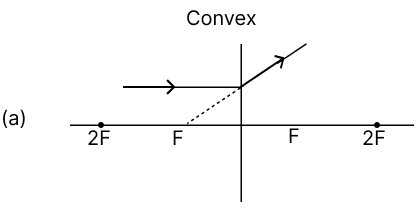
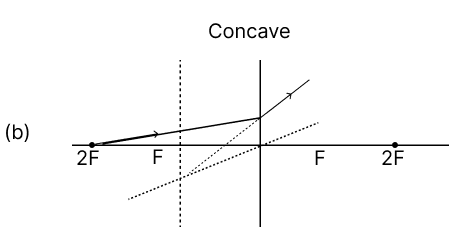
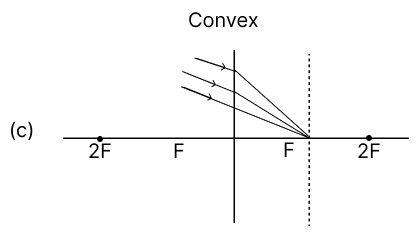
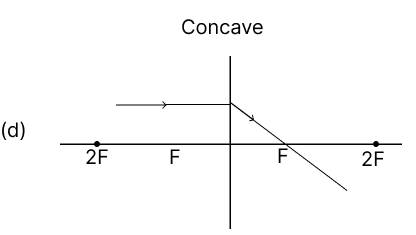
Which of the following diagrams shows the correct path of light through the lens?
Answer
Reason — Convex lens is converging lens and concave lens is diverging lens.
Option 1 Incorrect:
In this figure, the convex lens is shown causing divergence, which is not typical behavior for a convex lens.
Option 2 Correct:
In this figure, the concave lens is shown causing divergence, which aligns with its expected behavior.
Option 3 Incorrect:
In this figure, the parallel beam of light is incident obliquely on the lens, so it does not converge at the principal focus.
Option 4 Incorrect:
In this figure, the concave lens is shown causing convergence, which is incorrect as concave lenses diverge light.
The diagrams below show four pulley systems. State which of the statements following the diagrams is true.
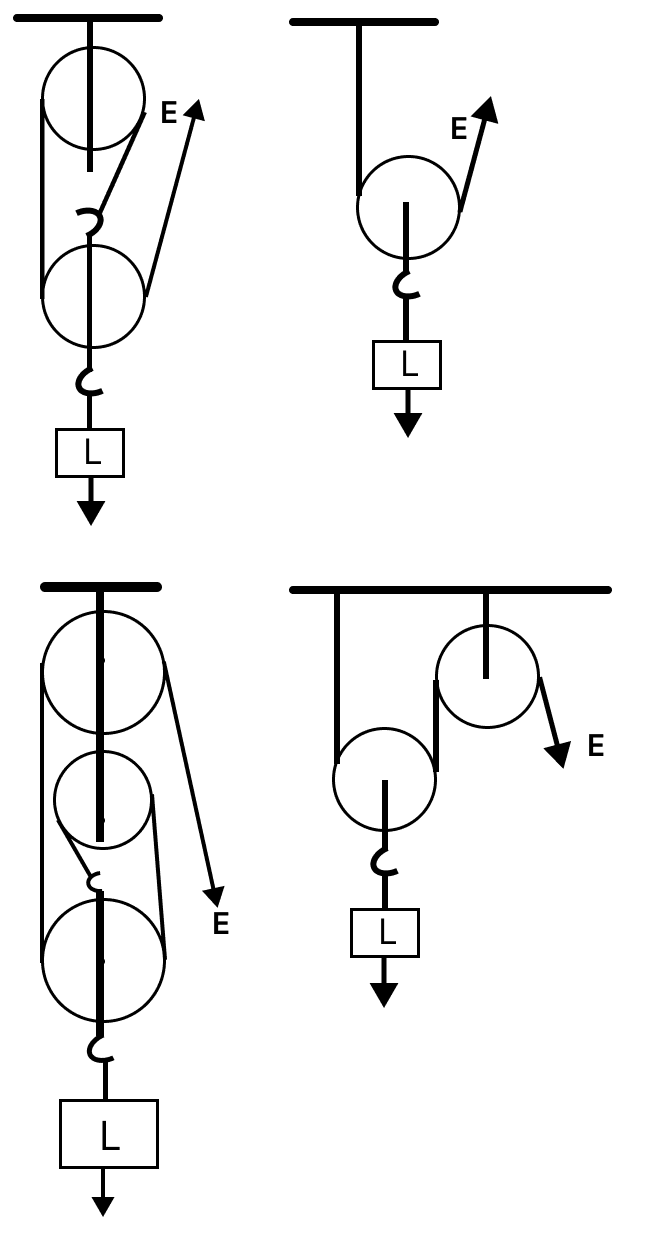
- There are three pulley systems with V.R. = 2 and one pulley system with V.R. = 1.
- There are two pulley systems with V.R. = 2, one pulley system with V.R. = 3 and one pulley system with V.R. = 1.
- There are two pulley systems with V.R. = 2, one pulley system with V.R.= 3 and one pulley system with V.R. = 4.
- There are two pulley systems with V.R. = 2 and two pulley system with V.R. = 3.
Answer
There are two pulley systems with V.R. = 2 and two pulley system with V.R. = 3
Reason — The velocity ratio is always equal to the number of strands of the tackle (or number of sections of the strings)
Velocity Ratio (V.R.) =
In Figure 1:
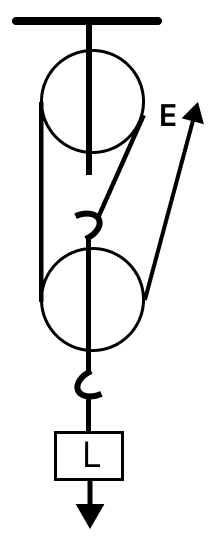
Number of sections of the strings = 3
So, the effort must move 3 units of distance to raise the load by 1 unit.
Velocity ratio =
Velocity ratio =
In Figure 2:
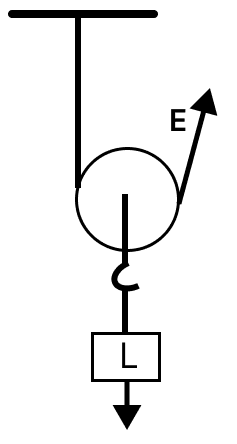
Number of sections of the strings = 2
So, the effort must move 2 units of distance to raise the load by 1 unit.
Velocity ratio =
velocity ratio =
In Figure 3:
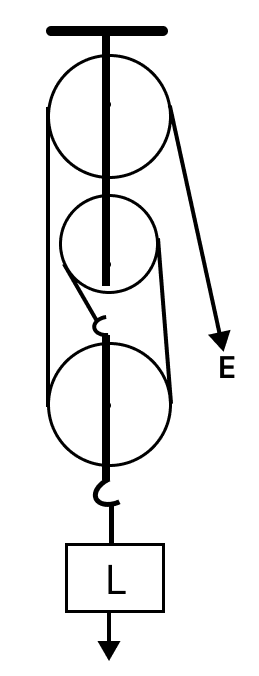
Number of sections of the strings = 3,
So, the effort must move 3 units of distance to raise the load by 1 unit.
Velocity ratio =
Velocity ratio
In Figure 4:
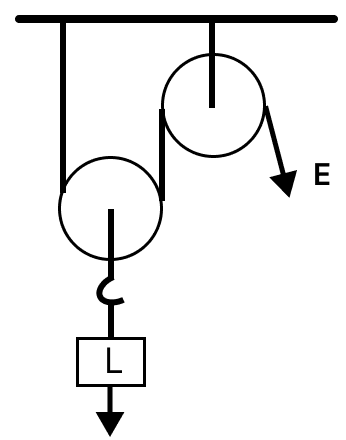
Number of sections of the strings = 2,
So, the effort must move 2 units of distance to raise the load by 1 unit.
Velocity ratio =
Velocity ratio =
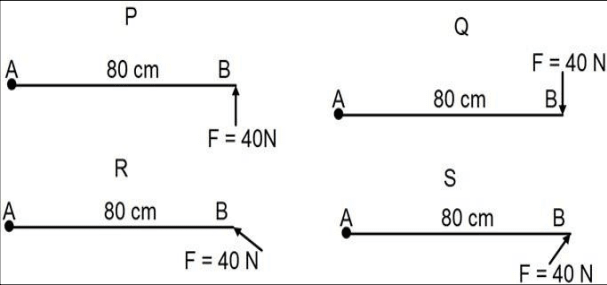
The diagrams below show a force F = 40 N acting on a rod AB pivoted at A in different directions. Identify the correct statement.
- P and S have opposite moments.
- The magnitude of the moment of force is maximum in R.
- The magnitude of the moment of force is maximum in P and Q.
- The moment of force in R is negative.
Answer
The magnitude of the moment of force is maximum in P and Q.
Reason
Option 1 Incorrect:
P & Q have same anticlockwise moment.
Option 2 Incorrect:
Maximum moment of force is for 90°. Here angle is not 90°.
Option 3 Correct:
Moment of force = force x perpendicular distance from pivot point.
For both P and Q, perpendicular distance from pivot point is maximum
Hence, the magnitude of the moment of force is maximum in P and Q.
Option 4 Incorrect:
R has anticlockwise moment which is taken positive.
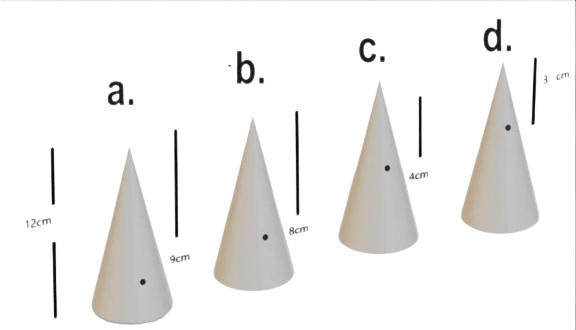
In the diagram below, four cones are depicted, each with a height of 12 cm. The position of the center of gravity is indicated by dots located at 9 cm, 8 cm, 4 cm, and 3 cm from the apex of each cone. Which of these cones is completely solid?
- 9 cm
- 8 cm
- 4 cm
- 3 cm
Answer
9 cm
Reason — For a completely solid cone (of uniform density), the center of gravity (CG) lies at a height of one-fourth the height from the base.
Distance from apex = x Height
So, for a cone of height 12 cm,
This means that only the cone with CG at 9 cm from the apex behaves like a completely solid cone.
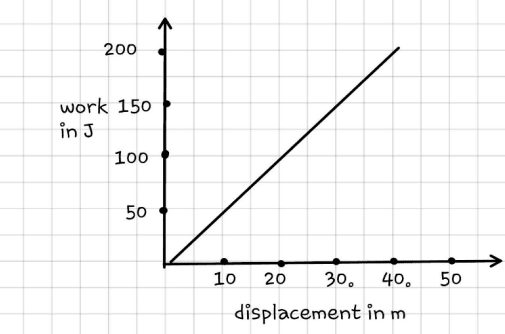
The given figure depicts the graph of work done vs. displacement under a constant force of 10 N. Which of the following statements is true?
- Force is acting at an angle of 0° with the displacement.
- Force is acting at an angle of 45° with the displacement.
- Force is acting at an angle of 60° with the displacement.
- Force is acting at an angle of 90° with the displacement.
Answer
Force is acting at an angle of 60° with the displacement.
Reason — From the graph, when displacement d = 10 m, work done W = 50 J
Slope = = 5 Nm
During his experiments with a single movable pulley, Jas determined the effort, mechanical advantage and efficiency as X, Y & Z, respectively. Subsequently, after lubricating the pulley thoroughly, he recalculated the effort, MA and efficiency. X', Y' & Z' respectively. Which of the following relationships accurately represents the scenario?
- X' > X
- Y' < Y
- Z' > Z
- Z' = Z
Answer
Z' > Z
Reason — Lubrication reduces friction at the axle of the pulley. This has three main effects:
- Less effort (X') is needed to lift the same load (X' < X).
- Since the machine now wastes less energy, the efficiency (Z') increases (Z' > Z).
- Mechanical Advantage (Y'), which is Load/Effort, increases because the effort decreases while the load stays the same.
- Option (1): X’ > X Incorrect (It actually decreases)
- Option (2): Y’ < Y Incorrect (MA increases)
- Option (3): Z’ > Z Correct
- Option (4): Z’ = Z Incorrect (Efficiency increases)
Assertion (A) : For a glass block, the i vs. r graph is a straight line.
Reason (R) : When a ray of light undergoes refraction, it follows Snell's law.
- Both Assertion and Reason are true, and the Reason is the correct explanation of the Assertion.
- Both Assertion and Reason are true, but Reason is not the correct explanation of the Assertion.
- Assertion is true, but the Reason is false.
- Assertion is false, but the Reason is true.
Answer
Assertion is false, but the Reason is true.
Explanation :
Assertion (A) is false : An vs. graph is not a straight line because Snell's law relates the sine of the angle of incidence to the sine of the angle of refraction not the angles themselves.
Reason (R) is true : Snell's Law is the law of refraction, it tells us how light bends when it passes from one medium to another.
............... of UV > ............... of microwaves
The quantity suitable for filling in both the blanks is:
- speed in vacuum
- speed in a medium
- frequency
- wavelength.
Answer
frequency
Reason
- Speed in Vacuum → incorrect.
All electromagnetic waves (radio, microwave, infrared, visible, UV, X-ray, gamma) travel at the same speed in a vacuum: So, speed of UV = speed of microwaves in vacuum - Speed in medium → incorrect.
When electromagnetic waves enter a medium like glass or water, they slow down.
UV rays have higher frequency than microwaves. Therefore, UV rays interacts more strongly with the medium hence, they slow down more. - frequency → correct.
UV has a much higher frequency than microwaves.
Frequency of UV = Hz
Frequency of Microwaves = around - Hz - wavelength → incorrect.
We know that,
This means that a higher frequency corresponds to a shorter wavelength, while a lower frequency corresponds to a longer wavelength.
Sumit, a teenager, enjoys playing his music loudly. However, his grandmother consistently lowers the volume of the music player. Analyze the wave to identify which characteristic of the wave has been altered when the grandmother reduces the volume.
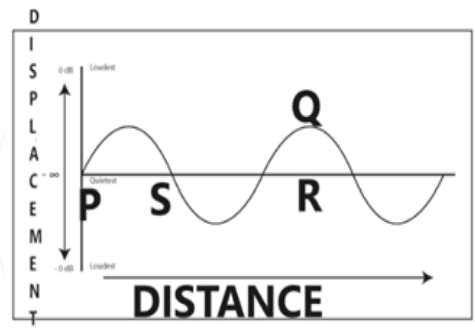
- The length PS becomes more.
- The length SR becomes less.
- The length QR becomes less.
- The length PR becomes less.
Answer
The length QR becomes less.
Reason — When Sumit’s grandmother lowers the volume, she’s reducing the wave’s amplitude, the maximum displacement from the mean position. In the diagram:
- P and R lie on the mean position (zero-displacement).
- Q marks the crest (maximum positive displacement).
- QR is the vertical distance from the equilibrium to the crest, which equals the amplitude. Reducing volume shrinks that vertical distance, so QR becomes smaller.
Data:
mass =10 g
quantity of heat supplied =120 J
rise in temperature = 10 °C
Statement A : The heat capacity of the substance is 12 J/g.
Statement B : The specific heat capacity of the substance is 1.2 J/gK.
- Only statement A is correct.
- Only statement B is correct.
- Both statements A and B are correct.
- Both statements A and B are incorrect.
Answer
Only statement B is correct.
Explanation :
Given,
Mass (m) = 10 g
Heat supplied (Q) = 120 J
Temperature rise (ΔT) = 10 °C = 10 K
Statement A is incorrect:
Heat capacity of the sample (C) = = J/K
Here, numerical value is correct but unit of heat capacity is wrong in statement A.
Statement B is correct:
Specific heat capacity (c) = = = 1.2 J/g K
Given that the resistivity of Gold and Platinum is 2.1 x 10⁻⁸ ohm.m and 10.5 x 10⁻⁸ ohm.m, respectively, which is the correct statement?
Statement A : 5 metres of platinum wire will have the same resistance as one metre of gold wire.
Statement B : Gold wire of 1 cm radius will have the same resistance as platinum wire of 5 cm radius.
- Only statement A is correct.
- Only statement B is correct.
- Both statements A and B are correct.
- Both statements A and B are incorrect.
Answer
Both statements A and B are incorrect.
Explanation :
By resistance formula,
Statement (A) is incorrect:
Given,
Resistivity of gold ρAu= 2.1 x 10⁻⁸ ohm.m
Resistivity of platinum ρPt= 10.5 x 10⁻⁸ ohm.m
Let the cross-sectional area A be the same for both wires.
Resistance of gold:
Resistance of platinum:
Statement (B) is incorrect:
Let the length of both wires are same.
Resistance of gold:
Resistance of platinum:
Assertion (A) : A switch will serve the purpose of making and breaking a circuit when it is connected to the neutral wire.
Reason(R) : Neutral wire is at zero potential.
- Both Assertion and Reason are true, and the Reason is the correct explanation of the Assertion
- Both Assertion and Reason are true, but Reason is not the correct explanation of the Assertion
- Assertion is true, but the Reason is false.
- Both Assertion & Reason are false.
Answer
Both Assertion and Reason are true, but Reason is not the correct explanation of the Assertion
Explanation :
Assertion (A) is true : A switch can be used to open and close a circuit, regardless of whether it's connected to the live or neutral wire. However, for safety reasons, the switch should be connected to the live wire.
Reason (R) is true : It is true that the neutral wire is at zero potential, but this does not justify its use for a switch. The function of a switch is to break the live wire, thereby completely disconnecting the circuit from the power source.
The given rods will attract each other when:
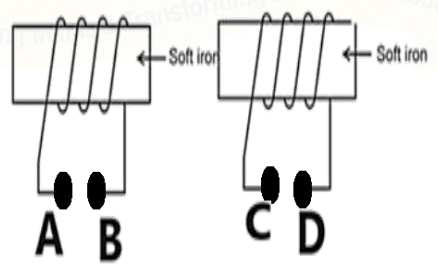
- A and C are connected to positive terminal of the battery.
- B and C are connected to the positive terminal of the battery.
- A and D are connected to the positive terminal of the battery.
- A and D are connected to the negative terminal of the battery.
Answer
A and C are connected to the positive terminal of the battery.
Reason — Clock rule : if current at the face of the loop is clockwise, so it behaves as south pole, while current at the face of the loop is anticlockwise, so it behaves as north pole.
"When points A and C are connected to the positive terminal, the second end of the first electromagnet becomes the south pole because the current at that end flows in clockwise direction. Similarly, the first end of the second electromagnet becomes the north pole since the current there is anticlockwise. Due to these opposite polarities at the facing ends, the electromagnets attract each other."
Which of the following equations are correctly balanced?
- Only D
- Only C
- Both A & B
- Both C & D
Answer
Both C & D
Reason — A balanced nuclear equation must conserve:
- Mass number (top value) — total nucleons (protons + neutrons)
- Atomic number (bottom value) — total protons
Equation A
LHS: Mass number= q-1
Atomic number = p-5
RHS: mass number= (q-5 + 4) = q-1
Atomic number= (p-3 + 2) = p-1
so this equation is not balanced.
Equation B
LHS: Mass number= q-4
Atomic number = p-4
RHS: mass number= (q-4 + 0) = q-4
Atomic number= p-5 + (-1) = p-6
so this equation is not balanced.
Equation C
LHS: Mass number= q-1
Atomic number = p-5
RHS: mass number= (q-5 + 4) = q-1
Atomic number= (p-7 + 2) = p-5
so this equation is balanced.
Equation D
LHS: Mass number= q-4
Atomic number= p-7
RHS: Mass number= q-4 + 0 = q-4
Atomic number= p-5 + 2(-1) = p-7
so this equation is balanced.
The below picture shows three cylinders filled with water to a different extent. The tuning forks L, M and N in vibration produce louder sound when held above the mouth of the cylinders. Which combination is correct for hearing a louder sound of the tuning fork?
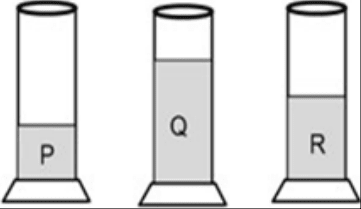
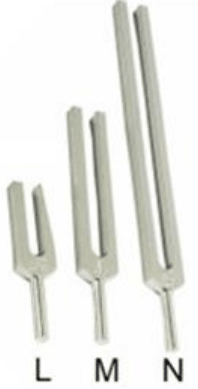
- L – R, M – Q, N – P
- L – P, M – Q, N – R
- L – R, M – P, N – Q
- L – Q, M – R, N – P
Answer
L – Q, M – R, N – P
Reason — The frequency of a tuning fork is inversely proportional to the square of the length of its prongs i.e.,
So, tunning fork L has highest frequency, N has lowest frequency and M has medium frequency
Frequency is inversely proportional to the length of the air column i.e.,
So, air column Q has highest frequency, P has lowest frequency and R has medium frequency
Highest frequency tuning fork (L) should match with the highest frequency air column (Q).
So, L-Q combination will resonate.
Medium frequency tuning fork (M) should match with the medium frequency air column (R).
So, M-R combination will resonate.
Lowest frequency tuning fork (N) should match with the lowest frequency air column (P).
So, N-P combination will resonate.
Three metals, A, B and C, are supplied with the same quantity of heat. Their masses are in the ratio 2 : 3 : 4. If they show the same rise in the temperature, then the ratio of their thermal capacities will be:
- 1:1:1
- 4:3:2
- 2:3:4
- 2:3:1
Answer
1:1:1
Reason — For each metal, the heat supplied is and the temperature rise is , so
Because both and are identical for A, B and C, the product i.e., the thermal (heat) capacity, is the same for all three metals. Hence their thermal capacities are in the ratio .
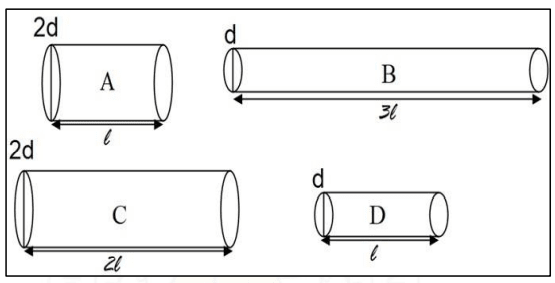
The below diagram shows different copper conductors of diameters d and 2d and lengths, which are multiples of l. The increasing order of their resistances will be:
- A < B < C < D
- A < C < D < B
- A < D < C < B
- D < A < C < B
Answer
A < C < D < B
Reason
Here, is specific resistance , l is length of conductor, d is diameter of conductor.
Conductor A:
Conductor B:
Conductor C:
Conductor D:
so, A < C < D < B
The diagram shows the magnificent dome at Gol Ghumbaz at Bijapur. A boy standing at A whispers, and it is clearly heard at B across the huge dome.
[Speed of sound is 330 ms-1]
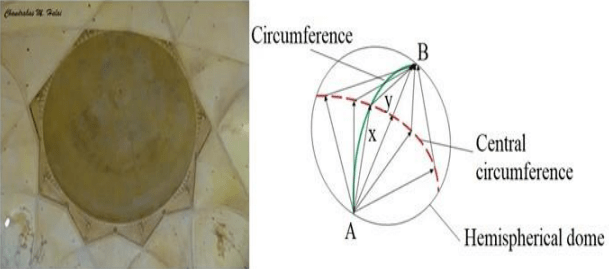
Assertion (A) : The distance travelled by sound waves (x+y) should be < 33 m.
Reason (R) : Sound reflected within 0.1 s is not heard by humans.
- A and R are true, and R is the reason for A.
- A and R are true, and R is not the reason for A.
- A is true, but R is false.
- A is false, but R is true.
Answer
A is false, but R is true.
Explanation :
Assertion (A) is false: to hear reflected sound.
Minimum distance (d) = 16.5 m
2d = x + y
So x + y ≥ 33 m, to hear the reflected sound.
Reason (R) is true: For humans to distinctly hear reflected sound must reach the ears at least 0.1 second after the original sound.
A magnetic compass is present on a small table, very close to the wall in a room. A man enters the room and switches on the Air Conditioner fitted near the ceiling. He observes that the needle in the compass shows immediate deflection. Identify the most probable reason for the deflection.
- Air blowing in the room.
- Current starts flowing through AC wire concealed in the adjacent wall.
- Vibrations are produced when the Man starts talking to his wife in the kitchen.
- Vibrations were produced due to a file in his hand that fell on the ground.
Answer
Current starts flowing through AC wire concealed in the adjacent wall.
Reason — When the AC is switched on, electric current flows through the concealed wires, generating a magnetic field around them. This magnetic field interacts with the magnetic compass, causing the needle to deflect. Air movement or vibrations don’t affect magnetic fields, so they wouldn’t cause the needle to move.
Two substances, A and B, have the same mass. Substance A has a higher specific heat capacity than substance B. What consequences would you expect when these substances are subjected to the same amount of heat energy?
- Substance A will experience a smaller temperature change than substance B.
- Substance A will experience a larger temperature change than substance B.
- Both substances will experience the same temperature change.
- Either of them can show a greater change in temperature as the temperature change depends on factors other than specific heat capacity.
Answer
Substance A will experience a smaller temperature change than substance B.
Reason — Specific heat capacity tells us how much heat is needed to raise the temperature of a substance. A higher specific heat means the substance absorbs more heat without a big temperature rise. So, with the same heat energy and mass, Substance A (with higher specific heat) will heat up less than Substance B.
A student traces the path of a ray of light through a glass prism for different angles of incidence. He analyses each diagram and draws the following conclusion:
I. On entering the prism, the light ray bends towards its base.
II. Light ray suffers refraction at the point of incidence and at the point of emergence while passing through the prism.
III. An emergent ray bends at a certain angle to the direction of the incident ray.
IV. While emerging from the prism at the second surface, the angle of refraction is less than the angle of incidence at that surface.
Which of the above inferences are correct?
- I, II and III
- I, III and IV
- II, III and IV
- All of these.
Answer
I, II and III
Reason
Conclusion I Correct: When light enters a denser medium from a rarer medium, it bends towards the normal due to refraction. In a prism, this causes the light to bend toward the base.
Conclusion II Correct:
Refraction occurs both at the entry and exit surfaces of the prism.
→ At the first surface (entry from air into glass), it bends towards the normal—because it's entering a denser medium.
→ At the second surface (exit from glass into air), it bends away from the normal—because it's emerging into a rarer medium.
Conclusion III. Correct:
The emergent ray deviates from the original path, forming an angle with the incident ray. This angle is called the angle of deviation.
conclusion IV Incorrect:
At the second surface (glass to air), light moves from denser to rarer medium, so it bends away from the normal. Hence, the angle of refraction is greater than the angle of incidence.
A metal ball is whirled inside a ring placed on a table, as shown in the diagram P. The diagram Q shows the motion of the ball after the ring is lifted.
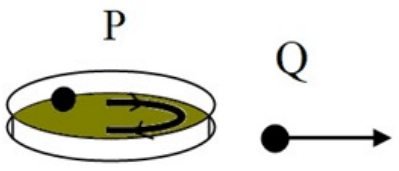
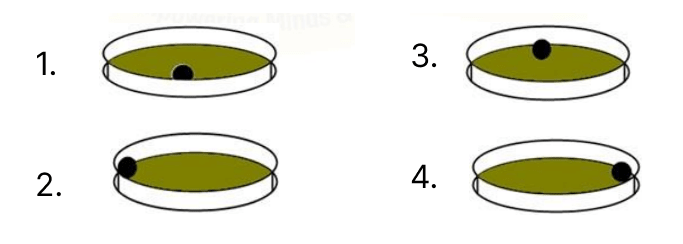
Which of the following diagrams shows the correct position of the metal ball in the ring when the ring is lifted?
Answer
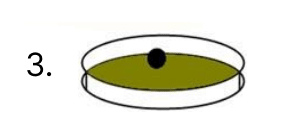
Reason — In circular motion, the velocity of an object is always tangential to the point on its path. In the figure, the ball is moving clockwise within the ring, and upon lifting the ring, the ball moves toward the right, making option 3 the correct choice.
Assertion (A): Sometimes the sky appears reddish in the evening.
Reason (R): Red, being longer in wavelength, scatter more than the other colours.
- A and R are true, and R is the reason for A.
- A and R are true, and R is not the reason for A.
- A is true, but R is false.
- A is false, but R is true.
Answer
A is true, but R is false.
Explanation :
Assertion (A) is true: During sunset (or sunrise), sunlight has to pass through a greater thickness of Earth’s atmosphere. Shorter wavelengths like blue and violet scatter more and get removed from the direct path. The longer wavelength red light dominates, giving the sky its reddish hue.
Reason (R) is false: Actually, red light scatters the least. According to Rayleigh scattering, the scattering is inversely proportional to the fourth power of wavelength. So shorter wavelengths scatter much more than longer ones—this is why the sky looks blue during midday.
Assertion (A) : When the displacement is zero, then the work is zero. So, if the work done is zero, then it necessarily means the displacement is zero.
Reason(R) : Work done is calculated by the relation 𝑊=𝐹𝑆 𝑐𝑜𝑠 𝜃
- A and R are true, and R is the reason for A.
- A and R are true, and R is not the reason for A.
- A is true, but R is false.
- A is false, but R is true.
Answer
A is false, but R is true.
Explanation :
Work is given by so the reason is correct.
But zero work doesn't always mean zero displacement. For example, when force is perpendicular to displacement (like carrying a bag horizontally). Here, the angle between force and displacement is 90° so work done work is still zero, even though displacement exists. Therefore, the reason is correct, but the assertion is not.
Which of the following statement is CORRECT?
The frequency of a stretched string is:
- directly proportional to its length but inversely proportional to the tension of the wire.
- inversely proportional to its length but directly proportional to the tension of the wire.
- directly proportional to the square root of its length but inversely proportional to the tension of the wire.
- inversely proportional to its length but directly proportional to the square root of the tension of the wire.
Answer
inversely proportional to its length but directly proportional to the square root of the tension of the wire.
Reason— The frequency f of a stretched string is given by:
Where:
- L is the length of the string,
- T is the tension,
- is the linear mass density
Therefore, frequency of a stretched string is inversely proportional to its length but directly proportional to the square root of the tension of the wire.
A ray of light passes obliquely from an optical medium of refractive index 1.33 to another medium of refractive index 1.5. While passing from the first medium to the second, the light ray will:
- bend towards the normal.
- bend away from the normal.
- move along the normal.
- suffer total internal reflection.
Answer
Bend towards the normal.
Reason— Given:
- First medium: Refractive index n1 = 1.33
- Second medium: Refractive index n2 = 1.5
Since n2 > n1 the second medium is optically denser.
When light travels obliquely from a rarer medium to a denser medium, it bends towards the normal.
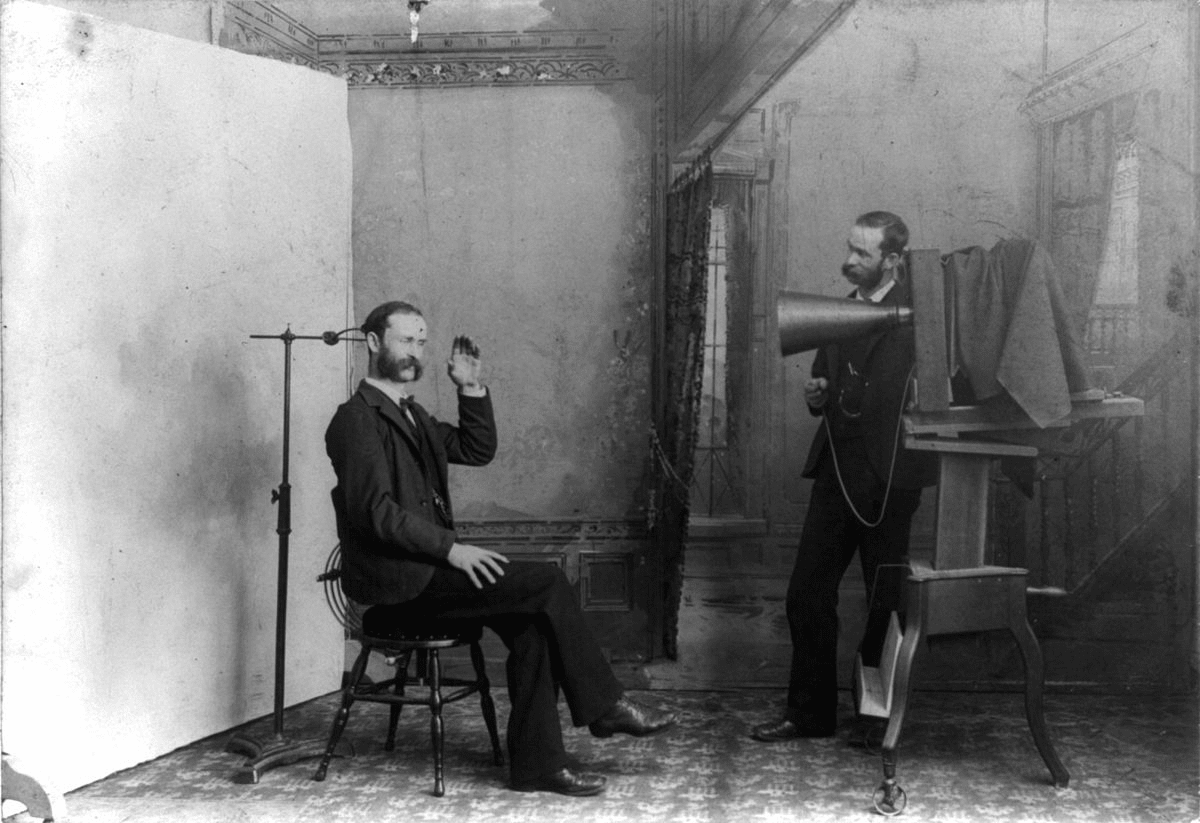
You want to register your name for an examination. For registration purposes, you need a passport-size photograph of yourself. When you went to a studio, the photographer told you to sit on a chair in front of a white screen in the room.
Assertion (A) : This is purposefully done so that you as an object should stand beyond the centre of curvature of the camera lens, but surely not at an infinite distance.
Reason(R) : The characteristics of the image formed are that it can be taken on a screen and is also diminished in size.
- Both A and R are true, and R is the correct explanation of A.
- Both A and R are true, and R is not the correct explanation of A.
- A is true, but R is false.
- Both A and R are false.
Answer
Both A and R are true, and R is the correct explanation of A.
Explanation :
Assertion (A) is true: Most cameras use a convex lens, and when an object is placed beyond the centre of curvature (i.e., farther than 2F), the image formed is: Real, Inverted, Diminished and can be captured on a screen.
Reason (R) is true: The image formed is real, can be taken on a screen, and is diminished in size. That matches the properties of the image formed by a convex lens when the object is placed beyond 2F. So the Reason is also true.
Rivers which originate from the glaciers at high altitudes have a supply of water throughout the year. This is because ice in high mountains does not melt all at once. This is due to:
- high specific heat of ice.
- low specific heat of ice.
- low specific latent heat of fusion of ice.
- high specific latent heat of fusion of ice.
Answer
high specific latent heat of fusion of ice.
Reason— Ice requires a large amount of heat energy to change from solid to liquid without a change in temperature. This is because it has a high specific latent heat of fusion—about 336 J/g. In high-altitude glaciers, even when temperatures rise slightly, the ice melts slowly and steadily over time, ensuring a continuous supply of water to rivers throughout the year.
If three resistors , and are connected in series and , then what is the relation between the currents , and respectively flowing through them?
Answer
Reason— In a series connection, the same current flows through each component, regardless of their resistances. This happens because there is only one path for the current.
∴ Current I is the same across all resistors, So
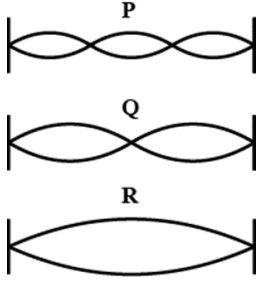
What is the ratio of wavelengths between P, Q and R?
- 3:2:1
- 1:2:3
- 6:3:2
- 2:3:6
Answer
2:3:6
Reason— A loop corresponds to half a wavelength, let length of string be .
- Pattern P has 3 loops, so P has
- Pattern Q has 2 loops, so Q has
- Pattern R has 1 loops, so R has
ratio ⇒
During the change of state of a substance from solid to liquid, heat is absorbed by a body, but its temperature does not rise. Which of the following statements explains the phenomenon?
- Only K.E of the molecules increases, but P.E remains the same.
- Only P.E of the molecules increases, but K.E remains the same.
- Both K.E and P.E of the molecules increase.
- There is no increase in the P.E and K.E of the molecules.
Answer
Only the P.E of the molecules increases, but the K.E remains the same.
Reason— When a substance changes from a solid to a liquid, the heat energy absorbed is used to overcome the intermolecular forces holding the solid particles together, thus increasing the potential energy (P.E.) of the molecules. However, the kinetic energy (K.E.), which relates to the vibrational motion of the molecules, does not change significantly during this phase change. The added energy goes entirely into breaking the bonds between the molecules, not into increasing their speed of vibration.
Assertion (A) : When current is passed through a wire, a magnetic field is generated around the wire.
Reason(R) : Whenever there is a change of magnetic flux linked up with the coil, the induced current is generated in the coil.
- Both A and R are correct, and R is the correct explanation of A.
- Both A and R are correct, but R is not the correct explanation of A.
- A is correct but R is wrong.
- Both A and R are wrong.
Answer
Both A and R are correct, but R is not the correct explanation of A
Explanation :
Assertion (A) is true: According to Oersted’s experiment and Ampere’s law, passing an electric current through a conductor generates concentric circular magnetic field lines around it.
Reason (R) is true: According to Faraday’s law of electromagnetic induction, A changing magnetic flux through a coil induces an electromotive force, hence a current.
Reason (R) describes electromagnetic induction (how a changing magnetic field induces current in a coil). Assertion (A) describes the generation of a magnetic field by a steady current. These are two distinct phenomenon, one is about field creation, the other about induced currents, so the Reason (R) does not explain the Assertion (A).
Which of the following combinations correctly shows the charges on the particles?
| + 1.6 X 10⁻¹⁹ C | - 1.6 X 10⁻¹⁹ C | + 3.2 X 10⁻¹⁹ C | |
|---|---|---|---|
| (a) | proton | neutron | alpha particle |
| (b) | alpha particle | electron | neutron |
| (c) | proton | electron | alpha particle |
| (d) | electron | Proton | alpha particle |
Answer
| (c) | proton | electron | alpha particle |
Reason — Charge on particles :
- Electron = - 1.6 X 10⁻¹⁹ C
- proton = + 1.6 X 10⁻¹⁹ C
- neutron = no charge
- alpha particle = + 3.2 X 10⁻¹⁹ C