
The diagram below shows two parallel wires carrying current in the downward direction. The magnitude of the current in wire A is greater than in wire B. It is also observed that the wires exert force on each other.
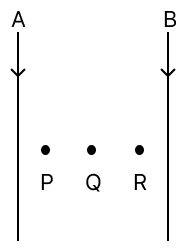
(a) State the direction of the force experienced by wire A.
(b) Name the law/laws used to come to the conclusion in (a).
(c) When a compass is placed in between the two wires, it does not remain along the direction of the magnetic field of wire A or wire B at one of the points P, Q, or R. State with a reason at which point you will observe this.
Answer
(a) Since both wires carry current downward and are parallel, they attract each other. So, wire A pulls toward wire B, and vice versa.
(b) Right hand thumb rule and Fleming’s left-hand rule.
(c) At point R
Since, the magnitude of the current in wire A is greater than in wire B, neutral point will always be formed near the weaker current wire.
Explanation:
(a) To find the direction of the force experienced by wire A:
Using the Right-Hand Thumb Rule (to find magnetic field):
For wire B, on pointing the right thumb in the direction of current (downwards), the fingers curl around the wire in the direction of the magnetic field. Hence, at the position of wire A (to the left of B), the magnetic field due to B is into the page.
Using Fleming’s Left-Hand Rule (to find force):
Applying Fleming's Left-Hand Rule to wire A:
- Magnetic field due to wire B at the location of wire A is into the page (first finger).
- Current in wire A is downward (second finger).
- Using Fleming's Left-Hand Rule, the thumb will point to the right.
Therefore, wire A experiences a force to the right, i.e., towards wire B.
(b) Right hand thumb rule and Fleming’s left-hand rule as explained above.
(c) The compass will not remain along the direction of the magnetic field of wire A or wire B at point R.
Point P: At this point, the magnetic field due to wire A is stronger than that due to wire B. As a result, the net magnetic field is in the direction of wire A’s magnetic field. Therefore, the magnetic compass will align itself along the direction of the magnetic field produced by wire A.
Point Q: This point lies midway between the two wires, equidistant from each. However, the magnetic field produced by wire A is stronger than that of wire B because the current in wire A is greater. As a result, the magnetic compass at this location will align itself with the direction of the magnetic field created by wire A.
Point R: Since the current in wire A is greater than that in wire B, the neutral point,where the magnetic fields from both wires cancel each other—will be located closer to wire B, the weaker current source. Therefore, point R is the most probable location of the neutral point resulting from the magnetic fields of both wires.
Shan is utilising a dynamometer to measure the force, expressed in newtons, on a bowstring. He records both the force and displacement of the bowstring and plots the data on a graph that shows the relationship between force in newtons and displacement in centimetres. Shan is interested in determining the highest point that the arrow reaches. He knows he can calculate the work done by finding the area under the graph.
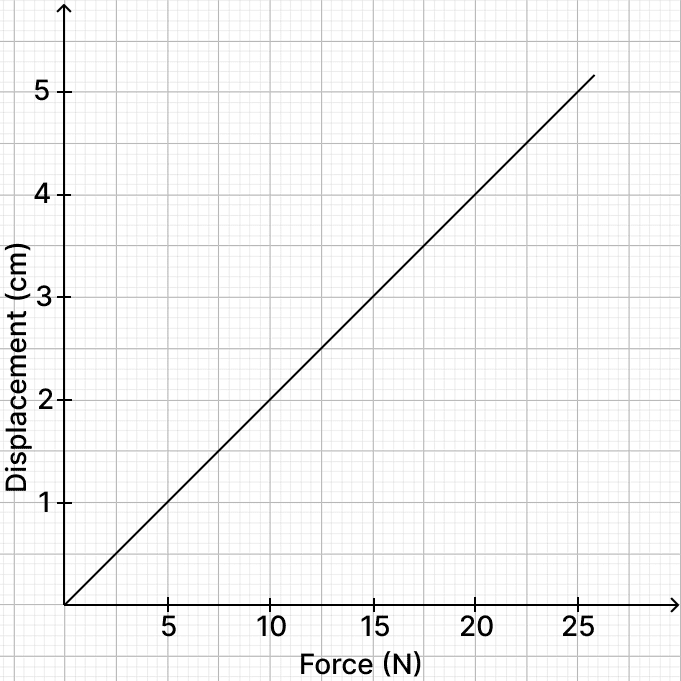
(a) What is the potential energy stored in the bow string, when the force is 25 N?
(b) If the mass of the arrow is 31.25 g, calculate the maximum velocity attained by the arrow.
(c) Calculate the maximum height reached by the arrow.
Answer
(a) PE = work done =area under the graph = x b x h = × 25 x 0.05 = 0.625 J
(b) Given, mass of arrow = 31.25 g = 0.03125 kg
By law of conservation of energy,
PE of the bow string = KE of the arrow
So, the maximum velocity attained by the arrow is 6.32 ms-1
(c) The potential energy stored in the bow string =
So, the maximum height attained by the arrow is 2 m
The graph illustrates the correlation between the number of protons (x-axis) and the number of neutrons (y-axis) for element C in the periodic table. The element is denoted by letters rather than their conventional symbols. When element C, depicted in the graph, undergoes radioactive decay, it releases radioactive rays.
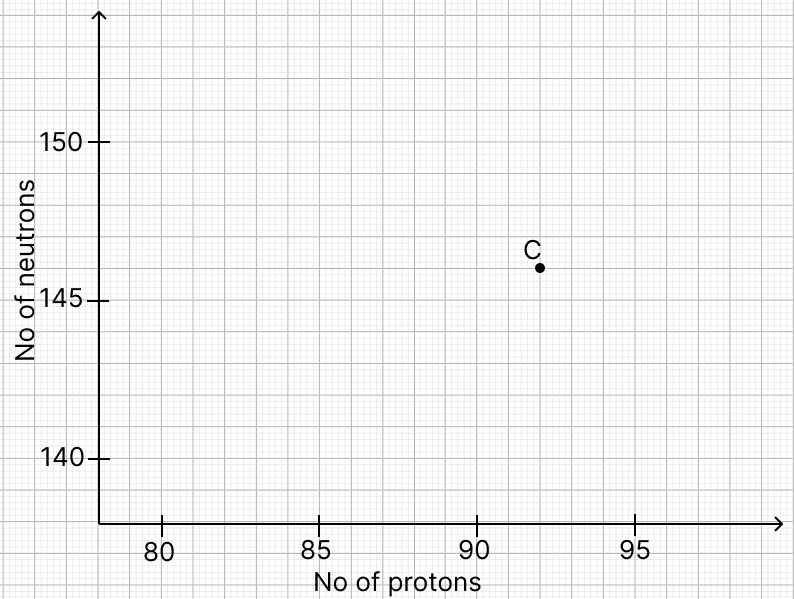
(a) Write the chemical symbol along with the mass number and atomic number for the element denoted as ‘C’.
(b) Plot on the graph,
i. The daughter element after the emission of beta radiation by the element ‘C’.
ii. The daughter element, as indicated in the previous answer, if it undergoes alpha decay.
Answer
(a)
(b)
(i)
Here,
No. of protons of daughter element = atomic number = 93
No. of neutrons of daughter element = mass number - atomic number = 238 - 93 = 145
(ii)
Here,
No. of protons of daughter element = atomic number = 91
No. of neutrons of daughter element = mass number - atomic number = 234 - 91 = 143

The adjacent diagram shows four solid plastic balls with wires fitted on a wooden base. A person shakes the wooden base to and fro (forward and backward) periodically. It is observed that even the balls start vibrating. It is also observed that all balls vibrate, but only one ball vibrates vigorously.
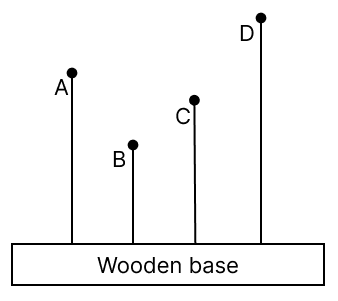
(a) Explain why only one ball vibrates vigorously.
(b) If fA, fB, fC, and fD are the natural frequencies of vibration of the wires, then arrange them in the increasing order of their frequencies and give reasons for the same.
Answer
(a) Each wire-ball system has its own natural frequency depending on the wire's length, tension, and mass distribution. The ball that vibrates vigorously is the one whose natural frequency matches the driving frequency. When the frequency of external vibrations matches an object's natural frequency, the object absorbs energy and vibrates with large amplitude due to resonance.
(b) fD < fA < fC < fB
Frequency of vibration is inversely proportional to the vibrating length. Shorter wires have higher natural frequencies, while longer ones have lower frequencies.
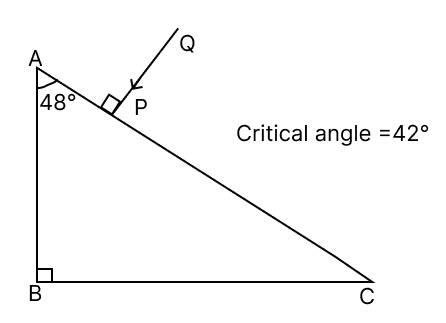
The above diagram shows a glass prism of a critical angle 42°.
(a) Redraw the diagram and complete the path of the light ray PQ till it emerges out of the prism.
(b) Also, calculate the net angle of deviation of the ray PQ when it emerges from the prism.
Answer
(a) Below diagram shows the completed path of light ray PQ till it emerges out of the prism:

(b) In △APX
∠A = 48° and ∠APX = 90°
So,
∠AXP = 180° - (48° + 90°) = 42°
∠PXN = 90° - 42° = 48°
∠PXN = ∠XYB = 48° (∵ Corresponding angles)
Angle of deviation of the ray PQ = ∠ D = 180°- 48° = 132°
The circuit depicted in the figure is employed to study Ohm's Law. Rather than employing a conventional resistor, a glass tube of length ‘l’ and cross-sectional area ‘a’, which is half-filled with mercury of resistivity ‘d’, is connected to the circuit via two electrodes, E1 and E2. These electrodes are linked to a battery with an emf of ‘E’ and negligible internal resistance. Provide the answer in terms of ‘a’, ‘l’, ‘d’, and ‘E’.
(a) Resistance of mercury in the tube.
(b) The ammeter reading.
(c) Voltmeter reading.
(d) Which of the measurements are altered when the tube is entirely filled with mercury?

Answer
Given,
Length of glass tube = l
Cross-sectional area of glass tube = a
Resistivity of mercury = d
Internal resistance of battery = 0
(a) When mercury is half filled in glass tube then cross sectional area of mercury =
Resistance of mercury in the tube:
(b) Reading of ammeter:
(c) Reading of voltmeter = E
(it does not depend on applied resistance)
(d) If mercury is entirely filled in tube then cross sectional area of mercury = a
Initially cross sectional area of mercury was
We know that:
And
By changing cross sectional area, the value of resistance and the reading of ammeter will change.
Two students are conducting experiments with identical 100 g mass simple pendulums, each raising the bob 5 m above the mean position. The graph depicting the relationship between distance from the mean position and velocities is presented in the diagram.

(a) Demonstrate, using mathematical calculations, that the path followed by student 1 is devoid of friction.
(b) Does the situation involving student 2 exhibit a breach of the law of conservation of energy?
Answer
(a) Given mass of simple pendulum = 100 g = 0.1 kg
Height raised = 5 m
Student 1
Potential energy: U1 = mgh
U1 = 0.1 x 10 x 5 = 5 J
Kinetic energy: K1 = mv2
K1 = x 0.1 x 10²
K1 =
K1 = 5 J
∴ Potential energy = Kinetic energy
Student 2
Potential energy: U2 = mgh
U2 = 0.1 x 10 x 5 = 5 J
Kinetic energy: K2 = mv2
K2 = mv2
K2 = x 0.1 x 82
K2 =
K2 = 3.2 J
∴ Potential energy > Kinetic energy
U2 - K2 = 5 J - 3.2 J = 1.8 J of energy is converted as heat energy due to friction.
(b) No, law of conservation of energy is not breached in case of student 2. The difference in the value of potential energy and kinetic energy is coming due to dissipation of energy caused by friction.
Potential energy = Kinetic energy + Degraded energy
Examine the graph depicting the transmitted (T) and reflected (R) waves from submarines A and B, which are equipped with a device emitting ultrasonic sounds. Study the graph and answer the following. (Speed of sound in water is 1500 m/s)
(a) Name the device used here.
(b) Why is ultrasonic sound used in this device?
(c) Which submarine is closer to the ship? Calculate the distance of the closest submarine.

Answer
(a) Sound Navigation and Ranging (SONAR)
(b) They are not easily absorbed by a medium and can travel undeviated over long distances in the form of a narrow, confined beam
(c) Submarine B is closer to ship, because reflection time R1 for submarine A = 50 s - 20 s = 30 s and reflection time R2 for submarine B = 60 s - 40 s =20 s.
Distance of closest submarine B
= 15000 m
= km
= 15 km
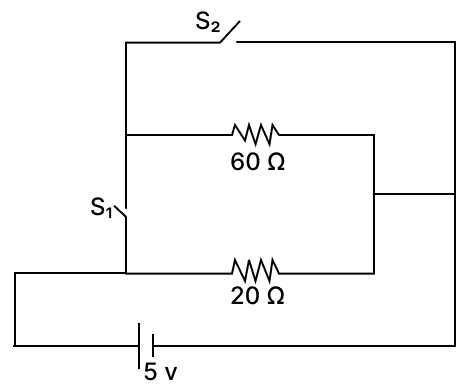
In the below circuit diagram, calculate the power consumed in the circuit when:
(a) the switch S1 is closed, and the switch S2 is open.
(b) the switch S2 is closed, and the switch S1 is open.
Answer
(a) When switch S1 is closed, and the switch S2 is open.
Here, 60 Ω and 20 Ω are in parallel
Let total resistance of circuit in this condition = R1
So, by formula
Power consumed =
(b) When switch S2 is closed, and the switch S1 is open.
Here, negligible current flows through the 60 Ω resistor because the majority of the current takes the path of least resistance, which includes the 20 Ω resistor. Therefore, most of the current flows through the 20 Ω path.
So, total resistance of circuit R2 = 20 Ω
Power consumed =
The diagram below shows a pulley used to lift an iron beam of length 3 m and weight 100 kgf, lying on the ground.
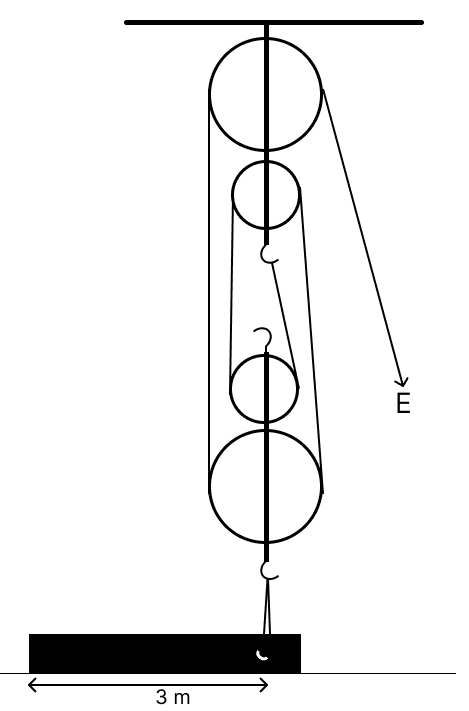
(a) Calculate the minimum effort needed to just lift the beam off the ground. [Assume no loss of energy]
(b) When the beam is being lifted from the ground, with the other end touching the ground, state with a reason whether the effort needed keeps on increasing, decreasing or remains constant.
Answer
Given,
Weight of iron beam (W) = 100 kgf
Length of iron beam (X) = 3 m
The minimum effort needed to just lift the beam off the ground:
Since the beam is uniform, its weight is evenly distributed over its length.
To just lift one end of the beam, we treat the beam like a uniform rod being pivoted at one end (the other end still touching the ground). The centre of gravity (CG) lies at the midpoint, i.e., at 1.5 m from the lifting end.
To lift one end, the torque due to effort must balance the torque due to the weight of the beam acting at the CG.
Let the effort E be applied vertically upwards through a pulley at one end.
Let Y be the minimum torque due to effort required to lift the beam.
Torque due to weight = 100 x 1.5 = 150 kgf m
Torque due to effort = Y x 3
By principle of levers:
Y x 3 = 150 kgf m
⇒ Y = = 50 kgf
M.A. = ...............(i)
M.A. = Total number of pulleys in both the blocks = 4 ...............(ii)
From equation (i) and (ii)
4 =
E =
(b) Effort needed remains the same.
Reason: Ratio between the effort arm and load arm is the same when the beam is being lifted.
You are doing an experiment on the refraction of light in your Physics laboratory. ABCD is a rectangular block. A ray of light is incident obliquely on the surface AB.
(a) Draw the path of the ray of light through the glass block and also show how it emerges from the block. [ The diagram should show the lateral displacement suffered by the ray.]
(b) Which two pairs of angles remain the same during the experiment?
(c) If the same experiment is performed first with red and then with blue light, which colour will suffer greater lateral displacement?
Answer
(a) Below diagram shows the lateral displacement of a ray of light when it passes through a parallel-sided glass slab:

(b)
- Angle of incidence = angle of emergence
- Angle of refraction at the first surface = Angle of incidence at the second surface.
(c) Blue, because lateral displacement increases with the deceases in wavelength of light.
An element emits one α-particle and then two β-particles consecutively to form an element Q.
(a) Show all the transformations by means of equations only.
(b) What are P and Q called?
Answer
(a)
(b) Isotopes, because they have the same atomic number but different mass number.
In the graph, a given quantity of ice is converted to water.
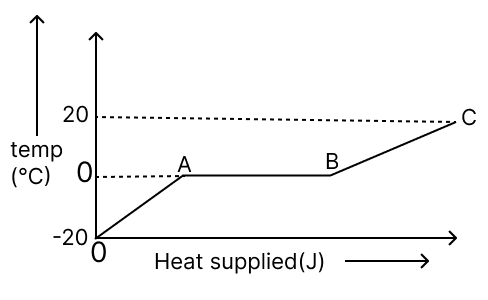
(a) What does the portion AB represent?
(b) Why is the portion AB parallel to the time axis?
(c) Why is the slope OA steeper than the slope BC?
Answer
(a) Melting of ice.
(b) During the melting of ice, the temperature remains constant, even though heat is supplied, until all the ice has converted into water. This is because the supplied heat is used to overcome the intermolecular forces holding the ice molecules together, rather than increasing their kinetic energy.
(c) As specific heat capacity of ice is less than specific heat capacity of water. Hence, ice needs less quantity of heat than water for the same rise of temperature.
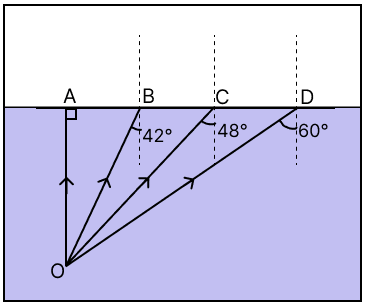
In the given diagram, two transparent optical media are shown. The rarer medium is air, while the denser medium is water. Redraw the diagram by showing the paths of the rays after striking the surface of separation AD for the incident rays OA, OB, OC and OD, respectively. (Critical angle for the denser medium = 48°)
Answer

(a) The ray OA will go straight without any deviation, because angle of incidence is zero.
(b) The ray OB, after striking the surface of separation, will move away from the normal, because angle of incidence is less than critical angle and ray is going from denser to rarer medium
(c) The ray OC, after striking the surface, will graze along the surface, because angle of incidence is equal to critical angle.
(d) The ray OD will return back to the same denser medium. We will see total internal reflection because angle of incidence is greater than critical angle. (Note- It is necessary to show the angle of reflection as 60°)
In a hydraulic power station, water is first stored in a dam at a higher altitude.
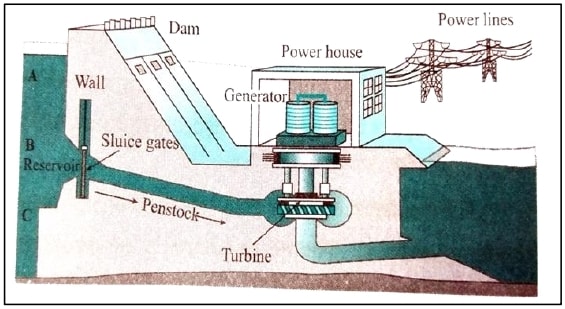
(a) What is the purpose of being stored at higher altitudes?
(b) When the water is allowed to fall on a turbine, what change of energy takes place for the water?
(c) Why is this turbine connected to the armature of a generator?
(d) Which basic law of physics is followed by the whole mechanism?
Answer
(a) The higher the altitude, the greater the potential energy, which can be efficiently converted into kinetic and then into electrical energy when released.
(b) As water flows down, potential energy of water is transformed into kinetic and heat energy which is then converted into electrical energy via the generator.
(c) The turbine spins due to water flow, and it is mechanically linked to the armature of the generator. This rotation induces a current, converting mechanical energy into electrical energy, according to electromagnetic induction principles.
(d) The entire process is based on the Law of Conservation of Energy.