
The energy transformation taking place in a Thermocouple is:
- Heat energy to electrical energy
- Heat energy to mechanical energy
- Electrical energy to heat energy
- Electrical energy to mechanical energy
Answer
Heat energy to electrical energy
Reason — A thermocouple is made by joining two wires of different metals so as to form two junctions. When one junction is kept hot and the other is kept cold, a current begins to flow in the circuit. Thus the heat energy supplied at the hot junction is converted into electrical energy.
The unit of the physical quantity expressed by equation is: (p is momentum and m is mass)
- newton
- joule
- watt
- joule per kilogram
Answer
joule
Reason — As momentum p = mv, so
which is the expression for kinetic energy. Since energy is measured in joule, the unit of is joule.
A block and tackle system has two pulleys in the movable block. In an ideal condition if L = 5T, then the number of pulleys in the fixed block is equal to:
(L is the load and T is the tension)
- 2
- 3
- 4
- 5
Answer
3
Reason — In a block and tackle system in which the effort is applied in the downward direction, the tension in the n segments of the string supports the load, so
L = nT
where n is the total number of pulleys used in both the blocks.
Here, L = 5T, so n = 5.
Then,
Number of pulleys in the fixed block = Total number of pulleys - Number of pulleys in the movable block = 5 - 2 = 3
If three equal forces F1, F2 and F3 are acting at the end A of the rod AB, pivoted at the center O, as shown in the diagram given below, then the moment of force is:
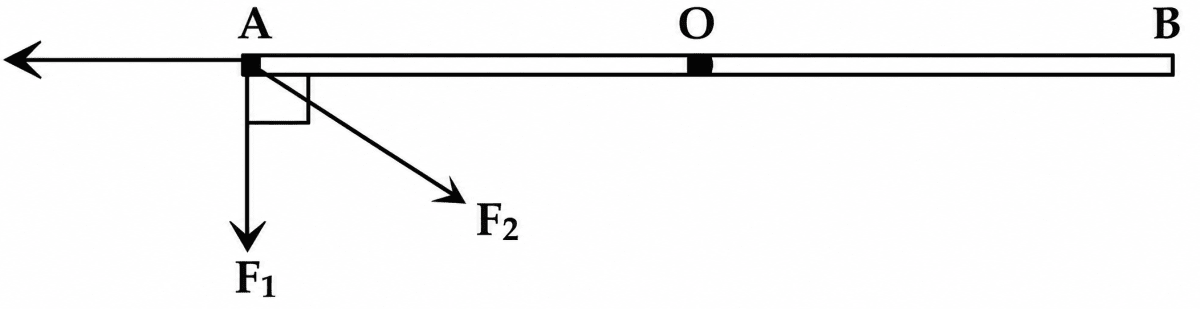
- least for F2 and maximum for F1
- least for F1 and maximum for F3
- least for F3 and maximum for F1
- least for F2 and maximum for F3
Answer
least for F3 and maximum for F1
Reason — The moment of a force is the product of the force and the perpendicular distance of its line of action from the pivot. If a force F acts at A at an angle θ with the rod and OA = r, then
All the three forces are equal and act at the same point A, so the moment of each depends only on the angle θ.
F3 acts along the rod, so θ = 0° and its line of action passes through O, giving τ3 = 0, the least.
F1 acts perpendicular to the rod, so θ = 90° and τ1 = F r, the maximum.
F2 acts at an angle between 0° and 90°, so its moment lies between the two.
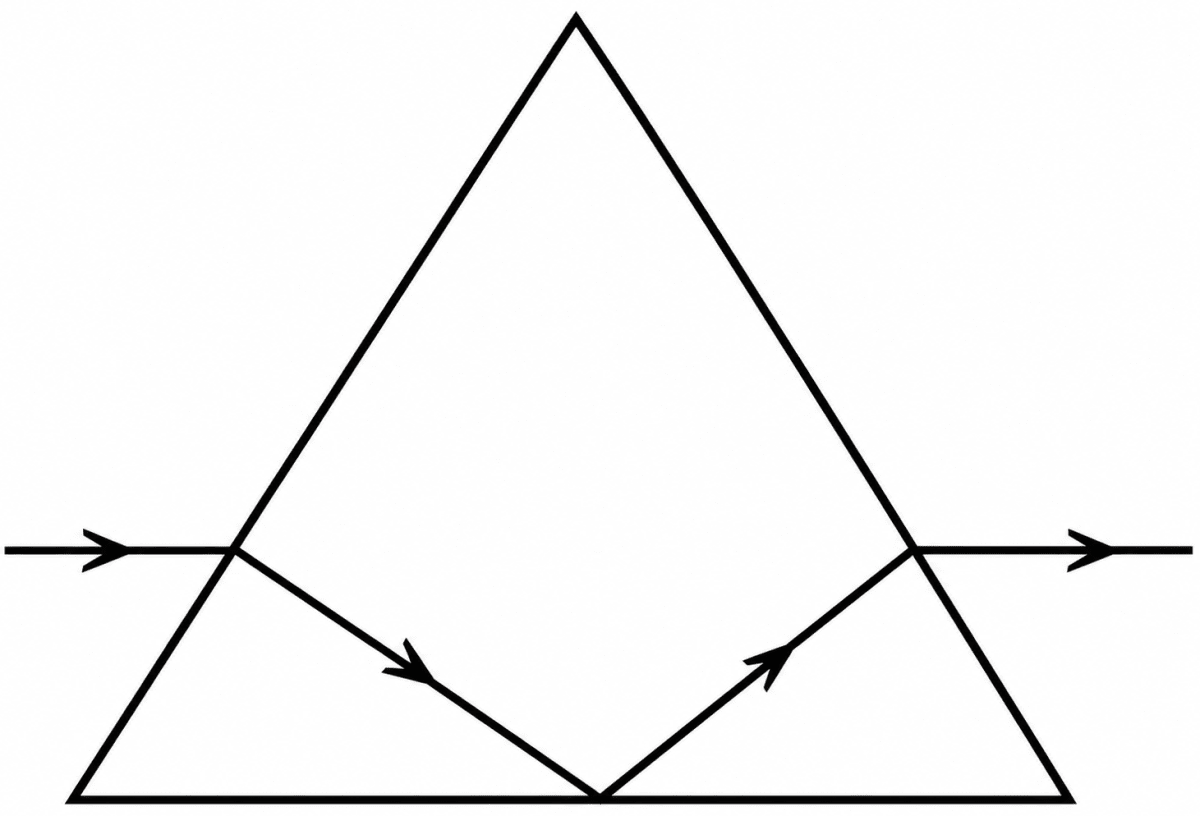
The net angle of deviation produced by the prism in the diagram shown below is ...............
- 0°
- 60°
- 90°
- 180°
Answer
0°
Reason — From the diagram, the light ray enters the prism through one refracting face, suffers total internal reflection at the base of the prism and finally emerges out through the other refracting face. The emergent ray is parallel to the incident ray and it travels in the same direction as the incident ray.
Since the emergent ray has not turned from the direction of the incident ray, the net angle of deviation produced by the prism is 0°.
A crack in a glass vessel often shines, like a mirror, in sunlight. Which of the following phenomenon of light is responsible for this?
- reflection
- refraction
- dispersion
- total internal reflection
Answer
total internal reflection
Reason — A crack in a glass vessel contains a thin layer of air. When light travelling inside the glass (denser medium) strikes this air layer (rarer medium) at an angle of incidence greater than the critical angle for the glass-air interface, the entire light is reflected back into the glass. Because 100% of the light is returned, the crack appears bright and shines like a mirror.
The magnification produced by a lens is +2. Then the image is:
- real and magnified
- virtual and diminished
- real and diminished
- virtual and magnified
Answer
virtual and magnified
Reason — The sign of magnification tells the nature of the image and its numerical value tells the size of the image.
Here, magnification is positive, which means the image is erect and hence virtual, and its numerical value is 2 (i.e., greater than 1), which means the image is twice the size of the object and hence magnified.
Identify the radiation that scatters the least.
- Radio waves
- Microwaves
- X-rays
- Gamma rays
Answer
Radio waves
Reason — The scattering of a radiation decreases as its wavelength increases. Among the given radiations, radio waves have the longest wavelength, so they are scattered the least. Gamma rays, having the shortest wavelength, are scattered the most.
Assertion (A): The buzzing of a mosquito is shriller than the roar of a lion.
Reason (R): The frequency of sound produced by a mosquito is greater than the frequency of sound produced by the roar of a lion.
- (A) is true but (R) is false.
- (A) is false but (R) is true.
- Both (A) and (R) are true and (R) is the correct explanation of (A).
- Both (A) and (R) are true but (R) is not the correct explanation of (A).
Answer
Both (A) and (R) are true and (R) is the correct explanation of (A).
Explanation
Assertion (A) is correct: The buzzing of a mosquito is a shrill, that is, a high pitched sound, whereas the roar of a lion is a low pitched sound. The roar is much louder than the buzz, but loudness depends on the amplitude of the sound wave, while shrillness depends on its pitch.
Reason (R) is also correct: A mosquito vibrates its wings very rapidly and therefore produces a sound of high frequency, while the roar of a lion is produced by the slower vibration of its vocal cords and is of low frequency.
Since the shrillness, or pitch, of a sound is decided by its frequency — the greater the frequency, the shriller the sound — the higher frequency of the mosquito is exactly the cause of its sound being shriller.
Therefore, both (A) and (R) are true and (R) is the correct explanation of (A).
A straight wire of resistance R is bent in a U shape. Its resistance is:
- R
- 2R
Answer
R
Reason — The resistance of a wire is given by
i.e., it depends on the resistivity of the material, the length of the wire and its area of cross-section.
On bending the wire into a U shape, neither its length, nor its area of cross-section, nor its material changes. Hence its resistance remains R.
Which of the following is NOT a characteristic of a fuse wire?
- It has high resistance.
- It has high conductivity.
- It is an alloy of lead and tin.
- It has a low melting point.
Answer
It has high conductivity.
Reason — A fuse wire must get heated up quickly and melt when the current in the circuit exceeds the safe value. For this it is made of an alloy of lead and tin which has a high resistance and a low melting point. High conductivity means low resistance, so the wire would not get heated enough to melt. Hence high conductivity is not a characteristic of a fuse wire.
Identify the correct statement with respect to the change of phase of a substance.
- Kinetic energy of the molecules remains the same.
- Potential energy of the molecules remains the same.
- Both potential and kinetic energies of the molecules increase.
- Both potential and kinetic energies of the molecules remain the same.
Answer
Kinetic energy of the molecules remains the same.
Reason — During a change of phase, the temperature of the substance does not change. Since the kinetic energy of the molecules depends on the temperature, the kinetic energy of the molecules remains the same. The heat energy supplied (i.e., the latent heat) is used up in increasing the potential energy of the molecules by increasing the separation between molecules against their attractive forces.
1 calorie is the amount of heat required to raise the temperature of:
- 1 kg of water through 1 K
- 1 g of water through 1 K
- 1 kg of water through 1°C
- 1 g of water through 10°C
Answer
1 g of water through 1 K
Reason — One calorie is defined as the amount of heat energy required to raise the temperature of 1 gram of water through 1 K (or 1 °C). Note that a change of 1 K is numerically equal to a change of 1 °C, so both express the same rise in temperature.
A current carrying conductor experiences a force when placed normal to a magnetic field. The force experienced does not depend on the:
- mass of the conductor
- current through the conductor
- strength of the magnetic field
- length of the conductor
Answer
mass of the conductor
Reason — For a conductor normal to the field, the force depends on the current, field strength and length of wire in the field; its mass does not determine the magnetic force.
When the nuclear radiation is subjected to a magnetic field, the direction of deflection is governed by:
- Flemming's Right Hand Rule
- Flemming's Left Hand Rule
- Clock Rule
- Right Hand Thumb Rule
Answer
Flemming's Left Hand Rule
Reason — The α-particles and β-particles are charged particles, so a beam of these radiations is equivalent to a current flowing in a conductor. When such a beam passes through a magnetic field, it experiences a force whose direction is obtained by Fleming's left hand rule, which gives the direction of the force acting on a current carrying conductor placed in a magnetic field.
Complete the following by choosing the correct answers from the bracket:
(a) If the displacement of a load is greater than the displacement of the effort, then the velocity ratio of the machine is ............... [less than one / more than one].
(b) Out of multiple images of an object, formed by a thick plane glass mirror, the ............... [first / second] image is the brightest.
(c) No negative temperature is possible on the ............... [Kelvin scale / Fahrenheit scale].
(d) 250 dB is ............... [shriller / louder] than 10 dB.
(e) In a series combination, across each resistor, the ............... [current / potential difference] remains the same.
(f) 18Ar40 and 20Ca40 are the examples of ............... [isobars / isotopes].
Answer
(a) If the displacement of a load is greater than the displacement of the effort, then the velocity ratio of the machine is less than one.
(b) Out of multiple images of an object, formed by a thick plane glass mirror, the second image is the brightest.
(c) No negative temperature is possible on the Kelvin scale.
(d) 250 dB is louder than 10 dB.
(e) In a series combination, across each resistor, the current remains the same.
(f) 18Ar40 and 20Ca40 are the examples of isobars.
Rekha has a metre ruler weighing 200 gf, half (50 cm) made of wood and half made of steel.
(a) Rekha wants to balance the ruler. To which part (wooden or steel) should she keep the knife edge?
(b) The above metre-rule is to be balanced by placing the knife edge at 50 cm mark using a known weight. Name the principle which can be used to calculate the position of the weight.
Answer
(a) The knife edge should be kept on the steel part.
Reason — Steel is much denser than wood, so for the same length the steel half is heavier than the wooden half. Hence the centre of gravity of the ruler is shifted from the 50 cm mark towards the steel half, and the ruler will balance only when the knife edge is placed at the centre of gravity, i.e., somewhere on the steel part.
(b) Principle of moments — according to which, in the equilibrium position, the sum of the anticlockwise moments about the knife edge is equal to the sum of the clockwise moments about it.
(a) In a second-class lever, the ratio of the effort arm to the load arm is ............... (greater than 1 / less than 1).
(b) State one advantage of the combination of one fixed and one movable pulley over a single movable pulley.
Answer
(a) In a second-class lever, the ratio of the effort arm to the load arm is greater than 1.
Reason — In a class II lever the load lies in between the fulcrum and the effort, so the effort arm is always longer than the load arm. Hence the ratio , which is the mechanical advantage, is always greater than 1.
(b) In a single movable pulley the effort has to be applied in the upward direction, which is inconvenient. By adding a fixed pulley to it, the direction of the effort is changed, so that the effort can now be applied in the downward direction, which is much more convenient since the weight of the person applying the effort also helps. The mechanical advantage remains 2 in both cases.
An upright lens is divided horizontally into a number of parts and the diagram given below shows the magnified view of its lowest part.
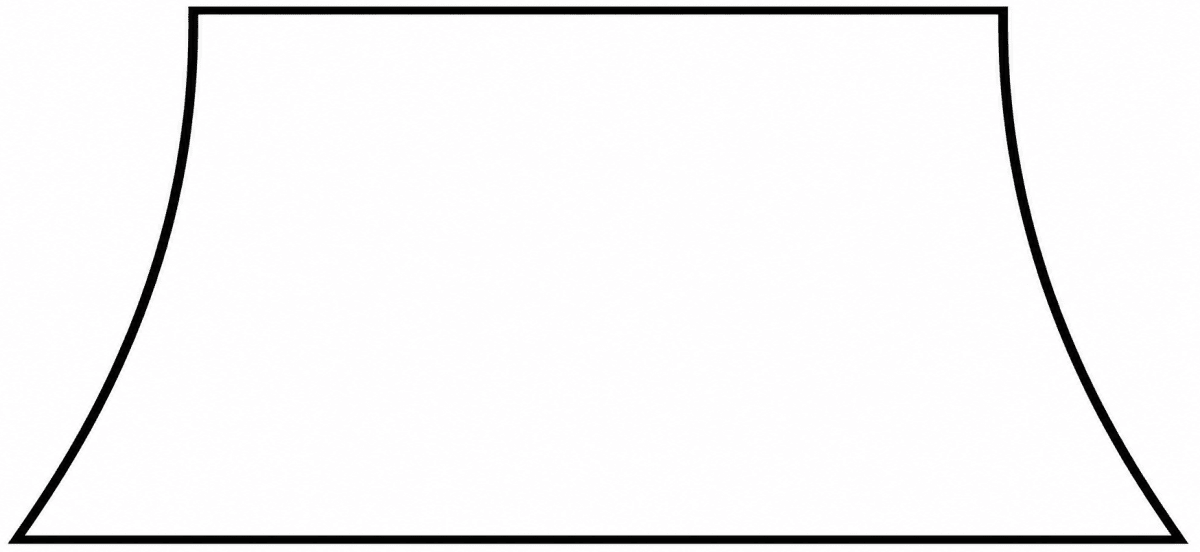
(a) Identify the lens.
(b) Justify your answer in (a) above.
Answer
(a) It is a concave (diverging) lens.
(b) The lowest part of the lens behaves like a small prism. From the diagram, this part is thicker at its lower edge and thinner at its upper edge, i.e., the base of this prism points away from the principal axis of the lens.
This means that as we move from the lower edge of the lens towards its middle, the lens becomes thinner. A lens which is thin at the middle and thick at the edges is a concave lens. Further, since each prism-like part bends the light towards its base, i.e., away from the principal axis, the lens diverges the incident light. Hence it is a concave lens.
(a) Why are thick wires used to carry current in high power appliances such as electric heaters and radiators?
(b) Name a device used to protect the electric circuits from overloading and short circuits.
Answer
(a) High power appliances such as heaters and radiators draw a large current. Since the resistance of a wire is inversely proportional to its area of cross-section, a thick wire has a large area of cross-section and hence a low resistance. Therefore the heat produced (H = I2Rt) in a thick wire is small and it can carry a heavy current without getting over-heated, so there is no danger of the insulation burning or of a fire.
(b) A fuse (or a miniature circuit breaker, MCB) is used to protect the electric circuits from overloading and short circuits.
The diagram below shows a socket in which the switch is ON.
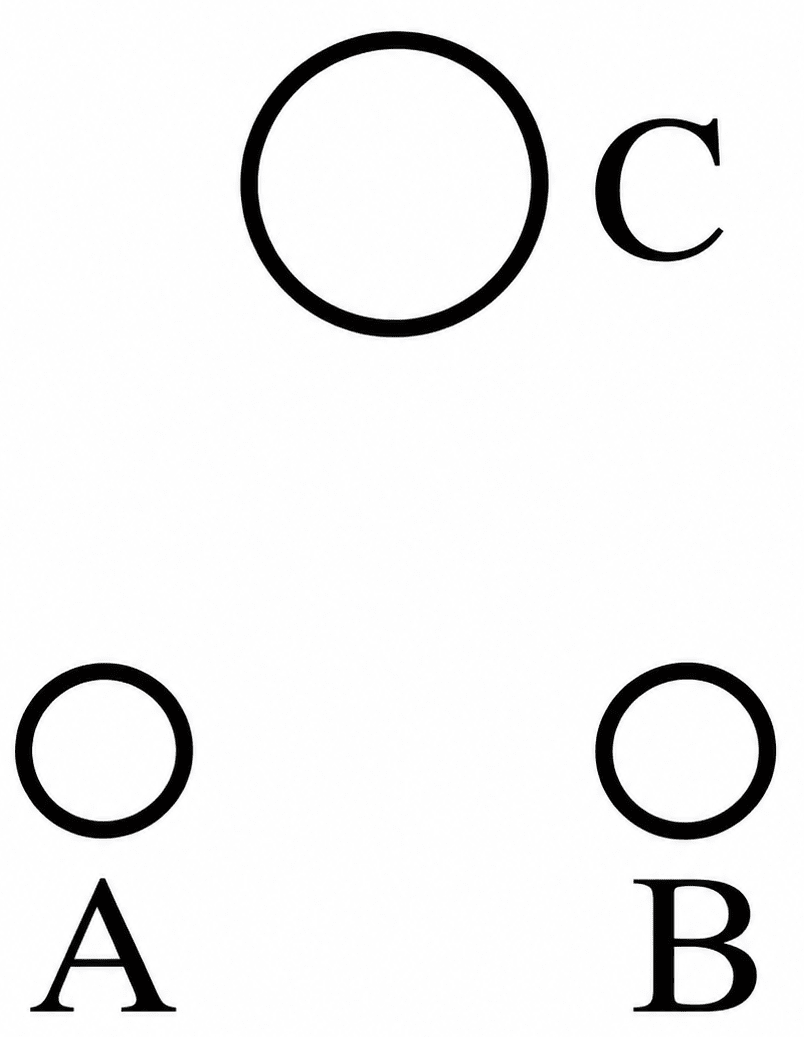
Will the bulb glow if:
(a) it is connected across B and C?
(b) it is connected across A and C?
Answer
In a three pin socket, the upper bigger hole is for the earth wire, the hole on the right side is for the live wire and the hole on the left side is for the neutral wire.
So here, C is earth, B is live and A is neutral.
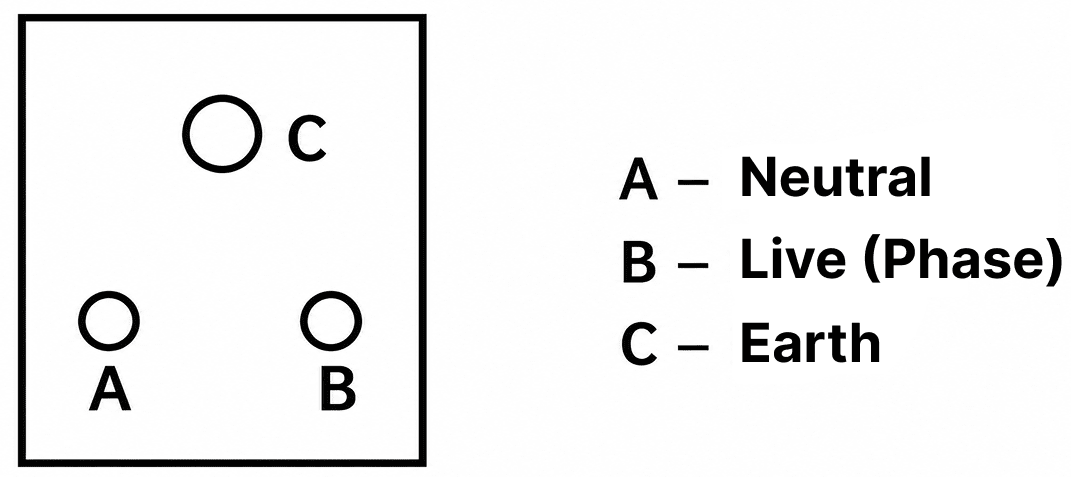
(a) Yes, the bulb will glow.
Reason — The live wire B is at a high potential (220 V) while the earth wire C is at zero potential, so there is a potential difference of 220 V across the bulb and a current flows through it.
(b) No, the bulb will not glow.
Reason — Both the neutral wire A and the earth wire C are at zero potential, so there is no potential difference across the bulb and hence no current flows through it.
The temperatures of two liquids are 80°C and 20°C. When they are mixed in the mass ratio of 8:5, the temperature of the mixture becomes 60°C. Calculate the ratio of their specific heat capacities. (Neglecting heat lost to the surroundings)
Answer
Given,
- Temperature of hot liquid = 80 °C
- Temperature of cold liquid = 20 °C
- Temperature of mixture = 60 °C
- Ratio of masses m1 : m2 = 8 : 5
Let the masses be m1 = 8m and m2 = 5m, and their specific heat capacities be c1 and c2 respectively.
Heat energy lost by the hot liquid = m1 x c1 x (80 - 60) = 8m x c1 x 20 = 160 m c1
Heat energy gained by the cold liquid = m2 x c2 x (60 - 20) = 5m x c2 x 40 = 200 m c2
By the principle of calorimetry,
Heat energy lost by the hot liquid = Heat energy gained by the cold liquid
Hence, the ratio of their specific heat capacities is 5 : 4.
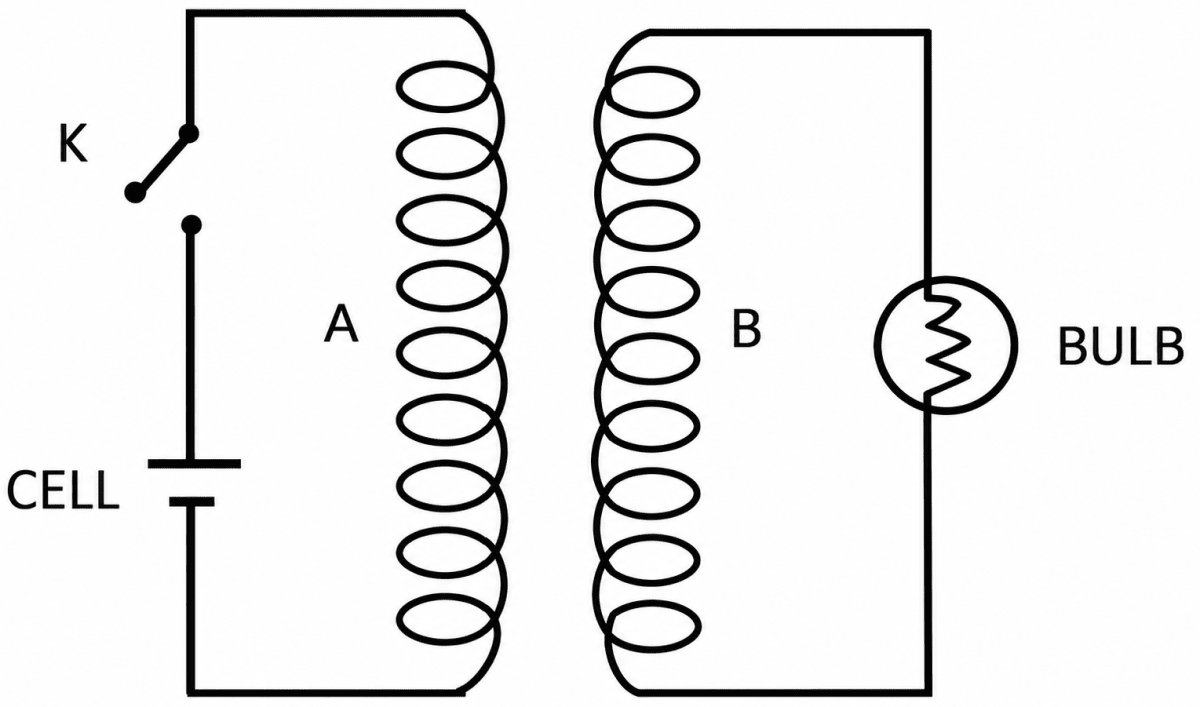
In the given figure, a cell is connected to a coil A and a bulb is connected to coil B.
(a) Fill in the blank.
When the key 'K' is closed, then the ............... [bulb glows continuously / bulb glows only for a moment].
(b) Support your answer to (a) above with a suitable reason.
Answer
(a) When the key 'K' is closed, then the bulb glows only for a moment.
(b) On closing the key, the current in coil A grows from zero to its maximum value. During this short interval the magnetic flux linked with coil B changes, so an e.m.f. is induced in coil B and an induced current flows through the bulb, making it glow.
Once the current in coil A becomes steady, the magnetic flux linked with coil B no longer changes. Hence no e.m.f. is induced, no current flows in coil B and the bulb stops glowing.
A uranium nucleus (92U235) undergoes an alpha emission followed by 2 beta emissions.
Calculate the atomic number and mass number of the daughter nucleus formed.
Answer
Given,
- Atomic number of uranium (Z) = 92
- Mass number of uranium (A) = 235
On emission of one α-particle — the atomic number decreases by 2 and the mass number decreases by 4.
Atomic number = 92 - 2 = 90
Mass number = 235 - 4 = 231
On emission of two β-particles — the atomic number increases by 1 for each β-particle and the mass number remains unchanged.
So, for emission of two β-particles:
Atomic number = 90 + 2 = 92
Mass number = 231
Hence, the daughter nucleus has atomic number 92 and mass number 231.
Two beakers A and B contain kerosene oil and water respectively. The speed of light in water is 2.25 x 10⁸ ms-1 and in kerosene oil 2.15 x 10⁸ ms-1.
(a) In which liquid will the angle of refraction be more, when light ray strikes the surface of both liquids at the same angle of incidence?
(b) Calculate the ratio of refractive indices of water to kerosene oil.
(c) If liquid A is heated, what change will you expect in the path of the refracted ray?
Answer
(a) The angle of refraction will be more in water (beaker B).
Reason — The refractive index of a medium is:
Since the speed of light in water is greater than that in kerosene oil,
μ water μ kerosene
For the same angle of incidence, light bends less towards the normal in the optically rarer medium. Therefore, the angle of refraction is greater in water (beaker B).
(b) Given,
- Speed of light in water (vw) = 2.25 x 10⁸ m s-1
- Speed of light in kerosene oil (vk) = 2.15 x 10⁸ m s-1
As, refractive index of a medium =
Then,
Hence, the ratio of the refractive indices of water to kerosene oil is 43 : 45.
(c) Liquid A is kerosene oil. On heating, the refractive index of kerosene oil decreases. Therefore the light ray bends less towards the normal, i.e., the angle of refraction increases and the refracted ray shifts away from the normal.
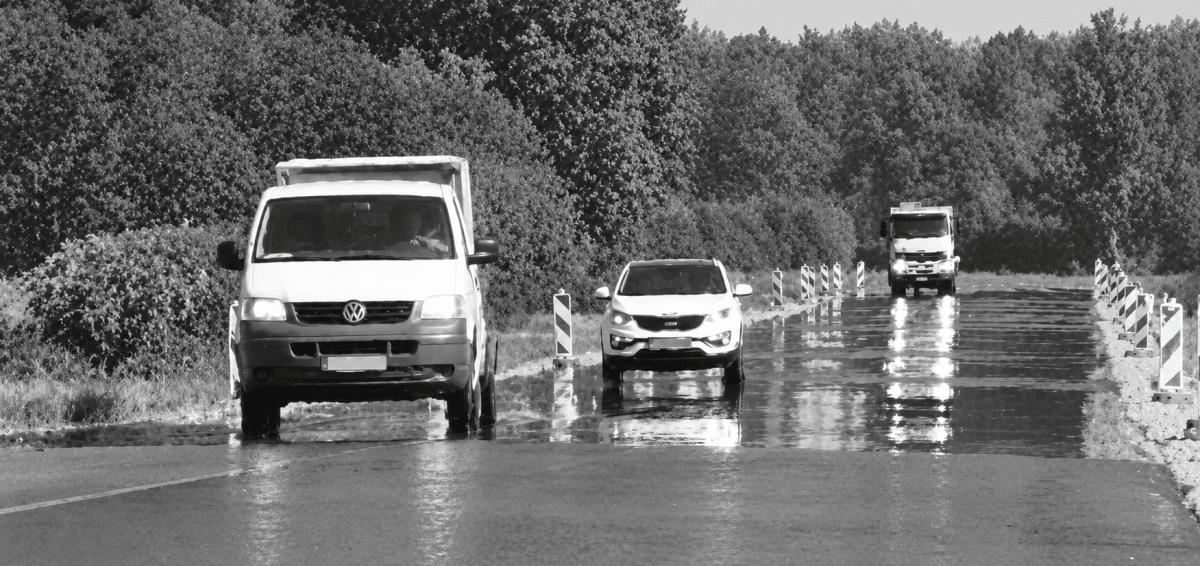
Rohit is travelling by a car through a highway on a hot summer afternoon. The road in front of him appears momentarily wet as shown in the picture below.
(a) Name and define the phenomenon responsible for this.
(b) Provide another example that demonstrates the same phenomenon.
Answer
(a) The phenomenon is Total internal reflection.
Total internal reflection is the phenomenon in which a ray of light travelling from an optically denser medium to an optically rarer medium is completely reflected back into the denser medium when the angle of incidence is greater than the critical angle.
On a hot afternoon the air near the road is hot and rarer, while the air above it is cooler and denser. Light coming from the sky travels from the denser upper layers to the rarer lower layers, bending away from the normal at each layer, until it strikes a layer at an angle greater than the critical angle. It is then totally internally reflected and reaches the driver's eye from below, so the driver sees the image of the sky on the road and the road appears wet.
(b) A diamond sparkles because of total internal reflection.
In the diagram given below, a concave (L1) and a convex (L2) lens of focal lengths 20 cm and 12 cm respectively are placed parallel to each other such that they have a common principal axis. Study the path of the ray through the lenses.
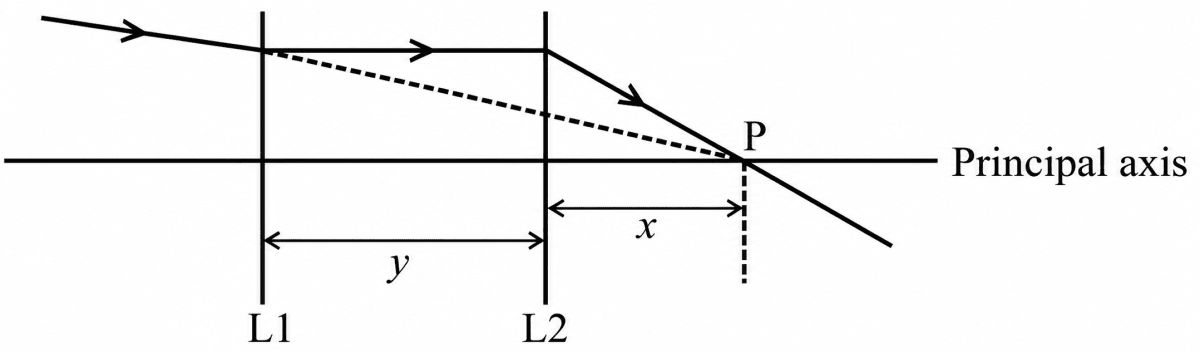
(a) Calculate the lengths of 'x' and 'y'.
(b) Define point P with respect to the concave lens (L1).
Answer
Given,
- Focal length of the concave lens L1 = 20 cm
- Focal length of the convex lens L2 = 12 cm
(a) Length x :
From the diagram, the ray travelling between the two lenses is parallel to the principal axis. A ray of light incident parallel to the principal axis of a convex lens passes, after refraction, through its second focal point.
Hence P is the second focal point of the convex lens L2, so
x = focal length of L2 = 12 cm
Length y :
The dotted line in the diagram shows that the ray incident on the concave lens L1 is directed towards the point P. After refraction through L1 this ray becomes parallel to the principal axis. This happens only when the incident ray is directed towards the first focal point of the concave lens.
Hence P is the first focal point of L1, so
Distance of P from L1 = focal length of L1 = 20 cm
Then,
y + x = 20
⇒ y = 20 - x = 20 - 12 = 8 cm
Hence, x = 12 cm and y = 8 cm.
(b) With respect to the concave lens L1, the point P is its first focal point (first focus) i.e., the point on the principal axis of the lens such that the incident rays of light appearing to meet at it become parallel to the principal axis after refraction through the lens.
(a) In an experiment to find the refractive index of glass, if yellow light is replaced by green light, then how will the refractive index of the glass change? Give a reason in support of your answer.
(b) What is the value of angle of deviation, when light ray falls normally on the surface during refraction?
(c) Is it possible to have a critical angle of water with respect to glass? (Write YES or NO)
Answer
(a) The refractive index of the glass will increase.
Reason — The refractive index of a medium increases as the wavelength of light decreases. Green light has a shorter wavelength than yellow light, so the refractive index of glass for green light is greater than that for yellow light.
(b) The angle of deviation is 0° (zero), because a ray falling normally on the surface is incident along the normal, so it passes into the second medium undeviated.
(c) NO
Reason — A critical angle exists only when light travels from a denser medium to a rarer medium. Here the light would travel from water to glass, i.e., from a rarer medium to a denser medium, so total internal reflection is not possible and there is no critical angle.
The diagram given below shows refraction of white light through a rectangular glass block.
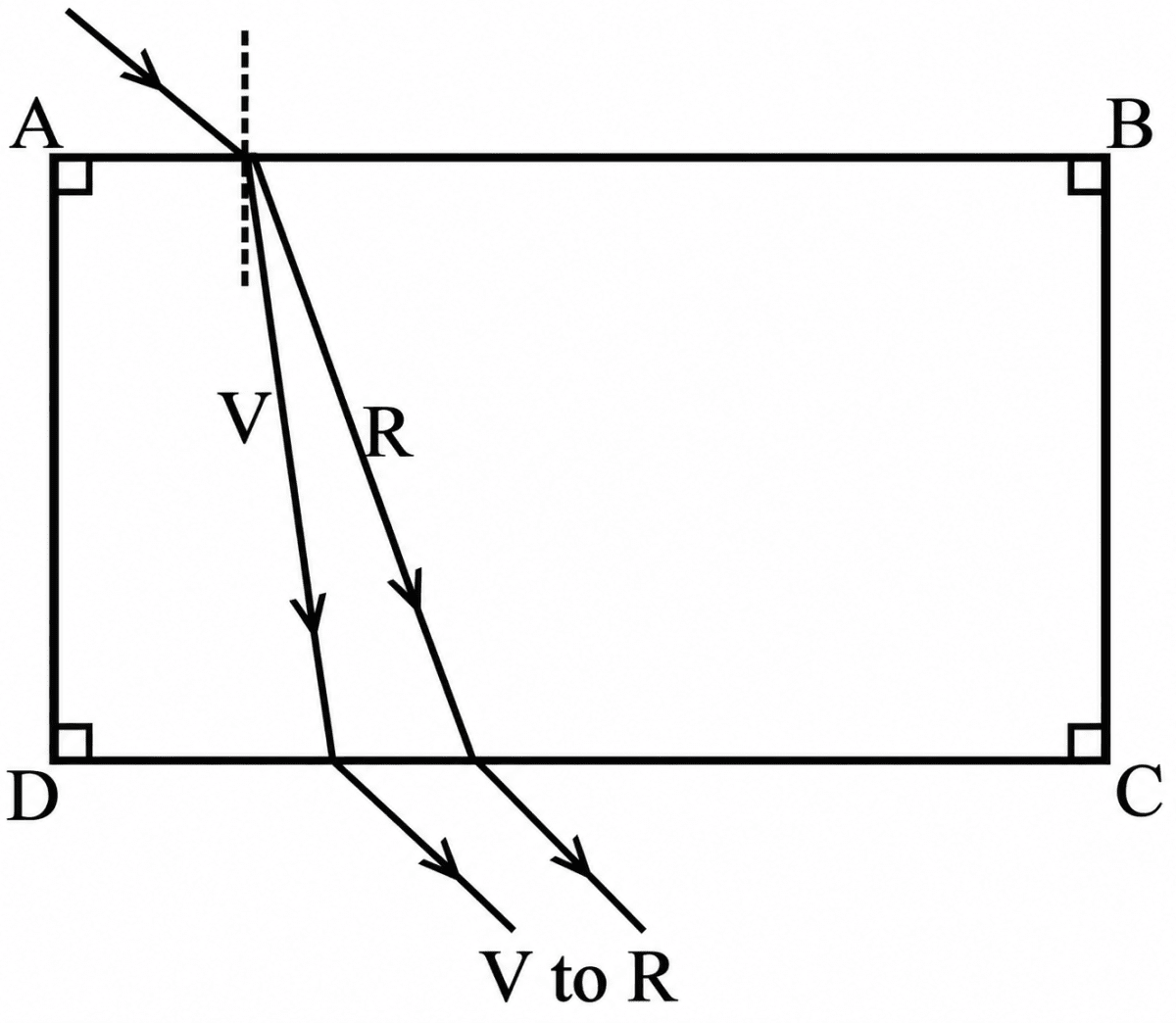
(a) Name the two phenomena taking place at the surface AB.
(b) With a reason state whether one can see these colours when seen from the side DC.
Answer
(a) The two phenomena taking place at the surface AB are :
- Refraction of light, and
- Dispersion of light.
(b) No, the separate colours cannot be seen when viewed from the side DC.
Reason — The two refracting surfaces AB and DC of a rectangular glass block are parallel to each other. At the first surface AB the colours get separated because each colour is deviated by a different amount. At the second surface DC, each colour is refracted in such a way that its emergent ray becomes parallel to the incident ray, so no further separation of colours takes place as it does in a prism. Hence the emergent coloured rays are parallel to one another and are so close together that they overlap, and the emergent light appears almost white.
The graph given below shows the change in temperature with time, when a substance is cooled.
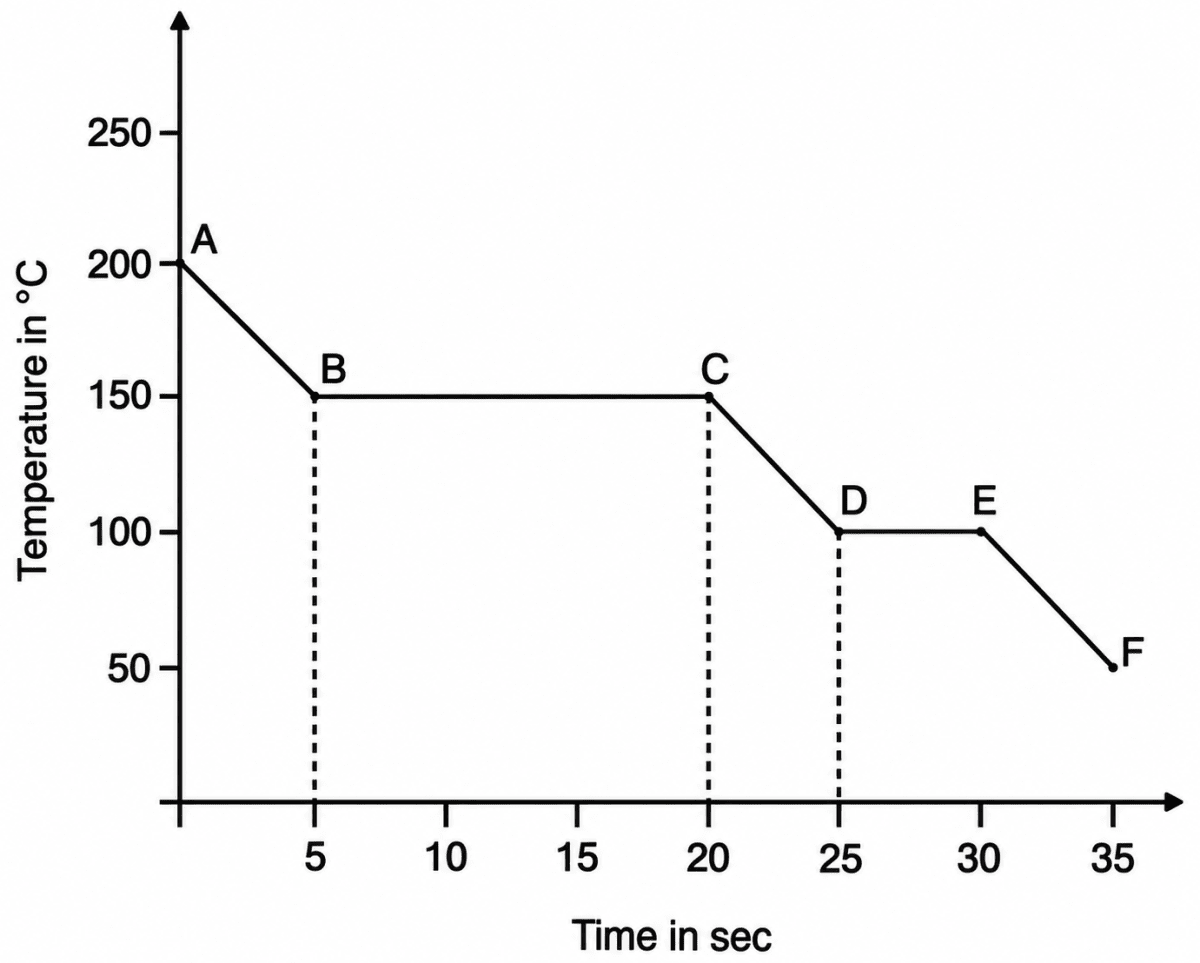
(a) State the boiling point of the substance.
(b) What is the phase change occurring in the region DE?
(c) State the range of temperature during which the substance is in liquid state.
Answer
(a) The temperature remains constant at 150 °C along the portion BC of the graph, during which the substance condenses from vapour to liquid.
Hence, the boiling point of the substance is 150 °C.
(b) Along DE the temperature remains constant at 100 °C while the substance is still giving out heat. Hence in the region DE the substance changes from the liquid state to the solid state, i.e., it is freezing (solidification).
(c) The substance is completely a liquid from the end of condensation (point C, at 150 °C) up to the beginning of freezing (point D, at 100 °C).
Hence, the substance is in the liquid state in the temperature range 150 °C to 100 °C.
280 g of ice at 0°C is mixed with 600 g of water at 50°C present in a metal container of mass 300 g.
If the final temperature of the mixture is 10°C. Assuming no loss of heat to the atmosphere, calculate the specific heat capacity of the metal container.
(Specific latent heat of ice is 336 J g-1,
Specific heat capacity of water is 4.2 J g-1 K-1)
Answer
Given,
- Mass of ice (m1) = 280 g at 0 °C
- Mass of water (m2) = 600 g at 50 °C
- Mass of the metal container (m3) = 300 g at 50 °C
- Final temperature of the mixture = 10 °C
- Specific latent heat of ice (L) = 336 J g-1
- Specific heat capacity of water (cw) = 4.2 J g-1 K-1
Let the specific heat capacity of the metal container be c.
Heat energy gained by the ice :
Heat used in melting the ice = m1 x L = 280 x 336 = 94080 J
Heat used in raising the temperature of the melted water from 0 °C to 10 °C
= m1 x cw x ΔT
= 280 x 4.2 x 10
= 11760 J
Total heat energy gained = 94080 + 11760 = 105840 J
Heat energy lost by the water and the container :
Heat lost by water = m2 x cw x ΔT
= 600 x 4.2 x (50 - 10)
= 600 x 4.2 x 40
= 100800 J
Heat lost by the container = m3 x c x ΔT
= 300 x c x 40
= 12000 c
By the principle of calorimetry,
Heat energy gained = Heat energy lost
Hence, the specific heat capacity of the metal container is 0.42 J g-1 K-1.
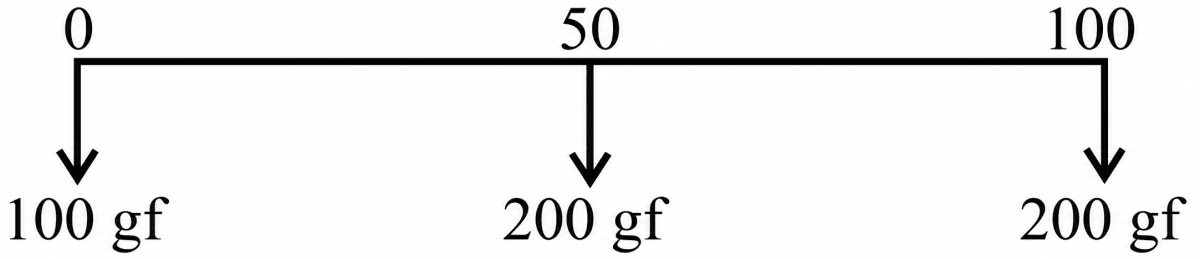
Observe the diagram of a uniform metre scale of mass 200 g given below. Weights of 200 gf and 100 gf are suspended from its ends. At which marking will the ruler be balanced?
Answer
Given,
- Weight suspended at the 0 cm mark = 100 gf
- Weight of the uniform metre scale = 200 gf, acting at its centre of gravity i.e., at the 50 cm mark
- Weight suspended at the 100 cm mark = 200 gf
Let the ruler be balanced when the knife edge is placed at the x cm mark.
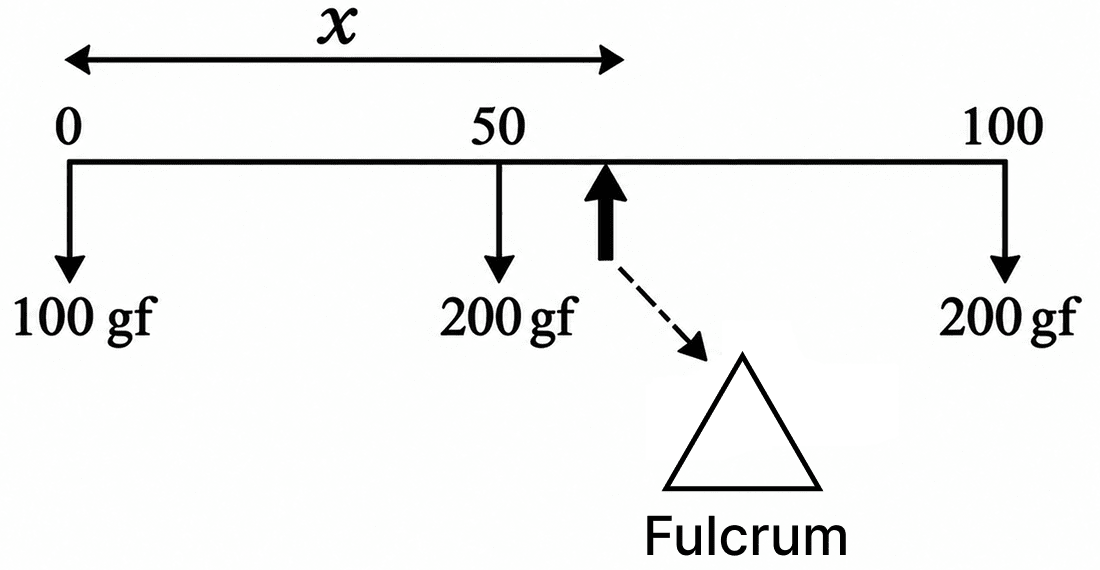
Taking moments about the knife edge,
Anticlockwise moments (due to the forces to the left of the knife edge)
= 100 x (x - 0) + 200 x (x - 50)
Clockwise moment (due to the force to the right of the knife edge)
= 200 x (100 - x)
By the principle of moments,
Anticlockwise moments = Clockwise moment
Hence, the ruler will be balanced at the 60 cm mark.
A constant force F acts on a horizontal uniform ruler AB at point A.
Case 1. The ruler is pivoted at the end B.
Case 2. Ruler is not pivoted.
(a) In which case is the moment of force greater? (Case 1 or Case 2)
(b) Give a reason for your answer in (a) above.
(c) In which case does the ruler exhibit both translational and rotational motion simultaneously? (Case 1 or Case 2)
Answer
(a) The moment of force is greater in Case 1.
(b) Reason — The moment of a force is the product of the force and the perpendicular distance of its line of action from the axis of rotation.
In Case 1, the ruler turns about the pivot at the end B, so the perpendicular distance of the force F at A from the axis is the whole length AB.
In Case 2, the ruler is free, so it turns about its centre of gravity which lies at the middle of the uniform ruler. Hence the perpendicular distance is only .
Since the force F is the same in both cases and the perpendicular distance in Case 1 is twice that in Case 2, the moment of force is greater in Case 1.
(c) The ruler exhibits both translational and rotational motion simultaneously in Case 2, because the ruler is free to move, so the force makes its centre of gravity move forward (translational motion) and at the same time turns the ruler about the centre of gravity (rotational motion).
(a) Derive a relation between mechanical advantage (MA), velocity ratio (VR) and efficiency (η).
(b) A stapler of Class III lever is used to staple papers.
Is this lever a speed multiplier or a force multiplier?
Give a reason for your answer to (1).
Answer
(a) Let a machine overcome a load L by the application of an effort E. In the process, let the displacement of the effort be dE and the displacement of the load be dL.
Then,
Work input = effort x displacement of effort = E x dE ...(i)
Work output = load x displacement of load = L x dL ...(ii)
By definition,
From eqns. (i) and (ii),
But,
= M.A. and = V.R.
Thus, the mechanical advantage of a machine is equal to the product of its efficiency and velocity ratio.
(b)
It is a speed multiplier.
Reason — In a class III lever the effort is applied in between the fulcrum and the load, so the effort arm is always shorter than the load arm. Hence its mechanical advantage and velocity ratio are always less than 1. Such a lever does not give a gain in force, but it gives a gain in speed, i.e., a larger displacement of the load is obtained by a smaller displacement of the effort.
A block and tackle system of pulleys has a Velocity Ratio (VR) = 5. Draw a labelled diagram of the system indicating clearly the direction of tension, load and effort.
Answer
As, in a block and tackle system,
V.R. = total number of pulleys used in both the blocks
So, for V.R. = 5, a total of five pulleys are needed. For the convenience of applying the effort in the downward direction, the upper (fixed) block is given three pulleys and the lower (movable) block is given two pulleys, and one end of the string is tied to the hook of the lower (movable) block.
The labelled diagram of the system is shown below :
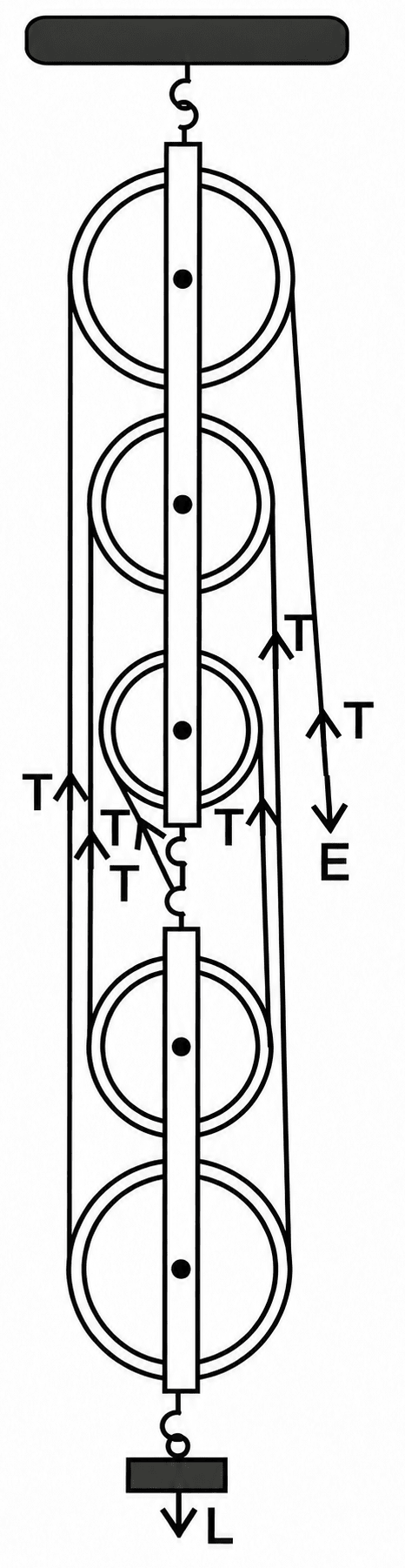
Here, the load L is attached to the hook of the lower movable block and the effort E is applied at the free end of the string in the downward direction. The tension T is the same all along the string, and the load is supported by the tension in the five segments of the string, so
L = 5T and E = T
It is observed during an earthquake, that the short period seismic waves damage low rise buildings while long period waves damage high rise buildings.
(a) Name the phenomenon responsible for the damage of the buildings.
(b) Why do long period seismic waves damage high rise buildings?
Answer
(a) Resonance.
(b) A high rise building is tall, so its natural time period of vibration is large (i.e., its natural frequency is low). When long period seismic waves reach such a building, the time period of these waves becomes equal to the natural time period of the building. The building therefore vibrates under resonance and the amplitude of its vibration becomes very large, so the building gets damaged.
A person standing between two vertical cliffs produces a sound and hears the first echo after 3 s. If the distance between the cliffs is 1760 m, then after how much time will he hear the second echo? (The speed of sound = 320 ms-1)
Answer
Given,
- Time after which the first echo is heard (t1) = 3 s
- Distance between the two cliffs = 1760 m
- Speed of sound (v) = 320 m s-1
The first echo is heard from the nearer cliff.
Let the distance of the person from the nearer cliff be d1.
Then,
Distance of the person from the farther cliff (d2) = 1760 - 480 = 1280 m
Let the second echo be heard after time t2.
Hence, he will hear the second echo 8 s after producing the sound, i.e., 5 s after the first echo.
Observe the circuit diagram given below.
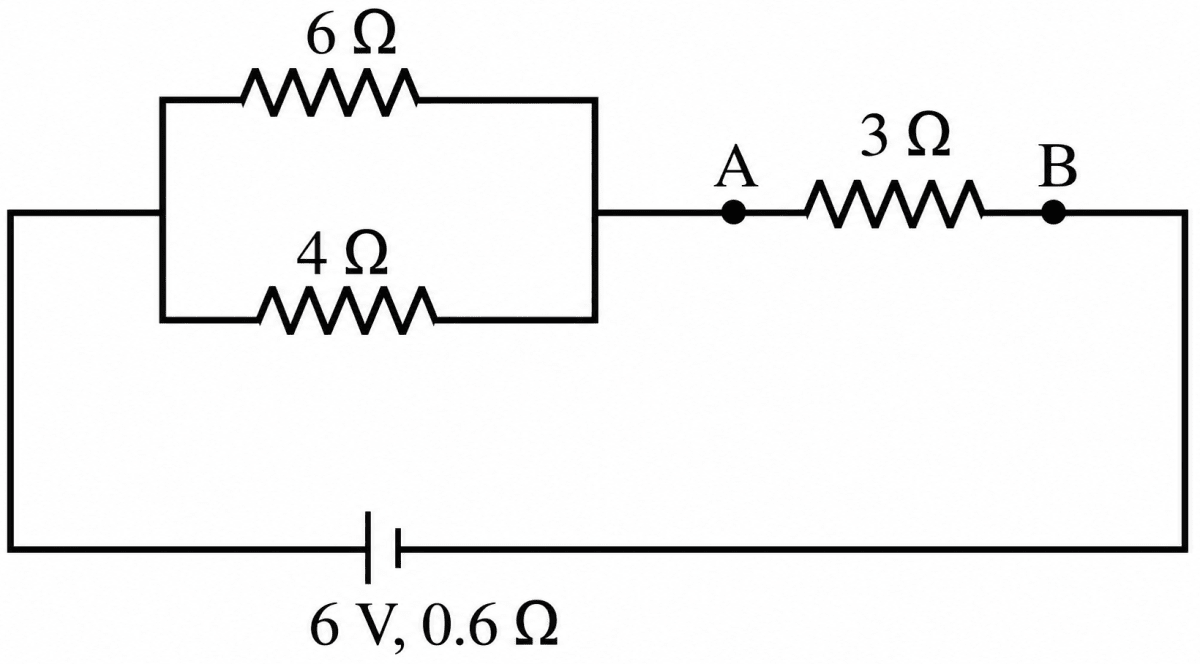
Calculate the current:
(a) through 3Ω resistor.
(b) drawn from the cell when the 3Ω resistance is replaced by a connecting wire of negligible resistance.
Answer
Given,
- E.m.f. of the cell (ε) = 6 V
- Internal resistance of the cell (r) = 0.6 Ω
- Resistances in parallel = 6 Ω and 4 Ω
- Resistance in series = 3 Ω
Let the resultant of the two parallel resistances be RP.
(a) Now RP is in series with the 3 Ω resistor and the internal resistance of the cell.
Total resistance of the circuit (RS) = 2.4 + 3 + 0.6 = 6 Ω
Current drawn from the cell = = 1 A
Since the 3 Ω resistor is in series with the cell, the whole of this current passes through it.
Hence, the current through the 3 Ω resistor is 1 A.
(b) When the 3 Ω resistance is replaced by a connecting wire of negligible resistance,
Total resistance of the circuit = 2.4 + 0.6 = 3 Ω
Current drawn from the cell = = 2 A
Hence, the current drawn from the cell is 2 A.
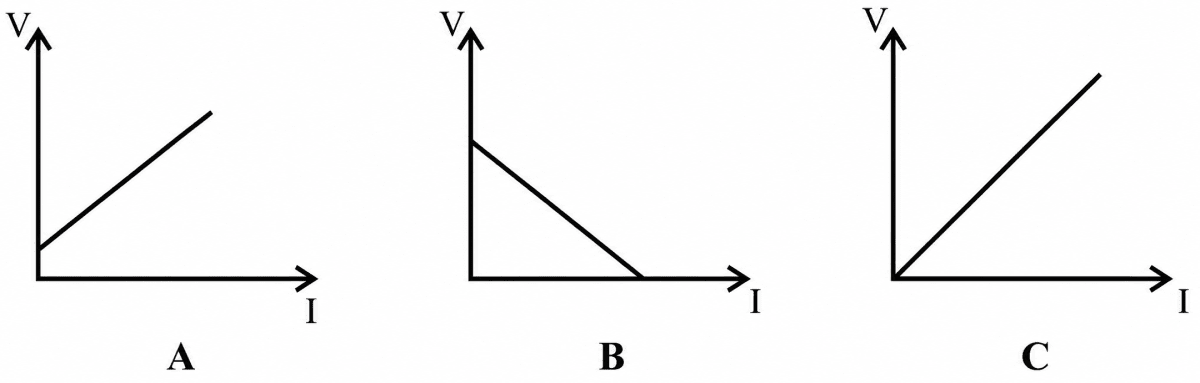
(a) Which of the following graphs (A, B or C) shows the correct relation between Potential difference (V) and Current (I) for an Ohmic resistor? Give a reason for your answer.
(b) Give an example of an Ohmic resistor.
Answer
(a) Graph C shows the correct relation.
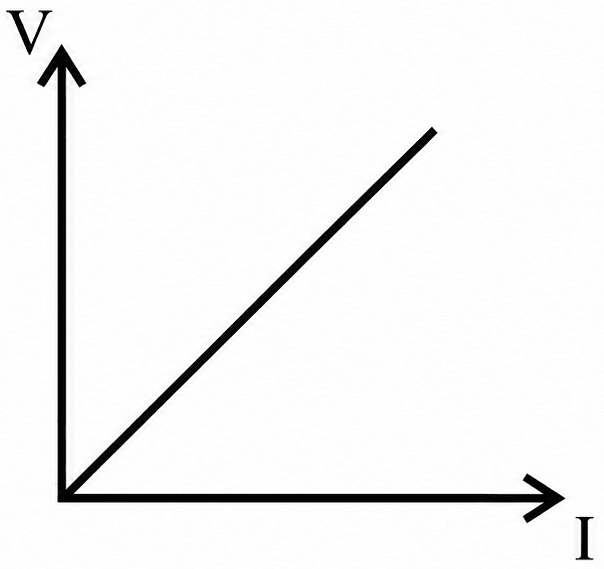
Reason — An ohmic resistor obeys Ohm's law, according to which the potential difference across the resistor is directly proportional to the current flowing through it (V ∝ I), provided the physical conditions remain unchanged. A directly proportional relation is represented by a straight line passing through the origin, which is the case only in graph C.
In graph A the line is straight but it does not pass through the origin, and in graph B the potential difference decreases with increase in current. Hence neither A nor B represents an ohmic resistor.
(b) All metallic conductors are ohmic resistors, for example a copper wire (or a resistor made of an alloy such as manganin or constantan).
(a) Ravi wants to install a fuse to the circuit of an oven and wants to control the oven from two different locations. Shown below is the circuit diagram which he used.
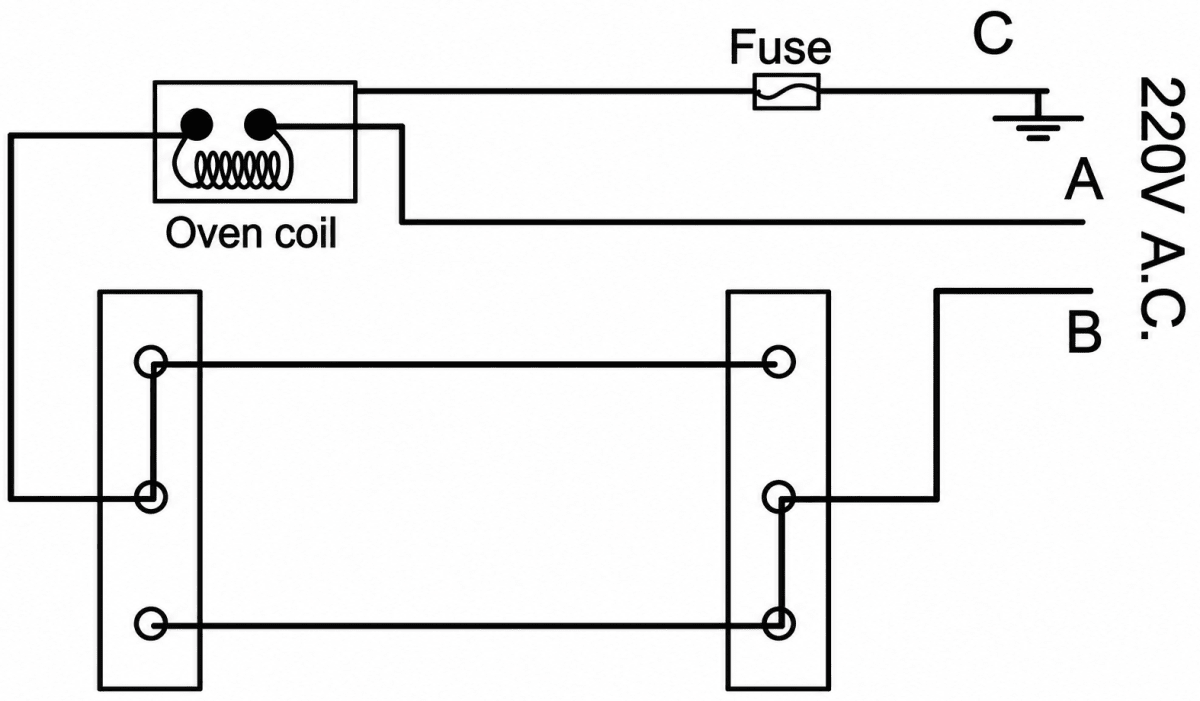
Which one of the two, A or B, should be a live wire? Why?
In the event of an overload, will the fuse serve its purpose?
(b) What does the statement 'A bulb is rated 600W, 220 V' mean?
Answer
(a) 1. B should be the live wire.
Reason — From the diagram, the two dual control (two-way) switches used to operate the oven from two different places are connected in the wire that leads to the terminal B. A switch must always be connected in the live wire, so that when the oven is switched off, it gets disconnected from the high potential point of the supply and it is then safe to touch the appliance. If the switches were in the neutral wire, the oven would remain connected to the live wire even when switched off, which is dangerous.
- No, the fuse will not serve its purpose.
Reason — In the given circuit the fuse has been connected in the wire joining the metal body of the oven to the earth terminal C, and not in the live wire. During an overload, the excessive current flows through the live wire and the oven coil, while the earth wire normally carries no current. Hence this fuse will not melt and the circuit will not be broken. A fuse is always connected in the live wire before the appliance, so that when the current exceeds the rated value, the fuse melts and prevents the heavy current from reaching the appliance.
(b) The statement 'A bulb is rated 600 W, 220 V' means that if the bulb is connected across a supply of 220 V, it will consume 600 W of electrical power, i.e., it will consume 600 joule of electrical energy in one second.
The diagram given below shows two bulbs rated 40 W, 12 V each.
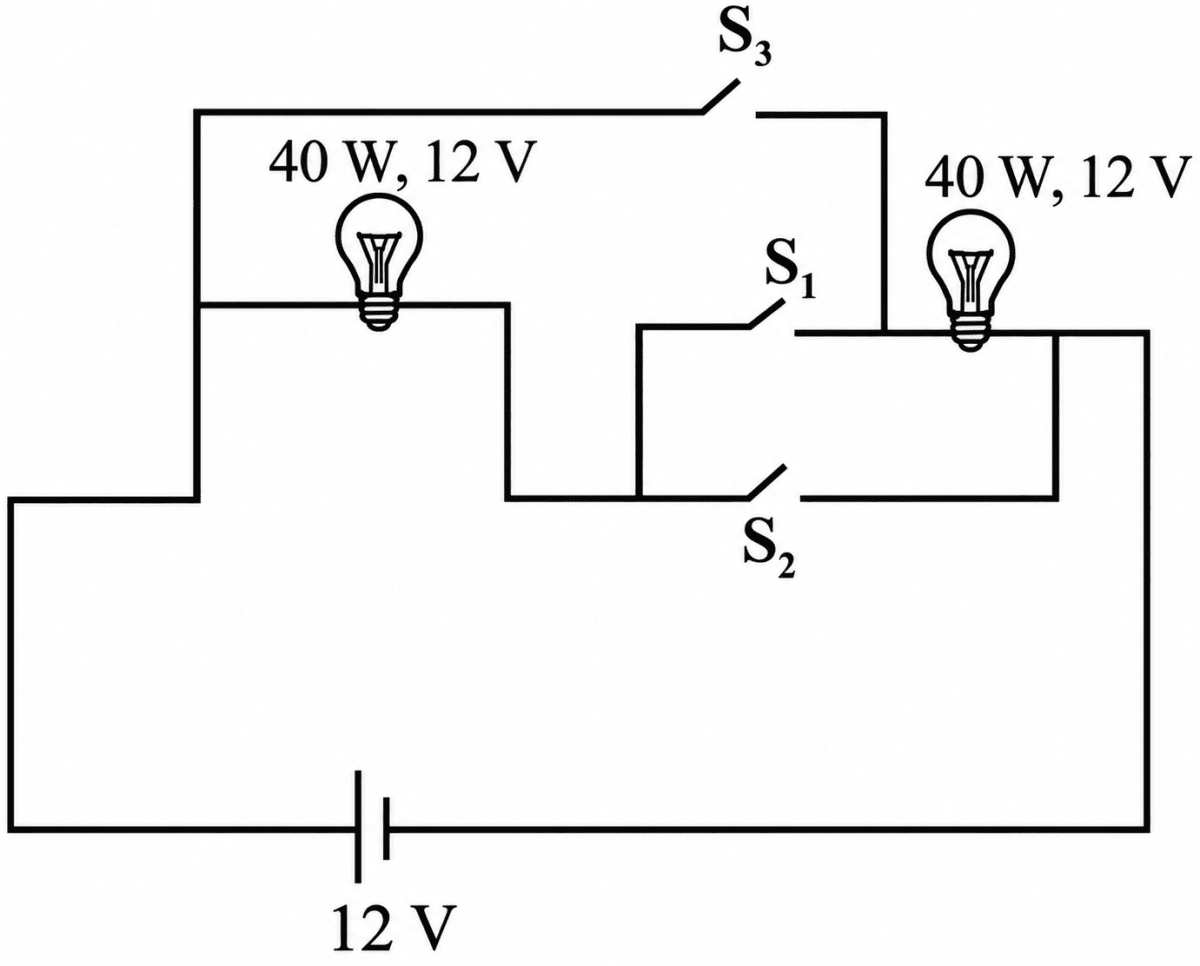
(a) Calculate the resistance of a bulb.
(b) What is the total power consumed by the circuit:
when S1 is closed and S2 and S3 are open?
when S1 is open and S2 and S3 are closed?
Answer
Given,
- Power rating of each bulb (P) = 40 W
- Voltage rating of each bulb (V) = 12 V
- E.m.f. of the battery = 12 V
(a) As,
Hence, the resistance of each bulb is 3.6 Ω.
(b) 1. When S1 is closed and S2 and S3 are open :
The current flows from the battery through the first bulb, then through the closed switch S1 and then through the second bulb. Hence the two bulbs are connected in series across the 12 V battery.
Total resistance (Rs) = 3.6 + 3.6 = 7.2 Ω
Total power consumed = = 20 W
Hence, the total power consumed by the circuit is 20 W.
- When S1 is open and S2 and S3 are closed :
The closed switch S3 provides a path from one terminal of the battery directly to the second bulb, and the closed switch S2 provides a path from the first bulb directly to the other terminal of the battery. Hence each bulb now gets connected directly across the 12 V battery, i.e., the two bulbs are connected in parallel.
So, total resistance:
Total power consumed = = 80 W
Hence, the total power consumed by the circuit is 80 W.
(a) Draw a diagram showing the magnetic lines of force around the straight wire carrying current.
(b) What will be the effect on the magnetic field if the current through the wire increases?
Answer
(a) The magnetic lines of force around a straight wire carrying current are concentric circles, lying in a plane perpendicular to the wire, with their centres on the wire, as shown below :
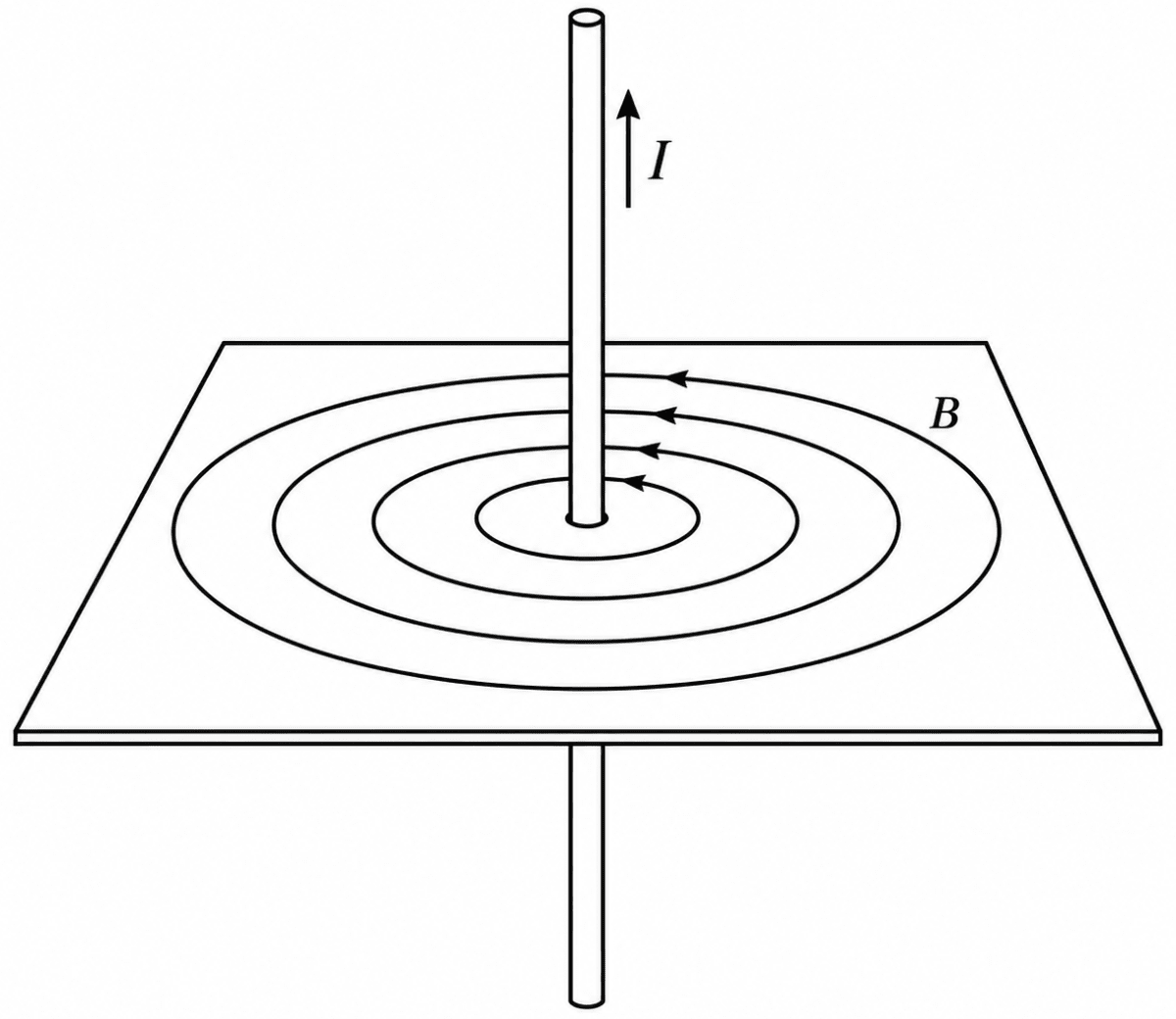
(b) On increasing the current through the wire, the strength of the magnetic field increases. The magnetic field lines become denser (i.e., more crowded) near the wire, and the field remains effective up to a larger distance from the wire.
Scientists unearthed an ancient scroll for determining the age of a fossil. The process involved collecting 6C14 from the fossil and comparing it with a fresh sample. Scientist found that the ratio of 6C14 : 6C12 decreased as compared to the fresh sample.
(a) Name the process.
(b) 6C14 and 6C12 are collectively known as ...............
(c) Why did the ratio decrease in the fossil?
(d) Complete the equation by filling the blanks:
...............X............... + 0n1 ⟶ 6C14 + 1P1
Answer
(a) The process is called carbon dating.
(b) 6C14 and 6C12 are collectively known as isotopes (of carbon).
(c) 6C14 is radioactive and it goes on decaying into nitrogen by the emission of β-particles, while 6C12 is stable and its amount does not change.
While the organism is alive, it keeps taking in carbon from its surroundings, so the ratio 6C14 : 6C12 in it remains the same as in a fresh sample. After its death this intake stops, so the 6C14 present in it goes on decreasing due to decay while the 6C12 remains unchanged. Hence in the fossil the ratio 6C14 : 6C12 is less than that in a fresh sample.
(d) In a nuclear reaction, the mass number and the atomic number are conserved on both sides.
Let the atomic number of X be Z and its mass number be A.
Equating the mass numbers :
A + 1 = 14 + 1
⇒ A = 14
Equating the atomic numbers :
Z + 0 = 6 + 1
⇒ Z = 7
The element with atomic number 7 is nitrogen (N).
Hence, the complete equation is 7N14 + 0n1 ⟶ 6C14 + 1P1.