
Study the image given below.
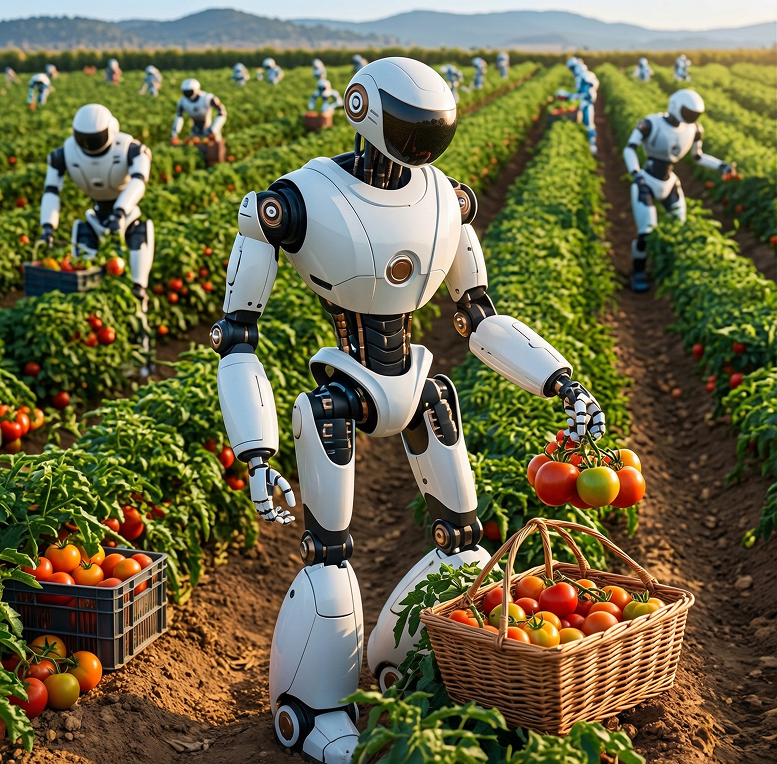
In which field is this robot used?
- Defence
- Agriculture
- Medicine
- Entertainment
Answer
Agriculture
Reason — The figure shows a robot used in agricultural fields. Such robots are designed to perform tasks like planting seeds, harvesting crops, spraying fertilizers or pesticides, and monitoring crop health.
............... is an example of deterministic computing.
- Traffic light sequencing
- Autonomous driving
- Stock market prediction
- Face recognition
Answer
Traffic light sequencing
Reason — In traffic light sequencing, the signals change in a fixed order (red → yellow → green) based on predefined time intervals. For a given input condition, the output is always the same and predictable. Hence, it follows a definite set of rules and produces consistent results, making it an example of deterministic computing.
A room heater is an example of a/an:
- gear
- robot
- actuator
- machine
Answer
machine
Reason — A room heater is a machine because it uses electrical energy to do useful work by producing heat energy.
Tinkercad is commonly used for:
- simulating robotic movements.
- data encryption.
- performing gear ratio calculations only.
- building operating systems.
Answer
simulating robotic movements.
Reason — Tinkercad is a simulation tool used to design and visualize circuits and robotic systems. It allows users to simulate the working and movements of robots in a virtual environment, which makes it useful for testing and understanding robotic behaviour.
In the block diagram of a robotic control system, the correct sequence is:
- Input → Robot → Controller → Feedback
- Feedback → Input → Controller → Robot
- Input → Controller → Robot → Feedback
- Controller → Input → Robot → Feedback
Answer
Input → Controller → Robot → Feedback
Reason — In a robotic control system, the input is first given to the controller, which processes the data and sends commands to the robot. The robot then performs the required action, and feedback is generated to monitor and adjust the system. Hence, the correct sequence is Input → Controller → Robot → Feedback.
Which of the following is an example of a linear actuator?
- DC motor
- Pneumatic piston
- Arduino
- Electric fan
Answer
Pneumatic piston
Reason — A linear actuator produces motion in a straight line. A pneumatic piston moves back and forth in a linear direction using compressed air, hence it is a linear actuator.
From the following, which function of Python checks whether all characters in a string 's' are alpha numeric?
- s.allnum()
- s.isnumal()
- s.isalnum()
- s.isalphanum()
Answer
s.isalnum()
Reason — The function isalnum() is used to check whether all characters in a string are alphanumeric (i.e., letters and numbers). It returns True if all characters are either alphabets or digits, otherwise it returns False. The other options are incorrect because they are not valid Python string methods.
A motor drives a small gear with 10 teeth which is connected to a larger gear with 40 teeth. What is the gear ratio?
- 4 : 1
- 1 : 4
- 1 : 2
- 2 : 1
Answer
4 : 1
Reason — The driving gear is the gear that receives power directly from the motor and moves first. Here, the motor drives the small gear with 10 teeth, so it is the driving gear.
The driven gear is the gear that is moved by the driving gear. Here, the larger gear with 40 teeth is connected to the small gear and rotates because of it, so it is the driven gear.
The formula for gear ratio is:
Substituting the values:
Hence, the correct answer is 4 : 1.
Which of the following string operators in Python is used to find the length of a string 'a'?
- len(a)
- len()
- a.len()
- a.len(a)
Answer
len(a)
Reason — The function len() is used to find the number of characters in a string. When the string a is passed as an argument, len(a) returns its length.
Unauthorised hardware access leads to:
- loss of data.
- increased computer speed.
- better performance.
- having more data.
Answer
loss of data.
Reason — Unauthorised hardware access can result in tampering, damage, or misuse of devices, which may lead to deletion or corruption of stored data. Hence, it results in loss of data rather than improved performance or increased data.
In machine learning, testing data is primarily used to:
- train the model for better performance.
- measure model performance on unseen data.
- store training parameters.
- provide labels for training.
Answer
measure model performance on unseen data.
Reason — Testing data is used after training the model to evaluate how well it performs on new, unseen data. It helps in measuring the accuracy and effectiveness of the model rather than training it.
The function of a sensor is to:
- detect changes in environment and send signals.
- process the input data and make decisions.
- change electrical energy into motion.
- supply power to the robot.
Answer
detect changes in environment and send signals.
Reason — A sensor is used to detect changes in the environment such as light, temperature or motion and convert them into signals that can be processed by the system.
The purpose of Turing Test is to evaluate:
- memory consumption of a computer.
- the processing speed of computers and humans.
- two computer programs.
- if a machine can exhibit human-like responses.
Answer
if a machine can exhibit human-like responses.
Reason — The Turing Test is used to determine whether a machine can imitate human behaviour in such a way that its responses are indistinguishable from those of a human. Hence, it evaluates the ability of a machine to exhibit human-like responses.
............... software is used to simulate a robotic system.
- LibreOffice
- MS Word
- Tinkercad
- MySQL
Answer
Tinkercad
Reason — Tinkercad is used to design and simulate robotic systems and circuits in a virtual environment. It helps in testing and visualising the working of robots, which makes it suitable for robotic simulation.
Assertion (A): Robots use actuators for movement.
Reason (R): Actuators sense the environment and convert it to electrical signals.
- (A) is true but (R) is false.
- (A) is false but (R) is true.
- Both (A) and (R) are true and (R) is the correct explanation for (A).
- Both (A) and (R) are true but (R) is not the correct explanation for (A).
Answer
(A) is true but (R) is false.
Reason — Robots use actuators to produce movement by converting energy into mechanical action, so the Assertion is true. However, sensing the environment and converting it into electrical signals is the function of sensors, not actuators. Therefore, the Reason is false.
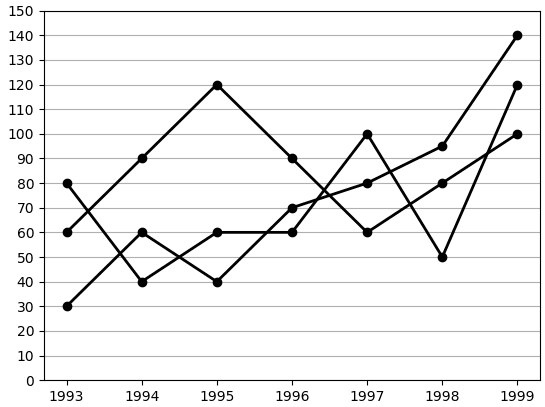
Identify the type of graph shown below:
- Scatter plot
- Bar graph
- Pie chart
- Line graph
Answer
Line graph
Reason — The graph shows data points connected by continuous lines representing changes over a period of time. Such representation of data using connected points is characteristic of a line graph.
In AI problem scoping, "Who" refers to the:
- dataset used for training.
- end users affected by the project.
- programming environment used.
- hardware requirements of the project.
Answer
end users affected by the project.
Reason — In AI problem scoping, "Who" refers to the people or users who will be impacted by or will use the solution. It helps in identifying the target audience and stakeholders of the project.
Give the output of the following Python code:
msg = "Artificial Intelligence"
print(msg[11:14])- tel
- Int
- ell
- gen
Answer
Int
Reason — The given code stores the string "Artificial Intelligence" in the variable msg. Python follows 0-based indexing, where the first character is at index 0.
Index Table:
| Index | Character |
|---|---|
| 0 | A |
| 1 | r |
| 2 | t |
| 3 | i |
| 4 | f |
| 5 | i |
| 6 | c |
| 7 | i |
| 8 | a |
| 9 | l |
| 10 | (space) |
| 11 | I |
| 12 | n |
| 13 | t |
| 14 | e |
| 15 | l |
| 16 | l |
| 17 | i |
| 18 | g |
| 19 | e |
| 20 | n |
| 21 | c |
| 22 | e |
The statement msg[11:14] performs string slicing, where:
- 11 is the starting index (included)
- 14 is the ending index (excluded)
Thus, characters at index 11, 12, and 13 are selected: 'Int'.
Hence, the output is Int.
The keyword used to include a package or module in a Python program is:
- export
- include
- collect
- import
Answer
import
Reason — In Python, the keyword import is used to include a module or package in a program so that its functions and features can be used.
What will be the output of the Python code given below?
x = "BOARD EXAMINATION"
print(x[0:4:2])- BOAR
- BA
- OR
- Error
Answer
BA
Reason — The string "BOARD EXAMINATION" is stored in variable x. Python uses 0-based indexing.
Index Table:
| Index | Character |
|---|---|
| 0 | B |
| 1 | O |
| 2 | A |
| 3 | R |
| 4 | D |
| 5 | (space) |
| 6 | E |
| 7 | X |
| 8 | A |
| 9 | M |
| 10 | I |
| 11 | N |
| 12 | A |
| 13 | T |
| 14 | I |
| 15 | O |
| 16 | N |
The slice x[0:4:2] means:
- Start from index 0
- Go up to index 4 (excluded)
- Take every 2nd character (step = 2)
So selected indices:
→ 0 → B
→ 2 → A
Thus, the output is BA.
Mention any two sensors used in autonomous drones.
Answer
Sensors used in Autonomous Drones:
- GPS sensor
- Ultrasonic sensor
'In a hospital, cobots assist nurses in delivering medicines to patients.'
Give any two advantages of using cobots in hospitals.
Answer
Advantages of using cobots in hospitals:
- They reduce the workload of nurses by assisting in routine tasks like delivering medicines.
- They improve efficiency and accuracy, ensuring timely delivery of medicines to patients.
What is spur gear? Mention one application of spur gear in robotics.
Answer
A spur gear is a gear with straight teeth that are parallel to the shaft axis, used to transmit motion and power between parallel shafts.
Application:
Spur gears are used in robotic arms to transmit motion and control the movement of joints.
Explain the role of data in Machine Learning.
Answer
Data refers to raw facts or inputs used in machine learning. Machines are trained using this data to identify patterns and relationships. It is processed into meaningful information that helps in making decisions, predictions, and classifications. The quality and quantity of data directly affect the accuracy and performance of the model.
How is machine intelligence similar to human intelligence?
Answer
Both machine intelligence and human intelligence improve through learning from experience. Machine intelligence learns from data during training, while humans learn from past experiences and observations. Both are capable of recognising patterns and using them to analyse situations, solve problems, and make decisions.
Mention any one benefit of using Kaggle for data acquisition.
Answer
Kaggle provides access to a large collection of real-world datasets, which can be easily used for training and testing machine learning models.
Why is modelling important in AI project framework?
Answer
Modelling is important as it involves selecting and training an appropriate AI model using the given data to achieve the desired goal. It helps the system learn patterns from data and enables it to make predictions or decisions effectively.
What will be the output of the following Python code?
a = 5
b = 3
print(a > b and b < 3)
Answer
False
Given: a = 5, b = 3
Evaluate the expression: a > b and b < 3
a > b→5 > 3→ Trueb < 3→3 < 3→ False
Now, True AND False → False (The AND operator returns True only when both conditions are True, otherwise, it returns False.)
Hence, the output is False.
What will be the output of the following Python code?
str1 = 'PYTHON'
print(str1[1:4])
Answer
YTH
The string 'PYTHON' is stored in the variable str1. Python uses 0-based indexing.
Index Table:
| Index | Character |
|---|---|
| 0 | P |
| 1 | Y |
| 2 | T |
| 3 | H |
| 4 | O |
| 5 | N |
The slice str1[1:4] selects characters from index 1 to 3 (excluding 4): YTH
Hence, the output is YTH.
What will be the output of the following Python code?
s = "Great Day"
print(s.count('a'))
print(s.startswith('g'))
Answer
2
False
In the string "Great Day":
The statement
s.count('a')counts the number of occurrences of lowercase'a'in the string. It appears 2 times, hence the output is 2.The statement
s.startswith('g')checks whether the string starts with lowercase'g'. Since the string starts with uppercase'G', it returns False as Python is case-sensitive.
Hence, the output is:
2
False
What are Assistant Robots?
Answer
Assistant robots are intelligent machines designed to support humans in performing various tasks. They help in activities such as customer service, personal assistance, healthcare support, and industrial work. These robots can perform tasks like answering questions, providing assistance, and handling repetitive or time-consuming jobs, thereby improving efficiency. A few examples of assistant robots are Pepper, Roomba, CloiHomeBot, Astro.
Give any two differences between deterministic computing and probabilistic computing with an example.
Answer
| Deterministic Computing | Probabilistic Computing |
|---|---|
| Produces fixed and predictable output for a given input. | Produces output based on probability and may vary. |
| Does not involve randomness. | Involves uncertainty and randomness. |
| Example: Calculator | Example: Face recognition |
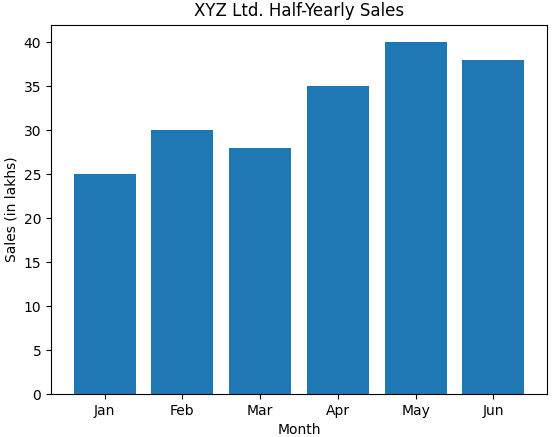
A company XYZ Ltd. records its monthly sales in lakhs as follows:
Month = ['Jan', 'Feb', 'Mar', 'Apr', 'May', 'Jun']
Sales = [25, 30, 28, 35, 40, 38]
Write a Python program using Matplotlib to:
- Store the data.
- Plot a bar chart with month on X-axis and sales on Y-axis.
- Label the axes and give a title "XYZ Ltd. Half-Yearly Sales"
Answer
import matplotlib.pyplot as plt

month = ['Jan', 'Feb', 'Mar', 'Apr', 'May', 'Jun']
sales = [25, 30, 28, 35, 40, 38]

plt.bar(month, sales)
plt.xlabel("Month")
plt.ylabel("Sales (in lakhs)")
plt.title("XYZ Ltd. Half-Yearly Sales")
plt.show()
Output
What are smart homes? Name any two features that make a home a smart home.
Answer
Smart homes are homes equipped with smart devices that are connected through the internet and can be controlled remotely to improve comfort, security, and efficiency.
Two features of a smart home are:
- Automated lighting and appliances allow devices to operate automatically based on user needs or conditions.
- Smart security systems use cameras and sensors to enhance safety and provide alerts for any unusual activity.
Briefly explain Data Exploration from AI project framework.
Answer
Data Exploration is the stage of the AI Project Cycle in which the collected data is examined carefully to understand its structure, patterns, trends, and relationships. It helps in identifying useful insights, detecting anomalies or unusual behaviour, and making the data easier to interpret through data visualisation tools such as charts and graphs. This stage also helps in selecting a suitable model for the next stage of the AI Project Cycle.
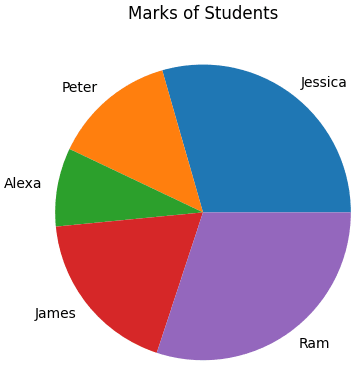
Write a Python program to plot a pie chart comparing marks of five students as given below:
stud_name = ['Jessica', 'Peter', 'Alexa', 'James', 'Ram']
marks = [48, 22, 14, 30, 49]
Import the necessary libraries.
Answer
import matplotlib.pyplot as plt

stud_name = ['Jessica', 'Peter', 'Alexa', 'James', 'Ram']
marks = [48, 22, 14, 30, 49]

plt.pie(marks, labels=stud_name)
plt.title("Marks of Students")
plt.show()
Output
Name the type of sensor used for each of the following purposes:
(a) Detecting obstacles
(b) Measuring light intensity
(c) Measuring temperature
Answer
(a) Ultrasonic sensor
(b) Light sensor
(c) Temperature sensor
Explain software theft. Mention any two consequences of software theft.
Answer
Software theft means the unauthorised use of software, whether by copying or modifying it. It is a legal offence and includes activities like illegal downloading, copying, or using pirated software.
Two consequences of software theft are:
- It results in financial losses for software developers and companies.
- It is a legal offence and may lead to punishments or legal actions.
Write a Python program to do the following tasks.
- Input a sentence and store it to a string variable.
- Print the length of the string, its first character, and its last character.
- Use a loop to traverse through the string and print the total number of digits present.
sentence = input("Enter a sentence: ")

l = len(sentence)
fc = sentence[0]
lc = sentence[-1]

print("Length of the string:", l)
print("First character:", fc)
print("Last character:", lc)

count = 0
for ch in sentence:
    if ch.isdigit():
        count += 1

print("Total number of digits:", count)Enter a sentence: Hello123 World45
Length of the string: 16
First character: H
Last character: 5
Total number of digits: 5
Briefly describe the different types of joints in robotics.
Answer
The different types of joints in robotics are:
- Prismatic Joint: A prismatic joint is also known as a sliding or linear joint. It allows the links of a robot to move linearly along an axis without rotating. It is used in applications requiring precise positioning and extension.
- Revolute Joint: A revolute joint is also known as a rotational or hinge joint. It allows links of a robot to rotate around a fixed axis, providing angular movement similar to a human elbow or knee.
- Spherical Joint: A spherical joint is also known as a ball-and-socket joint. It allows rotational movement in multiple directions around a single point, providing three degrees of freedom such as pitch, yaw and roll.
What is data theft? Give any two causes of data theft.
Answer
Data theft means acquiring someone's personal data, such as financial credentials, intellectual property or confidential documents. This activity could be very harmful for an individual or an organisation.
Any two causes of data theft:
Hacking – using someone else's computer, software, or network in an unauthorised manner to steal data.
Malware – harmful software that can enter a system and steal personal information.
Write a Python program to:
- Create a list of 10 numbers.
- Print the elements in the 2nd and 4th index of the list.
- Sort the list in ascending order.
- Ask the user to enter a number and search whether it exists in the list or not.
lst = [12, 45, 7, 23, 89, 34, 56, 90, 11, 5]

second_index = lst[2]
fourth_index = lst[4]

print("Element at 2nd index:", second_index)

print("Element at 4th index:", fourth_index)

lst.sort()

print("Sorted list:")
print(lst)

num = int(input("Enter a number to search: "))

if num in lst:
    print("Number exists in the list")
else:
print("Number does not exist in the list")Element at 2nd index: 7
Element at 4th index: 89
Sorted list:
[5, 7, 11, 12, 23, 34, 45, 56, 89, 90]
Enter a number to search: 23
Number exists in the list
Explain the role of controllers in a robotic system. How do they work together with sensors and actuators?
Answer
Role of Controller in a Robotic System:
A controller is the main part of a robotic system that manages and controls the overall functioning of the robot. It processes the input received and gives instructions to perform specific tasks.
Working with Sensors and Actuators:
- Sensors collect data from the environment and send it to the controller.
- The controller processes this data and makes decisions.
- It then sends signals to the actuators.
- Actuators carry out the action as instructed by the controller (like movement or operation).
Thus, the controller acts as a link between sensors and actuators, ensuring proper functioning of the robotic system.
Briefly explain supervised learning.
Answer
Supervised learning is a type of machine learning in which the model is trained using a labelled dataset, where both the input data and the correct output are known.
The data is divided into training data and test data. The training data is used to train the model, while the test data is used to check how accurately the model predicts the output for new data.
In supervised learning, the model learns from known results and then predicts the correct output for unseen inputs with good accuracy.
Write a Python program that performs the following tasks on a tuple.
- Create a tuple with elements (12, 27, 30, 47, 55, 49)
- Convert tuple into list.
- Remove element 30 from the list.
- Append a new list with elements [5, 25]
- Insert element 11 at index 3.
- Print the list.
- Convert the list to a tuple.
tup = (12, 27, 30, 47, 55, 49)

lst = list(tup)

lst.remove(30)

lst.append([5, 25])

lst.insert(3, 11)

print("List after operations:")
print(lst)

tup2 = tuple(lst)

print("Converted tuple:")
print(tup2)List after operations:
[12, 27, 47, 11, 55, 49, [5, 25]]
Converted tuple:
(12, 27, 47, 11, 55, 49, [5, 25])
What is Tinkercad? Give any two features of the Tinkercad workspace.
Answer
Tinkercad is a user-friendly, web-based design and modelling tool primarily used for 3D design, electronics and coding projects.
Two features of the Tinkercad workspace are:
- It provides an easy-to-use drag-and-drop interface for creating 3D models.
- It allows simulation of electronic circuits and robotic components.
Give any three different ways to represent data to gather meaningful information.
Answer
Three different ways to represent data to gather meaningful information are:
- Bar Graph: Used to compare quantities across different categories using rectangular bars. It helps in easily identifying differences and trends.
- Pie Chart: Represents data as parts of a whole in a circular form. It is useful for showing percentage distribution.
- Line Graph: Displays data points connected by lines, mainly used to show changes or trends over time.
Write a Python program that performs the following operations on a string:
- Define a string with the value "Machine Learning".
- Convert the string to lowercase and print it.
- Replace the word "Machine" with "Deep".
- Check if the string ends with "Learning" and print the result (True/False).
- Count and print the number of occurrences of the letter "n".
s = "Machine Learning"

lower_s = s.lower()
print("Lowercase string:", lower_s)

replaced_s = s.replace("Machine", "Deep")
print("After replacement:", replaced_s)

ends = s.endswith("Learning")
print("Ends with 'Learning':", ends)

count_n = s.count('n')
print("Number of occurrences of 'n':", count_n)Lowercase string: machine learning
After replacement: Deep Learning
Ends with 'Learning': True
Number of occurrences of 'n': 3