
Study the image given below.
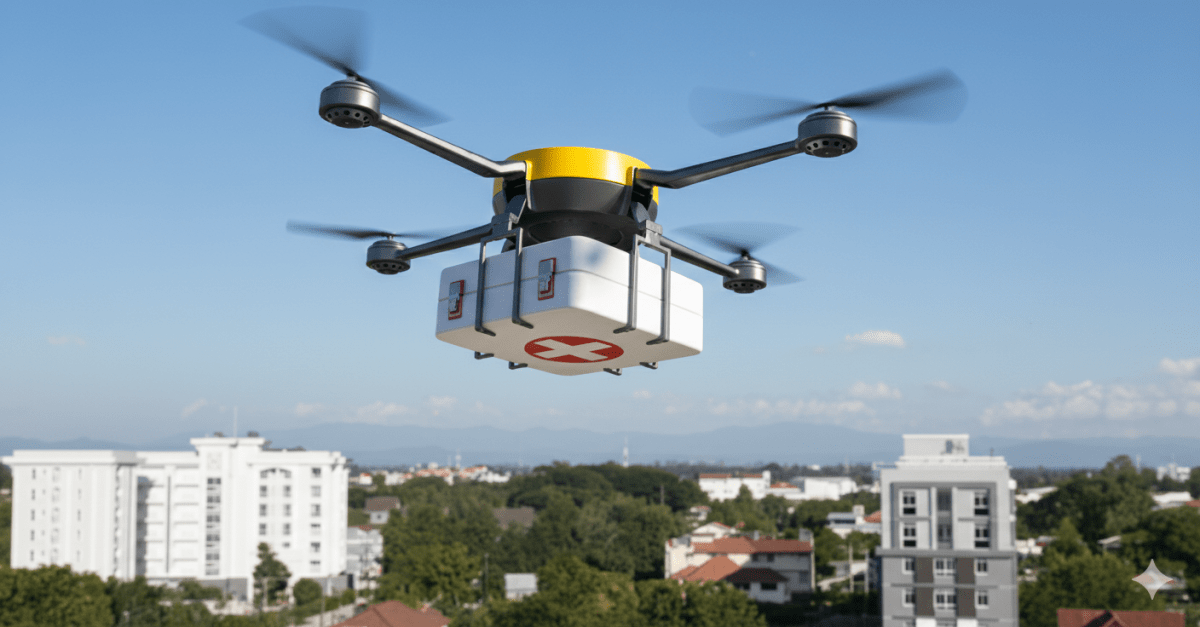
In which field is this robot used?
- Medicine delivery
- Connected vehicles
- Smart homes
- Driver assisted cars
Answer
Medicine delivery
Reason — The figure shows a drone used for delivering medicines. Drones are used to transport medical supplies such as medicines to remote or hard-to-reach areas quickly, especially during emergency situations.
Python programming is ............... .
- low level programming language
- high level programming language
- machine level programming language
- assembly level programming language
Answer
high level programming language
Reason — Python programming is a high level programming language because it uses simple, English-like statements that are easy to read, write, and understand by humans.
The first stage of Artificial Intelligence project cycle is ............... .
- Modelling
- Problem scoping
- Data acquisition
- Evaluation
Answer
Problem scoping
Reason — The first stage of the Artificial Intelligence project cycle is problem scoping. In this stage, the problem to be solved using AI is clearly identified and defined, and the goals and objectives of the AI project are set.
............... are evenly spaced projections along the circumference of the gear.
- Pitch Circle
- Dedendum
- Teeth
- Hub
Answer
Teeth
Reason — Teeth are the evenly spaced projections along the circumference of a gear. These projections interlock with the teeth of another gear to transmit motion and force.
The main function of a controller in robotics is to:
- keep the shape of the robot intact.
- change rotational directions of the Actuators.
- reduce friction between two gears.
- process sensory input and generate appropriate commands.
Answer
process sensory input and generate appropriate commands.
Reason — The main function of a controller in robotics is to receive input from sensors, process this information, and generate appropriate control signals for actuators so that the robot can perform the required task.
Why are Cobots important in industrial settings?
- They DO NOT work well with humans.
- They improve productivity by replacing human workers.
- They provide a safer human-robot collaboration.
- They do not require human control.
Answer
They provide a safer human-robot collaboration.
Reason — Cobots (collaborative robots) are specifically designed to work safely alongside humans. They are equipped with built-in safety features and sensors that detect human presence and adjust their speed or motion accordingly, making human–robot collaboration safer in industrial environments.
Identify the operation which is NOT allowed on a Python tuple.
- Accessing using an index.
- Converting tuple into a list.
- Appending a new element.
- Using len().
Answer
Appending a new element.
Reason — A tuple is immutable, which means its elements cannot be modified, added, or removed after creation. Therefore, appending a new element is not allowed in a Python tuple.
Which of the following is an example of a linear actuator in a robotic system?
- A motor rotating.
- A piston extending.
- A rotary joint.
- A gear system transmitting rotational force.
Answer
A piston extending.
Reason — A linear actuator produces straight-line (linear) motion. A piston extending moves in a linear direction, which is the defining characteristic of a linear actuator.
In Matplotlib, xlabel and ylabel are used to:
- add legend to the plot.
- set the axis limit.
- label x-axis and y-axis.
- colour the x-axis and y-axis.
Answer
label x-axis and y-axis.
Reason — In Matplotlib, xlabel is used to label the x-axis and ylabel is used to label the y-axis of a plot, helping users understand what each axis represents.
The sensor commonly used to detect obstacle in the path of a robot is:
- force sensor
- pressure sensor
- velocity sensor
- ultrasonic sensor
Answer
ultrasonic sensor
Reason — An ultrasonic sensor is used to detect obstacles in the path of a robot. It works by emitting ultrasonic waves and measuring the time taken for the waves to reflect back from an object, which helps the robot determine the presence and distance of obstacles.
Software theft leads to:
- increase in sales
- financial losses
- increased competition
- promotion
Answer
financial losses
Reason — Software theft involves the unauthorised copying, use, or distribution of software, which results in financial losses to software developers and organisations due to loss of revenue and violation of legal rights.
............... is an example of an external non-contact sensor used in robotics.
- Temperature sensor
- Position sensor
- Proximity sensor
- Force sensor
Answer
Proximity sensor
Reason — A proximity sensor is an external non-contact sensor used in robotics to detect the presence or absence of an object without physical contact. It works using light, sound, infrared, or electromagnetic fields.
The Turing test is conducted between ............... .
- two computer programs
- an AI machine and a human
- two humans
- two AI machines
Answer
an AI machine and a human
Reason — The Turing test is conducted between a human and a machine (AI), where an evaluator interacts with both simultaneously and compares their responses. If the evaluator cannot distinguish between the responses of the human and the machine, the machine is said to have passed the Turing test.
Identify the steps in machine learning for teaching a machine to make decisions.
- Collecting data → programing
- Collecting data → training → testing predictions
- Programing for every move
- Programing without any data
Answer
Collecting data → training → testing predictions
Reason — In machine learning, a machine is taught to make decisions by first collecting data, then training the model using that data, and finally testing its predictions to evaluate performance.
Assertion (A): Autonomous systems can make decisions based on probabilistic data, whereas automated systems follow deterministic rules.
Reason (R): Autonomous systems rely on predefined rules and algorithms, while automated systems use real-time data to make decisions.
- Both (A) and (R) are true and (R) is the correct explanation for (A).
- Both (A) and (R) are true but (R) is not the correct explanation for (A).
- (A) is true but (R) is false.
- (A) is false but (R) is true.
Answer
(A) is true but (R) is false.
Reason — Autonomous systems are capable of learning from their environment and making decisions using probabilistic data, whereas automated systems strictly follow deterministic, predefined rules and algorithms.
Who proposed the Turing test?
- Allen Turing
- Charles Babbage
- John won Newman
- Isaac Newton
Answer
Allen Turing
Reason — The Turing test was proposed by Allen Turing in 1950.
What will be the output of the code given below?
st = "This is a test String"
v = st.count("s")
print(v)- 1
- 2
- 3
- 4
Answer
3
Reason — The count("s") function counts only lowercase occurrences of the character "s" in the string. In the string "This is a test String", the lowercase letter s appears three times. The capital S is not counted because Python is case-sensitive.
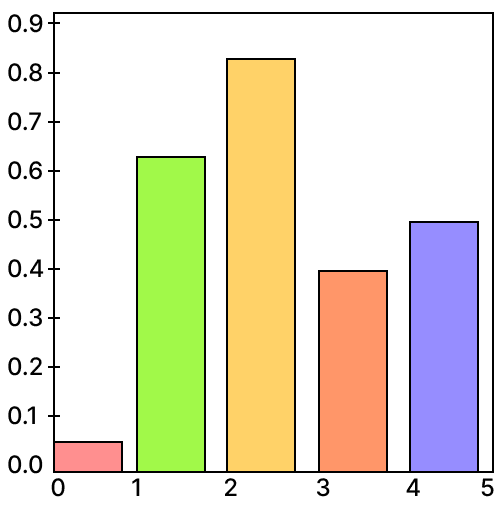
Identify the type of graph shown below.
- Line graph
- Pie plot
- Bar graph
- Scatter plot
Answer
Bar graph
Reason — The given figure represents a bar graph, where data values are shown using rectangular bars of equal width, and the height of each bar corresponds to the value of the data.
Which one of the following is a single board computer?
- Raspberry Pi
- TensorFlow
- PyTorch
- Media center
Answer
Raspberry Pi
Reason — Raspberry Pi is a single board computer that integrates the processor, memory, input/output interfaces, and other components on a single circuit board. It is widely used for learning programming, electronics, and building small computing and robotic projects.
Give the output of the following Python code.
my_list = [1, 2, 3, 4]
my_list.append(5)
my_list.insert(2, 10)
print(my_list)- [1, 2, 3, 4, 5, 10]
- [1, 10, 2, 3, 4, 5]
- [1, 2, 10, 3, 4, 5]
- [1, 2, 3, 10, 4, 5]
Answer
[1, 2, 10, 3, 4, 5]
Reason — First, append(5) adds 5 at the end of the list, so the list becomes [1, 2, 3, 4, 5]. Then, insert(2, 10) inserts 10 at index position 2, shifting the existing elements to the right. Hence, the final list printed is [1, 2, 10, 3, 4, 5].
What are warehouse robots and how are they used in transport industry?
Answer
Warehouse robots are automated robots used in warehouses to handle tasks like picking, sorting, packing, storing and moving goods quickly and accurately with the help of sensors and AI.
In the transport industry (logistics), they are used to move items from storage slots to the loading dock/trucks, manage order fulfilment and inventory movement, and optimise routes while avoiding obstacles for safe, faster dispatch by reducing human effort and errors.
Read the paragraph below and answer the question that follows.
"The helical gears are similar to spur gears but have angled teeth. This helical tooth arrangement enables smoother and quicker operation compared to spur gears. Helical gears are commonly used in applications where high torque transmission and reduced noise are essential."
Write any two key differences between helical gears and spur gears.
Answer
Two key differences between helical gears and spur gears are:
Tooth arrangement — Helical gears have angled (inclined) teeth, whereas spur gears have straight teeth.
Operation and noise — Helical gears operate more smoothly and quietly due to gradual tooth contact, while spur gears produce more noise because the teeth engage suddenly.
What are temperature sensors?
Answer
Temperature sensors are sensors that measure the level of heat (temperature) of an object or the surrounding environment. They convert the sensed temperature into a readable (electrical) signal/data so that a robot/controller can monitor temperature, maintain safe operation, and detect environmental changes.
What is the function of a velocity sensor in robotics?
Answer
A velocity sensor in robotics is used to measure the speed of movement of a robot or its components. The sensor sends this data to the controller so the robot can maintain or adjust its speed for accurate motion control (e.g., navigation and smooth movement).
Write any two differences between an autonomous system and automated system.
Answer
Two differences between an autonomous system and automated system are:
| Automated System | Autonomous System |
|---|---|
| Automated systems operate based on pre-programmed rules and instructions. | Autonomous systems can make decisions and adapt to new situations independently. |
| Automated systems do not learn from past experiences. | Autonomous systems use machine learning or AI to improve performance over time. |
Mention any two types of cyber threats.
Answer
Two types of cyber threats are:
- Malware
- Phishing
How does data acquisition play a key role in Artificial Intelligence project cycle?
Answer
Data acquisition is a key step in the AI project cycle because it involves collecting the required, relevant and sufficient data (as per the project’s data requirements) from reliable sources such as databases, APIs, web scraping, surveys/questionnaires and sensors/IoT devices. Good-quality and accurate data helps the AI model learn correct patterns and make more reliable predictions/decisions, so the success of an AI project depends greatly on proper data acquisition.
What will be the output of the following Python code?
x = [1, 2, 3, 4]
x.append([5, 6])
print(x)
Answer
[1, 2, 3, 4, [5, 6]]
The append() method adds the given element as a single item at the end of the list. Here, [5, 6] is a list, so it is added as a nested list, not as individual elements. Hence, the final list becomes [1, 2, 3, 4, [5, 6]].
What will be the output of the following Python code?
a = "hello"
b = "world"
print(a + b)
Answer
helloworld
The + operator is used for string concatenation in Python. It joins the two strings "hello" and "world" without adding any space, so the output is helloworld.
What will be the output of the following Python code?
x = {1: 'apple', 2: 'banana'}
x[3] = "cherry"
print(x)
Answer
{1: 'apple', 2: 'banana', 3: 'cherry'}
In a Python dictionary, values are stored using keys. The statement x[3] = "cherry" means that the value "cherry" is assigned to the key 3. This adds a new key–value pair to the dictionary, which is then displayed when the dictionary is printed.
Write any three benefits of health care robots.
Answer
Three benefits of health care robots are:
- Higher precision in surgery: Surgical robots help doctors perform precise and minimally invasive operations, improving accuracy and reducing damage to surrounding tissues.
- Faster and accurate diagnosis: Diagnostic robots analyse medical images and patient data quickly to detect abnormalities and support early diagnosis, improving treatment outcomes.
- Better patient care and support: Care robots can monitor vital signs, give medicine reminders, and provide mobility assistance, reducing the workload on healthcare staff and improving patient comfort.
Give the steps involved in machine learning.
Answer
The steps involved in machine learning are:
- Data Collection: Gather a large amount of relevant data (e.g., images, text, numbers).
- Data Pre-processing: Clean and prepare the data by removing errors/duplicates and converting it into a suitable format.
- Training Data and Labels: Split data into training data and labels (correct outputs) to teach the model.
- Algorithm Training: Apply ML algorithms on training data so the model learns patterns and rules.
- Model Evaluation: Test the trained model using separate test data to check accuracy and performance.
- Model Optimisation: Improve the model by tuning parameters/features or changing the algorithm until desired results are achieved.
- Prediction/Decision Making: Use the final model to make predictions/decisions on new (unseen) data.
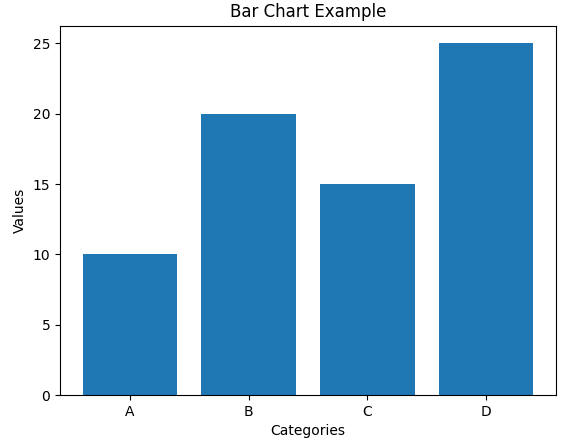
Write a Python program to plot a bar chart using the Matplotlib library. Your program should do the following:
- Import the necessary libraries.
- Create a list of categories and their corresponding values.
- Plot a bar chart with appropriate labels and a title.
Answer
import matplotlib.pyplot as plt
categories = ['A', 'B', 'C', 'D']
values = [10, 20, 15, 25]
plt.bar(categories, values)
plt.xlabel('Categories')
plt.ylabel('Values')
plt.title('Bar Chart Example')
plt.show()
Output
Describe the role of sensors in robotics. Give any two examples of different types of sensors.
Answer
Sensors act as the "sense organs" of a robot. They detect changes in the robot’s surroundings or inside the robot (like distance, light, sound, temperature, pressure, position, etc.) and convert this information into electrical signals. The robot’s controller uses these signals to make decisions and control actions, such as navigation, obstacle avoidance, safety, and accurate movement.
Examples:
- Vision sensor (Camera) — Captures images/video so the robot can recognise objects and support tasks like inspection and navigation.
- Proximity sensor (IR/Ultrasonic) — Detects presence or distance of nearby objects without contact, helping in obstacle detection and collision avoidance.
Explain how gears are used in robotics. Describe any two types of gears.
Answer
In robotics, gears are used to transmit motion and power from a motor to different parts of the robot (like wheels, arms, grippers). By changing the gear ratio, gears can increase torque (turning force) for lifting/gripping or increase speed for faster movement, and also help in smooth, controlled and precise motion of robot mechanisms.
Types of gears:
Spur gears — Spur gears have straight teeth and are mounted on parallel shafts. They are the most commonly used gears and are suitable for simple power transmission.
Helical gears — Helical gears have angled teeth, which allow smoother and quieter operation compared to spur gears. They are used in applications where high torque and reduced noise are required.
Write a Python program to accept a string and check if the given string is a palindrome.
st = input("Enter a string: ")

if st == st[::-1]:
    print("The given string is a palindrome")
else:
print("The given string is not a palindrome")Enter a string: madam
The given string is a palindrome
Enter a string: hello
The given string is not a palindrome
(a) State the type of sensor which is used for each of the following purposes.
- Proximity detection
- Vision sensing
(b) Name a type of sensor used in air conditioners.
Answer
(a) Type of sensor:
- Proximity detection — Proximity sensor (IR / ultrasonic)
- Vision sensing — Vision sensor (Camera)
(b) Temperature sensor (thermostat)
Give any two differences between linear and rotary actuators. Give examples of their use in robotics.
Answer
Differences between linear and rotary actuators:
| Linear Actuator | Rotary Actuator |
|---|---|
| A linear actuator produces linear (straight-line) motion. | A rotary actuator produces rotational (circular) motion. |
| It is used for pushing or pulling movements. | It is used for rotating components of a robot. |
| Example: Used in robotic systems such as pistons to move parts in a straight line. | Example: Used in motors to rotate robot wheels or joints. |
Write a Python program that performs operations on a list of integers. Your program should do the following:
- Create a list of integers: [2, 4, 6, 9, 5]
- Check and print even numbers.
- Check and print odd numbers.
numbers = [2, 4, 6, 9, 5]

print("Even numbers:")
for n in numbers:
    if n % 2 == 0:
        print(n)

print("Odd numbers:")
for n in numbers:
    if n % 2 != 0:
print(n)Even numbers:
2
4
6
Odd numbers:
9
5
Discuss any two advantages of visualising motion in a robot design. State any one use of Tinkercad.
Answer
Advantages of visualising motion in a robot design:
Better understanding of movement — Visualising motion helps in understanding how different robotic joints and parts move with respect to each other, which makes the working of the robot clear.
Error detection before implementation — It helps in identifying design or motion errors at an early stage, thereby reducing mistakes and saving time and cost during actual robot construction.
Use of Tinkercad:
Tinkercad is used to visualise, design, and simulate robotic components and circuits in a virtual environment before building the actual robot.
What are the different types of sources of data from where we can collect reliable and authentic datasets?
Answer
Different reliable and authentic sources of data for collecting datasets are:
- Databases – Organised collections of stored data (e.g., school records) from which correct and consistent data can be retrieved easily.
- APIs (Application Programming Interfaces) – Trusted applications/websites share data through APIs (e.g., online bookstore APIs for book reviews and details).
- Web Scraping – Using programs to collect information from authentic websites (e.g., book descriptions, author information), when permitted.
- Surveys and Questionnaires – Data collected directly from users (e.g., students’ favourite genres and reading habits), making it relevant and dependable.
- Sensors and IoT Devices – Real-time data gathered through sensors (e.g., book movement, environmental conditions in a library), which is accurate and measurable.
- Kaggle Platform – A well-known platform that provides datasets from many domains and supports downloading datasets for AI/ML projects.
Write a Python program to count the number of vowels in a given string. Your program should do the following:
- Define a string.
- Traverse the string and count the vowels (a, e, i, 0, u) using a loop.
- Print the total count of vowels.
st = "Artificial Intelligence"
count = 0
for ch in st:
    if ch in 'aeiouAEIOU':
        count += 1
print("Total number of vowels:", count)Total number of vowels: 10
Briefly explain the 4Ws of the Artificial Intelligence project cycle.
Answer
The 4Ws of the Artificial Intelligence project cycle are used in the Problem Scoping stage to understand the problem clearly:
Who — It identifies who is affected by the problem and who are the stakeholders involved.
What — It defines what the problem is and what needs to be solved.
Where — It explains where the problem exists or occurs.
Why — It states why the problem needs to be solved and the importance of solving it.
What is Evaluation in stages of Artificial Intelligence project cycle?
Answer
Evaluation is a stage of the Artificial Intelligence project cycle in which the performance of the AI model is tested and analysed. In this stage, the results produced by the model are checked for accuracy and correctness to determine whether the model meets the objectives of the problem. If the results are not satisfactory, the model may be improved or modified.
Write a Python program that creates a tuple with elements from a list. Your program should do the following:
- Create a list with multiple elements.
- Convert the list to a tuple.
- Print the tuple and demonstrate accessing an element of the tuple.
my_list = [10, 20, 30, 40, 50]
my_tuple = tuple(my_list)
element = my_tuple[2]
print("Tuple:", my_tuple)
print("Element at index 2:", element)Tuple: (10, 20, 30, 40, 50)
Element at index 2: 30
Briefly explain training data and testing data.
Answer
Training data is the data used to train a machine learning model so that it can learn patterns and make decisions based on the information provided.
Testing data is the data used to test and evaluate the trained model to check its accuracy and performance on new or unseen data.
How does the decision making by humans differ from that of the machines?
Answer
Human decision-making and machine decision-making differ in the following ways:
- Basis of decision: Humans often take decisions subjectively, influenced by feelings, experiences and personal judgement. Machines take decisions logically, following programmed rules/algorithms and available data.
- Bias and emotions: Humans may show bias and may be emotional while deciding. Machines are generally objective (not affected by emotions), so their decisions are more consistent.
- Speed and adaptability: Humans can be creative and adaptive, learning from situations, but they are usually slower. Machines can process information very fast and handle many variables quickly, but they act within their algorithmic limits.
Artificial Intelligence is making lives easier. Give any two reasons.
Answer
Artificial Intelligence is making lives easier due to the following reasons:
- It automates routine tasks, saving time and reducing human effort (e.g., chatbots answering queries, tools extracting information from documents).
- It reduces human errors and improves accuracy, as AI can detect mistakes/inconsistencies in data and systems and give more reliable outputs.
Write a Python program that performs the following operations on a list of integers:
- Create a list of integers: [5, 15, 25, 35, 45].
- Append the integer 55 to the list.
- Insert the integer 20 at index 1.
- Remove the integer 35 from the list.
- Find the index of the integer 25 and print it.
- Print the final list.
numbers = [5, 15, 25, 35, 45]

numbers.append(55)

numbers.insert(1, 20)

numbers.remove(35)

index_25 = numbers.index(25)
print("Index of 25:", index_25)

print("Final list:", numbers)Index of 25: 3
Final list: [5, 20, 15, 25, 45, 55]