
Mathematics
-11, -7, -3, …….,49, 53 are the terms of a progression.
Answer the following:
(a) What is the type of progression?
(b) How many terms are there in all?
(c) Calculate the value of middle most term.
AP
37 Likes
Answer
(a) Given,
-11, -7, -3, ……,49, 53
Second term - First term : −7 − (−11) = 4
Third term - Second term : −3 − (−7) = 4
Last term - Second last term : 53 − 49 = 4
Since the difference between consecutive terms is constant, the progression is an Arithmetic Progression (AP) with first term (a) = -11 and common difference (d) = 4.
Hence, the progression is an Arithmetic Progression.
(b) Let 53 be the nth term.
By formula,
⇒ tn = a + (n - 1)d
⇒ 53 = -11 + (n - 1)4
⇒ 53 = -11 + 4n - 4
⇒ 53 = -15 + 4n
⇒ 4n = 53 + 15
⇒ 4n = 68
⇒ n =
⇒ n = 17.
Hence, there are a total of 17 terms in the progression.
(c) Since, n = 17, is odd.
By formula,
Middle term =
=
=
= 9.
Thus, 9th term is middle term.
By formula,
⇒ t9 = a + (n - 1)d
= -11 + (9 - 1) × 4
= -11 + 8 × 4
= -11 + 32
= 21.
Hence, the value of the middle most term is 21.
Answered By
18 Likes
Related Questions
P is a point on the x-axis which divides the line joining A(-6, 2) and B (9, -4). Find:
(a) the ratio in which P divides the line segment AB.
(b) the coordinates of the point P.
(c) equation of a line parallel to AB and passing through (-3, -2).
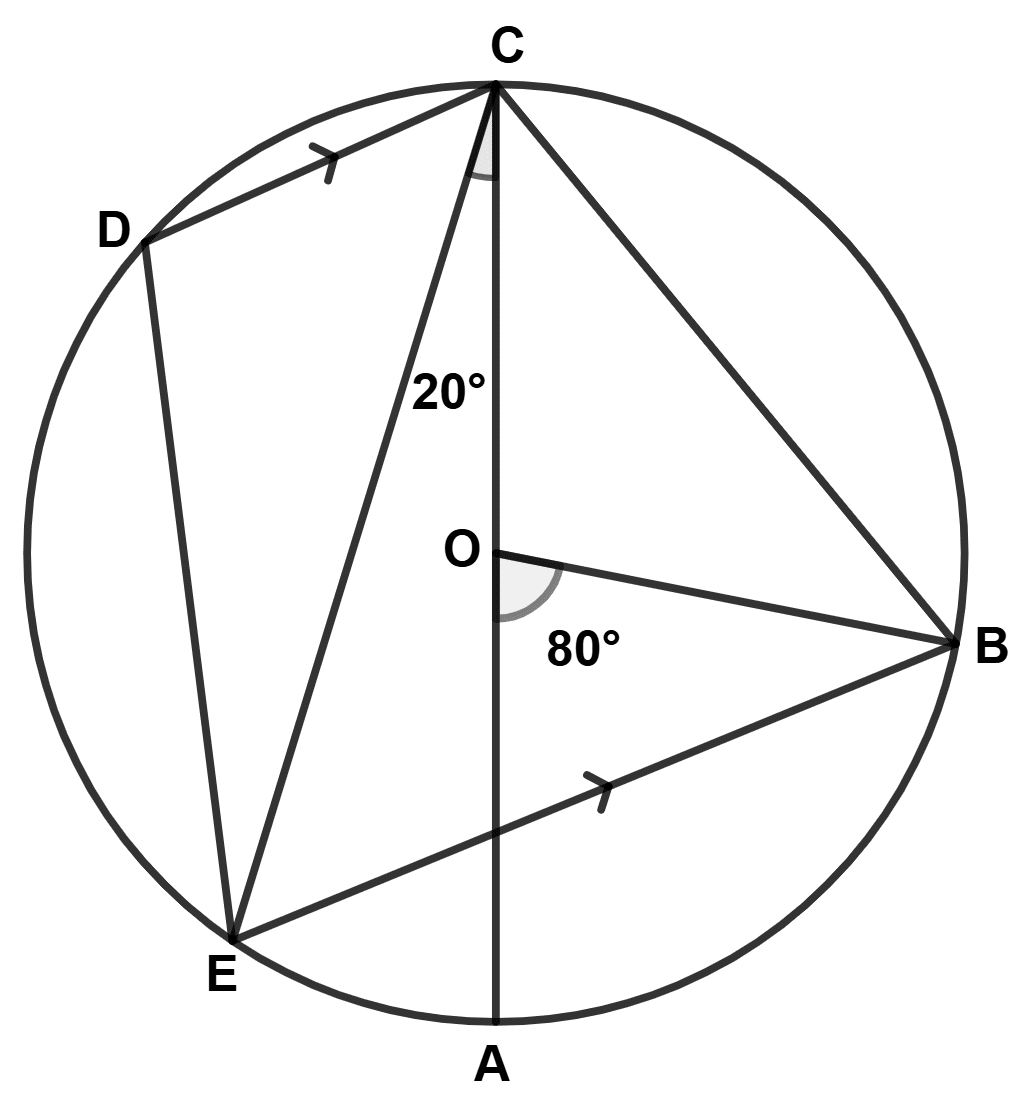
In the given figure AC is the diameter of the circle with center O. CD is parallel to BE.
∠AOB = 80° and ∠ACE = 20°. Calculate :
(a) ∠BEC
(b) ∠BCD
(c) ∠CED
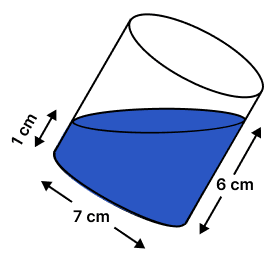
In the adjoining diagram, a tilted right circular cylindrical vessel with base diameter 7 cm contains a liquid. When placed vertically, the height of the liquid in the vessel is the mean of two heights shown in the diagram. Find the area of wet surface, when the cylinder is placed vertically on a horizontal surface. (Use )
Use a ruler and compass to answer this question.
(a) Construct a circle of radius 4.5 cm and draw a chord AB of length 6.5 cm.
(b) At A, construct ∠CAB = 75°, where C lies on the circumference of the circle.
(c) Construct the locus of all points equidistant from A and B.
(d) Construct the locus of all points equidistant from CA and BA.
(e) Mark the point of intersection of the two loci as P. Measure and write down the length of CP.